

Surgical Navigation Systems Market Summary:
According to Transpire Insight, a detailed research report on the Surgical Navigation Systems Market reflects that the neurology application segment dominates the market, accounting for approximately 35.5% of the total market share worldwide, supported by increasing adoption of image-guided neurosurgical procedures, advanced surgical planning, and navigation-assisted interventions. Medtronic plc leads the market with approximately over 18% market share, making it a leading contributor to market development, innovation, advanced surgical navigation technologies, integrated imaging and navigation platforms, expanding technological capabilities, and overall market growth dynamics.
Market Snapshot
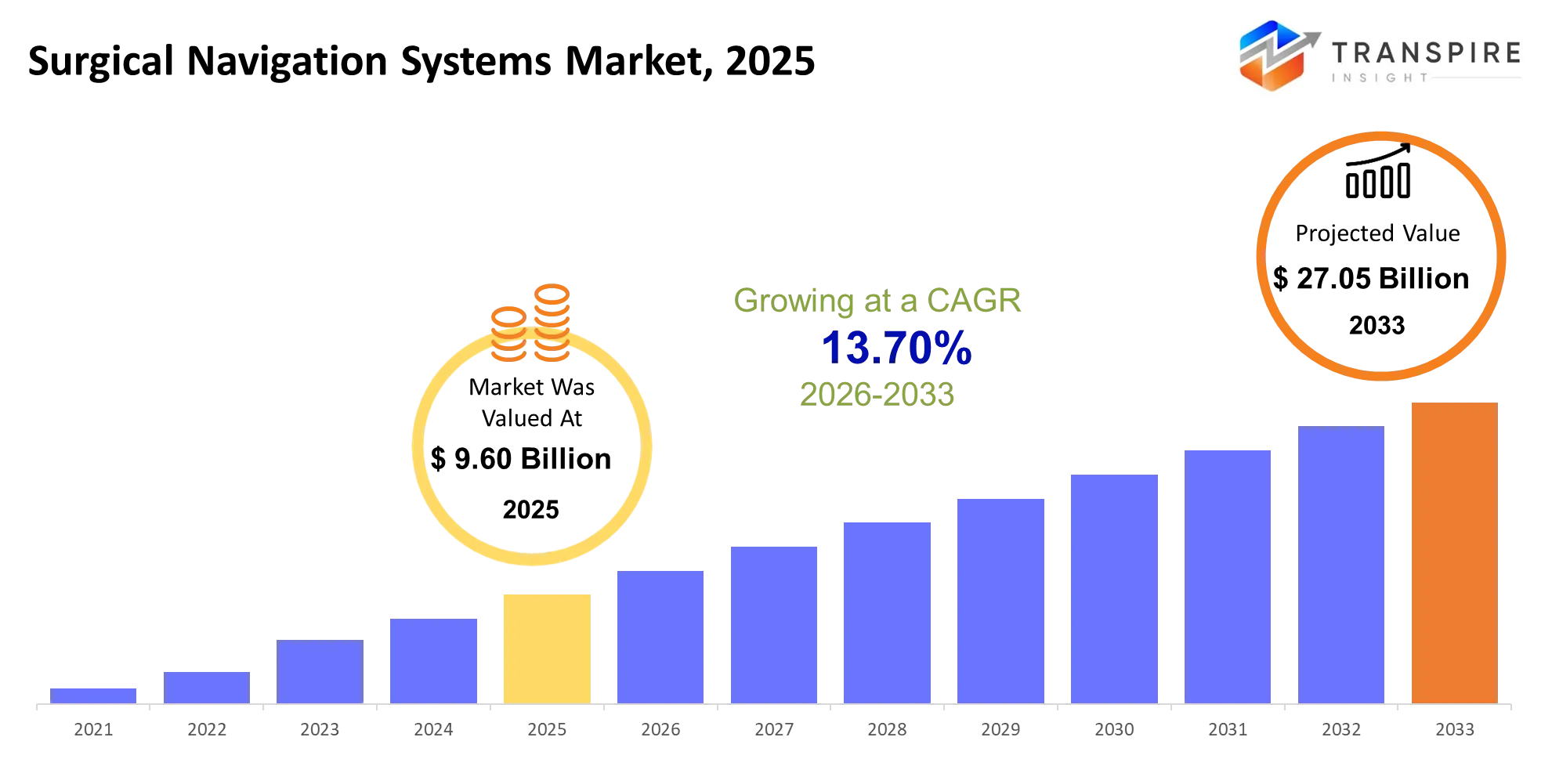
- Market Value (2025): USD 9.60 Billion.
- Expected Market Value (2026): USD 11.04 Billion.
- Estimated Market Value (2033): USD 27.05 Billion.
- Forecast CAGR (2026–2033): 13.70%
- Leading Region in 2025: North America
- Second-largest Region: Europe
- Fastest Growing Region: Asia Pacific
Introduction
The Surgical Navigation Systems Market includes advanced computer-assisted devices which assist surgeons in achieving precise visualization of anatomy, instrument tracking, surgical planning, and intraoperative navigation. This type of devices utilizes preoperative or intraoperative imaging such as CT, MRI, fluoroscopy, as well as 3D data in conjunction with highly advanced navigation software in order to achieve higher level of precision and better anatomical orientation during the operation. Currently, the technique of navigation is used widely for neurosurgery, orthopedic surgery, spinal surgeries, otolaryngology, and maxillofacial surgery whenever the precise positioning of instruments is required. Navigation technologies include optical, electromagnetic, and hybrid types of instrument tracking, thus offering various levels of flexibility and procedural accuracy.
For instance:-
- North America: Developed hospital infrastructures, established reimbursement channels, investments in hybrid operating rooms, and early adoption of AI-assisted navigation are driving continued demand for surgical navigation systems.
- Europe: Established clinical research infrastructure, experience with medical devices, and use of surgical technologies are contributing to the adoption of navigation systems in orthopedic, neurosurgery, spinal and ENT surgeries.
Key Market Highlights: -
- North America is expected to grow at a rapid CAGR in the Surgical Navigation Systems Market by holding around 43.1% of the share during the forecast period.
- Europe is anticipated to hold roughly 28% share of the Surgical Navigation Systems Market over the predicted timeframe.
- Asia Pacific is anticipated to hold nearly 27% share of the Surgical Navigation Systems Market over the predicted timeframe.
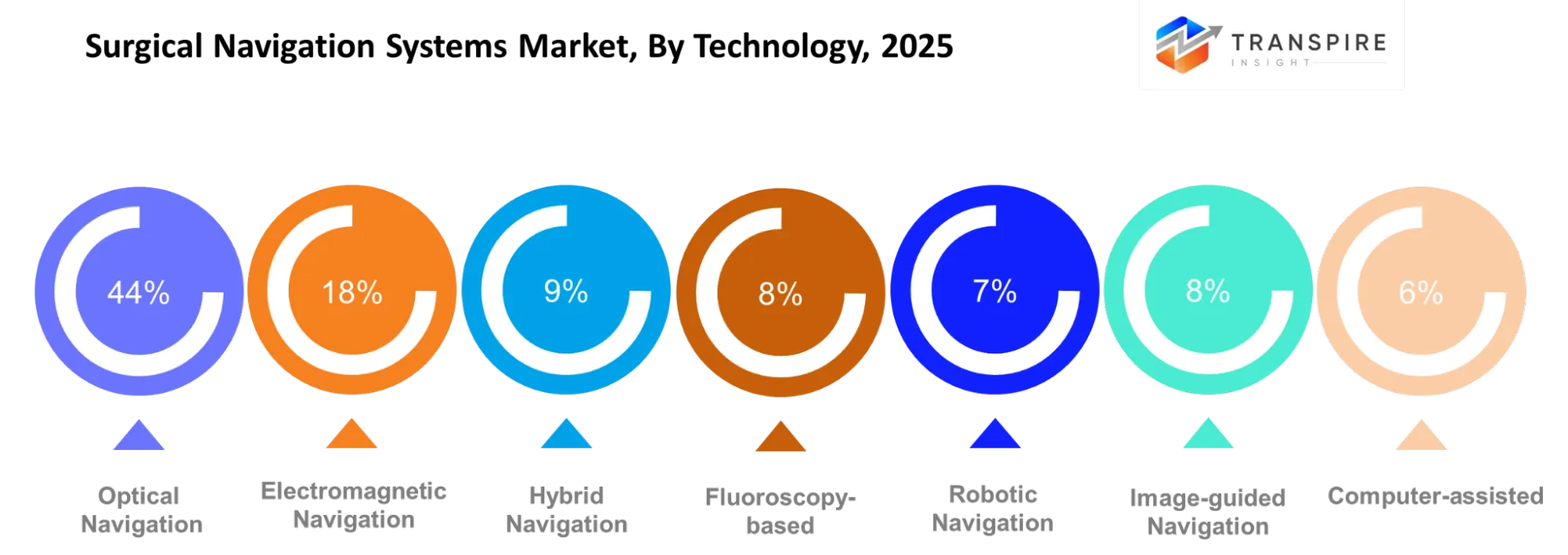
- By Technology, the Optical navigation systems dominated the market and holds nearly 42% share in 2025 and is projected to grow at a substantial CAGR during the forecast period.
- By Application, the Orthopedic surgery dominated the market and holds close to 40% share in 2025 and is projected to grow at a substantial CAGR during the forecast period.
- By Component, the Navigation Platform dominated the market and holds about 50% share in 2025 and is projected to grow at a substantial CAGR during the forecast period.
- Medical technology development driven by governments, healthcare infrastructure development, and cost-effective navigation systems are fostering innovations in surgical navigation systems.
How is Technology Driving Growth in the Surgical Navigation Systems Market?
The Technological Factors Affecting the Growth of the Surgical Navigation Systems Market include AI-assisted planning, 3D imaging, AR/MR (Augmented Reality/ Mixed Reality), tracking, and robotics. AI can help in anatomical segmentation and procedure planning, whereas AR/MR helps in real-time visualization of the patient anatomy and navigation data. Optical and Electromagnetic Tracking is used to assist in the localization of instruments, whereas robotics help in linking navigation with controlled surgery.
|
Report Metrics |
Details |
|
Market size value in 2025 |
USD 9.60 Billion |
|
Market size value in 2026 |
USD 11.04 Billion |
|
Revenue forecast in 2033 |
USD 27.05 Billion |
|
Growth rate |
CAGR of 11.70% from 2026 to 2033 |
|
Base year |
2025 |
|
Historical data |
2021 - 2024 |
|
Forecast period |
2026 - 2033 |
|
Report coverage |
Revenue forecast, competitive landscape, growth factors, and trends |
|
Regional scope |
United States; Canada; Mexico; United Kingdom; Germany; France; Italy; Spain; Denmark; Sweden; Norway; China; Japan; India; Australia; South Korea; Thailand; Brazil; Argentina; South Africa; Saudi Arabia; United Arab Emirates |
|
Key company profiled |
Medtronic, Stryker, Brainlab, GE HealthCare, Siemens Healthineers, Abbott, Zimmer Biomet, Johnson & Johnson MedTech, Smith+Nephew, Globus Medical, DePuy Synthes, NuVasive, Brainlab, Karl Storz, Medivis |
|
Customization scope |
Free report customization (country, regional & segment scope). Avail customized purchase options to meet your exact research needs. |
|
Report Segmentation |
By Technology (Optical Navigation, Electromagnetic Navigation, Hybrid Navigation, Fluoroscopy-based, Robotic Navigation, Image-guided Navigation, Computer-assisted, Others); By Application (Neurosurgery, Orthopedic Surgery, ENT Surgery, Spine Surgery, Trauma Surgery, Dental Surgery, Maxillofacial Surgery, Others); By Component (Navigation Platform, Tracking System, Surgical Instruments, Software, Cameras, Sensors, Displays, Others); By Modality (2D Imaging, 3D Imaging, CT-based, MRI-based, Ultrasound-based, Fluoroscopy, Hybrid Imaging, Others); By End User (Hospitals, Ambulatory Surgery Centers, Specialty Clinics, Academic Hospitals, Research Centers, Trauma Centers, Private Hospitals, Others); By Surgery Type (Open Surgery, Minimally Invasive Surgery, Robotic Surgery, Image-guided Surgery, Endoscopic Surgery, Microsurgery, Revision Surgery, Others); By Portability (Fixed, Mobile, Portable, Compact, Cart-based, Room-integrated, Robotic, Others) |
Market Drivers
Increasing use of minimally invasive and image-guided surgery needs more precise anatomical accuracy is what drives the Surgical Navigation Systems Market. Innovations such as three-dimensional imaging, real-time instrument tracking, navigation software, and artificial intelligence-assisted surgical planning are enhancing intra-operative visualization and workflows. More common orthopedic, neurosurgical, spinal and ear, nose and throat disorders, along with the aging population, are driving the need for surgical navigation systems. Technology adoption is being further boosted through integration with robot-assisted surgeries in that they integrate surgical planning, navigation, and procedure performance.
For instance:-
- Asia-Pacific: Development of healthcare infrastructure, aging demographics, increasing surgical numbers, and adoption of minimally-invasive surgeries are creating substantial opportunities for manufacturers of surgical navigation systems.
- Latin America: Increasing adoption by private hospitals and academic institutions, especially Brazil and Mexico, are creating niche opportunities for image-guided surgical technologies.
Restrain
Challenges in the Surgical Navigation Systems Market exist due to costly investments in acquiring, installing, maintaining, and upgrading the system's software. The use of sophisticated navigation systems also needs trained surgeons, operating room staff members, and technicians. Compatibility with infrastructure including sophisticated imaging equipment, operating room settings, and the hospital IT network can pose another limitation on their use. The limitation is highly relevant for small hospitals and ambulatory centers with restricted budgets and expertise.
|
Driver |
Relative Impact on Growth (%) |
Geographic Relevance |
Impact Timeline |
Demand Strength |
Growth Mechanism |
Key Beneficiaries |
Major Constraint |
|
Driver 1: Rising adoption of minimally invasive and robot-assisted surgery |
28% |
North America, Europe, Asia Pacific |
Short-term |
High |
Improves surgical precision while reducing invasiveness and recovery time. |
Navigation manufacturers, robotic-surgery firms, hospitals, surgeons |
High capital costs limit smaller-hospital adoption |
|
Driver 2: Integration of AI-driven surgical planning and real-time navigation |
24% |
North America, Europe, Asia Pacific |
Medium-term |
High |
AI improves anatomical planning, workflow guidance, and procedural accuracy. |
AI developers, navigation vendors, hospitals, surgical teams |
Clinical validation and regulatory requirements slow deployment |
|
Driver 3: Expansion of mixed reality, augmented reality, and 3D visualization |
20% |
North America, Europe, East Asia |
Medium-term |
High |
Immersive overlays improve anatomical visualization during complex procedures. |
AR/MR vendors, navigation companies, orthopedic and spine centers |
Integration complexity and surgeon training requirements |
|
Driver 4: Growing prevalence of orthopedic, neurological, ENT, and spinal disorders |
16% |
North America, Europe, Asia Pacific |
Long-term |
High |
Rising procedure volumes increase demand for accurate image-guided intervention. |
Hospitals, device manufacturers, surgeons, imaging providers |
Procedure affordability and healthcare capacity constraints |
|
Driver 5: Increasing investment in integrated digital surgical ecosystems |
12% |
North America, Europe, Asia Pacific |
Long-term |
Medium |
Integrated platforms connect imaging, planning, navigation, and robotic execution. |
Medtech firms, software vendors, hospitals, technology partners |
Interoperability and infrastructure costs constrain integration |
Analysis of Prices and Consumer Behaviour
The market for Surgical Navigation Systems is mostly occupied by the electromagnetic navigation systems, comprising approximately 41.4% of the total market share in 2025 on account of their versatility and utility in complicated image guided surgery procedures. The neurology applications market holds a share of around 35.5% of the worldwide market owing to the need for accurate navigation in complex neurology surgeries. Hospitals form approximately 45.0% of the market revenues because of their higher capital strength, specialized infrastructure for surgical procedures, and high volume of procedures performed. North America forms around 41.6% of the worldwide market owing to the sophisticated healthcare infrastructure and adoption of computer assisted surgical technologies.
|
Company |
Est. Revenue Share Range |
Key Offerings |
Strategic Positioning |
Geographic Strength |
Technology Focus |
|
Medtronic plc |
18–22% |
StealthStation S8; O-arm imaging; StealthStation ENT; StealthStation i7; AxiEM EM tracking |
Integrated navigation, imaging, robotics ecosystem leadership |
North America, Europe, Asia Pacific |
Optical/EM tracking, 3D imaging, AI, surgical planning |
|
Brainlab AG |
13–16% |
Curve Navigation; Cranial Navigation; Spine Navigation; Loop-X imaging integration |
Premium image-guidance and digital surgery specialization |
Europe, North America, Asia Pacific |
AI-assisted planning, navigation software, 3D imaging |
|
Zimmer Biomet Holdings, Inc. |
11–14% |
ROSA Robotics; ROSA Knee; ROSA Spine; surgical navigation solutions |
Robotics-led orthopedic navigation and procedure integration |
North America, Europe, Asia Pacific |
Robotics, computer-assisted surgery, AI-enabled planning |
|
Siemens Healthineers AG |
10–13% |
Cios Spin; mobile C-arm imaging; intraoperative 3D imaging; navigation integration |
Imaging-led navigation and intraoperative visualization |
Europe, North America, Asia Pacific |
2D/3D imaging, image guidance, digital OR integration |
|
Stryker Corporation |
8–11% |
NAV3i; Q Guidance System; SpineMap; navigation platforms |
Multi-specialty navigation with orthopedic ecosystem integration |
North America, Europe, Asia Pacific |
Optical tracking, smart instruments, 3D navigation |
|
Johnson & Johnson MedTech / DePuy Synthes |
4–7% |
VELYS Hip Navigation; VELYS Active Robotic Assistance; VELYS Enabling Technologies |
Implant-linked navigation and robotics ecosystem expansion |
North America, Europe, Asia Pacific |
AI landmarking, robotic assistance, digital planning |
|
B. Braun / Aesculap |
3–5% |
Aesculap navigation solutions; surgical navigation platforms; digital OR solutions |
Broad surgical portfolio with integrated navigation capabilities |
Europe, Asia Pacific, North America |
Image-guided surgery, digital OR integration, surgical planning |
|
KARL STORZ SE & Co. KG |
3–5% |
IMAGE1 systems; OR1 integration; endoscopic navigation solutions; ENT technologies |
Endoscopy-driven image-guided surgery specialization |
Europe, North America, Asia Pacific |
3D visualization, endoscopic imaging, navigation integration |
|
Smith+Nephew plc |
2–4% |
CORI Surgical System; NAVIO technology; orthopedic navigation; digital planning |
Technology-enabled orthopedic surgery and robotic navigation |
North America, Europe, Asia Pacific |
Robotics, computer-assisted navigation, digital planning |
|
Globus Medical, Inc. |
2–4% |
Excelsius3D; ExcelsiusGPS; spine navigation; intraoperative imaging |
Spine-focused navigation and robotic integration |
North America, Europe, Asia Pacific |
3D navigation, robotics, image guidance, spine planning |
Who are the Key Players in the Surgical Navigation Systems Market and how do they compete?
The competitiveness of companies participating in the international market for Surgical Navigation Systems is ensured by firms with expertise in technology innovation, solution design for surgeries, and creation of distribution channels on an international scale. Being competitive not only in terms of price but also in terms of advanced navigation systems, precision technologies, intelligent and connected surgical solutions, and digital and operating-room integration, this approach provides continuous product development and contributes to increased precision, process efficiency, accuracy, and visibility of operations within healthcare facilities.
The development of advanced surgical navigation systems, image-guided surgery solutions, robotics technologies, and integrated surgical platforms allows Medtronic to strengthen its position in the market. The development of high-performance surgical navigation and image-guidance technologies used for orthopedic, neurological, spinal, ENT, and other complex surgeries allows Stryker to differentiate itself from other market participants. Brainlab strengthens its market position through the development of integrated solutions for surgical navigation, digital surgery, intraoperative imaging, and surgical planning.
Top Companies in the Surgical Navigation Systems Market
- Medtronic
- Stryker
- Brainlab
- GE HealthCare
- Siemens Healthineers
- Abbott
- Zimmer Biomet
- Johnson & Johnson MedTech
- Smith+Nephew
- Globus Medical
- DePuy Synthes
- NuVasive
- Brainlab
- Karl Storz
- Medivis
|
Investment Factor |
Why It Matters to Investors |
Opportunity |
Investment Implication |
|
Minimally Invasive & Image-Guided Surgery Adoption |
Navigation improves precision in increasingly complex procedures. |
Spine, cranial, orthopedic, ENT navigation platforms |
Why it is attractive: Sustained procedure-driven equipment demand |
|
AI, Robotics & Navigation Convergence |
Integrated ecosystems create higher-value technology platforms. |
AI planning, robotic execution, navigation-imaging integration |
Why it is attractive: Enables premium technology differentiation |
|
Asia Pacific Expansion |
Healthcare infrastructure investment is expanding navigation adoption. |
India, China, Japan, South Korea, Southeast Asia |
Why it is attractive: Stronger emerging-market expansion potential |
|
Orthopedic & Spine Applications |
High procedure volumes support recurring technology deployment. |
Spine navigation, orthopedic robotics, surgical planning |
Why it is attractive: Large procedure-driven addressable opportunity |
|
Radiation-Free & Advanced Navigation Technologies |
Hospitals seek precise guidance while reducing imaging-related exposure. |
Machine-vision, electromagnetic, optical and hybrid navigation |
Why it is attractive: Differentiated technology supports premium positioning |
|
Integrated Digital Surgical Ecosystems |
Connected platforms increase switching costs and revenue opportunities. |
Planning, imaging, navigation, robotics, analytics, software |
Why it is attractive: Ecosystem models improve scalability and retention |
Surgical Navigation Systems Market Segmentation
The Surgical Navigation Systems Market share is divided into seven categories: By Technology, By Application, By Component, By Modality, By End User, By Surgery Type, By Portability.
The Optical navigation systems dominated the market, accounting for nearly 42% in 2025 and is expected to rise at a significant CAGR during the forecast period.
The Surgical Navigation Systems Market is by technology into optical navigation, electromagnetic navigation, hybrid navigation, fluoroscopy-based, robotic navigation, image-guided navigation, computer-assisted, others. Among these, the Optical navigation systems dominated the market, accounting for nearly 42% in 2025 and expected to increase at a significant CAGR during the forecast period. High-precision tracking of instruments, reliable spatial accuracy, and extensive compatibility with advanced imaging and robot-assisted surgeries make optical navigation an important system.
The Orthopedic surgery dominated the market, accounting for close to 40% in 2025, and is expected to rise at a significant CAGR during the forecast period
The Surgical Navigation Systems Market is segmented by application into neurosurgery, orthopedic surgery, ent surgery, spine surgery, trauma surgery, dental surgery, maxillofacial surgery, others. Among these, the Full Trainload segments dominated the market, accounting for close to 40% in 2025 and expected to increase at a significant CAGR during the forecast period. Increasing numbers of joint replacement surgeries, need for accurate implantation, and rise in robot-assisted orthopedic surgeries are promoting surgical navigation adoption in orthopedic surgeries.
The Navigation Platform dominated the market, accounting for about 50% in 2025 and is expected to rise at a significant CAGR during the forecast period.
The Surgical Navigation Systems Market by component into navigation platform, tracking system, surgical instruments, software, cameras, sensors, displays, others. Among these, the Navigation Platform dominated the market, accounting for about 50% in 2025 and expected to increase at a significant CAGR during the forecast period. Surgical navigation systems allow precise surgical planning, instrument tracking, better visualization of anatomy, and use with imaging and robot-assisted surgeries.
Regional Segment Analysis of the Surgical Navigation Systems Market
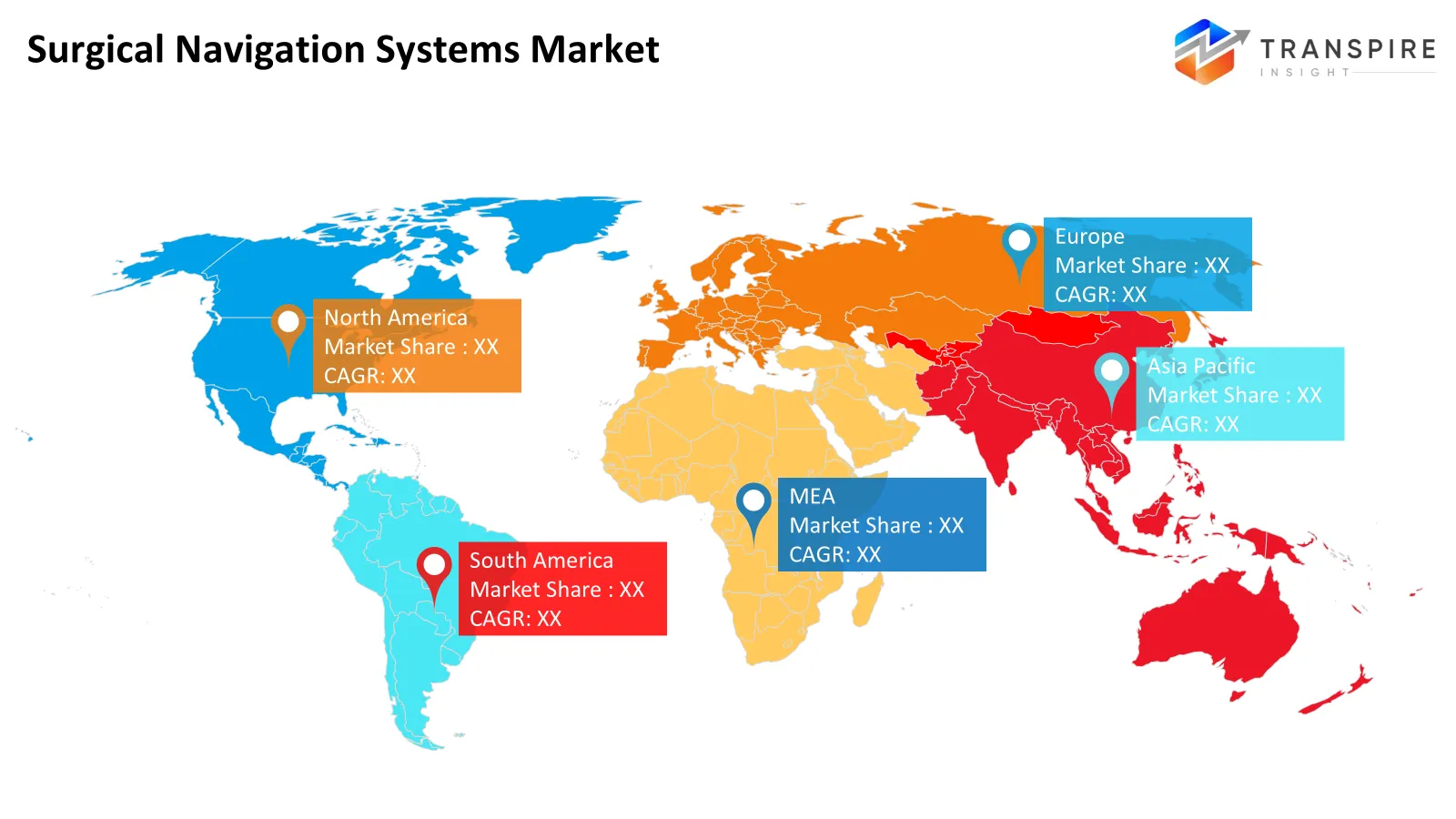
- Europe (Germany, France, U.K., Italy, Spain, Rest of Europe)
- North America (U.S., Canada, Mexico)
- Asia-Pacific (China, Japan, India, Rest of APAC)
- South America (Brazil and the Rest of South America)
- The Middle East and Africa (UAE, South Africa, Rest of MEA)
North America is expected to grow at a rapid CAGR in the Surgical Navigation Systems Market, holding around 43.1% of the share during the forecast period.
North America has taken the lead in the Surgical Navigation Systems Market because of advanced healthcare infrastructure, increased use of minimally invasive surgeries and image-guided surgeries, and high demand for precise surgical devices. The region is favored by medical device manufacturing companies, well-established hospitals, high healthcare spending, and quick integration of robots and advanced imaging techniques. Good clinical research facilities, favorable reimbursement policies, qualified surgeons, and constant developments of digital operating room equipment contribute to market growth.
Europe is the high-growth region in the Surgical Navigation Systems Market during the period, holding roughly 28% share.
Europe is seen as a high-growth region in the Surgical Navigation Systems Market owing to the presence of advanced healthcare infrastructure, increasing use of minimally invasive procedures, and high demand for image-guided surgical equipment. Good medical device manufacturing abilities, clinical research facilities, and investments in digital operating rooms drive regional market adoption. Moreover, increased orthopedic and neurological procedures, increasing robotics surgeries, and healthcare development in Europe help in raising demand for surgical navigation systems.
Asia Pacific is the fastest-growing region in the Surgical Navigation Systems Market during the period, holding nearly 27% share.
The Asia-Pacific region is the most rapidly growing market segment within the Surgical Navigation Systems Market because of developing healthcare infrastructure, higher surgeries, and increase in the use of minimally invasive surgeries. Higher health care expenditures in China, Japan, India, and South Korea have been boosting investments in new operating room technologies. Moreover, the higher incidence of orthopedic and neurological conditions, better availability of surgical treatments, development in medical device manufacturing, and robotics have boosted the regional market growth.
Strategies for Market Growth in Non-Leading Regions:
The development of non-leading regions using cost-effective and scalable surgical navigation technologies would greatly benefit small and mid-size hospitals and healthcare organizations. Local manufacturing, collaborations in technology and regional services can decrease dependence on imports, minimize the price of equipment and costs of maintenance. Collaboration with regional hospitals, surgical centers, medical device distributors, and healthcare technology firms will improve market penetration of surgical navigation devices. Training and development of technical skills are essential to increase the awareness of image guided surgery, navigation assisted surgery, AI planning and robot assisted surgery. Flexible financing plans, leasing agreements, maintenance contracts and procedure-based payments are important to make surgical navigation more accessible. Programs of collaboration with healthcare government programs, medical organizations and technology research centers, together with digital sales and customer support channels, will increase access and sustainable growth of the market in developing regions.
Future Market Trends for the Surgical Navigation Systems Market: -
- AI-Assisted Surgical Navigation: AI and machine learning would be used to assist with automation of image segmentation, anatomical alignment, surgical planning, and real-time decision-making for greater workflow efficiency during complex procedures.
- Surgical Navigation and Robotic Systems: The synergy between surgical navigation and robotic-assisted technology would help increase accuracy, consistency of procedures, and integration of workflows in spine, orthopedic, and neurosurgeries.
- 3D and AR Surgical Navigation: High-definition 3D imaging, augmented reality visualization, and markerless tracking would help improve anatomical navigation while enabling minimally invasive surgical workflows.
Recent Development
- In 13 February 2026 – Launch: Medtronic got clearance from U.S. FDA for Stealth AXiS™ technology, which includes intelligent planning, real-time navigation, and modularity robotic technology for spine surgery.
- In 28 April 2026 – Launch: Medtronic got European CE Mark clearance for Stealth AXiS™ technology, enabling further commercialization of the product in Europe with spine and cranial surgeries.
- In 1 May 2026 – Launch: Zeta Surgical obtained 510(k) clearance from the FDA for Zeta Navigation System technology, which offers the ability to perform AI-enabled computer vision neuro-navigations through the navigated Stylet and Bolt instruments.
Market Segment
This study forecasts revenue at global, regional and country levels from 2020 to 2033. Transpire Insight has segmented the Surgical Navigation Systems Market based on the below-mentioned segments:
Surgical Navigation Systems Market, By Technology
- Optical Navigation
- Electromagnetic Navigation
- Hybrid Navigation
- Fluoroscopy-based
- Robotic Navigation
- Image-guided Navigation
- Computer-assisted
- Others
Surgical Navigation Systems Market, By Application
- Neurosurgery
- Orthopedic Surgery
- ENT Surgery
- Spine Surgery
- Trauma Surgery
- Dental Surgery
- Maxillofacial Surgery
- Others
Surgical Navigation Systems Market, By Component
- Navigation Platform
- Tracking System
- Surgical Instruments
- Software
- Cameras
- Sensors
- Displays
- Others
Surgical Navigation Systems Market, By Modality
- 2D Imaging
- 3D Imaging
- CT-based
- MRI-based
- Ultrasound-based
- Fluoroscopy
- Hybrid Imaging
- Others
Surgical Navigation Systems Market, By End User
- Hospitals
- Ambulatory Surgery Centers
- Specialty Clinics
- Academic Hospitals
- Research Centers
- Trauma Centers
- Private Hospitals
- Others
Surgical Navigation Systems Market, By Surgery Type
- Open Surgery
- Minimally Invasive Surgery
- Robotic Surgery
- Image-guided Surgery
- Endoscopic Surgery
- Microsurgery
- Revision Surgery
- Others
Surgical Navigation Systems Market, By Portability
- Fixed
- Mobile
- Portable
- Compact
- Cart-based
- Room-integrated
- Robotic
- Others
By Regional Analysis
North America
- US
- Canada
- Mexico
Europe
- Germany
- UK
- France
- Italy
- Spain
- Russia
- Rest of Europe
Asia Pacific
- China
- Japan
- India
- South Korea
- Australia
- Rest of Asia Pacific
South America
- Brazil
- Argentina
- Rest of South America
Middle East & Africa
- UAE
- Saudi Arabia
- Qatar
- South Africa
- Rest of the Middle East & Africa
Frequently Asked Questions
Find quick answers to common questions.
Increasing minimally invasive procedures, advanced imaging, AI integration, robotic assistance, and demand for greater surgical precision are driving market expansion.
AI supports image segmentation, anatomical registration, surgical planning, and real-time decision support, improving workflow efficiency during complex surgical procedures.
Spine, orthopedic, neurosurgical, and ENT procedures offer strong opportunities due to increasing demand for image-guided and minimally invasive surgery.
AI-enabled navigation, robotic integration, advanced 3D imaging, augmented reality, and emerging markerless tracking technologies will increasingly shape market development.
Integration with robotic platforms enhances procedural precision, workflow consistency, surgical planning, and controlled instrument positioning across complex surgical applications.
- Medtronic
- Stryker
- Brainlab
- GE HealthCare
- Siemens Healthineers
- Abbott
- Zimmer Biomet
- Johnson & Johnson MedTech
- Smith+Nephew
- Globus Medical
- DePuy Synthes
- NuVasive
- Brainlab
- Karl Storz
- Medivis
About the Authors

Pankaj Ghogare Patil
I am Pankaj Ghogare Patil, a Senior Research Analyst at Transpire Insight, specializing in the Pharmaceutical, Chemicals & Materials, Healthcare IT, and Biotechnology industry. My expertise lies in conducting comprehensive market research, analyzing industry trends, evaluating competitive landscapes, and translating complex data into actionable insights. At Transpire Insight, I closely follow emerging technologies, regulatory developments, and market innovations to create accurate, well-researched, and informative content that helps businesses and professionals make informed decisions. I am committed to producing credible, evidence-based articles that reflect industry best practices while making technical topics accessible and valuable for a broad audience.

Chakradhar Khansole
Chakradhar serves as the Research Director at Transpire Insight, bringing over 8 years of experience in technology, innovation, and strategic market intelligence. He specializes in transforming complex market data into actionable business insights that enable organizations to make informed, growth-oriented decisions. Recognized for his strategic vision and analytical expertise, Chakradhar leads high-impact research initiatives, delivering comprehensive market assessments, competitive intelligence, and forward-looking industry analysis.
Recently Published Reports
-
Apr 2026
AI in Diabetic Retinopathy Market
AI in Diabetic Retinopathy Market Size, Share & Analysis Report By Type (Screening AI Systems, Diagnostic AI Systems, and Predictive AI Models), By Application Segment (Hospitals, Ophthalmology Clinics, Diagnostic Centers, and Research and Development), and Geography (North America, Europe, Asia-Pacific, Middle East and Africa, South and Central America), 2021 - 2031
-
Apr 2026
Psychometric Tests Market
Psychometric Tests Market Size, Share & Analysis Report By Type (Personality Tests, Ability/Aptitude Tests, Skill/Knowledge Tests, and Others), By Application (Talent Acquisition and Talent Management), and Geography (North America, Europe, Asia-Pacific, Middle East and Africa, South and Central America), 2021 – 2031
-
Apr 2026
Rare Biological Sample Collection Market
Rare Biological Sample Collection Market Size, Share & Analysis Report By Type (Isolation Kits & Reagent, Blood Collection Tubes, and Others), By Application (Oncology, Transcriptomics, Pharmacogenomics, and Others), and Geography (North America, Europe, Asia-Pacific, Middle East and Africa, South and Central America), 2021 – 2031
-
Jul 2026
Diabetic Retinopathy Market
Diabetic Retinopathy Market Size, Share & Analysis Report By Type (Proliferative Diabetic Retinopathy, and Diabetic Macular Edema (DME)), By Treatment Type (Anti VEGF Drug, Steroid Implants, Laser Surgeries, and Vitrectomy), and Geography (North America, Europe, Asia-Pacific, Middle East and Africa, South and Central America), 2021 – 2031
Our Clients







