
Subsea Production and Processing System Market Summary:
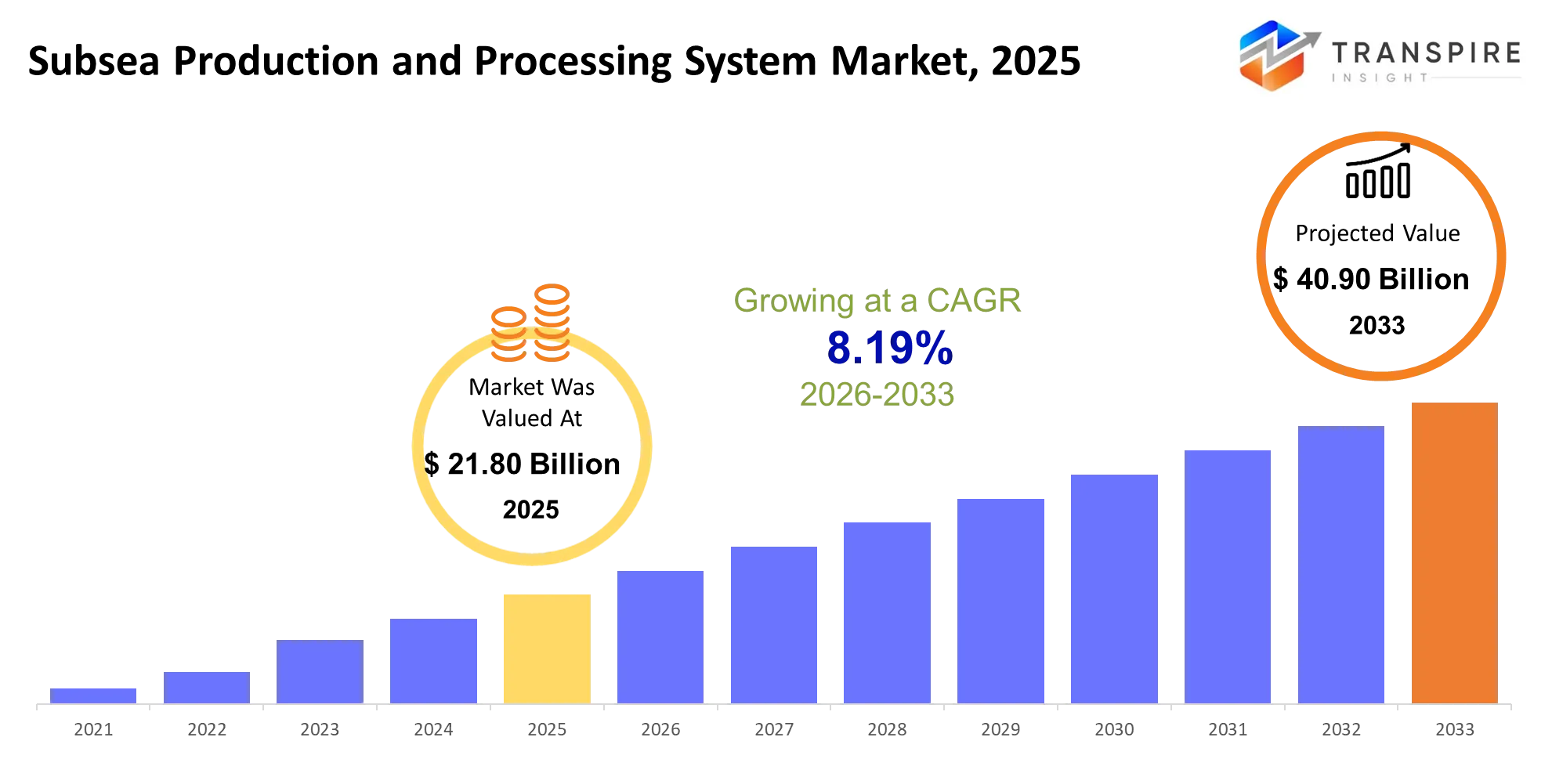
As per Transpire Insight, the Subsea Production and Processing System Market size is estimated at USD 21.80 billion in 2025 and is anticipated to reach USD 40.90 billion by 2033, growing at a CAGR of 8.19% from 2026 to 2033.
The subsea production and processing system market is changing offshore oil and gas operations. It allows hydrocarbons to be extracted, controlled and processed on the seabed before being sent to surface facilities.In the recent past, there has been an increasing trend of deepwater development where wells are connected to existing infrastructure through technology that increases oil and gas recovery from offshore reservoirs. The industry has shown an increasing trend towards the use of subsea equipment and integrated project delivery. The adoption of these technologies simplifies engineering activities and reduces the development cycle time. The increasing complexity of offshore developments in high pressure conditions and ultra-deepwater has led to the need for advanced production trees, manifolds, flowlines and subsea boosting systems. The recent contract awards for projects indicate that operators are spending in equipment that increases the efficiency of production and the performance of their assets. Given that conventional offshore reservoirs have matured, subsea processing and boosting technologies are now being used.
Subsea Production and Processing System Market Size & Forecast:
- Market Size 2025: USD 21.80 Billion
- Expected Market Value (2033): USD 40.90 Billion
- Forecast CAGR (2026–2033): 8.19%
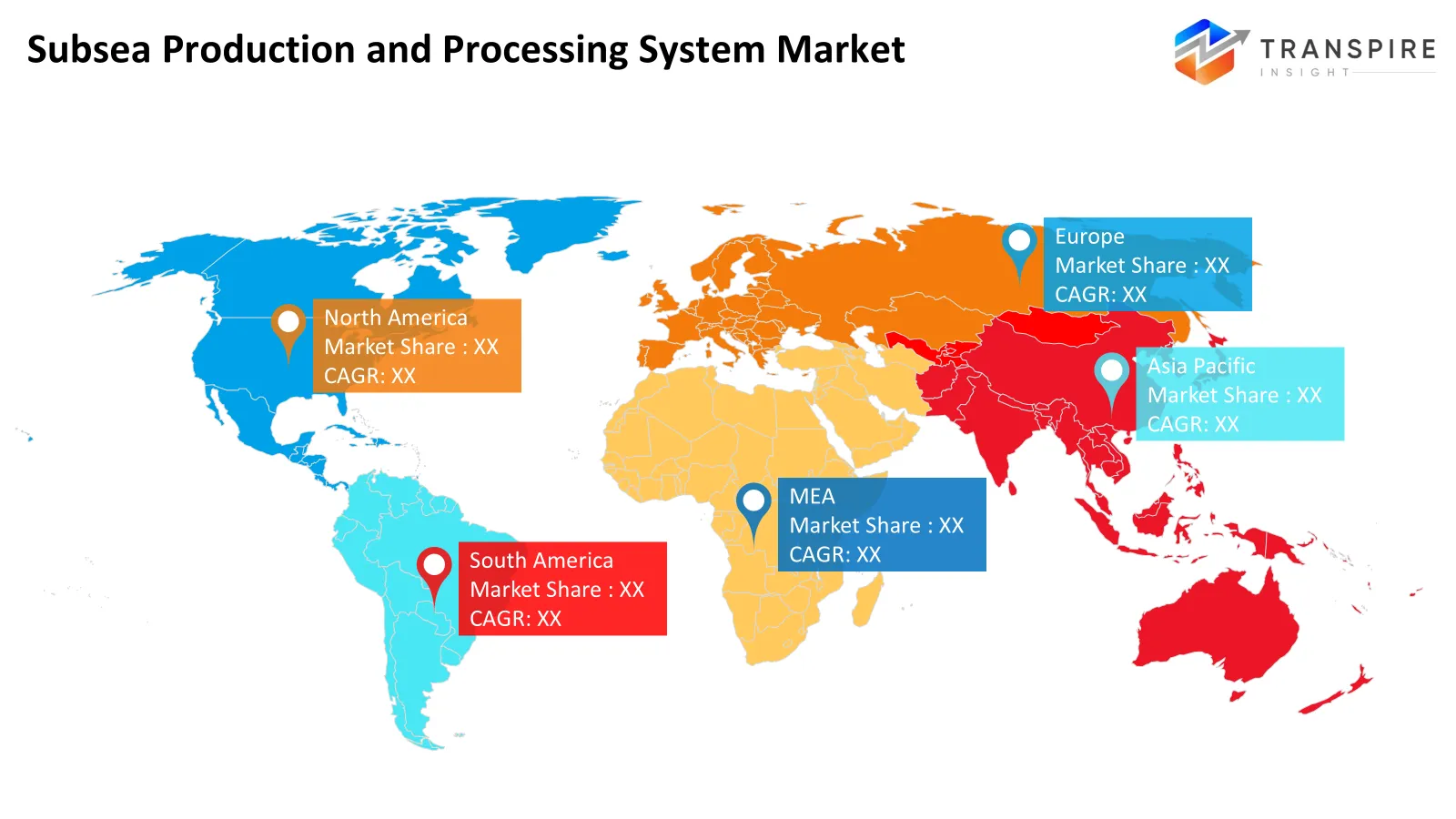
- Leading Region in 2025: North America
- Fastest Growing Region: Asia Pacific
- Key Company Profiles: TechnipFMC, SLB, Baker Hughes, Halliburton, OneSubsea, Subsea7, Saipem, Aker Solutions, Oceaneering, Dril-Quip, NOV, Technip Energies, Kongsberg, Shell, Equinor
Key Market Insights:
The market is shifting in connection with deep-water investments, equipment standardisation, and technologies for enhanced recovery from offshore fields.
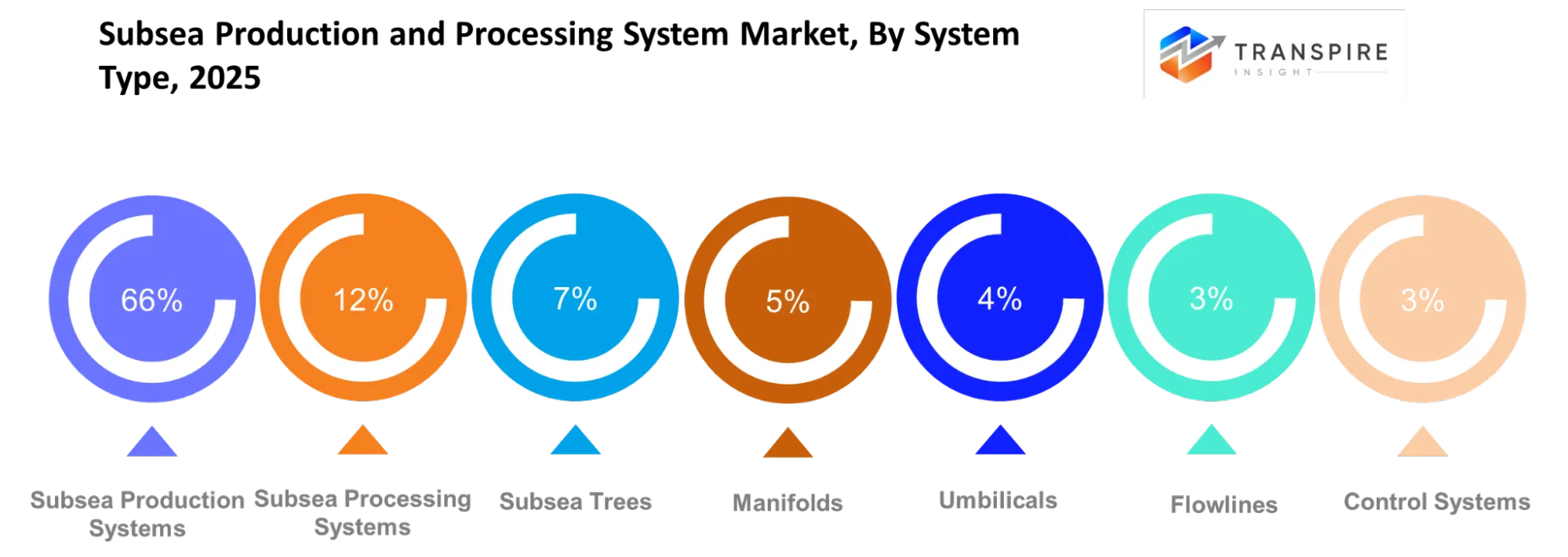
- Subsea Production Systems constitute 66.1% of the market and demonstrate the high significance of production trees, manifolds and other equipment for offshore field development.
- Subsea Processing Systems account for 12.0% of the market, whereas a 5.8% CAGR shows that subsea processing is gaining interest as a process of handling hydrocarbons in proximity to reservoirs.
- Subsea Trees account for 7.0% of the market, as equipment manufacturers produce specialised equipment intended to operate under high pressure and easy installation.
- Manifolds occupy 5.0% of the total market share because they perform functions of collection and distribution of fluids from various subsea wells.
- Umbilicals take 4.0% of the total market share because umbilicals ensure the transfer of power, data communication and hydraulic controls of offshore operations.
- Flowlines have a market share of 3.0% since they facilitate the transfer of fluids from subsea wells to processing units.
- Control Systems holds 2.0% of the total market share since digital monitoring and remote operating capabilities help to control complex offshore operations.
What are the Key Drivers, Restraints, and Opportunities in the Subsea Production and Processing System Market?
Drivers:
Investments in deep and ultra-deep projects have been fueling demand for sophisticated subsea production equipment. With readily available offshore reservoirs getting depleted, operators are pursuing more difficult offshore fields where dependable production trees, manifolds, subsea controls and flowlines are needed. Project sanctioning and contracting are good examples of how the need for access to offshore reserves translates into purchasing and maintenance opportunities. Standardization of equipment and integration of engineering solutions is also helping operators deal with project complexity and schedule issues.
Restraints:
High initial capital cost continues to be a challenge. Subsea projects necessitate engineering expertise, vessels for installation, remotely operated vehicles, test facilities and high-quality human resource. This makes the projects expensive and exposes them to delays owing to weather issues, logistical problems, equipment problems and installation problems. The lengthy process involved can make projects vulnerable to changes in oil and gas price levels and financing conditions.
Opportunities:
Market potential where improvement in efficiency and dependency upon the old school surface facility can be reduced includes subsea processing and multi-phase boosting and all-electric production technology.subsea boosting would help in sustaining the production rate even when there is a fall in reservoir pressure, whereas integrated processing will result in better fluid management. Asia-Pacific region also holds potential for improvement.
|
Driver |
Relative Impact on Growth (%) |
Geographic Relevance |
Impact Timeline |
Demand Strength |
Growth Mechanism (5–10 words) |
Key Beneficiaries (5–10 words) |
Major Constraint (5–10 words) |
|
Deepwater and ultra-deepwater oil and gas field development |
28% |
North America, South America, West Africa |
Long-term (≥4 years) |
High |
Unlocks offshore reserves requiring advanced subsea production infrastructure |
Subsea equipment manufacturers, offshore EPC contractors, oilfield operators |
High capital expenditure and long project approval cycles |
|
Expansion of subsea tiebacks and brownfield field redevelopment |
24% |
Europe, North America, South America |
Medium-term (2–4 years) |
High |
Connects satellite discoveries to existing offshore production infrastructure |
Subsea system suppliers, installation contractors, mature-field operators |
Existing infrastructure limitations and reservoir compatibility issues |
|
Rising investment in offshore oil and gas projects |
20% |
South America, North America, Middle East |
Medium-term (2–4 years) |
High |
Project sanctions generate demand for trees, manifolds, flowlines, and controls |
Subsea manufacturers, engineering firms, offshore construction providers |
Oil price volatility and fluctuating upstream investment budgets |
|
Adoption of subsea processing, boosting, compression, and digital monitoring |
16% |
North America, Europe, Asia-Pacific |
Long-term (≥4 years) |
High |
Improves recovery rates while reducing dependence on surface facilities |
Technology developers, subsea integrators, offshore production operators |
Technical complexity and demanding subsea reliability requirements |
|
Demand for improved recovery, operational efficiency, and lower-emission offshore production |
12% |
Europe, North America, Asia-Pacific |
Medium-term (2–4 years) |
Medium |
Extends field life while reducing operating costs and emissions |
Operators, subsea service providers, automation and monitoring vendors |
Regulatory uncertainty and high costs of equipment upgrades |
|
Total |
100% |
Global |
— |
— |
— |
— |
— |
What Has the Impact of Artificial Intelligence Been on the Subsea Production and Processing System Market?
The use of artificial intelligence is creating opportunities for improving the subsea equipment monitoring, planning of production, and maintenance of offshore facilities. Subsea production systems operate in conditions where it is hard to conduct an inspection and intervention costs much. By means of machine learning, analytics of data collected using pressure sensors, temperature, flow meters, vibration monitoring, and control systems will help to detect abnormal behaviour in advance. One of the most relevant applications of AI is predictive maintenance. Machine learning will help to estimate equipment wear, detect anomalies in pumps and plan maintenance depending on equipment state instead of time period. Digital twins will help in this process by combining equipment models with operation data and evaluating different operation scenarios and production limitations. Remote monitoring will also reduce unnecessary trips to the sea and improve operation planning. Implementation is complicated because of incomplete datasets in subsea environments, data format differences in equipment platforms and extreme conditions that influence the validity of the model. The application of AI should be based on engineering controls and sensor networks.
Instance:
In May 2025, the companies SLB and SBM Offshore introduced AI-driven digital collaboration aimed at improving the performance of offshore production systems. The technology uses artificial intelligence and operations data to identify potential problems, improve equipment reliability, reduce downtime, and handle maintenance of all offshore assets including subsea wells, risers, and flowlines. This case study shows how AI can be used to improve the efficiency and reliability of subsea production and processing.
Key Market Trends:
The industry trends move from an equipment-based procurement process to an integrated subsea solution, based on the performance of the entire field, has taken place.
- The trend of designing standardised subsea projects instead of using fully-customised equipment has become popular among operators to make engineering and delivery processes more efficient.
- Fully-electric subsea equipment attracts interest since operators consider alternatives to the hydraulic control system and aim to cut down the complexity of the surface system.
- Subsea boosting and compression are becoming important to continue production in mature reservoirs and increase oil recovery.
- Engineering, procurement, construction, and installation of the projects are promoting earlier cooperation between operators, equipment providers, and offshore contractors.
- Tieback projects attract interest since linking the wells to the already installed platform helps avoid constructing the new offshore installations.
- Digital monitoring increases the share of operational data in equipment surveillance and troubleshooting.
Subsea Production and Processing System Market Segmentation
By System Type:
Subsea Production Systems lead the market breakdown, accounting for 66.1% of the total share based on their key importance in the control and production of hydrocarbons through offshore wells. Subsea Processing Systems have 12.0%, followed by Subsea Trees with 7.0%, Manifolds with 5.0%, Umbilicals with 4.0%, Flowlines with 3.0%, Control Systems with 2.0%, and Others with 0.9%. Subsea Processing Systems are expected to grow at a CAGR of 5.8% in view of growing demand for improving efficiency through boosting, separation, and other technologies.
By Processing Technology:
The market encompasses boosting, separation, injection, compression, multiphase pumping, gas compression, water injection, and other specialised technologies. The function of boosting and multiphase pumping is to ensure the flow of hydrocarbons when the reservoir pressure falls below the required level. Separation helps in reducing the volume of fluid carried to surface facilities. Compression and gas injection are technologies used in pressure management and gas production techniques. Water injection is important for maintaining pressure in the reservoir and enhancing recovery.
By water depth:
The market consists of shallow-water, deepwater, ultra-deepwater, continental shelf, harsh-environment, high-pressure, high-temperature and other operating conditions. Shallow-water projects stand to leverage existing infrastructure and more achievable installation requirements. Deepwater and ultra-deepwater projects will need equipment that is designed for higher pressures, difficult access, and difficult subsea conditions. Harsh-environment, high-pressure, and high-temperature applications will add requirements for materials, reliability tests, and other aspects of design and engineering. Most future opportunities will be contingent upon how well operators are able to develop some of these technically challenging reserves while managing costs and risks.
By application:
Hydrocarbon production offshore is always a core application with subsea equipment used to develop and export hydrocarbons. Other applications include offshore processing and field development through the installation of subsea production systems linking reservoirs to the host facility. Additional use cases include enhanced recovery and mature-field production in which boosting, compression, and injection equipment enhances production. The growing demand for deepwater exploration creates an application for highly engineered equipment designed to accommodate complex reservoirs. Carbon management is an emerging area where subsea engineering may provide solutions for offshore carbon storage facilities. Adoption will depend on economics, technical availability, and regulations.
By component:
The commercial offerings comprise subsea trees, manifolds, risers, umbilicals, flowlines, control modules, pumps, and such other items. Trees are used for production control at wellheads. Manifolds are responsible for conveying fluid flow between wellheads and the export lines. Riser pipelines are used for piping between the floating or fixed processing platforms and the subsea systems. Umbilical cables transfer power, communication and hydraulic signals to the tree systems, pumps, and other operations, whereas flowlines ferry the produced items to the platform. Control modules and pumps are used for system management and production control.
By end user:
The market includes oil companies, gas companies, national oil companies, offshore contractors, floating production storage and offloading contractors, subsea contractors, engineering companies, and other companies that participate in the industry. International oil and gas companies may pay attention to efficiency, return, and reliable delivery in their projects across multiple offshore fields. For national oil companies, it can be a matter of developing national energy resources, local industrial participation, and resource recovery. The FPSO contractors and offshore contractors need reliable subsea systems and a coordinated schedule of their installations.
What are the Key Use Cases Driving the Subsea Production and Processing System Market?
Subsea production systems are used for producing and controlling the hydrocarbon flow from the reservoir via subsea trees, manifolds, and pipelines. The essential role of the above-mentioned system may be seen in the. The subsea production systems play a role in deep-water development as well as in connecting subsea wells with floating production vessels and existing offshore platforms. The application of subsea production systems extends towards the following areas such as field rejuvenation, subsea tieback, water injection, and multiphase boosting. Extra wells may be connected with the existing infrastructure or utilised to manage the reduced pressure of reservoirs and improve flow. The new use cases involve enhanced automation, equipment monitoring, digital twin, and subsea infrastructure for carbon offshore management. It gives a chance to the vendors to unite their subsea engineering skills with monitoring and reliability solutions.
|
Report Metrics |
Details |
|
Market size value in 2025 |
USD 21.80 Billion |
|
Market size value in 2026 |
USD 23.58 Billion |
|
Revenue forecast in 2033 |
USD 40.90 Billion |
|
Growth rate |
CAGR of 8.19% from 2026 to 2033 |
|
Base year |
2025 |
|
Historical data |
2021 - 2024 |
|
Forecast period |
2026 - 2033 |
|
Report coverage |
Revenue forecast, competitive landscape, growth factors, and trends |
|
Regional scope |
United States; Canada; Mexico; United Kingdom; Germany; France; Italy; Spain; Denmark; Sweden; Norway; China; Japan; India; Australia; South Korea; Thailand; Brazil; Argentina; South Africa; Saudi Arabia; United Arab Emirates |
|
Key company profiled |
TechnipFMC, SLB, Baker Hughes, Halliburton, OneSubsea, Subsea7, Saipem, Aker Solutions, Oceaneering, Dril-Quip, NOV, Technip Energies, Kongsberg, Shell, Equinor |
|
Customization scope |
Free report customization (country, regional & segment scope). Avail customized purchase options to meet your exact research needs. |
|
Report Segmentation |
System Type (Subsea Production Systems, Subsea Processing Systems, Subsea Trees, Manifolds, Umbilicals, Flowlines, Control Systems, Others)Processing Technology (Boosting, Separation, Injection, Compression, Multiphase Pumping, Gas Compression, Water Injection, Others)Water Depth (Shallow Water, Deepwater, Ultra-Deepwater, Continental Shelf, Harsh Environment, High-Pressure, High-Temperature, Others)Application (Offshore Oil & Gas, Offshore Processing, Field Development, Enhanced Recovery, Mature Field Production, Deepwater Exploration, Carbon Management, Others)Component (Subsea Trees, Manifolds, Risers, Umbilicals, Flowlines, Control Modules, Pumps, Others)End User (Oil Companies, Gas Companies, National Oil Companies, Offshore Contractors, FPSO Operators, Subsea Operators, Engineering Companies, Others) |
Which Regions are Driving the Subsea Production and Processing System Market Growth?
North America:
North America is leading the market with a share of 30.0%, thanks to its existing infrastructure and ongoing investment in the Gulf of Mexico. Deepwater projects necessitate highly developed subsea trees, manifolds, flowlines, and control systems that can function under high-pressure environments. Experience in offshore operations, engineering skills, and installation competencies back up the process implementation of projects in the area. Investments in mature field expansion and new deepwater projects may maintain the equipment demand and production development.
In November 2025, SLB OneSubsea won a contract for subsea boosting from bp for its Tiber development in the Gulf of Mexico, U.S. This contract represents rising demand for subsea boosting and advanced subsea production systems in deepwater oil and gas projects.
https://www.slb.com/newsroom/press-release/2025/slb-oss-bp-tiber-pr
Europe:
Europe constitutes 25.0%. Existing oil and gas infrastructure and offshore operations in the North Sea and the Norwegian Continental Shelf allow implementing subsea projects in the region. Mature fields and existing platforms give chances to implement subsea tie-back projects and improve existing offshore infrastructure through equipment for brownfield expansions that can help prolong the life of offshore production facilities.
In August 2025, SLB OneSubsea won a contract from Equinor for its Fram Sør project in offshore Norway. It consists of 12 subsea trees and four subsea templates which are tied back to the existing Troll C platform. This illustrates the company's commitment to invest in state-of-the-art subsea equipment.
https://www.slb.com/newsroom/press-release/2025/20250825-pr-slb-oss-equinor
Asia Pacific:
Asia Pacific accounts for 25.0% of the supplied market and is seen as the fastest-growing region, with a forecasted CAGR of 11.9%. The offshore investments in countries like China, Malaysia, and others in the region will provide the impetus to subsea equipment providers and project contractors. Deepwater development, reliable domestic energy production, and offshore infrastructure development investments will help in the adoption of advanced production and processing technologies. Companies that have local engineering, standardisation, and efficient installation solutions could well be positioned to gain from these offshore developments in the region.
In December 2025, TechnipFMC secured a contract for its subsea production systems in Chevron’s Gorgon Stage 3 development located in Western Australia. Subsea trees and flexible jumpers for offshore production are included in the contract, emphasising the need for subsea equipment companies in developing existing oil and gas fields.
Who are the Key Players in the Subsea Production and Processing System Market and how do they compete?
The competition in the subsea production and processing systems market is defined by technical competence, equipment reliability, execution capacity, and long-term partnerships with the operators. Key players are SLB OneSubsea, TechnipFMC, Subsea7, Baker Hughes, and Aker Solutions. Competitive strategies of companies vary based on their equipment offerings, integration capacity, geographical presence, and specialisation.SLB OneSubsea specialises in integrated production systems and advanced subsea processing systems such as boosting and subsea electrification systems. The company's project wins reveal a focus on standardised equipment and solutions for complex offshore fields. Competitiveness of TechnipFMC is based on its configurable subsea production systems and integrated engineering, procurement, construction, and installation services. Its strategy involves development of repeatable equipment platforms and support for major operators on their multiple offshore projects. Subsea7 is competitive due to its expertise in subsea infrastructure installation, engineering and project execution. The company is involved in projects related to flowlines, umbilicals, risers and offshore tiebacks to help the operators achieve integrated delivery.
Subsea Production and Processing System Market
- TechnipFMC
- SLB
- Baker Hughes
- Halliburton
- OneSubsea
- Subsea7
- Saipem
- Aker Solutions
- Oceaneering
- Dril-Quip
- NOV
- Technip Energies
- Kongsberg
- Shell
- Equinor
|
Company |
Est. Revenue Share Range |
Key Offerings |
Strategic Positioning |
Geographic Strength |
Technology Focus |
|
TechnipFMC |
Estimated 15–22% |
Subsea trees, manifolds, subsea controls, integrated production systems |
Integrated subsea solutions with end-to-end project execution |
North America, Latin America, Europe |
Subsea electrification, integrated systems, digital controls |
|
SLB OneSubsea |
Estimated 15–22% |
Subsea trees, boosting systems, separation systems, subsea controls |
Technology-led production optimization and integrated subsea architecture |
Latin America, Europe, North America |
Subsea processing, boosting, reservoir-to-production integration |
|
Baker Hughes |
Estimated 8–14% |
Subsea trees, wellheads, subsea controls, production equipment |
Diversified subsea equipment portfolio with engineering expertise |
North America, Europe, Middle East |
Intelligent controls, subsea equipment, production optimization |
|
Aker Solutions |
Estimated 5–10% |
Subsea production systems, subsea processing, umbilicals, field engineering |
Deepwater engineering expertise and integrated field development |
Europe, Latin America, Asia Pacific |
Subsea compression, separation, electrification |
|
Halliburton |
Estimated 3–7% |
Subsea completions, wellheads, completion systems, intervention solutions |
Well-completion specialization and production lifecycle support |
North America, Middle East, Latin America |
Intelligent completions, well monitoring, subsea intervention |
|
NOV Inc. |
Estimated 3–7% |
Subsea connectors, production equipment, control components, flowline equipment |
Broad equipment portfolio and specialized subsea component supply |
North America, Europe, Asia Pacific |
Subsea connectors, equipment integration, flow assurance |
|
Innovex International (formerly Dril-Quip) |
Estimated 2–5% |
Subsea wellheads, subsea trees, well-control equipment, connectors |
Specialized wellhead and subsea equipment engineering |
North America, Latin America, Europe |
High-pressure systems, subsea wellhead technology, equipment reliability |
|
Subsea7 |
Estimated 2–6%* |
Subsea engineering, installation, field development, SURF integration |
Offshore installation expertise and subsea project execution |
Europe, Latin America, Africa |
ROV-enabled operations, digital engineering, subsea installation |
|
Saipem |
Estimated 2–6%* |
Subsea installation, offshore engineering, pipeline systems, field development |
Deepwater construction capabilities and complex project delivery |
Europe, Latin America, Middle East & Africa |
Deepwater installation, subsea construction, automated operations |
|
Oceaneering International |
Estimated 1–4% |
ROV services, subsea umbilicals, tooling, inspection and intervention |
Specialized subsea robotics, inspection, and operational support |
North America, Europe, Middle East |
Remotely operated vehicles, subsea robotics, digital inspection |
Recent Development News
- In December 2025, TechnipFMC won an important contract from Chevron for a Subsea 2.0 production system for Gorgon Stage 3 offshore Australia. This includes the first 7-inch series of Subsea 2.0 horizontal subsea trees and flexible jumpers that have been designed to enable gas production and flow assurance. It underlines the importance of standardized components for brownfield developments. https://www.technipfmc.com/en/investors/financial-news-releases/press-release/technipfmc-awarded-significant-contract-for-subsea-20-production-systems-for-chevron-s-gorgon-stage-3-project/
- In March 2026, SLB reported that OneSubsea, their joint venture, had received an engineering, procurement and construction contract for the Kaiping 18-1 deepwater development in the South China Sea. It is related to development of 20 wells with production trees, manifolds, connectors and control systems. It shows the ongoing effort by the industry to develop integrated deepwater infrastructure solutions. https://www.slb.com/newsroom/press-release/2026/pr-2026-0316oss-kaiping-cnooc
What Strategic Insights Define the Future of the Subsea Production and Processing System Market?
This industry's future is driven by deepwater investments, maturation field development, and standardised equipment. Suppliers with a combination of production systems, processing, digitisation, and life cycle support may be better equipped to cater to the demand for reliable production and predictable project performance by their customers. An emerging market can be found in subsea boosting and processing systems, where increased production efficiency and extension of the productive life of offshore fields are possible. There is also room for growth in the Asia Pacific region, based on its outlook provided for the market. The hidden threat to this industry will be increasing complexities associated with the integration of the equipment. The failure of the equipment, delays during installation, issues with interoperability, or an inaccurate model for predicting maintenance will increase the cost of intervention in the offshore areas. For that reason, in addition to innovation, suppliers may need to invest in reliability tests, interoperability, and engineering validation.
Key Segmentations are:
System Type
- Subsea Production Systems
- Subsea Processing Systems
- Subsea Trees
- Manifolds
- Umbilicals
- Flowlines
- Control Systems
- Others
Processing Technology
- Boosting
- Separation
- Injection
- Compression
- Multiphase Pumping
- Gas Compression
- Water Injection
- Others
Water Depth
- Shallow Water
- Deepwater
- Ultra-Deepwater
- Continental Shelf
- Harsh Environment
- High-Pressure, High-Temperature
- Others
Application
- Offshore Oil & Gas
- Offshore Processing
- Field Development
- Enhanced Recovery
- Mature Field Production
- Deepwater Exploration
- Carbon Management
- Others
Component
- Subsea Trees
- Manifolds
- Risers
- Umbilicals
- Flowlines
- Control Modules
- Pumps
- Others
End User
- Oil Companies
- Gas Companies
- National Oil Companies
- Offshore Contractors
- FPSO Operators
- Subsea Operators
- Engineering Companies
- Others
By Regional Analysis
North America
- US
- Canada
- Mexico
Europe
- Germany
- UK
- France
- Italy
- Spain
- Russia
- Rest of Europe
Asia Pacific
- China
- Japan
- India
- South Korea
- Australia
- Rest of Asia Pacific
South America
- Brazil
- Argentina
- Rest of South America
Middle East & Africa
- UAE
- Saudi Arabia
- Qatar
- South Africa
- Rest of the Middle East & Africa
Frequently Asked Questions
Find quick answers to common questions.
The subsea production and processing system market size was valued at USD 21.80 billion in 2025 and is poised to reach USD 40.90 billion by 2033, expanding at an 8.19% CAGR.
Key segments for the subsea production and processing system market are System Type (Subsea Production Systems, Subsea Processing Systems, Subsea Trees, Manifolds, Umbilicals, Flowlines, Control Systems, Others)Processing Technology (Boosting, Separation, Injection, Compression, Multiphase Pumping, Gas Compression, Water Injection, Others)Water Depth (Shallow Water, Deepwater, Ultra-Deepwater, Continental Shelf, Harsh Environment, High-Pressure, High-Temperature, Others)Application (Offshore Oil & Gas, Offshore Processing, Field Development, Enhanced Recovery, Mature Field Production, Deepwater Exploration, Carbon Management, Others)Component (Subsea Trees, Manifolds, Risers, Umbilicals, Flowlines, Control Modules, Pumps, Others)End User (Oil Companies, Gas Companies, National Oil Companies, Offshore Contractors, FPSO Operators, Subsea Operators, Engineering Companies, Others).
Growth is primarily driven by increasing deepwater and ultra-deepwater exploration, rising oil and gas demand, depletion of easily accessible reserves, growing offshore investments, adoption of advanced subsea boosting and compression technologies, and the increasing use of subsea tiebacks to reduce operational costs and extend the life of existing oilfields.
The market is led by major manufacturers including TechnipFMC, SLB, Baker Hughes, Halliburton, OneSubsea, Subsea7, Saipem, Aker Solutions, Oceaneering, Dril-Quip, NOV, Technip Energies, Kongsberg, Shell, Equinor.
The North American region holds a 30.0% share in the subsea production and processing systems market due to the huge offshore oil and gas reserves, highly developed subsea technologies, significant deep-water exploration investments, and the presence of key players in the oil and gas industry.
Opportunities for the subsea production and processing system industry include deep water and ultra-deep water exploration, subsea tie-backs to existing offshore platforms, subsea boosting and compression systems, artificial intelligence monitoring and predictive maintenance, and upgrades to existing offshore oil and gas assets.
- TechnipFMC
- SLB
- Baker Hughes
- Halliburton
- OneSubsea
- Subsea7
- Saipem
- Aker Solutions
- Oceaneering
- Dril-Quip
- NOV
- Technip Energies
- Kongsberg
- Shell
- Equinor
About the Authors

Avinash Kumar
I’m Avinash Kumar, a Senior Research Analyst at Transpire Insight, with expertise in the Electronics and Semiconductor and Energy & Power industry. My work focuses on analyzing emerging technologies, market trends, industry developments, and innovation across these sectors. I specialize in transforming complex technical and market insights into clear, research-backed content that helps professionals, businesses, and decision-makers stay informed. Through continuous industry research and data-driven analysis, I strive to deliver accurate, reliable, and practical perspectives on the latest advancements shaping the semiconductor and energy landscape.

Chakradhar Khansole
Chakradhar serves as the Research Director at Transpire Insight, bringing over 8 years of experience in technology, innovation, and strategic market intelligence. He specializes in transforming complex market data into actionable business insights that enable organizations to make informed, growth-oriented decisions. Recognized for his strategic vision and analytical expertise, Chakradhar leads high-impact research initiatives, delivering comprehensive market assessments, competitive intelligence, and forward-looking industry analysis.
Recently Published Reports
-
Apr 2026
Active Power Filter Market
Active Power Filter Market Size, Share & Analysis Report By Type (Shunt Active Power Filters, Series Active Power Filter, Hybrid Active Power Filter), By Application (Harmonics Mitigation, Reactive Power Compensation, Voltage Regulation, Power Factor Correction), By Phase (Single Phase, Three Phase), By End-User Industry (Manufacturing, Healthcare, Commercial, Automotive, Oil and Gas, Others), and Geography (North America, Europe, Asia-Pacific, Middle East and Africa, South and Central America), 2021 - 2031
-
Apr 2026
Electrical Transformer Market
Electrical Transformer Market Size, Share & Analysis Report By Core (Closed, Shell, and Berry), By Insulation (Gas, Oil, Solid, Air, and Other), By Phase (Single, and Three), By Rating (100 MVA to 500 MVA, 501 MVA to 800 MVA, and 801 MVA to 1200 MVA), and Geography (North America, Europe, Asia-Pacific, Middle East and Africa, South and Central America), 2021 – 2031
-
Apr 2026
Hydraulic Piston Pumps Market
Hydraulic Piston Pumps Market Size, Share & Analysis Report By Type (Axial Piston Pumps, Radial Piston Pumps), By Operating Pressure (Low Pressure, Medium Pressure, High Pressure), By Application (Construction, Mining, Agriculture, Automotive, Oil & Gas, Industrial Machinery, Others), By End-User (OEMs, Aftermarket), and Geography (North America, Europe, Asia-Pacific, Middle East and Africa, South and Central America), 2021 – 2031
-
Apr 2026
Laboratory Gas Generators Market
Laboratory Gas Generators Market Size, Share & Analysis Report By Product (Nitrogen Gas Generator, Hydrogen Gas Generator, Zero Air Gas Generator, Purge Gas Generator, TOC Gas Generators, Others), By Application (Gas Chromatography, Liquid Chromatography-mass Spectrometry (LC-MS), Gas Analyzers, Others), By End-user (Life Science, Chemical & Petrochemical, Food & Beverage, Others), and Geography (North America, Europe, Asia-Pacific, Middle East and Africa, South and Central America), 2021 – 2031