
Steam Rooms Market Summary:
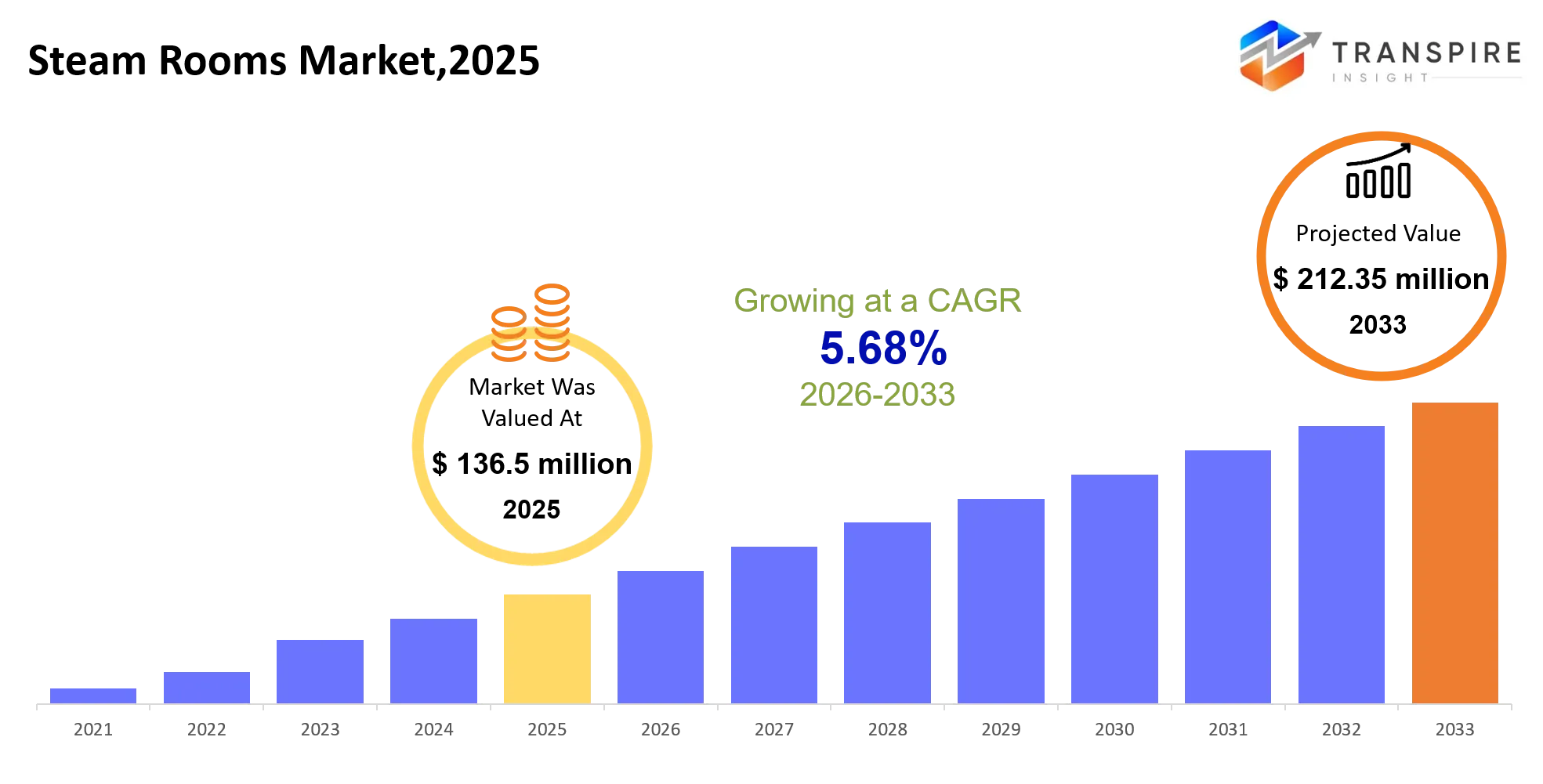
As per Transpire Insight Analysis, the Steam Rooms Market size is estimated at USD 136.5 million in 2025 and is anticipated to reach USD 212.35 million by 2033, growing at a CAGR of 5.68% from 2026 to 2033.
The steam room industry provides relaxation, recovery, and well-being experiences for people in both domestic and commercial spaces. In the past three to five years, the market has changed from simple steam machines to more advanced and stylish wellness areas. Smart controls, the ability to operate from a distance, automatic temperature settings and connected systems are becoming more popular because people want easier and more personal experiences. A big reason for this change is the increase in wellness centres and at-home spa setups, which has made property owners want to include steam rooms in their spaces. Harvia has added digital features like connected controls, mobile access, data on how the system is used and alerts for maintenance. Its ThermaSol part is also making its steam products better. These changes are making steam systems easier to use and customise. More people are also starting to use steam rooms at home as wellness features become more common in house designs.
Steam Rooms Market Size & Forecast:
- Market Size 2025: USD 136.5 million
- Expected Market Value (2033): USD 212.35 million
- Forecast CAGR (2026–2033): 5.68%
- Leading Region in 2025: Europe
- Fastest Growing Region: Asia-Pacific
- Key Company Profiles: Harvia, KLAFS, TyloHelo, Kohler, Steamist, MrSteam, ThermaSol, Saunacore, Amerec, Duravit, Effegibi, Finnleo, Physiotherm, Narvi
Key Market Insights:
The steam room industry is moving away from regular steam room installations to more sophisticated, connected, personal, and experiential wellness experiences. The commercial market represents a lucrative business opportunity, but there is also new demand arising from the domestic market.
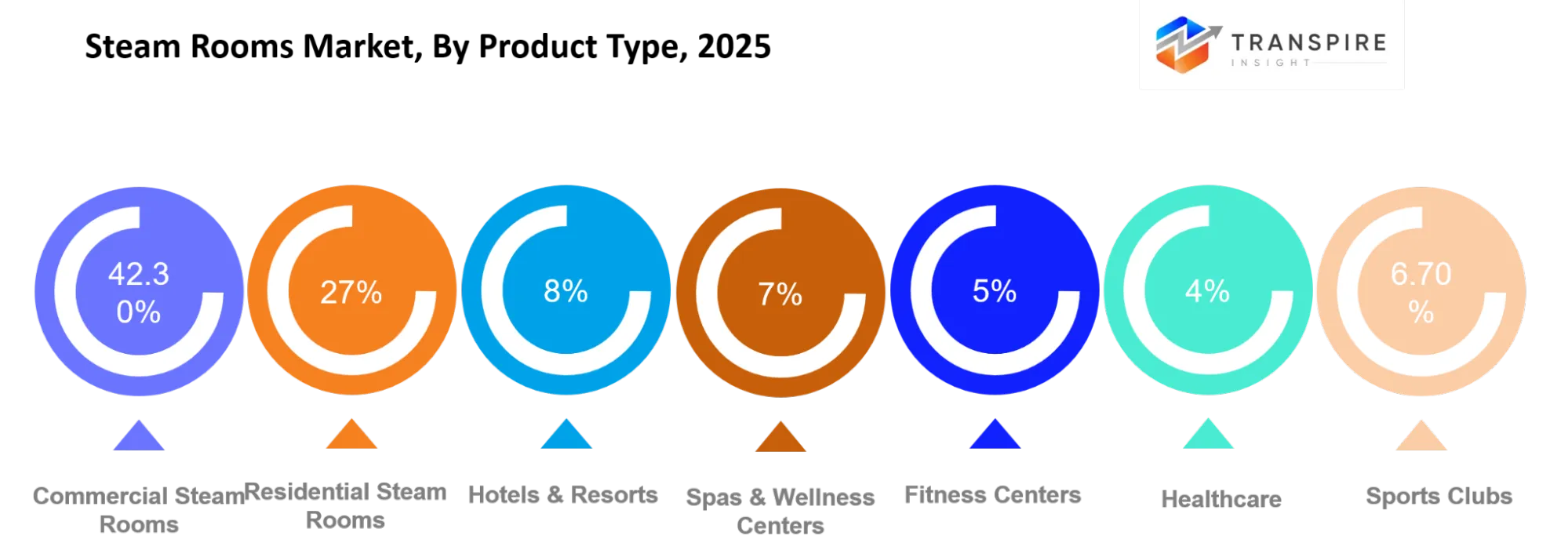
- Commercial steam rooms constitute 42.30% because of the adoption of steam technology by hotels, spas, gyms, and wellness centres.
- The residential steam rooms make up 27.00% due to the installation of private wellness rooms with modern steam technology.
- Hotels and resorts hold 8.00% of the market because the steam room technology is installed to improve the quality of wellness and guest experience.
- Spas and wellness centres make up 7.00% with the help of digital controls, aromatherapy and customised steam experiences.
- Gyms occupy 5.00% due to the increasing installation of steam rooms in recovery centres along with automated operating controls.
- Sport clubs have 3.00% of the market because sport clubs install steam rooms in conjunction with recovery and wellness services.
What are the Key Drivers, Restraints, and Opportunities in the Steam Rooms Market?
Drivers
This market is being fueled by the growth in wellness-focused construction of hotels, spas, fitness centres, and personal homes. There has been a trend towards steam rooms as part of overall wellness setups as opposed to being standalone additions. This means that there will be more opportunities for adoption because people will be able to add steam rooms together with relaxation rooms, recovery rooms, aroma rooms, lighting rooms, among others. The technology is also aiding in adoption. There have been developments in digital controls and connectivity that have made it easy to control the temperature, time, lighting, and other aspects of steam room usage.
Restraints
The high demands that have to be met during the process of installation serve as the major disadvantage of steam rooms, especially in the case when specialised building and installation work needs to be done. Commercial steam rooms will need even more maintenance compared to residential ones since they are used more often. All these factors will significantly increase the costs of the project and make the steam room less convenient for small areas. The purity of water is an important practical aspect.
Opportunities
There is an opportunity in steam room installations that are compact, connected, and energy-efficient. Manufacturers can capitalise on the opportunity to offer residential units that do not dedicate much space to a steam room. There is also immense potential for commercial units to adopt modular designs that enable easy installation and room customisation in terms of size and features. Companies such as KLAFS provide modular steam room designs and energy-efficient technologies, while Tylö provides digital and cloud-based systems for commercial applications.
What Has the Impact of Artificial Intelligence Been on the Steam Rooms Market?
The use of Artificial intelligence is starting to shape the steam rooms market mainly through the use of connected controls, automation, monitoring, and data-driven optimisation rather than through standalone AI-based steam generation. The use of smart systems may enable integration of temperature, session time, lighting, aroma functionality, and other room control options within a single digital platform. It would help users in developing consistent wellness routines by decreasing the number of manual operations. Remote management capabilities would also be possible, enabling users to get a steam room ready before actually getting into it. MrSteam's SteamLinx system, for example, lets users turn on or off their steam sessions and manage the temperature and time using their mobile devices, while the company has introduced its SteamLinx ecosystem with SpaNet Hub.AI adoption will still be hampered by high installation costs, compatibility issues of the equipment provided by different producers, and limited standardised operational data about steam rooms. Thus, the immediate influence of AI on the market is expected to be driven by smart automation and connected control.
Instance
In April 2026, Aevia Labs introduced an AI-powered safety and smart amenities management system for use in saunas and steam rooms, which is a patent-pending technology, and this technology does not employ the use of cameras or images to enhance safety, management and efficiency of energy in steam rooms.
Key Market Trends:
Trends are evolving toward personalisation and connectivity for steam spaces that emphasise the overall experience. New product developments involve steam technology being integrated with digital control systems, energy-saving technologies, modularity, and wellness experiences.
- Classical installations are transitioning into connected systems. The classical steam rooms were very dependent on manual controls, whereas the newer ones tend to use more digitised interfaces and remote controls.
- There is a trend towards technologizing wellness at home. Home users are supplied with smaller systems that have controllable temperature and duration.
- Commercial facilities are focusing on customisation. Hotels and spas seek to differentiate themselves from one another by customising their wellness areas with additional features.
- Wireless control is becoming increasingly important. MrSteam's TempoFlex system showcases the transition towards wireless control panels that do not require a physical connection to the generator.
- Mobile control is starting to be incorporated in the user experience. Connected systems allow users to control steam functions using smartphones and other digital platforms.
- Efficiency in energy usage is becoming a feature of new products. Companies are developing systems that allow for reducing consumption of resources while retaining the necessary conditions in the steam room.
Steam Rooms Market Segmentation
By Type
Traditional Steam Rooms have been providing the basics of the industry as they have become common for both the commercial operators and domestic users. Infrared Steam Rooms and others with technological applications have been gaining importance as customers are demanding different wellness services. The portable and modular steam rooms offer further convenience where permanent constructions cannot be done easily. The Residential Steam Rooms have been gaining increasing importance as people are now investing more in wellness at home, while the Commercial Steam Rooms constitute the major segment of the industry with a 42.30% share. The future of the type segment is therefore expected to be influenced by the convenience and customisation of services.
By End User
The Residential segment represents 27.00% of the provided market segmentation, whereas the commercial segment represents a bigger opportunity in case of taking into consideration the commercial steam-room segment for professional facilities. Hotels and Resorts make up 8.00%, which is due to the implementation of wellness services that would help enhance customer experience. Spas and Wellness Centres represent 7.00%, in which steam is an integral component of relaxation and treatment services. Fitness Centres represent 5.00%, especially recovery-focused centres, whereas Healthcare Facilities and Sports Clubs make up 4.00% and 3.00%, respectively. Other end users make up 3.70%. Future growth within end users would be based on how well steam rooms could fit into wellness, hospitality, fitness, and recovery facilities.
By Material
Glass becomes more suitable for today's steam showers as it fits open designs and modern bathroom concepts. Ceramic still has its relevance due to its ability to tolerate humid conditions and versatile design options. Stone is a product to be used in premium constructions with regard to its durability and look. Acrylic may be used for constructing lightweight and maintainable constructions, whereas Fiberglass is an additional option for factory-made installations. Wood is mostly used in selected designs with appropriate resistant materials and techniques.
By Technology
Digital Steam Generators constitute the primary technological basis for steam control, whereas Automatic Temperature Control ensures more consistent steam during one session. Smart Controls have become more relevant in terms of managing all the steam options with the help of digital controls. Aromatherapy Systems and Chromotherapy introduce new sensory options which allow operators to create unique experiences for their customers. Touchscreen Controls become more convenient for interacting with the equipment, whereas Remote Monitoring opens new possibilities for its mobile operation and facility management.
By Application
Relaxation continues to be an important application as steam baths are essentially synonymous with relaxation. Applications for wellness have been growing as consumers become more inclined to integrate steam baths with overall personal care regimes. The Fitness Recovery application has been emerging within the context of gyms and fitness spas, with Spa Treatment being important for wellness enterprises. Applications for Hospitality are especially important for hotels and resorts looking to provide unique services to their guests. The Therapeutic Use application offers a niche application when proper facility requirements are fulfilled.
What are the Key Use Cases Driving the Steam Rooms Market?
The commercial steam room represents the main use case, being already widespread in hotels, spas, fitness centres, and other professional wellness establishments. Such installations will enable service providers to offer an extra wellness benefit without depending only on traditional forms of fitness or therapy programs.
Residential wellness represents another significant use case, being part of the residential use of the offered segment classification. Homeowners tend to include steam facilities in their bathroom or personal wellness area installations, especially when small size and digital control become essential for such installations. Fitness recovery, wellness programs in the hospitality business, individual spa treatment, and smart home wellness routines represent new use cases of such steam rooms.
|
Report Metrics |
Details |
|
Market size value in 2025 |
USD 136.5 million |
|
Market size value in 2026 |
USD 144.25 million |
|
Revenue forecast in 2033 |
USD 212.35 million |
|
Growth rate |
CAGR of 5.68% from 2026 to 2033 |
|
Base year |
2025 |
|
Historical data |
2021 - 2024 |
|
Forecast period |
2026 - 2033 |
|
Report coverage |
Revenue forecast, competitive landscape, growth factors, and trends |
|
Regional scope |
United States; Canada; Mexico; United Kingdom; Germany; France; Italy; Spain; Denmark; Sweden; Norway; China; Japan; India; Australia; South Korea; Thailand; Brazil; Argentina; South Africa; Saudi Arabia; United Arab Emirates |
|
Key company profiled |
Harvia, KLAFS, TyloHelo, Kohler, Steamist, MrSteam, ThermaSol, Saunacore, Amerec, Duravit, Effegibi, Effegibi, Finnleo, Physiotherm, Narvi |
|
Customization scope |
Free report customization (country, regional & segment scope). Avail customized purchase options to meet your exact research needs. |
|
Report Segmentation |
Type (Traditional Steam Rooms, Infrared Steam Rooms, Portable Steam Rooms, Modular Steam Rooms, Residential Steam Rooms, Commercial Steam Rooms, Luxury Steam Rooms, Others); End User (Residential, Hotels, Spas, Fitness Centers, Healthcare Facilities, Wellness Centers, Sports Clubs, Others); Material (Glass, Ceramic, Stone, Acrylic, Fiberglass, Wood, Composite, Others); Technology (Digital Steam Generators, Automatic Temperature Control, Smart Controls, Aromatherapy Systems, Chromotherapy, Touchscreen Controls, Remote Monitoring, Others); Application (Relaxation, Wellness, Fitness Recovery, Spa Treatment, Hospitality, Therapeutic Use, Home Wellness, Others) |
Which Regions are Driving the Steam Rooms Market Growth?
North America
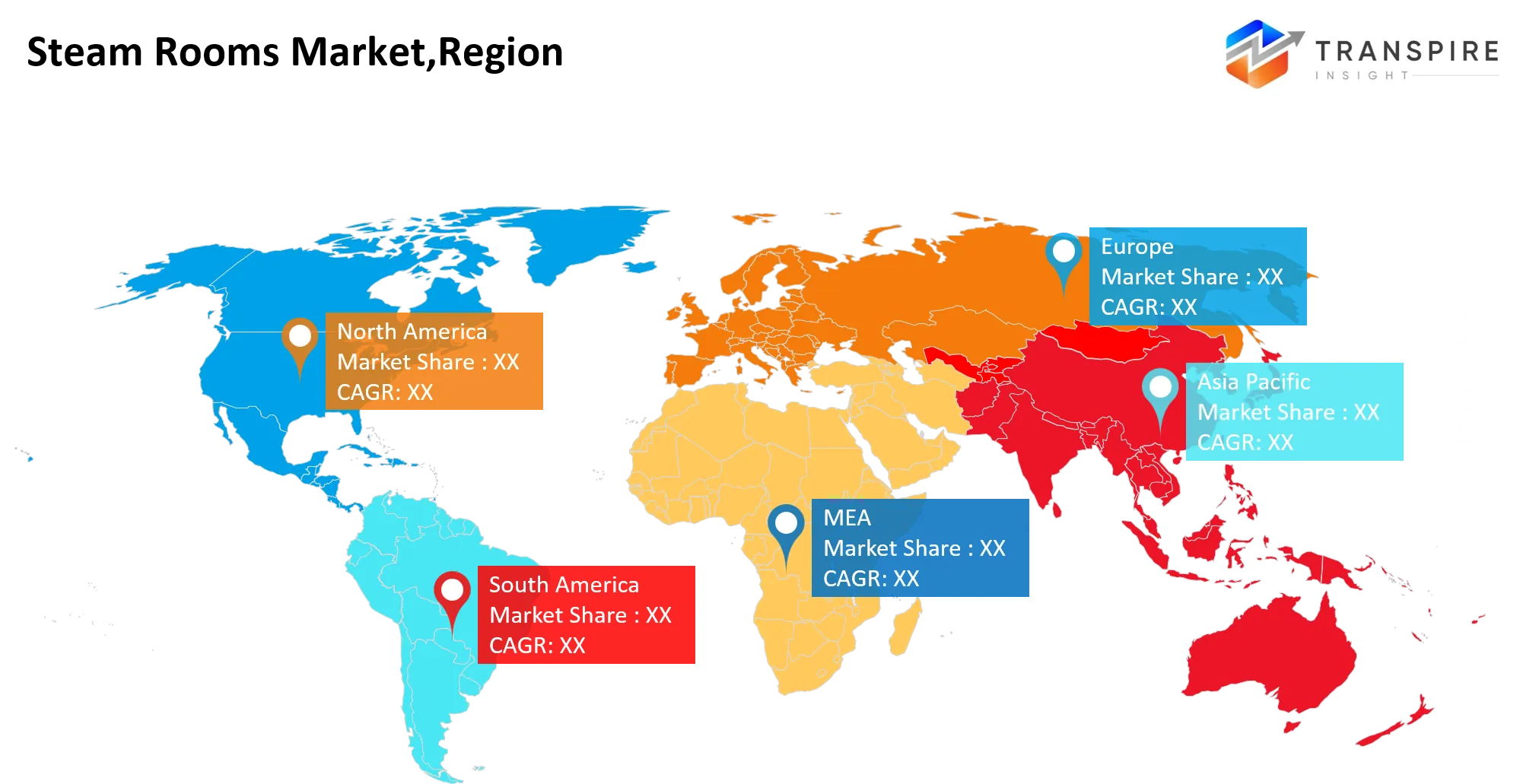
The North American region constitutes 30.00% of the market and is a key commercial and residential market. In contrast to the well-developed wellness market in Europe, the expansion of the North American market is associated mainly with residential remodelling, the development of premium bathrooms, fitness, and high-quality wellness construction projects. Moreover, the region saw strategic investments made by the leading manufacturers; the purchase of the U.S. company ThermaSol by the Finnish company Harvia allowed to strengthen its presence in the steam market in North America and gain access to digital steam technologies.
In August 2025, the Thermasol Company built the first-ever Sauna & Steam Showroom in Denver, Colorado, which includes a functional steam shower equipped with both aromatherapy and chromatherapy, showing the increasing incorporation of steam technology in North America's wellness and home designs.
https://www.thermasol.com/blogs/news/now-open-thermasol-s-first-sauna-steam-showroom-in-denver
Europe
Europe dominates as the leading region holds 35.20% market share of the worldwide steam rooms industry. This is justified by the presence of an existing culture of sauna and wellness, established players, well-built spas, and customer awareness of such health facilities. Moreover, there exists an existing environment of specialised wellness companies and steam room designers. The manufacturers in Europe have started integrating old-fashioned bathing practices with contemporary technology and customisation.
In March 2025, the company KLAFS brought out ESPURO as the foam steam bath that incorporates steam, foam, fragrance, lighting, and music to provide an improved wellness experience in commercial and hospitality locations.
https://www.klafs.com/commercial/products/detail/espuro-foam-steam-bath
Asia-Pacific
The Asia-Pacific region holds 21.00% of the market share and has the highest rate of development in the period considered, which is 6.40% CAGR, as per the provided data. The growth is driven by the development of wellness facilities, urban development, investment in the hotel industry, and increasing interest in premium personal care facilities. Moreover, there are many opportunities for manufacturers in the region, since the demand arises not in just one of the countries but in various consumer and commercial segments.
In May 2025, Soak Bathhouse launched its Alexandria spa centre in Sydney, which includes a separate steam room facility along with its mineral pools, saunas, and plunge pools.
Who are the Key Players in the Steam Rooms Market and how do they compete?
The competition within the steam rooms market comes from wellness-equipment manufacturers, speciality steam firms, luxury design providers, and regional suppliers. The firms are competing based on product reliability, installation services, digital controls, customizability, commercial installation knowledge, and distribution. Leading players in the industry include Harvia, KLAFS, TylöHelo, MrSteam, and ThermaSol.While Harvia has been known for its classic saunas, the company is now broadening its portfolio to incorporate steam options. Its acquisition of ThermaSol has helped expand its North American presence while adding more experience and digital control capability. In conclusion, Harvia's competitive advantage includes portfolio diversification, acquisitions, international distribution, and technology. MrSteam concentrates on product customizability and digital controls. The firm will introduce its products like TempoFlex, TempoTouch, and SpaNet Hub to improve control, convenience, and connectivity at home wellness centres.
Steam Rooms Market companies
- Harvia
- KLAFS
- TyloHelo
- Kohler
- Steamist
- MrSteam
- ThermaSol
- Saunacore
- Amerec
- Duravit
- Effegibi
- Effegibi
- Finnleo
- Physiotherm
- Narvi
Recent Development News
In April 2026, ThermaSol introduced its ThermaTouch2 intelligent user interface, with personalised user profiles, steam control, temperature control, lighting control, audio control, water distribution, and shower functions all within one interface. This introduces a further enhancement to their connected steam and wellness product line.
https://www.thermasol.com/blogs/news/thermatouch2-a-more-intuitive-approach-to-daily-wellness
In June 2025, MrSteam rolled out TempoFlex, TempoTouch, and SpaNet Hub. The introduction of these new products brought wireless controls and management capabilities, thus making MrSteam even more innovative in the field of digital steam experience.
What Strategic Insights Define the Future of the Steam Rooms Market?
The future of the steam rooms market around the world will involve moving towards intelligent, customised, modular, and experiential wellness facilities as opposed to just steam room devices. It would be important to retain commercial uses of steam rooms since hotels, spas, health clubs, and other wellness facilities will benefit from their installation as part of their service provision. At the same time, residential installations offer a promising avenue for growth due to compact systems and digital controls, making it easier to install at home. One major danger of this trend includes the increasing complexity of interconnected devices due to issues of interoperability, cybersecurity, maintenance, water quality, and installation, which may result in high lifetime costs. One of the opportunities associated with this trend involves integration with larger wellness solutions within homes and commercial settings where such things as temperature, lighting, aromas, sound and many others could be managed using a single interface.
By Type
- Traditional Steam Rooms
- Infrared Steam Rooms
- Portable Steam Rooms
- Modular Steam Rooms
- Residential Steam Rooms
- Commercial Steam Rooms
- Luxury Steam Rooms
- Others
By End User
- Residential
- Hotels
- Spas
- Fitness Centers
- Healthcare Facilities
- Wellness Centers
- Sports Clubs
- Others
By Material
- Glass
- Ceramic
- Stone
- Acrylic
- Fiberglass
- Wood
- Composite
- Others
By Technology
- Digital Steam Generators
- Automatic Temperature Control
- Smart Controls
- Aromatherapy Systems
- Chromotherapy
- Touchscreen Controls
- Remote Monitoring
- Others
By Application
- Relaxation
- Wellness
- Fitness Recovery
- Spa Treatment
- Hospitality
- Therapeutic Use
- Home Wellness
- Others
Frequently Asked Questions
Find quick answers to common questions.
The steam rooms market size was valued at USD 136.5 million in 2025 and is poised to reach USD 212.35 million by 2033, expanding at a 5.68% CAGR.
Key segments for the steam rooms market are Type (Traditional Steam Rooms, Infrared Steam Rooms, Portable Steam Rooms, Modular Steam Rooms, Residential Steam Rooms, Commercial Steam Rooms, Luxury Steam Rooms, Others); End User (Residential, Hotels, Spas, Fitness Centers, Healthcare Facilities, Wellness Centers, Sports Clubs, Others); Material (Glass, Ceramic, Stone, Acrylic, Fiberglass, Wood, Composite, Others); Technology (Digital Steam Generators, Automatic Temperature Control, Smart Controls, Aromatherapy Systems, Chromotherapy, Touchscreen Controls, Remote Monitoring, Others); Application (Relaxation, Wellness, Fitness Recovery, Spa Treatment, Hospitality, Therapeutic Use, Home Wellness, Others)
Growth is primarily driven by increased interest in wellness and relaxation among consumers, growth of spa centers and luxury hotels, increased spending on wellness in residences, health consciousness and fitness, and technological advances in steam room technology.
The market is led by major manufacturers including Harvia, KLAFS, TyloHelo, Kohler, Steamist, MrSteam, ThermaSol, Saunacore, Amerec, Duravit, Effegibi, Effegibi, Finnleo, Physiotherm, Narvi
The steam room industry is influenced by Europe due to its market share of 35.20%, attributed to high demand for wellness and spa services, well-established hospitality infrastructure, increasing preference for wellness at home, and advanced steam room technologies.
The commercial opportunities within the international steam room market sector encompass increased demand for wellness facilities, development of luxury hotels and resorts, incorporation of smart technology into steam rooms, increasing investments in health and fitness clubs, and growth in residential wellness solutions.
About the Authors

Chetan Dhatrak
I’m Chetan Dhatrak, a Senior Research Analyst at Transpire Insight, specializing in the Consumer Goods, Foods and Beverages industry. I focus on analyzing market trends, consumer behavior, competitive landscapes, and industry developments to deliver accurate, data-driven insights. My research at Transpire Insight is built on credible sources and in-depth analysis, helping businesses and readers better understand market dynamics, emerging opportunities, and evolving consumer preferences. I’m committed to creating reliable, well-researched content that supports informed decision-making and reflects the latest developments in the consumer goods and food & beverage sectors.

Chakradhar Khansole
Chakradhar serves as the Research Director at Transpire Insight, bringing over 8 years of experience in technology, innovation, and strategic market intelligence. He specializes in transforming complex market data into actionable business insights that enable organizations to make informed, growth-oriented decisions. Recognized for his strategic vision and analytical expertise, Chakradhar leads high-impact research initiatives, delivering comprehensive market assessments, competitive intelligence, and forward-looking industry analysis.
Recently Published Reports
-
Apr 2026
Bottled Water Market
Bottled Water Market Size, Share & Analysis Report By Product Type (Still Bottled Water, Carbonated Bottled Water, Functional Bottled Water, and Others), By Packaging (PET, Cans, and Others), By Sales Channel (Supermarkets/Hypermarkets, Convenience Stores/Drug Stores, Grocery Stores/Club Stores, Foodservice, and Others) and Geography (North America, Europe, Asia-Pacific, Middle East and Africa, South and Central America), 2021 - 2032
-
Apr 2026
Color Cosmetic Packaging Market
Color Cosmetic Packaging Market Size, Share & Analysis Report By Application (Mascara Packaging, Liquid Packaging, and Liquid Face), By Type (Tubes & Bottles, Pens & Markers, Compacts & Containers, and Droppers & Pumps), and Geography (North America, Europe, Asia-Pacific, Middle East and Africa, South and Central America), 2021 - 2031
-
Apr 2026
External Microphone For Camera Market
External Microphone For Camera Market Size, Share & Analysis Report By Type (Shotgun Microphone, Lavalier Microphone, and Others), By Application (Digital Camera, Professional Video Camera, and Others), and Geography (North America, Europe, Asia-Pacific, Middle East and Africa, South and Central America), 2021 - 2031
-
Apr 2026
Foot Orthotic Insoles Market
Foot Orthotic Insoles Market Size, Share & Analysis Report By Type (Pre-fabricated, and Custom-made), By Material (Thermoplastic, Composite Carbon Fiber, and Others), By Distribution Channel (Drug Stores, Hospitals & Clinics, and Others), and Geography (North America, Europe, Asia-Pacific, Middle East and Africa, South and Central America), 2021 - 2031