

Static Random-Access Memory Market Size & Forecast:
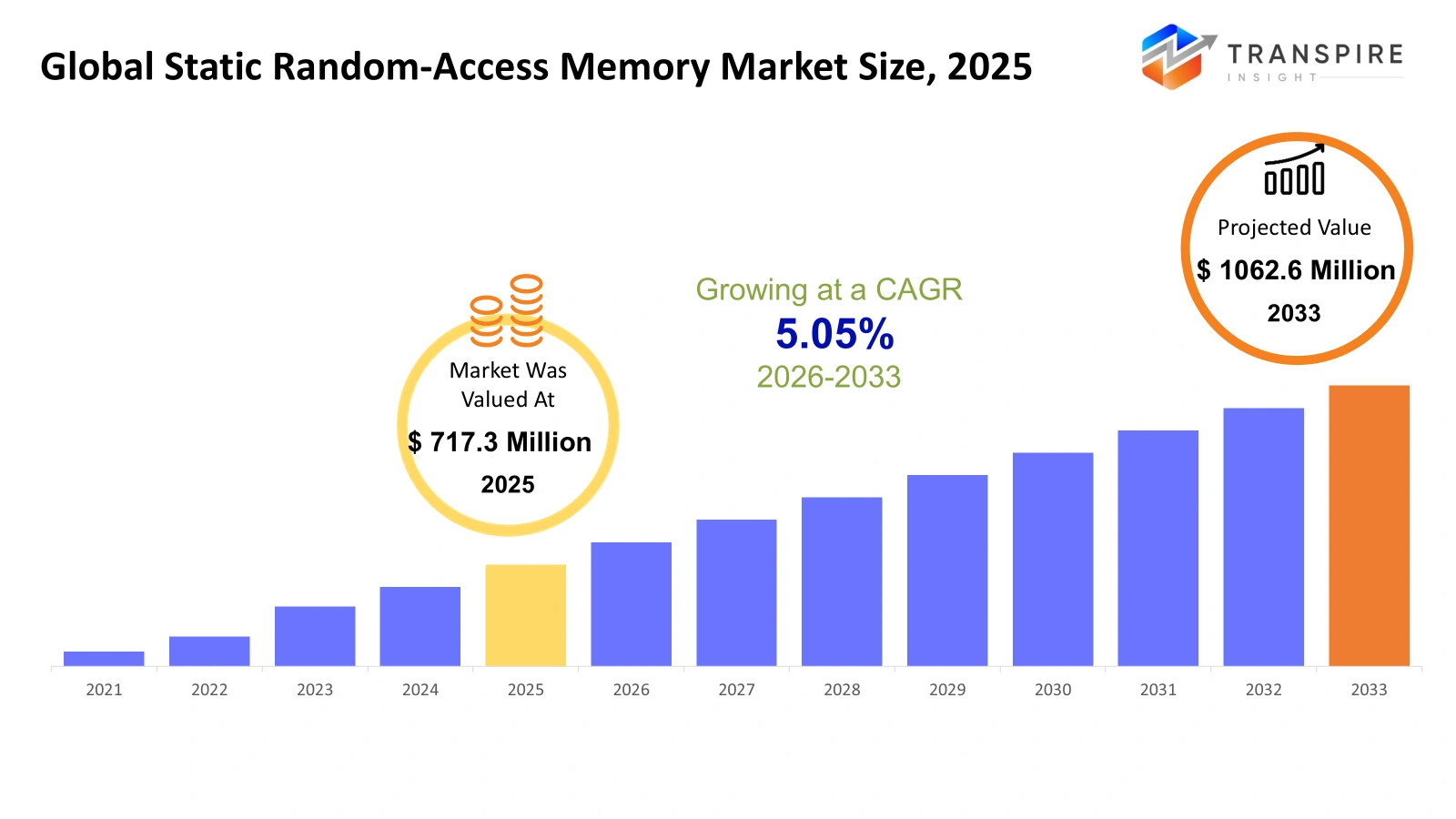
Static Random-Access Memory Market Size 2025: USD 717.3 Million
Static Random-Access Memory Market Size 2033: USD 1062.6 Million
Static Random-Access Memory Market CAGR: 5.05%
Static Random-Access Memory Market Segments: By Type (Asynchronous SRAM, Synchronous SRAM), By Application (Consumer Electronics, Automotive, Industrial, Networking & Telecommunications), By Memory Density (Low Density, Medium Density, High Density)
To learn more about this report,  Download Free Sample Report
Static Random-Access Memory Market Summary:
The Static Random-Access Memory Market reached an estimated value of USD 717.3 million in 2025 and is projected to grow to USD 1062.6 million by 2033, expanding at a CAGR of 5.05% from 2026 to 2033. Static Random-Access Memory (SRAM) is a semiconductor memory that uses bistable latching circuitry to store data, which remains intact as long as power is maintained. SRAM provides faster performance and better reliability than dynamic RAM because it does not need continuous refresh cycles for operation.
The Static Random-Access Memory Market is experiencing ongoing growth because industries require memory solutions that offer both speed and efficiency. SRAM is a fundamental component in systems that require fast data retrieval for cache memory operations in processors, networking equipment, and embedded systems. The system provides real-time computing capabilities through its ability to achieve low latency and high-speed execution.
The Static Random-Access Memory Market experiences growth because of the fast development in consumer electronic devices. The devices, which include smartphones and tablets, gaming consoles and wearable technology, need fast memory components to provide users with better performance and experience. The devices use SRAM for cache memory and buffering purposes.
The automotive industry helps to expand the market size. Modern vehicles use advanced electronic systems, including infotainment systems, driver assistance systems, and autonomous driving technologies. Automotive systems need dependable high-speed memory solutions, which drives the requirement for SRAM in automotive applications.
Key Market Trends & Insights:
- The Static Random-Access Memory Market experiences growth because there is rising demand for memory solutions which provide both high-speed performance and low-latency access.
- Consumer electronics devices have increased demand for SRAM, which manufacturers use in their processors and embedded systems.
- The automotive industry uses more SRAM because of increased adoption of automotive electronics and advanced driver assistance systems.
- The growing networking and telecommunications infrastructure creates greater demand for high-performance memory components.
- The latest technological developments enable SRAM devices to achieve higher memory storage capacity while consuming less power.
Static Random-Access Memory Market Segmentation
By Type
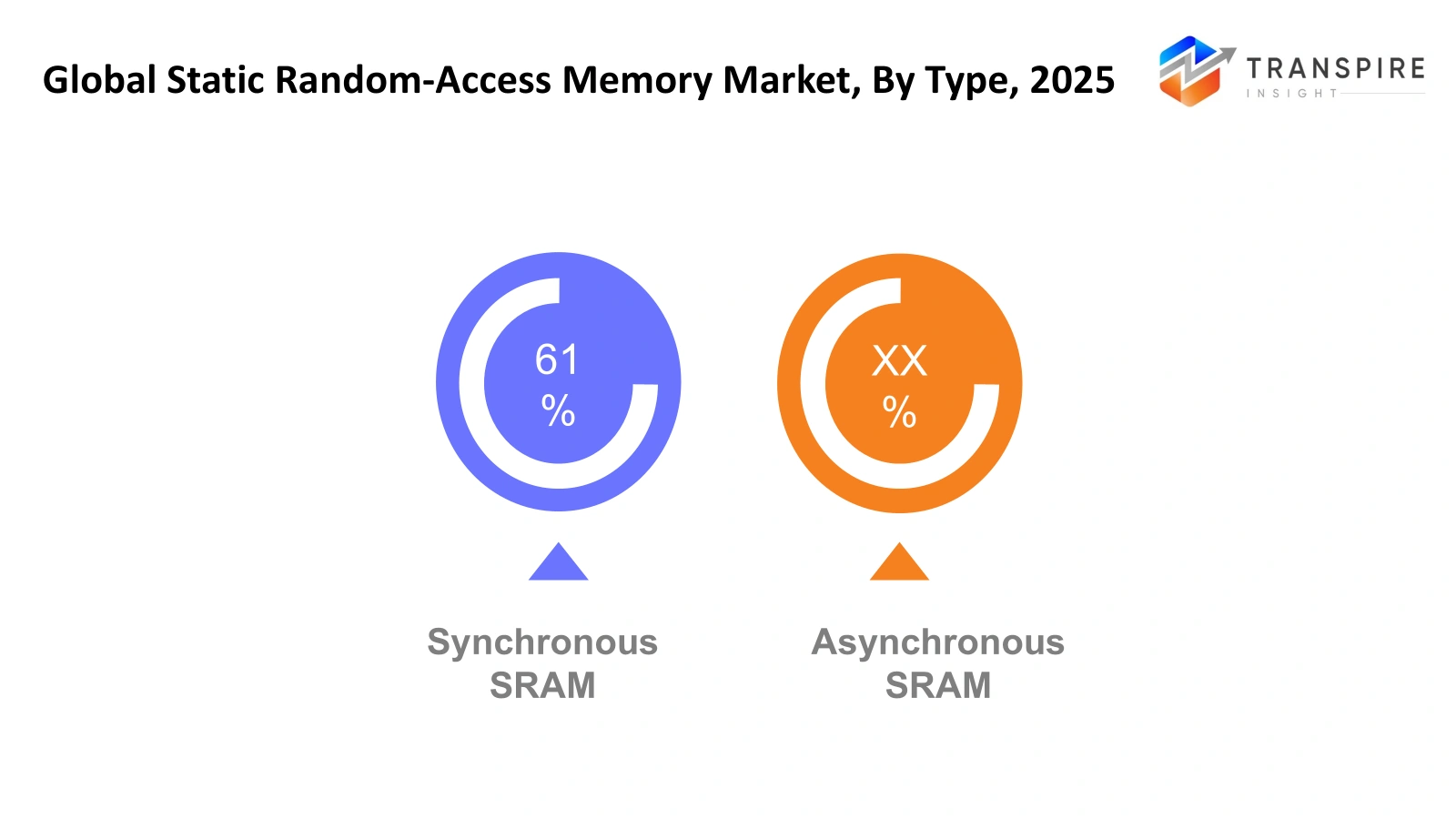
Asynchronous SRAM: The first point about asynchronous SRAM explains that this type of memory system can access data immediately after its address becomes available because it does not depend on clock signals. This type of SRAM is commonly used in simpler systems where timing requirements are less complex. The system provides multiple ways to operate because it delivers simple functions which work in different embedded systems.
Synchronous SRAM: The market for synchronous SRAM has reached its current state. The technology uses clock signals to control its operations, enabling faster data processing and precise data retrieval timing. The system provides excellent performance for networking components, high-speed processors and advanced computing systems.
To learn more about this report, Download Free Sample Report
By Application
Consumer Electronics: Consumer electronics represent a major application segment for SRAM. Devices such as smartphones, tablets, gaming consoles, and smart devices use SRAM for cache memory and temporary data storage, enabling faster processing and smoother performance.
Automotive: The automotive sector uses SRAM in systems such as advanced driver assistance systems (ADAS), infotainment systems, and control units. These applications require reliable and high-speed memory to ensure safety and performance.
Industrial: Industrial applications use SRAM in automation systems, robotics, and control equipment. These systems require real-time data processing and reliable memory performance.
Networking & Telecommunications: Networking devices such as routers, switches, and communication equipment rely heavily on SRAM for fast data buffering and processing. The expansion of 5G networks and data centers is increasing demand in this segment.
By Memory Density
Low Density: Low-density SRAM is used in basic applications where memory requirements are minimal. These devices are cost-effective and suitable for simple embedded systems.
Medium Density: Medium-density SRAM provides a balance between performance and cost, making it suitable for a wide range of applications including consumer electronics and industrial systems.
High Density: High-density SRAM is used in advanced applications that require large amounts of fast-access memory. These include networking equipment, high-performance computing systems, and data-intensive applications.
Country Insights
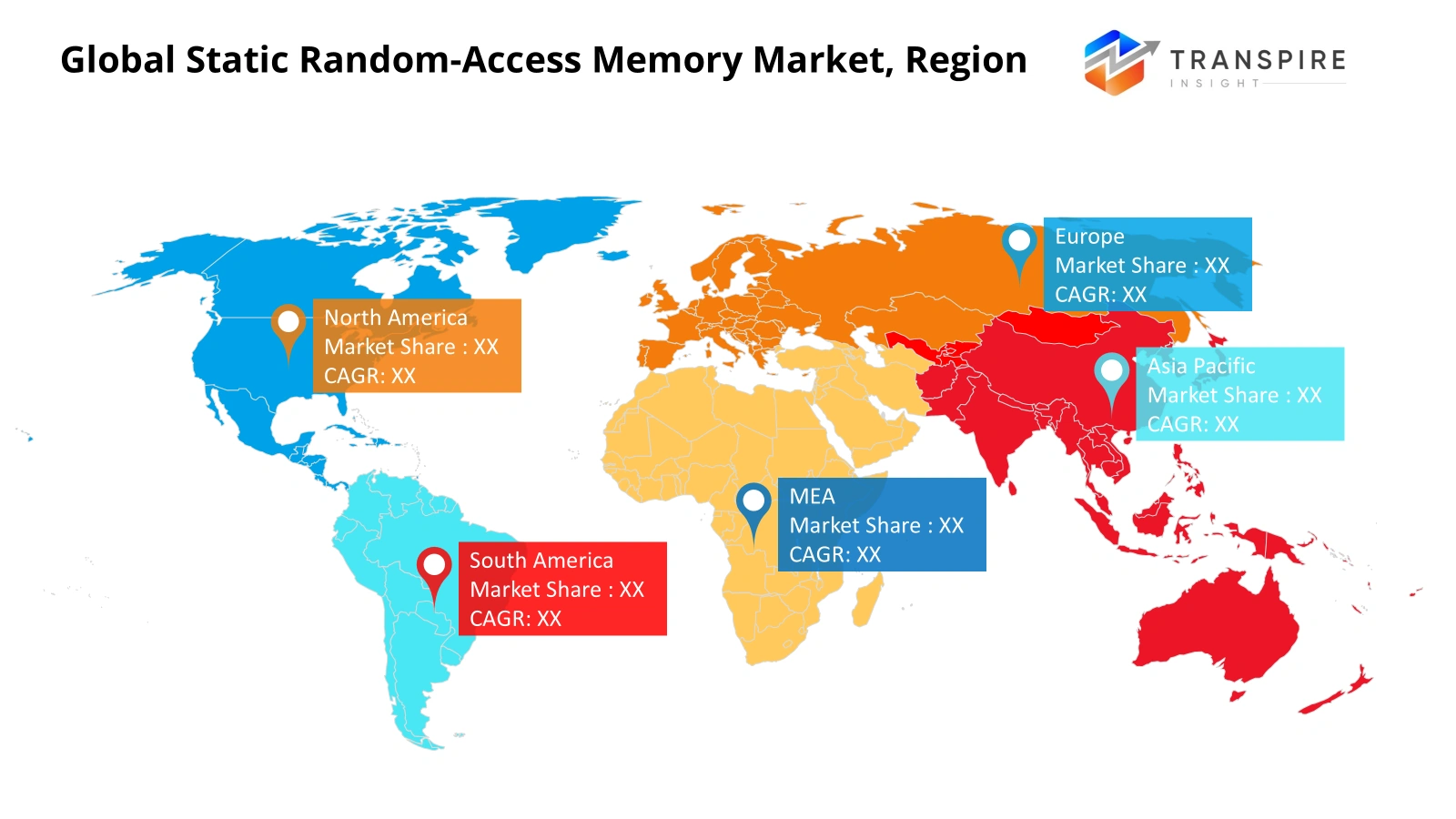
The worldwide market for Static Random-Access Memory shows growth because digital technologies keep developing. The market is growing through semiconductor production in North America, Asia-Pacific, and Europe.
Asia-Pacific governs the market because it contains major semiconductor companies and produces numerous consumer electronic devices. South Korea, Japan, China and Taiwan together produce and develop SRAM technology.
North America maintains its importance as a market because automotive, aerospace and technology industries create strong demand. The region benefits from its advanced research facilities that develop semiconductor technology.
Europe supports the market expansion through its development of automotive and industrial systems. The region demands high-performance memory solutions as its advanced manufacturing and automotive innovation activities progress.
The Static Random-Access Memory Market will experience ongoing growth because of rising global requirements for speedy and efficient electronic systems.
To learn more about this report, Download Free Sample Report
Recent Development News
Semiconductor companies are developing advanced SRAM technologies that offer higher memory density, improved speed, and reduced power consumption.
Manufacturers are also focusing on integrating SRAM into next-generation processors and networking devices to support high-performance computing applications.
|
Report Metrics |
Details |
|
Market size value in 2025 |
USD 717.3 Million |
|
Market size value in 2026 |
USD 752.5 Million |
|
Revenue forecast in 2033 |
USD 1062.6 Million |
|
Growth rate |
CAGR of 5.05% from 2026 to 2033 |
|
Base year |
2025 |
|
Historical data |
2021 - 2024 |
|
Forecast period |
2026 - 2033 |
|
Report coverage |
Revenue forecast, competitive landscape, growth factors, and trends |
|
Country scope |
Global |
|
Key company profiled |
Samsung Electronics Co. Ltd., SK Hynix Inc., Micron Technology Inc., Infineon Technologies AG, Integrated Silicon Solution Inc., GSI Technology Inc., Renesas Electronics Corporation, Toshiba Corporation, ON Semiconductor Corporation, NXP Semiconductors N.V., Microchip Technology Inc., Alliance Memory Inc., ROHM Semiconductor, Fujitsu Semiconductor Ltd., Winbond Electronics Corporation. |
|
Customization scope |
Free report customization (country, regional & segment scope). Avail customized purchase options to meet your exact research needs. |
|
Report Segmentation |
By Type (Asynchronous SRAM, Synchronous SRAM), By Application (Consumer Electronics, Automotive, Industrial, Networking & Telecommunications), By Memory Density (Low Density, Medium Density, High Density). |
Key Static Random-Access Memory Company Insights
The Static Random-Access Memory Market includes leading semiconductor companies that focus on developing high-performance memory solutions. These companies invest heavily in research and development activities that aim to enhance SRAM device performance through improved speed and efficiency, as well as better integration capabilities.
Manufacturers are developing systems which will increase memory density while decreasing power consumption to satisfy requirements of modern electronic systems. The research team is working on methods to combine SRAM technology with advanced processors, microcontrollers, and networking devices.
Companies create strategic partnerships with technology firms and device makers to enhance their market presence while developing new products. Companies also compete by offering customized memory solutions tailored to specific industry requirements.
The SRAM market will see demand growth for high-speed computing and advanced electronics, driving companies to develop innovative products while improving operational efficiency and performance.
Company List
- Samsung Electronics Co. Ltd.
- SK Hynix Inc.
- Micron Technology Inc.
- Infineon Technologies AG
- Integrated Silicon Solution Inc.
- GSI Technology Inc.
- Renesas Electronics Corporation
- Toshiba Corporation
- ON Semiconductor Corporation
- NXP Semiconductors N.V.
- Microchip Technology Inc.
- Alliance Memory Inc.
- ROHM Semiconductor
- Fujitsu Semiconductor Ltd.
- Winbond Electronics Corporation
Static Random-Access Memory Market Report Segmentation
By Type
- Asynchronous SRAM
- Synchronous SRAM
By Application
- Consumer Electronics
- Automotive
- Industrial
- Networking & Telecommunications
By Memory Density
- Low Density
- Medium Density
- High Density
Frequently Asked Questions
Find quick answers to common questions.
The Static Random-Access Memory Market is expected to reach approximately USD 1062.6 million by 2033.
Key segments include Type (Asynchronous SRAM, Synchronous SRAM), Application (Consumer Electronics, Automotive, Industrial, Networking & Telecommunications), and Memory Density (Low Density, Medium Density, High Density).
Major players include Samsung Electronics Co. Ltd., SK Hynix Inc., Micron Technology Inc., Infineon Technologies AG, Integrated Silicon Solution Inc., GSI Technology Inc., Renesas Electronics Corporation, Toshiba Corporation, ON Semiconductor Corporation, NXP Semiconductors N.V., Microchip Technology Inc., Alliance Memory Inc., ROHM Semiconductor, Fujitsu Semiconductor Ltd., and Winbond Electronics Corporation.
The Static Random-Access Memory Market is expected to reach approximately USD 717.3 million in 2025.
The Static Random-Access Memory Market is expected to grow at a CAGR of 5.05% from 2026 to 2033.
- Samsung Electronics Co. Ltd.
- SK Hynix Inc.
- Micron Technology Inc.
- Infineon Technologies AG
- Integrated Silicon Solution Inc.
- GSI Technology Inc.
- Renesas Electronics Corporation
- Toshiba Corporation
- ON Semiconductor Corporation
- NXP Semiconductors N.V.
- Microchip Technology Inc.
- Alliance Memory Inc.
- ROHM Semiconductor
- Fujitsu Semiconductor Ltd.
- Winbond Electronics Corporation
Recently Published Reports
-
Apr 2026
Fiber Optic Faceplates Market
Fiber Optic Faceplates Market Size, Share & Analysis Report By Type (< 300 mm2, 300-350 mm2, and > 350 mm2, By Application (Night Vision, Holographic Imaging, Medical, and Others), and Geography (North America, Europe, Asia-Pacific, Middle East and Africa, South and Central America), 2021 - 2031
-
Apr 2026
High Temperature Superconductors Market
High Temperature Superconductors Market Size, Share & Analysis Report By Type (1G HTS, and 2G HTS), By Application (Power Cable, Fault Current Limiter, and Transformer), and Geography (North America, Europe, Asia-Pacific, Middle East and Africa, South and Central America), 2021 - 2031
-
Apr 2026
Industrial Plugs and Socket Market
Industrial Plugs and Socket Market Size, Share & Analysis Report By Type (Industrial Plugs, Industrial Sockets), By Current (Up to 32 A, 32 to 125 A, Above 125 A), By Protection (Dustproof and Splash Proof, Waterproof, Explosion Proof), By End User (Heavy Industries, Oil and Gas, Chemicals and Pharmaceuticals, Power Generation, Others), and Geography (North America, Europe, Asia-Pacific, Middle East and Africa, South and Central America), 2021 - 2031
-
Apr 2026
InGaAs Avalanche Photodiodes Market
InGaAs Avalanche Photodiodes Market Size, Share & Analysis Report By Type (1100 - 1700 nm, and 1000 - 1600 nm), By Application (Missile Warning System, Muzzle Flash Detection, Wafer Defect Inspection, Laser Rangefinders, and Others), and Geography (North America, Europe, Asia-Pacific, Middle East and Africa, South and Central America), 2021 - 2031