

Sports Team And Clubs Market Summary:
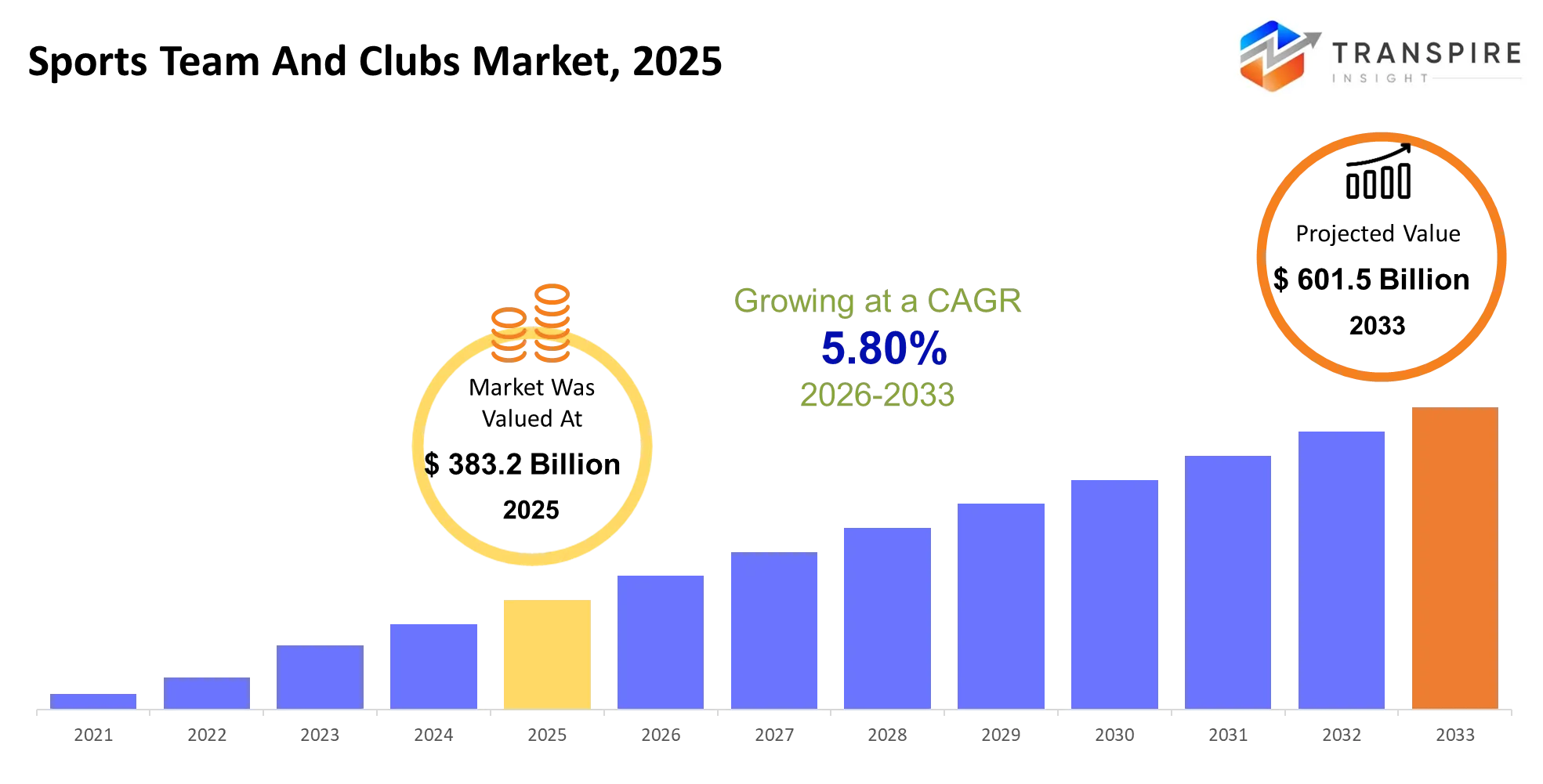
As per the Transpire Insight Analysis, The Sports Team and Clubs Market size is estimated at USD 383.2 billion in 2025 and is anticipated to reach USD 601.5 billion by 2033, growing at a CAGR of 5.80% from 2026 to 2033.
The sports teams and clubs market has moved from game-day monetisation to fan engagement and content creation all year round for entertainment, media, and commercial purposes. In the last 3-5 years, clubs have grown direct-to-fan channels, content streaming, data-driven sponsorships, and diverse ownership models and investor channels – making money beyond match tickets. The game-changing structural shift has been the club world's adoption of AI, shared data platforms and digital content as part of routine club activities – from finance and membership/season ticket renewals to real-time personalised highlights and supporters' needs. Stadiums have become (and are increasingly designed for) year-round entertainment destinations. The real-world constraint of rapidly growing international media consumption and international capital flows has motivated clubs to develop a much broader supporter base and monetise fan engagement across multiple channels: subs, advertising, merch, stadium/venue hospitality, sponsorships and digital content.
Sports Team And Clubs Market Size & Forecast:
- Market Size 2025: USD 383.2 Billion
- Expected Market Value (2033): USD 601.5 Billion
- Forecast CAGR (2026–2033): 5.80%
- Leading Region in 2025: North America
- Fastest Growing Region: Asia Pacific
- Key Company Profiles: Dallas Cowboys, Real Madrid, Manchester United, Golden State Warriors, New York Yankees, Los Angeles Lakers, FC Barcelona, Bayern Munich, Paris Saint-Germain, New York Giants, Los Angeles Rams, Boston Celtics, New England Patriots, Mumbai Indians, Los Angeles Dodgers.
Key Sports Team And Clubs Market Insights:
The market is converging to elite, branded clubs and leagues that are generating revenue from attention beyond just match days via media, digital and hospitality. Closed-league with centralised rights is becoming the commercial standard in North America, whereas Europe and Asia-Pacific are trialling multi-club ownership, public funding and grassroots development.
- North America accounts for 45% of the market value due to centrally managed rights, closed leagues and the high per-club revenues in the NFL, NBA and MLB.
- 31% of it is in Europe, with 32 “Big Five” clubs having American stakes and £52 billion allocated for stadium-based commercial improvements.
- Cricket is driving growth in India and football in China and Southeast Asia, accounting for 16% of revenue in Asia-Pacific, which is growing at a 9.6% CAGR.
- Together, Latin America and the Middle East & Africa account for 8%, with PSG, Newcastle, and multi-club groups being supported by investment from the Gulf to tap into IP.
- Media rights and broadcasting are the biggest piece at 34%, and digital fan engagement is growing at 10.8% CAGR via apps and streaming.
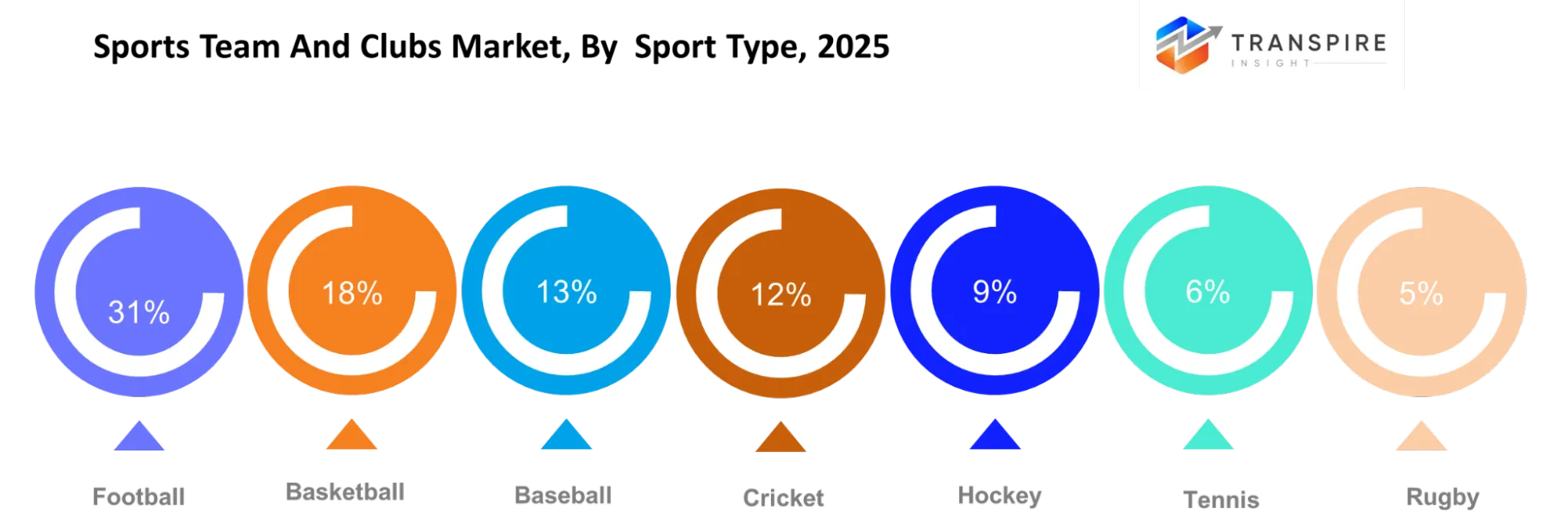
- Football leads by sport at 31%, followed by basketball (18%), baseball (13%), cricket (12%), hockey (9%), tennis (6%), rugby (5%), and others (6%).
- Professional teams are the leaders, but amateur, college, youth, community, and esports clubs are gaining ground with growing participation and digital audiences.
- Top clubs are diversifying their revenue streams beyond ticketing and media through sponsorship, licensing, merchandise, advertising, and hospitality.
What are the Key Drivers, Restraints, and Opportunities in the Sports Team And Clubs Market?
Driver:
Digital monetization and broader media distribution are pushing clubs to convert fragmented fan attention into recurring commercial revenue. The trigger is the migration of sports consumption toward streaming, social platforms, short-form video, and direct-to-fan services. This expands inventory for advertising, sponsorship activation, subscriptions, merchandising, and data-led campaigns beyond match days. Media rights are also being integrated with wider content and technology platforms, strengthening monetization opportunities.
Restraint:
High operating costs and fragmented technology infrastructure limit smaller clubs’ ability to capture these gains. Legacy ticketing, CRM, finance, content, and venue systems often operate separately, making data integration expensive and slowing automation. The issue persists because clubs must protect live-event reliability while upgrading systems without disrupting supporters or commercial partners.
Opportunity:
AI-enabled operating models and portfolio-style investment can unlock additional revenue without depending solely on attendance. Predictive ticket pricing, renewal targeting, personalized content, sponsorship measurement, and automated service can improve conversion and retention. Accenture’s 2026 partnership with Salford City illustrates this shift, combining AI, data, digital platforms, and operational transformation to support fan engagement and international growth. Emerging markets can also benefit as mobile-first fan platforms reduce geographic barriers.
What Has the Impact of Artificial Intelligence been on the Sports Team And Clubs Market?
AI will advance from experiments into active use club-wide. Teams will be able to free themselves from repetitive back-office tasks-including financial reconciliation, ticket-renewal campaigns, customer service, tagging of video clips, and reporting-while responding faster. AI-driven prediction models can forecast renewal likelihood, project attendance, detect buying patterns, optimise ticket packages, and guide sponsorship analysis.
For fans, AI will further tailor content feeds, produce highlights, answer questions, add accessibility and translation features, and deliver information during events. Increasingly, AI will serve as a loosely coupled bridge between operational systems and the fan experience. Recent projects by Salford City in football and the Seattle Seahawks in American football exemplify how clubs are structuring their data platforms, incorporating AI and digital strategies, and transforming their business. The key obstacle to watch for is systems integration: clubs with legacy, disjointed IT platforms will need to pay strong attention to high-value use cases, costs, data standards, information security, and integrating AI results into decision-making to generate value.
In January 2026, Arkero raised $6 million in pre-seed funding to expand its backend automation platform. This technology integrates with existing ticketing and CRM infrastructure to help clubs like the Seattle Sounders and Bolton Wanderers automate matchday planning and season ticket renewals.https://www.arkero.ai/press
Key Sports Team And Clubs Market Trends:
The market is shifting from match-based monetisation to ongoing fan relationships, and technology is linking up media, commerce, venues and club operations. In the past 3-5 years, data, digital content, and diversified ownership have become commercial infrastructure and not supporting functions.
- Clubs are moving from a broadcast-only model to streaming, short-form video, and direct-to-fan channels to monetize beyond matches.
- AI is expanding its presence in finance, ticketing, customer service, content creation and renewal processes, eliminating repetitive operating tasks.
- Clubs are increasingly adopting a more personalized approach to fan engagement, with the integration of CRM, behavioural data, mobile, and content recommendations.
- Stadiums are becoming a year-round entertainment hub, serving the needs of hospitality, retail, events, and community needs.
- Ownership is shifting to multi-club and multi-sport portfolios, which will allow for sharing of data and commercial skills and audience development across the international sphere.
- Sponsorship is moving beyond logos to evidence-based digital activation, content inclusion, audience analytics and performance-based packages.
- Women's sports and new emerging competitions are gaining commercial investment, expanding audience and generating new sponsorship and media inventory.
- There are growing concerns about multi-club ownership, cross-border investment, competitive integrity, and local club identity that are being put under the microscope, and compliance is becoming more strategic.
Sports Team And Clubs Market Segmentation
By Sport:
Football leads at 31%, supported by broadcasting, established leagues, international competitions, and extensive club ecosystems. Basketball follows at 18%, benefiting from international league expansion and digital content. Baseball accounts for 13%, while Cricket holds 12%, supported by franchise-based competitions and expanding overseas audiences. Hockey represents 9%, Tennis 6%, Rugby 5%, and Others 6%, with each sport developing distinctive commercial models through media, sponsorship, and digital engagement.
By Revenue Source:
Media Rights & Broadcasting holds the largest position at 34%, reflecting the value of premium live sports content across television and streaming platforms. Sponsorships, Ticketing, Merchandising, Licensing, Hospitality, Advertising, and Others provide complementary revenue channels. Clubs are increasingly combining these sources through integrated commercial packages, enabling sponsors to access physical venues, digital audiences, social communities, merchandise ecosystems, and exclusive experiences while reducing reliance on any single income stream.
By Team Type:
Professional Teams remain commercially central because established leagues provide recurring fixtures, recognizable brands, media exposure, and sponsorship inventory. Amateur Teams support grassroots participation, while College Teams combine sport with institutional communities and development pathways. National Teams generate event-driven international engagement, whereas Youth Clubs and Community Clubs strengthen local participation. Esports Teams introduce digitally native audiences and alternative content models, while Others address specialized competitive and organizational structures.
By Competition:
Domestic Leagues provide recurring schedules that support predictable media, ticketing, sponsorship, and merchandising activity. International Leagues extend commercial reach by connecting clubs with geographically diverse audiences and sponsors. Tournaments and Championships create concentrated media attention, while Cups provide additional competitive inventory. Friendly Matches and Exhibition Events support international tours, preseason commercialization, and fan experiences. Others include specialized competitions that create targeted opportunities for regional, digital, and community-based engagement.
By Fan Engagement:
Stadium Attendance remains important for ticketing, hospitality, concessions, and live experiences, while Digital Platforms, Social Media, Streaming, Memberships, Fan Clubs, Mobile Apps, and Others extend interaction beyond match days. Digital Fan Engagement records a 10.8% CAGR, reflecting the movement toward continuous supporter relationships. Clubs increasingly use personalized content, mobile notifications, loyalty programs, interactive features, and digital communities to convert engagement into subscriptions, merchandise purchases, sponsorship value, and memberships.
By Commercial Activity:
Sponsorship and Licensing remain important monetization channels, while Merchandise, Advertising, Brand Partnerships, Naming Rights, Hospitality, and Others broaden commercial opportunities. Clubs increasingly package these activities around measurable fan engagement rather than standalone visibility. Brand Partnerships can combine social content, stadium activations, merchandise, and digital campaigns, while Naming Rights and Hospitality monetize premium assets. Data-enabled advertising and personalized commerce further connect supporter behavior with revenue-generating commercial experiences.
By Ownership:
Private Owners and Corporations provide substantial capital for club development, while Public Companies introduce market-based financing and governance structures. Member-owned Clubs preserve supporter participation, whereas Government-backed entities can support strategic sports infrastructure. Investment Funds increasingly apply portfolio approaches, and Family-owned structures emphasize long-term stewardship. Others include specialized ownership models. Diversified ownership can finance technology, venues, academies, content capabilities, and international expansion while supporting operational expertise across sports markets.
What are the Key Use Cases Driving the Sports Team And Clubs Market?
Media Rights & Broadcasting is the largest spend and the dominant use case, with 34% of investment. Clubs and media stakeholders are generating additional monetisation opportunities through live match coverage, streaming, highlights, and international broadcast rights across many platforms to generate new media inventory for sponsorship and advertising activation, providing more opportunities to reach mass audiences beyond the stadium.
Digital Fan Engagement is a rapidly growing application, up 10.8% CAGR, with clubs engaged in developing mobile apps, social media platforms, personalised content, memberships and streaming to stay in touch between matches and convert these virtual audiences into merchandise, hospitality, subscription and sponsorship assets.
Emerging use cases include AI-enabled ticketing and renewal, automated support services, real-time personalised experiences, virtual collectables and digital integrations between stadium and digital brands.
|
Report Metrics |
Details |
|
Market size value in 2025 |
USD 383.2 Billion |
|
Market size value in 2026 |
USD 405.4 Billion |
|
Revenue forecast in 2033 |
USD 601.5 Billion |
|
Growth rate |
CAGR of 5.80% from 2026 to 2033 |
|
Base year |
2025 |
|
Historical data |
2021 - 2024 |
|
Forecast period |
2026 - 2033 |
|
Report coverage |
Revenue forecast, competitive landscape, growth factors, and trends |
|
Regional scope |
United States; Canada; Mexico; United Kingdom; Germany; France; Italy; Spain; Denmark; Sweden; Norway; China; Japan; India; Australia; South Korea; Thailand; Brazil; Argentina; South Africa; Saudi Arabia; United Arab Emirates |
|
Key companies profiled |
Dallas Cowboys, Real Madrid, Manchester United, Golden State Warriors, New York Yankees, Los Angeles Lakers, FC Barcelona, Bayern Munich, Paris Saint-Germain, New York Giants, Los Angeles Rams, Boston Celtics, New England Patriots, Mumbai Indians, Los Angeles Dodgers. |
|
Customization scope |
Free report customization (country, regional & segment scope). Available customized purchase options to meet your exact research needs. |
|
Report Segmentation |
By Sport (Football, Basketball, Baseball, Cricket, Hockey, Tennis, Rugby, Others); By Revenue Source (Media Rights, Sponsorships, Ticketing, Merchandising, Licensing, Hospitality, Advertising, Others); By Team Type (Professional Teams, Amateur Teams, College Teams, National Teams, Youth Clubs, Community Clubs, Esports Teams, Others); By Competition (Domestic Leagues, International Leagues, Tournaments, Championships, Cups, Friendly Matches, Exhibition Events, Others); By Fan Engagement (Stadium Attendance, Digital Platforms, Social Media, Streaming, Memberships, Fan Clubs, Mobile Apps, Others); By Commercial Activity (Sponsorship, Licensing, Merchandise, Advertising, Brand Partnerships, Naming Rights, Hospitality, Others); By Ownership (Private Owners, Corporations, Public Companies, Member-owned Clubs, Government-backed, Investment Funds, Family-owned, Others) |
Which Regions are Driving the Sports Team And Clubs Market Growth?
- The North American ecosystem, which accounts for 45% of the market, is leading due to high per-franchise means of maximising revenue due to a closed-league model and centralised negotiations for media rights. Existing stadium infrastructure, affluent corporations with access to fan data, high disposable income levels and established streaming markets help maintain premium prices for tickets, hospitality and merchandise. A sophisticated policy environment, robust media rights framework, fan data infrastructure, and streaming ecosystem give North America's premium sports clubs predictable, high-margin cash flows.
- In September 2026, Major League Soccer partnered with London-based firm Altius8 to market an exclusive, eight-figure league-wide presenting sponsorship deal. This action directly expands the league's centrally managed commercial assets to secure high-margin corporate revenue.https://www.marketscale.com/industries/sports-entertainment/mls-is-shopping-an-eight-figure-presenting-sponsorship-ahead-of-mls-30
- In Europe, 31% of scale comes from countries with high-quality leagues and large fanbases. Growth is underpinned by performance data in every academy, digitised stadium operations, increasing sports-tech integration by clubs and broadcasters, and public subsidy and strong local-authority collaboration for infrastructure. While expenditure caps limit the financial firepower of individual clubs, the open promotion-relegation model makes the market more dynamic than the closed systems of North America.
- In September 2026, Hewlett Packard Enterprise (HPE) with the English football club Tottenham Hotspur to serve as its Official Hybrid Cloud and IT Enterprise Networking Partner.https://connect-converge.com/tottenham-hotspur-and-hpe-transform-digital-fan-experience-and-stadium-operations/
- Asia-Pacific, accounting for 16% and expanding at a 9.6% CAGR, is the fastest-growing region as governments and private investors back sports infrastructure and leagues. India’s Khelo India programme, rising urban incomes, and cricket’s 60% revenue share are catalysing club and league growth, while China and Southeast Asia are developing football and multi-sport ecosystems. Recent ICC expansion into East Asia-Pacific and new T20 leagues are activating equipment, facility, and club demand in previously underserved markets. The future opportunity lies in converting large, young populations into paying fans through digital platforms, localised content, and hybrid physical-digital club experiences.
- In July 2026, the Union Cabinet of India approved the expansion and revamping of the flagship Khelo India Scheme along with enhanced assistance to National Sports Federations.https://www.ekamiasacademy.com/expanded-khelo-india-scheme/
Who are the Key Players in the Sports Team And Clubs Market, and how do they compete?
Competition is based on mass-audience brands, which deploy media rights, commercial partners, and digital platforms to generate revenues exceeding competitors'. Top-tier clubs and franchises distinguish themselves through on-pitch performance, top players, and multiscreen, seamless fan engagement extending beyond matchdays. Dallas Cowboys, New York Yankees, Los Angeles Lakers, Golden State Warriors and New England Patriots follow a premium-brand approach through high-priced naming rights, premium tickets and premium content to fetch higher sponsorship rates. Real Madrid, FC Barcelona, Manchester United, Bayern Munich and Paris Saint-Germain focus on football IP, extending through international tours, academy systems and digital memberships to monetise fan base. Mumbai Indians and other franchise leagues develop a niche, tournament-driven business model through developing a regional fan base, national broadcast rights and local sponsorship revenue. Their growth models differ: US teams expand through league-wide TV rights and cross-sport ownership, while European clubs achieve growth by multi-club ownership models and foreign investment. Asia-Pacific franchises develop through government investments in league infrastructure, corporate sponsorship, and digital-first fan engagement designed for young, mobile audiences.
Key Players are:
- Dallas Cowboys
- Real Madrid
- Manchester United
- Golden State Warriors
- New York Yankees
- Los Angeles Lakers
- FC Barcelona
- Bayern Munich
- Paris Saint-Germain
- New York Giants
- Los Angeles Rams
- Boston Celtics
- New England Patriots
- Mumbai Indians
- Los Angeles Dodgers
Recent Development News
- In September 2026, the Competition Commission of India officially approved the acquisition of a controlling stake in the Rajasthan Royals, Paarl Royals, and Barbados Royals cricket franchises by Westview Cricket Ltd and Poonawalla Sports and Fitness Pvt Ltd. This joint buyout by the Lakshmi Mittal family and Adar Poonawalla transitions the multi-market cricket network into a highly capitalized platform managed by two of India's prominent business families.https://www.thehindu.com/sport/cricket/cci-clears-lakshmi-mittal-family-poonawallas-purchase-of-rajasthan-royals-2-other-cricket-franchises/article71479190.ece
- In September 2026, Securitise and Socios.com partnered to develop regulated tokenised equity offerings representing minority interests in professional sports teams. The initiative creates a new digital route for eligible investors and fans to access sports-team ownership while using regulated infrastructure for issuance and ownership transfers.https://www.prnewswire.com/news-releases/securitize-and-socioscom-partner-to-develop-tokenized-equity-offerings-for-professional-sports-teams-302867662.html
- In August 2026, Accenture partnered with Salford City Football Club to apply AI, data, and digital technologies across club operations and supporter engagement. The partnership is designed to support international growth, improve fan experiences, and build scalable commercial capabilities.https://newsroom.accenture.com/news/2026/accenture-and-salford-city-football-club-announce-partnership-to-accelerate-a-new-era-of-reinvention-and-growth
What Strategic Insights Define the Future of the Sports Team And Clubs Market?
The future of the industry lies in integrated sports-entertainment platforms, where clubs generate revenue from audiences continuously across media, retail, events, memberships, and digital experiences. Increasingly, AI will be linked to multiple disjointed ticketing, CRM, finance, content, and operations platforms, providing clubs the ability to automate running the business and improve the experience with AI-driven personalization and better decision-making. The new challenge lies in speeding up the AI technology cycle while enabling data-driven models, because fragmentation of the data estate, increased cybersecurity risk, and expensive system integrations can occur if clubs don't standardise legacy systems. The new dynamic could be AI-enabled monetisation of direct-to-fan relationships, especially with dispersed fans across Asia Pacific via mobile, merchandise, video streaming, memberships and sponsorships. This will call for unified data architecture, quantifiable digital touchpoints, disciplined international partnerships, and improved governance models to grow the ownership portfolio before scaling them up.
Key Segmentations are:
By Sport
- Football
- Basketball
- Baseball
- Cricket
- Hockey
- Tennis
- Rugby
- Others
By Revenue Source
- Media Rights
- Sponsorships
- Ticketing
- Merchandising
- Licensing
- Hospitality
- Advertising
- Others
By Team Type
- Professional Teams
- Amateur Teams
- College Teams
- National Teams
- Youth Clubs
- Community Clubs
- Esports Teams
- Others
By Competition
- Domestic Leagues
- International Leagues
- Tournaments
- Championships
- Cups
- Friendly Matches
- Exhibition Events
- Others
By Fan Engagement
- Stadium Attendance
- Digital Platforms
- Social Media
- Streaming, Memberships
- Fan Clubs
- Mobile Apps
- Others
By Commercial Activity
- Sponsorship
- Licensing
- Merchandise
- Advertising
- Brand Partnerships
- Naming Rights
- Hospitality
- Others
By Ownership
- Private Owners
- Corporations
- Public Companies
- Member-owned Clubs
- Government-backed
- Investment Funds
- Family-owned
- Others
By Regional Analysis
North America
- US
- Canada
- Mexico
Europe
- Germany
- UK
- France
- Italy
- Spain
- Russia
- Rest of Europe
Asia Pacific
- China
- Japan
- India
- South Korea
- Australia
- Rest of Asia Pacific
South America
- Brazil
- Argentina
- Rest of South America
Middle East & Africa
- UAE
- Saudi Arabia
- Qatar
- South Africa
- Rest of the Middle East & Africa
Frequently Asked Questions
Find quick answers to common questions.
The sports team and clubs market size was valued at USD 383.2 billion in 2025 and is poised to reach USD 601.5 billion by 2033, expanding at a 5.80% CAGR.
Key segments for the sports team and clubs market are By Sport (Football, Basketball, Baseball, Cricket, Hockey, Tennis, Rugby, Others); By Revenue Source (Media Rights, Sponsorships, Ticketing, Merchandising, Licensing, Hospitality, Advertising, Others); By Team Type (Professional Teams, Amateur Teams, College Teams, National Teams, Youth Clubs, Community Clubs, Esports Teams, Others); By Competition (Domestic Leagues, International Leagues, Tournaments, Championships, Cups, Friendly Matches, Exhibition Events, Others); By Fan Engagement (Stadium Attendance, Digital Platforms, Social Media, Streaming, Memberships, Fan Clubs, Mobile Apps, Others); By Commercial Activity (Sponsorship, Licensing, Merchandise, Advertising, Brand Partnerships, Naming Rights, Hospitality, Others); By Ownership (Private Owners, Corporations, Public Companies, Member-owned Clubs, Government-backed, Investment Funds, Family-owned, Others).
Growth is primarily driven by expanding media-rights monetization, digital fan engagement, AI-enabled operations, international sponsorships, diversified ownership investment, and year-round venue and merchandise revenue.
The sports team and clubs market is led by major manufacturers, including Dallas Cowboys, Real Madrid, Manchester United, Golden State Warriors, New York Yankees, Los Angeles Lakers, FC Barcelona, Bayern Munich, Paris Saint-Germain, New York Giants, Los Angeles Rams, Boston Celtics, New England Patriots, Mumbai Indians, Los Angeles Dodgers.
North America holds 45% of the market, supported by mature professional leagues, advanced media-rights systems, strong sponsorship infrastructure, sophisticated venues, digital platforms, and institutional sports investment.
Key opportunities include AI-powered personalization, direct-to-fan monetization, streaming, international sponsorships, smart venues, digital memberships, merchandise expansion, and technology-enabled sports investment.
- Dallas Cowboys
- Real Madrid
- Manchester United
- Golden State Warriors
- New York Yankees
- Los Angeles Lakers
- FC Barcelona
- Bayern Munich
- Paris Saint-Germain
- New York Giants
- Los Angeles Rams
- Boston Celtics
- New England Patriots
- Mumbai Indians
- Los Angeles Dodgers
About the Authors

Chetan Dhatrak
I’m Chetan Dhatrak, a Senior Research Analyst at Transpire Insight, specializing in the Consumer Goods, Foods and Beverages industry. I focus on analyzing market trends, consumer behavior, competitive landscapes, and industry developments to deliver accurate, data-driven insights. My research at Transpire Insight is built on credible sources and in-depth analysis, helping businesses and readers better understand market dynamics, emerging opportunities, and evolving consumer preferences. I’m committed to creating reliable, well-researched content that supports informed decision-making and reflects the latest developments in the consumer goods and food & beverage sectors.

Chakradhar Khansole
Chakradhar serves as the Research Director at Transpire Insight, bringing over 8 years of experience in technology, innovation, and strategic market intelligence. He specializes in transforming complex market data into actionable business insights that enable organizations to make informed, growth-oriented decisions. Recognized for his strategic vision and analytical expertise, Chakradhar leads high-impact research initiatives, delivering comprehensive market assessments, competitive intelligence, and forward-looking industry analysis.
Recently Published Reports
-
Apr 2026
Bottled Water Market
Bottled Water Market Size, Share & Analysis Report By Product Type (Still Bottled Water, Carbonated Bottled Water, Functional Bottled Water, and Others), By Packaging (PET, Cans, and Others), By Sales Channel (Supermarkets/Hypermarkets, Convenience Stores/Drug Stores, Grocery Stores/Club Stores, Foodservice, and Others) and Geography (North America, Europe, Asia-Pacific, Middle East and Africa, South and Central America), 2021 - 2032
-
Apr 2026
Color Cosmetic Packaging Market
Color Cosmetic Packaging Market Size, Share & Analysis Report By Application (Mascara Packaging, Liquid Packaging, and Liquid Face), By Type (Tubes & Bottles, Pens & Markers, Compacts & Containers, and Droppers & Pumps), and Geography (North America, Europe, Asia-Pacific, Middle East and Africa, South and Central America), 2021 - 2031
-
Apr 2026
External Microphone For Camera Market
External Microphone For Camera Market Size, Share & Analysis Report By Type (Shotgun Microphone, Lavalier Microphone, and Others), By Application (Digital Camera, Professional Video Camera, and Others), and Geography (North America, Europe, Asia-Pacific, Middle East and Africa, South and Central America), 2021 - 2031
-
Apr 2026
Foot Orthotic Insoles Market
Foot Orthotic Insoles Market Size, Share & Analysis Report By Type (Pre-fabricated, and Custom-made), By Material (Thermoplastic, Composite Carbon Fiber, and Others), By Distribution Channel (Drug Stores, Hospitals & Clinics, and Others), and Geography (North America, Europe, Asia-Pacific, Middle East and Africa, South and Central America), 2021 - 2031