
South Korea Wireless Mesh Network Market Summary:
According to Transpire Insights, a detailed research report on the South Korea Wireless Mesh Network Market reflects that the broadband and residential connectivity application segment dominates the market, supported by the country's extensive high-speed internet infrastructure and growing adoption of Wi-Fi 6/7 and mesh-enabled networking solutions. KT Corporation leads the market with approximately 40.3% of South Korea's broadband internet market in 2025, followed by SK Broadband at approximately 28.7% and LG U+ at approximately 22.1%, making these leading telecommunications providers major contributors to market development, innovation, advanced wireless mesh network deployment, expanding high-speed connectivity capabilities, integrated Wi-Fi services, and overall market growth dynamics.
Market Snapshot
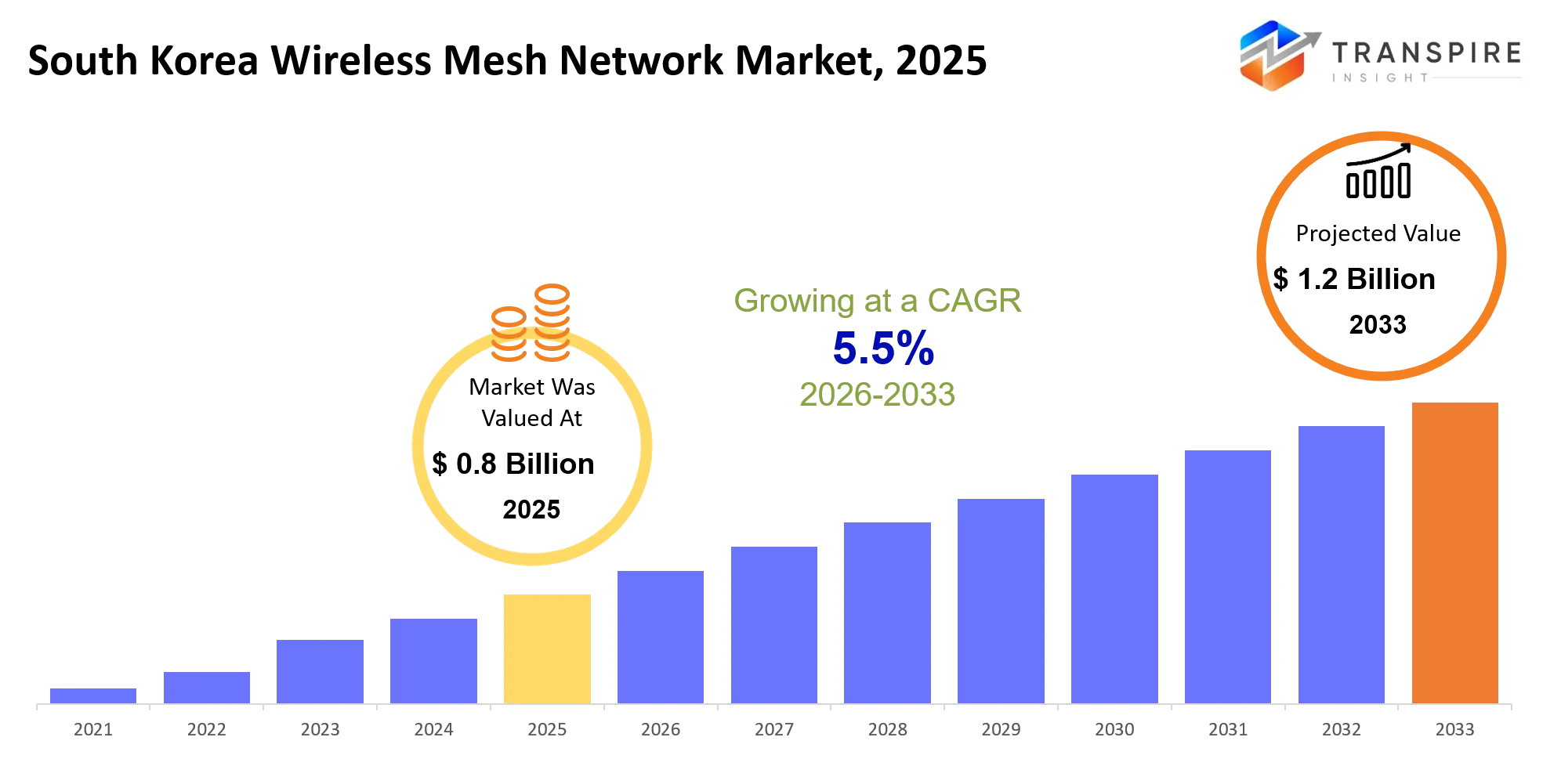
- Market Value (2025): USD 0.8 Billion.
- Expected Market Value (2026): USD 0.85 Billion.
- Estimated Market Value (2033): USD 1.2 Billion.
- Forecast CAGR (2026–2033): 5.05%.
Introduction
South Korea Wireless Mesh Network Market is a decentralised wireless communication system, where interconnected nodes, access points, gateways and connected devices work together to route data in multiple ways without having any single connection point. Wireless mesh networks offer self-healing connectivity, scalable flexibility, reliable coverage, and efficient network management, all of which are increasingly relevant to South Korea’s advanced digital infrastructure. Main applications include smart cities, smart manufacturing, industrial IoT, telecom, video surveillance, public safety, smart buildings, home automation, smart mobility, environment monitoring. The increased adoption of connected devices, industrial automation, smart-factory infrastructure and next-generation wireless technologies is creating the demand for resilient and scalable connectivity solutions. The market is also evolving through integration with IoT, Wi-Fi technologies, edge computing and intelligent network management, enabling wider digital transformation across residential, commercial, industrial and public sector environments.
Key Market Highlights: -
- By Component, the Physical Appliances dominated the market and holds approximately 48 % share in 2025 and is projected to grow at a substantial CAGR during the forecast period.
- By Radio Frequency, the DUAL-BAND GEAR dominated the market and holds approximately 49.10 % share in 2025 and is projected to grow at a substantial CAGR during the forecast period.
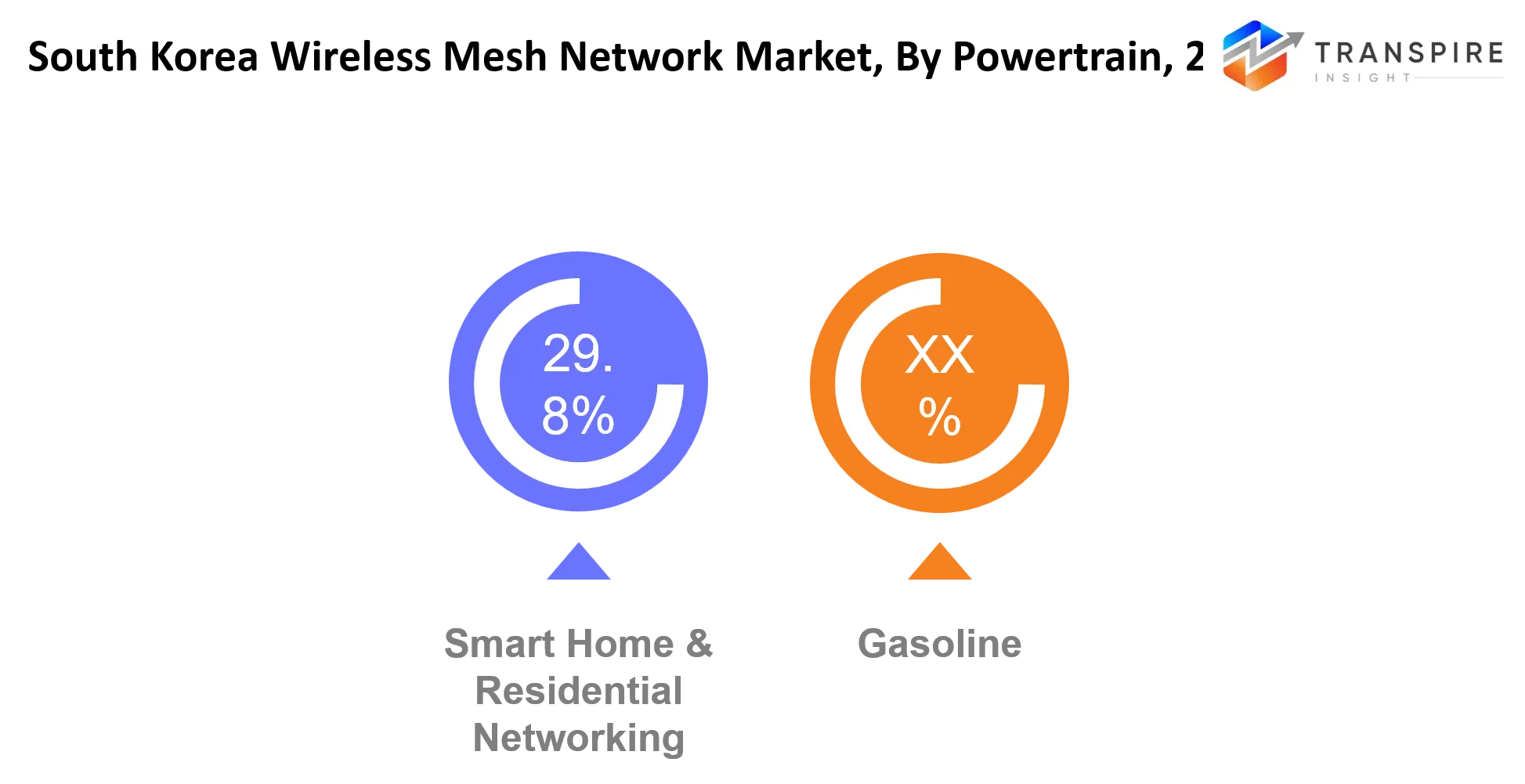
- By Application, the Industrial IoT Manufacturers segment dominated the market and holds approximately 32 % share in 2025 and is projected to grow at a substantial CAGR during the forecast period.
- South Korea is bolstering wireless mesh networking using Wi-Fi 7 upgrades, 6G research, smart-city initiatives, industrial connectivity and smart IoT infrastructure, supporting resilient digital transformation across the entire country.
How is Technology Driving Growth in the South Korea Wireless Mesh Network Market?
The South Korea Wireless Mesh Network Market is picking pace with Technology, Wi-Fi 7 modernisation, 5G integration, IoT connectivity and intelligent network management. Advanced wireless technologies enable increased network capacity, coverage, reliability and seamless connectivity across smart cities, enterprises and industrial environments. Seoul’s S-Net is a mashup of municipal broadband, public Wi-Fi, IoT networks and smart-city infrastructure. Its latest modernisation program adds Wi-Fi 7 for better speed and stability. Network management with AI capabilities also assists with traffic optimisation, fault detection and automation of network operations. These advances improve wireless mesh deployment across smart buildings, public infrastructure, industrial IoT, connected mobility and other digitally connected environments, enabling resilient and scalable communications infrastructure across South Korea.
Market Drivers
The South Korea Wireless Mesh Network Market is driven by the increasing smart-city infrastructure, industrial automation, advanced wireless connectivity and digital infrastructure modernization. With the growth of government sponsored programs for connecting cities, demand is rising for robust wireless networks to provide public Wi-Fi and support smart buildings, transportation and city services. Industrial IoT and smart-factories are generating the demand for reliable multi-node connectivity throughout manufacturing, logistics and connected equipment. South Korea’s early 6 GHz spectrum enablement is helping to accelerate network modernization and high-capacity wireless deployments, helping to encourage the quick move to Wi-Fi 7. Increasing density of connected devices and the need for scalable, reliable coverage further support adoption across residential, commercial, industrial and public-sector environments.
Restrain
Restraints affecting the South Korea Wireless Mesh Network Market include cybersecurity and data privacy issues because the connections between the nodes make the network susceptible to such threats and demand adequate protection measures. High costs of implementation and maintenance pose a barrier for small and medium-sized enterprises and organizations that have limited budgets for their infrastructure. Furthermore, problems associated with equipment interoperability may prove difficult when multiple vendors' equipment is involved.
|
Driver |
Relative Impact on Growth (%) |
Geographic Relevance |
Impact Timeline |
Demand Strength |
Growth Mechanism |
Key Beneficiaries |
Major Constraint |
|
Driver 1: Expansion of Smart-City and Public Connectivity Infrastructure |
27% |
Seoul, Busan, Incheon, Gyeonggi |
Short-term |
High |
Expands dense-area wireless coverage through interconnected access nodes |
Mesh equipment vendors, telecom operators, municipalities, public institutions, end users |
High deployment and maintenance costs |
|
Driver 2: Rapid Smart Factory and Industrial IoT Adoption |
23% |
Gyeonggi, Ulsan, Busan, Chungcheong |
Medium-term |
High |
Connects industrial sensors, robots, machines, and control systems reliably |
Industrial networking vendors, automation providers, manufacturers, system integrators |
Complex industrial integration requirements |
|
Driver 3: Wi-Fi 7 and Next-Generation Wireless Technology Upgrades |
20% |
Seoul, major metropolitan areas, commercial hubs |
Short-term |
High |
Improves throughput, latency, coverage, and multi-device network performance |
Wi-Fi vendors, mesh hardware manufacturers, enterprises, households |
Higher equipment replacement costs |
|
Driver 4: 5G SA, AI-RAN and Advanced Network Infrastructure Investment |
17% |
Nationwide, especially Seoul and industrial clusters |
Medium-term |
High |
Enables intelligent, resilient connectivity for distributed applications |
Telecom operators, network equipment firms, AI infrastructure vendors, enterprises |
Overlap with cellular network investments |
|
Driver 5: Growth of IoT, Edge Computing and Connected-Device Ecosystems |
13% |
Nationwide; urban and industrial deployments |
Long-term |
Medium |
Adds connected endpoints requiring scalable local wireless networking |
IoT vendors, edge providers, mesh manufacturers, smart-building operators |
Cybersecurity and interoperability challenges |
|
Total |
100% |
— |
— |
— |
— |
— |
— |
Analysis of Prices and Consumer Behaviour
High-performance mesh solutions have occupied approximately 68% of the total wireless mesh network solutions market, owing to the high demand from smart city, industrial automation, and enterprise networking industries (due to their requirement for high-performing and high-quality mesh systems). The cost of a high-performing standardized mesh solution will be approximately 35% higher than other products in the same market, considering the fact that the mesh solution will be manufactured using advanced wireless technology, quality certified components and consistent network performance. Approximately 45% of the units sold from wireless mesh network solutions are mesh hardware systems. This high sales volume is attributed to the flexibility of these products to be used in residential, commercial, industrial and public sector networks, and their flexible architecture. The industrial IoT and smart cities industry represents 70% of the total demand from these industries. The buying behavior of consumers shows that 55% of the consumers prioritize network reliability, security and wireless network coverage. Approximately 33% of the consumers prefer to purchase their products through bulk purchases or long-term contracts because they need to reduce the costs of procurement and ensure consistent supply from different parts of South Korea.
|
Company |
Est. Revenue Share Range |
Key Offerings |
Strategic Positioning |
Geographic Strength |
Technology Focus |
|
KT Corporation |
15–21% |
GiGA WiFi 7D, GiGA WiFi Buddy, Easy Mesh, GiGA WiFi services |
ISP-led mesh ecosystem and broadband bundling |
South Korea, nationwide |
Wi-Fi 7, EasyMesh, multi-gigabit broadband |
|
Cisco Systems |
10–15% |
Cisco Meraki MR, Catalyst Wireless, Wi-Fi 7 APs, Meraki Dashboard |
Enterprise leadership through cloud-managed networking |
North America, Europe, Asia Pacific |
Wi-Fi 7, AI networking, cloud management |
|
HPE Aruba Networking |
8–13% |
Aruba 720/730/750 APs, Aruba Central, Instant On, mesh WLAN |
Premium enterprise WLAN and AI-managed infrastructure |
North America, Europe, Asia Pacific |
Wi-Fi 7, AI insights, IoT, AIOps |
|
SK Broadband |
8–12% |
B WiFi, home Wi-Fi solutions, mesh-enabled broadband, IPTV connectivity |
Broadband-led residential connectivity and bundled services |
South Korea, nationwide |
Wi-Fi 6/7, mesh coverage, broadband integration |
|
LG Uplus |
7–11% |
U+ Wi-Fi, home networking, smart-home connectivity, mesh solutions |
Smart-home ecosystem and telecom service integration |
South Korea, nationwide |
Wi-Fi 6/7, smart home, IoT connectivity |
|
RUCKUS Networks (Vistance Networks) |
5–8% |
RUCKUS One, R-series APs, T-series outdoor APs, SmartZone |
High-density enterprise and venue specialization |
North America, Asia Pacific, Europe |
Wi-Fi 7, AI management, IoT, outdoor mesh |
|
Ubiquiti |
5–8% |
UniFi APs, UniFi Network, U7 series, outdoor wireless solutions |
Value-focused ecosystem for SMB and managed networks |
North America, Europe, Asia Pacific |
Wi-Fi 7, cloud management, wireless mesh |
|
TP-Link |
4–7% |
Omada APs, Omada SDN, Deco Mesh, Wi-Fi 7 systems |
Broad portfolio combining consumer and SMB networking |
Asia Pacific, Europe, North America |
Wi-Fi 7, EasyMesh, Omada SDN, MLO |
|
ASUS |
3–6% |
ZenWiFi, AiMesh, RT-BE series, AiProtection |
Premium consumer mesh and gaming connectivity |
Asia Pacific, North America, Europe |
Wi-Fi 7, AiMesh, MLO, AI networking |
|
Huawei |
2–5% |
Wi-Fi 7 APs, AirEngine WLAN, campus networking, smart-campus solutions |
Integrated campus networking and technology-led solutions |
Asia Pacific, Europe, Middle East |
Wi-Fi 7, AirEngine, AI networking, IoT |
Who are the Key Players in the South Korea Wireless Mesh Network Market and how do they compete?
International competitiveness of South Korea Wireless Mesh Network Market is contingent upon those companies that focus on innovation in technologies, industrial solutions, and distribution network development worldwide. The competitiveness that does not depend on pricing but is based on advanced networking equipment, wireless technology, smart and connected solutions and their integration into digital platforms and processes results in ongoing product development and increases productivity, connectivity, efficiency, resource optimization, and operational visibility of companies.
Cisco develops its competitive advantage by creating advanced solutions in wireless mesh networking, enterprise connectivity platforms, intelligent network management, and connected infrastructure. HPE Aruba Networking company creates its competitive advantages through creation of advanced wireless networking equipment that is used for enterprise connectivity, smart buildings, industrial network applications, and others. Huawei creates its competitive advantages by developing solutions in wireless networking, Wi-Fi infrastructure, automation, and smart connectivity.
Top Companies in the South Korea Wireless Mesh Network Market
- Cisco
- HPE Aruba Networking
- Huawei
- Ubiquiti
- Cambium Networks
- Extreme Networks
- NETGEAR
- Juniper Networks
- Rajant
- Fluidmesh
- Belden
- D-Link
- TP-Link
- Samsung Electronics
- Nokia
South Korea Wireless Mesh Network Market Segmentation
The South Korea Wireless Mesh Network Market share is divided into six categories: By Component, By Radio Frequency, By Application, By Network Type, By End User, By Deployment.
The Physical Appliances dominated the market, accounting for nearly 48%in 2025 and is expected to rise at a significant CAGR during the forecast period.
The South Korea Wireless Mesh Network Market is segmented by component into mesh routers, mesh access points, gateways, controllers, antennas, network management software, sensors, and communication modules. Among these, the Physical Appliances segment dominated the market, accounting for nearly 48%in 2025 and expected to increase at a significant CAGR during the forecast period. The division is leading because of mass domestic penetration, distribution channels, reliability of products, replacement sales, and growing customer inclination towards convenience.
The Dual-band gear dominated the market, accounting for nearly 49.10% in 2025, and is expected to rise at a significant CAGR during the forecast period.
The South Korea Wireless Mesh Network Market is segmented by radio frequency into 2.4 ghz, 5 ghz, 6 ghz, sub-ghz, dual-band, tri-band, multi-band, licensed spectrum. Among these, the Dual-band gear dominated the market, accounting for nearly 49.10% in 2025 and expected to increase at a significant CAGR during the forecast period. This segment leads because of the greater coverage, connectivity reliability, device compatibility, cost-effectiveness, and growing needs for high-performance wireless networking solutions.
The Industrial IoT dominated the market, accounting for nearly 32% in 2025 and is expected to rise at a significant CAGR during the forecast period.
The South Korea Wireless Mesh Network Market is segmentedby application into smart home, smart city, industrial iot, public safety, healthcare, transportation, military & defense, enterprise networking. Among these, the Industrial IoT dominated the market, accounting for nearly 32% in 2025 and expected to increase at a significant CAGR during the forecast period. This segment leads because of the smart factory, machine connectivity, monitoring, automation, scalability, and growing needs for wireless networking solutions in industries.
Future Market Trends for the South Korea Wireless Mesh Network Market: -
Integration of Wi-Fi 7, 5G, and Edge Computing: The integration of Wi-Fi 7, 5G, and edge computing will provide improved low-latency connectivity for smart cities, IoT applications, and industrial IoT.
Expansion of Smart City and Manufacturing Infrastructure: Smart city initiatives and next-gen manufacturing infrastructure will create more demands for flexible wireless mesh networks that offer public Wi-Fi, IoT devices, and automation.
AI-Driven Wireless Mesh Networks Management and Security: AI-driven wireless mesh network management and security will increase the reliability and performance of wireless mesh networks.
Recent Development
In March 19, 2026 – AI-Driven Network Launch: SK Telecom and Ericsson revealed a collaboration that includes AI-RAN, 5G advancements, autonomous networks, security and 6G standardization, to aid the development of next-generation wireless infrastructure.
In July 14, 2026 – SK Telecom: SK Telecom launched an AI-RAN pilot network in South Korea as part of the country’s Hyper-AI Network initiative, aiming for ultra-low-latency, high-reliability connectivity and physical AI applications.
In February 23, 2026 — SK Telecom reveals 6G network strategy SK Telecom published its third 6G white paper, highlighting AI-native networks, hyper-connectivity, cloud-native architecture, autonomous optimization, and Zero Trust security for future connectivity.
Market Segmentation
This study forecasts revenue at Japan, regional and country levels from 2020 to 2033. Transpire Insights has segmented the South Korea Wireless Mesh Network Market based on the below-mentioned segments:
South Korea Wireless Mesh Network Market, By Component
- Mesh Routers
- Mesh Access Points
- Gateways
- Controllers
- Antennas
- Network Management Software
- Sensors
- Communication Modules
South Korea Wireless Mesh Network Market, By Radio Frequency
- 2.4 GHz
- 5 GHz
- 6 GHz
- Sub-GHz
- Dual-Band
- Tri-Band
- Multi-Band
- Licensed Spectrum
South Korea Wireless Mesh Network Market, By Application
- Smart Home
- Smart City
- Industrial IoT
- Public Safety
- Healthcare
- Transportation
- Military & Defense
- Enterprise Networking
South Korea Wireless Mesh Network Market, By Network Type
- Infrastructure Mesh
- Client Mesh
- Hybrid Mesh
- Wireless Backhaul
- Ad Hoc Mesh
- Mobile Mesh
- Fixed Mesh
- Self-Healing Mesh
South Korea Wireless Mesh Network Market, By End User
- Enterprises
- Telecom Operators
- Government Agencies
- Utilities
- Industrial Companies
- Consumers
- Transportation Operators
- Defense Organizations
South Korea Wireless Mesh Network Market, By Deployment
- Indoor
- Outdoor
- Urban
- Rural
- Campus
- Industrial
- Residential
- Commercial
Frequently Asked Questions
Find quick answers to common questions.
Smart-city expansion, industrial IoT adoption, Wi-Fi 7 modernization, connected devices, and demand for reliable wireless connectivity are driving market growth.
Industrial IoT dominates, supported by smart-factory adoption, machine connectivity, automation, real-time monitoring, scalable infrastructure, and increasing industrial networking requirements.
Wi-Fi 7, 5G integration, edge computing, AI-driven network management, cybersecurity enhancements, and intelligent connectivity are shaping market development across industries.
Dual-band wireless equipment leads due to broad coverage, reliable connectivity, device compatibility, cost efficiency, and growing demand for high-performance networking solutions.
Key players include Cisco, HPE Aruba Networking, Huawei, Ubiquiti, KT Corporation, SK Broadband, LG Uplus, RUCKUS Networks, TP-Link, and ASUS.
- Cisco
- HPE Aruba Networking
- Huawei
- Ubiquiti
- Cambium Networks
- Extreme Networks
- NETGEAR
- Juniper Networks
- Rajant
- Fluidmesh
- Belden
- D-Link
- TP-Link
- Samsung Electronics
- Nokia
About the Authors

Mayur Shinde
I am Mayur Shinde, a Senior Research Analyst at Transpire Insight, specializing in the Automotive & Transportation and Information & Communication Technology (ICT) Industry. My work focuses on analyzing emerging market trends, technological advancements, competitive landscapes, and industry developments to deliver accurate, data-driven insights. I am passionate about transforming complex market information into clear, actionable content that helps businesses, professionals, and decision-makers stay informed and make confident strategic decisions.

Chakradhar Khansole
Chakradhar serves as the Research Director at Transpire Insight, bringing over 8 years of experience in technology, innovation, and strategic market intelligence. He specializes in transforming complex market data into actionable business insights that enable organizations to make informed, growth-oriented decisions. Recognized for his strategic vision and analytical expertise, Chakradhar leads high-impact research initiatives, delivering comprehensive market assessments, competitive intelligence, and forward-looking industry analysis.
Recently Published Reports
-
Apr 2026
3D Optical Profiler Market
3D Optical Profiler Market Size, Share & Analysis Report By Type (Desktop 3D Optical Profiler, and Portable 3D Optical Profiler), By Technology (Confocal Technology, and White Light Interference), By End-Use Industry (Manufacturing, Research Institutions, Automotive, Aerospace and Defense, Medical Devices, and Other), and Geography (North America, Europe, Asia-Pacific, Middle East and Africa, South and Central America), 2021 - 2031
-
Apr 2026
Depth Sensor Market
Depth Sensor Market Size, Share & Analysis Report By Type (Infrared Depth Sensors, Time-of-Flight (ToF) Sensors, Stereo Vision Sensors, Structured Light Sensors, Ultrasonic Depth Sensors), By Application (Automotive, Robotics, Gaming, Consumer Electronics, Industrial Automation, Healthcare, Security & Surveillance, Others), By End Users (Automotive Manufacturers, Consumer Electronics Companies, Healthcare Providers, Industrial Companies, Security Agencies, Gaming Companies, Robotics Companies, Others), and Geography (North America, Europe, Asia-Pacific, Middle East and Africa, South and Central America), 2021 – 2031
-
Apr 2026
Digital Manufacturing Market
Digital Manufacturing Market Size, Share & Analysis Report By Component (Hardware, Software, and Services), By Technology (Robotics, 3D Printing, Internet of Things (IoT), and Others), By Application (Automotive and Transportation, Aerospace and Defense, Consumer Electronics, Industrial Machinery, and Others), By Process Type (Computer-Based Designing, Computer-Based Simulation, Computer 3D Visualization, Analytics, and Others), and Geography (North America, Europe, Asia-Pacific, Middle East and Africa, South and Central America), 2021 – 2031
-
Apr 2026
Digital Visa Services Market
Digital Visa Services Market Size, Share & Analysis Report By Type (Individual Travelers, Group Travelers), By Application (Tourism, Business Travel, Others), and Geography (North America, Europe, Asia-Pacific, Middle East and Africa, South and Central America), 2021 – 2031