
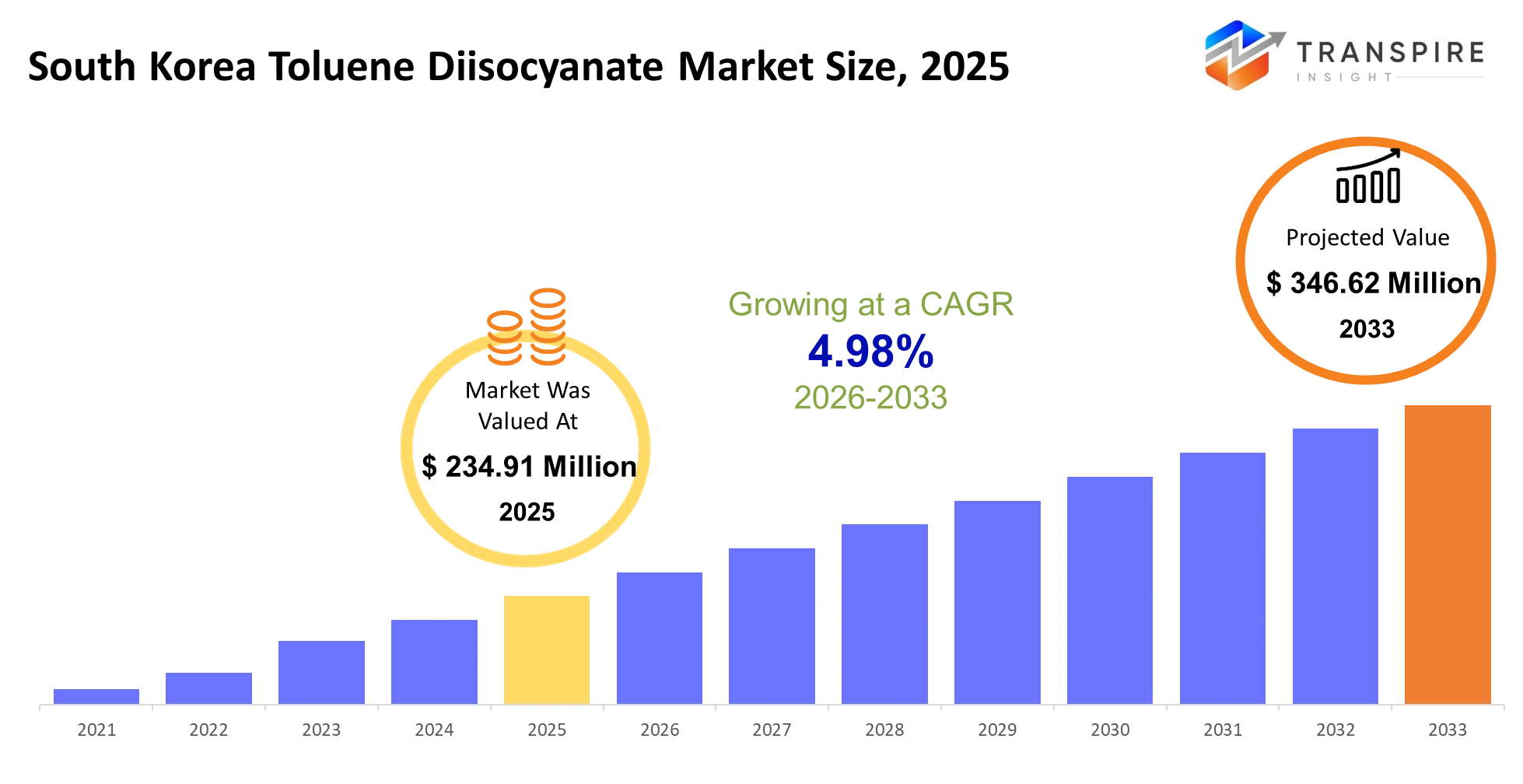
South Korea Toluene Diisocyanate Market Size & Forecast:
- South Korea Toluene Diisocyanate Market Size 2025: USD 234.91 Million
- South Korea Toluene Diisocyanate Market Size 2033: USD 346.62 Million
- South Korea Toluene Diisocyanate Market CAGR: 4.98%
- South Korea Toluene Diisocyanate Market Segments: By Grade (Flexible Foam Grade, Coating Grade, Elastomer Grade, Adhesive Grade, Others); By Application (Flexible Polyurethane Foams, Coatings, Adhesives & Sealants, Elastomers, Others); By End User (Furniture Industry, Automotive Industry, Construction Industry, Packaging Industry, Others); By Form (Liquid TDI, Modified TDI, Blended TDI, Others); By Distribution Channel (Direct Sales, Chemical Distributors, Online Distribution, Others).
To learn more about this report,  Download Free Sample Report
South Korea Toluene Diisocyanate Market Summary
The South Korea Toluene Diisocyanate Market was valued at USD 234.91 Million in 2025. It is forecast to reach USD 346.62 Million by 2033. That is a CAGR of 4.98% over the period.
In South Korea, toluene diisocyanate is widely used to make flexible polyurethane foams that end up in automotive seating, furniture cushioning, and industrial insulation products. In real life, this whole market kind of backs comfort, lighter mobility design, and more energy efficient construction materials that companies lean on to hit what they call performance and durability targets. Over the last 3–5 years, the industry has been shifting in a more structural way toward higher-grade, low-emission polyurethane formulations, since downstream buyers in automotive and construction started tightening their material performance rules.
One major thing that keeps reshaping supply behavior is this recurring disruption in the global aromatics along with isocyanate supply chains, especially during pandemic era logistics issues, which basically made Korean buyers push to diversify sourcing and lock in longer term contracts. So, producers have been leaning more heavily on integrated production efficiency and local-style supply stability. Right now growth is not just about expanding volume, it’s also more about substitution , like moving toward advanced foam systems that help energy efficiency , cut vehicle weight, and stretch overall product lifecycle capability.
Key Market Insights
- The South Korea Toluene Diisocyanate Market is kinda mostly run by flexible foam uses, and in 2025 it still sits at about 60–65% of overall consumption share, pushed by automotive cushioning needs and furniture padding demand, you know that kind of stuff.
- For automotive seating, that part is still the top-demand engine, with roughly a 30% share of downstream polyurethane usage, and it’s backed by EV interior lightweighting initiatives that keep getting stronger.
- Next come furniture and bedding, remaining the second-biggest bucket, contributing around 20–25% share, mainly driven by people seeking urban premium comfort and, lately, greater memory foam adoption.
- Insulation materials are the fastest growing area up through 2033, with strong double digit adoption momentum, because the energy efficient building rules are getting tighter across South Korea.
- South Korea also adds a notable piece of Northeast Asia demand, and exports make up nearly 35–40% of the polyurethane feedstock linked output coming from big integrated manufacturing hubs.
- Meanwhile, automotive OEM lightweight material blending has lifted TDI foam penetration by roughly 20–25% across newer EV platforms, which helps cabin efficiency and overall mass reduction.
- In construction, there’s a gradual shift toward high resilience insulation foams, with usage climbing about 15–18% in green certified building projects.
- Overall, the main strategic push across the South Korea Toluene Diisocyanate Market is centered on process optimization, polyurethane innovation, and longer term supply agreements with automotive and appliance manufacturers, so everything stays steady.
What are the Key Drivers, Restraints, and Opportunities in the South Korea Toluene Diisocyanate Market?
The main thing driving the South Korea Toluene Diisocyanate Market is this structural shift downstream, toward lighter, more energy-efficient manufacturing. Car makers and building companies are steadily moving away from older cushioning or insulating solutions, they now lean on polyurethane foams made from TDI to get less weight , better fuel economy, and basically stay aligned with tighter building energy rules. And yeah, this change bumps up the consumption intensity per unit of output, so suppliers get steadier revenue signals and are more likely to secure long-term purchasing commitments across the connected chemical value streams.
Still, one big brake is that upstream raw material supply stays inherently volatile, especially for toluene plus nitric acid derivatives which are linked to wider petrochemical rhythms. The volatility is kind of structural since it tracks crude oil pricing, and the global aromatics capacity, not some quick operational patch or local adjustment. Because of that, producers can get margin pressure, plus periodic headaches in production scheduling, so they end up being careful with rapid capacity expansion and they don’t have much freedom in pricing across the whole value chain.
At the same time, there’s a real chance starting to show up: integrating bio-based or low-carbon polyurethane feedstock routes into South Korea’s industrial setup. There are pilot efforts in advanced materials clusters, especially around export-focused automotive supply networks, that are creating pull for next-generation TDI formulations with lower lifecycle emissions. If suppliers invest early in cleaner manufacturing technologies, they can potentially secure premium, longer duration contracts with global OEMs. This could feel like a quiet pivot now, but it’s becoming more visible over time.
What Has the Impact of Artificial Intelligence Been on the South Korea Toluene Diisocyanate Market?
Artificial intelligence is being used more and more in polyurethane, and also in upstream chemical production systems, to somehow optimize reactor performance , emissions controls and energy use inside TDI manufacturing facilities. In South Korea, some producers are deploying machine learning models to monitor distillation column efficiency and catch early deviations in isocyanate synthesis, which really helps reduce batch inconsistencies and improves yield stability. These same setups also assist automated steering of temperature and pressure parameters, which makes process safety better in continuous production settings
Then there are predictive analytics tools now in the mix to forecast equipment wear and tear in high-pressure chemical reactors and gas-handling systems. That means maintenance teams can plan interventions ahead of time, instead of after, when a shutdown is already coming and it gets expensive. As a result operational uptime is better and there is less unplanned downtime across integrated chemical plants. On top of that, AI driven emissions monitoring systems help facilities stay aligned with stricter environmental rules, by tweaking combustion efficiency and waste gas treatment performance on the fly
Still, adoption is not fully rolling everywhere, mainly because integration costs are high, and because high-quality real-time process data is not always easy to get. Many legacy plants still rely on scattered sensor infrastructure, which degrades model accuracy under real operating conditions and slows full-scale deployment of AI across the entire TDI value chain.
Key Market Trends
- Flexible foam adoption rose sharply after 2022, sort of replacing the usual cushioning materials in car interiors across a bunch of major OEM programs.
- Automotive lightweighting initiatives made polyurethane foam usage jump by around 25% since 2021, especially for EV seat and interior uses, more or less.
- When the energy efficiency rules landed in 2023 they pushed insulation-grade foam demand higher by more than 18% in fresh construction projects , kind of directly.
- The import dependency swings during 2020–2022 prompted Korean buyers to rethink their sourcing, so they diversified between Covestro and other Asian suppliers.
- Kumho Mitsui Chemical’s integrated domestic production improved supply stability, and also trimmed the lead-time inconsistencies , too.
- Automotive OEMs started locking in long term contracting more , up about 30% , to keep polyurethane feedstock procurement steady after the global logistics disruptions.
- At the same time, foam formulation upgrades shifted toward low-VOC systems as compliance expectations tightened for industrial customers.
- In the furniture sector, demand shifted toward premium memory foam products, driven by urban residential consumption patterns.
- Export focused chemical producers also increased R&D spending on high resilience polyurethane systems between 2022 and 2025, not quietly either.
- Competitive pressure rose as BASF and Mitsui Chemicals deepened their Asia-Pacific supply chain integration strategies, which changed the overall tone.
South Korea Toluene Diisocyanate Market Segmentation
By Grade
Flexible Foam Grade is kind of holding the leading position overall, mostly because it gets used a lot in cushioning systems for automotive seating, furniture manufacturing and bedding stuff. The market share stays strong, not surprising, since this grade gives that pretty good mix of softness, rebound resilience, and cost efficiency, so it works well in high-volume production areas. Then Coating Grade sits more like a secondary choice, it is backed by industrial and automotive needs for surface shielding and such protection. The whole growth rationale seems to be driven by increasing requirements for abrasion resistance and chemical durability in engineered surfaces, really.
Elastomer Grade is also expanding at a steady pace, because industrial machinery and automotive parts are asking for vibration damping and high strength bonding materials more often now. Adhesive Grade meanwhile is picking up momentum in construction and packaging assembly lines where you need fast curing and solid bonding performance, that simple. The “Others” category stays kinda limited though, but still shows up in niche, specialty formulations used for insulation and technical textiles. Through the forecast period, Flexible Foam Grade will stay dominant, while elastomer and adhesive grades will probably grow faster, largely due to structural demand tied to mobility lightweighting , and industrial automation trends too.
By Application
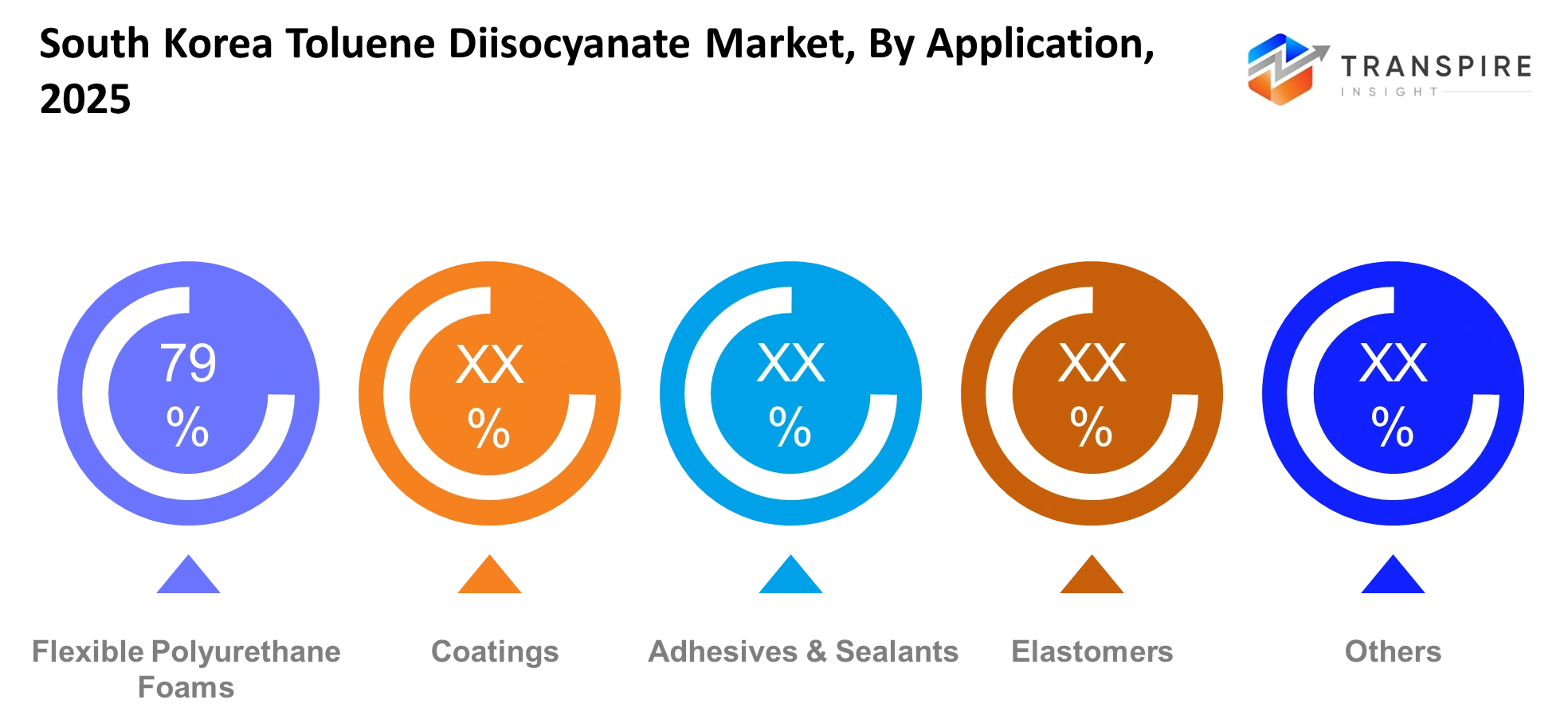
Flexible polyurethane foams kind of dominate the whole application story , mainly because they show up everywhere in seating setups, insulation layers, and cushioning for both mobility and building projects. The market share still remains strong, or at least that’s the sense, since foam uses can scale up easily, keep costs reasonable, and adjust performance depending on the industry. Coatings also maintain a solid foothold, helped by the overall protective coating requirement in automotive cabin parts and industrial devices. The growth momentum seems tied to people expecting greater durability, especially in high-wear areas.
Then there are adhesives and sealants which are expanding too , because assembly-style manufacturing keeps increasing across automotive lines and modular construction frameworks. Elastomers go along with that, but for more specialized reasons , like needing elasticity, better impact resistance, and even structural reinforcement in mechanical arrangements. “Others” covers smaller, niche kinds of uses , such as acoustic and thermal insulation products with a moderate level of adoption . Over the forecast period, flexible foams will keep anchoring demand, while adhesives and elastomers will pick up speed as manufacturing moves toward lighter bonding methods and more integrated structural design.
To learn more about this report, Download Free Sample Report
By End User
In the Furniture Industry, you see a pretty dominant position because foam-based cushioning materials are consumed at massive scale, especially for seating, mattresses, and that kind of interior décor stuff. Market share stays up there too, not just because people like premium comfort, but also because urbanization keeps rolling forward, and lifestyles do get upgrades, even in smaller cities. The automotive industry comes in as a solid secondary segment, pushed by vehicle production volumes, plus the growing use of lightweight interior materials. The whole growth story is also shaped by electrification trends , and by vehicle design that’s obsessed with efficiency and less weight.
Then there is the Construction Industry, which shows fairly steady expansion, as demand for insulation, sealing, and energy-efficient materials keeps rising in both residential and commercial projects. The packaging Industry is emerging and more value-driven, supported by protective foam needs for electronics and the logistics of fragile goods. “Others” basically cover industrial manufacturing and specialty applications where demand is kind of fragmented, and doesn’t move in one single direction. Over the forecast period, automotive and construction end users will become more strategically important, driven by sustainability mandates and material-efficiency requirements across both sectors.
By Form
Liquid TDI still seems to take the leading role, kind of because it’s directly usable in polyurethane production steps and it works well with big, industrial reactor setups. The market share stays solid too, mainly because the liquid form makes it easier to handle, more consistent for mixing, and, frankly, smoother for continuous manufacturing lines. Modified TDI on the other hand keeps gaining ground , especially in spots where people want tighter reactivity management and better material steadiness. The overall growth logic largely traces back to the need for tailored performance traits in newer foam systems.
Blended TDI is also slowly widening, as manufacturers keep tuning the cost-to-performance equation across a range of application needs. “Others” includes specialty blends for smaller, niche industrial runs where demand is limited but still dependable. Over the forecast window liquid TDI should keep dominating, largely from those process efficiency advantages, while modified and blended variants are likely to rise faster as downstream industries push for more application-specific material behavior and upgraded functional properties.
By Distribution Channel
Direct Sales kind of holds a dominant position because big industrial buyers tend to want longer term contracts, and they like staying with producers on stable procurement relationships. Market share stays high, not only because polyurethane manufacturers need consistent supply volumes, but also because they expect tailored technical assistance , all the time. Chemical Distributors still keep a strong secondary role though, mainly by giving regional accessibility and more flexible sourcing options for mid sized manufacturers. The whole growth logic comes from downstream demand being fragmented, and from companies wanting inventory buffering so nothing gets interrupted.
Online Distribution is slowly emerging as an extra channel, mostly used for smaller procurement runs and sourcing specialized chemicals . “Others” can include hybrid procurement frameworks in niche industrial use cases, where demand isn’t steady, it comes and goes. During the forecast period, direct sales should stay as the main channel, while distributor-led approaches will keep relevance by optimizing regional supply. Digital procurement platforms are likely to expand gradually, as chemical trading ecosystems get more digitized and transaction transparency increases across the industrial supply chain.
What are the Key Use Cases Driving the South Korea Toluene Diisocyanate Market?
The main use case for TDI in South Korea is flexible polyurethane foam, used in automotive seating and interior pieces. Here the demand is usually the biggest because automakers tend to favor lightweight materials, which help fuel efficiency, and also passenger comfort, while still satisfying durability requirements for mass production, you know.
A secondary set of use cases is gradually expanding in furniture manufacturing and in commercial bedding. In those areas, higher urban housing density and more premium lifestyle spending are driving demand for high-resilience cushioning materials. Also, industrial insulation for appliances and cold-chain logistics is picking up steam, especially as manufacturers aim for greater energy efficiency in refrigeration systems.
For emerging applications, advanced acoustic insulation for electric vehicles is showing up more often, and there are specialty foams going into lightweight industrial packaging. These are still in the process of forming, but they are gaining momentum, because producers are actively looking for performance-driven, material-efficient alternatives across fast-growing mobility and electronics related sectors.
|
Report Metrics |
Details |
|
Market size value in 2025 |
USD 234.91 Million |
|
Market size value in 2026 |
USD 246.61 Million |
|
Revenue forecast in 2033 |
USD 346.62 Million |
|
Growth rate |
CAGR of 4.98% from 2026 to 2033 |
|
Base year |
2025 |
|
Historical data |
2021 - 2024 |
|
Forecast period |
2026 - 2033 |
|
Report coverage |
Revenue forecast, competitive landscape, growth factors, and trends |
|
Regional scope |
South Korea |
|
Key company profiled |
BASF, Covestro, Wanhua Chemical, Huntsman Corporation, Tosoh Corporation, Mitsui Chemicals, Hanwha Solutions, OCI Company Ltd., Dow, Kumho Mitsui Chemicals, Evonik Industries, LANXESS, SKC, SABIC, Cangzhou Dahua. |
|
Customization scope |
Free report customization (country, regional & segment scope). Avail customized purchase options to meet your exact research needs. |
|
Report Segmentation |
By Grade (Flexible Foam Grade, Coating Grade, Elastomer Grade, Adhesive Grade, Others); By Application (Flexible Polyurethane Foams, Coatings, Adhesives & Sealants, Elastomers, Others); By End User (Furniture Industry, Automotive Industry, Construction Industry, Packaging Industry, Others); By Form (Liquid TDI, Modified TDI, Blended TDI, Others); By Distribution Channel (Direct Sales, Chemical Distributors, Online Distribution, Others). |
Which Regions are Driving the South Korea Toluene Diisocyanate Market Growth?
The coastal petrochemical corridor spanning Ulsan, Yeosu, and Daesan basically is the major production-consumption nerve for the South Korean Toluene Diisocyanate Market. It wins because there is a high-density kind of linkage: aromatics refining on one side, isocyanate synthesis in the middle, and then polyurethane downstream converters, all close enough that logistics stay pretty tight. The ports help a lot too, which means toluene feedstock can come in quickly, and the finished polyurethane intermediates get shipped out to global buyers without too much drama. You can also see that this is backed by old industrial clusters, where chemical producers, auto suppliers and foam makers work almost side by side. That close-knit setup cuts off turnaround times and it keeps supply steadier for big volume contracts, even when schedules get a bit messy. \
Then there is the Seoul–Gyeonggi industrial belt, which appears as the second-largest area. Here the story is more about downstream consumption, not so much about production strength. Unlike that coastal stretch, this belt leans on consumer goods manufacturing, electronics assembly, and automotive component suppliers that still need reliable polyurethane foam inputs . Growth feels calmer as well , because the demand is tied to long-term industrial output cycles, rather than export swings that can flip suddenly. Infrastructure is solid, and regulatory enforcement is pretty predictable, so procurement from mid-sized manufacturers keeps happening on schedule . So, it ends up being a dependable revenue engine, even during periods when global petrochemical prices move around .
After that, ASEAN export-linked markets are showing up as the fastest rising influence on the demand path for South Korea’s Toluene Diisocyanate Market . More automotive work and furniture making in Vietnam, Thailand, and Indonesia, has pushed import reliance upward, especially on Korean polyurethane intermediates .
Who are the Key Players in the South Korea Toluene Diisocyanate Market and How Do They Compete?
Competition in the South Korea Toluene Diisocyanate market is kind of moderately consolidated , you know , with the big global chemical players and several integrated Asian producers holding most of the supply capacity . Basically firms are not only fighting on pure price , more like they try to win via feedstock integration efficiency, production cost optimization, and also the long-term supply reliability side of things . The older incumbents usually keep their share by doing downstream linkages with automotive companies and polyurethane foam manufacturers . But at the same time , the pressure is rising because Asian producers keep expanding capacity , and they’re also improving their process know-how for isocyanate production efficiency .
BASF leans into technology driven differentiation , for example by tuning polyurethane formulations so energy efficiency gets better in automotive and construction contexts . Their edge comes from integrated R&D capabilities that let them customize foam systems quickly, aligned with OEM requirements. Expansion is supported through long term supply agreements with regional manufacturers, plus co-development work around advanced materials.
Covestro competes with high-performance material systems that are tuned for lightweight mobility and insulation performance . They differentiate by giving application specific polyurethane solutions , not commodity-grade intermediates. The growth angle comes from partnerships with automotive suppliers , along with investments in next-generation low emission production processes.
Mitsui Chemicals uses its built-in Asian production network , which helps keep supply steadier across Northeast Asia. The core advantage is tied to dependable feedstock access, and consistent quality output for industrial buyers . Meanwhile, Kumho Mitsui Chemical pushes forward through localized cost efficiency and this proximity to domestic automotive clusters , so it feels closer and faster for demand .
Company List
- BASF
- Covestro
- Wanhua Chemical
- Huntsman Corporation
- Tosoh Corporation
- Mitsui Chemicals
- Hanwha Solutions
- OCI Company Ltd.
- Dow
- Kumho Mitsui Chemicals
- Evonik Industries
- LANXESS
- SKC
- SABIC
- Cangzhou Dahua
Recent Development News
In December 2025, Mitsui Chemicals, Inc. expanded its MDI production capacity optimization program impacting integrated TDI supply chains. The company’s capacity restructuring and expansion strategy across Asia strengthened its long-term supply reliability for polyurethane intermediates used in automotive and furniture applications, including South Korea.
Source: https://www.bloominglobal
What Strategic Insights Define the Future of the South Korea Toluene Diisocyanate Market?
The South Korea Toluene Diisocyanate Market is moving, more or less, toward higher-value polyurethane systems that are tied into automotive electrification, energy-conscious construction, and export-led manufacturing circles. In practice, growth will depend less on pure “more volume” and more on how smoothly producers can connect upstream feedstocks with downstream, problem-specific foam solutions. There’s also a quieter sort of risk, the dependency on petrochemical-linked aromatics cycles, where abrupt crude swings can squeeze margins even when demand stays high and also make long-term contracting less steady.
At the same time, there’s a newer opening, EV-focused acoustic and lightweight foam systems, they’re turning into a must-have because vehicle design across Asia is shifting toward quieter and lighter electric platforms. Market players that put money in early application engineered polyurethane systems, and then lock in cross-border supply pacts with ASEAN manufacturers, should see better pricing stability, and clearer long-range demand signals in the next stretch of growth.
South Korea Toluene Diisocyanate Market Report Segmentation
By Grade
- Flexible Foam Grade
- Coating Grade
- Elastomer Grade
- Adhesive Grade
- Others
By Application
- Flexible Polyurethane Foams
- Coatings
- Adhesives & Sealants
- Elastomers
- Others
By End User
- Furniture Industry
- Automotive Industry
- Construction Industry
- Packaging Industry
- Others
By Form
- Liquid TDI
- Modified TDI
- Blended TDI
- Others
By Distribution Channel
- Direct Sales
- Chemical Distributors
- Online Distribution
- Others
Frequently Asked Questions
Find quick answers to common questions.
The expected South Korea Toluene Diisocyanate Market size for the market will be USD 346.62 Million in 2033.
Key segments for the South Korea Toluene Diisocyanate Market are By Grade (Flexible Foam Grade, Coating Grade, Elastomer Grade, Adhesive Grade, Others); By Application (Flexible Polyurethane Foams, Coatings, Adhesives & Sealants, Elastomers, Others); By End User (Furniture Industry, Automotive Industry, Construction Industry, Packaging Industry, Others); By Form (Liquid TDI, Modified TDI, Blended TDI, Others); By Distribution Channel (Direct Sales, Chemical Distributors, Online Distribution, Others).
Major South Korea Toluene Diisocyanate Market players are BASF, Covestro, Wanhua Chemical, Huntsman Corporation, Tosoh Corporation, Mitsui Chemicals, Hanwha Solutions, OCI Company Ltd., Dow, Kumho Mitsui Chemicals, Evonik Industries, LANXESS, SKC, SABIC, Cangzhou Dahua.
The South Korea Toluene Diisocyanate Market size is USD 234.91 Million in 2025.
The South Korea Toluene Diisocyanate Market CAGR is 4.98% from 2026 to 2033.
- BASF
- Covestro
- Wanhua Chemical
- Huntsman Corporation
- Tosoh Corporation
- Mitsui Chemicals
- Hanwha Solutions
- OCI Company Ltd.
- Dow
- Kumho Mitsui Chemicals
- Evonik Industries
- LANXESS
- SKC
- SABIC
- Cangzhou Dahua
Recently Published Reports
-
May 2026
Healthcare Polymer Packaging Market
Healthcare Polymer Packaging Market Size, Share & Analysis Report By Packaging Type (Syringes, IV Bottles and Pouches, Clamshells, Blisters, Bottles & Jars, Containers, Tubes, IV Parental Packaging, Others), By Type (Regulated, Non-regulated), By Polymer Type (LDPE (Low-Density Polyethylene), HDPE (High-Density Polyethylene), Homo-polymer (Homo), Random Copolymer (Random), Block Copolymer (Block), PET, Polystyrene, Polyvinyl Chloride, Polyamide/EVOH, Others), and Geography (North America, Europe, Asia-Pacific, Middle East and Africa, South and Central America), 2021 - 2031
-
Apr 2026
Hydrophilic Tape (Waterstop) Market
Hydrophilic Tape (Waterstop) Market Size, Share & Analysis Report By Type (Bentonite-Based Hydrophilic Tape, Rubber-Based Hydrophilic Tape), By Application (Residential Buildings, Commercial Buildings, Infrastructure Projects), and Geography (North America, Europe, Asia-Pacific, Middle East and Africa, South and Central America), 2021 - 2031
-
Apr 2026
Metalens Market
Metalens Market Size, Share & Analysis Report By Type (Visible Light Metalens, and Infrared Metalens), By Application (Consumer Electronics, Automotive Electronics, Industrial, Medical, and Others), and Geography (North America, Europe, Asia-Pacific, Middle East and Africa, South and Central America), 2021 - 2031
-
Apr 2026
PBT Resin Market
PBT Resin Market Size, Share & Analysis Report By Type (Reinforced PBT Resin, Unreinforced PBT Resin), By Processing Method (Injection Molding, Extrusion, Blow Molding, Others), By End-User (Automotive, Electrical & Electronics, Consumer Appliances, Industrial Machinery, Medical Devices, Packaging, Others), and Geography (North America, Europe, Asia-Pacific, Middle East and Africa, South and Central America), 2021 - 2031