
South Korea Time-Sensitive Networking Market Summary:
According to Transpire Insight, a detailed research report on the market reflects that the industrial automation application segment dominates the South Korea Time-Sensitive Networking Market, accounting for approximately 42% of the total share worldwide. Cisco Systems, Inc. leads the market with approximately (around USD 56 billion) in annual revenue and an estimated 18–22% South Korea market share, making it the leading contributor to South Korea market development, innovation, advanced Time-Sensitive Networking solutions, expanding networking capabilities, and growth dynamics.
Market Snapshot
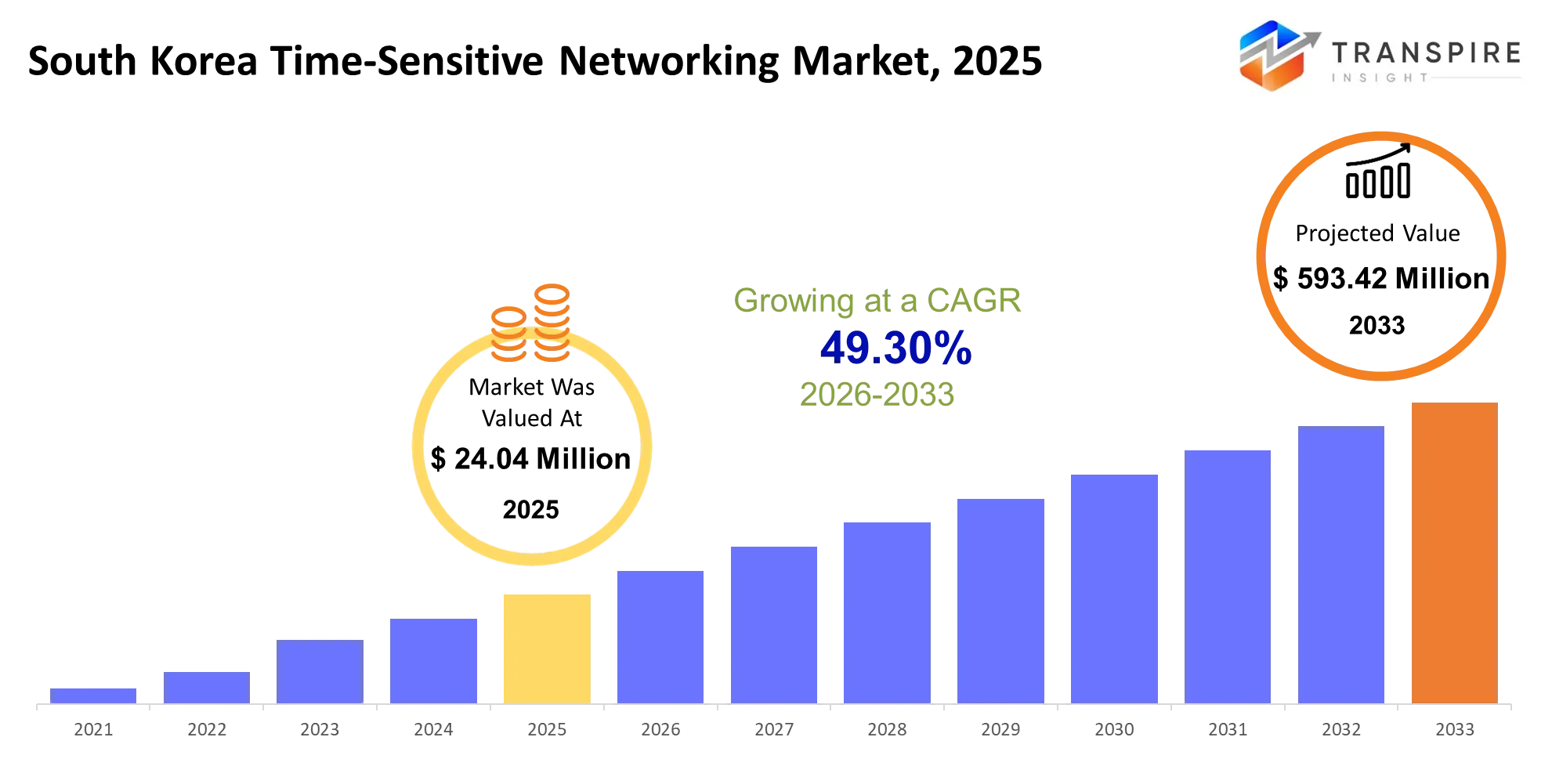
- Market Value (2025): USD 24.04 Million.
- Expected Market Value (2026): USD 35.89 Million.
- Estimated Market Value (2033): USD 593.42 Million.
- Forecast CAGR (2026–2033): 49.30%
Introduction
Time-Sensitive Networking (TSN) refers to a collection of standards, known as IEEE 802.1, which apply the principle of deterministic timing, real-time performance, and accurate timing to standard Ethernet networks. As a result, time-critical communications can occur alongside regular data traffic in one network. The South Korea Time-Sensitive Networking Market is growing due to deterministic communication, IT-OT alignment, newly developed automotive technologies, and semiconductor know-how. TSN is characterized by timely data transmission and synchronization of time, which is crucial for the use of precision robotics and automatic manufacturing. The adoption of standardized Ethernet grants seamless IT-OT connection and eliminates any complications connected with networking and improves working effectiveness in real-time. In the automotive field, TSN provides a large quantity of data exchange done in a timely manner for ADAS, cars with Internet technologies, and autonomous driving. The development of the semiconductor and electronics industry in South Korea provides a great base for TSN system advancement.
Key Market Highlights: -
- By component, the Switches segment dominated the market and holds nearly 30% share in 2025 and is projected to grow at a substantial CAGR during the forecast period.
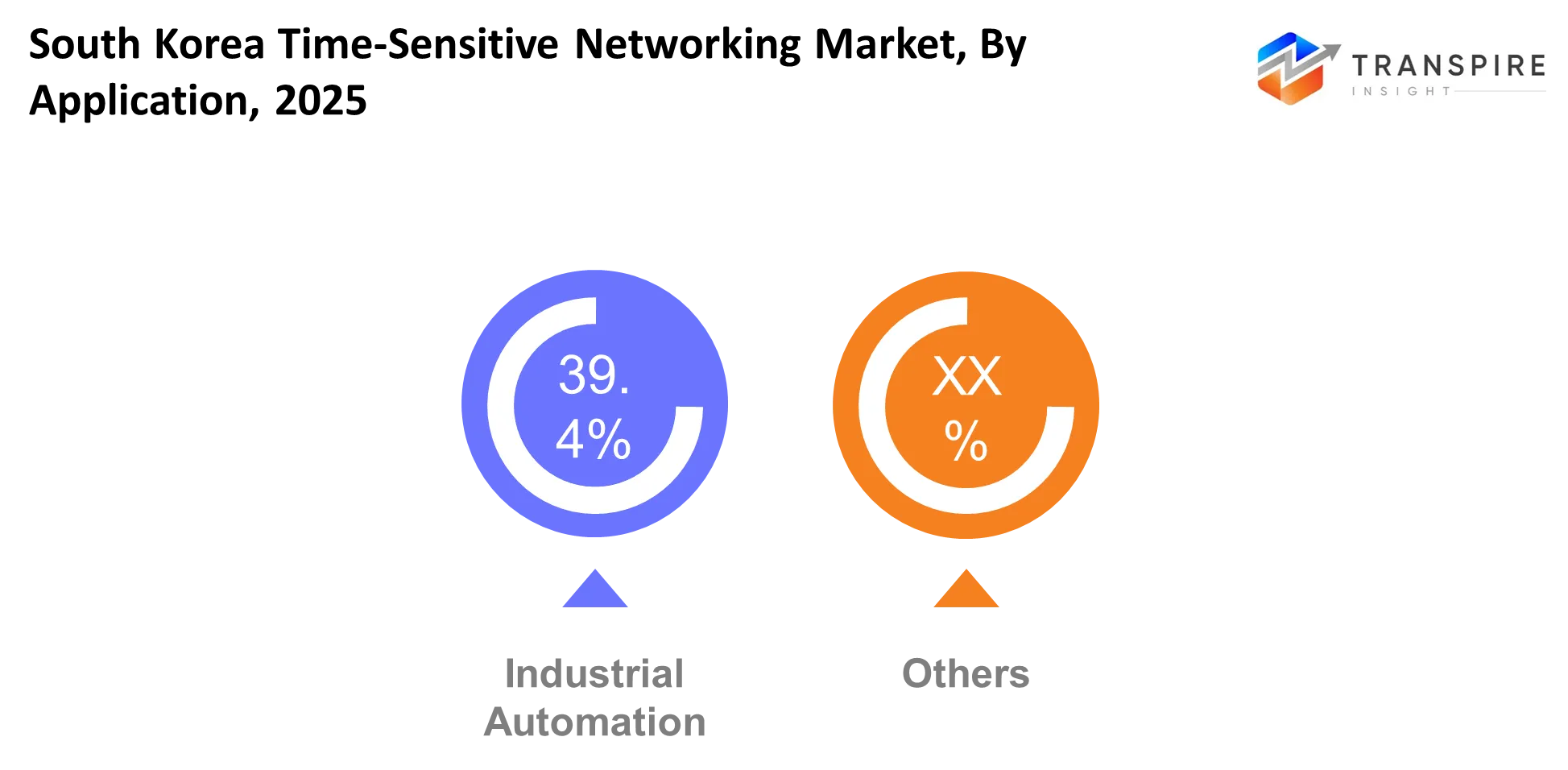
- By application, the Industrial Automation segment dominated the market and holds nearly 35% share in 2025 and is projected to grow at a substantial CAGR during the forecast period.
- By end user, the Manufacturing segment dominated the market and holds nearly 23% share in 2025 and is projected to grow at a substantial CAGR during the forecast period.
- Industry 4.0 & Smart Factories: South Korean government initiatives have propelled the company’s transformation into smart factories, facilitating the introduction of technologies such as the Internet of Things (IoT) in the manufacturing sector and development of intelligent linking solutions. These changes favorably position Time-Sensitive Networking as well as deterministic Ethernet technologies because of the growing requirements for synchronized low-latency communication between robots, automated machines and other connected devices.
How is Technology Driving Growth in the South Korea Time-Sensitive Networking Market?
The South Korean time-sensitive networking domain is undergoing a transformation due to the advent of industry 4.0 and innovations of automotive and semiconductor industries, as well as the development of edge computing technology and 5G network. In order to manage their operations effectively, automation technologies rely on fast, deterministic means of communication that provide millisecond-based communication needed for proper coordination of IoT devices and various types of robots. Additionally, the established semiconductor industry of South Korea lays a good foundation for producing TSN-compliant devices. Developing connected vehicles and advanced driver assistance systems requires an improvement in the speed and accuracy of data transfer and the possibility to use TSN technology in automotive devices allows implementing these requirements easily. The merger of TSN and 5G ultra-reliable low latency technology improves the overall performance of networks operating in industrial environments. It is also important to mention that edge computing allows processing data in the closest proximity to data sources and thereby decreasing the load on the core network.
Market Drivers
The South Korea Time-Sensitive Networking Market is propelled by the growth of smart factories, innovative automotive solutions, development of 5G tech and deterministic industrial automation processes. Various government-sponsored smart manufacturing initiatives triggered through the Ministry of SMEs and Startups promote the use of TSN technology in intelligent production facilities. South Korea’s strong automobile market and increasing usage of connected vehicles coupled with ADAS technologies increase the necessity for exact, synchronized in-vehicle communications. At the same time, the development of 5G networks and IIoT technologies increases the requirements for low-latency communication. In addition to that, replacing outdated fieldbus infrastructures by the time-synchronized Ethernet improves the communication process, which decreases production downtime and facilitates the introduction of TSN technology in South Korea’s industry. The South Korea Time-Sensitive Networking Market has been able to take advantage of its positioning when it comes to having powerful semiconductors, advanced industrial infrastructure, government backing and strong telecommunications capabilities. The country gets strengthened by having strong domestic semiconductor manufacturing thus giving it a solid technology operating environment in order to create and introduce TSN-ready networking components in commerce. The industries of Korea are in a position to drive demand as they deal with large scale production of automobiles and consumer electronics thus creating further new opportunities for reliable industrial communication. Last but not least, the economy of South Korea is facilitated by a digital innovation drive led by the government, which positively contributes to the country’s geographic location and makes it friendly for the implementation of the newest technological changes.
Restrain
High deployment costs, keystone integration difficulties, lack of budgets for SMEs, and incompatibility issues make the South Korea Time-Sensitive Networking Market a challenging place. The need for heavy investments in TSN-based hardware and software might decrease the willingness to adopt it. Problems with integration of modern deterministic Ethernet into existing systems can lead to disruptions of work processes. Low level of technical skills among SMEs can inhibit deployment. Unresolved issues of standardization and compatibility can hinder scalable introduction of TSN technology in industrial networks.
|
Driver |
Relative Impact on Growth (%) |
Geographic Relevance |
Impact Timeline |
Demand Strength |
Growth Mechanism |
Key Beneficiaries |
Major Constraint |
|
1. Smart Factory and Industry 4.0 Expansion |
28% |
Gyeonggi, Chungcheong, Busan |
Short-term |
High |
Accelerates deterministic connectivity across automated production environments |
TSN vendors, automation suppliers, manufacturers |
High retrofit costs for legacy factory networks |
|
2. Industrial Automation and Robotics Adoption |
23% |
Gyeonggi, Ulsan, Changwon |
Medium-term |
High |
Enables synchronized, low-latency communication for robotics |
Robot makers, switch vendors, system integrators |
Interoperability with existing industrial protocols |
|
3. Automotive Ethernet and Software-Defined Vehicles |
19% |
Seoul, Ulsan, Gyeonggi |
Medium-term |
High |
Supports high-bandwidth synchronized in-vehicle data transmission |
Automakers, semiconductor vendors, TSN suppliers |
Complex automotive qualification and integration requirements |
|
4. Semiconductor and Advanced Electronics Ecosystem |
17% |
Gyeonggi, Chungcheong |
Long-term |
High |
Strengthens domestic development of TSN-enabled networking components |
Chipmakers, equipment suppliers, networking vendors |
High R&D intensity and technology development costs |
|
5. 5G, Edge Computing and Industrial Connectivity |
13% |
Seoul, Gyeonggi, nationwide industrial zones |
Medium-term |
Medium |
Combines deterministic networking with localized real-time processing |
Telecom operators, edge providers, industrial users |
Integration complexity across wired-wireless networks |
Analysis of Prices and Consumer Behaviour
Time-Sensitive Networking solutions are being dominated by industrial automation applications with a market share of around 55-60% in 2026 (some of the major contributors to this demand include smart factories, semiconductor equipment manufacturing and industrial control systems). These cutting-edge products tend to be more costly than regular networking products because TSN technology requires specialized deterministic communication, precision timing, synchronization, and advanced Industrial Ethernet functionality. The majority (around 45%) of Time-Sensitive Networking sales is expected to be related to industrial Ethernet networking products. The volume of TSN sales is driven by the integration of the technology within smart factories, semiconductor manufacturing and car production. Industrial automation and manufacturing industries make up around 70% of the overall demand for TSN solutions. As regards purchasing behavior, around 55% of industrial users consider deterministic communication performance, reliability and low latency to be the most important factors when making purchase decisions. Additionally, 33% of consumers prefer making bulk purchases and long-term contracts in order to minimize the costs of acquiring networking products and to obtain a reliable supply for their production and customers in South Korea and globally.
Who are the Key Players in the South Korea Time-Sensitive Networking Market and how do they compete?
In the South Korean market, the competitiveness of Time-Sensitive Networks (TSN) is reliant on the working of organizations that are concerned with deterministic networks, automation, 5G integration, and the building of unique communication infrastructure. Organizations’ competition is based not only on quality but on real-time synchronization and low-latency communication through industrial ethernet and edge computing, and integration of smart factory systems making the process of developing technologies constant while bringing great results in terms of networking reliability and operational performance.
Advantech has made its entrance to the market with TSN-based networking solutions. Through the introduction of deterministic ethernet, industrial network, and automation systems for manufacturing, transport, and smart factories, Mitsubishi Electric and LS ELECTRIC have made themselves stand out in the field of networking. Cisco Systems is being successful in improving its company’s standing due to industrial ethernet switching, enterprise networking, and TSN solutions, while Samsung Electronics actively uses the technologies of 5G networks, chips, and other innovations to promote industrial automation.
Top Companies in the South Korea Time-Sensitive Networking Market
- Siemens
- NXP Semiconductors
- Texas Instruments
- Intel
- Cisco Systems
- Microchip Technology
- Broadcom
- Renesas Electronics
- Analog Devices
- Bosch
- TTTech
- Marvell Technology
- Keysight Technologies
- National Instruments
- Belden
|
Company |
Est. Revenue Share Range |
Key Offerings |
Strategic Positioning |
Geographic Strength |
Technology Focus |
|
Siemens |
8–12% |
SCALANCE X switches; PROFINET; TSN communication; industrial network management |
Industrial automation platform and ecosystem strategy |
Europe, Asia Pacific, North America |
TSN, PROFINET, OPC UA, industrial Ethernet |
|
NXP Semiconductors |
7–11% |
SJA1110 TSN switches; S32G processors; automotive Ethernet; AUTOSAR software |
Automotive networking technology leadership |
Asia Pacific, Europe, North America |
Automotive TSN, Ethernet, ADAS, vehicle networking |
|
Cisco Systems |
6–10% |
Catalyst IE3400; Industrial Ethernet; TSN switching; network management |
Enterprise-to-industrial networking integration strategy |
North America, Asia Pacific, Europe |
TSN, industrial Ethernet, IoT, cybersecurity |
|
Advantech |
6–9% |
EKI TSN switches; CC-Link IE TSN; industrial Ethernet; edge networking |
Industrial networking specialization and vertical integration |
Asia Pacific, Europe, North America |
TSN switching, edge computing, IIoT, automation |
|
Mitsubishi Electric |
5–8% |
CC-Link IE TSN switches; MELSEC iQ-R; remote I/O; TSN modules |
Factory automation ecosystem and integrated networking |
Asia Pacific, Europe, North America |
CC-Link IE TSN, PLCs, motion control, robotics |
|
Microchip Technology |
4–7% |
TSN-enabled Ethernet devices; SAM9X75D5M; Ethernet controllers; timing solutions |
Semiconductor technology and embedded connectivity |
North America, Asia Pacific, Europe |
TSN, Ethernet, MCUs/MPUs, timing, automotive |
|
Renesas Electronics |
4–7% |
RZ/N2L; RZ/T2M; TSN software packages; industrial Ethernet MPUs |
Real-time semiconductor and industrial connectivity specialization |
Asia Pacific, North America, Europe |
TSN, EtherCAT, PROFINET, edge control |
|
Belden |
3–6% |
Hirschmann TSN switches; HiOS software; industrial Ethernet; network management |
Premium industrial networking and reliability focus |
Europe, North America, Asia Pacific |
TSN, industrial Ethernet, OPC UA, redundancy |
|
TTTech |
2–5% |
TSN switch IP; TSN software stack; scheduling tools; automotive TSN IP |
Niche TSN IP and deterministic networking specialization |
Europe, North America, Asia Pacific |
TSN IP, IEEE 802.1AS, Qbv, Qbu, CB |
|
LS ELECTRIC |
2–4% |
PLCs; industrial Ethernet; automation networks; smart-factory solutions |
Regional automation integration and smart-factory expansion |
Asia Pacific, North America, Europe |
Industrial Ethernet, PLCs, automation, smart factories |
South Korea Time-Sensitive Networking Market Segmentation
The South Korea Time-Sensitive Networking Market share is divided into five categories: By component, standard, application, end user and deployment.
The Switches dominated the market, accounting for nearly 30% in 2025 and is expected to rise at a significant CAGR during the forecast period.
The South Korea Time-Sensitive Networking Market is segmented by component into Switches, Routers, Network Interface Controllers, Gateways, Software, Network Management Systems, Protocol Stacks, Services, Others. Among these, the Switches segment dominated the market, accounting for nearly 30% in 2025 and expected to increase at a significant CAGR during the forecast period. South Korea Time-Sensitive Networking Market is mainly driven by the switch segment as deployment of TSN-capable switches ensures deterministic traffic scheduling, accurate time synchronization, low latency communication and reliable transmission of data. Critical prominence of switches in various fields like industrial automation, smart factories, auto networking, and Industrial IoT is causing well acceptance of switches among the users. Further escalating popularity of Ethernet-based architecture continues to boost demand for the TSN switches in the following years.
The Industrial Automation dominated the market, accounting for nearly 35% in 2025, and is expected to rise at a significant CAGR during the forecast period.
The South Korea Time-Sensitive Networking Market is segmented by application into Industrial Automation, Automotive, Aerospace & Defense, Telecommunications, Power & Energy, Healthcare, Robotics, Professional Audio & Video, Others. Among these, the Industrial Automation segment dominated the market, accounting for nearly 35% in 2025 and expected to increase at a significant CAGR during the forecast period. In the South Korea Time-Sensitive Networking Market, the industrial automation segment is the most dominant segment as TSN provides deterministic, low latency and synchronized communication across robots, machines, sensors, and control systems. A swift adoption of smart factories, Industry 4.0 initiatives and increasing deployment of Industrial IoT are spurring the demand for advanced Ethernet infrastructure and TSN.
The Manufacturing dominated the market, accounting for nearly 23% in 2025 and is expected to rise at a significant CAGR during the forecast period.
The South Korea Time-Sensitive Networking Market is segmented by end user into Manufacturing, Automotive OEMs, Aerospace Companies, Telecom Operators, Utilities, Healthcare Providers, Research Institutes, Others. Among these, the food Manufacturing segment dominated the market, accounting for nearly 23% in 2025 and expected to increase at a significant CAGR during the forecast period. The manufacturing sector holds the largest share in South Korea's Time-Sensitive Networking Market, as TSN allows deterministic, low-latency communication among production machines, robots, sensors, and control systems. Growing usage of smart factories, Industry 4.0 implementation, Industrial IoT adoption, and growing investments in automation are driving the need for synchronized ethernet networks, leading to improved operating efficiency, dependability, and real-time performance in manufacturing.
Future Market Trends for the South Korea Time-Sensitive Networking Market: -
- Integration of Smart Manufacturing and Industry 4.0: National programs on smart factories have resulted in pressure on the industry, creating immense demand for deterministic and real-time communication.
- Automotive and Zonal Architectures: The ongoing trend of connected cars and ADA technologies is causing demand for Ethernet and low-delay connection in cars.
- IT-OT Convergence: Businesses merge their IT and OT processes as they convert to unified standard Ethernet networks.
- Leadership in Semiconductor and Electronics: Industrial nationwide leaders of South Korea, represented by the cities of Gyeonggi and Chungcheong, form a natural environment for the introduction of specialized TSN devices.
- 5G and Edge Computing Integration: The combination of private 5G-networks with TSN supply reliable low-latency connections.
Recent Development
- In January 2026: Advantech added value to its portfolio of industrial networking solutions by offering CC-Link IE TSN Class A certified EKI-series industrial switches. This allows for accurate synchronization and real-time communication in smart factories and Industrial IoT applications, and means that Advantech is well positioned to take advantage of the trend towards the use of deterministic Ethernet solutions in South Korea's manufacturing sector.
- In March 2026: There is a new product called the SAM9X75D5M. It has recently been launched by Microchip Technology and lies under the category of automotive-qualified hybrid MCU System-in-Package and supports Time-Sensitive Networking (TSN). It aims to provide real-time connectivity solutions in the automobile industry and deals with digital cockpit technology, smart cluster technology, EV charging, and car systems in South Korea.
Market Segment
This study forecasts revenue at South Korea, regional and country levels from 2020 to 2033. Transpire Insight has segmented the South Korea Time-Sensitive Networking Market based on the below-mentioned segments:
South Korea Time-Sensitive Networking Market, By Component
- Switches
- Routers
- Network Interface Controllers
- Gateways
- Software
- Network Management Systems
- Protocol Stacks
- Services
- Others
South Korea Time-Sensitive Networking Market, By Standard
- IEEE 802.1Qbv
- IEEE 802.1AS
- IEEE 802.1Qbu
- IEEE 802.1CB
- IEEE 802.1Qcc
- IEEE 802.1Qci
- IEEE 802.1Qch
- Others
South Korea Time-Sensitive Networking Market, By Application
- Industrial Automation
- Automotive
- Aerospace & Defense
- Telecommunications
- Power & Energy
- Healthcare
- Robotics
- Professional Audio & Video
- Others
South Korea Time-Sensitive Networking Market, By End User
- Manufacturing
- Automotive OEMs
- Aerospace Companies
- Telecom Operators
- Utilities
- Healthcare Providers
- Research Institutes
- Others
South Korea Time-Sensitive Networking Market, By Deployment
- On-Premise
- Edge-Based
- Cloud-Connected
- Hybrid
- Industrial Networks
- In-Vehicle Networks
- Others
Frequently Asked Questions
Find quick answers to common questions.
Smart factories, Industry 4.0, Industrial IoT, 5G networks, automotive technologies, and demand for deterministic, low-latency communication are driving market growth.
Industrial Automation dominates the application segment, accounting for nearly 35% in 2025, supported by smart factories, robotics, automation, and Industrial IoT adoption.
TSN switches enable deterministic traffic scheduling, precise synchronization, low-latency communication, and reliable data transmission across industrial and automotive networking environments.
Manufacturing dominates the end-user segment, accounting for nearly 23% in 2025, driven by smart manufacturing, automation, Industrial IoT, and real-time production requirements.
Key trends include Industry 4.0, automotive Ethernet, zonal architectures, IT-OT convergence, semiconductor innovation, 5G integration, and edge computing.
- Siemens
- NXP Semiconductors
- Texas Instruments
- Intel
- Cisco Systems
- Microchip Technology
- Broadcom
- Renesas Electronics
- Analog Devices
- Bosch
- TTTech
- Marvell Technology
- Keysight Technologies
- National Instruments
- Belden
About the Authors

Mayur Shinde
I am Mayur Shinde, a Senior Research Analyst at Transpire Insight, specializing in the Automotive & Transportation and Information & Communication Technology (ICT) Industry. My work focuses on analyzing emerging market trends, technological advancements, competitive landscapes, and industry developments to deliver accurate, data-driven insights. I am passionate about transforming complex market information into clear, actionable content that helps businesses, professionals, and decision-makers stay informed and make confident strategic decisions.

Chakradhar Khansole
Chakradhar serves as the Research Director at Transpire Insight, bringing over 8 years of experience in technology, innovation, and strategic market intelligence. He specializes in transforming complex market data into actionable business insights that enable organizations to make informed, growth-oriented decisions. Recognized for his strategic vision and analytical expertise, Chakradhar leads high-impact research initiatives, delivering comprehensive market assessments, competitive intelligence, and forward-looking industry analysis.
Recently Published Reports
-
Apr 2026
3D Optical Profiler Market
3D Optical Profiler Market Size, Share & Analysis Report By Type (Desktop 3D Optical Profiler, and Portable 3D Optical Profiler), By Technology (Confocal Technology, and White Light Interference), By End-Use Industry (Manufacturing, Research Institutions, Automotive, Aerospace and Defense, Medical Devices, and Other), and Geography (North America, Europe, Asia-Pacific, Middle East and Africa, South and Central America), 2021 - 2031
-
Apr 2026
Depth Sensor Market
Depth Sensor Market Size, Share & Analysis Report By Type (Infrared Depth Sensors, Time-of-Flight (ToF) Sensors, Stereo Vision Sensors, Structured Light Sensors, Ultrasonic Depth Sensors), By Application (Automotive, Robotics, Gaming, Consumer Electronics, Industrial Automation, Healthcare, Security & Surveillance, Others), By End Users (Automotive Manufacturers, Consumer Electronics Companies, Healthcare Providers, Industrial Companies, Security Agencies, Gaming Companies, Robotics Companies, Others), and Geography (North America, Europe, Asia-Pacific, Middle East and Africa, South and Central America), 2021 – 2031
-
Apr 2026
Digital Manufacturing Market
Digital Manufacturing Market Size, Share & Analysis Report By Component (Hardware, Software, and Services), By Technology (Robotics, 3D Printing, Internet of Things (IoT), and Others), By Application (Automotive and Transportation, Aerospace and Defense, Consumer Electronics, Industrial Machinery, and Others), By Process Type (Computer-Based Designing, Computer-Based Simulation, Computer 3D Visualization, Analytics, and Others), and Geography (North America, Europe, Asia-Pacific, Middle East and Africa, South and Central America), 2021 – 2031
-
Apr 2026
Digital Visa Services Market
Digital Visa Services Market Size, Share & Analysis Report By Type (Individual Travelers, Group Travelers), By Application (Tourism, Business Travel, Others), and Geography (North America, Europe, Asia-Pacific, Middle East and Africa, South and Central America), 2021 – 2031