
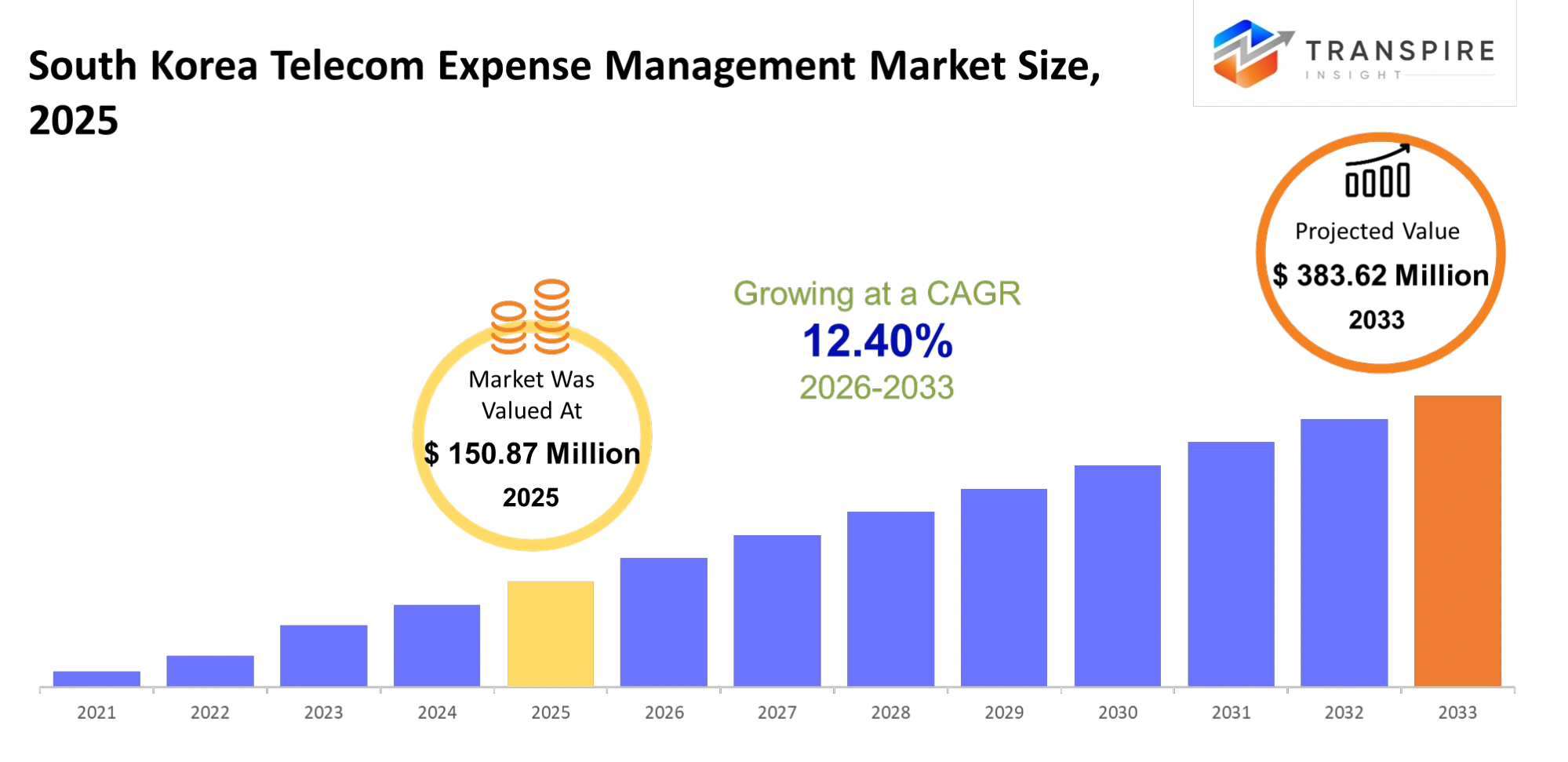
South Korea Telecom Expense Management Market Size & Forecast:
- South Korea Telecom Expense Management Market Size 2025: USD 150.87 Million
- South Korea Telecom Expense Management Market Size 2033: USD 383.62 Million
- South Korea Telecom Expense Management Market CAGR: 12.40%
- South Korea Telecom Expense Management Market Segments: By Component (Software, Services), By Deployment (Cloud, On-Premise), By Enterprise Size (Large Enterprises, SMEs), By End-User (IT & Telecom, BFSI, Healthcare, Retail
To learn more about this report,  Download Free Sample Report
South Korea Telecom Expense Management Market Summary:
South Korea Telecom Expense Management Market size was estimated at USD 150.87 Millionin 2025 and is anticipated to reach USD 383.62 Million by 2033, growing at a CAGR of 12.40% from 2026 to 2033.
The South Korea Telecom Expense Management Market operates as part of the telecom expense management industry which helps businesses between controlling their mobile expenditures and managing their vendor agreements and their cloud communication expenses. Enterprises will require consolidated financial dashboards which display all their carrier costs and device expenses and software subscription fees. Companies will demand transparent billing systems together with automated auditing capabilities and predictive expense monitoring solutions because they require modernized digital workplaces and remote work operations.
Service providers will implement artificial intelligence systems which identify billing discrepancies and track roaming behavior and predict user consumption patterns with high accuracy. New data protection regulations and corporate responsibility requirements will create new reporting standards which determine how vendors must handle their accountability. Clients will choose platforms that provide flexibility through their ability to work with enterprise resource planning systems which help compliance tasks and enhance financial transparency.
Key Market Trends & Insights:
- The increasing digital operations of huge companies and medium-sized businesses will create a need for effective expense management systems. Finance departments use advanced analytics tools which include centralized dashboard systems and automatic billing verification to monitor their spending activities. Organizations in South Korea Telecom Expense Management Market require clear telecom expense information and they want companies to provide them with precise budget control systems.
- The growing use of cloud platforms will lead to better integration between telecom expense management tools and enterprise resource planning systems. Organizations need to monitor their expenses through automated processes which enable them to develop accurate contracts and usage reports. Organizations want to use integrated systems which decrease the need for manual work and resolve billing problems while they create better financial plans for their different business units.
- Organizations will increase their need for telecom usage monitoring because of their growing reliance on remote work and their need to support employees who use mobile devices. Organizations use automated policy systems to control employee costs which include device expenses and roaming and data usage charges. Service providers develop versatile systems which enable organizations to oversee their operations from one location without needing workforce members to stop working or lose their ability to communicate with others.
- Artificial intelligence-based advanced analytics systems will enhance telecom cost management decision-making processes. The system achieves cost savings by using predictive usage assessments to identify unusual behavior and verify contract adherence through automated processes. The South Korea Telecom Expense Management Market develops because businesses choose smart systems which help them find cost savings while eliminating billing mistakes that could lead to financial losses.
- Organizations will adopt secure telecom expense platforms which use encrypted processing and provide audit-ready documentation because data protection standards need to be strengthened. National financial reporting regulations compel organizations to maintain transparent records which enable them to verify their billing methods. Vendors compete through their development of secure architectural systems together with access control mechanisms and dependable data storage solutions which ensure their products will function reliably over extended periods.
South Korea Telecom Expense Management Market Segmentation
By Component :
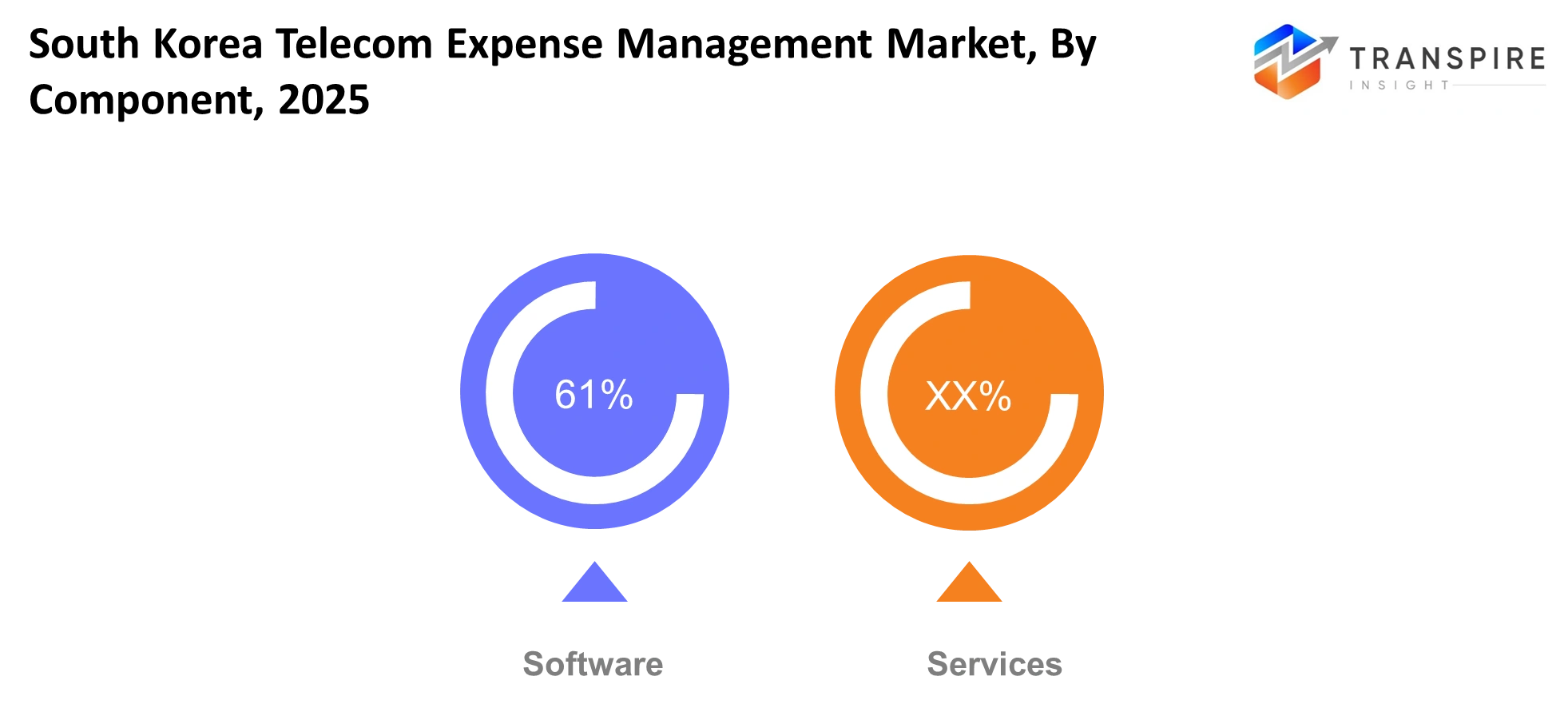
- Software: The operational backbone of South Korea Telecom Expense Management Market will depend on software solutions which enable automated tracking of telecom usage and invoice validation and expense allocation across departments. Advanced platforms will assist enterprises in monitoring their mobile data and roaming expenses through shared dashboard systems. The enterprise systems integration will deliver enhanced visibility which decreases billing mistakes while enabling organizations to adhere to their established policies.
- Services: Services will play a vital role in supporting implementation, customization, and ongoing management of expense platforms in the South Korea Telecom Expense Management Market. Managed service providers will assist organizations in auditing telecom bills, optimizing contracts, and identifying cost-saving opportunities. The organization will achieve effective deployment and continuous system upgrades through consulting and support services which ensure regulatory compliance and performance monitoring.
To learn more about this report, Download Free Sample Report
By Deployment :
- Cloud: The South Korea Telecom Expense Management Market will experience strong growth through cloud deployment because it offers organizations flexible solutions which can expand their operations at lower costs. Cloud-based platforms will allow organizations to access expense data in real time across multiple locations while ensuring secure storage and automated updates. Subscription-based pricing models will help businesses control operational costs and simplify system maintenance.
- On-Premise: Organizations that need to control their data and enforce internal security policies and customize their infrastructure will find on-premise deployment to be viable in the South Korea Telecom Expense Management Market. Dedicated in-house servers will allow enterprises to maintain sensitive billing information while ensuring system configuration based on specific operational needs. The model applies to firms which need to follow strict compliance rules while they must restrict their access to outside data.
By Enterprise Size :
- Large Enterprises:The South Korea Telecom Expense Management Market will receive most of its market share from large corporations which require complex telecom systems to support their extensive service operations. The company needs to establish a central system for tracking employee activities and their transit between different job sites because it operates multiple sites. Business units will achieve better operational efficiency through strategic cost planning and financial transparency which automated analytics will provide.
- SMEs: The South Korea Telecom Expense Management Market will see a growing number of small and medium enterprises which will adopt expense management tools to control their communication costs while enhancing their budgetary management. The affordable cloud solutions will provide small businesses with the ability to automate their invoice processing operations while monitoring employee telecom activity and blocking unnecessary expenses. The use of basic dashboards together with managed support services will enable small and medium enterprises to achieve their aim of maximizing their restricted financial resources.
By End-User :
- IT & Telecom:The South Korea Telecom Expense Management Market will see IT and telecom companies as its main customers because of their vast communication networks and extensive customer support operations. The organization needs to track expenses because its operations depend on three main factors which include high data usage and international network connections and their complicated vendor contracts. The implementation of automated systems will enhance billing precision and improve contract management and assist in overseeing extensive business operations.
- BFSI: Banking financial services and insurance organizations need structured telecom expense monitoring systems to safeguard their communication networks within the South Korea Telecom Expense Management Market. The operation of multiple branches together with customer service centers will create substantial telecom costs which need to undergo thorough verification. Expense platforms will help reduce billing disputes while ensuring compliance requirements and better financial management.
- Healthcare: Hospitals and digital health service providers will use telecom expense systems through the South Korea Telecom Expense Management Market. The healthcare sector will experience increased telecom usage because of secure data exchange and teleconsultation services and emergency response coordination. Expense monitoring tools will help control operational spending while supporting reliable connectivity across medical facilities.
- Retail:The South Korea Telecom Expense Management Market will see retail companies using expense management platforms to track their communication costs throughout their store networks, warehouse facilities and supply chain operations. The business will incur ongoing telecommunications costs through its point-of-sale systems and customer support centers and vendor management operations. Retailers will use centralized tracking systems to achieve budget control, billing error prevention and uninterrupted communication throughout their business operations.
Country Insights
- The South Korea Telecom Expense Management Market displays consistent development because of its established digital systems, which provide extensive urban connectivity while businesses use mobile devices. Service industries that depend on technology, along with large business groups, have ongoing needs for platforms that track expenses. The telecom sector will achieve transparent expense management through three key factors which include regulatory frameworks, sophisticated billing systems and complete cloud system deployment.
- The rapid 5G network development throughout South Korea causes businesses to depend more on mobile data services, which creates a greater demand for accurate telecom cost assessment systems. Companies use automated auditing systems and centralized control panels to minimize their operational waste. The logistics, finance and manufacturing industries will experience increased demand for that solution which helps them control their employee communication networks that operate across multiple locations.
- Domestic technology companies have established a strong market presence which makes Korean businesses prefer to develop customized software solutions that meet their specific needs. The combination of artificial intelligence with billing validation processes and usage forecasting will increase financial management capabilities. The South Korea Telecom Expense Management Market solutions will experience sustained growth through government-supported digital transformation initiatives and the implementation of smart workplace technologies.
Recent Development News
Record Fine for SK Telecom After Massive Data Breach
- SK Telecom Co., Ltd. was fined US$96.9 million after a major cyberattack exposed data of ~23 million users. Regulatory costs and remediation expenses from incidents like this can drive enterprises and carriers to adopt better expense oversight and compliance systems, including TEM processes.
Telecom Expense Management Market Growth Highlighted in Industry Coverage
- Major news platforms noted that the Telecom Expense Management market was poised for growth due to rising enterprise telecom complexity and hybrid workforce needs, signaling rising demand for TEM tools in environments like South Korea’s advanced telecom sector.
|
Report Metrics |
Details |
|
Market size value in 2025 |
USD 150.87 Million |
|
Market size value in 2026 |
USD 169.27 Million |
|
Revenue forecast in 2033 |
USD 383.62 Million |
|
Growth rate |
CAGR of 12.40% from 2026 to 2033 |
|
Base year |
2025 |
|
Historical data |
2021 - 2024 |
|
Forecast period |
2026 - 2033 |
|
Report coverage |
Revenue forecast, competitive landscape, growth factors, and trends |
|
Country scope |
South Korea |
|
Key company profiled |
Tangoe Inc., Calero Software LLC, Sakon Inc., Cass Information Systems Inc., IBM Corporation, Accenture plc, CGI Inc., Vodafone Group plc, Valicom Corporation, MDSL (One Source), WidePoint Corporation, Upland Software Inc., Brightfin Inc., Genuity Inc., Tellennium Inc. |
|
Customization scope |
Free report customization (country, regional & segment scope). Avail customized purchase options to meet your exact research needs. |
|
Report Segmentation |
By Component (Software, Services), By Deployment (Cloud, On-Premise), By Enterprise Size (Large Enterprises, SMEs), By End-User (IT & Telecom, BFSI, Healthcare, Retail |
Key South Korea Telecom Expense Management Company Insights
- The main service providers build their operations around platforms which enable businesses to track their telecom costs and handle billing mistakes while achieving better understanding of their mobile and fixed network expenses. Strong demand comes from large corporations managing complex communication systems. Vendors emphasize automation and analytics dashboards and compliance tools which enable organizations to handle expenses according to established rules while maintaining financial transparency.
- The competitive landscape displays technology-oriented companies which spend money on cloud solutions and AI-powered auditing systems and secure data connection technology. Partnerships with telecom operators strengthen service reach and billing accuracy. Market participants prioritize scalable solutions tailored for multinational firms which enable them to control expenses and manage contracts and produce detailed reports about their enterprise communication networks.
South Korea Telecom Expense Management Market Companies:
- Tangoe Inc.
- Calero Software LLC
- Sakon Inc.
- Cass Information Systems Inc.
- IBM Corporation
- Accenture plc
- CGI Inc.
- Vodafone Group plc
- Valicom Corporation
- MDSL (One Source)
- WidePoint Corporation
- Upland Software Inc.
- Brightfin Inc.
- Genuity Inc.
- Tellennium Inc
South Korea Telecom Expense Management Market Segmentation
By Component
- Software
- Services
By Deployment
- Cloud
- On-Premise
By Enterprise Size
- Large Enterprises
- SMEs
By End-User
- IT & Telecom
- BFSI
- Healthcare
- Retail
Frequently Asked Questions
Find quick answers to common questions.
The Approximate South Korea Telecom Expense Management Market size for the market will be USD 383.62 Million in 2033.
Key Segments for the South Korea Telecom Expense Management Market are By Component (Software, Services), By Deployment (Cloud, On-Premise), By Enterprise Size (Large Enterprises, SMEs), By End-User (IT & Telecom, BFSI, Healthcare, Retail.
Major South Korea Telecom Expense Management Market Players are Tangoe Inc., Calero Software LLC, Sakon Inc., Cass Information Systems Inc., IBM Corporation, Accenture plc, CGI Inc., Vodafone Group plc, Valicom Corporation, MDSL (One Source), WidePoint Corporation, Upland Software Inc., Brightfin Inc., Genuity Inc., Tellennium Inc.
The Current South Korea Telecom Expense Management Market size is USD 150.87 Million in 2025.
The South Korea Telecom Expense Management Market CAGR is 12.40%.
- Tangoe Inc.
- Calero Software LLC
- Sakon Inc.
- Cass Information Systems Inc.
- IBM Corporation
- Accenture plc
- CGI Inc.
- Vodafone Group plc
- Valicom Corporation
- MDSL (One Source)
- WidePoint Corporation
- Upland Software Inc.
- Brightfin Inc.
- Genuity Inc.
- Tellennium Inc
Recently Published Reports
-
Apr 2026
3D Optical Profiler Market
3D Optical Profiler Market Size, Share & Analysis Report By Type (Desktop 3D Optical Profiler, and Portable 3D Optical Profiler), By Technology (Confocal Technology, and White Light Interference), By End-Use Industry (Manufacturing, Research Institutions, Automotive, Aerospace and Defense, Medical Devices, and Other), and Geography (North America, Europe, Asia-Pacific, Middle East and Africa, South and Central America), 2021 - 2031
-
Apr 2026
Depth Sensor Market
Depth Sensor Market Size, Share & Analysis Report By Type (Infrared Depth Sensors, Time-of-Flight (ToF) Sensors, Stereo Vision Sensors, Structured Light Sensors, Ultrasonic Depth Sensors), By Application (Automotive, Robotics, Gaming, Consumer Electronics, Industrial Automation, Healthcare, Security & Surveillance, Others), By End Users (Automotive Manufacturers, Consumer Electronics Companies, Healthcare Providers, Industrial Companies, Security Agencies, Gaming Companies, Robotics Companies, Others), and Geography (North America, Europe, Asia-Pacific, Middle East and Africa, South and Central America), 2021 – 2031
-
Apr 2026
Digital Manufacturing Market
Digital Manufacturing Market Size, Share & Analysis Report By Component (Hardware, Software, and Services), By Technology (Robotics, 3D Printing, Internet of Things (IoT), and Others), By Application (Automotive and Transportation, Aerospace and Defense, Consumer Electronics, Industrial Machinery, and Others), By Process Type (Computer-Based Designing, Computer-Based Simulation, Computer 3D Visualization, Analytics, and Others), and Geography (North America, Europe, Asia-Pacific, Middle East and Africa, South and Central America), 2021 – 2031
-
Apr 2026
Digital Visa Services Market
Digital Visa Services Market Size, Share & Analysis Report By Type (Individual Travelers, Group Travelers), By Application (Tourism, Business Travel, Others), and Geography (North America, Europe, Asia-Pacific, Middle East and Africa, South and Central America), 2021 – 2031