
South Korea Synthetic & Bio-based Aniline Market Summary:
According to Transpire Insight, a detailed research report on the market reflects that the MDI (Methylene Diphenyl Diisocyanate) Polyurethanes application segment dominates the South Korea Synthetic & Bio-based Aniline Market, accounting for the largest application share in the country. The South Korea aniline market was valued at approximately USD 610.2 million in 2025 and is projected to reach USD 782.9 million by 2030, registering a 5.1% CAGR, with demand supported by polyurethane, automotive, construction, textile, pharmaceutical, and industrial manufacturing applications. BASF SE leads the market with a strong integrated production position through its Yeosu facility, supporting mononitrobenzene, aniline, MDI, TDI, carbonyl chloride derivatives, and polyurethane systems, making it a leading contributor to market development, technological advancement, integrated manufacturing capabilities, sustainable chemical production, and growth dynamics.
Market Snapshot
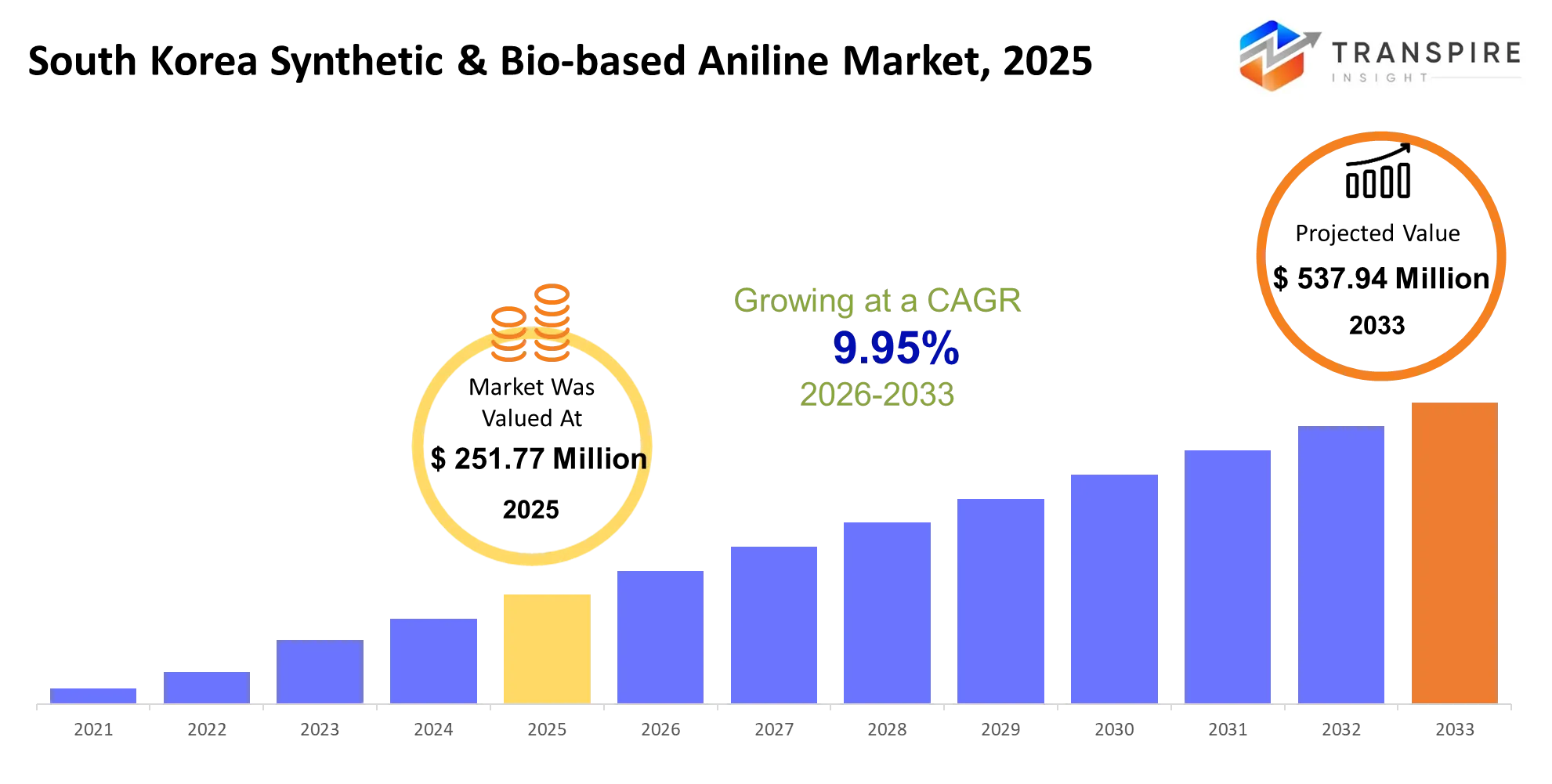
- Market Value (2025): USD 251.77 Million.
- Expected Market Value (2026): USD 276.95 Million.
- Estimated Market Value (2033): USD 537.94 Million.
- Forecast CAGR (2026–2033): 9.95%.
Introduction
South Korea Synthetic & Bio-based Aniline Market South Korea Synthetic & Bio-based Aniline Market is a part of the Advanced Chemical Manufacturing Industry and has a well-established petrochemical industry with integrated manufacturing infrastructure and strong downstream demand. Aniline is a significant aromatic amine intermediate widely used in the production of methylene diphenyl diisocyanate (MDI), polyurethane materials, rubber-processing chemicals, dyes, pigments, pharmaceuticals and agrochemicals. Conventional synthetic aniline continues to be closely linked to Korea’s petrochemical value chain, but increasing focus on carbon reduction and sustainable manufacturing is opening opportunities for bio-based alternatives. The complex industrial clusters of South Korea, its export-driven chemical industry, research capacity, and green-technology programs, provide an enabling environment for technology development and uptake of sustainable feedstocks. Growing demand for high-performance materials and low-carbon chemical solutions is anticipated to support continued market development.
Key Market Highlights: -
- By Type, the Synthetic dominated the market and holds approximately 88% share in 2025 and is projected to grow at a substantial CAGR during the forecast period.
- By Production Route, the NITROBENZENE HYDROGENATION dominated the market and holds approximately 95% share in 2025 and is projected to grow at a substantial CAGR during the forecast period.
- By Application, the MDI (Methylene Diphenyl Diisocyanate) Production Manufacturers segment dominated the market and holds approximately 80% share in 2025 and is projected to grow at a substantial CAGR during the forecast period.
- South Korea is accelerating sustainable chemical innovation through its synthetic biology policies, national biofoundry investment and biomanufacturing initiatives, opening up opportunities for bio-based aniline production and lower-carbon chemical value chains.
How is Technology Driving Growth in the South Korea Synthetic & Bio-based Aniline Market?
South Korea Synthetic & Bio-based Aniline Market is driven by the technological innovations in advanced catalytic processing, integrated aniline-to-MDI production, industrial biotechnology & circular-feedstock technologies. Conventional producers are enhancing process efficiency and integration of production. Bio-based aniline development combines plant-derived sugars, microbial fermentation and chemical catalysis to reduce dependence on fossil feedstock. Digital process optimisation and advanced process-control technologies further support energy efficiency, production consistency & utilisation of resources. At the same time, catalytic recycling technologies that enable recovery of aniline from polyurethane materials are emerging as another circular-economy pathway. These developments are bringing sustainable manufacturing to the fore, enabling the lower-carbon manufacturing of chemicals, and expanding the long-term potential of bio-based aniline in South Korea.
Market Drivers
South Korea Synthetic & Bio-based Aniline Market is propelled by rising automotive, electronics, construction, and polyurethane manufacturing activities which promote demand for aniline-based MDI and other chemical intermediates. South Korea’s integrated petrochemical infrastructure and established industrial clusters enhance production efficiency, logistics and regional supply reliability. The increasing focus on sustainable chemistry, carbon reduction and bio-based feedstocks is simultaneously driving manufacturers to develop lower carbon aniline production pathways. Asia Pacific market growth is further supported by the country’s advanced chemical ecosystem and export-oriented manufacturing base.
Restrain
Strict environmental and chemical-safety regulations increase the compliance and operation costs, which impede the growth of the South Korea Synthetic & Bio-based Aniline Market. High production costs for bio-based aniline and limited commercial-scale capacity can restrict adoption compared with established synthetic routes. Producers are feeling margin compression from volatility in benzene and petrochemical feedstock prices, while shifting sustainability standards and ESG expectations are compelling manufacturers to spend on cleaner technologies, process upgrades and lower-carbon production pathways, increasing near-term capital requirements.
|
Driver |
Relative Impact on Growth (%) |
Geographic Relevance |
Impact Timeline |
Demand Strength |
Growth Mechanism |
Key Beneficiaries |
Major Constraint |
|
1. Rising MDI and Polyurethane Demand |
30% |
Yeosu, Ulsan, Daesan |
Short-term |
High |
Expands aniline consumption through integrated MDI production |
Aniline producers, MDI manufacturers, polyurethane suppliers, automotive and appliance manufacturers |
MDI cyclicality and petrochemical feedstock volatility |
|
2. Automotive, Electronics and Construction Material Demand |
22% |
Gyeonggi, Ulsan, Yeosu, Chungnam |
Medium-term |
High |
Increases polyurethane and specialty chemical applications across industries |
Chemical producers, automotive suppliers, electronics manufacturers, construction-material companies |
Cyclical industrial demand and export-market uncertainty |
|
3. Shift Toward Bio-based and Lower-carbon Chemical Feedstocks |
18% |
Seoul, Gyeonggi, Ulsan, Yeosu |
Long-term |
Medium |
Creates sustainable aniline pathways and reduces fossil-feedstock dependence |
Bio-chemical developers, specialty chemical producers, technology vendors, sustainable-material users |
Higher production costs and limited commercial-scale bio-based capacity |
|
4. Government Green-Chemistry and Carbon-Neutrality Initiatives |
16% |
Nationwide; industrial complexes prioritized |
Medium-term |
Medium |
Encourages safer chemistry, substitution and low-carbon production investments |
Chemical manufacturers, process-technology providers, sustainability solution vendors |
Compliance costs and evolving environmental requirements |
|
5. Advanced Process Technology and Domestic Supply-Chain Resilience |
14% |
Yeosu, Ulsan, Daesan |
Long-term |
Medium |
Improves production efficiency, quality consistency and integrated feedstock utilization |
Aniline producers, process-equipment suppliers, MDI producers, downstream exporters |
High capital requirements and technology qualification barriers |
Analysis of Prices and Consumer Behaviour
The Market of South Korea Synthetic & Bio-based Aniline consists of premium aniline (68% of overall market; as the result of the demand from MDI, polyurethane, automotive, construction and specialty chemicals industries). Premium aniline will cost 35% more in price as compared with other products as the product will be made using the advanced purification technology and quality-certified procedures with chemical specifications. Approximately 45% of overall unit sales of Synthetic & Bio-based Aniline is in liquid form. The reason for the sales is the variety of liquid aniline use in MDI, polyurethane and industrial chemicals applications and suitability for continuous production process. The MDI, Polyurethane and specialty chemical industries account for about 70% of the demand from these industries. The consumer's buying behavior suggests that 55% of consumers consider the highest priority of chemical purity, product consistency and standardized aniline specification. Another 33% of consumers prefer to buy their products through bulk agreements or long-term contract as they want to cut costs related to the procurement of the products and ensure continuity of supply for their customers in various locations in the world.
|
Company |
Est. Revenue Share Range |
Key Offerings |
Strategic Positioning |
Geographic Strength |
Technology Focus |
|
BASF SE |
22–28% |
Aniline, mononitrobenzene, MDI, TDI, polyurethane systems |
Vertically integrated Korean aniline-MDI value chain |
Asia Pacific, Europe, North America |
Continuous aniline production and integrated MDI technology |
|
Kumho Mitsui Chemicals, Inc. |
14–19% |
Aniline, MDI, MDA, carbonyl chloride |
Korea-focused integrated MDI-aniline producer |
South Korea, Asia Pacific, Global exports |
Integrated aniline-MDA-MDI and recycling processes |
|
Covestro AG |
9–13% |
Aniline, MDI, polyurethane raw materials, circular materials |
Integrated MDI platform with sustainability differentiation |
Europe, Asia Pacific, North America |
Bio-based aniline and circular aniline recovery technology |
|
Wanhua Chemical Group Co., Ltd. |
7–11% |
Aniline, MDI, polyurethane intermediates, specialty chemicals |
Scale-driven Asian integrated polyurethane challenger |
Asia Pacific, Europe, North America |
Large-scale integrated petrochemical and MDI processes |
|
Huntsman Corporation |
5–8% |
Aniline, MDI, polyurethane systems, specialty chemicals |
Downstream polyurethane and specialty-application integration |
North America, Europe, Asia Pacific |
Integrated polyurethane formulation and MDI technologies |
|
Sumitomo Chemical Co., Ltd. |
4–7% |
Aniline, petrochemical intermediates, specialty chemicals |
Diversified Japanese chemical supplier with regional reach |
Asia Pacific, Japan, North America |
Catalytic chemical processing and specialty intermediates |
|
Tosoh Corporation |
3–6% |
Aniline, chlor-alkali chemicals, specialty intermediates, MDI-related materials |
Integrated Japanese chemicals and specialty-materials supplier |
Japan, Asia Pacific, Europe |
Integrated chlor-alkali and advanced chemical processing |
|
Sinopec |
3–6% |
Aniline, petrochemical intermediates, benzene derivatives, MDI-chain chemicals |
Feedstock-scale producer serving Asian chemical markets |
China, Asia Pacific, Middle East |
Large-scale petrochemical and aromatic chemical processing |
|
LANXESS AG |
2–4% |
Aniline-related intermediates, specialty chemicals, rubber chemicals |
Specialty-chemicals differentiation beyond commodity volumes |
Europe, Asia Pacific, North America |
High-purity intermediates and specialty chemical processing |
|
Mitsui Chemicals, Inc. |
2–4% |
Aniline-chain materials, MDI through Kumho Mitsui, polyurethane materials |
Strategic Korea presence through integrated MDI affiliate |
Japan, South Korea, Asia Pacific |
Polyurethane integration, recycling and process efficiency |
Who are the Key Players in the South Korea Synthetic & Bio-based Aniline Market and how do they compete?
Competitive success in the international market of South Korea Synthetic & Bio-based Aniline Market relies on companies specializing in innovation within chemical process development, specific application solutions, and creation of distribution networks across the globe. Not only competing in terms of pricing policy but in terms of the development of technologies allowing for high-purity aniline production, advanced manufacturing processes, sustainability of feedstocks used, and integration with downstream chemical production processes, such a strategy will ensure continuous product development and increased production efficiency, optimization, and reliability.
Innovation in advanced aniline production technologies, integrated chemical solutions, sustainable pathways to feedstocks, and high-purity chemicals, BASF increases its competitive advantages on the market. The development of high-performance chemical intermediates for MDI, polyurethane, specialty chemicals, and other industrial applications allows Covestro to differ from its competitors. By integrating solutions in aniline, MDI, polyurethane materials, specialty chemicals, and advanced chemical processing, Huntsman creates its competitive advantages.
Top Companies in the South Korea Synthetic & Bio-based Aniline Market
- BASF
- Covestro
- Huntsman
- Wanhua Chemical
- Mitsubishi Chemical
- Tosoh
- Sumitomo Chemical
- Mitsui Chemicals
- LG Chem
- Kumho Mitsui Chemicals
- OCI
- Bayer
- Evonik
- Cepsa
- Toray Industries
South Korea Synthetic & Bio-based Aniline Market Segmentation
The South Korea Synthetic & Bio-based Aniline Market share is divided into six categories: By Type, By Production Route, By Application, By Feedstock, By Grade, By End User.
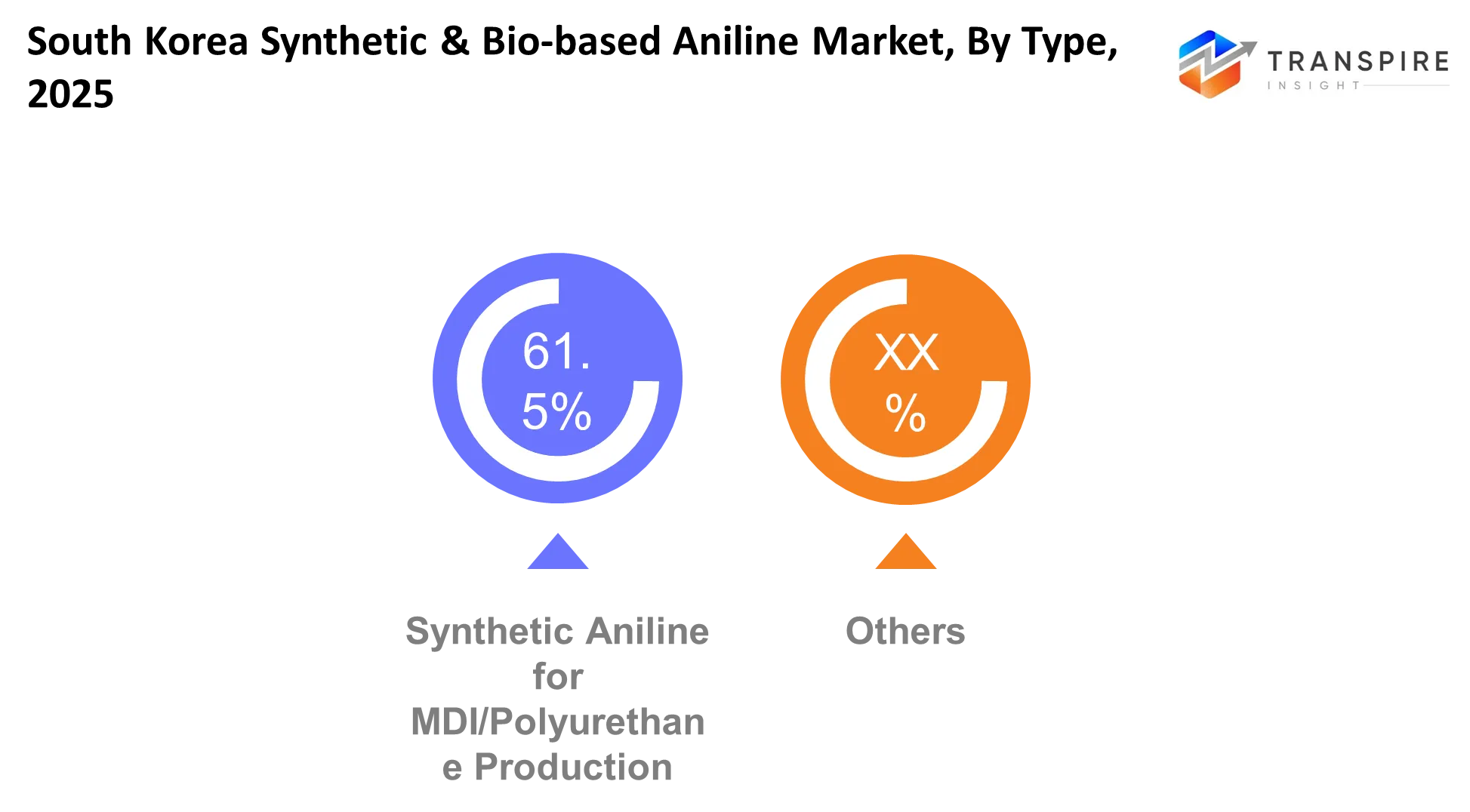
The Synthetic dominated the market, accounting for nearly 88% in 2025 and is expected to rise at a significant CAGR during the forecast period.
The South Korea Synthetic & Bio-based Aniline Market is segmented by type into synthetic aniline, bio-based aniline, low-carbon aniline, renewable aniline, conventional aniline, high-purity aniline, specialty aniline, bio-derived aromatics. Among these, the Synthetic segment dominated the market, accounting for nearly 88% in 2025 and expected to increase at a significant CAGR during the forecast period. The Synthetic segment accounted for the largest market share of nearly 88% in 2025 and is expected to grow at a healthy CAGR during the forecast period. The growth of the synthetic segment is primarily driven by the established production infrastructure, high demand for MDI, and low-cost petrochemical feedstocks.
The nitrobenzene hydrogenation dominated the market, accounting for nearly 95% in 2025, and is expected to rise at a significant CAGR during the forecast period.
The South Korea Synthetic & Bio-based Aniline Market is segmented by production route into nitrobenzene hydrogenation, ammonolysis, biomass conversion, bio-based fermentation, catalytic conversion, renewable feedstock route, chemical synthesis, hybrid route. Among these, the nitrobenzene hydrogenatiON dominated the market, accounting for nearly 95% in 2025 and expected to increase at a significant CAGR during the forecast period. Nitrobenzene hydrogenation held the largest share of the market in 2025, of nearly 95% and is projected to grow at a significant CAGR during the forecast period, due to established technology, high efficiency, and cost-effective large-scale production of aniline.
The MDI (Methylene Diphenyl Diisocyanate) Production dominated the market, accounting for nearly 80% in 2025 and is expected to rise at a significant CAGR during the forecast period.
The South Korea Synthetic & Bio-based Aniline Market is segmentedby application into mdi production, rubber chemicals, dyes & pigments, pharmaceuticals, agrochemicals, polyurethanes, specialty chemicals, textile chemicals. Among these, the MDI (Methylene Diphenyl Diisocyanate) Production dominated the market, accounting for nearly 80% in 2025 and expected to increase at a significant CAGR during the forecast period. The MDI (Methylene Diphenyl Diisocyanate) Production segment held the largest market share, accounting for almost 80% in 2025 and is projected to grow at a considerable CAGR throughout the forecast period owing to robust demand for polyurethanes, growing applications in the automotive & construction sectors and integrated aniline-MDI production capabilities across South Korea industries.
Future Market Trends for the South Korea Synthetic & Bio-based Aniline Market: -
- Feedstocks for Bio-Based and Sustainability: The rising needs for sustainability have prompted companies to implement biomass balance feedstocks, low carbon feedstocks, and sustainable aniline to MDI production pathways.
- Process Technologies: Companies have started to implement technologies such as integrated production, process optimization, and digitalization in order to enhance aniline quality, productivity, and efficiency.
- Carbon Reduction and Supply Chain Resilience: Rising environmental regulations and risk of petrochemical supply have accelerated investments for low carbon technologies, local production, recycling processes, and resilient aniline-MDI supply chains.
Recent Development
- In February 2026 – Regulatory Framework Introduction South Korea moves to establish measures for synthetic biology, strengthening the legal basis for bio-manufacturing, sustainable chemical development and future development of bio-based aniline.
- In March 2026 – Biofoundry Development: National biofoundry infrastructure initiatives are speeding up synthetic biology research, automation, and biomanufacturing capabilities, creating opportunities for sustainable chemical feedstocks and bio-based aniline technologies.
- In May 2026 – Sustainable Chemical Transition South Korea’s synthetic biology policies are bolstering biotechnology-based manufacturing capabilities, enabling the long-term evolution of lower-carbon chemical pathways and sustainable alternatives in the aniline value chain.
Market Segmentation
This study forecasts revenue at Japan, regional and country levels from 2020 to 2033. Transpire Insight has segmented the South Korea Synthetic & Bio-based Aniline Market based on the below-mentioned segments:
South Korea Synthetic & Bio-based Aniline Market, By Type
- Synthetic Aniline
- Bio-Based Aniline
- Low-Carbon Aniline
- Renewable Aniline
- Conventional Aniline
- High-Purity Aniline
- Specialty Aniline
- Bio-Derived Aromatics
South Korea Synthetic & Bio-based Aniline Market, By Production Route
- Nitrobenzene Hydrogenation
- Ammonolysis
- Biomass Conversion
- Bio-Based Fermentation
- Catalytic Conversion
- Renewable Feedstock Route
- Chemical Synthesis
- Hybrid Route
South Korea Synthetic & Bio-based Aniline Market, By Application
- MDI Production
- Rubber Chemicals
- Dyes & Pigments
- Pharmaceuticals
- Agrochemicals
- Polyurethanes
- Specialty Chemicals
- Textile Chemicals
South Korea Synthetic & Bio-based Aniline Market, By Feedstock
- Benzene
- Nitrobenzene
- Biomass
- Bio-Oils
- Lignin
- Agricultural Waste
- Renewable Aromatics
- Recycled Feedstocks
South Korea Synthetic & Bio-based Aniline Market, By Grade
- Industrial Grade
- High-Purity Grade
- Pharmaceutical Grade
- Polymer Grade
- Electronic Grade
- Specialty Grade
- Technical Grade
- Bio-Based Grade
South Korea Synthetic & Bio-based Aniline Market, By End User
- Polyurethane Producers
- Chemical Companies
- Pharmaceutical Companies
- Rubber Manufacturers
- Dye Manufacturers
- Agrochemical Companies
- Textile Companies
- Electronics Companies
Frequently Asked Questions
Find quick answers to common questions.
Strong MDI demand, polyurethane manufacturing, automotive production, sustainable chemistry initiatives, and integrated petrochemical infrastructure are driving South Korea’s aniline market growth.
Synthetic aniline dominates, supported by established production infrastructure, reliable petrochemical feedstocks, cost efficiency, and strong downstream demand from MDI manufacturers.
Nitrobenzene hydrogenation dominates because established technology, high efficiency, cost-effective operations, and scalable production support substantial aniline manufacturing across South Korea.
MDI production dominates due to strong polyurethane demand across automotive, construction, appliances, insulation, and industrial applications requiring performance-oriented materials.
Bio-based feedstocks, low-carbon production, digital process optimization, recycling technologies, and resilient supply chains are shaping South Korea’s future aniline industry.
- BASF
- Covestro
- Huntsman
- Wanhua Chemical
- Mitsubishi Chemical
- Tosoh
- Sumitomo Chemical
- Mitsui Chemicals
- LG Chem
- Kumho Mitsui Chemicals
- OCI
- Bayer
- Evonik
- Cepsa
- Toray Industries
About the Authors

Pankaj Ghogare Patil
I am Pankaj Ghogare Patil, a Senior Research Analyst at Transpire Insight, specializing in the Pharmaceutical, Chemicals & Materials, Healthcare IT, and Biotechnology industry. My expertise lies in conducting comprehensive market research, analyzing industry trends, evaluating competitive landscapes, and translating complex data into actionable insights. At Transpire Insight, I closely follow emerging technologies, regulatory developments, and market innovations to create accurate, well-researched, and informative content that helps businesses and professionals make informed decisions. I am committed to producing credible, evidence-based articles that reflect industry best practices while making technical topics accessible and valuable for a broad audience.

Chakradhar Khansole
Chakradhar serves as the Research Director at Transpire Insight, bringing over 8 years of experience in technology, innovation, and strategic market intelligence. He specializes in transforming complex market data into actionable business insights that enable organizations to make informed, growth-oriented decisions. Recognized for his strategic vision and analytical expertise, Chakradhar leads high-impact research initiatives, delivering comprehensive market assessments, competitive intelligence, and forward-looking industry analysis.
Recently Published Reports
-
May 2026
Healthcare Polymer Packaging Market
Healthcare Polymer Packaging Market Size, Share & Analysis Report By Packaging Type (Syringes, IV Bottles and Pouches, Clamshells, Blisters, Bottles & Jars, Containers, Tubes, IV Parental Packaging, Others), By Type (Regulated, Non-regulated), By Polymer Type (LDPE (Low-Density Polyethylene), HDPE (High-Density Polyethylene), Homo-polymer (Homo), Random Copolymer (Random), Block Copolymer (Block), PET, Polystyrene, Polyvinyl Chloride, Polyamide/EVOH, Others), and Geography (North America, Europe, Asia-Pacific, Middle East and Africa, South and Central America), 2021 - 2031
-
Apr 2026
Hydrophilic Tape (Waterstop) Market
Hydrophilic Tape (Waterstop) Market Size, Share & Analysis Report By Type (Bentonite-Based Hydrophilic Tape, Rubber-Based Hydrophilic Tape), By Application (Residential Buildings, Commercial Buildings, Infrastructure Projects), and Geography (North America, Europe, Asia-Pacific, Middle East and Africa, South and Central America), 2021 - 2031
-
Apr 2026
Metalens Market
Metalens Market Size, Share & Analysis Report By Type (Visible Light Metalens, and Infrared Metalens), By Application (Consumer Electronics, Automotive Electronics, Industrial, Medical, and Others), and Geography (North America, Europe, Asia-Pacific, Middle East and Africa, South and Central America), 2021 - 2031
-
Apr 2026
PBT Resin Market
PBT Resin Market Size, Share & Analysis Report By Type (Reinforced PBT Resin, Unreinforced PBT Resin), By Processing Method (Injection Molding, Extrusion, Blow Molding, Others), By End-User (Automotive, Electrical & Electronics, Consumer Appliances, Industrial Machinery, Medical Devices, Packaging, Others), and Geography (North America, Europe, Asia-Pacific, Middle East and Africa, South and Central America), 2021 - 2031