

South Korea Storage Tank Market Summary:
According to Transpire Insights, a detailed research report on the market reflects that the storage tank segment represents a significant component of the South Korea Storage Tank Market, supported by strong demand from industrial, chemical, petrochemical, energy, and water-storage applications. South Korea’s broader tanks, reservoirs, boilers and radiators industry reached approximately USD 3.4 billion in demand in 2025, while Rinnai Korea accounted for approximately 4.0% of the industry’s total production value, making it a notable contributor to South Korea’s industrial equipment development, manufacturing capabilities, and growth dynamics.
Market Snapshot
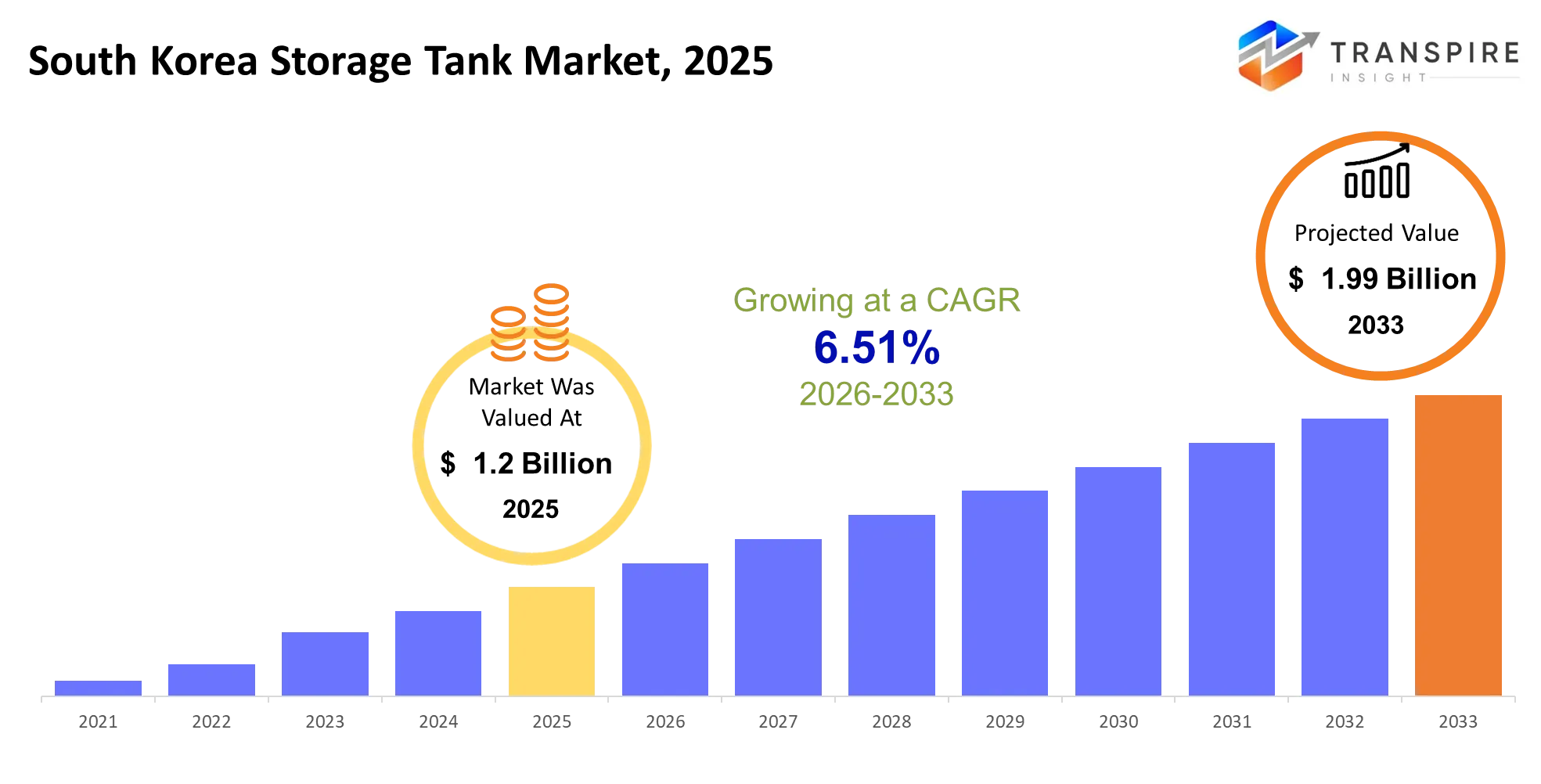
- Market Value (2025): USD 1.2 Billion.
- Expected Market Value (2026): USD 1.28 Billion.
- Estimated Market Value (2033): USD 1.99 Billion.
- Forecast CAGR (2026–2033): 6.51%
Introduction
Storage tank market refers to the entire process of producing the engineered storage tank including above-ground, underground, fixed-roof, floating-roof, and cryogenic tanks. Various materials such as steel, polyethylene, and composite plastics are used in the making of storage tanks. The storage tank market includes the supply of raw materials, production process, coating process, and the process of modernizing tanks by installing the IoT technologies. The Storage Tank Market of South Korea is strengthened by high-quality manufacturing capabilities, efficient government assistance, technologies application, and its favorable geographic location. The local manufacturers apply precise engineering technologies to produce special storage systems for various purposes. At the same time, the state programs, financial benefits, and ecological rules stimulate innovations, modernization of the infrastructure, and growth of the usage of clean storage technologies. Likewise, the automation, Internet of Things technologies, and digital systems enable to improve the operational efficiency and asset visibility, maintenance, and compliance with regulations.
Key Market Highlights: -
- By tank type, the Above-Ground Tank segment dominated the market and holds nearly 68% share in 2025 and is projected to grow at a substantial CAGR during the forecast period.
- By product, the Fuel Storage Tanks segment dominated the market and holds nearly 34% share in 2025 and is projected to grow at a substantial CAGR during the forecast period.
- By end user, the Bulk Storage segment dominated the market and holds nearly 45% share in 2025 and is projected to grow at a substantial CAGR during the forecast period.
- Development of Hydrogen Economy: Initiatives and investments made by South Korea in the development of the hydrogen economy increase the demand for advanced hydrogen storage solutions. The growth of hydrogen generation, transport, refueling, and storage systems causes the need for hydrogen storage tanks with high pressure uses. It is expected that the process encouraged by the government will boost the growth of the market of storage tanks in South Korea.
How is Technology Driving Growth in the South Korea Storage Tank Market?
The South Korea Storage Tank Market is making strides with the help of IoT-enabled monitoring, advanced materials, modular designs, and digital compliance solutions. With smart sensors and automation technology, tanks can now be constantly monitored in real-time. This enables early detection of leaks, predictive maintenance, increased safety measures, and a reduction in costs. Advanced materials, such as coatings resistant to corrosion and composite materials made of carbon fiber, enhance durability and reduce the weight of tanks, especially those used to store hydrogen and clean fuels. In addition, modular and scalable tank systems allow industrial plants to adapt their storage capacity in order to cater to new circumstances. At the same time, digital compliance and certification technologies improve safety documentation processes, compliance requirements, and asset traceability.
Market Drivers
The Government’s hydrogen initiatives, energy transition, regulatory compliance, energy-efficiency requirements, and modernization of urban infrastructure are the factors driving the growth of South Korea’s storage tanks market. The hydrogen initiatives being adopted by the government are impacting the demand for high pressure and liquid hydrogen storage tanks, and the efforts to promote LNG, renewable energy, and low carbon fuel technologies are shaping the need for specialized storage facilities. Toughened requirements regarding safety and environment in South Korea promote the use of anti-corrosion engineering materials and smart monitoring technologies. At the same time, the energy-efficiency requirements and building code regulations promote the use of water heating and thermal energy storage systems while the plans of smart cities developing as well as industrial growth and modernization of infrastructures are shaping the demand for the vertical and aboveground storage tanks. South Korea enjoys several advantages in the storage tank industry, including the presence of cutting-edge manufacturing services, strong government support, tough regulations, and an export-oriented environment. The combination of expert engineering and advanced production processes can facilitate the creation of effective storage facilities, composite hydrogen tanks, and automated monitoring systems. Government hydrogen pathways, investments in the public sector, and motivation toward sustainable industries contribute to the development of the domestic market. Strict safety, leakage prevention, and environmental regulations help to create the need for advanced storage solutions. Additionally, the presence of thriving industrial supply networks, high-tech capabilities, and manufacturing quality in South Korea allow local manufacturers to advance their production activity.
Restrain
The Storage Tank Market in South Korea deals with vulnerabilities related to supply chain, regulation pressures, necessities of the decarbonization process, and high cost of implementation of required technologies. Reliance on imported components and raw materials results in exposure to price fluctuations. Stringent safety regulations and environmental constraints increase the level of compliance costs, whereas advanced IoT monitoring, digitalization, and different monitoring systems involve vast capital investments restricting applicability for small businesses.
|
Driver |
Relative Impact on Growth (%) |
Geographic Relevance |
Impact Timeline |
Demand Strength |
Growth Mechanism |
Key Beneficiaries |
Major Constraint |
|
Hydrogen Economy and Clean-Energy Infrastructure |
28% |
Nationwide; industrial and hydrogen hubs |
Long-term |
High |
Expands demand for specialized hydrogen storage tanks |
Tank manufacturers, EPC firms, hydrogen companies |
High technology and safety costs |
|
LNG Infrastructure Expansion and Energy Security |
24% |
Coastal LNG hubs, including Dangjin |
Medium-term |
High |
New LNG terminals require large-capacity storage tanks |
Tank fabricators, EPC contractors, gas operators |
Capital-intensive infrastructure development |
|
Chemical and Petrochemical Storage Demand |
20% |
Ulsan, Yeosu, major industrial clusters |
Short-term |
High |
Industrial production increases specialized storage requirements |
Chemical firms, tank manufacturers, maintenance providers |
Feedstock volatility and capacity utilization |
|
Safety, Environmental Regulations and Compliance |
16% |
Nationwide industrial facilities |
Medium-term |
High |
Regulations encourage tank upgrades and monitoring systems |
Compliance providers, retrofit firms, technology vendors |
Higher compliance and modernization costs |
|
Smart Monitoring and Digital Tank Technologies |
12% |
Nationwide, technology-intensive facilities |
Medium-term |
Medium |
IoT monitoring improves safety, maintenance, and asset visibility |
IoT vendors, automation firms, tank operators |
High upfront digitalization investment |
Analysis of Prices and Consumer Behaviour
The market in the sector of storage tanks is mostly filled with industrial or commercial applications, which accounts for 70.5% of the country's demand in this sphere (the primary reason for this being the industrial and commercial use of storage tanks such as in the production of chemicals, petrochemicals, energy sources, manufacturing and water infrastructure). The total demand for the market of tanks, reservoirs, boilers, and radiators in South Korea is worth around 3.4 billion dollars, indicating a great demand for such industrial tanks. At the same time, the industrial steel tanks market in South Korea is worth about 1 billion dollars and is determined by the need for reliable steel storage systems. The purchasing habits of industrial consumers reveal that the most critical factors in selecting storage tanks are such features as quality of materials, resistance to corrosion, capacity for storage, compliance with safety requirements and cost of operation. The value of imports in the tanks, reservoirs, boilers and radiators market in South Korea is equal to 11 % which points out the strength of the local market.
Who are the Key Players in the South Korea Storage Tank Market and how do they compete?
In the South Korea Storage Tank Market, competition is determined by those companies that possess expertise in advanced tank production, engineering, material technology, and effective project management. The companies in the storage tank industry compete using real steel and stainless-steel tanks, FRP and composite solutions, corrosion-resistant designs, flexible capacities, and installation capabilities to support continuous product development and provide better storage for companies involved in different industrial sectors such as chemical, petrochemical, water, and manufacturing.
The KISCO Corporation enhances its competitive position through the development of engineered storage solutions, steel and stainless steel tanks, and customized systems as they create solutions for FRP, plastic, and composite tanks production. The Woongjin Chemical Company stands out for the use of materials technology and application-oriented production of FRP, plastic and composite tank systems for water and industrial sectors. The Dongyang Steel Tube Company has an edge because of the production of large steel tanks and structural fabrication technology.
Top Companies in the South Korea Storage Tank Market
- CST Industries
- Tank Connection
- McDermott
- PermianLide
- Superior Tank
- Shawcor
- Tarsco Bolted Tank
- Highland Tank
- Containment Solutions
- Snyder Industries
- Sintex
- Hyundai Heavy Industries
- Samsung E&A
- SK ecoplant
- Lotte Chemical
|
Company |
Est. Revenue Share Range |
Key Offerings |
Strategic Positioning |
Geographic Strength |
Technology Focus |
|
Korea Gas Corporation (KOGAS) |
10–15% |
LNG storage tanks; LNG terminals; cryogenic storage; hydrogen infrastructure |
Integrated energy infrastructure and storage leadership |
South Korea; Asia-Pacific |
Large-scale LNG; membrane; 9% nickel steel tanks |
|
Hyundai E&C |
8–13% |
LNG storage tanks; liquid-hydrogen tanks; terminal EPC; cryogenic infrastructure |
Engineering-led large-scale infrastructure specialist |
South Korea; Middle East; Asia-Pacific |
Cryogenic storage; thermal insulation; hydrogen tanks |
|
Samsung E&A |
7–11% |
LNG facilities; storage systems; chemical storage; terminal EPC |
EPC-led energy and industrial solutions provider |
South Korea; Middle East; Asia-Pacific |
LNG modularization; digital engineering; process integration |
|
Samsung Heavy Industries |
5–9% |
LNG cargo tanks; LNG-FSRU systems; LNG containment; offshore storage |
Advanced LNG containment and offshore specialization |
South Korea; North America; Asia-Pacific |
Membrane containment; LNG systems; automated welding |
|
SK ecoengineering |
4–8% |
LNG terminals; hydrogen infrastructure; industrial EPC; energy facilities |
Energy-transition EPC and integrated infrastructure challenger |
South Korea; Middle East; Europe |
Hydrogen infrastructure; LNG EPC; green-energy integration |
|
McDermott / CB&I |
4–7% |
Field-erected tanks; LNG storage; hydrogen storage; terminals |
Global engineered storage and energy infrastructure specialist |
North America; Asia-Pacific; Middle East |
Large-scale containment; cryogenic; liquid-hydrogen storage |
|
CST Industries |
3–6% |
Bolted tanks; welded tanks; glass-fused tanks; aluminum covers |
Diversified engineered bulk-storage technology provider |
North America; Europe; Asia-Pacific |
Glass-fused steel; bolted systems; engineered covers |
|
IHI Corporation |
2–5% |
LNG receiving terminals; above-ground LNG tanks; underground tanks; cryogenic systems |
Cryogenic LNG engineering and technology specialization |
Asia-Pacific; North America; Middle East |
Membrane; 9% nickel; prestressed-concrete containment |
|
Tarsco / TF Warren |
2–4% |
Welded steel tanks; API tanks; field construction; industrial storage |
Fabrication-led industrial storage and field services |
North America; Asia-Pacific; Middle East |
Welded steel; API-compliant fabrication; field erection |
|
Tank Connection |
1–3% |
Bolted steel tanks; epoxy tanks; liquid storage; industrial tanks |
Modular bolted-tank and engineered-storage specialization |
North America; Asia-Pacific; Middle East |
Bolted tank systems; epoxy coatings; modular construction |
South Korea Storage Tank Market Segmentation
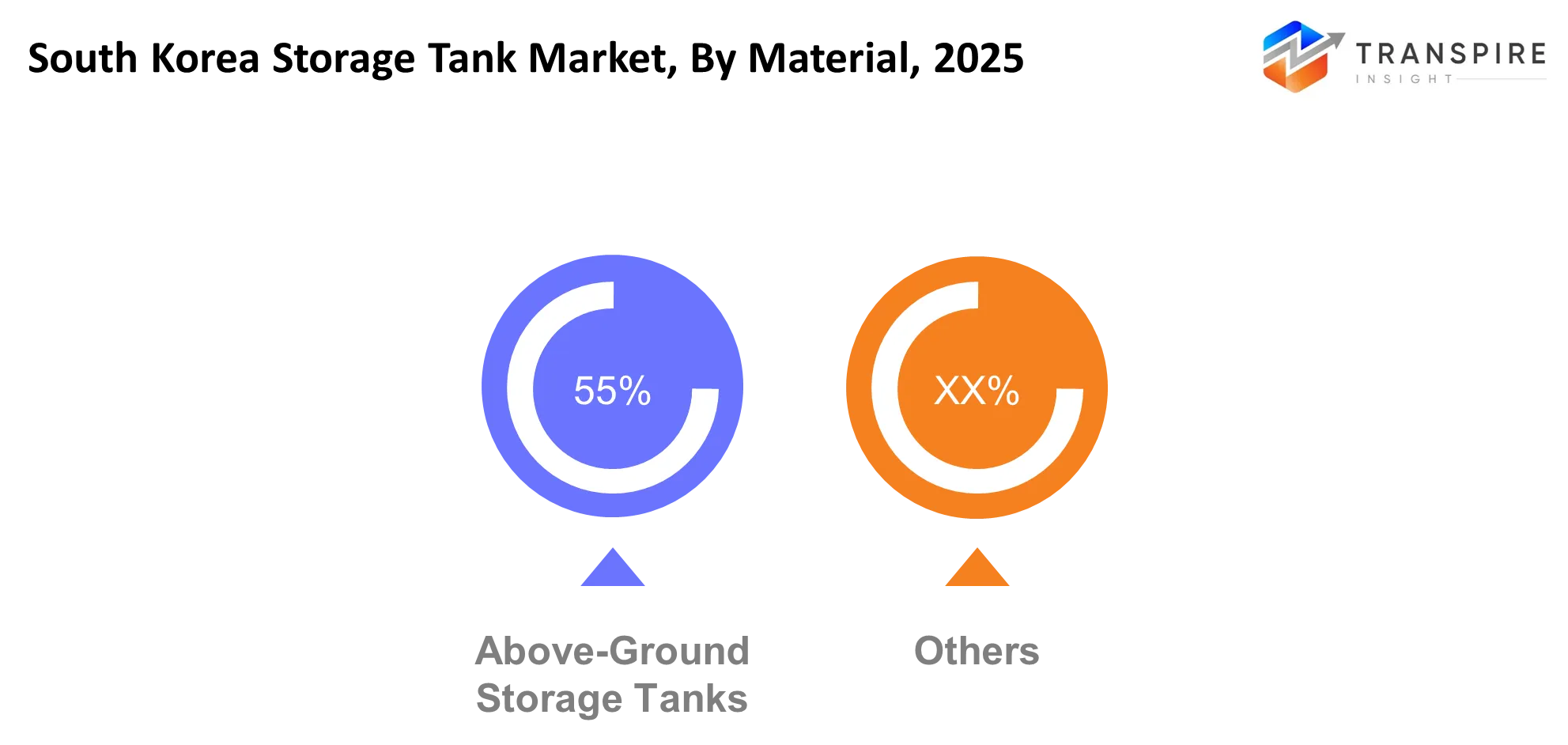
The South Korea Storage Tank Market share is divided into five categories: By material, tank, product, industry and application.
The Above-Ground Tank dominated the market, accounting for nearly 68% in 2025 and is expected to rise at a significant CAGR during the forecast period.
The South Korea Storage Tank Market is segmented by tank type into Fixed Roof, Floating Roof, Pressure Tank, Underground Tank, Above-Ground Tank, Spherical Tank, Horizontal Tank. Among these, the Above-Ground Tank segment dominated the market, accounting for nearly 68% in 2025 and expected to increase at a significant CAGR during the forecast period. In the South Korea Storage Tank Market, above-ground tanks emerged as the market leaders, holding an impressive market share of about 68% in 2025. Factors that contribute to this popularity include their ease of installation, ease of inspection and maintenance, low complexity during installation, and suitableness for various sectors like industrial and chemical and petrochemical uses, in addition to the energy and water storage sector. A big advantage is their ability to grow with the industry as the tanks are scalable, efficient, and compatible with modern monitoring solutions.
The Fuel Storage Tanks dominated the market, accounting for nearly 34% in 2025, and is expected to rise at a significant CAGR during the forecast period.
The South Korea Storage Tank Market is segmented by product into Fuel Storage Tanks, Chemical Storage Tanks, Water Storage Tanks, Oil Storage Tanks, Gas Storage Tanks, Food & Beverage Tanks, Pharmaceutical Tanks. Among these, the Fuel Storage Tanks segment dominated the market, accounting for nearly 34% in 2025 and expected to increase at a significant CAGR during the forecast period. In 2025, fuel storage tanks led the South Korea storage tank market, making up roughly 34% of the share due to continuous demand from refineries, petrochemical industries, power plants, transport infrastructure, and industrial activities. An increase in energy consumption, strict safety regulations, improvement of infrastructure, and investments into modern fuel handling systems are expected to drive growth of the segment.
The Bulk Storage dominated the market, accounting for nearly 45% in 2025 and is expected to rise at a significant CAGR during the forecast period.
The South Korea Storage Tank Market is segmented by application into Bulk Storage, Process Storage, Emergency Storage, Transportation Storage, Rainwater Storage, Firewater Storage, Waste Storage. Among these, the Bulk Storage segment dominated the market, accounting for nearly 45% in 2025 and expected to increase at a significant CAGR during the forecast period. In terms of market share, Bulk Storage takes the largest portion in the South Korean storage tank market, with the company accounting for nearly 45% by 2025, owing to the tremendous storage needs of the chemical, petrochemical, energy, and industrial sectors. The continuing rise in both manufacturing activities and infrastructure modernization coupled with the growing demand for more effective inventory management systems have pushed manufacturers to invest in large storage solutions.
Future Market Trends for the South Korea Storage Tank Market: -
- Hydrogen and Cryogenic Expansion: In the hydrogen storage and transportation market in South Korea, the market share is anticipated to rise from USD 143.54 million in 2026 to USD 1,037.6 million by 2031 with a CAGR of 48.5%, made possible through government-driven clean energy and fuel cell vehicle initiatives.
- LNG and Membrane Technologies: The installation of LNG terminals and the subsequent integration of downstream operations has led to an increase in the usage of cryogenic and membrane containment technologies (for example, collaborations with shipyards like Hanwha Ocean).
- Smart Monitoring and IoT Integration: Industrial as well as portable storage tanks are commonly integrated with automated monitoring, digitized garage/workshop supervision, and sensor measures to enhance inventory capacity and gain real-time information.
- Stricter Regulatory and Environmental Regulations: Regulations implemented by the government regarding carbon footprint and green chemistry is leading to stronger preference for corrosion-resistant, high-durability, and eco-friendly materials.
- Specific Manufacturers: Demand is changing towards specialized products with high-value focus including controlled electric-heated tanks for food and pharmaceuticals or portable energy-efficient containers for liquid nitrogen.
Recent Development
- In September 2026: Westlake Chemicals announced the commissioning of 3,000 m³ of new Glacial Acrylic Acid (GAA) tank storage capacity at South Korea’s Ulsan HDOT terminal. This development improves chemical storage infrastructure, enhances supply reliability, and boosts logistics efficiency and facilitates demand for specialized storage tanks across the chemical and petrochemical sectors of South Korea.
- In April 2026: Hyundai E&C began the KRW 29 billion state-sponsored project to create the very first flat-bottomed storage tanks in South Korea that can store liquid hydrogen. The goal is to develop storage solutions of 4,000 m³ and 50,000 m³, which would lead to the expansion of hydrogen infrastructure.
Market Segment
This study forecasts revenue at South Korea, regional and country levels from 2020 to 2033. Transpire Insights has segmented the South Korea Storage Tank Market based on the below-mentioned segments:
South Korea Storage Tank Market, By Material
- Steel
- Stainless Steel
- Fiberglass
- Plastic
- Concrete
- Aluminum
- Composite
South Korea Storage Tank Market, By Tank Type
- Fixed Roof
- Floating Roof
- Pressure Tank
- Underground Tank
- Above-Ground Tank
- Spherical Tank
- Horizontal Tank
South Korea Storage Tank Market, By Product
- Fuel Storage Tanks
- Chemical Storage Tanks
- Water Storage Tanks
- Oil Storage Tanks
- Gas Storage Tanks
- Food & Beverage Tanks
- Pharmaceutical Tanks
South Korea Storage Tank Market, By Industry
- Oil & Gas
- Chemicals
- Water & Wastewater
- Food & Beverage
- Pharmaceuticals
- Power Generation
- Mining
South Korea Storage Tank Market, By Application
- Bulk Storage
- Process Storage
- Emergency Storage
- Transportation Storage
- Rainwater Storage
- Firewater Storage
- Waste Storage
Frequently Asked Questions
Find quick answers to common questions.
The market is projected to reach USD 1.99 billion by 2033, growing at a 6.51% CAGR during 2026–2033.
The Above-Ground Tank segment dominates, holding approximately 68% market share in 2025, driven by installation flexibility and maintenance accessibility.
Fuel Storage Tanks lead with approximately 34% share in 2025, supported by refinery, petrochemical, transportation, and industrial fuel-storage demand.
Bulk Storage accounts for nearly 45% share in 2025, driven by high-volume storage requirements across chemical, energy, and industrial sectors.
Hydrogen infrastructure investments are increasing demand for high-pressure and liquid hydrogen storage tanks, supporting advanced storage technology development.
- CST Industries
- Tank Connection
- McDermott
- PermianLide
- Superior Tank
- Shawcor
- Tarsco Bolted Tank
- Highland Tank
- Containment Solutions
- Snyder Industries
- Sintex
- Hyundai Heavy Industries
- Samsung E&A
- SK ecoplant
- Lotte Chemical
About the Authors

Avinash Kumar
I’m Avinash Kumar, a Senior Research Analyst at Transpire Insight, with expertise in the Electronics and Semiconductor and Energy & Power industry. My work focuses on analyzing emerging technologies, market trends, industry developments, and innovation across these sectors. I specialize in transforming complex technical and market insights into clear, research-backed content that helps professionals, businesses, and decision-makers stay informed. Through continuous industry research and data-driven analysis, I strive to deliver accurate, reliable, and practical perspectives on the latest advancements shaping the semiconductor and energy landscape.

Chakradhar Khansole
Chakradhar serves as the Research Director at Transpire Insight, bringing over 8 years of experience in technology, innovation, and strategic market intelligence. He specializes in transforming complex market data into actionable business insights that enable organizations to make informed, growth-oriented decisions. Recognized for his strategic vision and analytical expertise, Chakradhar leads high-impact research initiatives, delivering comprehensive market assessments, competitive intelligence, and forward-looking industry analysis.
Recently Published Reports
-
Apr 2026
Active Power Filter Market
Active Power Filter Market Size, Share & Analysis Report By Type (Shunt Active Power Filters, Series Active Power Filter, Hybrid Active Power Filter), By Application (Harmonics Mitigation, Reactive Power Compensation, Voltage Regulation, Power Factor Correction), By Phase (Single Phase, Three Phase), By End-User Industry (Manufacturing, Healthcare, Commercial, Automotive, Oil and Gas, Others), and Geography (North America, Europe, Asia-Pacific, Middle East and Africa, South and Central America), 2021 - 2031
-
Apr 2026
Electrical Transformer Market
Electrical Transformer Market Size, Share & Analysis Report By Core (Closed, Shell, and Berry), By Insulation (Gas, Oil, Solid, Air, and Other), By Phase (Single, and Three), By Rating (100 MVA to 500 MVA, 501 MVA to 800 MVA, and 801 MVA to 1200 MVA), and Geography (North America, Europe, Asia-Pacific, Middle East and Africa, South and Central America), 2021 – 2031
-
Apr 2026
Hydraulic Piston Pumps Market
Hydraulic Piston Pumps Market Size, Share & Analysis Report By Type (Axial Piston Pumps, Radial Piston Pumps), By Operating Pressure (Low Pressure, Medium Pressure, High Pressure), By Application (Construction, Mining, Agriculture, Automotive, Oil & Gas, Industrial Machinery, Others), By End-User (OEMs, Aftermarket), and Geography (North America, Europe, Asia-Pacific, Middle East and Africa, South and Central America), 2021 – 2031
-
Apr 2026
Laboratory Gas Generators Market
Laboratory Gas Generators Market Size, Share & Analysis Report By Product (Nitrogen Gas Generator, Hydrogen Gas Generator, Zero Air Gas Generator, Purge Gas Generator, TOC Gas Generators, Others), By Application (Gas Chromatography, Liquid Chromatography-mass Spectrometry (LC-MS), Gas Analyzers, Others), By End-user (Life Science, Chemical & Petrochemical, Food & Beverage, Others), and Geography (North America, Europe, Asia-Pacific, Middle East and Africa, South and Central America), 2021 – 2031