

Software-Defined Storage Market Summary:
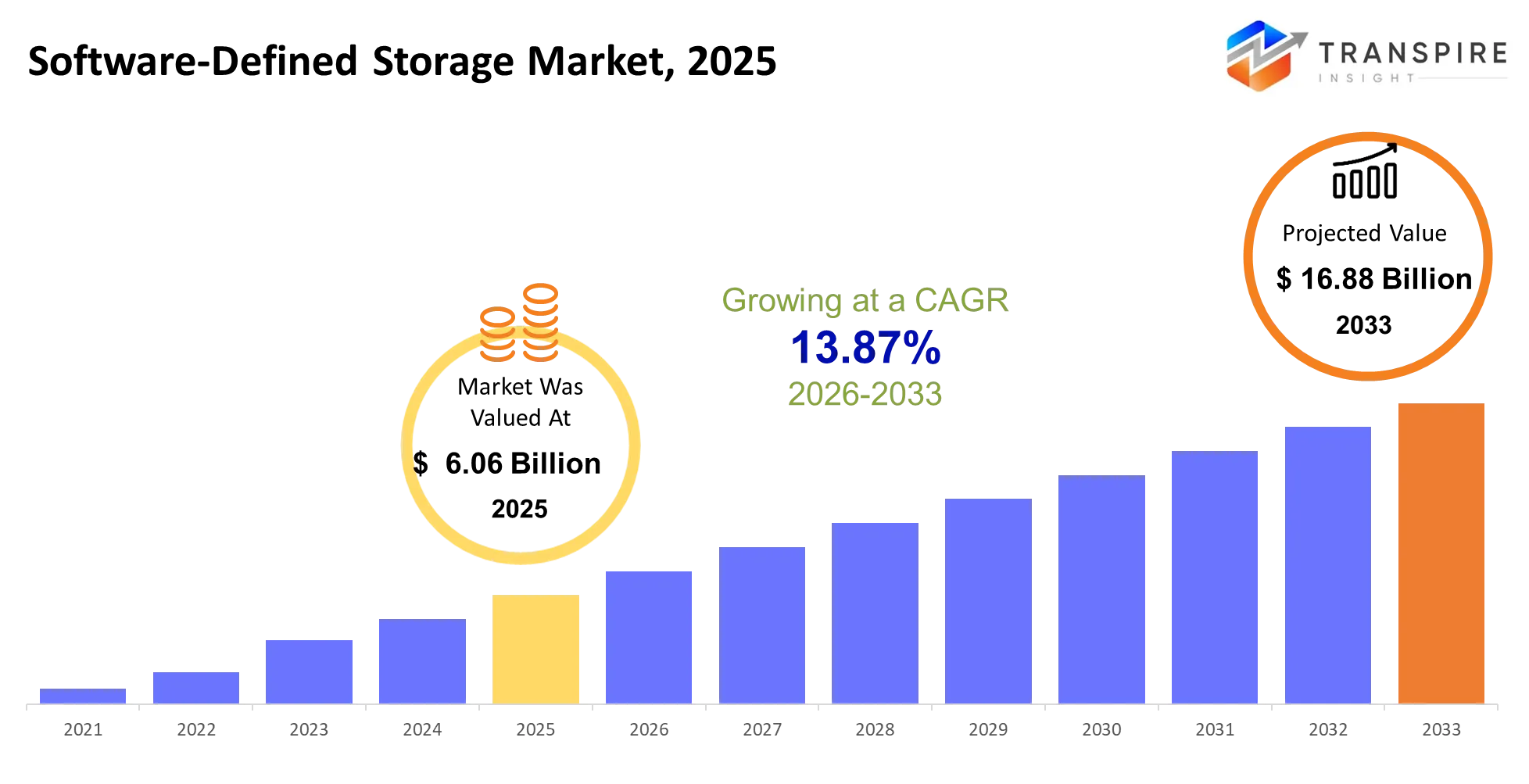
As per the Transpire Insight Analysis, The Software-Defined Storage Market size is estimated at USD 6.06 billion in 2025 and is anticipated to reach USD 16.88 billion by 2033, growing at a CAGR of 13.87% from 2026 to 2033.
The world's first wave of software-defined storage is changing the way businesses provision, move, and secure data by decoupling storage intelligence from fixed hardware. This approach allows capacity and performance to be managed across commodity servers, cloud assets, and the edge. In the past three to five years, the market has moved from basic virtualisation to disaggregated, cloud-native, and AI-aware configurations. A big structural change involves the transition to data platforms that span on-premises, private-cloud, public-cloud, and edge silos. Faster AI training and inference provide a very real use case, as GPU clusters demand higher throughput and more sophisticated data placement, while Kubernetes improves object-storage integration and automates tiering, snapshots, and replication for AI workloads. As companies look to avoid duplicating vast datasets on multiple systems, software-defined storage is also increasing optimisation, speed for applications, and flexible infrastructure economics. Essentially, this is changing the entire infrastructure.
Software-Defined Storage Market Size & Forecast:
- Market Size 2025: USD 6.06 Billion
- Expected Market Value (2033): USD 16.88 Billion
- Forecast CAGR (2026–2033): 13.87%
- Leading Region in 2025: North America
- Fastest Growing Region: Asia-Pacific
- Key Company Profiles: Dell Technologies, Hewlett Packard Enterprise, IBM, NetApp, Nutanix, Broadcom, Pure Storage, Hitachi Vantara, Huawei, Fujitsu, Lenovo, DataCore Software, Red Hat, Scality, MinIO.
Key Software-Defined Storage Market Insights:
Software-defined storage is becoming a data-control layer for AI, hybrid cloud, cyber recovery, and edge operations, rather than just a cheaper option to proprietary arrays. The investment focus is shifting towards policy-driven, portable data services that maintain performance and sovereignty across a mixed infrastructure.
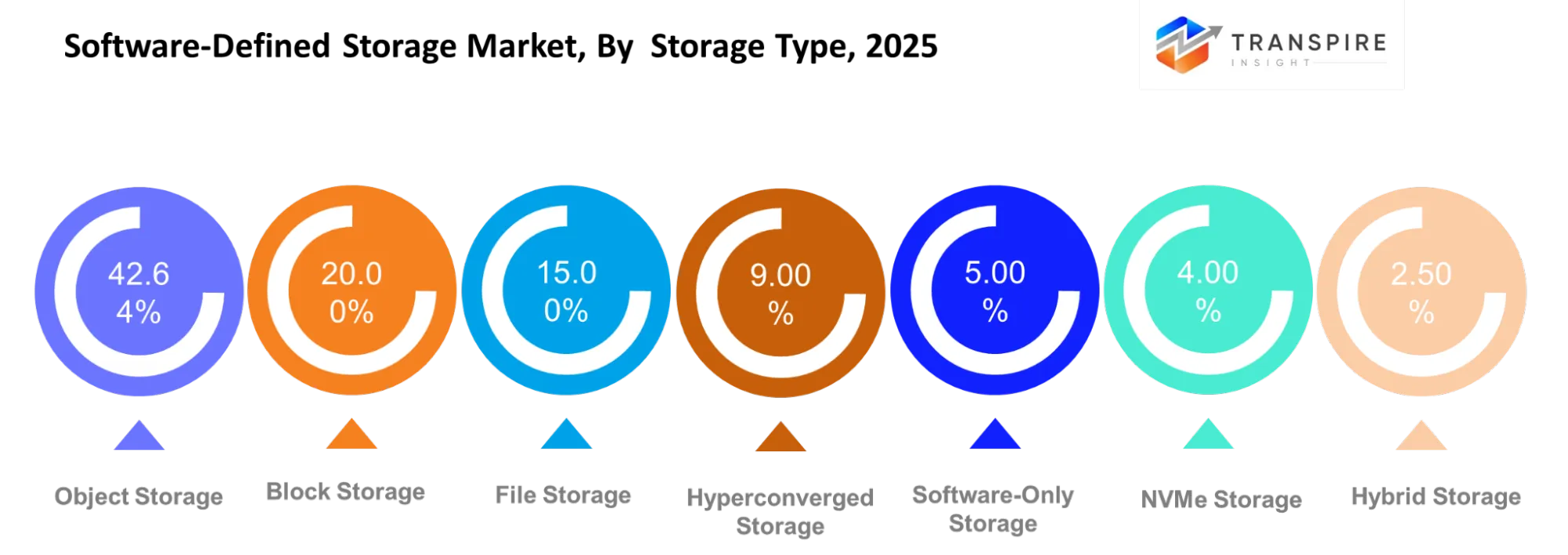
- At 42.64%, object storage is the most popular base for AI data lakes, while MinIO's AIStor is designed to handle S3-scale unstructured-data pipelines.
- Database relevance is maintained with Block storage (20.00%), and Dell is introducing QLC PowerStore capacity and Nutanix integration for private-cloud workloads.
- File storage, 15.00%, is undergoing a redesign for faster AI ingestion, with Dell PowerScale reporting 220% faster streaming writes.
- Hyperconverged storage (9.00%) is expanding beyond virtual machines; Nutanix–Pure Storage integration enables flexible and high-performance infrastructure.
- At 5.00%, software-only storage is hardware-independent, and DataCore is expanding virtualised storage from core sites to edge and cloud.
- At 4.00%, NVMe storage is moving to shared, low-latency fabrics; Nutanix and Pure are implementing NVMe/TCP to connect external FlashArray systems.
- At 2.50%, hybrid storage is becoming a more popular option for cloud bursting under governance as businesses weigh cloud costs against local control.
- At 1.86%, distributed storage is becoming more relevant to AI/HPC; DataCore's parallel file system is designed for up to 180 GBps throughput.
- Customer demand for location-aware, compliant data mobility is driving hybrid cloud deployment, which grew by 26.55%.
What are the Key Drivers, Restraints, and Opportunities in the Software-Defined Storage Market?
Driver:
Enterprise storage modernization is being driven by the collision of AI-scale data creation, containerised applications, and hybrid-cloud operating models. Traditional arrays are often sized and managed separately for each application, creating idle capacity, slow provisioning, and costly refresh cycles. SDS addresses this by abstracting storage services from underlying hardware, allowing organisations to automate provisioning and use commodity infrastructure where appropriate. The trigger has been production AI and data-intensive workloads, which require scalable object repositories, high-throughput data pipelines, and repeatable environments across private and public clouds. This increases spending not only on SDS licenses, but also on integration, migration, support, security, and managed services. Hybrid deployment is particularly important because regulated enterprises want cloud-scale capacity while retaining control over sensitive records; it is projected to grow at a 26.55% CAGR.
Restraint:
Legacy integration remains the principal barrier. Banks, telecom operators, hospitals, and manufacturers operate mixed estates containing proprietary arrays, older applications, virtual machines, and established backup tools. Migrating data without disrupting service levels is difficult, while latency-sensitive databases may not tolerate inconsistent performance. The constraint persists because SDS requires new operational skills in automation, networking, policy management, and cloud-native orchestration; it is not simply a hardware replacement.
Opportunity:
Sovereign hybrid storage is a major opportunity for SDS providers as regulated organizations seek cloud scalability without losing control over sensitive data. Platforms that support local data placement, customer-managed encryption keys, immutable backups, and controlled cloud bursting can address compliance-heavy workloads in banking, healthcare, government, and telecom. Investments in NVMe-over-TCP, Kubernetes-native data services, and S3-compatible object storage will strengthen AI data pipelines across Europe, India, and other markets prioritising data residency, auditability, and operational resilience.
What Has the Impact of Artificial Intelligence Been on the Software-Defined Storage Market?
AI makes software-defined storage (SDS) more autonomous and automated. AI/ML models can use telemetry streams from storage nodes, networks, workloads, and failure logs to detect suspicious latency, rebalance data, recommend tiering policies, and forecast drives, controllers, or capacity pools nearing saturation. AI eliminates manual troubleshooting processes and guides administrators' placement of high-performance storage to database instances or model-training workloads while shifting colder data to an inexpensive object tier.
AI/ML workloads also add to the demand for SDS. Training and inference pipelines generate huge streams of unstructured data, checkpoints, feature stores, and backup copies, and S3-based object storage is scaled out across a series of connected locations. An enterprise survey found that 48% of respondents ran AI/ML pipelines through a hybrid on-premises-public cloud model, highlighting the need for portable storage policies across the two environments. There are challenges to AI-driven storage, as these operations are sensitive to the availability of clean telemetry, integrated tooling, and accurate workload baselines. Enterprises with heterogeneous legacy storage array investments face high integration costs, and leeway on recommendations may jeopardise latency-bound performance. AI most accurately augments operations where comprehensive data visibility, policy controls, and architecture standardisation are in place.
In February 2026, IBM launched FlashSystem.ai as an embedded automated operational layer across its storage portfolio. This integration leverages AI telemetry models trained on system behaviour to autonomously execute capacity provisioning, workload placement, and remediation, directly reducing manual administrative intervention and stabilizing performance across enterprise environments.https://newsroom.ibm.com/next-generation-ibm-flashsystem-portfolio
Key Software-Defined Storage Market Trends:
The market is shifting from hardware-centric capacity management to programmable storage designed for AI, hybrid cloud, and resilience. The biggest change is the ability to store data that can automatically place, protect, and expose data where compute runs.
- Object storage is shifting from archival storage to becoming the primary storage for AI datasets, backups, analytics, and cloud-native applications.
- While some companies choose to move all their data to the cloud, others are opting for hybrid cloud, keeping some data on-site and cloud bursting when needed.
- Kubernetes integration is driving buyers to storage platforms that can provide automated provisioning, snapshots, and persistent-volume support.
- Immutable snapshots, isolated recovery copies, encryption, and policy-driven backup workflows are being adopted as the number of ransomware attacks rises.
- NVMe-over-TCP and disaggregated architectures are getting faster access to high-performance shared storage without being constrained by a single server.
- Location-aware replication, regional storage policies, and customer-controlled encryption keys are driven by data-sovereignty requirements.
- Manufacturers, retailers, telecom companies, and media organisations are processing data closer to the source, leading to the growth of edge deployments.
- Vendors are integrating AI-driven telemetry analysis to identify anomalies, predict capacity, and automate workload placement.
Software-Defined Storage Market Segmentation
Storage Type:
Object Storage holds the largest position at 42.64%, driven by AI datasets, data lakes, and unstructured-data repositories. Block Storage accounts for 20.00%, supporting databases and transaction-intensive applications, while File Storage represents 15.00% for shared enterprise workloads. Hyperconverged Storage contributes 9.00%, supporting integrated compute and storage environments. Software-Only Storage holds 5.00%, reflecting hardware-independent deployment, while NVMe Storage represents 4.00% for low-latency workloads. Hybrid Storage accounts for 2.50%, and Distributed Storage 1.86%, gaining relevance through flexible scaling, workload portability, and geographically distributed data management.
Deployment:
Public Cloud, Private Cloud and On-Premise remain important, while Hybrid Cloud records 26.55% CAGR, driven by enterprises balancing local data control with elastic cloud capacity. Edge deployments support latency-sensitive analytics, while Colocation and Hosted environments provide scalable infrastructure without full facility ownership. Multi-Cloud adoption is also expanding as organisations seek workload portability and reduce dependence on individual providers. Europe’s evolving cloud-sovereignty agenda is reinforcing investment in infrastructure that provides stronger control over data location, resilience and operational dependencies.
Organization Size:
Large Enterprises represent the principal adoption base because complex IT estates require centralised storage policies, automated provisioning and consistent protection across environments. SMEs are adopting software-defined infrastructure to avoid substantial hardware commitments, while Startups benefit from cloud-native deployment and rapid capacity expansion. Government organizations prioritize controlled data environments and procurement compliance, whereas Education institutions seek flexible infrastructure for research and digital learning. Healthcare requires scalable, governed storage capable of handling sensitive records and high-volume imaging workloads.
End User:
BFSI and Healthcare emphasise encrypted replication, retention policies and rapid disaster recovery because operational disruption carries significant financial and compliance consequences. IT & Telecom organizations prioritize distributed performance and automated infrastructure management across geographically dispersed environments. Manufacturing increasingly uses SDS to support analytics and machine-generated datasets, while Retail applies it to transaction systems and video analytics. Government, Media & Entertainment, and Education are expanding adoption for protected archives, digital content, research datasets, and increasingly AI-enabled applications.
Architecture:
Scale-Out and Disaggregated architectures are gaining strategic importance because they allow storage capacity and compute resources to scale independently, reducing infrastructure bottlenecks. Hyperconverged designs remain attractive where simplified deployment and centralised management are priorities. Distributed and Cloud-Native architectures support geographically dispersed applications, while Edge designs address latency-sensitive processing. Composable infrastructure provides greater resource flexibility by assembling storage and compute dynamically. Scale-Up architectures remain relevant for predictable enterprise workloads where centralised performance, simpler administration and established application compatibility outweigh independent scaling requirements.
Service:
Consulting and Integration remain important because enterprises must connect SDS platforms with existing storage, applications, networks and security systems. Migration services reduce disruption when organisations move from hardware-dependent architectures toward software-managed environments, while Security services address ransomware protection, access controls and regulatory requirements. Managed Services increasingly support organisations lacking specialised storage expertise, while Support and Maintenance sustain operational continuity. Training helps internal teams manage new platforms, and ongoing optimisation improves resource utilisation as workloads shift toward AI, hybrid-cloud and distributed environments.
What are the Key Use Cases Driving the Software-Defined Storage Market?
The core SDS use case is large-scale object storage for unstructured data. Enterprises deploy it for AI datasets, data lakes, surveillance footage, media libraries, logs, and protected backups, while S3-compatible access enables data portability across private and public environments.
Expanding applications include virtual-machine clusters, private clouds, databases, and container platforms. Block storage supports transaction-intensive workloads, while file storage serves engineering collaboration, healthcare imaging, and media production. BFSI and healthcare organisations increasingly apply SDS for encrypted replication, retention policies, and disaster recovery.
Emerging demand is coming from edge computing and AI operations. Manufacturers process machine-vision data locally, retailers analyse store video, and telecom operators manage distributed network functions. Hybrid architectures combine local responsiveness with centralised analytics, governance, and scalable data management.
|
Report Metrics |
Details |
|
Market size value in 2025 |
USD 6.06 Billion |
|
Market size value in 2026 |
USD 6.80 Billion |
|
Revenue forecast in 2033 |
USD 16.88 Billion |
|
Growth rate |
CAGR of 13.87% from 2026 to 2033 |
|
Base year |
2025 |
|
Historical data |
2021 - 2024 |
|
Forecast period |
2026 - 2033 |
|
Report coverage |
Revenue forecast, competitive landscape, growth factors, and trends |
|
Regional scope |
United States; Canada; Mexico; United Kingdom; Germany; France; Italy; Spain; Denmark; Sweden; Norway; China; Japan; India; Australia; South Korea; Thailand; Brazil; Argentina; South Africa; Saudi Arabia; United Arab Emirates |
|
Key companies profiled |
Dell Technologies, Hewlett Packard Enterprise, IBM, NetApp, Nutanix, Broadcom, Pure Storage, Hitachi Vantara, Huawei, Fujitsu, Lenovo, DataCore Software, Red Hat, Scality, MinIO. |
|
Customization scope |
Free report customisation (country, regional & segment scope). Available customised purchase options to meet your exact research needs. |
|
Report Segmentation |
Storage Type (Block Storage, File Storage, Object Storage, Hyperconverged Storage, Software-Only Storage, NVMe Storage, Hybrid Storage, Distributed Storage); Deployment (Public Cloud, Private Cloud, Hybrid Cloud, On-Premise, Edge, Colocation, Hosted, Multi-Cloud); Organization Size (Large Enterprises, SMEs, Startups, Government, Education, Healthcare, Media & Entertainment, Others); End User (BFSI, IT & Telecom, Healthcare, Retail, Manufacturing, Government, Media & Entertainment, Education); Architecture (Scale-Up, Scale-Out, Hyperconverged, Disaggregated, Distributed, Cloud-Native, Edge, Composable); Service (Consulting, Integration, Managed Services, Support, Maintenance, Training, Migration, Security) |
Which Regions are Driving the Software-Defined Storage Market Growth?
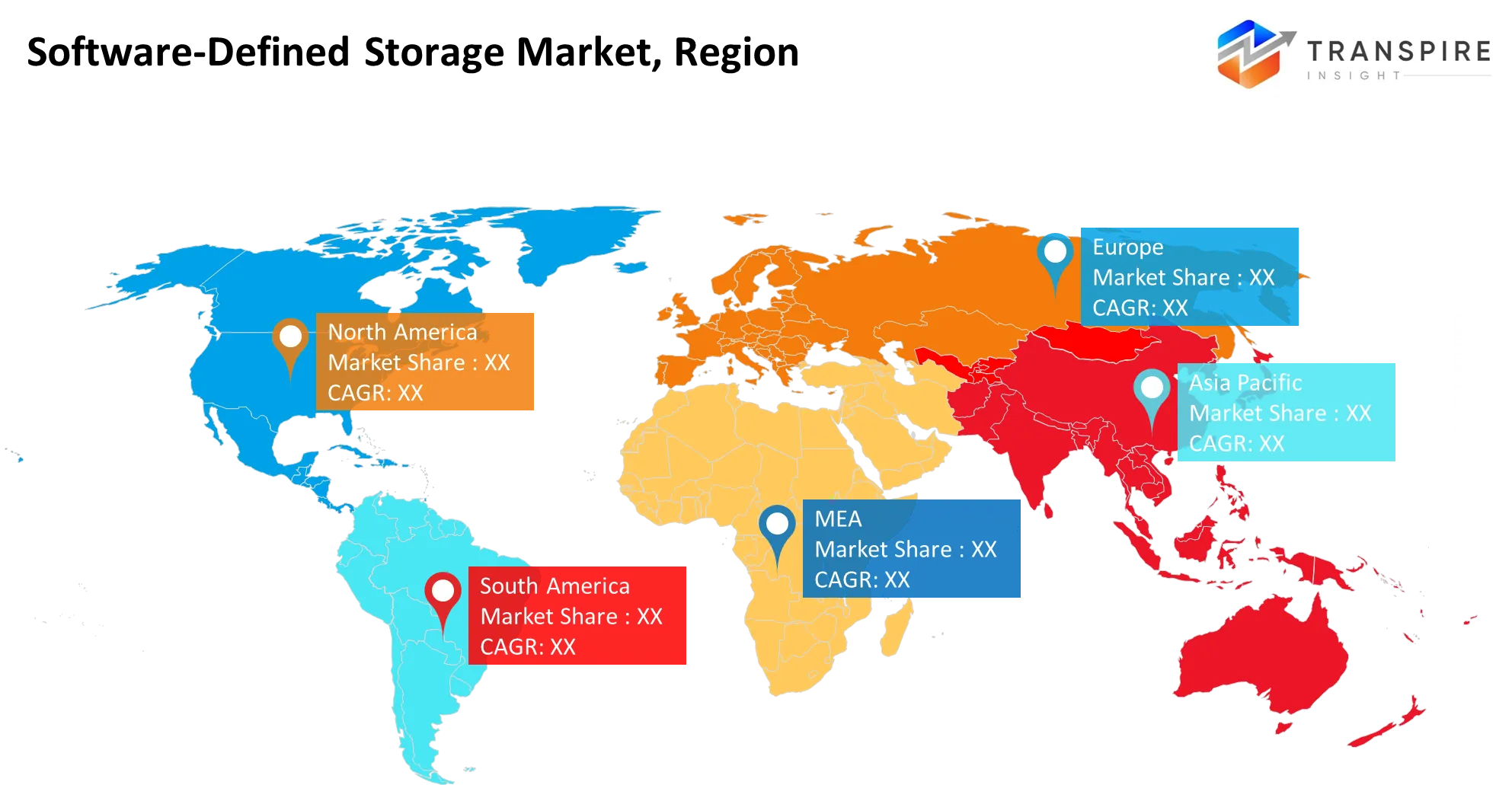
North America leads the market with a 38.73% share as high levels of enterprise investment in AI infrastructure, cyber recovery, and private-cloud modernisation support North American cloud leadership. North America benefits from deep hyperscale-cloud, colocation, semiconductor and storage-vendor markets. Fully matured enterprises are increasingly evaluating the economics of public-cloud storage for stable and GPU-optimized workloads, choosing more flexible private or hybrid platforms. North American cloud adoption, highly developed data-centre capacity and many core technology buyers keep it at the top.
In February 2026, Amazon Web Services (AWS) announced a $12 billion investment to build an advanced data centre campus in Louisiana. This footprint expansion dramatically scales high-density compute and inference capacity to support mature enterprises handling GPU-heavy, steady-state AI workloads while alleviating local infrastructure constraints.https://www.crn.com/news/ai/2026/aws-220b-ai-plan-is-driving-a-sales-flywheel-effect-ai-chief-explains-not-investing-on-a-whim
Europe accounts for 24.00% of market demand, but the approach to growth differs from the capacity-driven AI model. GDPR, the European Union AI Act, and more rigorous data governance expectations are prompting local infrastructure, managed encryption keys, and confirmable data residency. This makes SDS worthwhile for banks, public bodies, hospitals, and manufacturing firms that need flexible data storage solutions but want to preserve control over regulated data. Europe's institutional stability and mature manufacturing industry enable longer, compliance-driven cycles of modernisation.
In June 2026, Scality and OVHcloud expanded their technology partnership to launch a new joint sovereign cloud storage platform. This deployment delivers high-performance, cyber-resilient object storage that grants European organisations full data sovereignty and residency control without any operational dependency on third-party U.S. hyperscalers.https://www.scality.com/press-releases/scality-ovhcloud-sovereign-cloud-storage
Asia Pacific constitutes 23.50% of the market and is the fastest-growing segment at 26.45% CAGR as cloud services, telecommunications, e-commerce, and digital public service infrastructure are rapidly being put in place in both new and large economies. The current trend is from centralised storage systems to regional data centres, internal cloud capacity, edge processing, and regional AI platforms. Growing interest in India's cloud and AI industries is reflected by Microsoft's recently announced US$3 billion investment over two years, exhibiting demand for infrastructure; the opportunity is in sovereign hybrid architectures that enable organisations to comply with country-based data regulations and facilitate the rapid growth of digital services.
In June 2026, CPP Investments acquired an 8.2% stake in CtrlS Datacenters and formed a joint venture with a total commitment of up to INR 70 billion (C$1 billion). This funding accelerates the large-scale development of next-generation, AI-ready hyperscale data centre campuses across India to meet rising enterprise cloud demand.https://ca.finance.yahoo.com/news/cpp-investments-commits-c-1-092800037.html
Who are the Key Players in the Software-Defined Storage Market, and how do they compete?
Competition is focused on three leading positions: traditional infrastructure vendors with integrated platforms, cloud-native vendors with scale-out data planes, and software vendors with a hardware-agnostic position. Competition will be defined by AI throughput, ransomware resilience, multicloud mobility, Kubernetes architecture, and data residency compliance.
Dell Technologies, Hewlett Packard Enterprise (HPE), International Business Machines Corporation (IBM), Net App, Pure Storage, Hitachi Vantara, Huawei, Fujitsu, Lenovo win with enterprise installed base, flash performance, integrated service network and private-cloud footprint; HPE innovates with Alletra Storage MP X10000 for exabyte-scale object workloads, IBM combines Flash System hardware with AI-detected ransomware, Power Store integrated with Nutanix, Pure Storage combines FlashArray with Nutanix to target virtualization freedom. Nutanix, Broadcom, Data Core Software, Red Hat, Scality, MinIO focus on software, cloud-native infrastructures and specialized use cases; Nutanix points to hypervisor independence, enterprise AI, Red Hat to open source infrastructure, Data Core targets heterogeneous workloads including parallel file, Scality and MinIO on S3-compatible object store. Their production expansion will be based on channel partnerships and open interfaces, rather than hardware lock-in, and positioning with AI, container, and hyperscale data ecosystems.
Key Players are:
- Dell Technologies
- Hewlett Packard Enterprise
- IBM
- NetApp
- Nutanix
- Broadcom
- Pure Storage
- Hitachi Vantara
- Huawei
- Fujitsu
- Lenovo
- DataCore Software
- Red Hat
- Scality
- MinIO
Recent Development News
- In March 2026, JetStor partnered with Lightbits Labs to launch a next-generation high-performance software-defined block storage engine designed for private cloud infrastructure. This product release integrates JetStor's high-density NVMe-optimized hardware with Lightbits' NVMe-over-TCP protocol, eliminating the physical scaling limitations of traditional Storage Area Networks (SANs) to seamlessly run data-intensive cloud workloads.https://www.jetstor.com/news/jetstor-and-lightbits-launch-next-gen-software-defined-storage-for-private-clouds
- In June 2026, StorONE and Myota introduced a scale-out enterprise S3 storage platform combining StorONE’s storage architecture with Myota’s Cyberstorage technology. The launch targets secure, flash-efficient, and cloud-compatible storage deployments, with integrated protection against ransomware and data loss.https://www.globenewswire.com/news-release/2026/06/10/3309662/0/en/storone-and-myota-introduce-scale-out-enterprise-s3-storage-with-the-smallest-flash-footprint-and-the-highest-level-of-data-security.html
- In April 2026, Lenovo completed its acquisition of Infinidat, a prominent developer of enterprise-grade software-defined data storage systems. This structural market expansion absorbs Infinidat's multi-petabyte storage architecture directly into Lenovo's mainstream infrastructure ecosystem, immediately positioning the hardware vendor as a primary provider of high-capacity software-defined arrays for virtualised environments.https://www.crn.com/news/storage/2026/the-50-coolest-software-defined-storage-vendors-the-2026-storage-100
What Strategic Insights Define the Future of the Software-Defined Storage Market?
The market is heading towards policy-based storage fabrics with data being distributed between cloud, core and edge environments based on performance, cost, resilience and jurisdictional constraints. The unseen risk of such a fragmentation is that the speed at which enterprises can deploy diverse storage platforms might outpace their ability to consolidate identity, observability, security controls and recovery testing. This may undermine the cost reductions and automation efficiencies expected from SDS. The real opportunity is in sovereign AI storage, as the demand for massive-scale object and high-end file systems to keep training data, metadata, encryption keys and audit trails in approved locations persists under the GDPR, European Union AI Act and national localisation requirements. The key is for providers to add value with migration, immutable recovery, data ingress/egress, Kubernetes, workload telemetry and location-aware policy. For buyers, production pilots should deliver recovery, latency, and compliance guarantees using open APIs before mission-critical workloads are consolidated.
Key Segmentations are:
Storage Type
- Block Storage
- File Storage
- Object Storage
- Hyperconverged Storage
- Software-Only Storage
- NVMe Storage
- Hybrid Storage
- Distributed Storage
Deployment
- Public Cloud
- Private Cloud
- Hybrid Cloud
- On-Premise
- Edge
- Colocation
- Hosted
- Multi-Cloud
Organization Size
- Large Enterprises
- SMEs
- Startups
- Government
- Education
- Healthcare
- Media & Entertainment
- Others
End User
- BFSI
- IT & Telecom
- Healthcare
- Retail
- Manufacturing
- Government
- Media & Entertainment
- Education
Architecture
- Scale-Up
- Scale-Out
- Hyperconverged
- Disaggregated
- Distributed
- Cloud-Native
- Edge
- Composable
Service
- Consulting
- Integration
- Managed Services
- Support
- Maintenance
- Training
- Migration
- Security
By Regional Analysis
North America
- US
- Canada
- Mexico
Europe
- Germany
- UK
- France
- Italy
- Spain
- Russia
- Rest of Europe
Asia Pacific
- China
- Japan
- India
- South Korea
- Australia
- Rest of Asia Pacific
South America
- Brazil
- Argentina
- Rest of South America
Middle East & Africa
- UAE
- Saudi Arabia
- Qatar
- South Africa
- Rest of the Middle East & Africa
Frequently Asked Questions
Find quick answers to common questions.
The software-defined storage market size was valued at USD 6.06 billion in 2025 and is poised to reach USD 16.88 billion by 2033, expanding at a 13.87% CAGR.
Key segments for the software-defined storage market are Storage Type (Block Storage, File Storage, Object Storage, Hyperconverged Storage, Software-Only Storage, NVMe Storage, Hybrid Storage, Distributed Storage); Deployment (Public Cloud, Private Cloud, Hybrid Cloud, On-Premise, Edge, Colocation, Hosted, Multi-Cloud); Organization Size (Large Enterprises, SMEs, Startups, Government, Education, Healthcare, Media & Entertainment, Others); End User (BFSI, IT & Telecom, Healthcare, Retail, Manufacturing, Government, Media & Entertainment, Education); Architecture (Scale-Up, Scale-Out, Hyperconverged, Disaggregated, Distributed, Cloud-Native, Edge, Composable); Service (Consulting, Integration, Managed Services, Support, Maintenance, Training, Migration, Security).
Growth is primarily driven by AI and data-intensive workloads, hybrid-cloud adoption, Kubernetes-based infrastructure, demand for scalable storage, cyber-resilience requirements, and migration from hardware-dependent storage to disaggregated architectures.
The software-defined storage market is led by major manufacturers including Dell Technologies, Hewlett Packard Enterprise, IBM, NetApp, Nutanix, Broadcom, Pure Storage, Hitachi Vantara, Huawei, Fujitsu, Lenovo, DataCore Software, Red Hat, Scality, and MinIO.
North America holds 38.73% of the market, supported by advanced data-centre infrastructure, AI investment, hyperscale cloud adoption, enterprise modernisation, and strong technology ecosystems.
Key opportunities include AI-native storage, hybrid-cloud platforms, disaggregated NVMe infrastructure, Kubernetes storage, edge deployments, cyber-resilient architectures, and sovereign-cloud solutions.
- Dell Technologies
- Hewlett Packard Enterprise
- IBM
- NetApp
- Nutanix
- Broadcom
- Pure Storage
- Hitachi Vantara
- Huawei
- Fujitsu
- Lenovo
- DataCore Software
- Red Hat
- Scality
- MinIO
About the Authors

Mayur Shinde
I am Mayur Shinde, a Senior Research Analyst at Transpire Insight, specializing in the Automotive & Transportation and Information & Communication Technology (ICT) Industry. My work focuses on analyzing emerging market trends, technological advancements, competitive landscapes, and industry developments to deliver accurate, data-driven insights. I am passionate about transforming complex market information into clear, actionable content that helps businesses, professionals, and decision-makers stay informed and make confident strategic decisions.

Chakradhar Khansole
Chakradhar serves as the Research Director at Transpire Insight, bringing over 8 years of experience in technology, innovation, and strategic market intelligence. He specializes in transforming complex market data into actionable business insights that enable organizations to make informed, growth-oriented decisions. Recognized for his strategic vision and analytical expertise, Chakradhar leads high-impact research initiatives, delivering comprehensive market assessments, competitive intelligence, and forward-looking industry analysis.
Recently Published Reports
-
Apr 2026
3D Optical Profiler Market
3D Optical Profiler Market Size, Share & Analysis Report By Type (Desktop 3D Optical Profiler, and Portable 3D Optical Profiler), By Technology (Confocal Technology, and White Light Interference), By End-Use Industry (Manufacturing, Research Institutions, Automotive, Aerospace and Defense, Medical Devices, and Other), and Geography (North America, Europe, Asia-Pacific, Middle East and Africa, South and Central America), 2021 - 2031
-
Apr 2026
Depth Sensor Market
Depth Sensor Market Size, Share & Analysis Report By Type (Infrared Depth Sensors, Time-of-Flight (ToF) Sensors, Stereo Vision Sensors, Structured Light Sensors, Ultrasonic Depth Sensors), By Application (Automotive, Robotics, Gaming, Consumer Electronics, Industrial Automation, Healthcare, Security & Surveillance, Others), By End Users (Automotive Manufacturers, Consumer Electronics Companies, Healthcare Providers, Industrial Companies, Security Agencies, Gaming Companies, Robotics Companies, Others), and Geography (North America, Europe, Asia-Pacific, Middle East and Africa, South and Central America), 2021 – 2031
-
Apr 2026
Digital Manufacturing Market
Digital Manufacturing Market Size, Share & Analysis Report By Component (Hardware, Software, and Services), By Technology (Robotics, 3D Printing, Internet of Things (IoT), and Others), By Application (Automotive and Transportation, Aerospace and Defense, Consumer Electronics, Industrial Machinery, and Others), By Process Type (Computer-Based Designing, Computer-Based Simulation, Computer 3D Visualization, Analytics, and Others), and Geography (North America, Europe, Asia-Pacific, Middle East and Africa, South and Central America), 2021 – 2031
-
Apr 2026
Digital Visa Services Market
Digital Visa Services Market Size, Share & Analysis Report By Type (Individual Travelers, Group Travelers), By Application (Tourism, Business Travel, Others), and Geography (North America, Europe, Asia-Pacific, Middle East and Africa, South and Central America), 2021 – 2031