
South Korea Staple Food Market Size & Forecast:
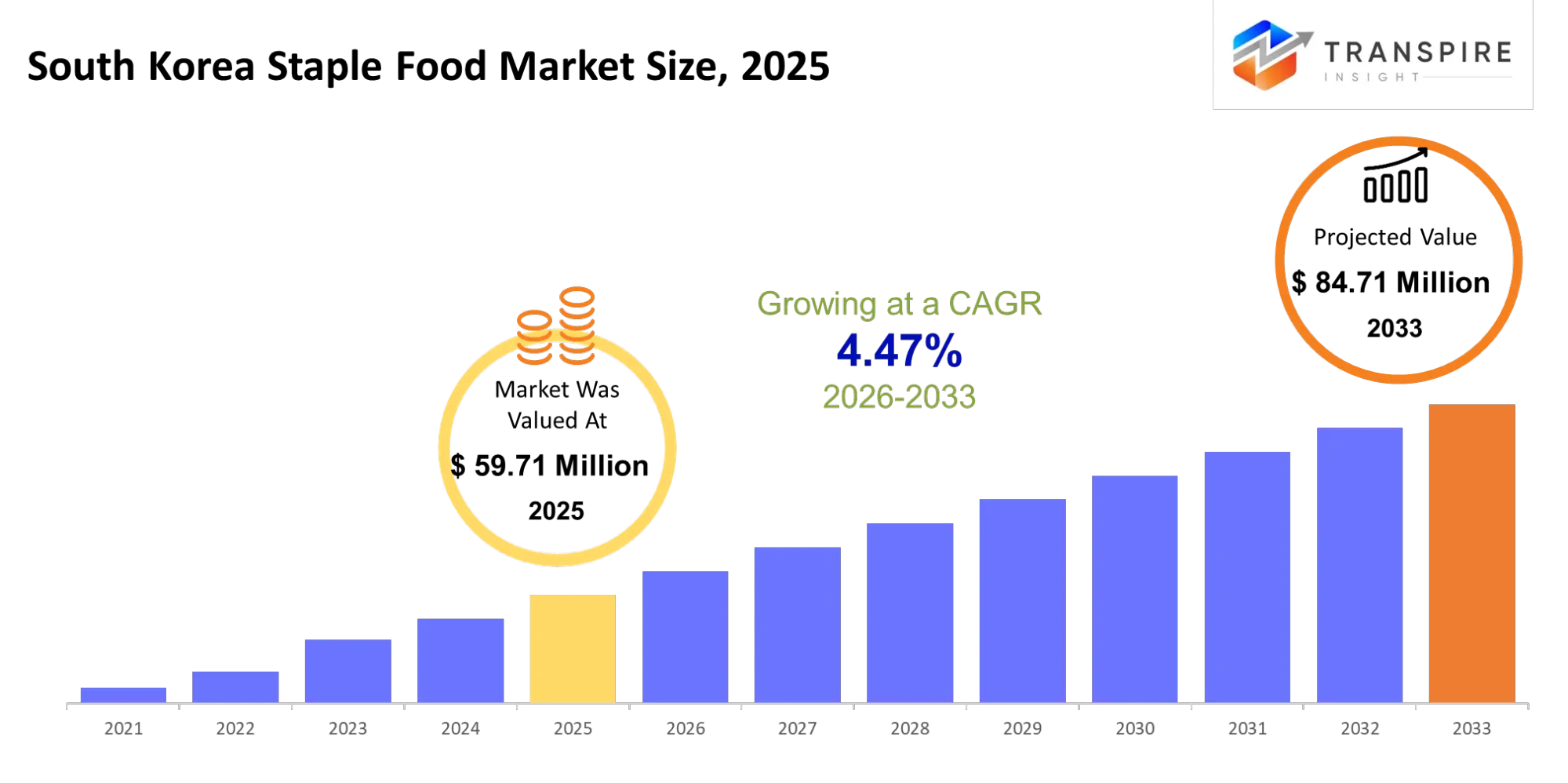
- South Korea Staple Food Market Size 2025: USD 59.71 Billion
- South Korea Staple Food Market Size 2033: USD 84.71 Billion
- South Korea Staple Food Market CAGR: 4.47%
- South Korea Staple Food Market Segments: By Product Type (Rice, Wheat Products, Noodles, Bread, Cereals, Others); By Distribution Channel (Supermarkets, Convenience Stores, Online, Others); By End User (Households, Foodservice, Institutions, Others)
To learn more about this report,  Download Free Sample Report
South Korea Staple Food Market Summary
The South Korea Staple Food Market was valued at USD 59.71 Billionin 2025. It is forecast to reach USD 84.71 Billion by 2033. That is a CAGR of 4.47%over the period.
The South Korea staple food market, kinda keeps national food security and everyday nutrition going, mainly through big scale production and distribution of rice, noodles, bread, cereals and other processed wheat goods. Food makers, retailers, and foodservice teams kinda lean on steady staple food supply chains so they can deal with shifting eating habits and urban routines , plus that convenience first meal craving. Packaged staple foods also hit hard for institutional catering, restaurant workflows, and even emergency food distribution nets across the country.
In the last three to five years, the whole market vibe shifted away from plain bulk staples toward more premium, convenience oriented, health minded packaged formats. A pretty rapid rise in single person homes and that busy city work culture made people gravitate more toward ready to cook rice meals, instant noodles, and portion controlled bakery items. At the same time, global grain price swings and supply chain disruptions after the Russia Ukraine conflict, changed how manufacturers and distributors buy and plan things. So, a lot of companies pushed forward with domestic sourcing approaches, inventory management systems, and more value added processed foods, to lower supply risks and protect their operating margins. This shift also opened up real revenue chances for packaged food brands that can balance affordability longer shelf life, and true day to day convenience across both modern retail and online channels.
Key Market Insights
- South Korea Staple Food Market is kinda moving fast, toward convenience-first , premium, and more health oriented packaged food eating habits, mainly because of urban lifestyles and how much digital retail is growing. Overall, the market is still expected to show pretty steady forecasted gains through 2032, as food makers keep pushing processed food innovation, plus they try to improve supply chain resilience too.
- The Seoul metropolitan region still dominates the South Korea Staple Food Market, taking in close to 45% of revenue share in 2025, largely from the dense web of retail and foodservice operations.
- Busan turned out to be the fastest-growing regional market through 2032, mostly because convenience food demand and online grocery penetration rose quickly after 2023, like almost all at once.
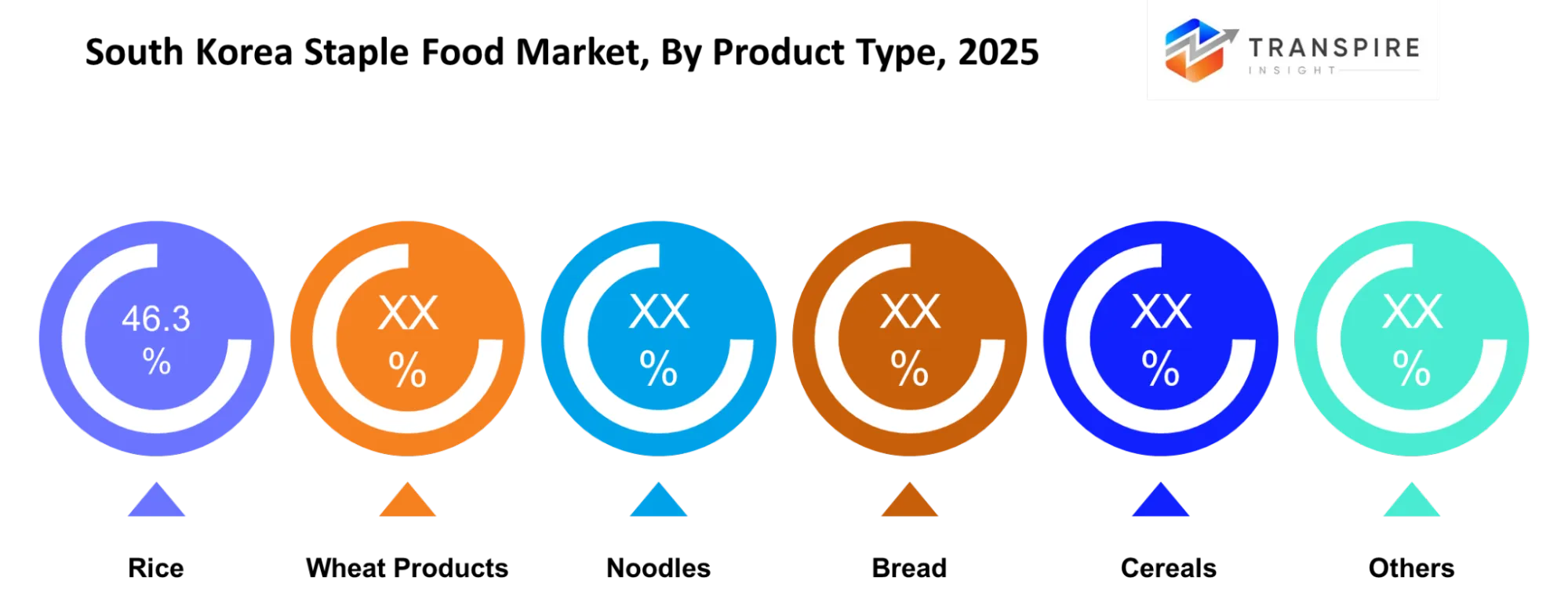
- Rice products held a strong market position in 2025, since packaged cooked rice plus ready-to-eat meal styles kept matching the way urban households buy food now.
- Noodles stayed in the #2 spot for segments, with instant meal consumption increasing among single-person households and younger working groups.
- Functional cereals, along with protein enriched bakery products, are seeing the quickest demand growth , driven by more health centered dietary purchasing behavior after 2022.
- Supermarkets and hypermarkets generated over 48% of distribution share, because big retailers widened their premium packaged food ranges , and also grew private-label staple food portfolios.
- Online grocery platforms are the fastest-growing distribution channel, after people rapidly adopted same day delivery and subscription style food purchasing models.
- Household consumption lead the South Korea Staple Food Market, helped by ongoing needs for shelf stable packaged foods, and portion controlled meal products that fit busy routines.
- Foodservice operators boosted procurement of frozen rice meals and processed wheat products to improve kitchen efficiency and reduce labor cost m
What are the Key Drivers, Restraints, and Opportunities in the South Korea Staple Food Market?
The strongest driver really shaping the South Korea staple food market is this kind of structural shift toward convenience centered buying, backed by urban household changes and the faster growth of digital grocery channels. More and more single-person households ,and people working longer hours, basically pushed demand upward for ready-to-eat rice meals, instant noodles, and packaged bakery items that cut preparation time. Then retail modernization plus same day delivery systems made products easier to reach, and that tends to raise purchase frequency, while also widening revenue potential for packaged food manufacturers. Food businesses then adjusted too, scaling automated production lines and using data-driven demand forecasting to keep supply steadier, and to support tighter margin control, even when demand swings a bit.
One key restraint comes from volatility in the global grain and wheat supply chain ,which directly drags production costs and can shake pricing stability for staple food manufacturers. This is structural, since South Korea depends strongly on imported agricultural commodities ,meaning the whole sector is exposed to outside shocks like geopolitical disruptions and climate related harvest irregularities. Those price shifts also reduce the ability to keep stable long-term contracts between suppliers and retailers, so product rollout can get delayed and processors end up with less predictable profit margins.
A major opportunity is taking shape around health focused functional staple foods and smart nutrition products, especially aimed at aging populations and wellness aware urban consumers. Companies are putting money into fortified rice, high-protein noodles, and low-sodium packaged meals , supported by precision food processing technologies. Places like Seoul and Incheon are turning into sort of testing grounds for subscription based smart grocery systems, that link personalized diet tracking with automated food delivery.
What Has the Impact of Artificial Intelligence Been on the South Korea Staple Food Market?
Artificial intelligence and advanced digital technologies are kinda reshaping staple food production and distribution in South Korea, mostly by improving demand forecasting , production scheduling, and retail inventory optimization. Food manufacturers are leaning on AI-driven automation systems that manage production lines for rice, noodles, and packaged bakery goods, and that cuts down on manual interference . It also keeps output quality more steady. Retailers and e-commerce platforms then apply machine learning models for shelf replenishment, plus dynamic pricing so items move quicker and waste drops across perishable and semi-perishable inventory channels. In practice these tools help day to day efficiency, because they reduce stockouts and also lower storage related losses.
Predictive analytics tools are getting more common for anticipating raw material needs from seasonal demand patterns , and past consumption records. At the same time machine learning models help production planning by forecasting shifts in city based consumption behaviors, especially in convenience and ready-to-eat segments. As a result the supply chain becomes more responsive, and some manufacturers mention smoother production cycles, along with fewer distribution delays. In logistics, AI-enabled route optimization systems help reduce transportation costs, plus they improve delivery speed across dense urban areas.
Still, there’s a major snag that remains, namely the high integration cost of AI systems inside legacy food processing and distribution infrastructure. A lot of mid-sized food companies deal with fragmented data setups, and they often lack standardized digital architecture. This makes large scale rollout slower, and it can also reduce model accuracy in real world operations environments.
Key Market Trends
- Since 2022, the consumption of packaged rice and instant meal items moved up quite sharply, mostly because single-person households kept expanding across Seoul and Busan, metro regions.
- Retailers also seemed to shrink the bulk staple assortment a bit after 2021, so the shelf space kind of slid over into premium boxed products and portion-controlled convenience formats .
- At the same time online grocery platforms kept pushing staple food sales share, and in 2025 it went past 30% thanks to the rapid rollout of same day delivery capability. later, after 2023, manufacturers leaned more into AI-based demand forecasting systems to keep production schedules steadier, and also to lower inventory waste.
- Global wheat price swings during 2022–2024 then made Korean food processors adjust, they diversified sourcing plans and tightened domestic procurement agreements.
- CJ CheilJedang also expanded automated production lines for ready-to-eat rice and processed meal goods after 2023, driven by those efficiency upgrades .
- Nongshim, for its part, put more money into overseas manufacturing, partly to balance domestic cost pressure and to support export-led growth that feels more reliable.
- meanwhile health-leaning staple options, like high-protein noodles and fortified cereals, started catching on after 2023 among younger city consumers.
- Foodservice operators, meanwhile, increased purchasing of pre-cooked staple food products because it reduced labor reliance and improved kitchen efficiency.
- And by 2025, subscription grocery services grew fast too, nudging traditional shopping behavior toward recurring automated deliveries of staple goods.
South Korea Staple Food Market Segmentation
By Product Type
Rice is still kind of a core product category, because everyday meals in households and institutions keep leaning on familiar rice consumption patterns. Packaged rice , and ready-to-cook rice formats, got more take-up as urban consumers drifted toward convenience focused meal prep, even if it feels slightly quicker than it used to be. To keep things rolling manufacturers ramped up output of processed rice products too, aiming for longer shelf-life and smoother transport through retail shelves. So, demand stability in rice products should keep nudging steady revenue for staple food producers for quite a while
Wheat products also became more important over time, particularly for bakery items, noodles, and other processed wheat foods that spread through modern retail and foodservice. Noodles held up well because they match quick cooking expectations among working populations , and also among single-person households. Bread and cereals had a gradual uptick, as morning routines moved toward ready-to-eat packaged options. Overall, this diversification across wheat based categories helped widen consumer adoption in urban markets , kinda continuously and broadly.
To learn more about this report, Download Free Sample Report
By Distribution Channel
Honestly, supermarkets still stay as one of the top distribution channels, mainly because big retail chains bring a broad product lineup and keep a steadier, almost reliable supply of staple food items too. Convenience stores kinda expanded more in city areas , by selling single-serve packs and ready to eat packaged staples, which sounds simple but it really fits the day to day rhythm. Then online channels really took off, mostly because same day delivery options made it easier to reach groceries when households need them not later . Other distribution routes stayed smaller but they were still pretty stable, across things like institutional buyers and local retail spots.
Online distribution got serious momentum when digital grocery platforms improved logistics efficiency, and also pushed more subscription based food delivery services. Supermarkets kept adapting, for example giving more shelf space to premium staple food and health focused staple food products. Convenience stores also leaned in, targeting quick meal consumption patterns, especially in high density urban neighborhoods. Overall, that shift across distribution channels helped people get staples more easily, and it also supported a higher purchase frequency across the staple food categories.
By End User
Households still sit as the biggest end-user group, not just because daily nutrition needs keep showing up, but also because packaged food consumption just keeps being consistent, and that staple level demand remains kinda steady. With urban living changes, people leaned more on convenience driven packaged meals, plus those portion-controlled food products , which sort of fit busy schedules. In response, manufacturers rolled out product innovations meant to make cooking faster , and to stretch storage life longer. So overall, household demand stability should keep backing core market growth across the different product categories.
On the other hand, foodservice operators began buying more processed staple foods, mainly to boost kitchen efficiency and to reduce labor dependency , especially in high-volume operations. Institutions like schools and hospitals kept buying in a steady way, relying on standardized packaged food supply chains. Meanwhile, other end users added smaller but still reliable demand through catering setups and specialized food distribution systems. This kind of end-user diversification adds resilience to the market, and it also helps keep product innovation moving across staple food offerings.
What are the Key Use Cases Driving the South Korea Staple Food Market?
Household meal consumption still feels like the main use case in the South Korea Staple Food Market, sort of, because urban consumers basically lean on packaged rice, noodles and bread for day to day nutrition. The demand stays pretty high too, since busy work schedules, single person households and even a little preference for fast prep meal options that really cut down cooking time, they all weigh in.
At the same time, foodservice operations and institutional catering are getting more attention, not just a side note. restaurants, schools and hospitals are starting to adopt processed staple foods so they can run smoother, and keep a steady meal quality. convenience stores also push this along, because they offer ready to eat packaged meals for quick break snacks, especially in those crowded urban areas where time matters.
More lately, you can spot newer use cases like subscription based smart grocery systems, delivering customized staple food bundles based on dietary patterns and consumption history. And on top of that, industrial workforce canteen automation plus AI supported meal planning systems in smart factories look like they have a strong upside, for adoption across manufacturing hubs and those clustered production zones.
|
Report Metrics |
Details |
|
Market size value in 2025 |
USD 59.71 Billion |
|
Market size value in 2026 |
USD 62.38 Billion |
|
Revenue forecast in 2033 |
USD 84.71 Billion |
|
Growth rate |
CAGR of 4.47%from 2026 to 2033 |
|
Base year |
2025 |
|
Historical data |
2021 - 2024 |
|
Forecast period |
2026 - 2033 |
|
Report coverage |
Revenue forecast, competitive landscape, growth factors, and trends |
|
Regional scope |
South Korea |
|
Key company profiled |
CJ CheilJedang, Nongshim, Ottogi, Daesang, Samyang, Lotte, SPC Group, Orion, Dongwon, Pulmuone, Nestle, PepsiCo, Unilever, General Mills, Kellogg's |
|
Customization scope |
Free report customization (country, regional & segment scope). Avail customized purchase options to meet your exact research needs. |
|
Report Segmentation |
By Product Type (Rice, Wheat Products, Noodles, Bread, Cereals, Others); By Distribution Channel (Supermarkets, Convenience Stores, Online, Others); By End User (Households, Foodservice, Institutions, Others) |
Which Regions are Driving the South Korea Staple Food Market Growth?
Seoul metropolitan region pretty much leads the South Korea Staple Food Market , mostly because it bunches together the highest population density, retail networks and overall foodservice pull. The logistics side is strong enough to push packaged rice, noodles, bread, and cereals quickly across supermarkets and convenience stores , so the whole supply rhythm stays tight. On top of that, government supported food safety rules, plus the digital retail expansion, keep the distribution systems more standardized in this area. There’s also this busy web of producers, retailers, and online grocery platforms, which basically means products stay on shelves, with high consumption frequency.
Then Busan shows up as the second major region, mainly from port linked trade activity and the way its industrial workforce consumes food. Compared with Seoul’s retail driven demand, Busan leans harder into foodservice supply chains, institutional catering, and export oriented processing units. Because manufacturing activity stays steady and shipping operations run consistently, demand for processed staple foods holds up over time. And steady investment from food producers and logistics companies helps it contribute to the market without sharp swings.
Incheon is the fastest-growing region, largely because logistics modernization moved quickly, and warehouse expansion changed food distribution efficiency after 2023. E-commerce fulfillment centers, plus cold-chain infrastructure, made demand rise for packaged staple foods that can last longer on shelves. Also, recent smart city programs and transport connectivity upgrades improved supply chain speed, while lowering distribution costs a bit. This momentum should pull in more food manufacturers and investors aiming for scalable opportunities across automated retail and digital grocery ecosystems between 2026 and 2033.
Who are the Key Players in the South Korea Staple Food Market and How Do They Compete?
Competition in the South Korea staple food market still looks pretty moderately consolidated, sort of, with a few major food manufacturers that end up controlling high-volume packaged rice, noodles, and processed wheat items while smaller regional brands keep competing in those niche pockets. Most players try to protect shelf space in supermarkets and convenience stores, but newer entrants sometimes get attention by pushing health-forward, premium, and super convenience-oriented options. In practice, competition is mostly pulled by distribution muscle, brand trust, pricing efficiency, and also by how well the firm can scale automated production. Retail tie ups and e-commerce visibility now seem to affect market share almost as much as product differentiation.
CJ CheilJedang takes a technology-led approach, with big investments going into automated production systems , and also AI-based supply forecasting for ready to eat rice and processed meal products. This helps keep production steadier and cuts down on inventory losses, which basically supports its edge inside large scale retail supply networks. Nongshim, meanwhile, leans on global expansion plus ongoing product innovation in instant noodles, using overseas manufacturing facilities to help stabilize costs and keep export momentum going. It also relies on differentiated flavor selections and fairly strong distribution internationally, so it doesn’t have to ride domestic demand cycles as hard.
Ottogi stays competitive with a wider spread of product lines, including low-sodium and health-oriented packaged foods that aim at the changing consumer diet patterns. The company keeps expanding through continuous product reformulation, plus partnerships with retail chains, to strengthen shelf presence at home. Nestle positions itself by focusing on nutrition centered product innovation and digital retail collaborations across Asia, which can help speed up penetration in premium staple food categories, and so on—at least that’s the gist.
Company List
- CJ CheilJedang
- Nongshim
- Ottogi
- Daesang
- Samyang
- Lotte
- SPC Group
- Orion
- Dongwon
- Pulmuone
- Nestlé
- PepsiCo
- Unilever
- General Mills
- Kellogg's
Recent Development News
In January 2026, CJ CheilJedang expanded its Hetbahn Rice Plan portfolio with additional slow-aging instant rice products. The expansion strengthened the company’s position in South Korea’s staple food market by targeting growing demand for healthier rice-based convenience foods and functional staple products.https://apps.fas.usda.gov
What Strategic Insights Define the Future of the South Korea Staple Food Market?
South Korea’s staple food market is sort of slowly shifting toward a convenience-led, and also more data driven setup, where packaged rice , noodles and processed wheat items will start to feel like the default in day to day consumption. I mean the change is being pulled by continued urbanization, the rise of single person households, and better integration of digital grocery platforms, which will likely rework how staple foods are made, moved, and actually eaten. In the next five to seven years, manufacturers will probably lean harder on automation plus predictive demand systems to match output with what people are doing in real time, that should help with supply efficiency and also cut down waste across retail channels.
One more thing , there’s a key hidden risk that’s easy to overlook: growing dependency on imported grain and wheat supply chains. That makes the market more exposed to geopolitical shocks and price swings, and those effects might not show up neatly in short-term demand patterns. Because of that structural reliance, food processors could keep facing margin pressure, and packaged staple categories may struggle to maintain steady pricing.
At the same time, there’s a real opportunity forming around personalized nutrition based staple foods. With AI driven dietary profiling, the industry can build customized meal kits and fortified food products for health oriented city shoppers. Market players should focus investments into digital retail ecosystems, and smart food manufacturing capabilities too, because competitive advantage may depend less on traditional scale alone , and more on how quickly they respond to shifting consumption data.
South Korea Staple Food Market Report Segmentation
By Product Type
- Rice
- Wheat Products
- Noodles
- Bread
- Cereals
- Others
By Distribution Channel
- Supermarkets
- Convenience Stores
- Online
- Others
By End User
- Households
- Foodservice
- Institutions
- Other
Frequently Asked Questions
Find quick answers to common questions.
The expected South Korea Staple Food Market size for the market will be USD 84.71 Billion in 2033.
By Product Type (Rice, Wheat Products, Noodles, Bread, Cereals, Others); By Distribution Channel (Supermarkets, Convenience Stores, Online, Others); By End User (Households, Foodservice, Institutions, Others).
Major South Korea Staple Food Market players areCJ CheilJedang, Nongshim, Ottogi, Daesang, Samyang, Lotte, SPC Group, Orion, Dongwon, Pulmuone, Nestle, PepsiCo, Unilever, General Mills, Kellogg's.
The South Korea Staple Food Market size is USD 59.71 Billion in 2025.
The South Korea Staple Food Market CAGR is 4.47% from 2026 to 2033.
- CJ CheilJedang
- Nongshim
- Ottogi
- Daesang
- Samyang
- Lotte
- SPC Group
- Orion
- Dongwon
- Pulmuone
- Nestlé
- PepsiCo
- Unilever
- General Mills
- Kellogg's
About the Authors

Chetan Dhatrak
I’m Chetan Dhatrak, a Senior Research Analyst at Transpire Insight, specializing in the Consumer Goods, Foods and Beverages industry. I focus on analyzing market trends, consumer behavior, competitive landscapes, and industry developments to deliver accurate, data-driven insights. My research at Transpire Insight is built on credible sources and in-depth analysis, helping businesses and readers better understand market dynamics, emerging opportunities, and evolving consumer preferences. I’m committed to creating reliable, well-researched content that supports informed decision-making and reflects the latest developments in the consumer goods and food & beverage sectors.

Chakradhar Khansole
Chakradhar serves as the Research Director at Transpire Insight, bringing over 8 years of experience in technology, innovation, and strategic market intelligence. He specializes in transforming complex market data into actionable business insights that enable organizations to make informed, growth-oriented decisions. Recognized for his strategic vision and analytical expertise, Chakradhar leads high-impact research initiatives, delivering comprehensive market assessments, competitive intelligence, and forward-looking industry analysis.
Recently Published Reports
-
Apr 2026
Baby Infant Formula Market
Baby Infant Formula Market Size, Share & Analysis Report By ype (Infant Milk, Follow On Milk, Specialty Baby Milk, Growing-Up Milk), By Ingredient (Carbohydrate, Fat, Protein, Minerals, Vitamins, and Others), By Product Form (Powder, Liquid, and Ready-to-feed), By Distribution Channels (Supermarket/Hypermarket, Specialty Store, Pharmacies, Online Retail, and Others), and Geography (North America, Europe, Asia-Pacific, Middle East and Africa, South and Central America), 2021 - 2031
-
Apr 2026
Edible Insects for Animal Feed Market
Edible Insects for Animal Feed Market Size, Share & Analysis Report By Type (Insect Powder, Insect Meal, Insect Bar, Insect Paste, Insect Oil, and Others), By Insect Type (Beetles, Cricket, Caterpillar, Hymenoptera, Orthoptera, Tree Bugs, and Others), By Application (Livestock, Pet Food, and Aquaculture), By Livestock Type (Poultry, Swine, and Others), and Geography (North America, Europe, Asia-Pacific, Middle East and Africa, South and Central America), 2021 - 2031
-
Apr 2026
Food Industry Disinfection and Bacterial Control Market
Food Industry Disinfection and Bacterial Control Market Size, Share & Analysis Report By Type (Chemical Disinfectants, Physical Disinfectants, and Biocides and Antimicrobials), By Application (Food Processing Equipment Surface Disinfection, Food Preparation Areas Surface Disinfection, Storage Areas Surface Disinfection, Anti-microbial Coatings Food Preservation, and Preservative Solutions Food Preservation), By End User (Meat and Poultry Processing, Dairy Processing, Seafood Processing, Bakery and Confectionery, Restaurants and Commercial Kitchens, and Food Service Providers), By Sales Channel (Online, Offline), and Geography (North America, Europe, Asia-Pacific, Middle East and Africa, South and Central America), 2021 - 2031
-
May 2026
Freeze Dried Food Market
Freeze Dried Food Market Size, Share & Analysis Report By Product Type (Fruits, Vegetables, Freeze-Dried Dairy Products, Freeze-Dried Meat and Seafood, Freeze-Dried Pet Food, and Prepared Meal), By Nature (Organic, and Conventional), By Form (Powdered, Granules, and Diced), By End Use (Breakfast Cereals, Dairy Products, Bakery & Confectionery, Nutritional Bars & Supplements, Powdered Beverages, Snacks, and Retail (Household)), and Geography (North America, Europe, Asia-Pacific, Middle East and Africa, South and Central America), 2021 - 2031