
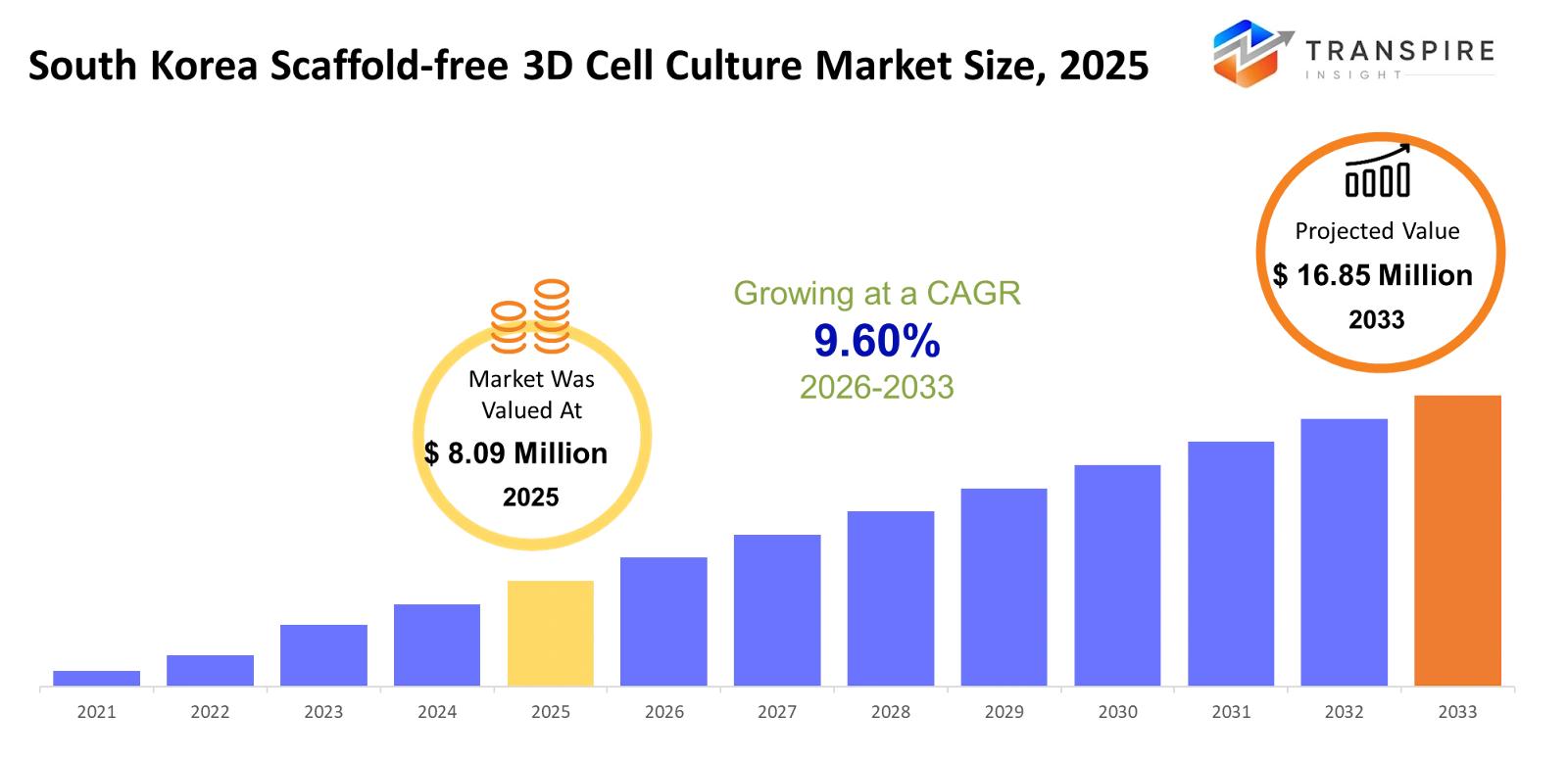
South Korea Scaffold-free 3D Cell Culture Market Size & Forecast:
- South Korea Scaffold-free 3D Cell Culture Market Size 2025: USD 8.09 Million
- South Korea Scaffold-free 3D Cell Culture Market Size 2033: USD 16.85 Million
- South Korea Scaffold-free 3D Cell Culture Market CAGR: 9.60%
- South Korea Scaffold-free 3D Cell Culture Market Segments: By Type (Organoids, Spheroids), By Application (Cancer Research, Drug Discovery, Stem Cell Research), By End-User (Pharmaceutical Companies, Biotechnology Companies, Research Institutes).
To learn more about this report,  Download Free Sample Report
South Korea Scaffold-free 3D Cell Culture Market Summary:
The South Korea Scaffold-free 3D Cell Culture Market size was estimated at USD 8.09 Million in 2025 and is anticipated to reach USD 16.85 Million by 2033, growing at a CAGR of 9.60% from 2026 to 2033.
The South Korea Scaffold-free 3D Cell Culture Market in the biotechnology industry will continue to attract attention because researchers and pharmaceutical companies require better drug testing and tissue development models. The market for scaffold-free techniques will grow because researchers need dependable systems that enable cells to form spheroids and organoids through self-assembly without using artificial scaffolds. Research organizations and business partners will establish partnerships that drive forward scientific progress through improved cell culture methods and advanced automation and imaging solutions. The new regulatory requirements will deliver better safety and efficacy results in preclinical assessments.
The South Korea Scaffold-free 3D Cell Culture Market will experience market changes because research funding will now prioritize personalized medicine and regenerative therapies. Researchers will obtain access to high-throughput screening platforms which enable them to conduct extensive experiments through automated processing. The demand for laboratory models that fulfill ethical standards and deliver accurate results will drive the creation of culture systems which replicate natural cell behavior. The evolution of regulations will push companies toward establishing standard procedures that enhance their ability to scale operations while decreasing their expenses which will produce a stronger and more efficient market framework.
Key Market Trends & Insights:
- The South Korea Scaffold-free 3D Cell Culture Market will witness increased adoption in pharmaceutical research as it allows more accurate modeling of human tissue. Researchers use scaffold-free techniques to study drug efficacy, which decreases their need for animal tests and shortens their preclinical study periods, thus making drug development faster and more economical.
- Market demand will increase because scaffold-free 3D cell culture platforms continue to improve their capabilities. Research institutions and biotech companies will use new technologies that provide automated cell aggregation and high-throughput screening together with better reproducibility to generate more trustworthy research outcomes. This trend will improve overall efficiency and scalability in cellular experiments.
- The South Korea Scaffold-free 3D Cell Culture Market will experience changes because of increasing demand for personalized medicine. Scaffold-free models allow patient-specific cells to be cultured, enabling tailored therapies. This approach improves precision drug response testing together with disease mechanism analysis, which enables development of personalized treatment methods for complex diseases such as cancer and neurological disorders.
- The South Korea Scaffold-free 3D Cell Culture Market will experience substantial growth because of governmental funding initiatives and funding programs. The establishment of advanced 3D culture methods will benefit from policies that support biotechnology innovation together with research grants for cell-based studies and public research center-private company collaborative projects.
- The South Korea Scaffold-free 3D Cell Culture Market will experience market growth through biopharmaceutical companies forming strategic partnerships with research institutes. Market expansion will occur through partnerships that focus on developing new drugs and regenerative medicine and conducting toxicity tests. The combination of joint ventures and knowledge sharing between organizations will drive innovation and build better scaffold-free cell culture systems.
South Korea Scaffold-free 3D Cell Culture Market Segmentation
By Type:
- Organoids: Organoids provide scientists with miniature three-dimensional cell models which simulate both the functional capabilities and structural design of actual human organs. The South Korea Scaffold-free 3D Cell Culture Market shows strong interest in organoids which enable researchers to study complex biological systems through their capacity to reproduce specific organ functions. The culture system creates authentic disease models which enable researchers to study drug reactions and track disease development without using standard two-dimensional cell cultures that do not reflect actual cellular behavior.
- Spheroids: Spheroids are spherical clusters of cells that naturally aggregate, forming a microenvironment similar to tissues in the human body. The South Korea Scaffold-free 3D Cell Culture Market relies on spheroids because they provide consistent results which make them suitable for testing multiple drugs through high-volume screening processes. The system enables cell-based research through its capacity to facilitate cell-to-cell connections and cell-to-matrix connections which researchers need to investigate tumor development and tissue development and regenerative medicine. Spheroids provide researchers with the ability to conduct extended studies which reveal how cells behave during different environmental circumstances throughout the study period.

To learn more about this report, Download Free Sample Report
By Application:
- Cancer Research: The South Korea Scaffold-free 3D Cell Culture Market shows major advantages for cancer research through scaffold-free 3D models which provide better tumor microenvironment simulations than standard cell cultures. Researchers can study cancer cell growth, metastasis, and drug resistance in conditions that match human tissue environments. The models deliver dependable test results which researchers need to assess anticancer compounds and forecast clinical results. Researchers in cancer studies use organoids and spheroids which lead to less animal testing while they develop personalized treatment methods and learn about tumor development at both cellular and molecular stages.
- Drug Discovery: Drug discovery in the South Korea Scaffold-free 3D Cell Culture Market is becoming more efficient with scaffold-free techniques. Three-dimensional cultures allow precise evaluation of drug efficacy and toxicity in environments that resemble human tissues. The approach enables quicker identification of therapeutic candidates while decreasing the possibility of clinical trial failures. Organoids and spheroids provide better insights into drug metabolism and pharmacodynamics, helping researchers refine compounds before moving to human studies. The market growth depends on the increasing demand for predictive preclinical models which decrease dependence on standard cell culture methods and animal testing procedures.
- Stem Cell Research: The South Korean Scaffold-free 3D Cell Culture Market uses stem cell research to create organoid and spheroid systems which enable stem cells to maintain their natural growth pattern and develop into other cell types. The models provide more accurate results for research which investigates how tissues grow back and how diseases develop. Scaffold-free 3D cultures improve the efficiency of stem cell-based therapies by providing controlled environments for cell growth and maturation. The research enables scientists to study how stem cells interact with their surrounding environment which leads to better knowledge of how tissues regenerate and better development of regenerative medicine techniques.
By End-User:
- Pharmaceutical Companies: The South Korea Scaffold-free 3D Cell Culture Market uses organoids and spheroids for testing and drug development by pharmaceutical companies. The models provide researchers with an accurate research tool which allows them to study how drugs affect human tissue. Companies are investing in scaffold-free 3D cell culture technologies to optimize research timelines, reduce costs, and minimize failures in clinical trials. The growing need for personalized medicine together with precise disease models drives pharmaceutical organizations to adopt these solutions, which enable them to enhance therapy results and achieve their regulatory objectives.
- Biotechnology Companies: The South Korea Scaffold-free 3D Cell Culture Market uses organoids and spheroids for therapeutic innovation and biomedical research by biotechnology companies. The organizations develop dependable tissue models, which help to speed up drug testing and regenerative medicine and diagnostic test development. Companies use scaffold-free 3D cultures to discover new applications, which include genetic research and cellular therapy development. The use of these models improves research precision while helping organizations create more effective treatments and gives biotechnology companies a stronger position to provide cutting-edge medical solutions.
- Research Institutes: Research institutes in South Korea use organoids and spheroids as the primary model systems for their studies in basic and applied research work. The models enable scientists to study human tissue through their use in cancer research and neurobiology research and stem cell research. The institutes conduct research to advance scientific knowledge while their scientists test experimental results through research training in advanced culture methods. Research institutes use scaffold-free 3D cultures to create more authentic scientific studies which decrease their need for animal testing and lead to scientific progress, which helps them discover new biological information and develop innovative treatment methods.
Country Insights
- The South Korean Scaffold-free 3D Cell Culture Market will experience continuous growth because research and pharmaceutical sectors are increasingly using advanced cell culture methods. The demand for scaffold-free 3D cell culture platforms will increase because investments in biotechnology and regenerative medicine continue to rise. Innovations in cell modeling and tissue engineering applications will be driven by academic and private research institutes.
- Government initiatives that support life sciences research will create momentum for the South Korean Scaffold-free 3D Cell Culture Market. The development of biotechnology through policy initiatives and the establishment of biomedical research funding programs will create a solid foundation for the growth of advanced cell culture technologies. The partnership between universities and industry players will create new market opportunities through their development of affordable and high-performance scaffold-free 3D cell culture systems.
- The South Korean Scaffold-free 3D Cell Culture Market will develop through technological progress which produces better cell growth models that research teams can replicate. Research results will improve through automated 3D cell culture systems which work together with imaging and analysis technologies. The market will expand because more people realize that scaffold-free systems provide better advantages than traditional methods used in pharmaceutical and academic settings.
Recent Development News
South Korea biotech tied to 3D cell culture applications — cultivated meat cost reduction
South Korean food tech startup SeaWith signed a supply deal with a UK firm using advanced 3D cell culture media, helping cut cultivated beef costs ~30%. This highlights applied 3D culture media use in Korean biotech.
Broader 3D cell culture applications gaining traction
3D cell culture is increasingly reported in major science news as a valuable model for drug screening and cell biology research — covering benefits of 3D vs. traditional 2D culturing. Mainstream summaries now appear in science outlets and inform regulatory and biotech policy coverage.
|
Report Metrics |
Details |
|
Market size value in 2025 |
USD 8.09 Million |
|
Market size value in 2026 |
USD 8.87 Million |
|
Revenue forecast in 2033 |
USD 16.85 Million |
|
Growth rate |
CAGR of 9.60% from 2026 to 2033 |
|
Base year |
2025 |
|
Historical data |
2021 - 2024 |
|
Forecast period |
2026 - 2033 |
|
Report coverage |
Revenue forecast, competitive landscape, growth factors, and trends |
|
Country scope |
South Korea |
|
Key company profiled |
Thermo Fisher Scientific Inc., Merck KGaA, Corning Incorporated, Lonza Group AG, STEMCELL Technologies Inc., Bio-Techne Corporation, InSphero AG, MIMETAS BV, MatTek Corporation, Greiner Bio-One International GmbH, Emulate Inc., Organovo Holdings Inc., DefiniGEN Ltd., HUB Organoids Holding B.V., 3D Biotek LLC. |
|
Customization scope |
Free report customization (country, regional & segment scope). Avail customized purchase options to meet your exact research needs. |
|
Report Segmentation |
By Type (Organoids, Spheroids), By Application (Cancer Research, Drug Discovery, Stem Cell Research), By End-User (Pharmaceutical Companies, Biotechnology Companies, Research Institutes). |
Key South Korea Scaffold-free 3D Cell Culture Company Insights
- The South Korea Scaffold-free 3D Cell Culture Market will witness significant activity from leading biotechnology and life sciences companies which develop new 3D cell culture technologies. South Korean companies make investments in new scaffold-free techniques to create drug discovery and toxicity testing and regenerative medicine models which better represent actual human physiology. The research focuses on developing technologies which enable cells to form spheroids and organoids without needing external scaffolds, thereby enhancing reproducibility. Collaboration between domestic research institutes and industry players will drive innovation and product development in the market, enabling faster adoption of scaffold-free approaches in academic and pharmaceutical research.
- Market players in South Korea will continue to focus on expanding their product portfolios to meet the growing demand for high-throughput screening and precision medicine applications. Companies now use microfluidics and bioprinting and automated culture systems to create scaffold-free 3D cell culture solutions that scale easily and cost low. Local firms will prioritize partnerships with global biotechnology companies to access cutting-edge technologies while maintaining regulatory compliance for research applications. Research development investment will enhance their competitive advantage, which enables companies to develop unique products that assist organoid creation, co-culture system development, and disease modeling, which will drive growth in the South Korea Scaffold-free 3D Cell Culture Market.
South Korea Scaffold-free 3D Cell Culture Market Companies:
- Thermo Fisher Scientific Inc.
- Merck KGaA
- Corning Incorporated
- Lonza Group AG
- STEMCELL Technologies Inc.
- Bio-Techne Corporation
- InSphero AG
- MIMETAS BV
- MatTek Corporation
- Greiner Bio-One International GmbH
- Emulate Inc.
- Organovo Holdings Inc.
- DefiniGEN Ltd.
- HUB Organoids Holding B.V.
- 3D Biotek LLC
South Korea Scaffold-free 3D Cell Culture Market Segmentation
By Type
- Organoids
- Spheroids
By Application
- Cancer Research
- Drug Discovery
- Stem Cell Research
By End-User
- Pharmaceutical Companies
- Biotechnology Companies
- Research Institutes
Frequently Asked Questions
Find quick answers to common questions.
The approximate South Korea Scaffold-free 3D Cell Culture Market size for the market will be USD 16.85 Million in 2033.
Key segments for the South Korea Scaffold-free 3D Cell Culture Market are By Type (Organoids, Spheroids), By Application (Cancer Research, Drug Discovery, Stem Cell Research), By End-User (Pharmaceutical Companies, Biotechnology Companies, Research Institutes).
Major South Korea Scaffold-free 3D Cell Culture Market players are Thermo Fisher Scientific Inc., Merck KGaA, Corning Incorporated, Lonza Group AG, STEMCELL Technologies Inc., Bio-Techne Corporation, InSphero AG, MIMETAS BV, MatTek Corporation, Greiner Bio-One International GmbH, Emulate Inc., Organovo Holdings Inc., DefiniGEN Ltd., HUB Organoids Holding B.V., 3D Biotek LLC.
The South Korea Scaffold-free 3D Cell Culture Market size is USD 8.09 Million in 2025.
The South Korea Scaffold-free 3D Cell Culture Market CAGR is 9.60%.
- Thermo Fisher Scientific Inc.
- Merck KGaA
- Corning Incorporated
- Lonza Group AG
- STEMCELL Technologies Inc.
- Bio-Techne Corporation
- InSphero AG
- MIMETAS BV
- MatTek Corporation
- Greiner Bio-One International GmbH
- Emulate Inc.
- Organovo Holdings Inc.
- DefiniGEN Ltd.
- HUB Organoids Holding B.V.
- 3D Biotek LLC
Recently Published Reports
-
Apr 2026
Cord Blood Banking Services Market
Cord Blood Banking Services Market Size, Share & Analysis Report By Type of Service (Collection, Processing, Storage), By Bank Type (Private Banks, Public Banks, and Hybrid Banks), By Component (Cord Blood, and Cord Tissue), By End User (Hospitals, Research Institutions, Biotechnology Companies, and Others) and Geography (North America, Europe, Asia-Pacific, Middle East and Africa, South and Central America), 2021 - 2031
-
Apr 2026
ELISA Processors Market
ELISA Processors Market Size, Share & Analysis Report By Type (Optical Filter ELISA Analyzer, and Optical Grating ELISA Analyzers), By Mode (Automated ELISA Analyzers, and Semi-Automated ELISA Analyzers), By Applications (Immunology, Vaccine development, Drug Monitoring, and Others), By End Users (Biotechnology Companies, Pharmaceutical Companies, Contract Research Organization, and Diagnostic Laboratories) and Geography (North America, Europe, Asia-Pacific, Middle East and Africa, South and Central America), 2021 - 2031
-
Apr 2026
Microscope Slide Scanner Market
Microscope Slide Scanner Market Size, Share & Analysis Report By Type (Portable Microscope Slide Scanner, and Desktop Microscope Slide Scanner), By Application (Biological Research, Medicine, Veterinary, and Other) and Geography (North America, Europe, Asia-Pacific, Middle East and Africa, South and Central America), 2021 - 2031
-
Apr 2026
Microwave Cookware Market
Microwave Cookware Market Size, Share & Analysis Report By Material Type (Plastic, Glass, Ceramic, Silicone, and Metal), By Application (Cooking, Reheating, and Defrosting), By End User (Household, Commercial (Restaurants, Hotels, and Cafes), and Food Service Industry), By Sales Channel (Online Retail, Offline Retail (Supermarkets, Hypermarkets, Specialty Stores), and Direct Sales (Company Outlets)) and Geography (North America, Europe, Asia-Pacific, Middle East and Africa, South and Central America), 2021 - 2031