

South Korea Private Tutoring Market Summary:
According to Transpire Insight, a detailed research report on the market reflects that the academic tutoring application segment dominates the South Korea Private Tutoring Market, accounting for approximately 65% of the total share nationwide. MegaStudy Co., Ltd. leads the market with approximately (around USD 600 million) in annual revenue and an estimated 15–20% South Korea market share, making it a leading contributor to South Korea market development, digital learning innovation, advanced private tutoring services, expanding online education capabilities, and market growth dynamics.
Market Snapshot
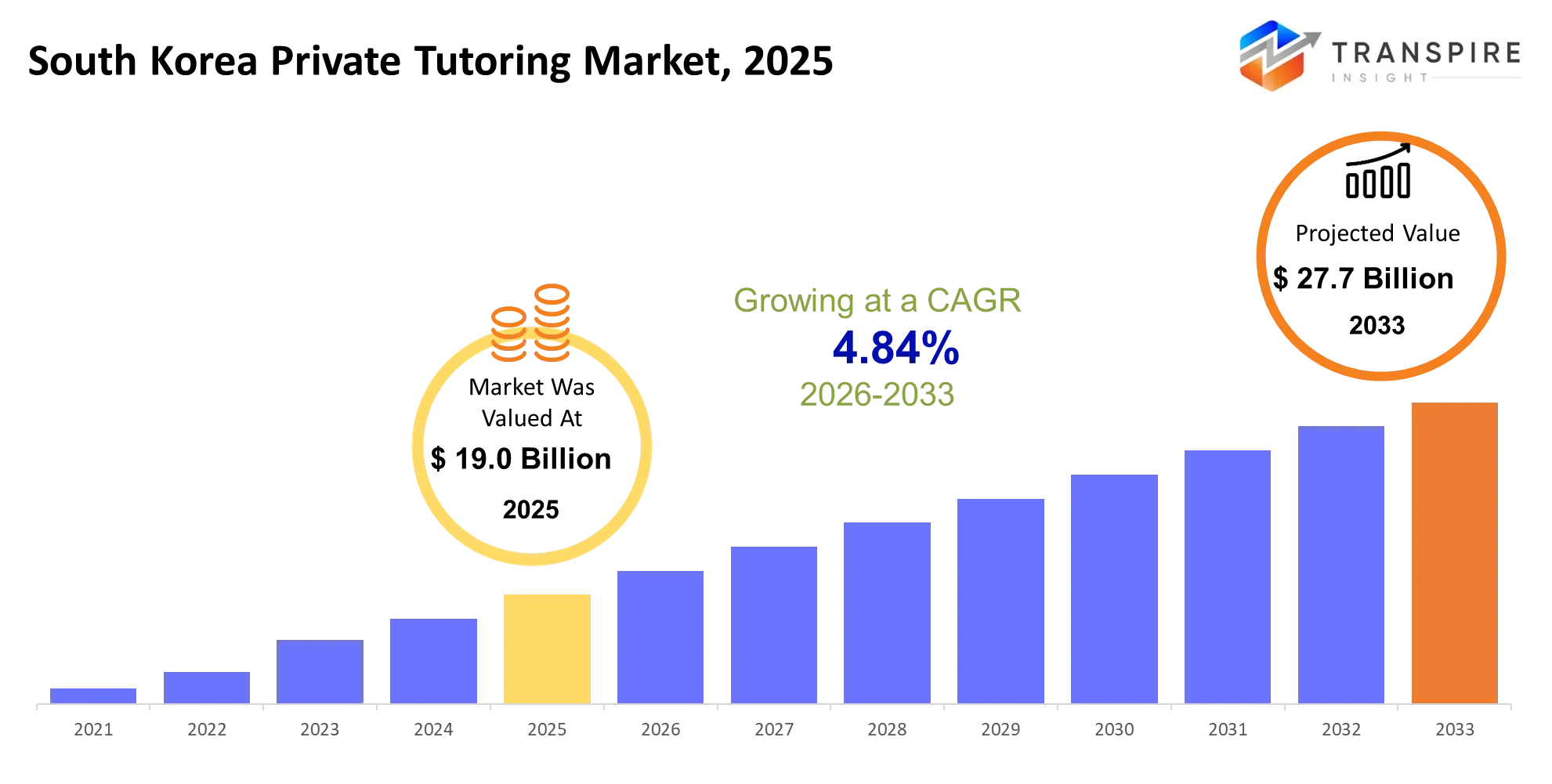
- Market Value (2025): USD 19.0 Billion.
- Expected Market Value (2026): USD 19.9 Billion.
- Estimated Market Value (2033): USD 27.7 Billion.
- Forecast CAGR (2026–2033): 4.84%
Introduction
The private tutoring industry is made up of for-profit education, extracurricular teaching, exam preparation, homework assistance, and digital learning platforms developed outside the traditional school system. In South Korea, the private tutoring industry is popularly known as hagwon (for-profit private education facilities), private home tutoring, small classes, and online learning. Education can also be referred to as the academic term used to refer to tutoring. The term is described as an additional type of education in school subjects outside the regular school hours. It is called "shadow" because it is similar to what is taught in traditional schools and changes as the school system does. Significant educational and competitive advantages are provided by South Korea’s private tutoring market thanks to its effective exam preparation programs, personalized lessons, and state-of-the-art technology. Targeted tutoring helps students achieve better academic results by bridging the knowledge gaps and getting ready for standardized testing. By utilizing AI learning platforms, analytics, and gamification techniques, the effectiveness of personalized learning is improved. Online tutoring makes it possible to access high-quality teaching personnel, who were previously inaccessible due to geographic limitations. It also takes part in the development of STEM, foreign language, and other vocational skills required in a competitive academic environment.
Key Market Highlights: -
- By subject, the Mathematics segment dominated the market and holds nearly 45% share in 2025 and is projected to grow at a substantial CAGR during the forecast period.
- By provider, the Tutoring Academies segment dominated the market and holds nearly 55% share in 2025 and is projected to grow at a substantial CAGR during the forecast period.
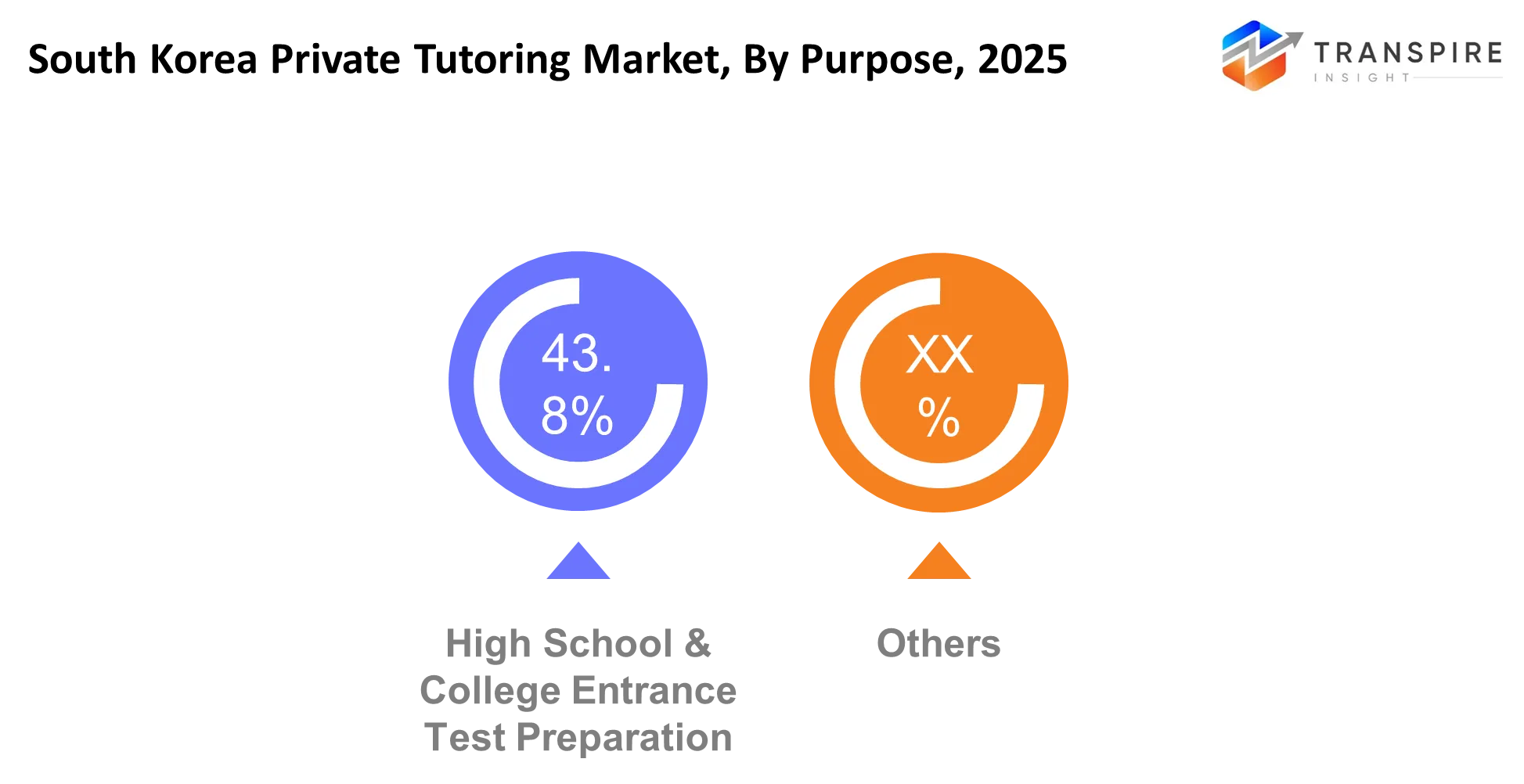
- By purpose, the School Support segment dominated the market and holds nearly 38% share in 2025 and is projected to grow at a substantial CAGR during the forecast period.
- Curfews and Tuition Transparency: The South Korean government has imposed curfews for private tutoring centers. For example, hagwons in Seoul are obliged to close by 10 p.m. relevant opening hours restrictions in combination with tuition fee reporting and disclosure requirements help strengthen the transparency of the market and the effectiveness of regulatory supervision.
How is Technology Driving Growth in the South Korea Private Tutoring Market?
The South Korean private tutoring market is swiftly incorporating technologies such as adapting learning, AI, and data-driven technology to offer lessons based on students’ learning styles and achievement gaps. The country’s excellent digital infrastructure, high mobile phone adoption, and 5G technology facilitate easy access to online tuition. Furthermore, innovations such as micro-learning, interactive tests and flexible class schedules boost students’ involvement in the learning process, giving them the chance to attend both lessons in schools and private institutions. High education expenditure per family contributes to the popularity of high subscription platforms and AI learning solutions. What is more, the introduction of learning initiatives by the government aimed at increasing the information literacy and usage of the cloud technologies is developing the infrastructure for making the market more technologically advanced.
Market Drivers
Another reason for the boom in private tutoring services in South Korea is the fierce competition for the entrance examinations for the top universities that has made students and parents consider formal education the main obstacle to higher education and jobs. The standard education system pushes families to provide additional lessons that can help them fulfill their educational needs. The rapid rise of Edtech, online tutoring, mobile learning, and other innovations in education has made private tutoring more flexible and accessible. The enormous amounts spent by parents on students’ education (especially in case of well-off families living in urban areas) provide the private tutoring system with constant demand. The success of the private tutoring market in South Korea is rooted in a cultural belief in the power of education and the high value of career advancement. Parents are willing to spend almost any amount on their children’s coaching and laud the development of better, more advanced education systems. The fact that education is mostly rigid and neither personalized nor modular makes parents seek alternative educational solutions. Furthermore, the emergence of technology in this industry has led to the introduction of advanced practices such as AI learning, adaptive learning, and automated troubleshooting solutions and, consequently, enhanced opportunities for service providers.
Restrain
Private tutoring in South Korea has to deal with rules related to operation hours and laws that are making running tutoring schools difficult and costly. Due to the high rates charged by tutors, the families with low incomes find it hard to use these services. Also, they experience the demographic problem, as they are facing a slowing student population. Moreover, they need to deal with the strong competition from free and low-cost digital learning option solutions. Finally, the difficulties due to the constant threat of sanctions and use of illegal practices in the field make are another obstacle.
|
Driver |
Relative Impact on Growth (%) |
Geographic Relevance |
Impact Timeline |
Demand Strength |
Growth Mechanism |
Key Beneficiaries |
Major Constraint |
|
Driver 1: Intensifying University Admission Competition |
30% |
Seoul, Gyeonggi, Incheon; major metropolitan areas |
Long-term |
High |
Drives continuous exam-focused supplementary learning demand |
Hagwons, private tutors, test-preparation platforms |
Demographic decline reduces student population |
|
Driver 2: High Household Spending on Private Education |
24% |
Nationwide, strongest in affluent urban households |
Medium-term |
High |
Sustains recurring spending on academic tutoring services |
Tutoring academies, tutors, education companies |
Household affordability and economic pressure |
|
Driver 3: AI and Digital Learning Adoption |
20% |
Nationwide; digitally advanced urban education markets |
Medium-term |
High |
Enables adaptive content, analytics, and personalized instruction |
EdTech firms, AI vendors, online tutoring platforms |
Privacy, accuracy, and technology adoption concerns |
|
Driver 4: Rising Demand for Personalized Supplementary Education |
15% |
Seoul metropolitan area and other education-intensive cities |
Medium-term |
High |
Addresses individual learning gaps beyond classroom instruction |
Private tutors, academies, adaptive-learning providers |
Premium personalized services increase costs |
|
Driver 5: Expansion of Online and Hybrid Tutoring Models |
11% |
Nationwide, including regional and digitally connected areas |
Short-term |
Medium |
Improves accessibility, flexibility, and service scalability |
Online platforms, mobile-app providers, tutors |
Intense competition and free learning resources |
|
Total |
100% |
— |
— |
— |
— |
— |
— |
Analysis of Prices and Consumer Behaviour
Private education primarily consists of services whose patterns of activity are determined by the information of the students of academic institutions or students preparing for specific exams (80.0% in 2024, mostly because of students wishing to enter a college/university or improve their performance in the studies). Each participant of private education spends about 592,000 KRW/month for this purpose, which signifies that there is persistent investment made by the households in additional education and expensive tutoring. In total, about 29.2 trillion won were spent on private education in 2024, with the sales volume being greatly influenced by active participation of elementary, middle school, and secondary school students as well as the ongoing learning competition. Each student spent an average of 7.6 hours participating in private education on a weekly basis. The purchasing behavior of consumers shows that household income significantly influences their participation in private education, especially if higher income levels are taken into account.
Who are the Key Players in the South Korea Private Tutoring Market and how do they compete?
In the South Korean private tutoring sector, competition largely involves companies that offer customized education, learning programs targeted at passing examinations, technology-based education, and widespread digital delivery network. By competing not only based on pricing but also focusing on quality of teaching, use of AI, platforms for online learning, adaptive materials and measurable results, the strategy brings about further innovations in services provided leading to improved learning of students.
In order to strengthen its market share, MegaStudy develops integrated online education platforms, AI-based personalized learning and training programs that enable it to prepare for tests. By introducing high-quality education materials and special educational programs connecting to university entrance exams, companies set themselves apart from competitors.
Top Companies in the South Korea Private Tutoring Market
- MegaStudy
- Daekyo
- Woongjin ThinkBig
- Chungdahm Learning
- YBM
- EBS
- NE Neungyule
- Pagoda
- Hackers Education
- Mathnasium
- Eye Level
- Kyowon
- Eduwill
- MegastudyEdu
- Riiid
|
Company |
Est. Revenue Share Range |
Key Offerings |
Strategic Positioning |
Geographic Strength |
Technology Focus |
|
MegaStudyEdu |
2.5–3.5% |
Online lectures, offline academies, exam preparation, admissions programs |
Integrated exam-preparation platform leadership |
South Korea; Seoul metropolitan area |
AI learning analytics and digital lecture platforms |
|
Daekyo |
2.0–3.0% |
Noonnoppi, home learning, academies, online education |
Personalized learning and nationwide education ecosystem |
South Korea; Asia-Pacific |
Adaptive learning and personalized education technology |
|
Woongjin ThinkBig |
1.5–2.5% |
ThinkBig, SmartAll, Book Club, AI learning programs |
AI-enabled comprehensive home-learning differentiation |
South Korea; selected overseas markets |
AI adaptive learning and digital content platforms |
|
Kyowon Group |
1.0–2.0% |
Kumon, RedPen, home learning, educational memberships |
Subscription-based personalized education ecosystem |
South Korea; Asia-Pacific |
Digital content and personalized learning platforms |
|
ETOOS Education |
0.8–1.5% |
Online education, Gangnam Hyper, ETOOS247, boarding academies |
Hybrid online-offline university admissions specialization |
South Korea; nationwide |
Learning analytics and integrated digital education |
|
Chungdahm Learning |
0.5–1.0% |
Chungdahm, April, language academies, digital programs |
Premium English education and franchise differentiation |
South Korea; Asia-Pacific |
AI-assisted language learning and digital classrooms |
|
Hackers Education |
0.4–0.8% |
Online academy, test preparation, language courses, study materials |
Specialized test-preparation and content leadership |
South Korea; selected international markets |
Online learning platforms and mobile study tools |
|
YBM Net |
0.2–0.4% |
YBM online education, YBM/ECC academies, AI tutoring, learning apps |
Language-learning platform and franchise specialization |
South Korea; Asia-Pacific and international markets |
AI tutors and adaptive language-learning analytics |
|
NE Neungyule |
0.2–0.4% |
Junior Lab, textbooks, learning materials, online education |
Content-led education and EdTech specialization |
South Korea; Asia, Middle East, Latin America |
AI digital materials and education platforms |
|
Pagoda Education |
0.2–0.4% |
Pagoda academies, Pagoda Junior, Pagoda One, language tutoring |
Premium language tutoring and personalized services |
South Korea; selected Asian markets |
Customized online learning and digital tutoring |
South Korea Private Tutoring Market Segmentation
The South Korea Private Tutoring Market share is divided into six categories: By subject, mode, education level, provider, purpose and distribution channel.
The Mathematics dominated the market, accounting for nearly 45% in 2025 and is expected to rise at a significant CAGR during the forecast period.
The South Korea Private Tutoring Market is segmented by subject into Mathematics, English, Korean Language, Science, Social Studies, Foreign Languages, Test Preparation, Arts & Music. Among these, the Mathematics segment dominated the market, accounting for nearly 45% in 2025 and expected to increase at a significant CAGR during the forecast period. In the private tutoring sector in South Korea, the Mathematics sector has been the largest contributor with approximately 45% market share in 2025 due to increased demand for math education, test preparation, and college admission support services. Math plays a major role in securing a student’s academic progress, while personalized tutoring helps to cover learning gaps, boost problem-solving skills, and enhance performance during exams leading to the remarkable market expansion.
The Tutoring Academies dominated the market, accounting for nearly 55% in 2025, and is expected to rise at a significant CAGR during the forecast period.
The South Korea Private Tutoring Market is segmented by provider into Private Tutors, Tutoring Academies, Online Platforms, Education Companies, Freelance Tutors, Learning Centers, Universities, Specialized Institutes. Among these, the Tutoring Academies segment dominated the market, accounting for nearly 55% in 2025 and expected to increase at a significant CAGR during the forecast period. The South Korea private tutoring market is largely driven in terms of revenues by its Tutoring Academies segment, which is expected to hold nearly 55% in 2025. The segment has been growing due to increased demand for structured education, examination-oriented instruction, and skilled instructors. Hagwons not only create structured and comprehensive curricula and offer customized solutions through regular assessments but also provide assignment-based academic support, and well-prepared students for college admissions.
The School Support dominated the market, accounting for nearly 38% in 2025 and is expected to rise at a significant CAGR during the forecast period.
The South Korea Private Tutoring Market is segmented by purpose into School Support, College Entrance Preparation, Exam Preparation, Language Learning, Skill Development, Homework Support, Career Preparation, Enrichment. Among these, the School Support segment dominated the market, accounting for nearly 38% in 2025 and expected to increase at a significant CAGR during the forecast period. The sector of school assistance ruled over the South Korean market for private tutoring and held around 38% share in the year 2025 due to its popularity among students who needed some extra lessons in addition to their formal studies. Private tuition provides students with the opportunity to consolidate what they have learnt at school and focus on any particular issues with their subject, complete their homework assignments and get ready for their exams.
Future Market Trends for the South Korea Private Tutoring Market: -
- Shift to Digital & Mobile Solutions: The quick rise of innovative web-based educational platforms that provide flexibility in planning sessions and allowing for remote usage.
- AI Booms and becomes Personalizing Mechanism: Usage of smart AI tools which analyze students' weaknesses and tailor their learning paths.
- Super Tutor (Ilta) Reigns: The dominant usage of star teachers who utilize various academic concepts combined with emotional support.
- Curriculum Alignments: Increased focus on AI, digital literacy, and ability to communicate with others which supports changes in public school systems.
Recent Development
- In April 2026: The Seoul Metropolitan Office of Education has launched a new program aimed at enhancing career and admissions counseling through experts who will provide assistance year-round. The program seeks to enhance public resources available in regard to the admissions guidance, minimize reliance on the paid consultancy services, and develop changes in demand for private tutoring services.
- In January 2026: The Education Korea 2026 event took place at the COEX exhibition center in Seoul, South Korea, considering generative AI technology, AI in classrooms, hyper-personalized learning, and digital solutions in education. The event emphasized fast-growing Edtech adoption and personalized learning technologies, which facilitate digital transformation and innovation in the private tutoring sector, increasing the need for technologically-enhanced education.
Market Segment
This study forecasts revenue at South Korea, regional and country levels from 2020 to 2033. Transpire Insight has segmented the South Korea Private Tutoring Market based on the below-mentioned segments:
South Korea Private Tutoring Market, By Subject
- Mathematics
- English
- Korean Language
- Science
- Social Studies
- Foreign Languages
- Test Preparation
- Arts & Music
South Korea Private Tutoring Market, By Mode
- One-to-One Tutoring
- Group Tutoring
- Online Tutoring
- Hybrid Tutoring
- Home Tutoring
- Academy-Based
- Video-Based
- AI-Based Tutoring
South Korea Private Tutoring Market, By Education Level
- Primary
- Middle School
- High School
- University
- Adult Education
- Preschool
- Vocational
- Professional
South Korea Private Tutoring Market, By Provider
- Private Tutors
- Tutoring Academies
- Online Platforms
- Education Companies
- Freelance Tutors
- Learning Centers
- Universities
- Specialized Institutes
South Korea Private Tutoring Market, By Purpose
- School Support
- College Entrance Preparation
- Exam Preparation
- Language Learning
- Skill Development
- Homework Support
- Career Preparation
- Enrichment
South Korea Private Tutoring Market, By Distribution Channel
- Offline Centers
- Online Platforms
- Mobile Apps
- Direct Tutors
- Education Franchises
- Social Platforms
- Schools
- Education Marketplaces
Frequently Asked Questions
Find quick answers to common questions.
University admission competition, education spending, personalized learning demand, and rapid adoption of AI-powered and online tutoring platforms drive market growth.
Mathematics dominates with nearly 45% share in 2025, supported by examination preparation, academic improvement, problem-solving, and university admission requirements.
Tutoring Academies dominate with nearly 55% share in 2025, supported by structured curricula, experienced instructors, assessments, and examination-focused learning.
AI enables adaptive content, performance analytics, automated doubt resolution, and personalized learning pathways, improving tutoring accessibility, engagement, and efficiency.
Digital tutoring, AI personalization, hybrid learning, star-teacher platforms, mobile education, and technology-enabled curriculum development represent major future market trends.
- MegaStudy
- Daekyo
- Woongjin ThinkBig
- Chungdahm Learning
- YBM
- EBS
- NE Neungyule
- Pagoda
- Hackers Education
- Mathnasium
- Eye Level
- Kyowon
- Eduwill
- MegastudyEdu
- Riiid
About the Authors

Mayur Shinde
I am Mayur Shinde, a Senior Research Analyst at Transpire Insight, specializing in the Automotive & Transportation and Information & Communication Technology (ICT) Industry. My work focuses on analyzing emerging market trends, technological advancements, competitive landscapes, and industry developments to deliver accurate, data-driven insights. I am passionate about transforming complex market information into clear, actionable content that helps businesses, professionals, and decision-makers stay informed and make confident strategic decisions.

Chakradhar Khansole
Chakradhar serves as the Research Director at Transpire Insight, bringing over 8 years of experience in technology, innovation, and strategic market intelligence. He specializes in transforming complex market data into actionable business insights that enable organizations to make informed, growth-oriented decisions. Recognized for his strategic vision and analytical expertise, Chakradhar leads high-impact research initiatives, delivering comprehensive market assessments, competitive intelligence, and forward-looking industry analysis.
Recently Published Reports
-
Apr 2026
3D Optical Profiler Market
3D Optical Profiler Market Size, Share & Analysis Report By Type (Desktop 3D Optical Profiler, and Portable 3D Optical Profiler), By Technology (Confocal Technology, and White Light Interference), By End-Use Industry (Manufacturing, Research Institutions, Automotive, Aerospace and Defense, Medical Devices, and Other), and Geography (North America, Europe, Asia-Pacific, Middle East and Africa, South and Central America), 2021 - 2031
-
Apr 2026
Depth Sensor Market
Depth Sensor Market Size, Share & Analysis Report By Type (Infrared Depth Sensors, Time-of-Flight (ToF) Sensors, Stereo Vision Sensors, Structured Light Sensors, Ultrasonic Depth Sensors), By Application (Automotive, Robotics, Gaming, Consumer Electronics, Industrial Automation, Healthcare, Security & Surveillance, Others), By End Users (Automotive Manufacturers, Consumer Electronics Companies, Healthcare Providers, Industrial Companies, Security Agencies, Gaming Companies, Robotics Companies, Others), and Geography (North America, Europe, Asia-Pacific, Middle East and Africa, South and Central America), 2021 – 2031
-
Apr 2026
Digital Manufacturing Market
Digital Manufacturing Market Size, Share & Analysis Report By Component (Hardware, Software, and Services), By Technology (Robotics, 3D Printing, Internet of Things (IoT), and Others), By Application (Automotive and Transportation, Aerospace and Defense, Consumer Electronics, Industrial Machinery, and Others), By Process Type (Computer-Based Designing, Computer-Based Simulation, Computer 3D Visualization, Analytics, and Others), and Geography (North America, Europe, Asia-Pacific, Middle East and Africa, South and Central America), 2021 – 2031
-
Apr 2026
Digital Visa Services Market
Digital Visa Services Market Size, Share & Analysis Report By Type (Individual Travelers, Group Travelers), By Application (Tourism, Business Travel, Others), and Geography (North America, Europe, Asia-Pacific, Middle East and Africa, South and Central America), 2021 – 2031