
South Korea Pour Point Depressant Market Size & Forecast:
- South Korea Pour Point Depressant Market Size 2025: USD 384.6 Million
- South Korea Pour Point Depressant Market Size 2033: USD 693.6 Million
- South Korea Pour Point Depressant Market CAGR: 8.13%
- South Korea Pour Point Depressant Market Segments: By Type (Polyalkyl Methacrylates, Ethylene Co-polymers, Styrene Esters, Others), By Application (Lubricants, Diesel Fuel, Crude Oil, Industrial Oils), By End-User (Oil & Gas, Automotive, Industrial, Marine)
To learn more about this report,  Download Free Sample Report
South Korea Pour Point Depressant Market Summary:
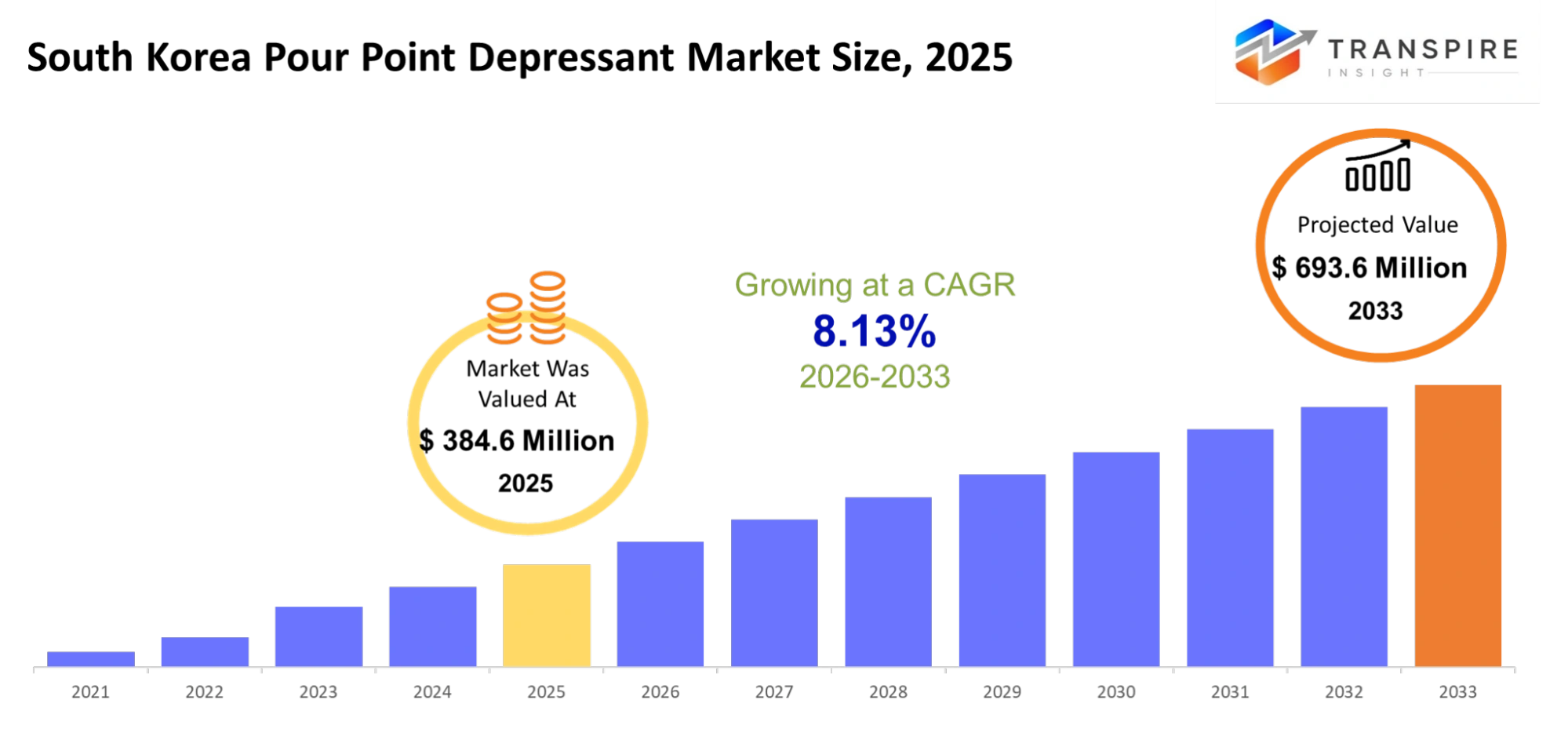
The South Korea Pour Point Depressant Market size is estimated at USD 384.6 Million in 2025 and is anticipated to reach USD 693.6 Million by 2033, growing at a CAGR of 8.13% from 2026 to 2033.
The South Korea pour point depressant market will serve the specialty chemicals and lubricants industry through its dedicated response to the country's industrial strength and its fluctuating seasonal temperature patterns. The market will develop through constant needs from automotive and marine and heavy machinery industries which demand dependable fluid operation during cold weather. Domestic refiners and chemical producers will continue to refine additive formulations to suit locally used base oils, while also aligning with the preferences of export-oriented lubricant manufacturers.
The demand for advanced additive mixes will grow because consumers want equipment to last longer and deliver better fuel efficiency. The chemical design and application process will evolve because of regulatory requirements that focus on emissions control and the development of cleaner fuel technologies. The ongoing advancements in polymer science together with the development of additive compatibility will create more effective product formulas which enable manufacturers to fulfill higher quality requirements while delivering consistent performance in different operational settings.
What Has the Impact of Artificial Intelligence Been on the South Korea Pour Point Depressant Market?
The industrial value chains across different sectors experience rapid transformation through artificial intelligence which now demonstrates its effects on the South Korea pour point depressant market. South Korea companies utilize AI technology to manage their pour point depressant market activities by analyzing extensive data sets to identify concealed market patterns and improve their decision-making processes. The combination of advanced analytics and machine learning models enables companies to investigate crude oil behavior and lubricant performance and seasonal demand fluctuations with improved accuracy.
The South Korea pour point depressant market uses artificial intelligence technology to enhance its demand forecasting capabilities and production scheduling processes. Predictive analytics tools help manufacturers anticipate fluctuations in lubricant consumption across automotive, marine, and industrial sectors, which leads to reduced overproduction and minimized waste.
Smart automation systems create manufacturing efficiencies through their ability to increase formulation accuracy while decreasing equipment downtime and maintaining product quality. The operational efficiencies lead to reduced costs which results in higher organizational productivity that gives businesses an edge in domestic and international markets.
As artificial intelligence applications develop throughout South Korea's pour point depressant market, businesses gain new opportunities to create customized products through their research into more effective solutions. The South Korean pour point depressant market strategies which adopt artificial intelligence technology create industry environments that operate with enhanced flexibility while using data to improve their competitive abilities.
Key Market Trends & Insights:
- South Korea holds complete control over its pour point depressant market because Ulsan and Yeosu produce strong industrial growth through their active production centers.
- The Southeast Asian and Chinese markets create the fastest expanding export-based demand which will reach more than 6% annual growth until 2030.
- Ethylene co-polymers dominate with over 45% share in the south korea pour point depressant market due to superior cold-flow performance.
- The second-largest market share belongs to polyalkyl methacrylates which automotive lubricants and engine oils widely use.
- The bio-based pour point depressants market represents its fastest-growing section which will experience substantial growth throughout the years 2025 to 2030 because of ongoing sustainability developments.
- The automotive lubricants market holds the largest share in South Korea because vehicle production and maintenance needs create strong demand for these products.
- The industrial oils market shows the fastest growth because manufacturing operations and heavy equipment utilization continue to rise.
- The South Korean pour point depressant market sees its major share from automotive original equipment manufacturers and aftermarket services because of their ongoing lubricant demand.
- The South Korean shipbuilding industry and its export logistics operations continue to drive the marine and shipping industries which expand their activities as end-users.
- Afton Chemical, Evonik Industries, BASF, Chevron Oronite, and Infineum represent the main competitors in the market.
South Korea Pour Point Depressant Market Segmentation
By Type :
Polyalkyl methacrylates maintain high market demand because they consistently reduce wax crystal formation at low temperatures. Fuel and lubricant formulations use ethylene co-polymers because they provide both stability and cost-effective performance. Styrene esters attract industrial users who need better flow performance.
Specialized chemical blends create exceptional performance capabilities for environments which include extreme cold storage and offshore operations. The industrial sector in South Korea experiences growth according to its diverse activities which lead manufacturers to develop products that operate efficiently with various oil mixtures.
By Application :
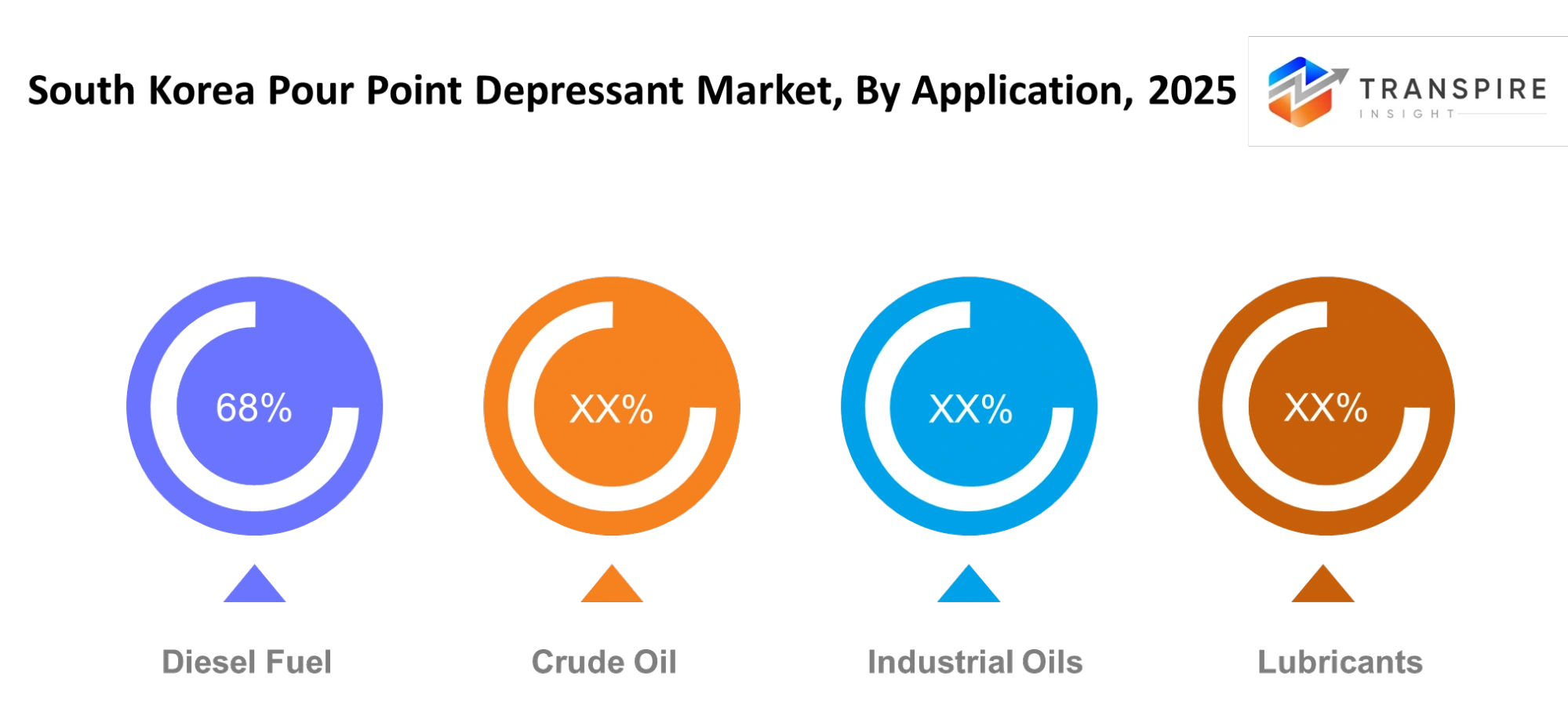
Lubricants serve as an important application area which enables machinery to function smoothly in cold weather conditions. The diesel fuel demand maintains its steady pattern because transportation and logistics operations require it while flow improvement measures guarantee engine performance during winter months.
The petroleum industry depends on pour point depressants to maintain pipeline operations and secure constant crude oil transportation. The industrial oil manufacturing process requires these additives because stable viscosity and flow characteristics are essential for equipment performance and maintenance schedule determination.
To learn more about this report, Download Free Sample Report
By End-User :
The oil and gas sector demonstrates high energy consumption because of its continuous exploration and refining and transportation work. The automotive sector demonstrates continuous demand because people require engine oils and fuels which function effectively across different temperature ranges.
The industrial segment includes manufacturing units which depend on trustworthy lubricant performance to extend their machinery lifespan. The marine sector uses pour point depressants to maintain fuel and oil flow in cold sea environments which enables them to operate continuously while decreasing the risk of fuel solidification.
What are the Main Challenges for the South Korea Pour Point Depressant Market Growth?
The south korea pour point depressant market faces several technical and operational challenges that limit its growth potential. The South Korean market for pour point depressants faces its main development challenge through the need to preserve product performance together with its original quality during temperature changes and different crude oil types. The need to create specialized products results from differences between base oil quality and wax content which creates more complex manufacturing processes that businesses cannot expand.
The South Korean market for pour point depressants faces two major obstacles which include rising operational costs and the need to meet government regulations. The manufacturing of high-performance additives requires both advanced processing technologies and substantial research and development expenses which increase total production costs.
The South Korea pour point depressant market experiences its main development challenges from difficulties in adoption. The adoption process faces limitations because smaller end-users lack knowledge and require technical skills for product formulation and implementation. Market growth faces restrictions because of infrastructure deficiencies and insufficient trained workers for handling specialized chemicals.
Country Insights
The South Korean Market for Pour Point Depressants will experience steady growth because automotive and industrial lubricant needs are increasing. The demand for pour point depressants exists because cold temperatures continue to be a major challenge. The local petroleum manufacturing industry will produce refined products which create constant needs throughout various markets.
The South Korean Market for Pour Point Depressants will operate through industrial centers which include Ulsan and Yeosu because these areas contain both refining and petrochemical plants. The demand from these regions will increase because they require extensive lubricant production and storage facilities. The rising shipping operations at coastal locations will boost the use of products which are designed for marine lubricants.
The South Korean Market for Pour Point Depressants will gain advantages from lubricant formulation technology advancements which focus on developing better low-temperature performance capabilities.
The Regional Insights section will demonstrate that urban industrial centers and port-based economies maintain equal demand throughout their territories. The export increase of finished lubricants will drive companies to integrate advanced additive solutions into their operations. The strong logistics and storage infrastructure across different regions enables product distribution which allows industrial users to operate their activities without any interruptions.
Recent Development News
In March 2026, BASF SE expanded its low-temperature lubricant additive portfolio targeting Asia-Pacific, including South Korea industrial applications. The expansion strengthens its supply of pour point depressant formulations used in automotive and oil & gas lubricants for cold-flow performance improvement.
Sourcehttps://www.basf.com/
In April 2026, Chevron Oronite announced that it has optimized its lubricant additive production process to supply products more reliably to markets across the Asia-Pacific region which includes South Korea. The project increases the supply of pour point depressant materials needed for engine oils and industrial lubricants which operate in cold temperatures.
Source https://www.chevron.com/
|
Report Metrics |
Details |
|
Market size value in 2025 |
USD 384.6 Million |
|
Market size value in 2026 |
USD 401.3 Million |
|
Revenue forecast in 2033 |
USD 693.6 Million |
|
Growth rate |
CAGR of 8.13% from 2026 to 2033 |
|
Base year |
2025 |
|
Historical data |
2021 - 2024 |
|
Forecast period |
2026 - 2033 |
|
Report coverage |
Revenue forecast, competitive landscape, growth factors, and trends |
|
Regional scope |
United States; Canada; Mexico; United Kingdom; Germany; France; Italy; Spain; Denmark; Sweden; Norway; China; Japan; India; Australia; South Korea; Thailand; Brazil; Argentina; South Africa; Saudi Arabia; United Arab Emirates |
|
Key company profiled |
BASF, Evonik, Clariant, Croda, Lubrizol, Infineum, Afton Chemical, Chevron Oronite, Dorf Ketal, Lanxess, Arkema, ExxonMobil, TotalEnergies, SK Innovation, GS Caltex |
|
Customization scope |
Free report customization (country, regional & segment scope). Avail customized purchase options to meet your exact research needs. |
|
Report Segmentation |
By Type (Polyalkyl Methacrylates, Ethylene Co-polymers, Styrene Esters, Others), By Application (Lubricants, Diesel Fuel, Crude Oil, Industrial Oils), By End-User (Oil & Gas, Automotive, Industrial, Marine) |
How Can New Companies Establish a Strong Foothold in the South Korea Pour Point Depressant Market?
The South Korea pour point depressant market requires new market entrants to start their business operations through niche market selection and value proposition development. Companies should develop solutions which address particular performance deficiencies in marine lubricants and high-wax crude applications instead of competing against existing market leaders. Early market advantage develops when products meet current industry needs which include sustainable additives and energy-saving product designs.
The development of innovation strategies represents the main approach through which businesses can establish themselves in the South Korean pour point depressant market. Startups use superior formulation methods which include polymer engineering and data-driven testing to create solutions that deliver both high performance and cost efficiency. GreenFlow Tech develops bio-based pour point depressants while LubeAI Solutions uses predictive analytics to enhance additive performance.
Strategic partnerships and localized expansion further support growth in the south korea pour point depressant market. The company partners with lubricant manufacturers and refineries and distribution networks to speed up product launch and reach more customers. New market entrants can achieve competitive advantages through cost-effective production and high-quality manufacturing processes which result from implementing smart manufacturing systems and digital technologies.
Key South Korea Pour Point Depressant Market Company Insights
The industrial and automotive sectors will experience continuous growth because there is an increasing need for better fuel performance in cold weather. The need for better fuel efficiency and equipment reliability in various industries that use cold storage and transportation and heavy machinery operations will increase the use of pour point depressants in diesel blends and lubricants.
Refiners will increase their fuel consumption because they want to improve their fuel flow characteristics through increased refinery output and modernization initiatives. The marine and logistics industries will create demand because they require constant fuel availability for operations. The market will benefit from product innovation that enhances compatibility with various types of crude oil.
The market will maintain moderate competition because major companies concentrate on delivering consistent products while managing their operational costs. Strategic partnerships with refineries and lubricant producers will play an important role. Domestic suppliers will face pressure from global participants who provide both innovative product formulations and consistent delivery of their products.
Research and development activities will increase, aiming to create formulations suitable for varying climatic conditions and fuel compositions. Companies will focus on performance testing and regulatory compliance to boost their market position. The pricing strategies will remain competitive because large industrial buyers purchase products through bulk procurement.
The company will expand through two main strategies which involve increasing operational capacity and developing its distribution network inside industrial clusters. Long-term supply agreements will create better revenue prediction for the company.
Company List
- BASF
- Evonik
- Clariant
- Croda
- Lubrizol
- Infineum
- Afton Chemical
- Chevron Oronite
- Dorf Ketal
- Lanxess
- Arkema
- ExxonMobil
- TotalEnergies
- SK Innovation
- GS Caltex
What are the Key Use-Cases Driving the Growth of South Korea Pour Point Depressant Market?
The south korea pour point depressant market depends on its essential function within automotive lubricants which require materials to stay liquid at low temperatures for their engines to work efficiently and last longer. The production base of South Korea together with its export activities leads to widespread use of pour point depressants in engine oils and transmission fluids and gear oils.
The south korea pour point depressant market develops through its application in industrial manufacturing and heavy machinery operations. Hydraulic oils and industrial lubricants need to maintain their performance when used in construction and mining and power generation activities at temperatures below freezing. The use of pour point depressants prevents wax crystallization which results in better operational stability because it minimizes equipment downtime and increases productivity.
The marine and shipping sector also plays a significant role in the south korea pour point depressant market, given the country’s global leadership in shipbuilding and maritime trade. Marine fuels and lubricants need to maintain consistent flow characteristics during extended operations at sea especially in regions with low temperatures. New business possibilities arise in specialty oils and bio-based lubricants because advanced additive solutions enable companies to achieve their environmental sustainability objectives.
South Korea Pour Point Depressant Market Report Segmentation
By Type
- Polyalkyl Methacrylates
- Ethylene Co-polymers
- Styrene Esters
By Application
- Lubricants
- Diesel Fuel
- Crude Oil
- Industrial Oils
By End-User
- Oil & Gas
- Automotive
- Industrial
- Marine
Frequently Asked Questions
Find quick answers to common questions.
The approximate South Korea Pour Point Depressant Market size for the market will be USD 693.6 Million in 2033.
Key segments for the South Korea Pour Point Depressant Market are By Type (Polyalkyl Methacrylates, Ethylene Co-polymers, Styrene Esters, Others), By Application (Lubricants, Diesel Fuel, Crude Oil, Industrial Oils), By End-User (Oil & Gas, Automotive, Industrial, Marine).
Major South Korea Pour Point Depressant Market players are BASF, Evonik, Clariant, Croda, Lubrizol, Infineum, Afton Chemical, Chevron Oronite, Dorf Ketal, Lanxess, Arkema, ExxonMobil, TotalEnergies, SK Innovation, GS Caltex.
The South Korea Pour Point Depressant Market size is USD 384.6 Million in 2025.
The South Korea Pour Point Depressant Market CAGR is 8.13%.
- BASF
- Evonik
- Clariant
- Croda
- Lubrizol
- Infineum
- Afton Chemical
- Chevron Oronite
- Dorf Ketal
- Lanxess
- Arkema
- ExxonMobil
- TotalEnergies
- SK Innovation
- GS Caltex
Recently Published Reports
-
May 2026
Healthcare Polymer Packaging Market
Healthcare Polymer Packaging Market Size, Share & Analysis Report By Packaging Type (Syringes, IV Bottles and Pouches, Clamshells, Blisters, Bottles & Jars, Containers, Tubes, IV Parental Packaging, Others), By Type (Regulated, Non-regulated), By Polymer Type (LDPE (Low-Density Polyethylene), HDPE (High-Density Polyethylene), Homo-polymer (Homo), Random Copolymer (Random), Block Copolymer (Block), PET, Polystyrene, Polyvinyl Chloride, Polyamide/EVOH, Others), and Geography (North America, Europe, Asia-Pacific, Middle East and Africa, South and Central America), 2021 - 2031
-
Apr 2026
Hydrophilic Tape (Waterstop) Market
Hydrophilic Tape (Waterstop) Market Size, Share & Analysis Report By Type (Bentonite-Based Hydrophilic Tape, Rubber-Based Hydrophilic Tape), By Application (Residential Buildings, Commercial Buildings, Infrastructure Projects), and Geography (North America, Europe, Asia-Pacific, Middle East and Africa, South and Central America), 2021 - 2031
-
Apr 2026
Metalens Market
Metalens Market Size, Share & Analysis Report By Type (Visible Light Metalens, and Infrared Metalens), By Application (Consumer Electronics, Automotive Electronics, Industrial, Medical, and Others), and Geography (North America, Europe, Asia-Pacific, Middle East and Africa, South and Central America), 2021 - 2031
-
Apr 2026
PBT Resin Market
PBT Resin Market Size, Share & Analysis Report By Type (Reinforced PBT Resin, Unreinforced PBT Resin), By Processing Method (Injection Molding, Extrusion, Blow Molding, Others), By End-User (Automotive, Electrical & Electronics, Consumer Appliances, Industrial Machinery, Medical Devices, Packaging, Others), and Geography (North America, Europe, Asia-Pacific, Middle East and Africa, South and Central America), 2021 - 2031