

South Korea Potassium Sulfate Market Size & Forecast:
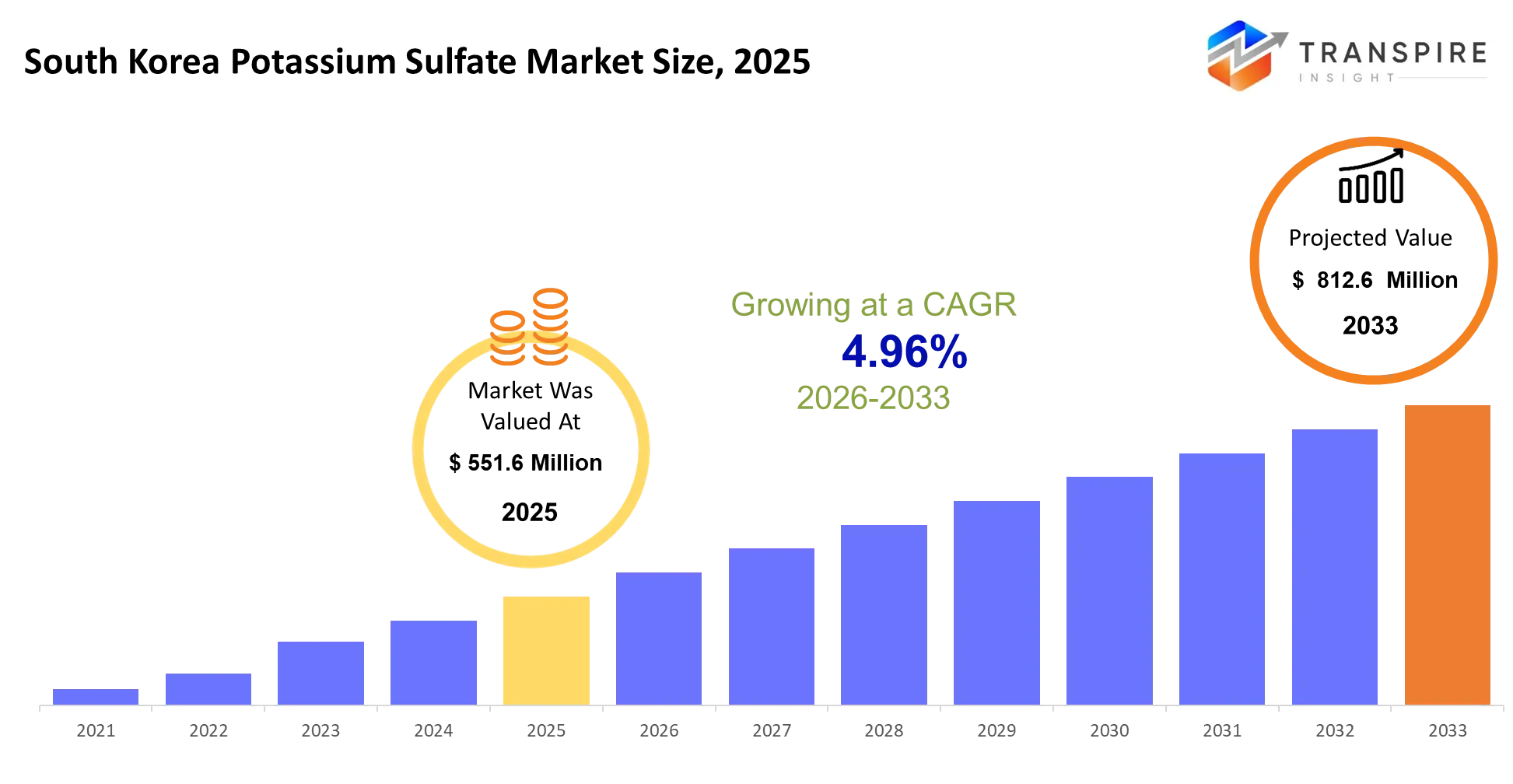
- South Korea Potassium Sulfate Market Size 2025: USD 551.6 Million
- South Korea Potassium Sulfate Market Size 2033: USD 812.6 Million
- South Korea Potassium Sulfate Market CAGR: 4.96%
- South Korea Potassium Sulfate Market Segments: By Form (Powder Potassium Sulfate, Granular Potassium Sulfate, Liquid Potassium Sulfate, Water-soluble Potassium Sulfate, Industrial Grade Potassium Sulfate, Others); By Application (Fertilizers, Industrial Chemicals, Pharmaceuticals, Food Additives, Glass Manufacturing, Others); By Crop Type (Fruits & Vegetables, Cereals & Grains, Oilseeds & Pulses, Turf & Ornamentals, Others); By Distribution Channel (Direct Sales, Dealers & Distributors, Online Sales, Retail Stores, Others); By End User (Agriculture Industry, Chemical Industry, Food Industry, Pharmaceutical Industry, Others)
To learn more about this report,  Download Free Sample Report
South Korea Potassium Sulfate Market Summary
The South Korea Potassium Sulfate Market was valued at USD 551.6 Million in 2025. It is forecast to reach USD 812.6 Million by 2033. That is a CAGR of 4.96% over the period.
South Korea’s potassium sulfate market kind of has a very practical job: it helps keep crop output steady on limited arable land, while also dealing with tighter export rules and food-quality expectations. Fertilizer blenders, plus greenhouse operators, lean on potassium sulfate for high-value crops like fruits, vegetables, and specialty horticulture, because it brings potassium to the plant without the chloride that , in some cases, can harm delicate crops or gradually dull soil performance. In more industrial settings, it even supports certain specialty chemical and glass manufacturing steps where purity, sort of literally, matters.
In the past few years, the market has moved away from only chasing higher tonnage fertilizer use, and more toward precision nutrient management that’s linked with controlled-environment agriculture and premium food production. This change picked up momentum after global fertilizer supply hiccups connected to the Russia-Ukraine conflict, which made it clear how much South Korea relies on imported raw materials. So distributors had to rethink where they source from, and diversification became more than a buzz phrase. Meanwhile, stricter environmental limits around soil and water quality pushed growers toward lower-salinity fertilizer inputs. Put together, these factors have improved demand for higher-efficiency formulations, letting suppliers ask for stronger margins, while also expanding uptake through commercial farming networks.
Key Market Insights
- Gyeonggi along with South Gyeongsang kinda collectively took over most of the South Korea Potassium Sulfate Market, over 38% market share in 2025, mainly due to intensive greenhouse cultivation.
- The farming belts near cities showed notable fertilizer consumption growth from 2022 to 2025 as controlled environment agriculture rolled out very fast.
- For 2025, standard potassium sulfate fertilizer basically led the overall industry size, with almost 54% share because it fits a wide range of commercial farming uses.
- Water soluble potassium sulfate came in as the second biggest segment, driven by more adoption in drip irrigation and hydroponic agriculture systems, so yeah.
- Granular premium grade potassium sulfate is expected to be the fastest growing segment through 2030, because high value fruit producers need more exact nutrient delivery.
- In 2025 Horticulture applications basically sat at around 46% market share, and it was mostly pushed by South Korea’s premium vegetable and fruit growing sector.
- For the greenhouse side, it feels like that application segment is growing the quickest, since growers keep chasing yield optimization along with export-ready quality crops, like always.
- On the commercial production front, agricultural producers were the ones leading the South Korea Potassium Sulfate Market, roughly 61% share in 2025, helped by big scale greenhouse operations.
- Smart farming operators are also labeled as the fastest-growing end-user group, mostly because automated fertigation setups call for very soluble sulfate fertilizers, pretty directly.
- And agricultural cooperatives, after 2022, bumped up procurement volumes, with the goal to stabilize fertilizer supply during global raw material price swings, kind of unavoidable.
What are the Key Drivers, Restraints, and Opportunities in the South Korea Potassium Sulfate Market?
The main thing shaping the South Korea potassium sulfate market is basically the spread of precision greenhouse farming, connected to premium fruit and vegetable production, kind of tied together. In the past five years, many commercial growers quietly moved toward crops that do not tolerate chloride well like strawberries, tomatoes, and paprika . That happened because export buyers and local retailers started applying tougher quality rules, plus longer shelf-life requirements. So naturally, they leaned more on potassium sulfate instead of conventional potash fertilizers because they wanted nutrient inputs that help crop color, raise sugar content, and also keep storage stability strong, all without creating trouble for soil conditions. As a consequence, fertilizer suppliers ended up with better-margin sales, especially from specialty blends made for fertigation and hydroponic setups, where accuracy matters.
The biggest restraint in the market is South Korea’s reliance on imported potassium-based raw materials. The country doesn’t have big domestic mineral reserves, which makes fertilizer producers face freight swings, geopolitical disruptions, and currency volatility, all at once. This feels structural, not temporary, because setting up substitute supply routes or securing long-term overseas mining rights takes serious capital and usually multi-year deals. You can see the effect in uneven fertilizer pricing, procurement that starts late or drags , and less buying freedom for smaller agricultural cooperatives.
A noticeable opportunity is also forming through smart farming investments in places like Jeolla and South Gyeongsang. Government-supported controlled-environment agriculture projects are increasingly using automated nutrient delivery systems, and those systems tend to require highly soluble sulfate fertilizers. That opens long-run room for premium water-soluble potassium sulfate suppliers, particularly those focusing on technology-driven commercial farming networks.
What Has the Impact of Artificial Intelligence Been on the South Korea Potassium Sulfate Market?
Artificial intelligence plus more advanced digital tech are, yeah, changing the way potassium sulfate producers and agricultural distributors run things across South Korea. Fertilizer manufacturers more and more rely on AI enabled process-control setups to handle sulfate conversion, keep temperature in check, and manage energy inside their plants. These systems, in real time, track reaction performance and raw material consumption ,so people can cut down on waste and keep product consistency steady when they’re pushing out goods in big volume production cycles. Also a few of the bigger fertilizer distributors add IoT sensors to cloud based inventory platforms, that way they can watch warehouses automatically and fine tune delivery timing for greenhouse farming groups.
Meanwhile machine learning is getting better at forecasting in both fertilizer manufacturing and precision agriculture work. Producers are using predictive maintenance software to spot early warning signals like corrosion on equipment ,pump issues, or filtration inefficiencies long before any shutdown happens. In controlled-environment farming, AI driven fertigation tools look at soil conductivity ,humidity, and how crops actually pull nutrients from the medium, then they adjust potassium sulfate delivery amounts accordingly. Result wise, fertilizer use efficiency improves, while excess nutrient runoff drops and operating costs for commercial growers tend to get lower too.
Digital optimization tools also help with real, measurable operational wins. Automated monitoring systems have assisted some greenhouse operators to cut fertilizer waste by double digit percentages ,and at the same time keep crop consistency steadier , leading to more yield stability. Still, the steep integration costs are a big bottleneck, especially for smaller agricultural cooperatives that do not yet have the infrastructure, plus the practical technical know-how required, to roll out advanced AI-based nutrient management solutions in a smooth way.
Key Market Trends
- Between 2021 and 2025, greenhouse vegetable producers started buying more water-soluble potassium sulfate, as fertigation setups became the norm across many commercial farms.
- South Korean agricultural cooperatives , shifted how they procured products after the Russia-Ukraine conflict , which bent the imported fertilizer routes and made the raw material prices swing more often and harder.
- Since 2022, chloride sensitive crops , like strawberries and paprika, saw cultivation areas expand quite a bit, so growers leaned more toward sulfate based specialty fertilizers, rather than the usual potash options.
- Fertilizer companies such as Yara International and SQM also expanded their distribution links across East Asia, in order to keep deliveries steady and protect or grow regional market share.
- Smart farming efforts in Jeolla and South Gyeongsang moved faster after 2023, and that boosted demand for highly soluble nutrients that work well with automated nutrient delivery systems.
- From 2023 through 2025, domestic distributors increasingly used AI enabled forecasting tools , to cut down warehouse overstock and make seasonal allocation work more efficiently.
- At the same time, fertilizer pricing got more unstable after 2021, mainly because shipping charges rose, currency swings showed up, and geopolitical events disrupted long term supplier agreements.
- Commercial growers then gradually swapped out bulk granular fertilizers for more premium formulations, which are said to improve crop hue, shelf life, and the consistency needed for export grade results in controlled environment agriculture.
- After 2022, environmental monitoring requirements got stricter in many intensive farming zones, so producers pushed programs that lower chloride applications, aimed at reducing soil salinity too.
South Korea Potassium Sulfate Market Segmentation
By Form:
Powder potassium sulfate keeps getting steady demand across most farming actions because it mixes fast and is pretty easy for people to spread on soil, so nutrient management stays regular. In greenhouse cultivation setups, operators tend to like the powder option more often, mainly for controlled fertilizer dosing and pretty uniform crop feeding. With storage that stays stable , and shipping that feels straightforward too, commercial use continues through agricultural cooperatives and fertilizer distributors too.
Granular potassium sulfate is still popular in open-field growing where slow release of nutrients helps with long crop cycles. Liquid potassium sulfate is getting more attention in precision farming systems, mostly because it works well with drip irrigation gear. Water soluble potassium sulfate will keep expanding in hydroponics and greenhouse farming, since rapid uptake makes nutrient efficiency better. For industry, potassium sulfate in industrial grade supports chemical processing and also glass manufacturing, while other special variants cover customized industrial needs and agricultural preferences.
By Application:
Fertilizers end up taking the largest share,mostly because potassium sulfate helps chloride-sensitive crops, like tomatoes ,peppers, strawberries and also horticulture produce. In actual commercial farming, operations lean on sulfate based fertilizers to boost crop quality , shelf life, and keep color consistent. And with more people using fertigation systems lately, that trend also keeps pushing usage in controlled growing environments too.
On the other hand industrial chemicals generate extra demand, since potassium sulfate shows up in specialty chemical making and lab processing work. Pharmaceutical uses also matter, particularly in regulated manufacturing, where purity standards still feel critical. In food additive contexts, it’s used in controlled processing activities ,while glass manufacturing plants utilize potassium sulfate during more specialized glass production runs. Beyond that, there are water treatment applications and some selected industrial blending steps, where sulfate compounds help maintain steady production output.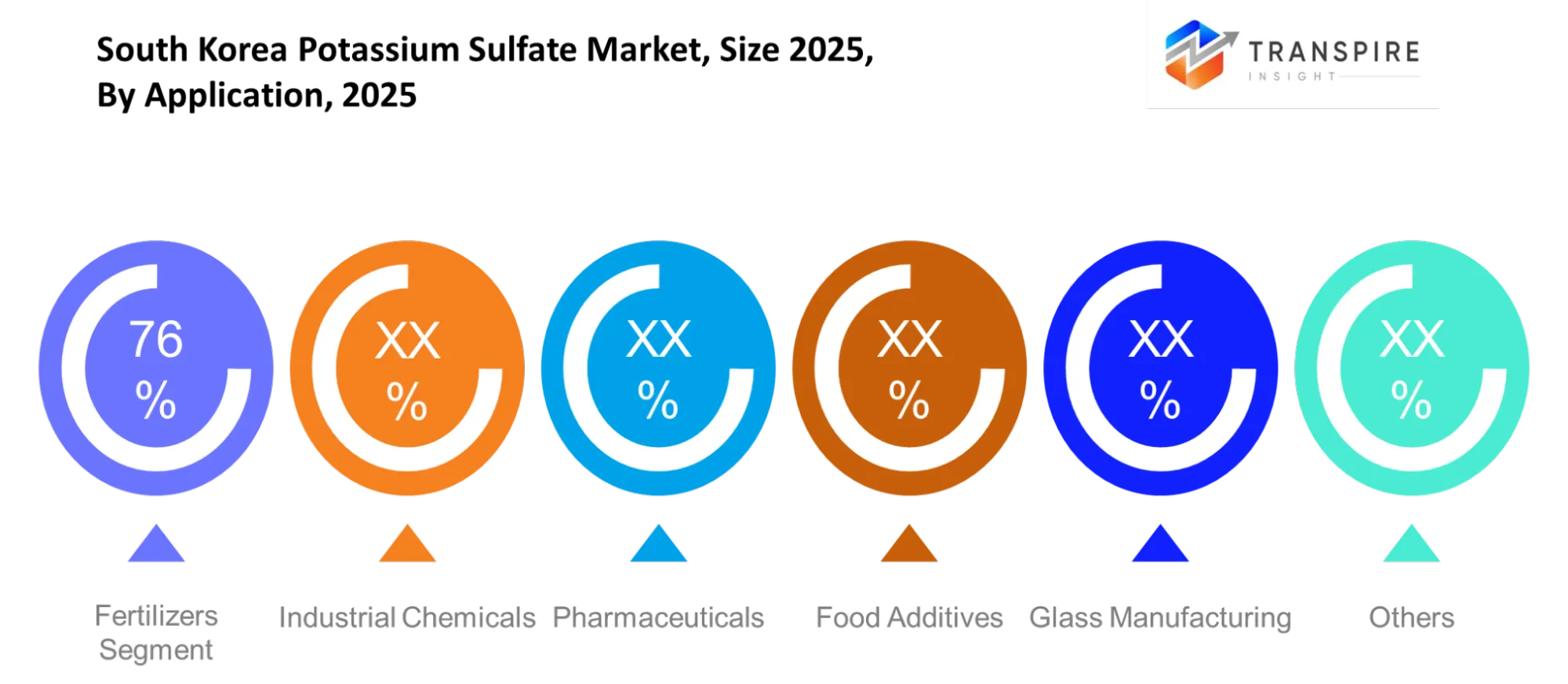
To learn more about this report, Download Free Sample Report
By Crop Type:
Fruits and vegetables end up using a rather strong fertilizer amount because premium crop growing needs careful nutrient management, plus a lower level of soil salinity. In real use, many commercial greenhouse operators rely on potassium sulfate , to keep the crops in good shape, boost storage steadiness, and back export driven agricultural production. High-value horticulture farming still helps with a steady product demand across many South Korean agricultural areas.
As for cereals and grains, their consumption tends to stay moderate, since a well-timed potassium supply helps plant growth and the overall output of the crop. Oilseeds and pulses often take up sulfate fertilizers during nutrient-heavy cultivation rounds. Turf and ornamental farming also adds demand, because landscaping and decorative plant growing need consistent nutrient plans , for appearance and growth management. There are also other crop categories, like specialized farming setups , with their own tailored fertilizer needs.
By Distribution Channel:
Direct sales is still sort of important for big agricultural producers and industrial buyers, because bulk purchasing agreements help keep supply steadier and also give more pricing control, which is kinda key. Fertilizer manufacturers are still building stronger direct partnerships with greenhouse operators plus farming cooperatives, to help with long-term buying schedules and make sure product availability stays more predictable.
Dealers and distributors also have a major role in how fertilizer moves around regionally , since local networks expand market reach and make seasonal deliveries more efficient. Online sales channels will keep growing, especially as agricultural procurement platforms get better digital ordering systems for farming businesses. Retail stores back up small-scale agricultural buyers and independent growers who need easier access to fertilizer products. Other ways of distribution include contract supply programs and industrial procurement arrangements, which can be pretty formal.
By End User:
Agriculture sector basically drives the overall consumption, because potassium sulfate helps crop productivity, supports greenhouse agriculture, and makes precision nutrient management feel more doable. In the commercial farming business, sulfate fertilizer usage keeps climbing , especially for premium fruits, vegetables, and export minded horticulture production. Even controlled environment farming systems, they keep pushing the long run agricultural demand too, pretty steadily.
For chemical industry needs, consumption looks fairly steady, since potassium sulfate backs specialty manufacturing and also helps with industrial blending work. Meanwhile the food industry keeps buying too, mostly due to regulated additive usage and tightly controlled processing functions. In the pharmaceutical arena, intake depends on purity first production norms and on specialized chemical requirements. There are other end users as well , like laboratory operations, water treatment activities, and some chosen industrial sectors that use sulfate based compounds in the middle of manufacturing processes.
What are the Key Use Cases Driving the South Korea Potassium Sulfate Market?
Commercial greenhouse farming is still the biggest reason why potassium sulfate is getting used more in South Korea, you know , the kind of use case that just keeps rolling forward. In these places high-value crops like strawberries , tomatoes , and peppers need a low-chloride nutrient approach so the plants keep the right color and better shelf life. Export quality too, is part of that routine. Greenhouse operators tend to lean on water soluble sulfate fertilizers because automated fertigation setups ask for fast nutrient uptake and a mixing that stays steady, even when things are moving quickly.
Then there are the secondary applications, which are slowly spreading out into industrial chemicals and even specialty glass manufacturing. Chemical producers put potassium sulfate into controlled processing steps, where purity matters and reaction stability stays front and center. Food processing companies also bring sulfate compounds into play, mostly for regulated additive uses that connect to packaged and processed food work.
More recently you start seeing new directions in hydroponic vertical farming , plus the AI enabled smart agriculture facilities. In controlled environment projects in areas like Jeolla, some growers are pairing sensor based nutrient delivery with a real time optimization style. So the sulfate fertilizer usage gets adjusted on the go, not just on a fixed schedule. There’s also a longer-term opening in specialty pharmaceutical processing, since the demand is growing for high purity sulfate compounds within regulated manufacturing spaces.
|
Report Metrics |
Details |
|
Market size value in 2025 |
USD 551.6 Million |
|
Market size value in 2026 |
USD 578.9 Million |
|
Revenue forecast in 2033 |
USD 812.6 Million |
|
Growth rate |
CAGR of 4.96% from 2026 to 2033 |
|
Base year |
2025 |
|
Historical data |
2021 - 2024 |
|
Forecast period |
2026 - 2033 |
|
Report coverage |
Revenue forecast, competitive landscape, growth factors, and trends |
|
Country scope |
South Korea |
|
Key company profiled |
K+S Aktiengesellschaft, SQM S.A., Tessenderlo Group, Yara International, Compass Minerals, Sesoda Corporation, Migao Corporation, The Mosaic Company, Intrepid Potash, Nutrien Ltd., Halogens, China Ching Shiang Chemical, SDIC Xinjiang Luobupo Potash, Kemira Kemi AB, SOPerior Fertilizer Corp. |
|
Customization scope |
Free report customization (country, regional & segment scope). Avail customized purchase options to meet your exact research needs. |
|
Report Segmentation |
By Form (Powder Potassium Sulfate, Granular Potassium Sulfate, Liquid Potassium Sulfate, Water-soluble Potassium Sulfate, Industrial Grade Potassium Sulfate, Others); By Application (Fertilizers, Industrial Chemicals, Pharmaceuticals, Food Additives, Glass Manufacturing, Others); By Crop Type (Fruits & Vegetables, Cereals & Grains, Oilseeds & Pulses, Turf & Ornamentals, Others); By Distribution Channel (Direct Sales, Dealers & Distributors, Online Sales, Retail Stores, Others); By End User (Agriculture Industry, Chemical Industry, Food Industry, Pharmaceutical Industry, Others) |
Which Regions are Driving the South Korea Potassium Sulfate Market Growth?
Gyeonggi Province kind of leads the South Korea potassium sulfate market, mainly because the area backs intensive greenhouse cultivation, plus it has pretty advanced agricultural distribution networks. You see big vegetable and fruit producers sitting not far from major consumption centers, which helps logistics move faster, and keeps fertilizer availability steadier through the year too. On top of that, government support for smart farming projects has nudged more farmers toward water-soluble sulfate fertilizers, especially in automated fertigation setups, and they seem to like the convenience. Also, there are agricultural cooperatives, research institutions, and specialized input suppliers around, so it ends up feeling like a stable ecosystem, and that keeps continuous commercial fertilizer demand going.
South Gyeongsang acts like the second major regional driver, but the growth rhythm is a bit different, not as much about closeness to urban farming. Here, industrial stability matters more than simple proximity. The region gets help from fairly balanced agriculture, while chemical manufacturing and processing activities also use sulfate compounds for various industrial operations. Farming communities that have been there for a long time keep putting money into crop quality improvements, rather than rushing into acreage expansion. That difference tends to make fertilizer purchasing cycles more even and less jumpy. Reliable transportation infrastructure and long term relationships with distributors also help keep product movement consistent even when global fertilizer pricing wobbles.
Jeolla kind of represents the fastest growing regional market, mostly because there’s been rapid investment in controlled-environment agriculture and this modernization of farming operations since 2022, you know. Local authorities also expanded their help for smart greenhouse projects, which are intended to support food security and at the same time boost export competitiveness. As a result adoption picked up for precision nutrient management systems and that’s where a lot of the energy is coming from. Meanwhile younger commercial growers moving into higher value horticulture farming have pushed demand up for premium sulfate based fertilizers that have to be compatible with hydroponic setups and automated irrigation technologies. This whole momentum should create solid opportunities for fertilizer suppliers, agri technology firms, and specialty nutrient providers looking to expand between 2026 and 2033.
Who are the Key Players in the South Korea Potassium Sulfate Market and How Do They Compete?
South Korea potassium sulfate market looks like it has moderately consolidated players, where global fertilizer producers keep going head to head with regional distributors and specialty nutrient suppliers. Still, the fight is not just about volume based pricing , it is more about how well the product performs, whether supply stays steady and dependable , and how easily it fits into precision farming systems. Most established firms keep defending their share via long term distributor arrangements, plus premium grade fertilizer lines that are tuned for greenhouse agriculture . Meanwhile, smaller specialty companies move into narrower zones like hydroponics and smart farming, where bespoke nutrient formulations and hands on technical guidance tend to lock in customers better than plain low cost bulk offerings.
SQM tends to stand out with high purity water soluble potassium sulfate aimed for fertigation and controlled environment cultivation. The company leans into technology led crop nutrition programs that help commercial growers smooth out yield consistency and also push better nutrient efficiency . Their growth plans across East Asia involve deeper distributor cooperation and more localized agronomic support for greenhouse operators . Yara International also competes differently, using integrated crop management services that bundle specialty fertilizers with digital farming tools and nutrient tracking systems. This kind of method helps solidify long run relationships with commercial farming networks that want data oriented nutrient tuning .
K+S Aktiengesellschaft keeps its edge by having pretty stable access to raw materials and also because it can operate at large scale around the world, so procurement risk gets lower when markets go a bit wild, or volatile. At the same time the firm is still tightening its regional supply routes. This is meant to boost delivery dependability especially for Asian agricultural buyers. Compass Minerals, in turn, is more focused on specialty sulfate products for crops that are sensitive to chloride. They stand out by keeping product quality steady, even when the use case is premium in agriculture. Tessenderlo Group goes after industrial and agricultural customers with tailored sulfate formulations. That way they get stronger footholds in specialty chemical processing, and also in precision horticulture, sort of where detailed control really matters.
Company List
- K+S Aktiengesellschaft
- SQM S.A.
- Tessenderlo Group
- Yara International
- Compass Minerals
- Sesoda Corporation
- Migao Corporation
- The Mosaic Company
- Intrepid Potash
- Nutrien Ltd.
- Halogens
- China Ching Shiang Chemical
- SDIC Xinjiang Luobupo Potash
- Kemira Kemi AB
- SOPerior Fertilizer Corp.
Recent Development News
In October 2025, Green On announced expansion of its sulfate of potash (SOP) production capacity by adding two new Mannheim production lines. The expansion is expected to raise total SOP capacity to 100,000 tons per year by Q2 2026, strengthening regional supply availability for Northeast Asian import markets including South Korea.
Source https://www.argusmedia.com/
In July 2025, Sask Potash entered the development phase of its sulfate of potash (SOP) project in Saskatchewan. The project is expected to produce 50,000 metric tons of SOP annually in its first phase, strengthening future global potassium sulfate supply availability for Asia-Pacific fertilizer markets including South Korea.Source https://www.argusmedia.com/
What Strategic Insights Define the Future of the South Korea Potassium Sulfate Market?
South Korea's potassium sulfate market is kinda moving, sort of, toward a technology-connected specialty nutrition business instead of that usual bulk fertilizer routine. In the next five to seven years, most of the growth will probably come from precision farming, automated greenhouse cultivation, and some data centered nutrient routines that really lean into crop quality not fertilizer quantity. That kind of shift is going to reward suppliers who can offer water soluble blends, plus agronomic guidance services, and also make it work with AI enabled fertigation setups. Overall value creation will lean more on how well things perform and how reliably the supply shows up, rather than just raw size alone.
There is also a not-so-obvious risk hiding here, because the market depends heavily on imported potassium feedstock and only a small circle of global suppliers. So if mining output slows down, or maritime freight routes get messy, or trade relations turn sour for a while, pricing can get unstable and smaller distributors might have trouble absorbing those swings. At the same time, there is an opportunity that seems to be forming around vertical farming and city agriculture clusters near big metropolitan areas, since controlled environment production needs pretty high purity nutrient solutions. If companies want in, they should start early with localized blending facilities, and also build digital agronomy partnerships, so they can lock in longer term relationships with smart farming operators before this segment gets crowded and very competitive.
South Korea Potassium Sulfate Market Report Segmentation
By Form
- Powder Potassium Sulfate
- Granular Potassium Sulfate
- Liquid Potassium Sulfate
- Water-soluble Potassium Sulfate
- Industrial Grade Potassium Sulfate
By Application
- Fertilizers
- Industrial Chemicals
- Pharmaceuticals
- Food Additives
- Glass Manufacturing
By Crop Type
- Fruits & Vegetables
- Cereals & Grains
- Oilseeds & Pulses
- Turf & Ornamentals
By Distribution Channel
- Direct Sales
- Dealers & Distributors
- Online Sales
- Retail Stores
By End User
- Agriculture Industry
- Chemical Industry
- Food Industry
- Pharmaceutical Industry
Frequently Asked Questions
Find quick answers to common questions.
The South Korea Potassium Sulfate Market size is USD 812.6 Million in 2033.
Key Segments for the South Korea Potassium Sulfate Market are By Form (Powder Potassium Sulfate, Granular Potassium Sulfate, Liquid Potassium Sulfate, Water-soluble Potassium Sulfate, Industrial Grade Potassium Sulfate, Others); By Application (Fertilizers, Industrial Chemicals, Pharmaceuticals, Food Additives, Glass Manufacturing, Others); By Crop Type (Fruits & Vegetables, Cereals & Grains, Oilseeds & Pulses, Turf & Ornamentals, Others); By Distribution Channel (Direct Sales, Dealers & Distributors, Online Sales, Retail Stores, Others); By End User (Agriculture Industry, Chemical Industry, Food Industry, Pharmaceutical Industry, Others).
Major South Korea Potassium Sulfate Market Players are K+S Aktiengesellschaft, SQM S.A., Tessenderlo Group, Yara International, Compass Minerals, Sesoda Corporation, Migao Corporation, The Mosaic Company, Intrepid Potash, Nutrien Ltd., Halogens, China Ching Shiang Chemical, SDIC Xinjiang Luobupo Potash, Kemira Kemi AB, SOPerior Fertilizer Corp..
The current South Korea Potassium Sulfate Market size is USD 551.6 Million in 2025.
The South Korea Potassium Sulfate Market CAGR is 4.96% from 2026 to 2033.
- K+S Aktiengesellschaft
- SQM S.A.
- Tessenderlo Group
- Yara International
- Compass Minerals
- Sesoda Corporation
- Migao Corporation
- The Mosaic Company
- Intrepid Potash
- Nutrien Ltd.
- Halogens
- China Ching Shiang Chemical
- SDIC Xinjiang Luobupo Potash
- Kemira Kemi AB
- SOPerior Fertilizer Corp.
Recently Published Reports
-
May 2026
Healthcare Polymer Packaging Market
Healthcare Polymer Packaging Market Size, Share & Analysis Report By Packaging Type (Syringes, IV Bottles and Pouches, Clamshells, Blisters, Bottles & Jars, Containers, Tubes, IV Parental Packaging, Others), By Type (Regulated, Non-regulated), By Polymer Type (LDPE (Low-Density Polyethylene), HDPE (High-Density Polyethylene), Homo-polymer (Homo), Random Copolymer (Random), Block Copolymer (Block), PET, Polystyrene, Polyvinyl Chloride, Polyamide/EVOH, Others), and Geography (North America, Europe, Asia-Pacific, Middle East and Africa, South and Central America), 2021 - 2031
-
Apr 2026
Hydrophilic Tape (Waterstop) Market
Hydrophilic Tape (Waterstop) Market Size, Share & Analysis Report By Type (Bentonite-Based Hydrophilic Tape, Rubber-Based Hydrophilic Tape), By Application (Residential Buildings, Commercial Buildings, Infrastructure Projects), and Geography (North America, Europe, Asia-Pacific, Middle East and Africa, South and Central America), 2021 - 2031
-
Apr 2026
Metalens Market
Metalens Market Size, Share & Analysis Report By Type (Visible Light Metalens, and Infrared Metalens), By Application (Consumer Electronics, Automotive Electronics, Industrial, Medical, and Others), and Geography (North America, Europe, Asia-Pacific, Middle East and Africa, South and Central America), 2021 - 2031
-
Apr 2026
PBT Resin Market
PBT Resin Market Size, Share & Analysis Report By Type (Reinforced PBT Resin, Unreinforced PBT Resin), By Processing Method (Injection Molding, Extrusion, Blow Molding, Others), By End-User (Automotive, Electrical & Electronics, Consumer Appliances, Industrial Machinery, Medical Devices, Packaging, Others), and Geography (North America, Europe, Asia-Pacific, Middle East and Africa, South and Central America), 2021 - 2031