
South Korea Polysilicon Market Size & Forecast:
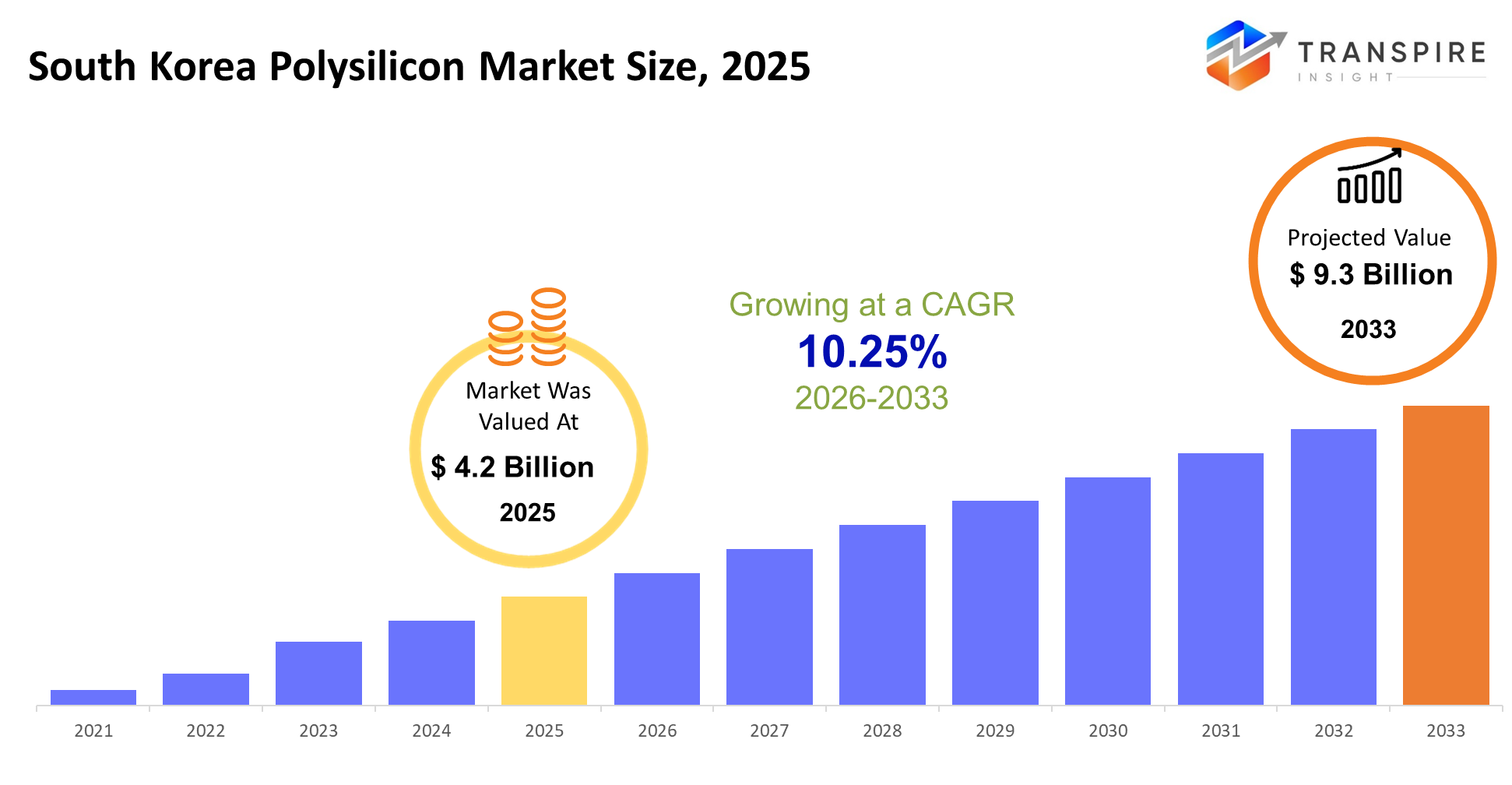
- South Korea Polysilicon Market Size 2025: USD 4.2 Billion
- South Korea Polysilicon Market Size 2033: USD 9.3 Billion
- South Korea Polysilicon Market CAGR: 10.25%
- South Korea Polysilicon Market Segments: By Grade (Solar Grade, Electronic Grade, Metallurgical Grade, Recycled), By Production Method (Siemens Process, FBR, UMG, Hybrid), By Application (Solar PV, Semiconductors, Electronics, Chemicals), By Distribution Channel (Direct Sales, Distributors, Export, OEM Supply), By End-User (Solar Companies, Semiconductor Firms, Industrial Users, Electronics Manufacturers)
To learn more about this report,  Download Free Sample Report
South Korea Polysilicon Market Summary:
The South Korea Polysilicon Market size is estimated at USD 4.2 Billion in 2025 and is anticipated to reach USD 9.3 Billion by 2033, growing at a CAGR of 10.25% from 2026 to 2033.
The South Korea polysilicon market operates as the main center for advanced materials and renewable energy development in the country because it depends on two competing forces which include domestic production capacity and international market availability.Existing market operations will experience changes which result from new demands made by solar module manufacturers who now require both higher purity materials and fixed contract agreements that last multiple years. Korean manufacturers have been developing better production techniques which allow them to use less energy while they comply with new environmental regulations which will determine operational and growth practices for their facilities in forthcoming years.
Polysilicon production and usage will be transformed by technological advancements which will implement automation and process optimization to minimize waste while achieving better product consistency. Businesses will deal with international supplier pricing challenges through trade policies and regional competition that remain essential for their operations. End users will increasingly prioritize traceability and sustainability, which will require suppliers to implement environmentally friendly production techniques. The market will establish its future development path through existing political policies, technological advancements and transformation of buyer demands in the market.
What Has the Impact of Artificial Intelligence Been on the South Korea Polysilicon Market?
The South Korea polysilicon market is undergoing transformation because artificial intelligence technology helps companies improve their data analysis capabilities which enables better demand forecasting and industry adaptation. The South Korea polysilicon market now employs AI-based systems to handle extensive datasets that include solar energy consumption information and semiconductor manufacturing data and international trade statistics. The South Korean polysilicon market uses artificial intelligence technology which enables companies to predict market trends by analyzing price changes and material shortages and changes in renewable energy regulations.
The South Korean polysilicon market production process benefits from AI technology which improves operational efficiency through advanced automated systems and machine learning capabilities. Advanced algorithms track production processes in real-time to decrease production errors and increase output quality while decreasing power usage. The cost-saving advantages of these changes become essential because businesses need to maintain exact performance standards to safeguard their profit margins.
AI technology not only improves efficiency in the South Korean polysilicon industry but also creates new business opportunities which help companies maintain their market lead. Companies use machine learning models to create metals with higher purity which they use to produce specialized silicon products for their semiconductor and photovoltaic needs. This transformation enables businesses to create unique products which help them meet new customer demands while establishing their market position to achieve sustained development and technical superiority.
Key Market Trends & Insights:
- The South Korean polysilicon market in 2025 will have South Korea controlling more than 85% of the market because it operates domestic manufacturing plants and export-driven production facilities.
- The southeastern industrial belt will become the most rapidly expanding area until 2030 because of the planned development of solar-grade polysilicon production plants and accompanying infrastructure projects. The market for solar-grade polysilicon will reach 65% market share in 2025 because of the increasing demand for photovoltaic systems and goals for renewable energy development. The second-largest market share of electronic-grade polysilicon exists because of its essential role in semiconductor production and its continuous technological progress.
- The period between 2025 and 2030 will see the high-purity polysilicon market grow at a compound annual growth rate of more than 8% because of chip industry requirements.
- The South Korean polysilicon market, which solar photovoltaic applications control with more than 60% of the market share, shows strong clean energy adoption through its operational capacity in 2025.
- The semiconductor industry grows most quickly through advanced chip technology and AI hardware and memory device applications which experience increased market demand.
- Solar energy companies dominate end-user demand because they hold a major market share which government-supported renewable energy programs and their upcoming capacity expansions will help them maintain.
- The South Korea polysilicon market receives substantial market share from key players which include OCI Company Ltd., Hanwha Solutions, Samsung Electronics, SK Siltron, and Wacker Chemie AG.
- Companies use product innovation of ultra-high-purity polysilicon to achieve competitive advantage in semiconductor-grade applications.
South Korea Polysilicon Market Segmentation
By Grade :
Solar grade polysilicon maintains high purity standards which make it suitable for manufacturing photovoltaic cells that deliver stable energy performance. Electronic grade materials reach ultra-high purity standards which enable their use in integrated circuits because even the smallest defects will compromise their functionality. Metallurgical grade functions as a primary substance which contains lower purity levels that engineers utilize to create alloys and conduct intermediate processing operations.
Recycled polysilicon emerges from production scrap and end-of-life materials, offering cost efficiency and sustainability benefits. The recycling process transforms collected materials into refined products which fulfill necessary standards while reducing the need for new raw materials. Manufacturers across industrial and technological sectors require different grades of products because they need to meet application requirements and budget requirements and their manufacturing methods evolve.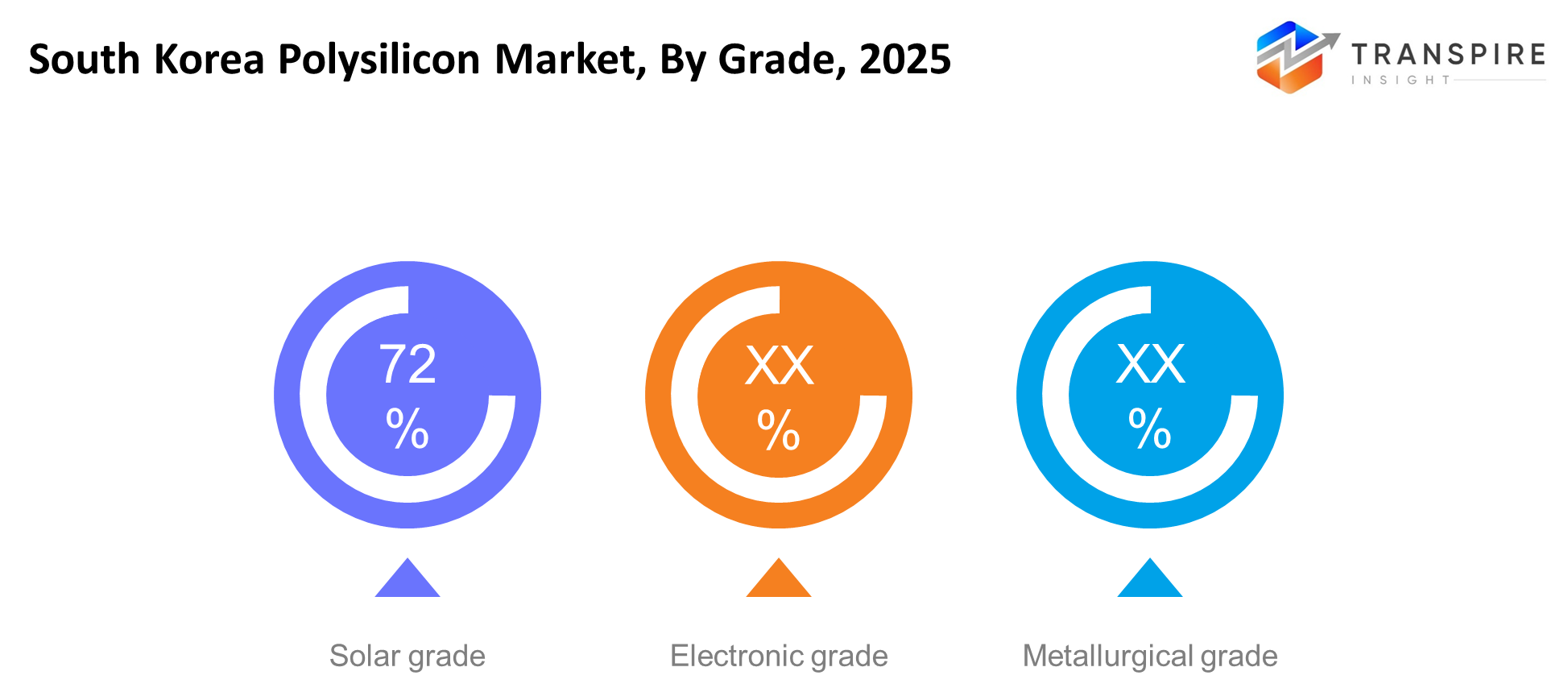
To learn more about this report, Download Free Sample Report
By Production Method :
The Siemens process has maintained its status as a dominant industry standard because it can produce high-purity polysilicon through chemical vapor deposition. The method delivers stable product quality but requires substantial energy expenditures. The fluidized bed reactorFBR technology delivers better efficiency because it operates at all times while using reduced energy consumption.
The upgraded metallurgical gradeUMG technology enables the transformation of lower-grade silicon into profitable polysilicon through affordable industrial processes. Hybrid methods combine both traditional techniques and modern approaches to achieve three goals which are pure results and affordable solutions and energy-efficient operations.The manufacturing facility production method selection process requires evaluation of three factors: target application, scalability requirements, and operational cost structures.
By Application :
The demand for solar photovoltaic systems increased because renewable energy projects expanded and more photovoltaic systems became installed. The production of solar wafers and cells depends on the essential raw material polysilicon which determines the complete efficiency of their systems. Semiconductor applications require extremely pure material for chip fabrication which guarantees the dependable operation of their devices.
Electronic products use semiconductors and other components that include sensors and displays because material quality remains essential for their operation. The chemical industry uses polysilicon as a raw material for producing silicones and other chemical compounds which serve various industrial applications. Each application segment requires different purity standards which impact industry growth while technological advancements create new market demands.
By Distribution Channel :
Direct sales involve manufacturers supplying polysilicon directly to large buyers, which establishes both fixed supply agreements and predetermined pricing systems. The channel enables businesses to establish extended contracts which require them to work more closely with their production partners. Distributors help businesses because they access smaller customers while they handle operations for local distribution networks.
Through export channels producers can enter international markets while they adapt to changes in global demand and trade patterns. OEM supply creates partnerships with original equipment manufacturers which use polysilicon in their manufacturing processes. The distribution methods of a business depend on its production capacity and its market distribution and its network ties.
By End-User :
The solar industry functions as a primary end-user market because it utilizes large-scale solar systems while participating in current energy transition initiatives. The production process requires continuous access to superior polysilicon materials which determine operational success. The semiconductor industry requires high-purity materials for its development of cutting-edge chip production processes.
Industrial users utilize polysilicon in various applications, including alloys and intermediate materials, where cost and availability influence purchasing decisions. Electronics manufacturers require consistent material delivery to create components for both consumer and industrial products. Each end-user segment reflects different performance expectations, pricing sensitivity, and long-term demand outlook.
What are the Main Challenges for the South Korea Polysilicon Market Growth?
The South Korean market for polysilicon faces multiple operational and technical challenges which result in decreased production capacity and restricted operational growth. The manufacturing process for polysilicon requires excessive energy consumption which results in higher production expenses while making sustainable development impossible according to industry standards. The South Korean polysilicon market experiences supply chain disruptions because raw materials become unavailable while manufacturers depend on international trade systems, which makes it difficult for them to produce goods consistently.
The South Korean polysilicon market expansion faces major delays because of existing commercialization and manufacturing obstacles. New businesses face entry restrictions because the production process requires them to spend substantial funds on advanced equipment while meeting high-quality production needs. The South Korean polysilicon market faces two main challenges which decrease profit margins and postpone business development activities about international market competition and price competition from overseas businesses.
The South Korean polysilicon market encounters major obstacles because of two main problems: challenges related to adoption and problems with existing infrastructure which prevent advanced applications from being expanded. The development of technology encounters two major challenges which include the shortage of skilled workers who can perform accurate manufacturing tasks and the lack of investment needed to develop advanced production facilities. The solar and semiconductor industries experience unpredictable demand patterns which create uncertainty that affects their long-term strategic planning and investment choices.
The introduction of alternative materials and new production methods has created heightened competition in the market while simultaneously increasing potential dangers that will affect upcoming market developments. The South Korea polysilicon market faces increased competition from global oversupply and major exporters who implement aggressive pricing strategies which create additional market constraints and uncertain future business development.
Country Insights
The South Korean polysilicon market maintains its steady development because solar energy and semiconductor manufacturing create strong market demand. The manufacturing capacity now meets both domestic and export requirements because advanced processing technology and stable supply chains support current operations. The market experiences growth because people now focus more on renewable energy, which depends on polysilicon as an essential material for making photovoltaic cells.
The production patterns show an industry shift that requires more pure materials for semiconductor manufacturing, which mandates strict precision and quality standards. Local producers maintain their competitive edge through efficiency improvements and cost control measures despite international price fluctuations which affect their business operations. Solar panel manufacturers create market demand which results in higher production rates while improvements in wafer technology enable manufacturers to achieve greater material efficiency and waste reduction during their production procedures.
The South Korean Polysilicon Market shows equal development across its regions because government programs work to build renewable energy supply chains. The construction of production facilities through strategic investments will create regional manufacturing capacity which benefits from access to major ports for export operations. The industrial zones experience continuous expansion because their downstream sectors maintain ongoing demand for their products.
Recent Development News
In March 2026, OCI Holdings achieved consistent polysilicon production results because of increased demand for semiconductor-grade materials. The company sustained its Korean polysilicon facility production because of higher prices in Northeast Asia and continuous purchase agreements from solar and electronics clients.
Source https://www.oci.co.kr/en
In April 2026, Hanwha Solutions expanded its downstream solar value chain integration strategy linked to polysilicon supply security. The company strengthened its vertically integrated solar business in South Korea by optimizing sourcing and processing alignment with its Qcells manufacturing operations.
Sourcehttps://www.hanwhasolutions.com/
|
Report Metrics |
Details |
|
Market size value in 2025 |
USD 4.2 Billion |
|
Market size value in 2026 |
USD 4.7 Billion |
|
Revenue forecast in 2033 |
USD 9.3 Billion |
|
Growth rate |
CAGR of 10.25% from 2026 to 2033 |
|
Base year |
2025 |
|
Historical data |
2021 - 2024 |
|
Forecast period |
2026 - 2033 |
|
Report coverage |
Revenue forecast, competitive landscape, growth factors, and trends |
|
Regional scope |
United States; Canada; Mexico; United Kingdom; Germany; France; Italy; Spain; Denmark; Sweden; Norway; China; Japan; India; Australia; South Korea; Thailand; Brazil; Argentina; South Africa; Saudi Arabia; United Arab Emirates |
|
Key company profiled |
OCI Company, Wacker Chemie, Hemlock Semiconductor, GCL-Poly, Daqo New Energy, REC Silicon, Tokuyama, Mitsubishi Materials, Shin-Etsu Chemical, Sumitomo Chemical, KCC Corporation, Hanwha Solutions, LG Chem, SK Materials, BASF |
|
Customization scope |
Free report customization (country, regional & segment scope). Avail customized purchase options to meet your exact research needs. |
|
Report Segmentation |
By Grade (Solar Grade, Electronic Grade, Metallurgical Grade, Recycled), By Production Method (Siemens Process, FBR, UMG, Hybrid), By Application (Solar PV, Semiconductors, Electronics, Chemicals), By Distribution Channel (Direct Sales, Distributors, Export, OEM Supply), By End-User (Solar Companies, Semiconductor Firms, Industrial Users, Electronics Manufacturers) |
How Can New Companies Establish a Strong Foothold in the South Korea Polysilicon Market?
The South Korea polysilicon market allows new entrants to develop strong market positions through their exclusive focus on niche areas which see growing demand and have limited competing businesses. The companies can achieve market alignment by developing high-purity polysilicon products for semiconductor use and specialized solar-grade materials which will power future photovoltaic technologies. The South Korea polysilicon market enables companies to achieve market differentiation through their development of innovative energy-efficient production processes and their implementation of sustainable manufacturing methods which solve existing industry challenges related to expenses and environmental impact.
The South Korea polysilicon market requires businesses to establish strategic partnerships in order to surpass their entry obstacles. The companies gain immediate access to technological resources and distribution channels and enduring contractual agreements through partnerships with established semiconductor companies and solar module producers and research organizations.
The South Korea polysilicon market needs to receive new market entry from emerging players who show their ability to create new business possibilities through innovative strategies.The Japanese company Tokuyama Corporation invests in ultra-high-purity materials which it develops for use in semiconductor applications, while REC Silicon investigates advanced fluidized bed reactor technologies to reduce its manufacturing expenses.
Key South Korea Polysilicon Market Company Insights
The polysilicon market in South Korea will maintain continuous operations because solar power needs and semiconductor production requirements create strong demands. The increasing emphasis on renewable energy sources together with domestic semiconductor manufacturing will create a steady need for power. The industrial sector will determine supply conditions while export operations will affect pricing trends throughout different time periods.
The competitive analysis will show that a few major companies dominate the market because they possess advanced manufacturing capabilities and extensive international partnerships. Companies will focus on controlling costs while they enhance product quality through establishing long-term supply contracts. The company will stay competitive through its strategic partnerships and technology advancements while smaller competitors will struggle against larger companies and market pricing strategies.
Company List
- OCI Company
- Wacker Chemie
- Hemlock Semiconductor
- GCL-Poly
- Daqo New Energy
- REC Silicon
- Tokuyama
- Mitsubishi Materials
- Shin-Etsu Chemical
- Sumitomo Chemical
- KCC Corporation
- Hanwha Solutions
- LG Chem
- SK Materials
- BASF
What are the Key Use-Cases Driving the Growth of South Korea Polysilicon Market?
The South Korea polysilicon market exists because the material is essential for manufacturing solar photovoltaic systems which serve as the primary application that drives market expansion. The increasing demand for high-efficiency solar panels which South Korea requires to achieve its renewable energy goals leads to higher polysilicon usage.
The usage case creates continuous market requirements while driving advancements in purification methods which help suppliers achieve high-performance targets and develop their capabilities in valuable market segments.
South Korea's polysilicon market is growing, driven by contributions from both the electronics and automotive industries. Polysilicon-based materials are needed by consumer electronics which include smartphones and displays and IoT devices. Electric vehicles now require semiconductor systems to handle power management tasks and automation functions.
The South Korea polysilicon market develops through new applications which include smart manufacturing and advanced energy storage systems. Digital transformation and automation adoption by industries creates a demand for dependable semiconductor materials which establishes continuous market growth potential while providing opportunities for innovation-based expansion.
South Korea Polysilicon Market Report Segmentation
By Grade
- Solar Grade
- Electronic Grade
- Metallurgical Grade
- Recycled
By Production Method
- Siemens Process
- FBR
- UMG
- Hybrid
By Application
- Solar PV
- Semiconductors
- Electronics
- Chemicals
By Distribution Channel
- Direct Sales
- Distributors
- Export
- OEM Supply
By End-User
- Solar Companies
- Semiconductor Firms
- Industrial Users
- Electronics Manufacturers
Frequently Asked Questions
Find quick answers to common questions.
The Approximate South Korea Polysilicon Market size for the Market will be USD 9.3 Billion in 2033.
Key Segments for the South Korea Polysilicon Market are By Grade (Solar Grade, Electronic Grade, Metallurgical Grade, Recycled), By Production Method (Siemens Process, FBR, UMG, Hybrid), By Application (Solar PV, Semiconductors, Electronics, Chemicals), By Distribution Channel (Direct Sales, Distributors, Export, OEM Supply), By End-User (Solar Companies, Semiconductor Firms, Industrial Users, Electronics Manufacturers).
Major South Korea Polysilicon Market Players are OCI Company, Wacker Chemie, Hemlock Semiconductor, GCL-Poly, Daqo New Energy, REC Silicon, Tokuyama, Mitsubishi Materials, Shin-Etsu Chemical, Sumitomo Chemical, KCC Corporation, Hanwha Solutions, LG Chem, SK Materials, BASF.
The Current South Korea Polysilicon Market size is USD 4.2 Billion in 2025.
The South Korea Polysilicon Market CAGR is 10.25%.
- OCI Company
- Wacker Chemie
- Hemlock Semiconductor
- GCL-Poly
- Daqo New Energy
- REC Silicon
- Tokuyama
- Mitsubishi Materials
- Shin-Etsu Chemical
- Sumitomo Chemical
- KCC Corporation
- Hanwha Solutions
- LG Chem
- SK Materials
- BASF
Recently Published Reports
-
May 2026
Healthcare Polymer Packaging Market
Healthcare Polymer Packaging Market Size, Share & Analysis Report By Packaging Type (Syringes, IV Bottles and Pouches, Clamshells, Blisters, Bottles & Jars, Containers, Tubes, IV Parental Packaging, Others), By Type (Regulated, Non-regulated), By Polymer Type (LDPE (Low-Density Polyethylene), HDPE (High-Density Polyethylene), Homo-polymer (Homo), Random Copolymer (Random), Block Copolymer (Block), PET, Polystyrene, Polyvinyl Chloride, Polyamide/EVOH, Others), and Geography (North America, Europe, Asia-Pacific, Middle East and Africa, South and Central America), 2021 - 2031
-
Apr 2026
Hydrophilic Tape (Waterstop) Market
Hydrophilic Tape (Waterstop) Market Size, Share & Analysis Report By Type (Bentonite-Based Hydrophilic Tape, Rubber-Based Hydrophilic Tape), By Application (Residential Buildings, Commercial Buildings, Infrastructure Projects), and Geography (North America, Europe, Asia-Pacific, Middle East and Africa, South and Central America), 2021 - 2031
-
Apr 2026
Metalens Market
Metalens Market Size, Share & Analysis Report By Type (Visible Light Metalens, and Infrared Metalens), By Application (Consumer Electronics, Automotive Electronics, Industrial, Medical, and Others), and Geography (North America, Europe, Asia-Pacific, Middle East and Africa, South and Central America), 2021 - 2031
-
Apr 2026
PBT Resin Market
PBT Resin Market Size, Share & Analysis Report By Type (Reinforced PBT Resin, Unreinforced PBT Resin), By Processing Method (Injection Molding, Extrusion, Blow Molding, Others), By End-User (Automotive, Electrical & Electronics, Consumer Appliances, Industrial Machinery, Medical Devices, Packaging, Others), and Geography (North America, Europe, Asia-Pacific, Middle East and Africa, South and Central America), 2021 - 2031