
South Korea Organic Phycocyanin Powder Market Summary
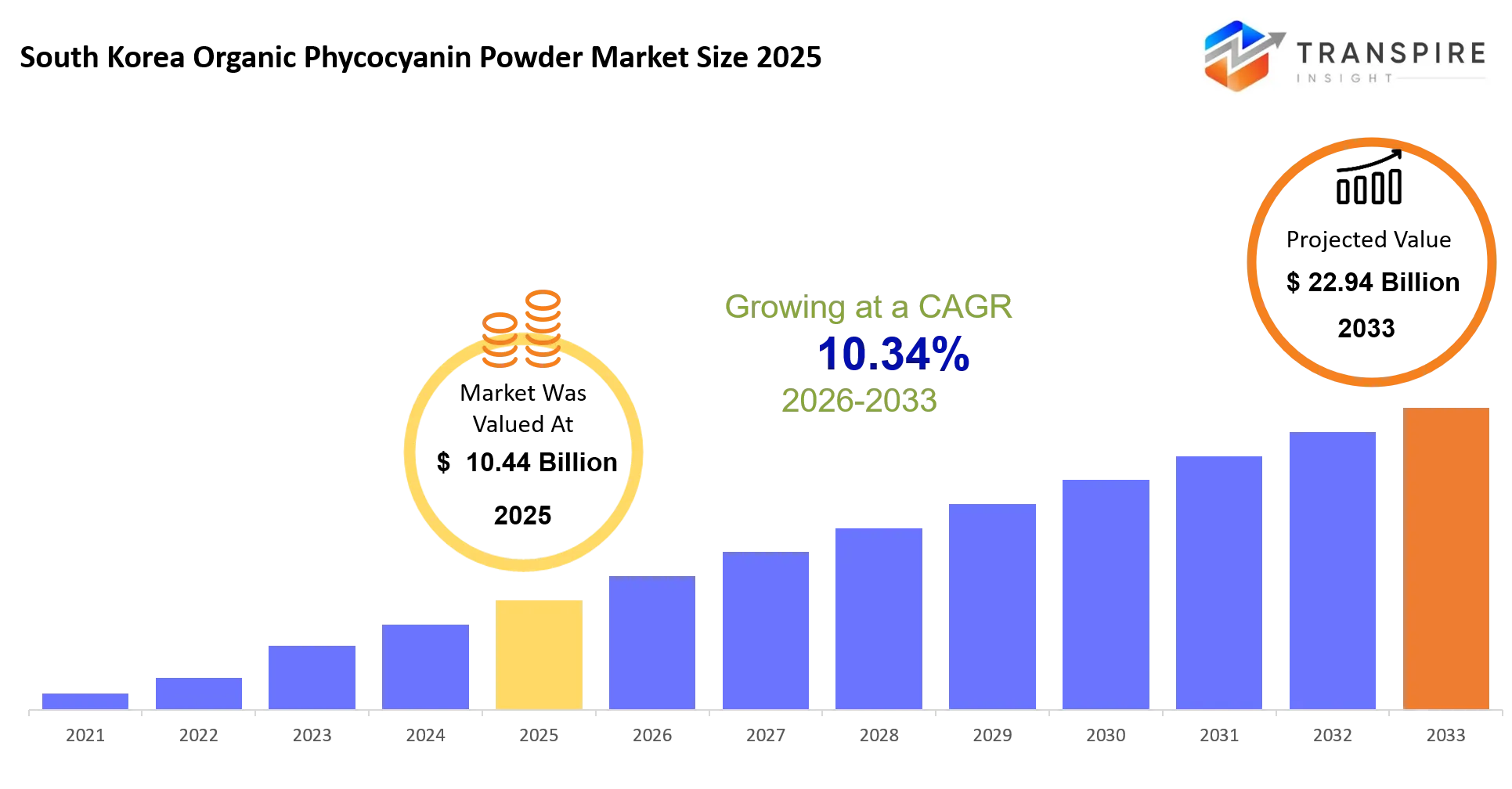
As per Transpire Insight Analysis the South Korea Organic Phycocyanin Powder Market size is estimated at USD 10.44 Million in 2025 and is anticipated to reach USD 22.94 Million by 2033, growing at a CAGR of 10.34% from 2026 to 2033.
South Korea's market for organic phycocyanin powder offers food producers, supplement companies, and cosmetic developers a completely natural blue pigment - one that substitutes synthetic dyes whilst also adding great antioxidant value simultaneously. Manufacturers isolate this very deep blue extract from spirulina and other algae sources, before drying it down into a quite stable powder that mixes quite smoothly into beverages, snacks, capsules, and even skincare products. Domestic demand is always rising because Korean customers are paying much more attention to the ingredients used in their products - pushing brands harder towards plant-based colorants instead of artificial ones. Expectations around 'clean' labelling from retailers put even more pressure on this trend, making manufacturers treat organic certification as a basic necessity more often than not. Meanwhile, the country's highly developed nutraceutical industry, its very deep K-beauty market, and an increasingly popular functional food scene really provide phycocyanin powder with a number of excellent entry points all at once. As extraction methods continue to improve and organic algae cultivation spreads wider, this ingredient is likely going to retain its formulation spaces right across various industries over the coming years.
South Korea Organic Phycocyanin Powder Market Size & Forecast:
- South Korea Organic Phycocyanin Powder Market Size 2025: USD 10.44 Million
- Expected Market Value 2033: USD 22.94 Million
- Forecast CAGR: 10.34%
- Leading application in 2025: Food & Beverage
- Fastest Growing application: Nutraceuticals
- Key Profile: DIC Corporation, Parry Nutraceuticals, Naturex, GNT Group, Sensient, DDW, Fuqing King Dnarmsa, Nan Pao, Dongtai City Spirulina, Bluetec Naturals, Cyanotech, AlgoSource, EID Parry, Zhejiang Binmei, PhycoHealth
Key Market Insights
- Food & Beverage will continue to be the biggest driver of application demand - retaining a very similar 44. 9% share in 2025 - because Korean drink and snack makers keep substituting artificial blue dyes with natural spirulina extract.
- Nutraceuticals are set to expand at the fastest rate over the next decade or so, mainly because Korean wellness brands rely heavily on phycocyanin's antioxidant properties to support their line of immune-focused supplements.
- Spirulina remains the largest source segment - as local and imported spirulina biomass give manufacturers a highly dependable and very well-documented starting material for extraction purposes.
- Algae blends have also gained some attention lately, as producers try to refine pigment stability and intensify colour value by combining different algae strains into one product.
- Food-grade phycocyanin holds a commanding position due to consistent demand from bakers, confectioners, and beverage producers searching for natural colouring agents themselves.
- Pharma-grade phycocyanin is expected to grow rapidly - driven by initial clinical interest in its anti-inflammatory and antioxidant properties.
- Cosmetic-grade demand is rising steadily as well - furthered by South Korea's internationally renowned K-beauty industry and its demand for natural active ingredients itself.
- Organic certification has become almost an essential requirement - as retailers and export partners ever more frequently request verified cultivation methods that are free from chemicals.
What are the Key Drivers, Restraints, and Opportunities in the South Korea Organic Phycocyanin Powder Market?
Demand is still increasing because Korean food and drink companies substitute synthetic blue dyes with a natural pigment derived from spirulina in beverages, sweets, and dairy products. Stringent 'clean label' regulations from Korean food safety authorities push manufacturers towards organic, chemical-free ingredients - and phycocyanin really fits the bill. K-beauty brands offer yet another opportunity for growth, as they highly value the pigment's antioxidant properties besides its all-natural blue hue for skincare and cosmetics. As even more formulators learn about phycocyanin's double role as both colourant and functional ingredient, its adoption continues to broaden across numerous categories.
Nevertheless, organic spirulina cultivation in South Korea remains somewhat restricted - and quite a lot of the raw biomass is actually sourced from China, India, or Southeast Asia, adding extra cost and a complicated supply chain. Extraction technology required to maintain the pigment's stability when exposed to heat and light demands significant investment, something smaller-scale producers frequently struggle to secure funds for. Consequently, pricing remains relatively higher than those of synthetic alternatives - and that difference holds back adoption especially amongst very price-conscious manufacturers, especially in the mass-market food sector.
However, there are promising opportunities emerging around local algae cultivation initiatives supported by an increasing desire to decrease our reliance on imports for valuable functional ingredients. Domestic biotechnology companies are also developing enhanced extraction techniques that might help bring down production costs and boost yields. As Korean consumers continue to prefer all-natural, easily tracked ingredients, and as nutritional supplements plus cosmetics remain super popular, organic phycocyanin powder will likely discover even more formulation possibilities throughout the country's food, health, and beauty industries.
What Has the Impact of Artificial Intelligence Been on the South Korea Organic Phycocyanin Powder Market?
Artificial intelligence is really changing how South Korean producers cultivate and process organic phycocyanin powder. AI-driven monitoring systems now track algae cultivation conditions - such as light exposure, temperature, and nutrient levels - in real time, enabling farmers to spot potential problems well before they affect yield. Predictive models also enable much more accurate estimation of harvest time, keeping pigment concentration and quality remarkably consistent from batch to batch.
On the processing side, machine learning tools greatly assist in optimising extraction parameters, allowing manufacturers to achieve more stable, highly pure phycocyanin - all with less trial-and-error experimentation. Quality control teams are increasingly using image recognition and spectral analysis software to inspect colour intensity and identify contaminants much faster than manual tests allow, resulting in far fewer rejected batches - and therefore a more consistent supply for our downstream customers.
However, even so, AI adoption at smaller Korean algae farms still varies quite a lot because the initial cost of sensors and software can be difficult to justify for relatively small-scale operations. Standardizing data across different cultivation sites is another problem since test results differ significantly based on factors like climate, water source, and algae strain type. Greater adoption will probably rely on declining technology costs and even stronger industry collaboration around common data standards.
Key Market Trends
- Domestic spirulina cultivation projects really gained momentum post-2023 - all with the aim of decreasing our reliance on imported biomass even further.
- K-beauty brands are increasingly featuring phycocyanin not just as a coloring agent but as a key active ingredient itself in their high-end skincare lines.
- Clean label food reformulation continued its rapid pace through 2024 and 2025 as Korean beverage manufacturers completely phased out synthetic blue dyes from their products.
- Requirements for organic certification from big-name retailers got much stricter, compelling suppliers to opt for verified cultivation methods that are both chemical-free and sustainable.
- Functional beverage brands have begun combining phycocyanin with other superfood ingredients to create a broader range of health benefits associated with their products.
- Partnerships surrounding extraction technology between Korean biotech companies and international algae producers have been expanding steadily since 2023 through to 2025.
- Interest in using phycocyanin for pharmaceutical-grade research purposes increased significantly - backed up by early studies looking into its potential antioxidant and anti-inflammatory properties.
- Interest in exporting Korean cosmetic formulations containing natural blue pigments also kept growing strongly across neighbouring Asian markets.
South Korea Organic Phycocyanin Powder Market Segmentation
By Source:
Spirulina remains the leading raw material source, since it delivers consistent phycocyanin yield and has a well established cultivation and extraction track record across Asia. Manufacturers favor it because the supply chain, though partly import dependent, is mature and predictable enough for large scale production.
Algae blends are gaining traction as producers experiment with mixing multiple algae strains to fine tune color depth and stability. The remaining others category, covering less common cyanobacteria sources, stays a small niche for now, mostly used in specialized research and pilot scale formulation work.
By Application:
Food and beverage applications lead the segment, holding close to 44.9% share, as Korean drink, dairy, and confectionery brands keep swapping synthetic dyes for natural blue coloring. Nutraceuticals follow closely, driven by wellness brands that market phycocyanin's antioxidant properties inside capsules, powders, and functional drinks.
Cosmetics represent a fast growing slice too, thanks to South Korea's globally influential K-beauty sector and its appetite for natural active ingredients. Pharmaceutical use remains early stage but promising, tied to ongoing research into anti-inflammatory benefits, while other niche applications keep emerging as formulators experiment further.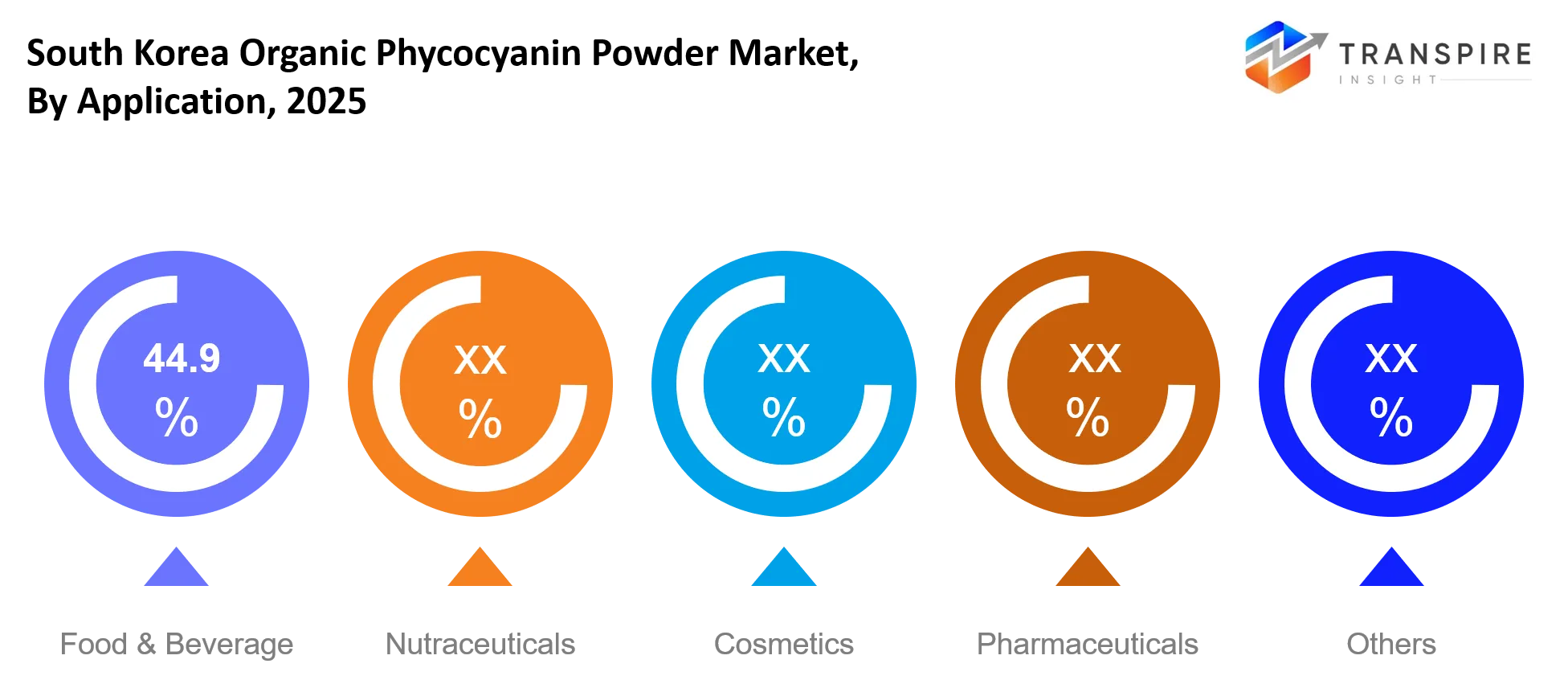
By Grade:
Food grade phycocyanin holds the biggest share, backed by steady demand from bakery, beverage, and confectionery manufacturers needing reliable natural coloring. Cosmetic grade phycocyanin follows, supported by skincare and makeup brands looking for both pigment and antioxidant functionality in one ingredient.
Pharma grade phycocyanin, while smaller today, is expected to grow quickly as clinical interest in its therapeutic properties builds. Other grade variations, including reagent and specialty formulations, continue supporting research and niche product development across smaller manufacturing segments.
What are the Key Use Cases Driving the South Korea Organic Phycocyanin Powder Market?
Natural food and beverage coloring is still the main use case, since Korean manufacturers keep replacing synthetic blue dyes across drinks, dairy, and confectionery lines. Food and beverage companies drive the biggest share of purchasing activity, mainly because clean label expectations keep pushing formulators toward plant based colorant options.
For nutraceuticals and cosmetics, use is also growing, but the pattern looks a bit different, spreading through supplement brands and K-beauty formulators. Rising antioxidant positioning, wider organic certification, and updated ingredient labeling expectations make it easier for companies to introduce phycocyanin earlier into product development pipelines.
Looking ahead, emerging opportunities are showing up in functional beverage blends and premium skincare actives, especially when paired with other natural wellness ingredients. Domestic biotech firms continue evaluating improved extraction methods through pilot projects, while precision fermentation and cultivation research are expected to help lower costs and expand supply throughout the forecast period.
|
Market size value in 2025 |
USD 10.44 Million |
|
Market size value in 2026 |
USD 11.52 Million |
|
Revenue forecast in 2033 |
USD 22.94 Million |
|
Growth rate |
CAGR of 10.34% from 2026 to 2033 |
|
Base year |
2025 |
|
Historical data |
2021 - 2024 |
|
Forecast period |
2026 - 2033 |
|
Report coverage |
Revenue forecast, competitive landscape, growth factors, and trends |
|
Regional scope |
South Korea (Seoul Capital Area, Yeongnam Region, Others) |
|
Key company profiled |
DIC Corporation, Parry Nutraceuticals, Naturex, GNT Group, Sensient, DDW, Fuqing King Dnarmsa, Nan Pao, Dongtai City Spirulina, Bluetec Naturals, Cyanotech, AlgoSource, EID Parry, Zhejiang Binmei, PhycoHealth. |
|
Customization scope |
Free report customization (region, application & grade scope). Avail customized purchase options to meet your exact research needs. |
|
Report Segmentation |
By Source (Spirulina, Algae Blends, Others); By Application (Food & Beverage, Nutraceuticals, Cosmetics, Pharmaceuticals, Others); By Grade (Food Grade, Pharma Grade, Cosmetic Grade, Others) |
Which Regions are Driving the South Korea Organic Phycocyanin Powder Market Growth?
The Seoul Capital Area, covering Seoul, Incheon, and Gyeonggi Province, drives most of the country's demand, since the bulk of food processing companies, cosmetic brands, and nutraceutical manufacturers sit within this dense industrial and commercial corridor. Strong retail infrastructure, higher consumer spending power, and easy access to import and export logistics keep this region firmly in the lead.
The Yeongnam region, including Busan and surrounding provinces, is expected to grow the fastest through the forecast window, as expanding food processing facilities and rising interest in functional beverage manufacturing take hold outside the capital. Improved regional distribution networks and growing local biotech investment should keep supporting wider phycocyanin adoption across this area moving forward.
Who are the Key Players in the South Korea Organic Phycocyanin Powder Market and How Do They Compete?
Competition remains moderately fragmented, with established international algae processors and specialty ingredient suppliers competing alongside smaller regional distributors. Product purity, certification credentials, and consistent supply reliability matter more than price alone, especially for cosmetic and pharmaceutical grade buyers who need documented quality standards.
DIC Corporation and Cyanotech lead on production scale and integrated cultivation to extraction supply chains, giving them an edge in consistent quality. Parry Nutraceuticals and EID Parry lean on organic certified spirulina farming to serve the premium segment, while Sensient and GNT Group bring established natural colorant expertise into Korean food and beverage formulations.
Smaller specialized producers, including AlgoSource, Bluetec Naturals, and PhycoHealth, compete by offering flexible order volumes and tailored formulation support for niche cosmetic and nutraceutical brands. As Korean demand for verified organic ingredients keeps growing, partnerships between global suppliers and domestic distributors should keep shaping competitive positioning across the market.
Company List
- DIC Corporation
- Parry Nutraceuticals
- Naturex
- GNT Group
- Sensient
- DDW
- Fuqing King Dnarmsa
- Nan Pao
- Dongtai City Spirulina
- Bluetec Naturals
- Cyanotech
- AlgoSource
- EID Parry
- Zhejiang Binmei
- PhycoHealth
Recent Development News
In 2026, DIC Corporation continued scaling its LINABLUE phycocyanin production through its integrated Life & Healthcare segment, expanding supply capacity to meet rising natural colorant demand across Asian food and beverage markets, a trend that directly supports ingredient availability for South Korean manufacturers.
In 2024, Cyanotech Corporation launched a new high purity, pharmaceutical grade C-phycocyanin product line aimed at clinical research and therapeutic applications, a move that signals rising interest in phycocyanin's therapeutic profile among ingredient buyers across nutraceutical and pharmaceutical channels, including South Korea's growing wellness sector.
What Strategic Insights Define the Future of the South Korea Organic Phycocyanin Powder Market?
Over the next five to seven years, expect organic phycocyanin powder to move further into mainstream Korean food and beverage formulation, supported by tighter clean label expectations and growing consumer trust in natural colorants. Nutraceutical and cosmetic applications should keep expanding too, as antioxidant positioning becomes a stronger selling point across wellness categories.
A quieter risk sits with import dependence for raw algae biomass, since supply disruptions or price swings in source countries could squeeze domestic manufacturers with thin margins.
At the same time, opportunity is building around domestic cultivation investment and improved extraction technology, both of which could lower costs and strengthen supply security. Companies that invest early in local algae farming partnerships and advanced processing capability should be best positioned to capture long term growth across South Korea's expanding organic ingredient landscape.
South Korea Organic Phycocyanin Powder Market Report Segmentation
By Source
- Spirulina
- Algae Blends
- Others
By Application
- Food & Beverage
- Nutraceuticals
- Cosmetics
- Pharmaceuticals
- Others
By Grade
- Food Grade
- Pharma Grade
- Cosmetic Grade
- Others
Frequently Asked Questions
Find quick answers to common questions.
The Expected South Korea Organic Phycocyanin Powder Market size for the Market will be USD 22.94 Million in 2033.
Key segments for the South Korea Organic Phycocyanin Powder Market are By Source (Spirulina, Algae Blends, Others); By Application (Food & Beverage, Nutraceuticals, Cosmetics, Pharmaceuticals, Others); By Grade (Food Grade, Pharma Grade, Cosmetic Grade, Others).
Major South Korea Organic Phycocyanin Powder Market players are DIC Corporation, Parry Nutraceuticals, Naturex, GNT Group, Sensient, DDW, Fuqing King Dnarmsa, Nan Pao, Dongtai City Spirulina, Bluetec Naturals, Cyanotech, AlgoSource, EID Parry, Zhejiang Binmei, PhycoHealth.
The current South Korea Organic Phycocyanin Powder Market size is USD 10.44 Million in 2025.
The South Korea Organic Phycocyanin Powder Market CAGR is 10.34% from 2026 to 2033.
- DIC Corporation
- Parry Nutraceuticals
- Naturex
- GNT Group
- Sensient
- DDW
- Fuqing King Dnarmsa
- Nan Pao
- Dongtai City Spirulina
- Bluetec Naturals
- Cyanotech
- AlgoSource
- EID Parry
- Zhejiang Binmei
- PhycoHealth
About the Authors

Pankaj Ghogare Patil
I am Pankaj Ghogare Patil, a Senior Research Analyst at Transpire Insight, specializing in the Pharmaceutical, Chemicals & Materials, Healthcare IT, and Biotechnology industry. My expertise lies in conducting comprehensive market research, analyzing industry trends, evaluating competitive landscapes, and translating complex data into actionable insights. At Transpire Insight, I closely follow emerging technologies, regulatory developments, and market innovations to create accurate, well-researched, and informative content that helps businesses and professionals make informed decisions. I am committed to producing credible, evidence-based articles that reflect industry best practices while making technical topics accessible and valuable for a broad audience.

Chakradhar Khansole
Chakradhar serves as the Research Director at Transpire Insight, bringing over 8 years of experience in technology, innovation, and strategic market intelligence. He specializes in transforming complex market data into actionable business insights that enable organizations to make informed, growth-oriented decisions. Recognized for his strategic vision and analytical expertise, Chakradhar leads high-impact research initiatives, delivering comprehensive market assessments, competitive intelligence, and forward-looking industry analysis.
Recently Published Reports
-
May 2026
Healthcare Polymer Packaging Market
Healthcare Polymer Packaging Market Size, Share & Analysis Report By Packaging Type (Syringes, IV Bottles and Pouches, Clamshells, Blisters, Bottles & Jars, Containers, Tubes, IV Parental Packaging, Others), By Type (Regulated, Non-regulated), By Polymer Type (LDPE (Low-Density Polyethylene), HDPE (High-Density Polyethylene), Homo-polymer (Homo), Random Copolymer (Random), Block Copolymer (Block), PET, Polystyrene, Polyvinyl Chloride, Polyamide/EVOH, Others), and Geography (North America, Europe, Asia-Pacific, Middle East and Africa, South and Central America), 2021 - 2031
-
Apr 2026
Hydrophilic Tape (Waterstop) Market
Hydrophilic Tape (Waterstop) Market Size, Share & Analysis Report By Type (Bentonite-Based Hydrophilic Tape, Rubber-Based Hydrophilic Tape), By Application (Residential Buildings, Commercial Buildings, Infrastructure Projects), and Geography (North America, Europe, Asia-Pacific, Middle East and Africa, South and Central America), 2021 - 2031
-
Apr 2026
Metalens Market
Metalens Market Size, Share & Analysis Report By Type (Visible Light Metalens, and Infrared Metalens), By Application (Consumer Electronics, Automotive Electronics, Industrial, Medical, and Others), and Geography (North America, Europe, Asia-Pacific, Middle East and Africa, South and Central America), 2021 - 2031
-
Apr 2026
PBT Resin Market
PBT Resin Market Size, Share & Analysis Report By Type (Reinforced PBT Resin, Unreinforced PBT Resin), By Processing Method (Injection Molding, Extrusion, Blow Molding, Others), By End-User (Automotive, Electrical & Electronics, Consumer Appliances, Industrial Machinery, Medical Devices, Packaging, Others), and Geography (North America, Europe, Asia-Pacific, Middle East and Africa, South and Central America), 2021 - 2031