
South Korea Non-Alcoholic RTD Beverages Market Size & Forecast:
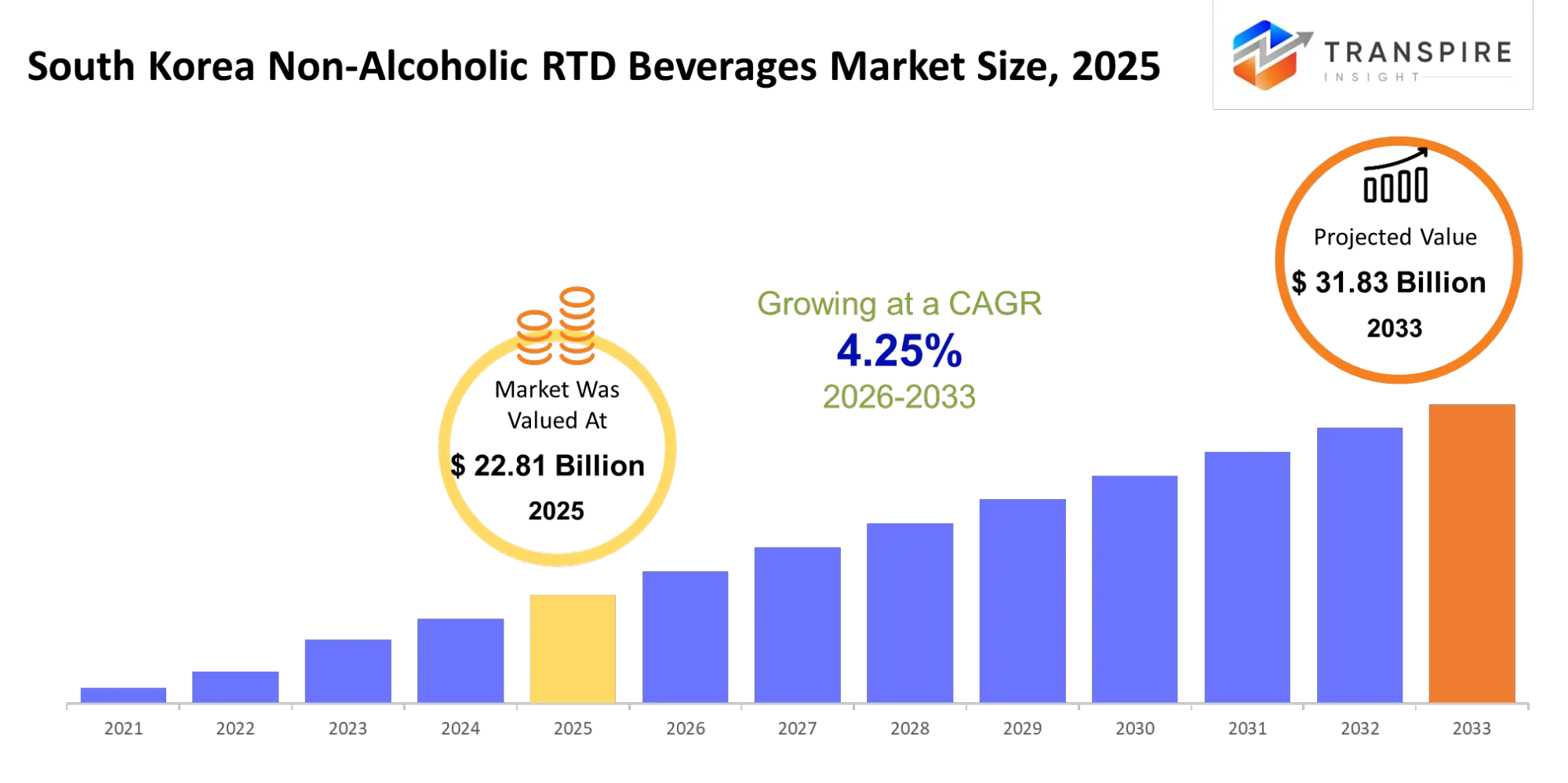
- South Korea Non-Alcoholic RTD Beverages Market Size 2025: USD 22.81 Billion
- South Korea Non-Alcoholic RTD Beverages Market Size 2033: USD 31.83 Billion
- South Korea Non-Alcoholic RTD Beverages Market CAGR: 4.25%
- South Korea Non-Alcoholic RTD Beverages Market Segments: By Product Type (Tea, Coffee, Juice, Functional Drinks, Others); By Distribution Channel (Supermarkets, Convenience Stores, Online, Others); By End User (Adults, Youth, Others)
To learn more about this report,  Download Free Sample Report
South Korea Non-Alcoholic RTD Beverages Market Summary
The South Korea Non-Alcoholic RTD Beverages Market was valued at USD 22.81 billion in 2025. It is forecast to reach USD 31.83 billion by 2033. That is a CAGR of 4.25% over the period.
The Market for Non-Alcoholic RTD's in South Korea has been revolutionized over the past few years. The way we consume beverages today is different from how we consumed them in previous generations. A wide variety of beverages can now be purchased at numerous locations throughout South Korea, including retail outlets, convenience stores, foodservice providers and other types of outlets. Consumers have changed their consumption habits while working each day due to increased access to ready-to-drink (or express) beverages instead of prepared beverages. In addition, a large number of non-alcoholic RTD's have entered the workplace, travel retail, and vending devices. For these reasons, the way consumers use beverages across South Korea continues to change.
There has been a significant shift over the past 3 to 5 years in the Non-Alcoholic RTD's within South Korea's Non-Alcoholic Beverage Marketplace. The shift from traditional, full-sugar formulations to non-alcoholic RTD's with functional and low-sugar (aka reduced) formulations has been primarily driven by regulatory pressure (e.g., Healthier Futures – New Public Health Guidelines on Sugar and Health Impact Assessments). As such, beverage companies are having to reformulate many of their products to meet new regulatory guidelines and requirements affecting product formulation and labeling. As a result of the changing beverage landscape, manufacturers have also begun investing heavily in innovating the type of ingredients utilized in their beverages (e.g., using plant-based sugar substitutes and adding functional vitamins to the formulation). Also, due to the disruption in the global logistics system, many manufacturers have moved away from global sourcing of ingredients and will look to localize production of more of their ingredients within South Korea.
Key Market Insights
- It is estimated that by the year 2025, the North Metropolitan Area will represent 42% of all non-alcoholic ready-to-drink (NA-RTD) beverages sold nationwide. The high density of retail establishments and the prevalence of on-the-go consumption patterns in this region make it very vibrant.
- The Southeast Region is not expected to change significantly because of its concentration of manufacturing and bottling plants as well as the ongoing urban logistics improvements that affect distribution efficiency.
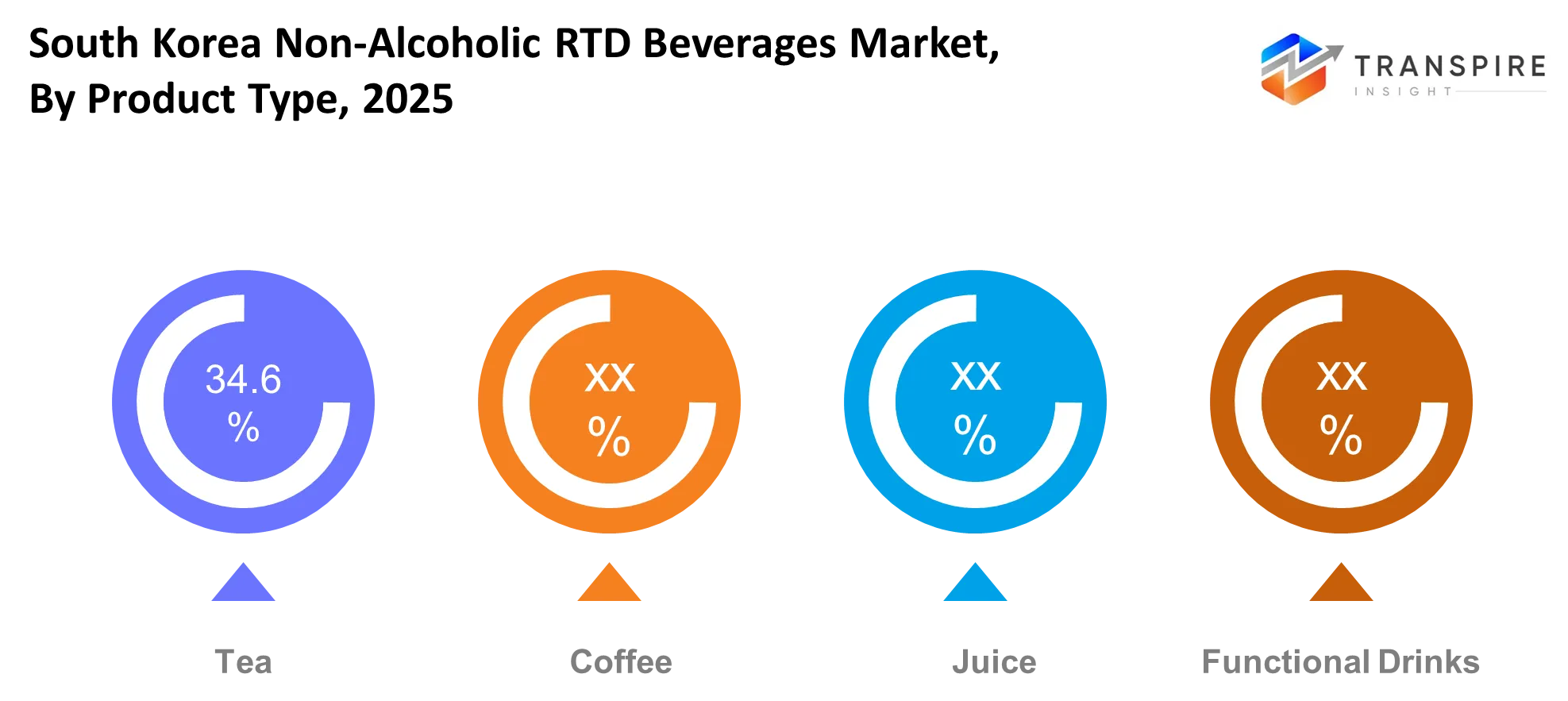
- The ready-to-drink tea and coffee sector will make up almost 38% of total RTD beverage sales in 2025, predominantly due to consumption being done at work or while commuting to/from work.
- Functional beverages will be the fastest-growing segment in the RTD beverage market by 2030, due to advancements in fortified vitamins and lower sugar formulations.
- Convenience Stores will represent the primary Application Channel for NA-RTD Beverages with around 55% of Application Channel Share in 2025, owing to impulse buying behaviour and high foot traffic levels at such locations.
- The fastest growing Application Channel inclusive of RTD Beverage Delivery via eCommerce is continuing to expand, supported by Subscription Service models and increasingly rapid improvements in Last-Mile Logistics.
- Younger Adult Consumers will ultimately represent the leading End User Group, accounting for a large share of total demand, primarily due to lifestyle driven tendencies in their consumption behaviour.
- Health-Conscious Consumers are the fastest-growing End User Category, having shifted their demand toward Sugar-Free, Plant-Based, and Fortified RTD Beverages.
- Companies are trying to make their food and drinks with sugar. They are also coming up with ideas for ingredients that are good for us and making their ready to drink products sound really fancy.
- They are working with stores and shops to get their products on the shelves and make people see their brand names.
What are the Key Drivers, Restraints, and Opportunities in the South Korea Non-Alcoholic RTD Beverages Market?
Drivers
The demand for convenient, ready-to-drink beverages is on the rise, and this is due to the evolving lifestyle habits and ways to consume products by consumers. Consumers were quite mobile in the past; living and working in metropolitan areas like Seoul, while the amount of daily commuter traffic continues to grow at several locations. Because of this, consumers are relying increasingly on purchasing ready-to-drink (RTD) beverages via convenience store or vending machine options available. Therefore, there has been a considerable increase in RTD beverage sales, driven by ease of access to quick-and-easy-to-consume products, digitizing of retailers, as well as improvements in the cold chain systems.
Restraints
Although there are multiple drivers impacting the non-alcoholic beverage category, one of the major constraints impacting growth in this category is the intense competition amongst retailers putting pressure on retailers, which has resulted in an extremely saturated marketplace. The vast majority of retailers are very large distributors thus putting added pressure on price; therefore limiting margins. Also, brands primarily compete on promotion versus product differentiation at the retail level. Additionally, established retailers dominate the retail distribution network which hinders smaller producers from obtaining shelf placement and visibility without a significant investment in marketing
Opportunities
Artificial Intelligence Systems can provide a unique and innovative opportunity to allow consumers in both Seoul and Busan to have access to personalized beverage preferences. The AI Systems will utilize an analysis of historical purchasing patterns (data) along with an analysis of how weather impacts the consumption of beverages, in order to provide consumers with functional beverage recommendations.
What Has the Impact of Artificial Intelligence Been on the South Korea Non-Alcoholic RTD Beverages Market?
The South Korean non-alcoholic RTD beverage market is undergoing major transformations, thanks to AI's impact on enhancing production planning, demand forecast accuracy and retail distribution efficiency within densely populated metropolitan areas. Beverage manufacturers now utilize automated AI control systems to monitor their production lines; thereby, enabling them to modify both carbonation and packaging parameters while simultaneously reducing inconsistencies in batch sizes.
Retail distributors have adopted algorithm-driven fleet monitoring/trackers to optimize delivery routes amongst convenience stores and vending machines - improving inventory delivery times in key areas of high demand (i.e., Seoul & Incheon).
In addition, predictive maintenance is aided by machine learning models that assess equipment vibrations, temperature deviations, and the pressure levels of bottling lines, resulting in minimized unscheduled downtime and stable continuous production cycles during peak seasons.Demand forecasting tools incorporate meteorological data, holiday/event schedules & retailer sales velocity to help allocate inventory, enhancing product availability and minimizing excess stock at low-volume retailers.
Beverage manufacturers report improved operational efficiency by utilizing these technologies and report shorter production cycles, reduced logistics waste, and more consistent utilization of cold chain storage and transport throughout the RTD beverage distribution network.
However, mid-tier beverage producers using aging bottling facilities are limited by the expense of integrating their legacy bottling systems with newly developed AI based technologies. Additionally, older production equipment is unable to interface and communicate effectively with newer generation AI platforms.
Key Market Trends
- The market for non-alcoholic ready to drink (RTD) beverages in South Korea has seen a shift toward functional beverages, low sugar, and convenience-based consumption driven largely by urban retail expansion and digital distribution systems.
- We expect accelerated growth driven by advancements in AI-enabled forecasting, vending automation, and retail modernization, which are improving the production efficiency of beverage manufacturers while also changing consumer purchasing behavior.
- By 2025, convenience store channels will exceed 55% of the total available market share as impulse purchases of RTD beverages shift from supermarkets to urban micro-outlets.
- Consumer adoption of functional beverages will grow rapidly after 2023 as consumers move towards consuming vitamin-fortified beverages versus the traditional RTD products, which are often high in sugar.
- The growth of consumption in metropolitan Seoul will continue due to commuter lifestyle patterns and the rapid development of refrigerated retail distribution networks.
- RTD beverage subscription sales through e-commerce have increased following 2024, supported by improved last-mile cold chain logistics infrastructure.
- Lotte Chilsung and other domestic manufacturers have been reformulating low sugar RTD products at an increasing rate since 2023 due to stricter nutrition labeling requirements.
- Smart vending machines have been deployed at transit hubs following 2024, providing AI-driven product recommendations which help to identify consumer preferences based on location.
- Coca-Cola and PepsiCo strengthened their digital retail partnerships in 2025 by linking their data-driven inventory systems with convenience store chains in South Korea.
- Predictive analytics technologies have been implemented by bottlers post-2024, allowing AI to monitor production equipment and reduce equipment downtime.
South Korea Non-Alcoholic RTD Beverages Market Segmentation
By Product Type
Tea-based drinks are still very popular in South Korea's Non-Alcoholic RTD Beverages Market. People in cities like to drink them every day at work.Coffee drinks are also used steadily because many people travel to work and offices are very busy in cities.Juice drinks are stable. Moving slowly as people choose drinks with less sugar. Functional drinks are getting attention as more healthy drinks are available in stores.Product development trends show companies are making drinks with sugar and more nutrition.They are investing more in drinks with vitamins and herbs to match what people want.There is competition among functional and tea-based drinks as companies focus on health.The South Korea Non-Alcoholic RTD Beverages Market is changing to match what people want.
To learn more about this report, Download Free Sample Report
By Distribution Channel
Convenience stores sell the drinks because they are easy to find and people buy things on impulse in cities.Supermarkets sell an amount but are not growing as fast as people want quicker shopping.Online sales are increasing because of subscription delivery and better cold storage.Other channels like vending machines help people buy drinks on the go.Distribution patterns are changing as online shopping systems work with inventory management.Convenience stores have refrigerated space for RTD drinks.Online platforms have delivery systems to keep drinks fresh.The South Korea Non-Alcoholic RTD Beverages Market is working better with retail and online ordering.
By End User
Adults drink the RTD beverages because they drink them at work and like coffee and tea drinks.Young people like flavored drinks because of trends and variety.Other groups like people drink a steady amount of low-sugar and healthy drinks.People are paying attention to healthy choices.
Young people try drinks in stores.Adults still drink an amount every day.The South Korea Non-Alcoholic RTD Beverages Market is changing as people's lifestyles shape what they buy.
What are the Key Use Cases Driving the South Korea Non-Alcoholic RTD Beverages Market?
Consumers generally desire ready-to-drink (RTD) non-alcoholic beverages which offer convenience and can be consumed on a daily basis globally. Commuters are typically able to consume RTD-type of tea, coffee and functional beverages throughout the course of their workday as they replace fluids lost through their single exercise sessions, or merely quench their thirst while commuting to work.
Mass-market retailers such as cities (i.e., Seoul and Busan) with high density of retail locations will continue to influence the purchasing of non-alcoholic RTD beverages through impulse buying. The convenience associated with RSRT BD (ready to serve RTD beverage) is primarily based on how close the RSRT BD is to the consumer’s point of purchase through both physical (i.e., metro stations) and online (i.e., e-comm, retail) means.
Within corporate offices and industrial/warehouse facilities, there is a trend toward new application/use of RTD beverages at work. This trend is particularly applicable for adult consumers within industrial and service businesses who use RTD beverages as a time-efficient and effective method of consuming an RTD beverage. More specifically, younger customers shopping or attending school in retail (commercial) and school (educational) settings are contributing to an increase in demand for functional beverages.
|
Report Metrics |
Details |
|
Market size value in 2025 |
USD 22.81 Billion |
|
Market size value in 2026 |
USD 23.78 Billion |
|
Revenue forecast in 2033 |
USD 31.83 Billion |
|
Growth rate |
CAGR of 4.25% from 2026 to 2033 |
|
Base year |
2025 |
|
Historical data |
2021 - 2024 |
|
Forecast period |
2026 - 2033 |
|
Report coverage |
Revenue forecast, competitive landscape, growth factors, and trends |
|
Regional scope |
South Korea |
|
Key company profiled |
Coca-Cola, PepsiCo, Suntory, Nestle, Starbucks, Dongwon, Lotte Chilsung, Coca-Cola Korea, Nongshim, Del Monte, Dole, Danone, Unilever, Ito En, CJ Foods |
|
Customization scope |
Free report customization (country, regional & segment scope). Avail customized purchase options to meet your exact research needs. |
|
Report Segmentation |
By Product Type (Tea, Coffee, Juice, Functional Drinks, Others); By Distribution Channel (Supermarkets, Convenience Stores, Online, Others); By End User (Adults, Youth, Others) |
Which Regions are Driving the South Korea Non-Alcoholic RTD Beverages Market Growth?
The Seoul metropolitan region is the leader of the South Korea Non-Alcoholic RTD Beverages Market. This is because a lot of people live there, many people commute to work and there are convenience stores. The stores in this area are very advanced; they have refrigeration everywhere so they can always have products. There are offices and train stations so people buy a lot of ready-to-drink coffee, tea and other beverages every day. The companies that make these beverages have a system to get their products to the stores, which helps Seoul stay the leader.
Busan and the southeastern coastal regions also have a demand for these beverages. This is because there are ports and factories and the people who work there need something to drink. It is different from Seoul because in Busan the factories and ports are more important for the beverage market. The people who work in these factories and ports drink beverages all year round so the demand is always stable. The products can always be delivered to the stores because the ports have roads and logistics.
Some other cities, like Incheon and Daejeon are growing fast. This is because new logistics parks and city retail programs have been built. Now it is easier for people to buy beverages because there are distribution centers and cold-chain investments. More and more people are buying beverages online, which is changing the way people drink. This means that the companies that make beverages will have opportunities to sell their products because more people will be able to buy them. This will happen from 2026 to 2033 as more stores open in these areas. The South Korea Non-Alcoholic RTD Beverages Market will keep growing in these secondary cities, like Incheon and Daejeon.
Who are the Key Players in the South Korea Non-Alcoholic RTD Beverages Market and How Do They Compete?
The South Korea Non-Alcoholic RTD Beverages Market has a few companies that control most of it. These companies, including some from other countries , have a strong hold on the market. They make sure they have space on store shelves by making term deals with convenience stores and by having sales. New companies are trying to get into the market in areas like healthy drinks and low sugar drinks.. It is hard for them to get big because it costs a lot to get their products to stores and they do not have a lot of visibility.
Lotte Chilsung is one of these companies. It makes a lot of drinks. Has a strong system for getting them to stores in cities. This helps it stay on top in convenience stores. The company works closely with stores and always updates its low sugar drinks. Coca-Cola is another company. It focuses on making its brand look premium. Adds new functional drinks to its line. It uses marketing that's specific to the area and puts its drinks in vending machines in places like train stations. PepsiCo has a lot of products and works with other companies to sell its drinks in stores and restaurants.
Nongshim is a company that tries to stand out by making flavored drinks and healthy drinks. It targets people who like to try new things. Kwangdong Pharmaceutical is a company that uses its knowledge of medicine to make drinks with added vitamins and herbs. This helps it become a company in the health food area. These companies get bigger by working with stores putting their drinks in vending machines and always updating their products to fit what people in cities want to drink.
Company List
Coca-Cola
PepsiCo
Suntory
Nestlé
Starbucks
Dongwon
Lotte Chilsung
Coca-Cola Korea
Nongshim
Del Monte
Dole
Danone
Unilever
Ito En
CJ Foods
Recent Development News
In April 2026, LOTTE Asahi Liquor Co., Ltd. announced the launch of Asahi CLEAR HIGHBALL in South Korea as a new RTD product line. The launch marked the entry of canned RTD highball beverages under the Asahi brand into the South Korean market, expanding competition in premium RTD alcohol-adjacent beverage formats.https://www.asahigroup-holdings.com
In March 2025, The Coca-Cola Company entered a strategic RTD expansion agreement with Bacardi Limited to develop and distribute ready-to-drink cocktail products in global markets, including Asia-Pacific. The partnership strengthened Coca-Cola’s portfolio diversification into alcoholic RTD segments, increasing competitive pressure across beverage categories in South Korea.https://www.bacardilimited.com
In January 2025, Nestlé and Lotte Group announced the wind-down of their joint venture in South Korea, impacting coffee and beverage distribution operations within the RTD segment. The restructuring reflects shifting competitive strategies among major food and beverage firms in the domestic market.https://www.foodingredientsfirst.com
What Strategic Insights Define the Future of the South Korea Non-Alcoholic RTD Beverages Market?
The South Korea Non-Alcoholic RTD Beverages Market is changing. It is becoming more about people buying things and getting things that are just right for them. The South Korea Non-Alcoholic RTD Beverages Market will not grow much because people are buying more things. It will grow because companies are using computers to figure out what people want and making products that are good for people.
Over the 5 to 7 years cities will have stores that are easy to use and computers will help figure out what people want to buy. This means companies that make drinks will have to make things that people in areas want to buy. They can not just make things that everyone in the country wants to buy.
There is a problem that's not easy to see. A few big stores and websites sell most of the drinks. This means they get to decide how much things cost. This is bad for companies that make drinks because they do not have a lot of power to say how much their drinks should cost. Even when people want to buy a lot of drinks, these companies can not make much money.
South Korea Non-Alcoholic RTD Beverages Market Report Segmentation
By Product Type
- Tea-based RTD beverages
- Coffee RTD beverages
- Juice-based RTD beverages
- Functional beverages
- Others
By Distribution Channel
- Convenience stores
- Supermarkets
- Online retail
- Vending machines
- Others
By End User
- Adults
- Youth
- Health-conscious consumers
- Others
Frequently Asked Questions
Find quick answers to common questions.
The expected South Korea Non-Alcoholic RTD Beverages Market size for the market will be USD 31.83 Billion in 2033.
Key segments for the South Korea Non-Alcoholic RTD Beverages Market are By Product Type (Tea, Coffee, Juice, Functional Drinks, Others); By Distribution Channel (Supermarkets, Convenience Stores, Online, Others); By End User (Adults, Youth, Others).
Major South Korea Non-Alcoholic RTD Beverages Market players are Coca-Cola, PepsiCo, Suntory, Nestle, Starbucks, Dongwon, Lotte Chilsung, Coca-Cola Korea, Nongshim, Del Monte, Dole, Danone, Unilever, Ito En, CJ Foods.
The South Korea Non-Alcoholic RTD Beverages Market size is USD 22.81 Billion in 2025.
The South Korea Non-Alcoholic RTD Beverages Market CAGR is 4.25% from 2026 to 2033.
Coca-Cola
PepsiCo
Suntory
Nestlé
Starbucks
Dongwon
Lotte Chilsung
Coca-Cola Korea
Nongshim
Del Monte
Dole
Danone
Unilever
Ito En
CJ Foods
About the Authors

Chetan Dhatrak
I’m Chetan Dhatrak, a Senior Research Analyst at Transpire Insight, specializing in the Consumer Goods, Foods and Beverages industry. I focus on analyzing market trends, consumer behavior, competitive landscapes, and industry developments to deliver accurate, data-driven insights. My research at Transpire Insight is built on credible sources and in-depth analysis, helping businesses and readers better understand market dynamics, emerging opportunities, and evolving consumer preferences. I’m committed to creating reliable, well-researched content that supports informed decision-making and reflects the latest developments in the consumer goods and food & beverage sectors.

Chakradhar Khansole
Chakradhar serves as the Research Director at Transpire Insight, bringing over 8 years of experience in technology, innovation, and strategic market intelligence. He specializes in transforming complex market data into actionable business insights that enable organizations to make informed, growth-oriented decisions. Recognized for his strategic vision and analytical expertise, Chakradhar leads high-impact research initiatives, delivering comprehensive market assessments, competitive intelligence, and forward-looking industry analysis.
Recently Published Reports
-
Apr 2026
Baby Infant Formula Market
Baby Infant Formula Market Size, Share & Analysis Report By ype (Infant Milk, Follow On Milk, Specialty Baby Milk, Growing-Up Milk), By Ingredient (Carbohydrate, Fat, Protein, Minerals, Vitamins, and Others), By Product Form (Powder, Liquid, and Ready-to-feed), By Distribution Channels (Supermarket/Hypermarket, Specialty Store, Pharmacies, Online Retail, and Others), and Geography (North America, Europe, Asia-Pacific, Middle East and Africa, South and Central America), 2021 - 2031
-
Apr 2026
Edible Insects for Animal Feed Market
Edible Insects for Animal Feed Market Size, Share & Analysis Report By Type (Insect Powder, Insect Meal, Insect Bar, Insect Paste, Insect Oil, and Others), By Insect Type (Beetles, Cricket, Caterpillar, Hymenoptera, Orthoptera, Tree Bugs, and Others), By Application (Livestock, Pet Food, and Aquaculture), By Livestock Type (Poultry, Swine, and Others), and Geography (North America, Europe, Asia-Pacific, Middle East and Africa, South and Central America), 2021 - 2031
-
Apr 2026
Food Industry Disinfection and Bacterial Control Market
Food Industry Disinfection and Bacterial Control Market Size, Share & Analysis Report By Type (Chemical Disinfectants, Physical Disinfectants, and Biocides and Antimicrobials), By Application (Food Processing Equipment Surface Disinfection, Food Preparation Areas Surface Disinfection, Storage Areas Surface Disinfection, Anti-microbial Coatings Food Preservation, and Preservative Solutions Food Preservation), By End User (Meat and Poultry Processing, Dairy Processing, Seafood Processing, Bakery and Confectionery, Restaurants and Commercial Kitchens, and Food Service Providers), By Sales Channel (Online, Offline), and Geography (North America, Europe, Asia-Pacific, Middle East and Africa, South and Central America), 2021 - 2031
-
May 2026
Freeze Dried Food Market
Freeze Dried Food Market Size, Share & Analysis Report By Product Type (Fruits, Vegetables, Freeze-Dried Dairy Products, Freeze-Dried Meat and Seafood, Freeze-Dried Pet Food, and Prepared Meal), By Nature (Organic, and Conventional), By Form (Powdered, Granules, and Diced), By End Use (Breakfast Cereals, Dairy Products, Bakery & Confectionery, Nutritional Bars & Supplements, Powdered Beverages, Snacks, and Retail (Household)), and Geography (North America, Europe, Asia-Pacific, Middle East and Africa, South and Central America), 2021 - 2031