
South Korea Lithium Sulphur Battery Market Size & Forecast:
- South Korea Lithium Sulphur Battery Market Size 2025: USD 42.02 Million
- South Korea Lithium Sulphur Battery Market Size 2033: USD 346.86 Million
- South Korea Lithium Sulphur Battery Market CAGR: 30.20%
- South Korea Lithium Sulphur Battery Market Segments: By Component (Cathode, Anode, Electrolytes, Separators, Battery Packs, Others) | By Application (EVs, Aerospace, Consumer Electronics, Energy Storage, Defense, Others) | By Capacity (Below 500mAh, 500-2000, 2000-5000, Above 5000, Others) | By End User (Automotive, Aerospace, Electronics, Energy, Others).
South Korea Lithium Sulphur Battery Market Summary
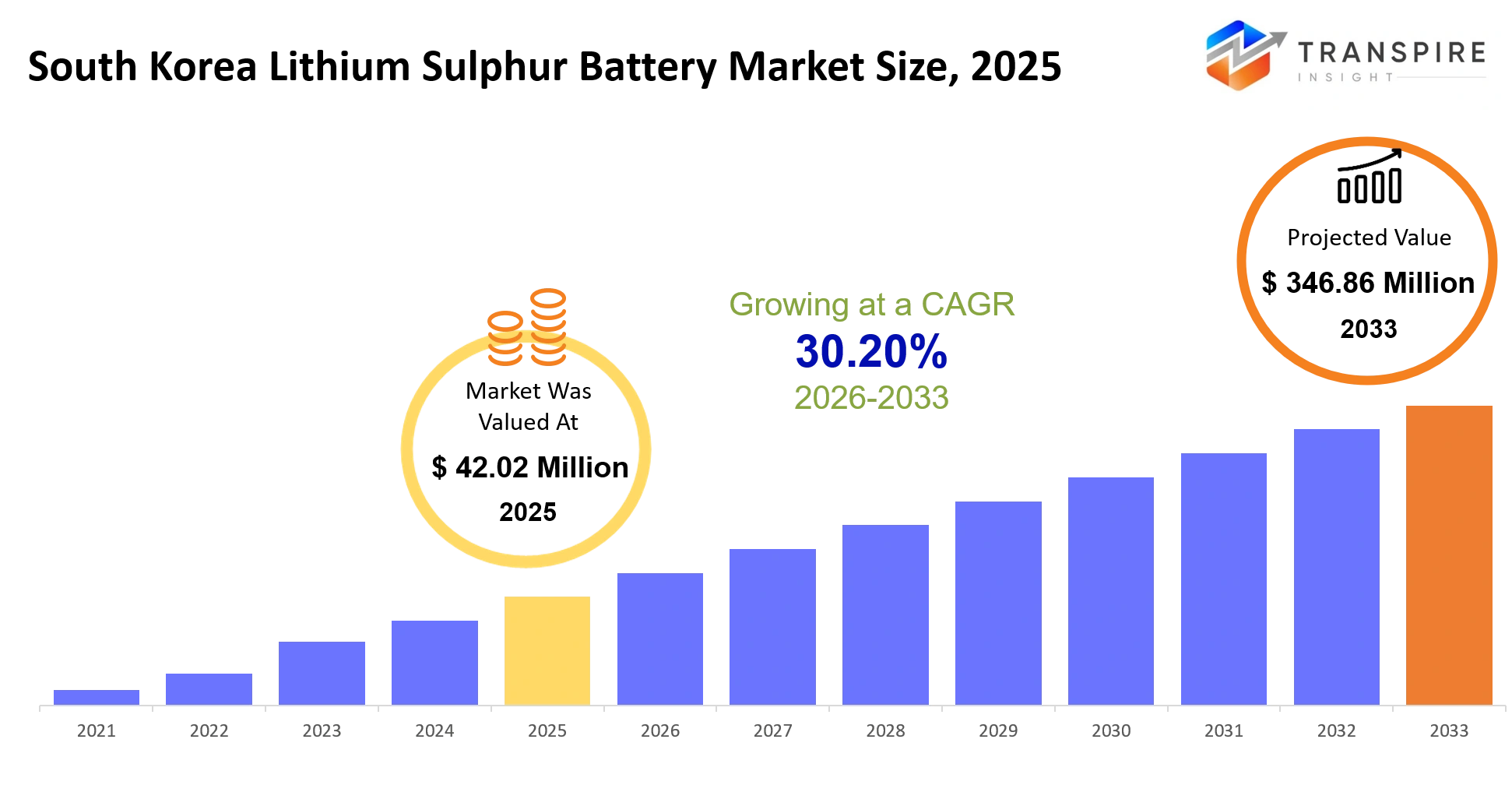
The South Korea Lithium Sulphur Battery Market was valued at USD 42.02 Million in 2025. It is forecast to reach USD 346.86 Million by 2033. That is a CAGR of 30.20% over the period.
The South Korea lithium sulphur battery market sort of moves around a similar goal, making lighter and higher energy storage solutions , but specifically for cases where the mass of the battery really touches real performance. You see this in electric mobility , aerospace, defense, and also next generation industrial equipment. With lithium sulphur batteries, the idea is that the theoretical energy density is higher than for usual lithium ion chemistries, so it helps with the everyday problem of pushing further on a single charge while also trimming the system weight.
In the last three to five years, the market vibe has changed from mostly laboratory scale research into pilot manufacturing and commercial validation, and this has been helped along by government funding. At the same time, strategic partnerships between battery developers, research institutes, and manufacturing firms have become more common. The momentum got even faster after global supply chain disruptions. It also connects to rising worries about dependence on critical minerals, which made the weak spots in existing battery material sourcing pretty clear.
Now many companies are looking for chemistries that lean less on nickel and cobalt, so more of the investment has been flowing toward lithium sulphur technology. That shift supports stronger paths to commercialization and it opens up extra revenue routes, through prototype deployment, cooperative agreements, and early adoption inside higher value industrial sectors.
Key Market Insights
- In 2025, Gyeonggi Province kind of dominated the South Korea Lithium Sulphur Battery Market with around 38% market share, largely because there are dense battery manufacturing clusters, also ongoing R&D spending which is pretty substantial.
- Meanwhile North Chungcheong Province is likely to become the fastest-moving regional market during 2026-2033, driven by the expansion of battery material production and those government-backed tech parks that keep multiplying.
- In terms of product, high-energy rechargeable lithium sulphur batteries held close to 64% market share in 2025, which basically shows stronger mainstream adoption in mobility plus aerospace use cases.
- Prototype and specialty lithium sulphur battery systems made up the second biggest portion, as pilot deployments keep continuing and defense-oriented research keeps getting traction too.
- Going forward, solid state lithium sulphur battery technologies should ramp up at the fastest pace through 2033, helped by electrolyte stability that is getting better and safety performance that is improving too, kind of in tandem.
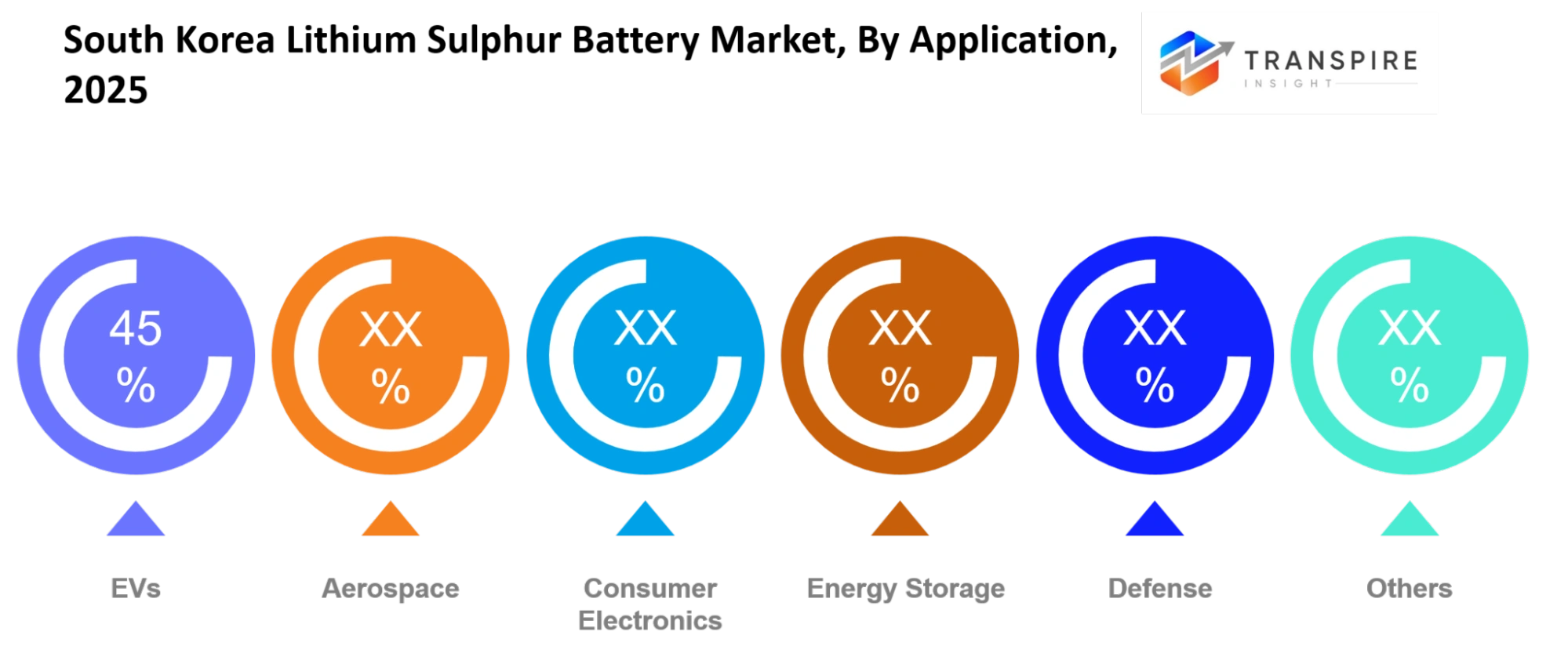
- On the applications front, electric vehicles really led the way with about 42% market share in 2025 due to demand for less massive battery packs with higher energy density, it makes sense.
- Also, unmanned aerial vehicles and aerospace systems are projected to grow quickest during the forecast period, mostly because longer flight endurance is turning into a must, not only a nice-to-have thing.
- Automotive manufacturers held roughly 46% market share in 2025, showing strong spend on advanced battery tech for next generation EV platforms.
- Lastly defense and aerospace organizations are expected to be the most rapidly expanding end user group through 2033, pushed by lightweight, high capacity energy storage needs that just keep climbing, year after year.
What are the Key Drivers, Restraints, and Opportunities in the South Korea Lithium Sulphur Battery Market?
The main growth driver is South Korea’s strategic push to commercialize next generation batteries past the usual lithium-ion path. National spending on advanced battery research, plus rising support from big manufacturers has sped up the push for lithium sulphur chemistry. This momentum got stronger when electric vehicle makers started looking for cells that can deliver energy density above today’s lithium-ion setups, and at the same time lessen reliance on nickel and cobalt. As pilot production ramps up , battery developers are now lining up collaborations with automotive as well as aerospace companies , so they can create new income streams via prototype verification and also longer term supply pacts.
The biggest structural snag, still is the short cycle life and the shaky stability of lithium metal. On the cathode side, sulfur materials suffer from polysulfide shuttling, while on the anode side, lithium metal is prone to dendrite growth, which cuts durability when you charge again and again. Because of that , these technical limits force a kind of heavier material engineering and manufacturing upgrades, and you cant fix them with small incremental process tweaks only. So, commercialization schedules stay pretty long, which in turn delays wide scale production and mutes near-term market revenue, even if customer interest is clearly growing.
The best future shot seems to be in aerospace, unmanned air systems, and newer defense platforms, where high energy density wins out over cost, most of the time. In South Korea, the growing money into autonomous aircraft, the broader military upgrade efforts, and the talk around urban air mobility all add up, for lithium sulphur batteries to fit in well. If the country keeps putting funds behind solid state lithium sulphur research, and pairs it with AI guided material discovery plus domestic pilot line manufacturing , then in theory it could enable commercial scale roll out within about the next ten years.
What Has the Impact of Artificial Intelligence Been on the South Korea Lithium Sulphur Battery Market?
Artificial intelligence is a kind of reshaping of lithium sulphur battery development, mostly by speeding up material discovery, boosting manufacturing efficiency, and helping with battery performance tweaking. More and more manufacturers are using machine learning models to screen thousands of sulfur cathode recipes, electrolyte mixes, and lithium metal protection approaches before anything gets built in the lab, which in turn shrinks development timelines , a lot. AI enabled quality inspection systems also do the extra work on the ground by automatically spotting coating defects, electrode mismatches , and other weird manufacturing irregularities during pilot runs. This makes the whole process feel steadier, while also trimming production waste, and that part matters.
Alongside that, advanced digital platforms help with predictive maintenance across battery manufacturing equipment by watching temperature, pressure, vibration, and also coating accuracy all the time, kind of like a constant vigilance thing. Once predictive analytics is in place unexpected equipment failures fall down, production uptime gets better, and overall manufacturing repeatability improves over time, not immediately but steadily. And on top of it, a lot of battery developers lean on digital twins to reproduce charge behavior, thermal patterns, and degradation pathways so engineers can tune the battery design prior to commercialization. Taken together, these tools push production yields up, operating costs down, and battery reliability higher, generally.
Still, even with these wins, AI adoption is not unlimited. It’s held back by limited real world datasets for lithium sulphur chemistry. Because commercial deployment is still in an early phase, a lot of predictive models depend on lab generated data that does not fully reflect large scale manufacturing reality. There are also high integration costs, plus a shortage of specialized battery data scientists, and that combination slows down broad rollout across emerging production sites.
Key Market Trends
- Since 2023, manufacturers have been shifting investments from conventional lithium ion upgrades toward lithium sulphur research, in order to reach energy densities that go past 500 Wh/kg, which sounds simple but is actually pretty tough.
- Battery companies are now partnering more and more with universities and research institutes, to cut commercialization timelines through shared pilot production and material validation programs, sort of like “learn faster by building sooner” even if the process is messy.
- Automotive manufacturers have also broadened their evaluation programs for lithium sulphur batteries, because next generation EV platforms need lighter battery packs, with longer driving ranges, and they cannot wait around too long.
- Solid-state lithium sulphur technologies have drawn more funding since 2024 as developers try to build safer battery architectures with better cycle stability, not just higher numbers.
- At the same time, domestic supply chains are increasingly putting sulfur-based cathode materials at the center of their planning, so they can reduce long-term dependence on pricey nickel and cobalt procurement.
- Meanwhile, AI-driven battery material discovery has sped up electrolyte optimization. This helps manufacturers spot promising chemical combinations more efficiently than traditional testing, which can be slow and kind of wasteful.
- Defense and aerospace organizations have started adopting prototypes more actively too, since lightweight batteries can support longer endurance for unmanned aerial systems, and for specialized platforms that need extra reliability.
- Battery manufacturers continue fortifying their intellectual property stacks, with more patent filings covering sulfur cathodes, lithium protection layers and advanced electrolytes, because they know competition moves quickly.
- Government-backed battery innovation programs are increasingly supporting pilot manufacturing facilities, which is meant to encourage faster transfer from laboratory research into commercial production.
South Korea Lithium Sulphur Battery Market Segmentation
By Component :
The cathode forms that energy storage section by using sulfur as the active material, while the anode generally uses lithium metal to support a high output of energy. Electrolytes carry lithium ions between the two electrodes and separators keep the cathode, and the anode apart , yet still allow ionic movement for a safe battery operation, kinda like a careful hallway rule.
Battery packs then combine multiple cells into one complete energy storage unit, fit for different applications. Other parts show up too: current collectors, protective casings, battery management systems and thermal control materials that will improve safety, efficiency, and long-term operating performance under various environmental and usage conditions.
By Application :
Electric vehicles are a big application area, because lithium sulphur batteries can bring higher energy density and less battery mass, which helps extend the driving range.Aerospace use cases sort of rely on light weight batteries, to nudge aircraft and unmanned aerial vehicle performance upward, while consumer electronics tends to want compact battery packs, with longer stretch of operation… not so much heavy storage.
Energy storage systems in general also help with renewable power, by keeping electricity for later use, which then improves grid stability too.Defense applications call for dependable, light and high capacity batteries for advanced communication gear, surveillance systems, and portable military devices. Beyond that, there are industrial equipment setups, robotics platforms, and specialized research systems that need advanced battery technology.
By Capacity :
Batteries under 500mAh mostly back compact electronic products, where tiny dimensions stay the main point even if the runtime is limited. The 500-2000mAh band is aimed at pocket consumer devices that need a sort of middle ground between stored energy and real day to day runtime. The batteries sitting in the 2000-5000mAh range are usually good for larger electronics, as well as medium-power equipment too, because that added capacity helps keep things stable, performance wise.
When you pass 5000mAh, these batteries can be put into electric cars, energy storage arrangements, aerospace systems, and defense applications, basically all the spots where you want reliable output for longer stretches without much drop off.Other capacity groups also exist, including customized battery configurations, created for particular industrial, scientific, and commercial demands based on exact energy goals and performance targets. In practice the whole idea is matching the pack to the workload, and sometimes to the space constraints too.
By End User :
In the automotive space , lithium sulphur batteries show up to extend vehicle range while trimming down battery mass. In aerospace , organizations look for lightweight energy storage for aircraft satellites, and unmanned platforms. Electronics manufacturers also put in advanced batteries for handheld and mobile devices, so users can stretch the time between charges without it feeling extra bulky or heavy in the hand.
Meanwhile the energy sector leans on those same batteries for renewable energy storage efforts, and also for spare power systems that can help steady electricity management, plus make the whole supply more dependable overall.Other end users cover industrial makers, defense teams, research groups, and healthcare equipment producers that are hunting for higher-performing battery tech designed around specialized operational requirements.
What are the Key Use Cases Driving the South Korea Lithium Sulphur Battery Market?
Electric vehicles are still the main use case that basically keeps supporting demand in the South Korea Lithium Sulphur Battery Market, at least for now. Automotive manufacturers keep looking at lithium sulphur technology, mainly because better energy density and lower battery weight should help driving range, and at the same time cut down the total vehicle mass. so the next generation of electric mobility can be more efficient, yes.
Meanwhile, aerospace and defense applications are getting broader, since companies want lightweight power sources for unmanned aerial vehicles, satellites, and various portable military equipment. On the consumer side, electronics firms are also ramping up research into lithium sulphur batteries, aiming for longer operating time in premium portable devices, without making the overall product size bigger than it needs to be.
Then there are the newer ideas too, like grid-scale renewable energy storage, and urban air mobility platforms. As battery durability keeps improving through continued research, these areas may open up fresh commercial chances. Industrial robotics and advanced autonomous systems, they’re showing pretty strong long-term potential as well, because industries are searching for lightweight cells that can handle longer operating cycles without so much hassle.
|
Report Metrics |
Details |
|
Market size value in 2025 |
USD 42.02 Million |
|
Market size value in 2026 |
USD 54.69 Million |
|
Revenue forecast in 2033 |
USD 346.86 Million |
|
Growth rate |
CAGR of 30.20% from 2026 to 2033 |
|
Base year |
2025 |
|
Historical data |
2021 - 2024 |
|
Forecast period |
2026 - 2033 |
|
Report coverage |
Revenue forecast, competitive landscape, growth factors, and trends |
|
Country scope |
South Korea |
|
Key company profiled |
LG Energy Solution, Samsung SDI, SK On, OXIS, Sion Power, Lyten, PolyPlus, Saft, CATL, BYD, Panasonic, Toshiba, Johnson Matthey, Solid Power, SES AI. |
|
Customization scope |
Free report customization (country, regional & segment scope). Avail customized purchase options to meet your exact research needs. |
|
Report Segmentation |
By Component (Cathode, Anode, Electrolytes, Separators, Battery Packs, Others) | By Application (EVs, Aerospace, Consumer Electronics, Energy Storage, Defense, Others) | By Capacity (Below 500mAh, 500-2000, 2000-5000, Above 5000, Others) | By End User (Automotive, Aerospace, Electronics, Energy, Others). |
Which Regions are Driving the South Korea Lithium Sulphur Battery Market Growth?
Gyeonggi Province stays as the top regional market, mainly because it has a big cluster of battery manufacturers, research institutes, and advanced material providers, so in practice the whole chain is close by. On top of that, the government support for next generation battery development is still strong, which keeps pushing research money and pilot output activities forward. Universities, technology firms, and the automotive manufacturers work together in a fairly tight manner, this makes product development feel quicker and it also helps commercialization happen sooner. Because of this whole industrial ecosystem working as one, companies can shift more smoothly from lab based experiments to early stage production, even if the timing is tight.
North Chungcheong Province shows up as the next biggest contributor, though the momentum there feels more like manufacturing expansion, not really a concentration of corporate headquarters. The area is helped by continuous spending on battery materials, component production, and purpose built industrial facilities. Industrial parks in the region keep drawing in suppliers, and that gradually strengthens the domestic battery value chain while also improving production efficiency. With investment staying steady from both public funds and private sources, the province looks dependable for long term industry growth.
North Gyeongsang Province is expected to post the fastest growth in the 2026–2033 period, since advanced manufacturing investments keep rising. In recent years, new battery material production facilities, along with upgraded research infrastructure, have made conditions more favorable for commercial scale projects. Many companies are picking the region for fresh production capacity because there’s land available, plus industrial support is there for the long run. This wave of investment should open up solid opportunities for technology providers, material suppliers, and investors who want to get in early on advanced battery manufacturing.
Who are the Key Players in the South Korea Lithium Sulphur Battery Market and How Do They Compete?
Competition is still pretty technology driven, mainly because commercial production is sort of in the process of catching up and companies tend to win via research capacity, intellectual property, and advanced manufacturing know-how, not just on sheer production volume alone. The established battery players keep upgrading their research programs, and then research groups with material specialists bring in fresh approaches. Those approaches end up making batteries perform better, last longer, and feel safer too. So the real battleground is extending cycle life, making lithium metal more stable, and pushing commercialization to move faster.
LG Energy Solution puts a lot of weight into advanced battery chemistry studies, plus pilot production, so that the timeline toward commercialization gets shorter. They also reinforce their stance through partnerships with automakers and research organizations, while they work on the next generation of batteries alongside the existing lithium ion base. Samsung SDI meanwhile leans hard into material engineering and very precise manufacturing, which helps it support high-performance battery platforms. By continuing to invest in joint research efforts and next generation cell design, the company can boost energy density and also improve manufacturing efficiency without slowing down.
SK On is basically focusing on the next generation battery innovation, somehow by mixing lithium sulphur research with advanced battery management technologies and this is meant to back future electric mobility applications. POSCO Future M boosts its competitiveness through battery material development , especially for advanced cathode materials, plus it pushes supply chain integration so it can support domestic manufacturing more steadily. The Korea Institute of Science and Technology also contributes via fundamental battery research, and then with technology transfer programs, which helps speed up commercialization by linking scientific innovation directly to industrial manufacturing partners .
Company List
- LG Energy Solution
- Samsung SDI
- SK On
- OXIS
- Sion Power
- Lyten
- PolyPlus
- Saft
- CATL
- BYD
- Panasonic
- Toshiba
- Johnson Matthey
- Solid Power
- SES AI
Recent Development News
In April 2026, LG Energy Solution became the first battery company to join SDVerse, a global B2B automotive software marketplace. The partnership strengthens the company's software-defined battery capabilities, supporting future commercialization of advanced battery technologies, including lithium sulphur research.
Source: https://news.lgensol.com/
In April 2025, LG Energy Solution entered a battery recycling joint venture with France-based Derichebourg (DBG). The partnership expands battery material recovery capabilities and supports a more sustainable supply chain for next-generation battery chemistries, including future lithium sulphur battery production.
Source: https://news.lgensol.com/
What Strategic Insights Define the Future of the South Korea Lithium Sulphur Battery Market?
South Korea Lithium Sulphur Battery Market is kinda changing, structurally, from that earlier laboratory level push toward a more focused commercial rollout across the next five to seven years. This shift is being pulled by the craving for next generation energy storage, you know, higher energy density, lighter mass, and less reliance on the usual critical minerals. Over time growth will be less about simply scaling up capacity and more about being able to handle cycle life limits while also fitting everything into scalable manufacturing operations.
There is also a not so obvious risk—technology substitution. If solid-state batteries keep advancing quickly, and if silicon anode lithium-ion designs get cheaper faster, they could shrink the commercialization timeframe for lithium sulphur solutions before they become cost competitive enough.
Still, a real chance is showing up at the same time: lithium-sulphur batteries being adopted in high altitude drones, defense systems, and aerospace platforms where weight reduction gives an immediate performance boost. Market players should, in practice, push for strategic collaborations with aerospace, defense, and research institutions , plus keep investing in sulfur cathode stabilization and in pilot scale manufacturing, so they can build a defendable position before wider commercialization ramps up.
South Korea Lithium Sulphur Battery Market Report Segmentation
By Component
- Cathode
- Anode
- Electrolytes
- Separators
- Battery Packs
By Application
- EVs
- Aerospace
- Consumer Electronics
- Energy Storage
- Defense
By Capacity
- Below 500mAh
- 500-2000
- 2000-5000
- Above 5000
By End User
- Automotive
- Aerospace
- Electronics
- Energy
Frequently Asked Questions
Find quick answers to common questions.
The South Korea Lithium Sulphur Battery Market size is USD 346.86 Million in 2033.
Key segments for the South Korea Lithium Sulphur Battery Market are By Component (Cathode, Anode, Electrolytes, Separators, Battery Packs, Others) | By Application (EVs, Aerospace, Consumer Electronics, Energy Storage, Defense, Others) | By Capacity (Below 500mAh, 500-2000, 2000-5000, Above 5000, Others) | By End User (Automotive, Aerospace, Electronics, Energy, Others).
Major South Korea Lithium Sulphur Battery Market players are LG Energy Solution, Samsung SDI, SK On, OXIS, Sion Power, Lyten, PolyPlus, Saft, CATL, BYD, Panasonic, Toshiba, Johnson Matthey, Solid Power, SES AI.
The South Korea Lithium Sulphur Battery Market size is USD 42.02 Million in 2025.
The South Korea Lithium Sulphur Battery Market CAGR is 30.20% from 2026 to 2033.
- LG Energy Solution
- Samsung SDI
- SK On
- OXIS
- Sion Power
- Lyten
- PolyPlus
- Saft
- CATL
- BYD
- Panasonic
- Toshiba
- Johnson Matthey
- Solid Power
- SES AI
About the Authors

Avinash Kumar
I’m Avinash Kumar, a Senior Research Analyst at Transpire Insight, with expertise in the Electronics and Semiconductor and Energy & Power industry. My work focuses on analyzing emerging technologies, market trends, industry developments, and innovation across these sectors. I specialize in transforming complex technical and market insights into clear, research-backed content that helps professionals, businesses, and decision-makers stay informed. Through continuous industry research and data-driven analysis, I strive to deliver accurate, reliable, and practical perspectives on the latest advancements shaping the semiconductor and energy landscape.

Chakradhar Khansole
Chakradhar serves as the Research Director at Transpire Insight, bringing over 8 years of experience in technology, innovation, and strategic market intelligence. He specializes in transforming complex market data into actionable business insights that enable organizations to make informed, growth-oriented decisions. Recognized for his strategic vision and analytical expertise, Chakradhar leads high-impact research initiatives, delivering comprehensive market assessments, competitive intelligence, and forward-looking industry analysis.
Recently Published Reports
-
Apr 2026
Active Power Filter Market
Active Power Filter Market Size, Share & Analysis Report By Type (Shunt Active Power Filters, Series Active Power Filter, Hybrid Active Power Filter), By Application (Harmonics Mitigation, Reactive Power Compensation, Voltage Regulation, Power Factor Correction), By Phase (Single Phase, Three Phase), By End-User Industry (Manufacturing, Healthcare, Commercial, Automotive, Oil and Gas, Others), and Geography (North America, Europe, Asia-Pacific, Middle East and Africa, South and Central America), 2021 - 2031
-
Apr 2026
Electrical Transformer Market
Electrical Transformer Market Size, Share & Analysis Report By Core (Closed, Shell, and Berry), By Insulation (Gas, Oil, Solid, Air, and Other), By Phase (Single, and Three), By Rating (100 MVA to 500 MVA, 501 MVA to 800 MVA, and 801 MVA to 1200 MVA), and Geography (North America, Europe, Asia-Pacific, Middle East and Africa, South and Central America), 2021 – 2031
-
Apr 2026
Hydraulic Piston Pumps Market
Hydraulic Piston Pumps Market Size, Share & Analysis Report By Type (Axial Piston Pumps, Radial Piston Pumps), By Operating Pressure (Low Pressure, Medium Pressure, High Pressure), By Application (Construction, Mining, Agriculture, Automotive, Oil & Gas, Industrial Machinery, Others), By End-User (OEMs, Aftermarket), and Geography (North America, Europe, Asia-Pacific, Middle East and Africa, South and Central America), 2021 – 2031
-
Apr 2026
Laboratory Gas Generators Market
Laboratory Gas Generators Market Size, Share & Analysis Report By Product (Nitrogen Gas Generator, Hydrogen Gas Generator, Zero Air Gas Generator, Purge Gas Generator, TOC Gas Generators, Others), By Application (Gas Chromatography, Liquid Chromatography-mass Spectrometry (LC-MS), Gas Analyzers, Others), By End-user (Life Science, Chemical & Petrochemical, Food & Beverage, Others), and Geography (North America, Europe, Asia-Pacific, Middle East and Africa, South and Central America), 2021 – 2031