
South Korea Industrial ORC Waste Heat to Power Market Summary:
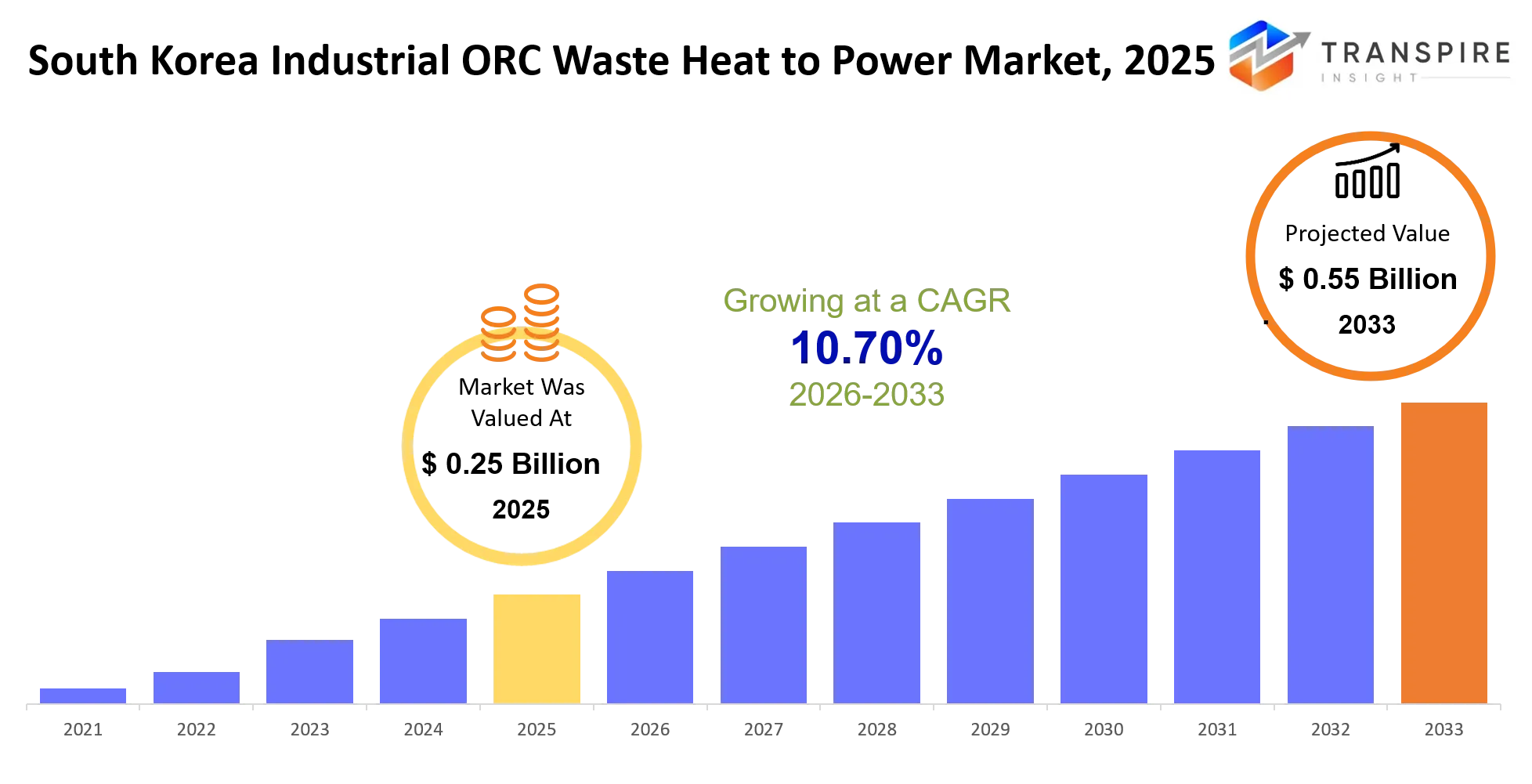
According to Transpire Insights, a detailed research report on the South Korea Industrial ORC Waste Heat to Power Market reflects that the industrial waste heat recovery application segment dominates market demand, driven by the adoption of Organic Rankine Cycle (ORC) technology for onsite electricity generation across energy-intensive industries. Turboden, part of Mitsubishi Heavy Industries Group, demonstrates a significant market presence through its industrial ORC technology and a documented 1.2 MWe waste heat recovery project with POSCO ICT in Gwangyang, South Korea, supporting industrial energy efficiency, process heat recovery, and electricity generation. Turboden's advanced ORC systems, industrial heat recovery solutions, expanding technological capabilities, and established steel-sector project experience contribute to market development, innovation, and growth dynamics.
Market Snapshot
- Market Value (2025): USD 0.25 Billion.
- Expected Market Value (2026): USD 0.27 Billion.
- Estimated Market Value (2033): USD 0.55 Billion.
- Forecast CAGR (2026–2033): 10.70%.
Introduction
The South Korea Industrial ORC Waste Heat to Power Market is a specialized area of industrial energy recovery that involves the conversion of unused heat energy to electricity. The Organic Rankine Cycle (ORC) technology is a means to convert low- and medium-temperature industrial waste heat to power using organic working fluids with low boiling points. The technology allows for energy efficiency and decarbonization in the steel, petrochemical, chemical, cement, glass and heavy manufacturing sectors. ORC systems use expanders, heat exchangers, pumps, condensers and control systems to effectively convert thermal to electrical energy. Market adoption is supported by growing industrial interest to reduce energy consumption, optimize operational costs and reduce emissions. Technological progress, tailored system integration and industrial sustainability efforts are creating the context for the development of South Korean industrial ORC waste heat recovery.
Key Market Highlights: -
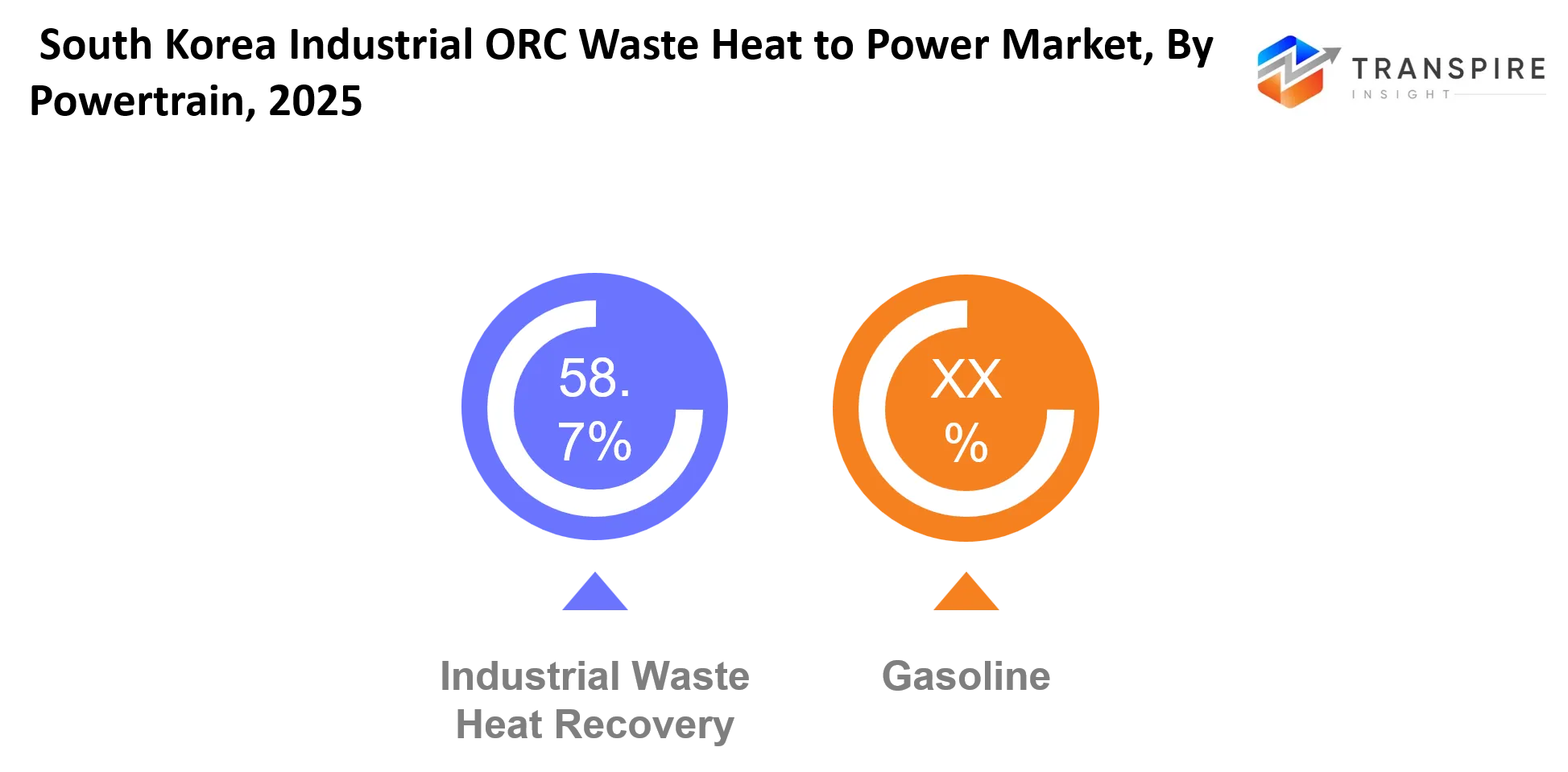
- By Power Capacity, the Above 50 MW segment dominated the market and holds approximately 76.8% share in 2025 and is projected to grow at a substantial CAGR during the forecast period.
- By Heat Source, the EXHAUST GASES dominated the market and holds approximately 37% share in 2025 and is projected to grow at a substantial CAGR during the forecast period.
- By Application, the Iron & Steel Manufacturers segment dominated the market and holds approximately 65% share in 2025 and is projected to grow at a substantial CAGR during the forecast period.
- The South Korean industrial ORC waste heat-to-power market is growing as manufacturers seek to improve energy efficiency, reduce industrial carbon emissions and generate on-site electricity through advanced waste heat recovery technologies.
How is Technology Driving Growth in the South Korea Industrial ORC Waste Heat to Power Market?
Technology is helping growth in the South Korea Industrial ORC Waste Heat to Power Market with improved thermal conversion efficiency, advanced working fluids and modular system designs. ORC technology allows industrial sites to generate power from low- and medium-temperature waste heat that is not appropriate for conventional steam cycles. Compact skid mounted systems make for easy installation and integration into existing manufacturing processes. Recovered heat can reduce the purchased electricity consumption and increase energy efficiency in steel, petrochemical, cement and other energy intensive industries. Developments in turbine architecture, heat exchangers and automated controls are also improving operational flexibility and industrial decarbonisation and the potential for onsite waste heat to power generation.
Market Drivers
Industrial decarbonization, energy cost optimization, and growing demand for efficient waste heat recovery drive the South Korea Industrial ORC Waste Heat to Power Market. However, national climate goals and requirements for carbon reductions offer incentives to energy intensive industries to improve their energy performance and reduce emissions. The increasing cost of electricity also encourages manufacturers to use onsite ORC power generation to reduce dependence on the grid and operating costs. However, the well-established steel, petrochemical, cement, and shipbuilding industries in South Korea generate significant waste heat flows, providing opportunities for the deployment of ORC system. Corporate sustainability commitments & ESG objectives further support investment in advanced waste heat recovery technologies, solidifying market adoption and long-term growth prospects.
Restrain
The South Korea Industrial ORC Waste Heat to Power Market is facing many challenges for adoption such as high initial investment costs for specialized turbines, heat exchangers, and system installation. Retrofitting of ORC equipment into existing steel, petrochemical and manufacturing facilities can require complex engineering and operational adjustments. The varying availability of waste heat may affect power output and system efficiency. Moreover, limited technical awareness, project-specific permitting requirements, and uncertain payback periods for investments may limit uptake, particularly for small and medium-sized industrial companies.
|
Driver |
Relative Impact on Growth (%) |
Geographic Relevance |
Impact Timeline |
Demand Strength |
Growth Mechanism |
Key Beneficiaries |
Major Constraint |
|
1. Industrial energy efficiency and waste heat recovery initiatives |
27% |
Ulsan, Yeosu, Pohang, and Gyeonggi industrial clusters |
Medium-term (2–4 years) |
High |
Converts process waste heat into electricity, reducing purchased power consumption and improving plant energy efficiency. |
ORC equipment manufacturers, energy service companies, industrial plant operators |
High installation costs and variable waste heat availability |
|
2. Industrial decarbonization and carbon reduction commitments |
23% |
Ulsan petrochemical complexes, Pohang steel facilities, and Chungcheong manufacturing hubs |
Long-term (≥4 years) |
High |
Reduces indirect emissions through recovered heat-based electricity generation and lower grid electricity dependence. |
Heavy industries, ORC technology suppliers, decarbonization solution providers |
Competing decarbonization investments and uncertain project payback |
|
3. Government energy-efficiency policies and financial support |
20% |
Nationwide, particularly energy-intensive industrial complexes |
Short-term (≤2 years) |
High |
Encourages waste heat utilization through energy-saving investment support and industrial efficiency programs. |
Industrial facility owners, ORC suppliers, energy-saving project developers |
|
|
Eligibility restrictions and competition for funding |
|||||||
|
4. Advancements in ORC technology and low-temperature heat recovery |
17% |
Ulsan, Yeosu, Gyeonggi, and other process-intensive manufacturing regions |
Medium-term (2–4 years) |
Medium |
Improves conversion efficiency and expands economically recoverable low-grade heat sources. |
ORC manufacturers, heat exchanger suppliers, engineering and integration firms |
Heat-source variability and refrigerant performance limitations |
|
5. Rising industrial electricity costs and energy security priorities |
13% |
Ulsan, Busan, Gyeongsang, and major manufacturing clusters |
Short-term (≤2 years) |
Medium |
Improves electricity cost stability by generating onsite power from otherwise unused thermal energy. |
Electricity-intensive manufacturers, ORC system integrators, industrial energy managers |
Electricity price uncertainty and lengthy investment recovery periods |
|
Total |
100% |
— |
— |
— |
— |
— |
— |
Analysis of Prices and Consumer Behaviour
The South Korea Industrial ORC Waste Heat to Power market is driven by the need for heat power generation efficient waste heat recovery systems, especially in energy-intensive industries such as steel, petrochemicals, cement and manufacturing. High efficiency ORC systems require premium price for advanced turbine technology, specialised heat exchangers and optimised thermal-to-electric conversion performance. Modular ORC systems allow industrial deployment through easy installation and flexible integration to existing facilities. Energy intensive industry is a big source of demand, with industrial decarbonisation and energy efficiency measures. The industrial buyer is looking for conversion efficiency, system reliability and operational performance. Industrial facilities can benefit from bulk procurement contracts and long-term service agreements which can help reduce equipment costs, provide maintenance support and reliable access to technology.
|
Company |
Est. Revenue Share Range |
Key Offerings |
Strategic Positioning |
Geographic Strength |
Technology Focus |
|
1. Turboden (Mitsubishi Heavy Industries Group) |
Estimated: 15–30% |
Industrial waste-heat ORC systems; HRS and HR series; custom ORC turbogenerators; engineering and lifecycle services. |
Established industrial ORC specialist with proven steel-sector deployment. |
Europe, Asia Pacific, North America |
High-capacity ORC turbines, thermal integration, modular skid systems. |
|
2. Exergy International |
Estimated: 8–18% |
ORC power plants; industrial waste-heat recovery; geothermal ORC systems; engineering and maintenance. |
Competes through proprietary turbine design and project customization. |
Europe, Asia Pacific, Middle East |
Radial-outflow turbine architecture, high-efficiency thermodynamic cycles. |
|
3. Orcan Energy |
Estimated: 5–15% |
efficiency PACK ORC modules; industrial heat recovery; turnkey engineering; installation and financing solutions. |
Modular deployment and cost-focused waste-heat monetization. |
Europe, Asia Pacific, North America |
Compact ORC modules, standardized packages, partial-load performance. |
|
4. Enogia |
Estimated: 2–8% |
Micro-ORC systems; industrial heat recovery; engine waste-heat recovery; compact power-generation modules. |
Niche specialization in compact, lower-power ORC installations. |
Europe, Asia Pacific |
High-speed turbomachinery, compact expanders, modular ORC systems. |
|
5. Dürr Cyplan |
Estimated: 2–8% |
Industrial ORC systems; waste-heat recovery packages; process integration; engineering services. |
Industrial engineering integration and customized heat-recovery projects. |
Europe, Asia Pacific |
ORC process integration, heat exchangers, automated plant controls. |
|
6. Kaishan Group |
Estimated: 2–7% |
ORC power-generation systems; industrial waste-heat recovery; geothermal power systems; engineering solutions. |
Equipment manufacturing scale and industrial energy-system diversification. |
Asia Pacific, North America, Europe |
ORC turbomachinery, heat recovery integration, industrial power systems. |
|
7. Againity |
Estimated: 1–5% |
ORC power plants; industrial waste-heat recovery; biomass-based electricity generation; turnkey installations. |
Small-to-medium-scale project specialization and turnkey delivery. |
Europe, selected international markets |
Modular ORC plants, low-temperature heat recovery, automated operation. |
|
8. Triogen |
Estimated: 1–5% |
ORC power systems; industrial heat recovery; engine-based waste-heat conversion; system integration. |
Specialized ORC solutions for distributed industrial power generation. |
Europe, Asia Pacific |
Compact ORC systems, heat-source matching, power-cycle optimization. |
|
9. Electratherm |
Estimated: 1–4% |
ORC waste-heat-to-power systems; industrial heat recovery; distributed generation solutions. |
Niche waste-heat conversion and distributed-power specialization. |
North America, selected international markets |
Small-scale ORC power conversion, packaged heat recovery. |
|
10. Mitsubishi Heavy Industries |
Estimated: 5–15% |
Industrial energy systems; ORC technology through Turboden; power-generation integration; engineering and service support. |
Parent-level integration, financing strength, and industrial customer relationships. |
Asia Pacific, Europe, North America |
Integrated energy systems, ORC turbine engineering, industrial heat recovery. |
Who are the Key Players in the South Korea Industrial ORC Waste Heat to Power Market and how do they compete?
The competitiveness of the South Korea Industrial ORC Waste Heat to Power Market process heating on the international level is provided by companies engaged in technology innovations, industry-oriented solutions, and creation of a global distribution network. Competing not through pricing, but through durable equipment, high-level technology, intelligent and connected solutions, and digital platform and system integration, this type of competition is characterized by constant product development, and at the same time it enables organizations to become more efficient, productive, and optimized.
Mitsubishi Heavy Industries strengthens its position in the market due to the development of advanced ORC systems, industrial waste heat recovery systems, and power generation technology. Toshiba Energy Systems can differentiate itself from other players by creating high performance energy systems aimed at industrial waste heat recovery, electricity generation, and energy efficiency applications. Kaishan Group can create its market position through the provision of an integrated solution in the ORC technology, industrial energy recovery, and power generation.
Top Companies in the South Korea Industrial ORC Waste Heat to Power Market
- Mitsubishi Heavy Industries
- Toshiba Energy Systems
- Kaishan Group
- Turboden
- Enogia
- Ormat Technologies
- Siemens Energy
- ABB
- Alfa Laval
- Dürr
- Atlas Copco
- Bosch Industriekessel
- Kobe Steel
- IHI Corporation
- Hanwha Power Systems
South Korea Industrial ORC Waste Heat to Power Market Segmentation
The South Korea Industrial ORC Waste Heat to Power Market share is divided into six categories: By Power Capacity, By Heat Source, By Application, By System Type, By Working Fluid, By End User.
The Above 50 MW segment dominated the market, accounting for nearly 76.8% in 2025 and is expected to rise at a significant CAGR during the forecast period.
The South Korea Industrial ORC Waste Heat to Power Market is segmented by power capacity into below 100 kw, 100 kw–1 mw, 1–5 mw, 5–10 mw, 10–20 mw, 20–50 mw, above 50 mw, modular systems. Among these, the Above 50 MW segment segment dominated the market, accounting for nearly 76.8% in 2025 and expected to increase at a significant CAGR during the forecast period. This is because the 50 MW section dominated due to the need for highly rated ORCs in heavy industries owing to significant waste heat recovery potential.
The Exhaust Gases dominated the market, accounting for nearly 37% in 2025, and is expected to rise at a significant CAGR during the forecast period.
The South Korea Industrial ORC Waste Heat to Power Market is segmented by heat source into industrial waste heat, flue gas, exhaust gas, geothermal heat, biomass, solar thermal, process heat, gas turbine exhaust. Among these, the Exhaust Gases dominated the market, accounting for nearly 37% in 2025 and expected to increase at a significant CAGR during the forecast period. This exhaust gases section dominates because there are lots of available waste heat at high temperatures from various industrial activities, thus making it suitable for ORC power production.
The Iron & Steel dominated the market, accounting for nearly 65% in 2025 and is expected to rise at a significant CAGR during the forecast period.
The South Korea Industrial ORC Waste Heat to Power Market is segmentedby application into steel, cement, chemicals, refineries, petrochemicals, glass, food processing, manufacturing. Among these, the Iron & Steel dominated the market, accounting for nearly 65% in 2025 and expected to increase at a significant CAGR during the forecast period. The Iron & Steel Section dominates because of high energy utilization and waste heat generated that can be recovered through ORCs.
Future Market Trends for the South Korea Industrial ORC Waste Heat to Power Market: -
Recovering Energy from Industrial Waste Heat: ORC technology is being considered for the recovery of electricity from the waste heat produced by South Korean steel and chemicals industry.
Recovering Electricity from Low- and Medium-temperature Waste Heat: With the development of ORC technology, heat exchanger and working fluid, new avenues have emerged for producing electricity from low- and medium- temperature waste heat from industries.
Generating Electricity On-Site: The adoption of ORC systems that recover waste heat and generate electricity on-site at industries has helped the industries meet their power needs.
Recent Development
In February 3, 2026: South Korea adopted its energy transition framework, which includes provisions for renewable energy development and coal plant closure that are applicable to industrial decarbonization and energy recovery.
In September 2026: South Korea implemented new rates for industrial electricity, which could increase the incentive for ORC installation and power generation on-site.
In September 2026: South Korea’s energy transition framework considered the repurposing of coal plant grid infrastructure, thereby providing an opportunity for localized energy systems and energy recovery from industrial waste heat.
Market Segmentation
This study forecasts revenue at Japan, regional and country levels from 2020 to 2033. Transpire Insights has segmented the South Korea Industrial ORC Waste Heat to Power Market based on the below-mentioned segments:
South Korea Industrial ORC Waste Heat to Power Market, By Power Capacity
- Below 100 kW
- 100 kW–1 MW
- 1–5 MW
- 5–10 MW
- 10–20 MW
- 20–50 MW
- Above 50 MW
- Modular Systems
South Korea Industrial ORC Waste Heat to Power Market, By Heat Source
- Industrial Waste Heat
- Flue Gas
- Exhaust Gas
- Geothermal Heat
- Biomass
- Solar Thermal
- Process Heat
- Gas Turbine Exhaust
South Korea Industrial ORC Waste Heat to Power Market, By Application
- Steel
- Cement
- Chemicals
- Refineries
- Petrochemicals
- Glass
- Food Processing
- Manufacturing
South Korea Industrial ORC Waste Heat to Power Market, By System Type
- Subcritical ORC
- Supercritical ORC
- Recuperated ORC
- Regenerative ORC
- Single-Loop
- Dual-Loop
- Modular ORC
- Integrated ORC
South Korea Industrial ORC Waste Heat to Power Market, By Working Fluid
- Hydrocarbons
- Siloxanes
- Refrigerants
- Aromatic Hydrocarbons
- Fluids with Low Boiling Points
- Organic Fluids
- Mixed Fluids
- Specialty Fluids
South Korea Industrial ORC Waste Heat to Power Market, By End User
- Industrial Plants
- Utilities
- Manufacturing Facilities
- Steel Producers
- Chemical Companies
- Energy Companies
- Refineries
- EPC Contractors
Frequently Asked Questions
Find quick answers to common questions.
Industrial energy efficiency, decarbonization goals, electricity cost optimization, and demand for recovering unused process heat are supporting market growth.
The iron and steel industry leads, supported by energy-intensive operations and substantial recoverable waste heat suitable for ORC electricity generation.
Exhaust gases account for the largest share, reflecting their availability across industrial processes and suitability for waste heat-to-power conversion.
ORC systems convert low- and medium-temperature waste heat into electricity, reducing purchased power consumption and improving industrial energy utilization.
High upfront costs, complex retrofitting, variable heat availability, and uncertain investment payback can constrain industrial ORC system deployment.
- Mitsubishi Heavy Industries
- Toshiba Energy Systems
- Kaishan Group
- Turboden
- Enogia
- Ormat Technologies
- Siemens Energy
- ABB
- Alfa Laval
- Dürr
- Atlas Copco
- Bosch Industriekessel
- Kobe Steel
- IHI Corporation
About the Authors

Avinash Kumar
I’m Avinash Kumar, a Senior Research Analyst at Transpire Insight, with expertise in the Electronics and Semiconductor and Energy & Power industry. My work focuses on analyzing emerging technologies, market trends, industry developments, and innovation across these sectors. I specialize in transforming complex technical and market insights into clear, research-backed content that helps professionals, businesses, and decision-makers stay informed. Through continuous industry research and data-driven analysis, I strive to deliver accurate, reliable, and practical perspectives on the latest advancements shaping the semiconductor and energy landscape.

Chakradhar Khansole
Chakradhar serves as the Research Director at Transpire Insight, bringing over 8 years of experience in technology, innovation, and strategic market intelligence. He specializes in transforming complex market data into actionable business insights that enable organizations to make informed, growth-oriented decisions. Recognized for his strategic vision and analytical expertise, Chakradhar leads high-impact research initiatives, delivering comprehensive market assessments, competitive intelligence, and forward-looking industry analysis.
Recently Published Reports
-
Apr 2026
Active Power Filter Market
Active Power Filter Market Size, Share & Analysis Report By Type (Shunt Active Power Filters, Series Active Power Filter, Hybrid Active Power Filter), By Application (Harmonics Mitigation, Reactive Power Compensation, Voltage Regulation, Power Factor Correction), By Phase (Single Phase, Three Phase), By End-User Industry (Manufacturing, Healthcare, Commercial, Automotive, Oil and Gas, Others), and Geography (North America, Europe, Asia-Pacific, Middle East and Africa, South and Central America), 2021 - 2031
-
Apr 2026
Electrical Transformer Market
Electrical Transformer Market Size, Share & Analysis Report By Core (Closed, Shell, and Berry), By Insulation (Gas, Oil, Solid, Air, and Other), By Phase (Single, and Three), By Rating (100 MVA to 500 MVA, 501 MVA to 800 MVA, and 801 MVA to 1200 MVA), and Geography (North America, Europe, Asia-Pacific, Middle East and Africa, South and Central America), 2021 – 2031
-
Apr 2026
Hydraulic Piston Pumps Market
Hydraulic Piston Pumps Market Size, Share & Analysis Report By Type (Axial Piston Pumps, Radial Piston Pumps), By Operating Pressure (Low Pressure, Medium Pressure, High Pressure), By Application (Construction, Mining, Agriculture, Automotive, Oil & Gas, Industrial Machinery, Others), By End-User (OEMs, Aftermarket), and Geography (North America, Europe, Asia-Pacific, Middle East and Africa, South and Central America), 2021 – 2031
-
Apr 2026
Laboratory Gas Generators Market
Laboratory Gas Generators Market Size, Share & Analysis Report By Product (Nitrogen Gas Generator, Hydrogen Gas Generator, Zero Air Gas Generator, Purge Gas Generator, TOC Gas Generators, Others), By Application (Gas Chromatography, Liquid Chromatography-mass Spectrometry (LC-MS), Gas Analyzers, Others), By End-user (Life Science, Chemical & Petrochemical, Food & Beverage, Others), and Geography (North America, Europe, Asia-Pacific, Middle East and Africa, South and Central America), 2021 – 2031