

South Korea Industrial Dust Collector Market Size & Forecast:
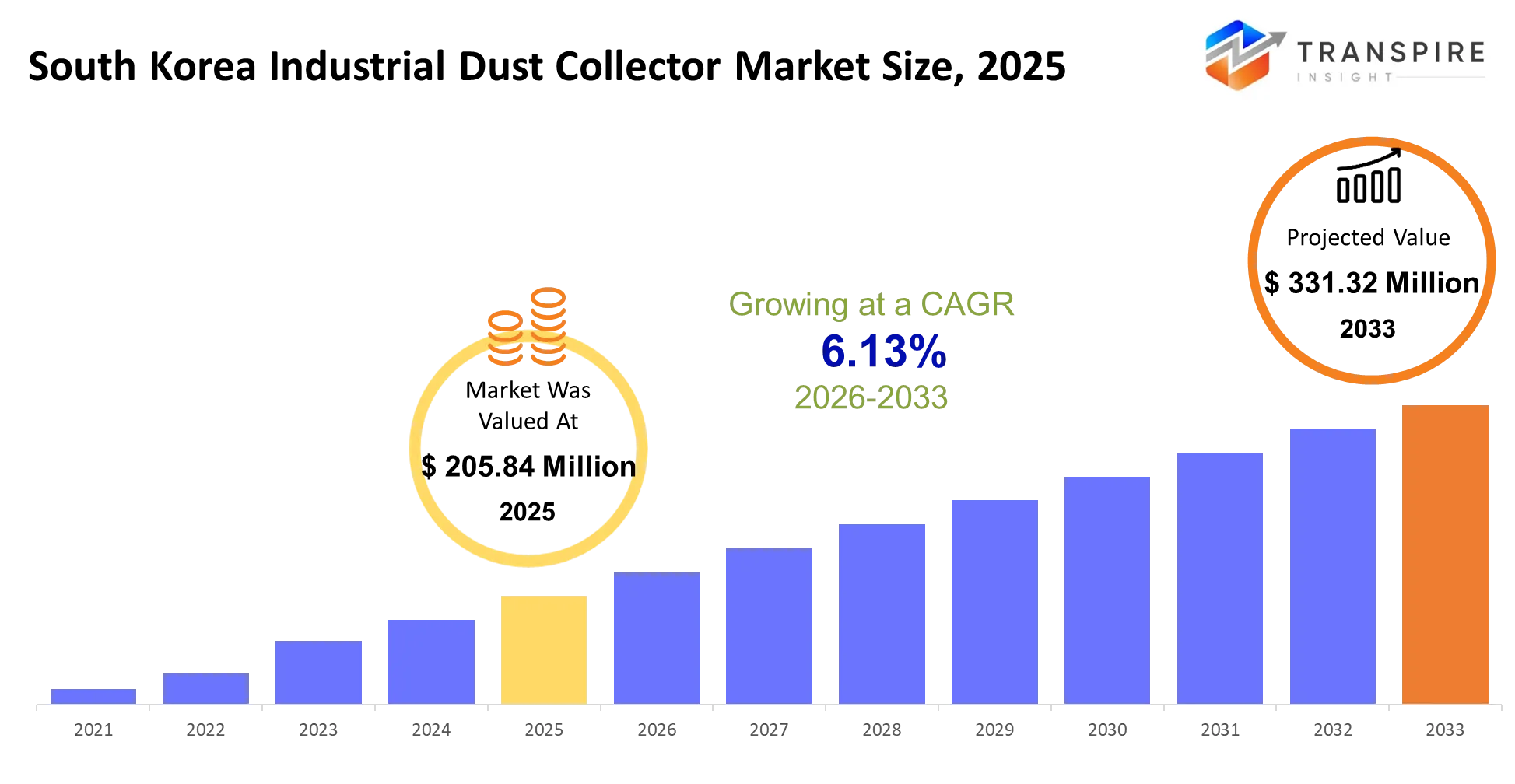
- South Korea Industrial Dust Collector Market Size 2025: USD 205.84 Million
- South Korea Industrial Dust Collector Market Size 2033: USD 331.32 Million
- South Korea Industrial Dust Collector Market CAGR: 6.13%
- South Korea Industrial Dust Collector Market Segments: By Collector Type (Baghouse Dust Collectors, Cartridge Dust Collectors, Cyclone Dust Collectors, Wet Scrubbers, Others); By Technology (Pulse Jet Systems, Electrostatic Precipitators, Vacuum Dust Collection, Others); By Application (Metal Processing, Cement Industry, Food Processing, Pharmaceuticals, Others); By End User (Manufacturing Industry, Construction Industry, Mining Industry, Chemical Industry, Others); By Installation Type (Portable Dust Collectors, Centralized Dust Collection Systems, Others)
To learn more about this report,  Download Free Sample Report
South Korea Industrial Dust Collector Market Summary
The South Korea Industrial Dust Collector Market was valued at USD 205.84 Million in 2025. It is forecast to reach USD 331.32 Million by 2033. That is a CAGR of 6.13% over the period.
In South Korea’s heavy industrial , and manufacturing hubs, dust collectors kinda play a critical role in grabbing airborne particulate matter that comes out during steel processing, shipbuilding, cement production, and precision electronics fabrication. These aren’t just some “auxiliary” things anymore, more like required backbone infrastructure, helping keep production steady and also staying inside strict workplace air quality norms . Over the last five years, the market has been leaning away from conventional bag-filter units toward high-efficiency , sensor-enabled filtration systems that can dynamically tune airflow and capture rates depending on real-time emissions loads.
One big structural change has been the smart monitoring systems being stitched into industrial air filtration networks, so facilities can watch particulate emissions continuously, instead of doing it with periodic inspections. This move got pushed faster by tighter enforcement of Korea’s particulate matter reduction policies and those post-pandemic industrial compliance audits , which basically made manufacturers modernize older ventilation setups. Because of all that, adoption is now more connected to regulatory risk management and operational uptime rather than just environmental compliance alone , and that’s driving continued capital investment across the industrial zones.
Key Market Insights
- South Korea Industrial Dust Collector Market is slowly, but clearly being pushed by smart filtration upgrades in a lot of heavy manufacturing plants, and also inside port-based industrial clusters, where particulate management is always kinda urgent.
- Demand for industrial dust collectors went up noticeably after 2023, mainly because the PM2.5 enforcement rules got stricter across industrial areas in South Korea, so operators had to act, more or less.
- In 2025, the South Korea Industrial Dust Collector Market reached about USD 205.84 Million, which shows a solid pull from industrial retrofit cycles, especially when older units need replacing.
- Fixed industrial baghouse systems held around 42% of the market share in 2025, mostly because steel and cement plants kept rolling out deployments, again and again.
- Cartridge-based systems are the fastest-growing part, and their adoption is widening in electronics and precision manufacturing environments, where filtration consistency matters a lot.
- By application, manufacturing took the lead with roughly 48% share in 2025, driven by heavy industrial particulate emissions, not just “small dust.”
- For electronics and semiconductor fabrication, this area looks like the fastest-growing application segment, stretching through 2033 in a pretty clear upward trend.
- On the end-user side, the industrial segment accounted for more than 55% share, backed by big production facilities and export-focused manufacturing activity.
- Nederman and Donaldson Company are also expanding their filtration lineups, leaning into AI-enabled monitoring and energy-efficient dust control systems, which is becoming a selling point.
- More and more smart dust collectors, with IoT sensors included, are turning into the kind of default retrofit choice in Korean industrial modernization programs, even when budgets are tight.
What are the Key Drivers, Restraints, and Opportunities in the South Korea Industrial Dust Collector Market?
The main engine behind the South Korea Industrial Dust Collector Market is the tightening enforcement of particulate matter rules across industrial corridors, especially around steel, shipbuilding, and cement production hubs. In a way, these rules have nudged compliance from periodic reporting into continuous emissions monitoring, so manufacturers end up having to put money into automated dust extraction systems. That helps reduce the chances of operational shutdowns, and it also makes audits feel way more “ready.” Because of that, the regulatory squeeze very directly turns into capital spending on stronger filtration setups, which then stretches replacement cycles a bit, and speeds up aftermarket demand for upgrades , plus maintenance services.
Still, there is a major brake on the side: the high upfront cost to integrate new solutions with older plant ventilation layouts. Lots of facilities run exhaust systems that are multi-decade old, meaning it’s not really a quick swap of a single part. Instead, it often needs full retrofitting, and that’s a structural limitation. So adoption slows, particularly for mid-sized manufacturers, and revenue conversion gets delayed even while regulatory pressure stays on. On top of that, installation downtime messes with production schedules, which makes modernization feel harder to execute quickly.
On the opportunity side, smart predictive filtration systems—connected with industrial IoT platforms—are starting to show up more frequently. In Ulsan and Incheon industrial zones, some sites are piloting sensor-driven airflow optimization, basically to cut energy use while still staying under compliance limits. That shifts the whole storyline: dust collectors are no longer only passive filtration machines, they become data-enabled efficiency tools. And once you see it that way, it opens room for bundled software hardware solutions, along with recurring service revenue models, instead of only one-time equipment sales.
What Has the Impact of Artificial Intelligence Been on the South Korea Industrial Dust Collector Market?
Artificial intelligence is getting more and more tied into industrial dust collection setups using automated airflow regulation , sensor fusion, and a centralized emissions monitoring dashboard kind of thing. In big manufacturing plants, AI-enabled controllers start tweaking suction pressure and filter cycling on the fly, based on how dense the particulates are, and it really cuts down on the amount of manual meddling. At the same time it helps keep operations more uniform across different shifts, which is kind of the main point. Operators are also able to dial in energy use while still staying within particulate emission thresholds, so the compliance part stays steady.
On top of that, machine learning models are being used to foresee filter clogging trends and maintenance needs. They dig through older records like airflow resistance and particulate load measurements, then estimate when a filter replacement will likely be required. That tends to reduce surprise shutdowns and can even extend the actual service life of the equipment. Some sites mention better uptime stability, plus smoother maintenance scheduling, especially in continuous-process industries, such as steel and cement production.
Still, the rollout is not completely smooth because good training data is limited, especially when you factor in real-world industrial variety. Dust composition can swing a lot from one facility to the next, and if sensors aren’t calibrated in a consistent way, prediction quality can drop. Also integration costs can be rough for mid-tier manufacturers, particularly when the old equipment doesn’t really play well with digital add-ons. Even with those obstacles, AI-enabled scrubber performance systems are slowly moving from trial runs to more standard industrial upgrades, mainly in advanced manufacturing hubs.
Key Market Trends
- After 2023 the retrofit demand kind of jumped, because factories had to upgrade older filtration setups to align with tougher air quality rules, and you know how that goes.
- In 2025 IoT-enabled dust collectors kept spreading fast, up by more than 18% adoption in big industrial sites across South Korea, mostly where particulate loads are heavy.
- Steel manufacturing plants now represent almost 30% of the installed dust collector capacity, mostly tied to the constant particulate emissions that don’t really stop.
- At the same time, semiconductor cleanroom growth boosted interest in ultra-fine filtration systems , somewhere around 14% during 2024–2025.
- Donaldson Company rolled out smart monitoring upgrades that reportedly lift filter efficiency by as much as 12% in pilot runs.
- Nederman also broadened energy-efficient extraction systems across several Asian industrial hubs, so their regional presence got stronger.
- Meanwhile Camfil’s high-efficiency filtration units started to catch on in electronics manufacturing, mainly because the particulate tolerance requirements are really low there.
- Even shipbuilding adoption moved upward steadily as emission control compliance got tighter, especially in coastal industrial areas.
- With predictive maintenance integration the pilot plants saw unplanned downtime drop by nearly 20% across the 2025 deployments, which is pretty significant.
- And government-backed air quality programs pushed inspection frequency higher, which in turn sped up compliance-driven spending from industry.
South Korea Industrial Dust Collector Market Segmentation
By Collector Type
Baghouse Dust Collectors kind of keep that dominant spot because they’re used a lot in steel cement and heavy manufacturing areas, where high particulate loads mean the filtration has to stay steady all the time. They’re also really durable, and they can deal with high temperature exhaust streams, so the deployments keep spreading across industrial zones. Then there’s the long service life too , which makes the whole thing look even stronger for their market position.
Cartridge Dust Collectors look like they’re getting adopted quicker in precision fields like electronics, pharmaceuticals and light manufacturing, mainly because they need space efficiency and really fine particulate capture, not just bulk stuff. Cyclone Dust Collectors still get consistent use as a pre filtration step for bulk material handling systems, particularly in mining and raw processing units. Wet Scrubbers get used in environments that are chemically aggressive, where you really need gas liquid contact to remove contaminants properly. There are also other options like hybrid systems that blend multiple filtration mechanisms, kind of mixing methods as needed.Across the forecast window, cartridge-based systems will likely grow the fastest, helped by compact factory layouts and a retrofit- driven push for modernization. At the same time, baghouse systems will stay as the backbone for heavy industry installations, even as upgrades happen.
By Technology
Pulse Jet Systems pretty much own the technology segment because they bring high cleaning efficiency, and they can run in a continuous way even in dust heavy places like cement or metal processing facilities. With that kinda constant throughput the leadership stays, it’s reinforced by strong adoption—especially where there’s a lot of grit. Also the maintenance downtime, is noticeably lower compared to mechanical shaking systems, and that makes operators prefer them more , rather than thinking twice.
Meanwhile Electrostatic Precipitators are still seeing steady adoption in power generation and also in large industrial exhaust setups, mainly when fine particulate removal efficiency has to stay consistent. Vacuum Dust Collection systems are also gaining traction for localized industrial cleaning and for workstation-level dust management, particularly in electronics and assembly line contexts. Other options are showing up too, like hybrid filtration setups, and smart sensor based control systems. Over the forecast period pulse jet systems will keep leading, mostly because scalability is easier, while electrostatic systems remain relevant in high volume emission control scenarios where ultra-fine particulate capture is non-negotiable.
By Application
Metal Processing kind of holds the dominant position because there are continuous emissions coming from cutting, welding and smelting activities across steel as well fabrication industries. The particulate intensity stays high and regulatory pressure remains strong, this sort of thing then makes the sustained installation of advanced filtration systems feel inevitable. Big industrial clusters help reinforce the long-term demand steadiness too, even when the market shifts a little.
Cement Industry is tied closely to dust collection systems since raw material grinding and kiln operations generate a lot of fine particulate matter, every day in high volume. Food Processing is expanding steadily, mostly because hygiene compliance keeps tightening and contamination prevention is treated like a must. Pharmaceuticals also need controlled environments with ultra low particulate thresholds, since that protects production integrity in practical terms. Others cover ceramics and chemical manufacturing.
Over the forecast period, cement and metal processing should still stay as the core demand drivers, while pharmaceuticals will show the fastest growth, driven by strict cleanroom compliance and more investments in precision manufacturing.
By End User
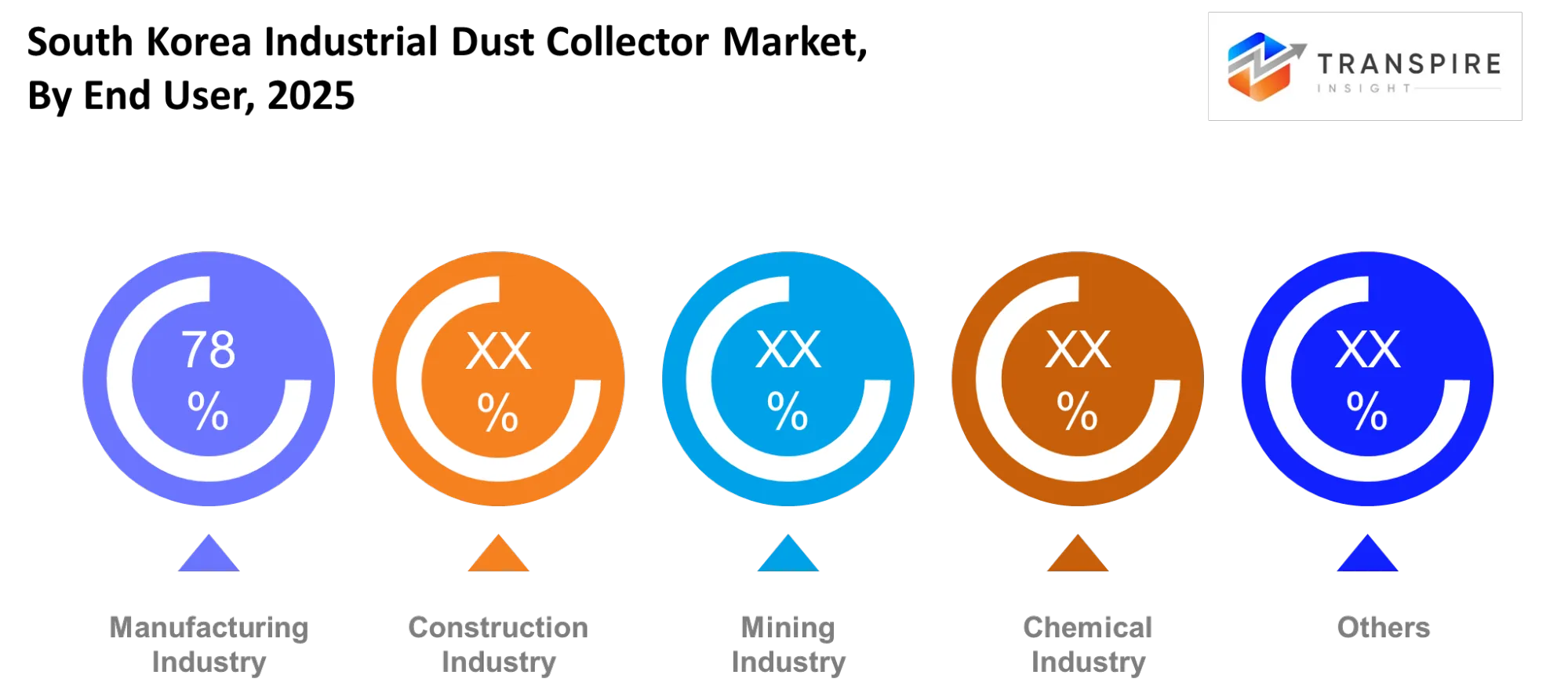
Manufacturing Industry kind of holds the leading share, mostly because it’s been rolled out very widely across steel, automotive, electronics and heavy equipment production facilities. There are continuous production cycles and also tighter emission compliance frameworks, so overall system integration across industrial plants stays strong. On top of that, large scale industrial modernization keeps pushing its dominance further, and it all feels pretty consistent.
Construction Industry shows a steady demand, it’s tied to on-site dust suppression and material handling activities, even when schedules get hectic. The Mining Industry in particular depends on dust collection systems for ore crushing, screening, and material transport operations, so the need doesn’t really disappear. Chemical Industry adoption is also rising because hazardous particulate control requirements keep showing up in processing environments. Other areas include logistics and infrastructure sectors, you can see it in day to day operations too.
Over the forecast period, manufacturing will remain the primary demand center, while chemical and mining sectors will expand faster, mainly due to stricter environmental regulations and also operational safety upgrades.
To learn more about this report, Download Free Sample Report
By Installation Type
Portable dust collectors keep getting adopted in kinda flexible industrial environments, and they work well during maintenance operations or at temporary construction sites where mobility is really needed , plus quick deployment too. Being easy to move around helps them get used across multi-site operations , including smaller industrial units. Their compact design also makes adoption easier in cramped areas, where there isn’t much room.
Meanwhile, centralized dust collection systems tend to dominate big industrial facilities, because they can handle high-volume particulate extraction across several production lines. They also integrate well with the factory wide ventilation infrastructure, which supports long term deployment in heavy industries. You’ll also see hybrid distributed systems, basically a mix of localized extraction and centralized extraction models. Over the forecast period, centralized systems should stay in the lead for large-scale manufacturing plants, while portable systems will keep growing in modular factories and in construction driven use cases that demand operational flexibility.
What are the Key Use Cases Driving the South Korea Industrial Dust Collector Market?
The main thing here is particulate capture in really heavy manufacturing settings like steel, cement, and metal fabrication plants, where dust keeps showing up, and honestly it can mess with production efficiency and also clash with emission standards. In practice, these systems keep things running without interruption while still staying within regulatory rules, even across high-output industrial lines that never seem to pause.
On the broader side, the same approach is now getting pulled into electronics manufacturing and automotive component production. In those places, controlling fine particulates is basically a must, especially for precision assembly lines and to cut down on defects. And then there’s shipbuilding yards too, kind of a secondary but growing use, mainly in coastal industrial zones where environmental oversight is stricter, and everyone is watching more closely.
Now for the newer stuff, smart factory integration is starting to show up more, where dust collectors get tied into centralized industrial IoT platforms, so energy consumption can be optimized, plus predictive maintenance scheduling becomes more proactive. Another newer angle is semiconductor clean-adjacent production environments, where the threshold for ultra-low particulate is extremely tight, like for next-generation chip fabrication where small deviations can matter.
|
Report Metrics |
Details |
|
Market size value in 2025 |
USD 205.84 Million |
|
Market size value in 2026 |
USD 218.46 Million |
|
Revenue forecast in 2033 |
USD 331.32 Million |
|
Growth rate |
CAGR of6.13% from 2026 to 2033 |
|
Base year |
2025 |
|
Historical data |
2021 - 2024 |
|
Forecast period |
2026 - 2033 |
|
Report coverage |
Revenue forecast, competitive landscape, growth factors, and trends |
|
Regional scope |
South Korea; |
|
Key company profiled |
Donaldson Company, Nederman, Camfil, Parker Hannifin, Daikin Industries, Mitsubishi Heavy Industries, Honeywell, FLSmidth, Thermax, Sly Inc., Babcock & Wilcox, AAF International, CECO Environmental, Dust Control Technology, Schenck Process |
|
Customization scope |
Free report customization (country, regional & segment scope). Avail customized purchase options to meet your exact research needs. |
|
Report Segmentation |
By Collector Type (Baghouse Dust Collectors, Cartridge Dust Collectors, Cyclone Dust Collectors, Wet Scrubbers, Others); By Technology (Pulse Jet Systems, Electrostatic Precipitators, Vacuum Dust Collection, Others); By Application (Metal Processing, Cement Industry, Food Processing, Pharmaceuticals, Others); By End User (Manufacturing Industry, Construction Industry, Mining Industry, Chemical Industry, Others); By Installation Type (Portable Dust Collectors, Centralized Dust Collection Systems, Others) |
Which Regions are Driving the South Korea Industrial Dust Collector Market Growth?
The leading part is basically the Seoul–Incheon industrial belt, sort of powered by dense manufacturing clusters and also by pretty strict enforcement of air quality rules. This area kinda gets a lot from upgraded port infrastructure and a heavy concentration of production facilities that are export-oriented. Ongoing government monitoring programs keep pushing frequent system upgrades across the industrial sites. So, in practice it keeps being the most mature and also the most compliance-sensitive market for deploying dust collectors.
Then you have the southeastern industrial corridor, with Ulsan and Busan in it, which acts like a steady second-tier region. There you’ll see strong petrochemical, shipbuilding and automotive manufacturing foundations. Unlike Seoul, it is less shaped by regulatory intensity, and more by long-term capital investment cycles led by big conglomerates. Industrial operators there tend to favor durability and lifecycle efficiency instead of constantly switching to the newest technology. That ends up generating demand that is consistent, but a bit steadier for industrial dust collection systems.
The fastest-growing area is the central industrial expansion zone, where new manufacturing parks and logistics-linked clusters are showing up. Recent infrastructure investments plus a kind of decentralization of production facilities has sped up new plant construction. Because of that, the demand is leaning toward greenfield dust collection systems rather than retrofit approaches. During the 2026–2033 stretch, this region is expected to pull serious interest from equipment suppliers who are targeting early-stage industrial installations.
Who are the Key Players in the South Korea Industrial Dust Collector Market and How Do They Compete?
In the South Korea Industrial Dust Collector Market, competition is kind of moderately consolidated, with global filtration specialists plus diversified industrial engineering players going head to head. They usually compete on tech efficiency, compliance performance, and lifecycle service know-how, even if it’s not always stated the same way. Instead of price alone, the differentiation has been drifting toward energy efficiency, digital monitoring integration, and the longer-term maintenance arrangement side. The bigger established names tend to defend their ground by doing continuous product upgrades, plus expanding regional service reach, and sometimes it feels like they do it in parallel.
Donaldson Company leans into advanced cartridge and bag filtration systems, and it pairs that with sensor-based monitoring tools that help industrial customers lower the risk of unplanned downtime. The key edge is basically the high-efficiency media technology, it’s designed for harsh particulate conditions, where dust just doesn’t behave. Nederman, for its part, stresses energy-efficient dust extraction solutions, and it has expanded fairly aggressively into Asian manufacturing hubs. This is supported by localized service networks, and also through industrial partnerships that help them get closer faster.Camfil differentiates through ultra-low particulate filtration systems, kind of tuned for semiconductor plus precision electronics environments. That focus helps keep its position in higher-spec applications, where tolerance matters more than people think.
Parker Hannifin leverages its broader industrial integration abilities. It offers filtration solutions that can be embedded into larger manufacturing automation systems, so the collector isn’t just a standalone unit, more like part of a workflow. Thermax tends to focus on cost-efficient industrial air pollution control systems for heavy industry. It’s also expanding via turnkey project delivery across Asian manufacturing zones, and they typically market it as a full-scope approach from installation through ongoing performance.
Company List
- Donaldson Company
- Nederman
- Camfil
- Parker Hannifin
- Daikin Industries
- Mitsubishi Heavy Industries
- Honeywell
- FLSmidth
- Thermax
- Sly Inc.
- Babcock & Wilcox
- AAF International
- CECO Environmental
- Dust Control Technology
- Schenck Process
Recent Development News
In March 2025, Camfil entered a strategic partnership with Nordfab Ducting to co-develop integrated dry-type dust collection systems combining filtration and modular ducting design. The collaboration reduces installation complexity and improves system lifecycle efficiency for industrial users.https://www.wiseguyreports.com
What Strategic Insights Define the Future of the South Korea Industrial Dust Collector Market?
South Korea’s Industrial Dust Collector Market seems to be drifting, kind of quietly , toward intelligent and compliance integrated air management setups, not so much toward standalone filtration gear. The upward movement should come from the overlap of tighter environmental rule enforcement plus industrial automation rolling through major manufacturing districts. Still there is this quieter risk that people do not always see, it’s tech fragmentation where each plant follows slightly different digital standards, so the smart filtration systems do not really talk to each other well, and that can slow the whole big scale data unification process.
One noticeable opening shows up in emissions intelligence platforms that are truly stitched together, with the dust collection hardware paired with predictive analytics screens, meant for enterprise level compliance control. Industrial zones pushing smart factory upgrades are probably going to adopt these bundled solutions earlier than others. For anyone in the market, the most practical path feels like moving away from only selling units, and instead leaning into service arrangements , like monitoring plus upkeep and performance fine tuning agreements. That shift should be pretty important if the goal is to win longer term recurring income in a market that is driven by compliance expectations.
South Korea Industrial Dust Collector Market Report Segmentation
By Collector Type
- Baghouse Dust Collectors
- Cartridge Dust Collectors
- Cyclone Dust Collectors
- Wet Scrubbers
- Others
By Technology
- Pulse Jet Systems
- Electrostatic Precipitators
- Vacuum Dust Collection
- Others
By Application
- Metal Processing
- Cement Industry
- Food Processing
- Pharmaceuticals
- Others
By End User
- Manufacturing Industry
- Construction Industry
- Mining Industry
- Chemical Industry
- Others
By Installation Type
- Portable Dust Collectors
- Centralized Dust Collection Systems
- Others
Frequently Asked Questions
Find quick answers to common questions.
The estimated South Korea Industrial Dust Collector Market size for the market will be USD 331.32 Million in 2033.
Key segments for the South Korea Industrial Dust Collector Market are By Collector Type (Baghouse Dust Collectors, Cartridge Dust Collectors, Cyclone Dust Collectors, Wet Scrubbers, Others); By Technology (Pulse Jet Systems, Electrostatic Precipitators, Vacuum Dust Collection, Others); By Application (Metal Processing, Cement Industry, Food Processing, Pharmaceuticals, Others); By End User (Manufacturing Industry, Construction Industry, Mining Industry, Chemical Industry, Others); By Installation Type (Portable Dust Collectors, Centralized Dust Collection Systems, Others).
Major South Korea Industrial Dust Collector Market players are Donaldson Company, Nederman, Camfil, Parker Hannifin, Daikin Industries, Mitsubishi Heavy Industries, Honeywell, FLSmidth, Thermax, Sly Inc., Babcock & Wilcox, AAF International, CECO Environmental, Dust Control Technology, Schenck Process.
The South Korea Industrial Dust Collector Market size is USD 205.84 Million in 2025.
The South Korea Industrial Dust Collector Market CAGR is 6.13% from 2026 to 2033.
- Donaldson Company
- Nederman
- Camfil
- Parker Hannifin
- Daikin Industries
- Mitsubishi Heavy Industries
- Honeywell
- FLSmidth
- Thermax
- Sly Inc.
- Babcock & Wilcox
- AAF International
- CECO Environmental
- Dust Control Technology
- Schenck Process
Recently Published Reports
-
Apr 2026
Handling and Lifting Equipment Market
Handling and Lifting Equipment Market Size, Share & Analysis Report By Product (Cranes and Hoists, Forklifts, Conveyor Systems, Aerial Work Platforms, Others), By Application (E-Commerce, Automotive and Railway, Food and Beverages, Aviation, Others), and Geography (North America, Europe, Asia-Pacific, Middle East and Africa, South and Central America), 2021 - 2031
-
Apr 2026
HVAC Equipment Market
HVAC Equipment Market Size, Share & Analysis Report By Heating Equipment Type (Boilers and Furnaces, Heat Pumps, and Unitary Heaters), By Ventilation Equipment (Air Handling Units, Humidifiers and Dehumidifiers, Air Filters, and Fan Coiling Units), By Air Conditioning Equipment (Unitary Air Conditioners, Room Air Conditioners, Packaged Terminal Air Conditioners, and Chillers), By End User (Commercial, Residential, Industrial, and others), and Geography (North America, Europe, Asia-Pacific, Middle East and Africa, South and Central America), 2021 – 2031
-
Apr 2026
Refrigeration Valves Market
Refrigeration Valves Market Size, Share & Analysis Report By Type (Solenoid Valves, Expansion Valves, Check Valves, Service Valves, Others), By Application (Commercial Refrigeration, Industrial Refrigeration, Transport Refrigeration, Residential Refrigeration, Air Conditioning Systems), By End User (Food and Beverage Industry, Pharmaceutical Industry, HVAC Industry, Chemical Industry, Others), and Geography (North America, Europe, Asia-Pacific, Middle East and Africa, South and Central America), 2021 – 2031
-
Apr 2026
E-Commerce Packaging Materials Market
E-Commerce Packaging Materials Market By Material Type (Corrugated Boxes, Paper & Paperboard, Foam & Cushioning Materials, Plastic Packaging, Flexible Packaging, Protective Packaging, Others), By Product(Primary Packaging, Secondary Packaging, Tertiary Packaging), By Packaging Function (Protective Packaging, Branding & Presentation Packaging, Transit & Logistic Packaging, Sustainable Packaging, Tamper Evidence Packaging), By End-User (Retail & Consumer Goods, Electronic Appliances, Food & Beverages, Healthcare & Pharmaceutical, Fashion & Apparel, Home & Furnishing, Others); By Industry Analysis, Size, Share, Growth, Trends, and Forecasts 2021-2033