
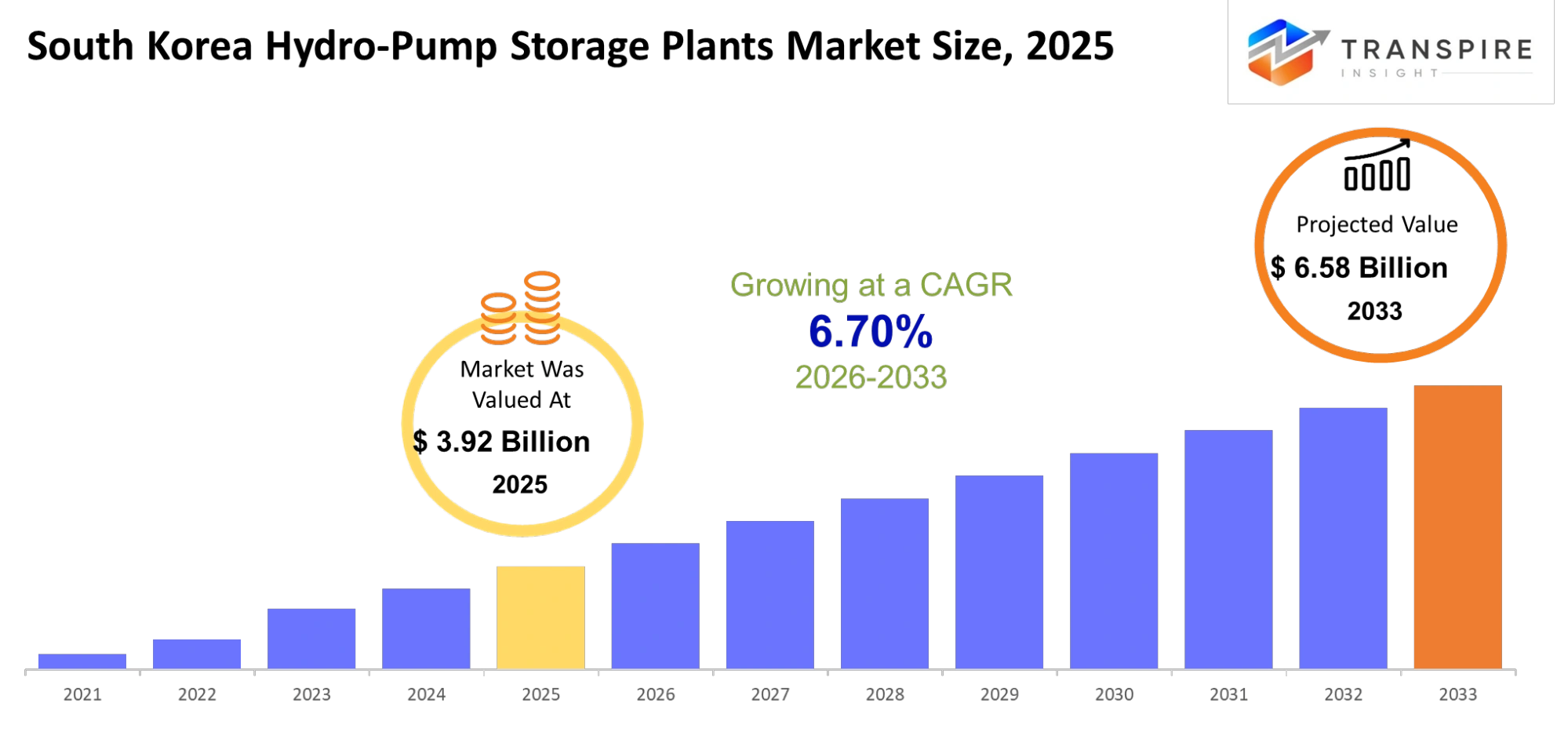
South Korea Hydro-Pump Storage Plants Market Size & Forecast:
- South Korea Hydro-Pump Storage Plants Market Size 2025: USD 3.92 Billion
- South Korea Hydro-Pump Storage Plants Market Size 2033: USD 6.58 Billion
- South Korea Hydro-Pump Storage Plants Market CAGR: 6.70%
- South Korea Hydro-Pump Storage Plants Market Segments: By Type (Closed-loop Systems, Open-loop Systems, Variable Speed Systems, Fixed Speed Systems, Hybrid Systems, Others); By Application (Energy Storage, Grid Stability, Renewable Integration, Peak Load Management, Backup Power, Others); By End-User (Utilities, Govt, Energy Companies, Industrial, Power Producers, Others); By Capacity (Small, Medium, Large, Mega, Custom, Others)
To learn more about this report,  Download Free Sample Report
South Korea Hydro-Pump Storage Plants Market Summary:
The South Korea Hydro-Pump Storage Plants Market size is estimated at USD 3.92 Billion in 2025 and is anticipated to reach USD 6.58 Billion by 2033, growing at a CAGR of 6.70% from 2026 to 2033.
The South Korean hydro-pump storage plants market operates as part of the energy storage and power infrastructure sector which establishes electricity distribution methods to handle changing power usage patterns. The market will demonstrate changing power delivery requirements because renewable energy systems will become more widely used. Utilities and grid operators need large-scale storage systems to handle excess power production while they need to maintain electricity supply during times of high demand.
The demand for constant power supply combined with the need for environmentally friendly energy solutions drives power companies to adopt flexible energy storage systems which increases the importance of pumped storage in their future energy strategies.
What Has the Impact of Artificial Intelligence Been on the South Korea Hydro-Pump Storage Plants Market?
Artificial intelligence is becoming essential for transforming operational efficiency and decision-making processes in South Korea's hydro pump storage facilities market. The South Korean hydro pump storage facilities market uses artificial intelligence to conduct advanced market research and energy demand analysis by processing extensive datasets which include weather data and grid operational information.
Artificial intelligence enables South Korean hydro pump storage facilities to achieve better production efficiency through operational automation beyond its analytical capabilities. The team implemented machine learning algorithms to monitor equipment performance which enabled them to identify faults in advance and plan predictive maintenance schedules that minimized equipment downtime and reduced operational expenses.
South Korean hydro pump storage facilities market strategies gain from artificial intelligence integration because it generates fresh paths for both innovation and competitive marketplace domination. Artificial intelligence implementation enables companies operating in the South Korean hydro pump storage facilities market to enhance system reliability and decrease operational expenses while boosting their capacity to maintain business expansion.
Key Market Trends & Insights:
- The Gyeonggi and Gangwon regions maintain their dominant position in the market because they control more than 35% of the market share that will exist in 2025 which results from their advantageous geographical features and their sufficient transportation systems.
- The southern regions of the country experience the most rapid development because they will grow at an annual rate of 6% until 2030 while industrial requirements and energy initiatives drive their progress.
- The market for closed-loop systems will reach its peak in 2025 when these systems will control almost 40% of the market because they provide companies with operational autonomy and improved efficiency benefits.
- The second-largest market share belongs to open-loop systems because they provide lower upfront expenses and permit users to access existing water resources.
- The energy storage market holds the leading position because it accounts for more than 45% of the market share which renewable energy capacity growth and demand equilibrium requirements support.
- The field of renewable energy integration develops at the fastest rate because solar and wind power installations increase.
- Utilities maintain their leading position in the market because they control over 50% of the market share which results from their investment in extensive grid management systems and infrastructure development projects.
- The industrial sector functions as the most rapidly expanding market segment because businesses seek to reduce operational expenses while obtaining dependable electricity supply.
- The company establishes its market presence through strategic partnerships while accelerating project development through its regional expansion initiatives.
- Organizations that invest in advanced technologies acquire market advantages which help them reach higher market portions.
South Korea Hydro-Pump Storage Plants Market Segmentation
By Type:
The South Korean Hydro-Pump Storage Plants Market includes six essential operational systems through its closed-loop systems, open-loop systems, variable speed systems, fixed speed systems, hybrid systems and other systems which fulfill different operational requirements.
The closed-loop systems enable independent water circulation while the open-loop systems operate based on natural water sources. The variable speed systems provide flexible operation capabilities while the fixed speed systems deliver constant operational performance. The hybrid systems will combine various advantages to achieve better operational results.
By Application:
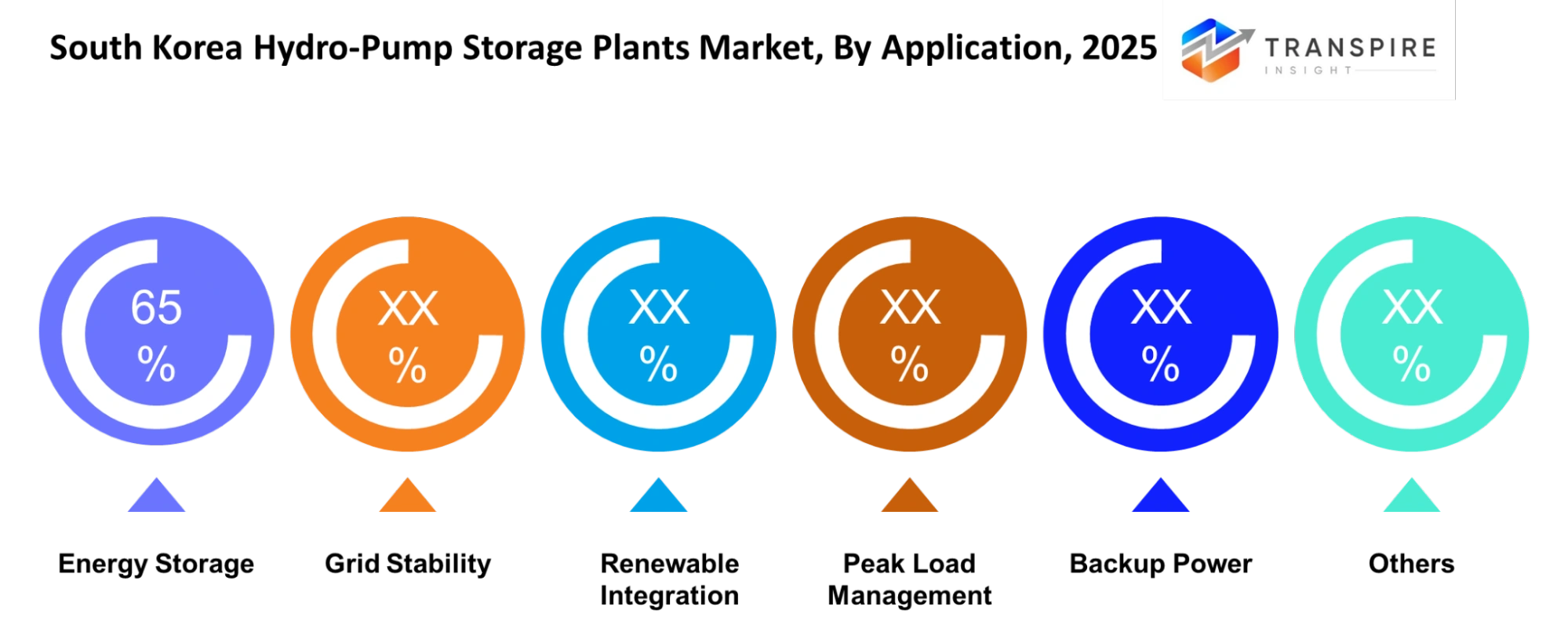
The South Korean Hydro-Pump Storage Plants Market uses six main application areas which include energy storage and grid stability and renewable integration and peak load management and backup power to create market demand. The energy storage system allows for the distribution of additional electricity while the grid stability system maintains uninterrupted power delivery. The renewable integration system enables operators to control solar and wind energy output while the peak load management system helps reduce the load on electrical distribution networks. The backup power system provides system dependability throughout power disruptions.
To learn more about this report, Download Free Sample Report
By End-User:
The South Korea Hydro-Pump Storage Plants Market has utilities government bodies energy companies industrial sectors and power producers as its main end-user segments that determine demand patterns. The utilities sector will implement extensive system deployment while government support will create a framework for policy development. Energy companies and power producers will focus on efficiency while industrial sectors use systems to manage costs and maintain continuous operational functions.
By Capacity:
The South Korea Hydro-Pump Storage Plants Market uses capacity-based segmentation which defines small medium large mega custom and other categories to match project scale and investment capacity. The system will provide small and medium capacity systems for specific localized requirements while large and mega facilities will meet national grid demands. The operational needs and site conditions will be solved through custom solutions.
What are the Main Challenges for the South Korea Hydro-Pump Storage Plants Market Growth?
South Korean hydro-pump storage plants market growth faces major obstacles through operational and technical problems which arise from particular site requirements and their demanding engineering standards. The development of pumped storage systems requires appropriate geographic conditions and sufficient water resources and extensive infrastructure, which creates limitations on their capacity to expand. The system experiences operational difficulties because its construction process takes a long time and needs constant monitoring, which creates ongoing obstacles for the growth of the South Korean hydro-pump storage plants market.
The manufacturing and commercialization process faces obstacles that prevent South Korea from developing hydro-pump storage plants because the market experiences increasing capital costs and requires extensive regulatory approval. The project execution process experiences delays because it requires large initial investments and environmental assessments and land acquisition activities. The need for funding together with cost overruns results in project financing risks that prevent new projects from being announced, which causes major obstacles to growth and decreases market development speed.
The existing infrastructure limitations together with the shortage of skilled workers who can design and operate projects create ongoing obstacles for project adoption. The complexity of grid integration together with the requirements for developing advanced transmission networks creates obstacles that slow down adoption.
The market faces additional pressure because customers have alternatives to battery energy storage systems, which are their main storage solution. The South Korean hydro-pump storage plants market must develop new solutions and reduce costs as battery technology continues to advance and prices keep falling, creating competitive business challenges.
Regional Insights
The South Korean hydro-pump storage plants market shows active development in areas where energy demand remains strong and renewable energy expansion requires grid stability. Gyeonggi and Gangwon regions experience increased project planning and site development activities because of their suitable terrain and water resources. The local authorities will provide their assistance to infrastructure systems which need upgrades and the permitting procedures which need approvals.
The South Korean hydro-pump storage plants market shows Southern regions which include South Jeolla and South Gyeongsang as suitable locations for large-scale storage systems because these areas provide easy access to industrial facilities and their existing electricity infrastructure. The upcoming manufacturing sector will create electricity requirements which make projects financially attractive and secure their investment prospects for extended periods. Regional Insights: The industrial growth of the area will create a constant requirement for additional storage facilities.
The South Korean hydro-pump storage plants market shows Eastern coastal areas which connect with renewable energy systems that include wind power projects as their main advantage. The region has geographic features which support quick development of water reservoirs and construction of grid systems. The growing partnership between regional governments and private developers will result in better project delivery times and enhanced system performance. Regional Insights: The development of coastal areas will enhance the capacity of the region to integrate renewable energy sources and utilize storage facilities.
Recent Development News
In April 2026, ANDRITZ reported earnings growth. The company recorded a surge in hydropower and pumped storage orders contributing to a record €3.6 billion order intake in Q1 2026, reflecting strong global and South Korea-linked project demand. https://www.waterpowermagazine.com
|
Report Metrics |
Details |
|
Market size value in 2025 |
USD 3.92 Billion |
|
Market size value in 2026 |
USD 4.18 Billion |
|
Revenue forecast in 2033 |
USD 6.58 Billion |
|
Growth rate |
CAGR of 6.70% from 2026 to 2033 |
|
Base year |
2025 |
|
Historical data |
2021 - 2024 |
|
Forecast period |
2026 - 2033 |
|
Report coverage |
Revenue forecast, competitive landscape, growth factors, and trends |
|
Regional scope |
South Korea |
|
Key company profiled |
GE, Siemens Energy, Voith Hydro, Andritz Hydro, Mitsubishi Electric, Toshiba, Hitachi, ABB, Alstom, Korea Hydro & Nuclear Power, Doosan Heavy Industries, Hyundai Engineering, KEPCO, Sumitomo Electric, SNC-Lavalin |
|
Customization scope |
Free report customization (country, regional & segment scope). Avail customized purchase options to meet your exact research needs. |
|
Report Segmentation |
By Type (Closed-loop Systems, Open-loop Systems, Variable Speed Systems, Fixed Speed Systems, Hybrid Systems, Others); By Application (Energy Storage, Grid Stability, Renewable Integration, Peak Load Management, Backup Power, Others); By End-User (Utilities, Govt, Energy Companies, Industrial, Power Producers, Others); By Capacity (Small, Medium, Large, Mega, Custom, Others) |
How Can New Companies Establish a Strong Foothold in the South Korea Hydro-Pump Storage Plants Market?
Existing companies in the south korea hydro-pump storage plants market need to identify specific market segments which their established competitors cannot serve. The development of mid-scale storage systems will enable smart cities and industrial clusters to enter the market faster because these systems help meet local grid balancing needs. The new enterprises need to address peak load management and renewable intermittency challenges because these solutions will help them develop products that meet current market demands.
Innovation strategies will determine how companies compete in the south korea hydro-pump storage plants market. Startups like Korea-based “HydroFlex Energy” (illustrative) are exploring modular pumped storage designs that reduce construction timelines and costs. BlueReservoir Tech develops AI-based forecasting systems which optimize energy dispatch performance. The technology differentiation approach enables new companies to achieve competitive advantages in a market that requires substantial investment.
The south korea hydro-pump storage plants market requires strategic partnerships which companies need to establish their operational expansion. The new companies need to establish partnerships with utility providers and construction firms and technology vendors to obtain the required infrastructure and funding and technical knowledge. The establishment of joint ventures with manufacturing facilities and urban development projects will enable companies to develop consistent demand streams which will help them enter new markets.
To achieve sustainable growth, companies must combine their data analysis methods with their long-term facility development strategies. The implementation of digital monitoring together with predictive maintenance and hybrid storage systems will enhance performance while establishing trust with customers who demand reliable and efficient solutions.
Key South Korea Hydro-Pump Storage Plants Market Company Insights
The current market for Hydro-Pump Storage Plants in South Korea expands through grid stability which serves as the main requirement for growth. The increasing capacity of solar and wind energy sources creates supply interruptions which require storage solutions that can manage energy demand during peak times and non-peak times. The system uses pumped storage to transfer energy and control frequency which results in better system reliability. The major utility companies use competitive analysis to direct their capacity expansion and efficiency improvement efforts.
The manufacturing and automotive industries adopt industrial energy optimization technologies to enhance their operational efficiency. The need to reduce electricity costs drives facilities to implement storage solutions which help them decrease peak power expenses and maintain electrical reliability during their operational periods. The two major advantages of cost containment and operational stability drive organizations to make investment choices. Industrial partnerships enable companies to build stronger pipelines through their project development activities.
The Hydro-Pump Storage Plants market in South Korea experiences consistent growth because of both governmental backing and continuous energy security protection measures. The government supports low-carbon system development through its infrastructure initiatives which also promote nuclear power and thermal energy system integration. The system will use digital monitoring and forecasting systems to enhance both its operational performance and its capacity to scale up. The competitive environment exists because technology companies make investments in intelligent solutions which will help them succeed in upcoming projects.
Company List
- GE
- Siemens Energy
- Voith Hydro
- Andritz Hydro
- Mitsubishi Electric
- Toshiba
- Hitachi
- ABB
- Alstom
- Korea Hydro & Nuclear Power
- Doosan Heavy Industries
- Hyundai Engineering
- KEPCO
- Sumitomo Electric
- SNC-Lavalin
What are the Key Use-Cases Driving the Growth of the South Korea Hydro-Pump Storage Plants Market?
The primary factor which drives the south korea hydro-pump storage plants market stems from its essential function which maintains stability for the national power grid during periods when renewable energy sources become more integrated into the system. The utilities use pumped storage systems to handle excess energy which needs to be stored during periods of low demand and then used during peak demand times as solar and wind generation sources experience rapid growth. The application of hydro-pump storage systems directly solves this use-case problem because it provides essential support for maintaining grid reliability and frequency regulation operations which are needed to manage South Korea's changing energy supply system.
The south korea hydro-pump storage plants market experiences another growth driver through its usage as an industrial power solution. Manufacturing and automotive production industries use these systems to maintain continuous operation while they reduce electricity expenses through load shifting.
The south korea hydro-pump storage plants market is experiencing positive growth because of government-backed decarbonization efforts and energy security development programs. Infrastructure development projects enable both utilities and independent power producers to implement advanced storage technologies which work in conjunction with nuclear and thermal power generation systems. The system integration process enables organizations to achieve their long-term sustainability objectives while decreasing their dependency on imported energy resources.
The south korea hydro-pump storage plants market will grow through digital monitoring innovation and AI energy forecasting development and hybrid storage model implementation. The new technologies enable smarter grid integration which improves asset performance and generates new revenue opportunities for the market to achieve continuous business development.
South Korea Hydro-Pump Storage Plants Market Report Segmentation
By Type
- Closed-loop Systems
- Open-loop Systems
- Variable Speed Systems
- Fixed Speed Systems
- Hybrid Systems
- Others
By Application
- Energy Storage
- Grid Stability
- Renewable Integration
- Peak Load Management
- Backup Power
- Others
By End-User
- Utilities
- Govt
- Energy Companies
- Industrial
- Power Producers
- Others
By Capacity
- Small
- Medium
- Large, Mega
- Custom
- Others
Frequently Asked Questions
Find quick answers to common questions.
The approximate South Korea Hydro-Pump Storage Plants Market size for the market will be USD 6.58 Billion in 2033.
Key segments for the South Korea Hydro-Pump Storage Plants Market are By Type (Closed-loop Systems, Open-loop Systems, Variable Speed Systems, Fixed Speed Systems, Hybrid Systems, Others); By Application (Energy Storage, Grid Stability, Renewable Integration, Peak Load Management, Backup Power, Others); By End-User (Utilities, Govt, Energy Companies, Industrial, Power Producers, Others); By Capacity (Small, Medium, Large, Mega, Custom, Others).
Major South Korea Hydro-Pump Storage Plants Market players are GE, Siemens Energy, Voith Hydro, Andritz Hydro, Mitsubishi Electric, Toshiba, Hitachi, ABB, Alstom, Korea Hydro & Nuclear Power, Doosan Heavy Industries, Hyundai Engineering, KEPCO, Sumitomo Electric, SNC-Lavalin.
The South Korea Hydro-Pump Storage Plants Market size is USD 3.92 Billion in 2025.
The South Korea Hydro-Pump Storage Plants Market CAGR is 6.70%.
- GE
- Siemens Energy
- Voith Hydro
- Andritz Hydro
- Mitsubishi Electric
- Toshiba
- Hitachi
- ABB
- Alstom
- Korea Hydro & Nuclear Power
- Doosan Heavy Industries
- Hyundai Engineering
- KEPCO
- Sumitomo Electric
- SNC-Lavalin
Recently Published Reports
-
Dec 2024
Active Power Filter Market
Active Power Filter Market Size, Share & Analysis Report By Type (Shunt Active Power Filters, Series Active Power Filter, Hybrid Active Power Filter), By Application (Harmonics Mitigation, Reactive Power Compensation, Voltage Regulation, Power Factor Correction), By Phase (Single Phase, Three Phase), By End-User Industry (Manufacturing, Healthcare, Commercial, Automotive, Oil and Gas, Others), and Geography (North America, Europe, Asia-Pacific, Middle East and Africa, South and Central America), 2021 - 2031
-
Jan 2025
Electrical Transformer Market
Electrical Transformer Market Size, Share & Analysis Report By Core (Closed, Shell, and Berry), By Insulation (Gas, Oil, Solid, Air, and Other), By Phase (Single, and Three), By Rating (100 MVA to 500 MVA, 501 MVA to 800 MVA, and 801 MVA to 1200 MVA), and Geography (North America, Europe, Asia-Pacific, Middle East and Africa, South and Central America), 2021 – 2031
-
Jan 2025
Hydraulic Piston Pumps Market
Hydraulic Piston Pumps Market Size, Share & Analysis Report By Type (Axial Piston Pumps, Radial Piston Pumps), By Operating Pressure (Low Pressure, Medium Pressure, High Pressure), By Application (Construction, Mining, Agriculture, Automotive, Oil & Gas, Industrial Machinery, Others), By End-User (OEMs, Aftermarket), and Geography (North America, Europe, Asia-Pacific, Middle East and Africa, South and Central America), 2021 – 2031
-
Jan 2025
Laboratory Gas Generators Market
Laboratory Gas Generators Market Size, Share & Analysis Report By Product (Nitrogen Gas Generator, Hydrogen Gas Generator, Zero Air Gas Generator, Purge Gas Generator, TOC Gas Generators, Others), By Application (Gas Chromatography, Liquid Chromatography-mass Spectrometry (LC-MS), Gas Analyzers, Others), By End-user (Life Science, Chemical & Petrochemical, Food & Beverage, Others), and Geography (North America, Europe, Asia-Pacific, Middle East and Africa, South and Central America), 2021 – 2031