
South Korea Human Organoids Market Size & Forecast:
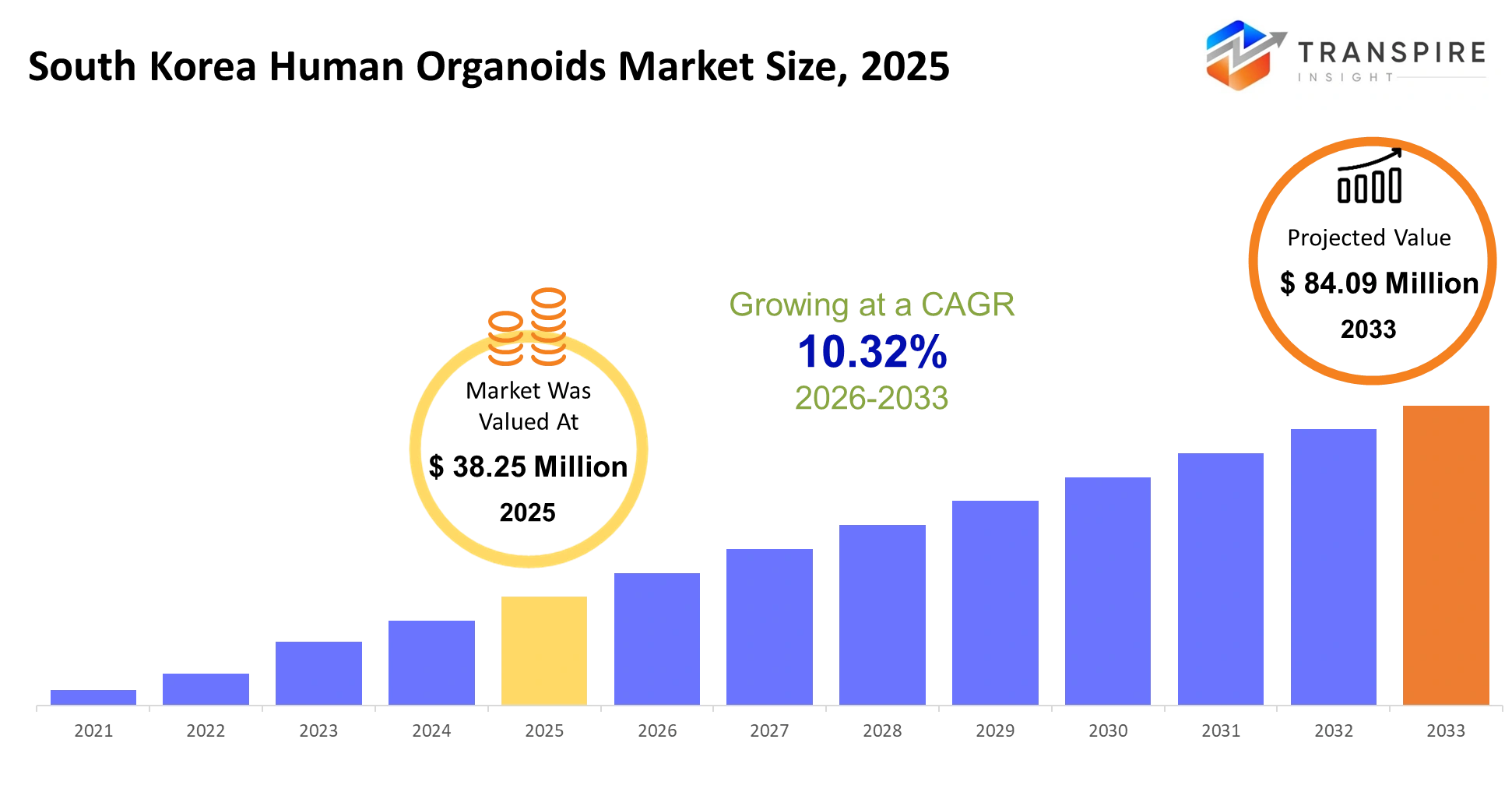
- South Korea Human Organoids Market Size 2025: USD 38.25 Million
- South Korea Human Organoids Market Size 2033: USD 84.09 Million
- South Korea Human Organoids Market CAGR: 10.32%
- South Korea Human Organoids Market Segments: By Type (Liver Organoids, Brain Organoids, Intestinal Organoids, Others), By Application (Drug Discovery, Personalized Medicine, Disease Modeling), By End-User (Pharmaceutical Companies, Research Institutes)
To learn more about this report,  Download Free Sample Report
South Korea Human Organoids Market Summary:
South Korea Human Organoids Market size was estimated at USD 38.25 Millionin 2025 and is anticipated to reach USD 84.09 Million by 2033, growing at a CAGR of 10.32% from 2026 to 2033.
The human organoids market of South Korea will continue to impact research and medical practices by providing better methods for studying human biology. Academic laboratories and clinical research facilities will search for new testing methods that compete with existing standard testing procedures. Laboratories will adopt organoid-based testing methods because patients and doctors demand customized treatment options which show their individual results.
Stem cell engineering progress and microenvironment control development will transform laboratory work methods yet South Korean regulatory agencies will start establishing definite rules for clinical testing and ethical research practices. Investment will move toward scalable production methods, and collaborations between hospitals and biotech firms will strengthen translational outcomes. The public will gain more understanding about safety testing which will create higher expectations for disease modeling that will lead the market to adopt more trustworthy human-related testing methods.
Key Market Trends & Insights:
- The South Korea Human Organoids Market experiences stable development because of its strong laboratory research environment and its established funding mechanisms. Academic centers and biotech firms are focusing on organoid-based disease modeling which enables them to study cell behavior in a controlled environment. This direction supports consistent development without excessive dependency on traditional animal testing methods.
- The South Korea Human Organoids Market operates through an increasing number of university and private laboratory partnerships which create a secure space for innovative work. Government-supported initiatives promote clinical applicability, particularly in research related to cancer and genetic disorders. The research objectives and healthcare requirements of the organization form a partnership which supports the long-term viability of organoid technology across different medical treatment fields.
- The South Korea Human Organoids Market expands through stem cell technology progress which enables better human tissue structure reproduction. The development of better culturing methods leads to improved drug response testing results which show increased reliability. The advancements help to decrease experimental differences while building trust with pharmaceutical companies who require predictive preclinical models.
- The South Korea Human Organoids Market experiences growing interest from pharmaceutical companies who need effective drug screening systems. Organoids enable researchers to conduct toxicity and efficacy assessments during the initial stages of drug development within controlled settings which leads to quicker identification of successful drug candidates. The new approach helps to keep expenses down while preserving scientific integrity throughout the drug development process.
- The South Korean Human Organoids Market shows slow progress toward adopting personalized medicine methods that require patient-specific samples for their treatment selection process. The research organizations and hospitals are developing customized medical treatments through their work with organoid systems. The method increases precise treatment planning through its targeted treatment techniques and results in better patient outcomes.
South Korea Human Organoids Market Segmentation
By Type :
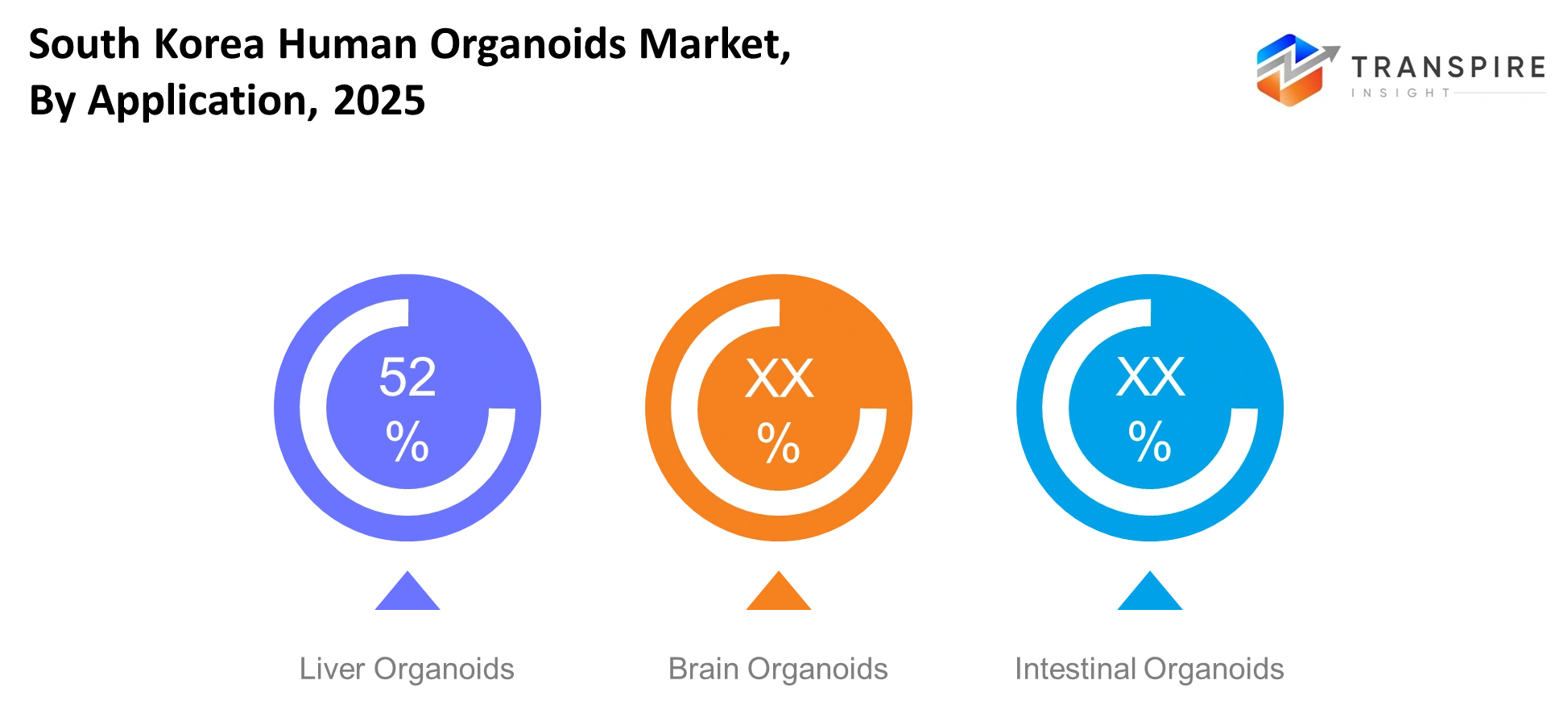
- Liver Organoids: The market for liver organoids in South Korea Human Organoids Market keeps growing because people increasingly study liver diseases and use toxicology research. The laboratory-grown liver structures will enable researchers to assess drug safety through metabolic testing. South Korean research groups will use these models to decrease animal testing needs while better predicting human liver reaction patterns.
- Brain Organoids: The Human Organoids Market in South Korea shows increased demand for brain organoids which researchers use to study neurological disorders and developmental disorders. The mini brain structures will enable scientists to study cellular activities under controlled testing conditions. Academic and clinical research settings in South Korea will use such models to better understand diseases like Alzheimer’s and improve early-stage drug screening processes.
- Intestinal Organoids: The South Korea Human Organoids Market uses intestinal organoids as essential tools to investigate digestive health and gut-related disorders. The structures will enable researchers to recreate human intestinal operations and study how microbes interact with each other. South Korean hospitals and research facilities will use these models to investigate infections and assess treatment effectiveness for gastrointestinal diseases.
By Application :
- Drug Discovery: The South Korea Human Organoids Market will experience strong growth in drug discovery because organoids deliver human-like testing results which scientists need for their research. The pharmaceutical development process will receive advantages through enhanced predictions which will determine drug effectiveness and harmfulness. South Korean clinical trials will experience shorter development periods and decreased study failure rates through the implementation of organoid research.
- Personalized Medicine: The South Korea Human Organoids Market will advance personalized medicine through its ability to create patient-specific testing which uses organoids obtained from their individual cells. Treatment plans will become more precise as responses to therapies can be observed before clinical use. Healthcare providers in South Korea will integrate this approach to improve outcomes and reduce trial-and-error treatments.
- Disease Modeling: The South Korea Human Organoids Market will enhance disease modeling through its ability to create laboratory environments which accurately reproduce human disease conditions. Organoids will help study progression and underlying mechanisms of complex diseases. The research institutions in South Korea will use these models to study new treatments while gaining a better understanding of rare diseases and chronic health conditions.
To learn more about this report, Download Free Sample Report
By End-User :
- Pharmaceutical Companies: Pharmaceutical companies will drive substantial market growth in South Korea Human Organoids Market because they want to create better research methods which decrease their operational expenses. Organoids will function as dependable instruments for testing chemical compounds and confirming medication development targets. South Korean companies plan to implement these systems because they want to increase their project success rates while they develop new medical treatments.
- Research Institutes: The South Korea Human Organoids Market will depend on research institutions to provide ongoing technological improvements which scientists will use to enhance organoid research techniques. The scientific studies will develop methods to achieve better research outcomes and create new research possibilities. Research institutions throughout South Korea will help create new knowledge while working together to support the development of organoid research methods which will be used in practical settings.
Country Insights
- The South Korea Human Organoids Market demonstrates continuous development because of its well-established laboratory system and its ability to conduct advanced scientific research studies. Cell-based research programs receive government support which enables scientists to develop new research methods. The continuous advancement of organoid models for disease research and drug evaluation and personalized medicine development results from the ongoing collaboration between academic institutions and biotechnology companies.
- The South Korea Human Organoids Market experiences growth because more funds enter the fields of regenerative medicine and precision healthcare. Local companies focus on improving scalability and reproducibility of organoid production. The pharmaceutical research sector demands organoids because they enable safer and more precise drug testing procedures. The regulatory framework establishes a secure foundation which supports both clinical research and product development activities.
- The South Korea Human Organoids Market experiences growth because people now understand better that they have alternatives to animal testing which require human-based testing methods. Hospitals and research centers use organoid technology to study cancer and investigate rare diseases. The combination of skilled workers and modern technological resources enables South Korea to become a major research center in this scientific field.
Recent Development News
In January 2026, Korea University improves cardiac organoid function using magnetic stimulation. The researchers at Korea University demonstrated that applying controlled magnetic torque to developing cardiac organoids significantly improves their maturation and vascular development The study uses real heart mechanics to study organoid behavior which results in more human tissue-like behavior The approach provides essential heart models which use realistic heart technology for drug testing and regenerative medicine research purposes.
In October 2025, breakthrough in organoid monitoring using microfluidics and bioelectronics. New advancements that link microfluidic systems with bioelectronic devices can now better monitor and manage organoids that function as organ-like biological systems. South Korean laboratories make significant contributions to this field through their research which implements these essential innovations to improve organoid reproducibility and clinical application value.
|
Report Metrics |
Details |
|
Market size value in 2025 |
USD 38.25 Million |
|
Market size value in 2026 |
USD 42.28 Million |
|
Revenue forecast in 2033 |
USD 84.09 Million |
|
Growth rate |
CAGR of 10.32% from 2026 to 2033 |
|
Base year |
2025 |
|
Historical data |
2021 - 2024 |
|
Forecast period |
2026 - 2033 |
|
Report coverage |
Revenue forecast, competitive landscape, growth factors, and trends |
|
Country scope |
South Korea |
|
Key company profiled |
Thermo Fisher Scientific Inc., Merck KGaA, Corning Incorporated, Lonza Group AG, STEMCELL Technologies Inc., Bio-Techne Corporation, MIMETAS BV, InSphero AG, Emulate Inc., Organovo Holdings Inc., HUB Organoids Holding B.V., DefiniGEN Ltd., MatTek Corporation, Greiner Bio-One International GmbH, 3D Biotek LLC. |
|
Customization scope |
Free report customization (country, regional & segment scope). Avail customized purchase options to meet your exact research needs. |
|
Report Segmentation |
By Type (Liver Organoids, Brain Organoids, Intestinal Organoids, Others), By Application (Drug Discovery, Personalized Medicine, Disease Modeling), By End-User (Pharmaceutical Companies, Research Institutes) |
Key South Korea Human Organoids Company Insights
- The South Korean market for human organoids has been receiving increased attention because researchers are investigating better alternatives to current methods which use traditional cell cultures and animal testing. The research centers and biotech firms collaborate to enhance organoid properties because this process allows scientists to study complex diseases more effectively. The government provides strong backing for technology development which establishes conditions that enable sustained industry growth. The increasing use of drug discovery pipelines demonstrates practical benefits which enhance trust among international pharmaceutical companies.
- The South Korean market for human organoids expands through automated systems and data analysis tools which enable laboratories to conduct extensive research studies at greater productivity levels. The field will experience continuous advancement through investments which develop expert personnel and state-of-the-art facilities. International partners drive demand which enables South Korea to become a dependable participant in worldwide biomedical research activities. The ongoing enhancement of organoid technologies will create new possibilities for developing advanced treatment methods and accurate medical solutions.
South Korea Human Organoids Market Companies:
- Thermo Fisher Scientific Inc.
- Merck KGaA
- Corning Incorporated
- Lonza Group AG
- STEMCELL Technologies Inc.
- Bio-Techne Corporation
- MIMETAS BV
- InSphero AG
- Emulate Inc.
- Organovo Holdings Inc.
- HUB Organoids Holding B.V.
- DefiniGEN Ltd.
- MatTek Corporation
- Greiner Bio-One International GmbH
- 3D Biotek LLC
South Korea Human Organoids Market Segmentation
By Type
- Liver Organoids
- Brain Organoids
- Intestinal Organoids
By Application
- Drug Discovery
- Personalized Medicine
- Disease Modeling
By End-User
- Pharmaceutical Companies
- Research Institutes
Frequently Asked Questions
Find quick answers to common questions.
The Approximate South Korea Human Organoids Market size for the Market will be USD 84.09 Million in 2033.
Key Segments for the South Korea Human Organoids Market are By Type (Liver Organoids, Brain Organoids, Intestinal Organoids, Others), By Application (Drug Discovery, Personalized Medicine, Disease Modeling), By End-User (Pharmaceutical Companies, Research Institutes).
Major South Korea Human Organoids Market Players are Thermo Fisher Scientific Inc., Merck KGaA, Corning Incorporated, Lonza Group AG, STEMCELL Technologies Inc., Bio-Techne Corporation, MIMETAS BV, InSphero AG, Emulate Inc., Organovo Holdings Inc., HUB Organoids Holding B.V., DefiniGEN Ltd., MatTek Corporation, Greiner Bio-One International GmbH, 3D Biotek LLC.
The Current South Korea Human Organoids Market size is USD 38.25 Million in 2025.
The South Korea Human Organoids Market CAGR is 10.32%.
- Thermo Fisher Scientific Inc.
- Merck KGaA
- Corning Incorporated
- Lonza Group AG
- STEMCELL Technologies Inc.
- Bio-Techne Corporation
- MIMETAS BV
- InSphero AG
- Emulate Inc.
- Organovo Holdings Inc.
- HUB Organoids Holding B.V.
- DefiniGEN Ltd.
- MatTek Corporation
- Greiner Bio-One International GmbH
- 3D Biotek LLC
Recently Published Reports
-
Apr 2026
Cord Blood Banking Services Market
Cord Blood Banking Services Market Size, Share & Analysis Report By Type of Service (Collection, Processing, Storage), By Bank Type (Private Banks, Public Banks, and Hybrid Banks), By Component (Cord Blood, and Cord Tissue), By End User (Hospitals, Research Institutions, Biotechnology Companies, and Others) and Geography (North America, Europe, Asia-Pacific, Middle East and Africa, South and Central America), 2021 - 2031
-
Apr 2026
ELISA Processors Market
ELISA Processors Market Size, Share & Analysis Report By Type (Optical Filter ELISA Analyzer, and Optical Grating ELISA Analyzers), By Mode (Automated ELISA Analyzers, and Semi-Automated ELISA Analyzers), By Applications (Immunology, Vaccine development, Drug Monitoring, and Others), By End Users (Biotechnology Companies, Pharmaceutical Companies, Contract Research Organization, and Diagnostic Laboratories) and Geography (North America, Europe, Asia-Pacific, Middle East and Africa, South and Central America), 2021 - 2031
-
May 2026
Microscope Slide Scanner Market
Microscope Slide Scanner Market Size, Share & Analysis Report By Type (Portable Microscope Slide Scanner, and Desktop Microscope Slide Scanner), By Application (Biological Research, Medicine, Veterinary, and Other) and Geography (North America, Europe, Asia-Pacific, Middle East and Africa, South and Central America), 2021 - 2031
-
Apr 2026
Microwave Cookware Market
Microwave Cookware Market Size, Share & Analysis Report By Material Type (Plastic, Glass, Ceramic, Silicone, and Metal), By Application (Cooking, Reheating, and Defrosting), By End User (Household, Commercial (Restaurants, Hotels, and Cafes), and Food Service Industry), By Sales Channel (Online Retail, Offline Retail (Supermarkets, Hypermarkets, Specialty Stores), and Direct Sales (Company Outlets)) and Geography (North America, Europe, Asia-Pacific, Middle East and Africa, South and Central America), 2021 - 2031