
South Korea High Entropy Alloy Market Summary:
According to Transpire Insights, a detailed research report on the market reflects that the aerospace & defense application segment dominates the South Korea High Entropy Alloy Market, accounting for approximately 42% of the total share worldwide. POSCO leads the market with approximately (around USD 54.7 billion) in annual revenue and an estimated 12–16% South Korea market share, making it a leading contributor to South Korea market development, innovation, advanced high entropy alloy production, expanding manufacturing capabilities, and growth dynamics.
Market Snapshot
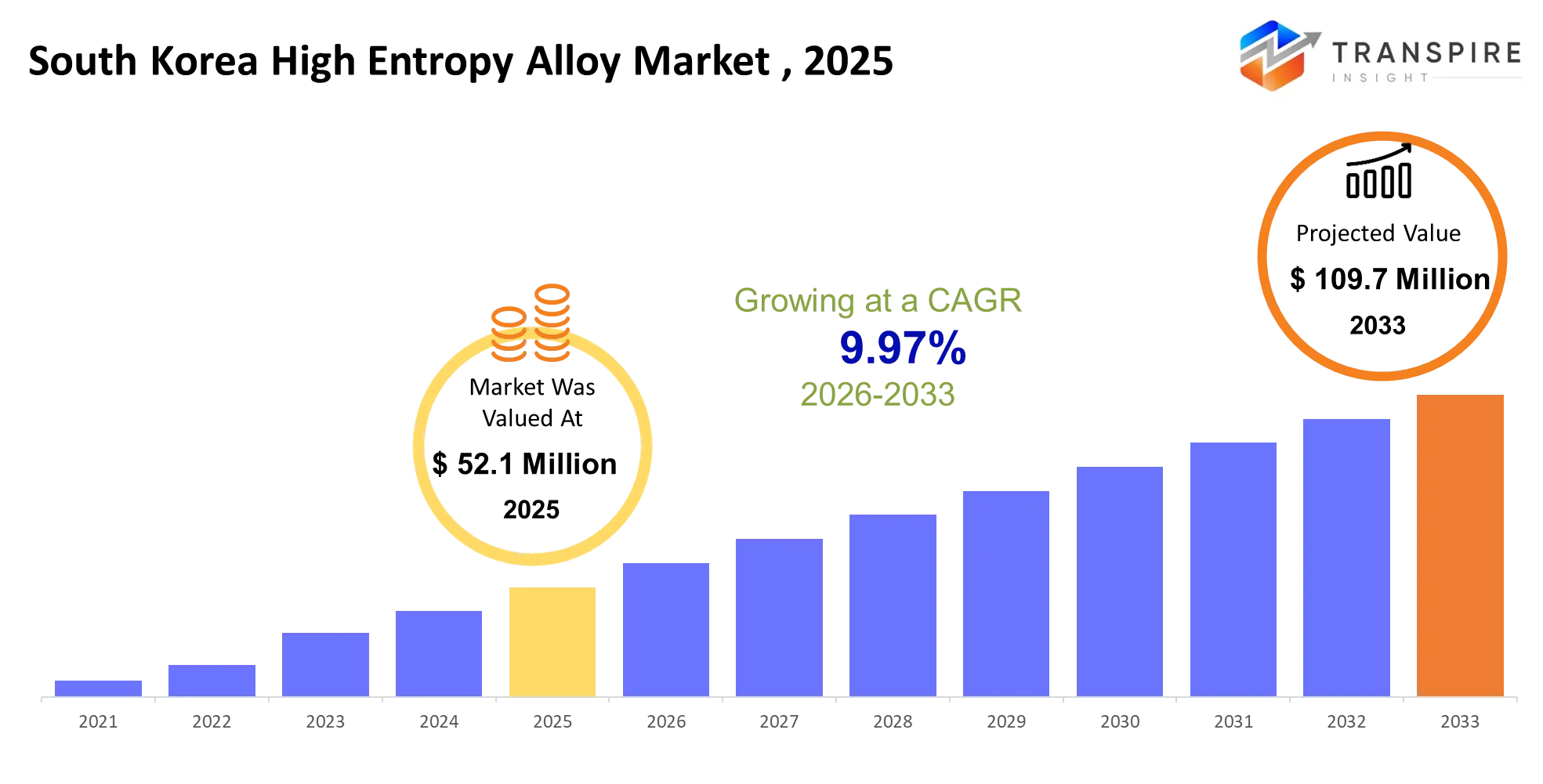
- Market Value (2025): USD 52.1 Million.
- Expected Market Value (2026): USD 56.4 Million.
- Estimated Market Value (2033): USD 109.7 Million.
- Forecast CAGR (2026–2033): 9.97%
Introduction
High-entropy alloys are developed through the combination of five or more major elements in equal or near-equal concentrations. Unlike regular alloys, which are composed of a majority element like iron or aluminum, HEAs are made up of multiple components. In other words, a high-entropy alloy is a type of metal made from mixing five or more main elements in equal proportions or almost equal proportions. The development of various types of high entropy alloys possesses the most significant feature for the advancement of a multitude of demanding applications in aerospace, defense, energy, and industrial sectors in South Korea. High stability with respect to heat makes HEAs capable of keeping their mechanical characteristics and resisting softening at higher temperatures. Their unique strength-to-weight ratio allows using less material in the designs that still maintain good strength levels. Better resistance to corrosion and wear allows for high durability in harsh, chemically aggressive, marine, and any high-friction environments. What is modern in HEAs' materials is the fact that lattice distortion and slow diffusion may suppress dislocation motion and movements of the atoms that result in better resistance to degradation even under the extremely high levels of mechanical, thermal, and radiation effects.
Key Market Highlights: -
- By alloy type, the Single-Phase segment dominated the market and holds nearly 45% share in 2025 and is projected to grow at a substantial CAGR during the forecast period.
- By composition, the 5-Element segment dominated the market and holds nearly 40% share in 2025 and is projected to grow at a substantial CAGR during the forecast period.
- By application, the Electronics segment dominated the market and holds nearly 24% share in 2025 and is projected to grow at a substantial CAGR during the forecast period.
- Initiative on Advanced Materials: The South Korean government provides backing for R&D in advanced materials, manufacturing strategies, commercialization, and innovation clusters. The initiatives aim to improve research infrastructure to support High Entropy Alloys (HEAs) and the good application of technology in the aerospace, defense, energy, automotive and advanced manufacturing sectors. Public-private partnerships support the realization of innovations and technologies in the HEA field.
How is Technology Driving Growth in the South Korea High Entropy Alloy Market?
Technological advancements such as modern methods of manufacturing, processing, and computation are driving the development of South Korea's High Entropy Alloy Market. By utilizing additive manufacturing, HEA components are produced that are complex and weightless, as well as conserve on the material usage. In addition, the utilization of plasma spheroidization technique helps create a uniform powder for improved performance in printing. The process of powder metallurgy provides various advantages, including control over the composition, increased consistency of material and scalable HEA manufacturing that proves to be more efficient than conventional melting methods. At the same time, artificial intelligence, as well as computational materials science, push alloy finding because composition evaluation is conducted and the stability of a phase as well as mechanical properties are predicted and optimized using the creation of simulation. Thanks to this combination of processes and technologies, Korea manages to strengthen its innovative abilities towards alloys, precision manufacturing, aerospace, defense, energy, and other high-performance industries.
Market Drivers
The high entropy alloy market in South Korea is supported by growing demand coming from aerospace and defense industries, which request alloys possessing outstanding corrosion resistance and good thermal stability. The implementation of novel manufacturing technologies in the automotive, industrial, electronics, and machinery sectors is enabling the increased usage of high-performance materials. Separate investments made both by public and private sectors are supporting the domestic market of HEA solutions through research in advanced manufacturing, nuclear energy, and other innovative technologies. In addition, advancements in the field of AI-enabled materials identification technology, computing, additive manufacturing, and advanced processing technology are contributing to the reduction of the time necessary for alloy development. The South Korean high entropy alloy market profits from the outstanding performance of high entropy alloys (HEAs) which usually have a number of main metals, enhancing mechanical properties. High durability provides high strengths, hardness and abrasion-resistance compared to many traditional alloys. Good thermal stability of HEAs is beneficial for their performance at high temperatures, making them suitable for usage in aerospace, turbines, energy sector, and advanced manufacturing. Good resistance to corrosion contributes to reliable performance in chemically aggressive and high temperatures environments. In addition, unique properties of different metals permit engineers to make alloys according to all customer’s requirements including making them light, resistant to radiations, oxidation, and high temperatures, which makes them suitable for usage in advanced industries in South Korea.
Restrain
There are challenges in the South Korea High Entropy Alloy Market related to production costs arising from the usage of costly special metals and advanced methods of processing. The technological complexities such as controlled melting, powder processing and special heat treatment raise manufacturing costs. The limited scalability and large capital requirements make it hard to produce commercially. Apart from that, poor standardization efforts, unique infrastructure requirements and strict qualification processes can slow down the market introduction of high entropy alloys in industrial applications in such areas as aerospace, defense, and energy technologies.
|
Driver |
Relative Impact on Growth (%) |
Geographic Relevance |
Impact Timeline |
Demand Strength |
Growth Mechanism |
Key Beneficiaries |
Major Constraint |
|
Driver 1: Aerospace & Defense Material Demand |
25% |
Gyeongsangnam-do, Daejeon, National |
Long-term (≥4 years) |
High |
Enables stronger, lighter, heat-resistant aerospace components |
HEA producers, defense manufacturers, aerospace suppliers |
High qualification and certification requirements |
|
Driver 2: AI-Driven Alloy Discovery & Materials R&D |
22% |
Daejeon, Seoul, National |
Medium-term (2–4 years) |
High |
Accelerates composition screening, prediction, and alloy optimization |
Materials researchers, AI vendors, HEA developers |
Limited high-quality materials datasets |
|
Driver 3: Additive Manufacturing & Powder Processing |
20% |
Gyeonggi, Daejeon, National |
Medium-term (2–4 years) |
High |
Enables complex geometries, rapid prototyping, and material efficiency |
AM companies, powder producers, equipment vendors |
High powder and processing costs |
|
Driver 4: Hydrogen & Advanced Energy Infrastructure |
18% |
Pohang, Daejeon, National |
Long-term (≥4 years) |
High |
Creates demand for hydrogen-resistant, high-strength structural materials |
HEA producers, energy firms, infrastructure suppliers |
Technology validation and commercialization timelines |
|
Driver 5: Semiconductor & Advanced Electronics Manufacturing |
15% |
Gyeonggi, Seoul, National |
Short-term (≤2 years) |
Medium |
Supports thermally stable, corrosion-resistant manufacturing materials |
Electronics firms, semiconductor equipment suppliers, HEA manufacturers |
Limited commercial HEA standardization |
Analysis of Prices and Consumer Behaviour
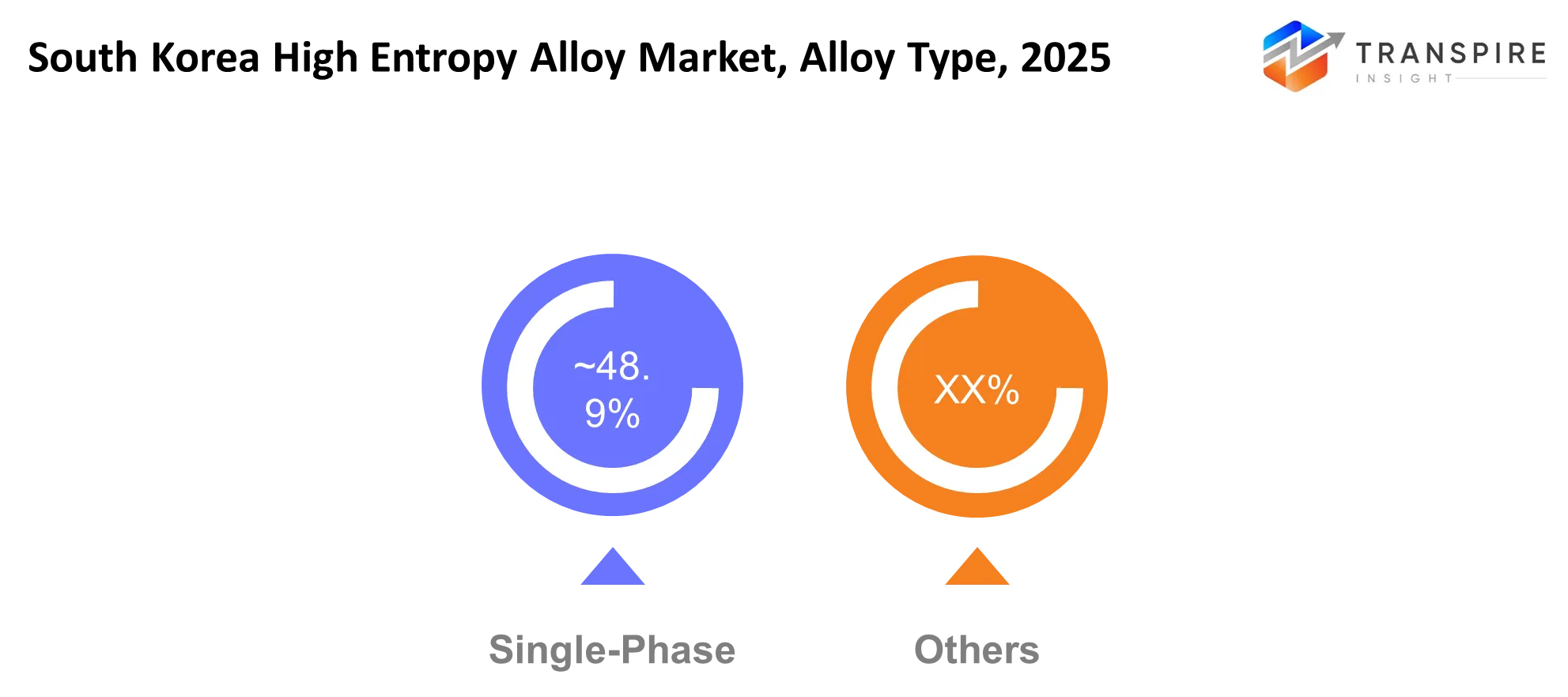
Single-phase high entropy alloys are the reigning alloy category, accounting for 48.94% of the overall alloy revenue in 2025 due to their notable characteristics, such as mechanical strength, thermal stability, corrosion resistance, and their applicability in demanding industries. Materials with advanced features, such as optimized high entropy alloys, are expected to be offered at a higher price compared to regular alloy products, since they require complex processing systems, high-purity components, tight quality control, and reliable material properties. High entropy alloys are produced by means of casting and solidification techniques on a global scale, with about 43.1% of production by these methods, but no exact percentage is available for South Korea. The aerospace and defense sector is the largest customer segment, motivated by the need for materials that can work in challenging conditions, such as high or low temperatures, high mechanical forces, and corrosive environments. Purchasing behavior of consumers indicates that the most important characteristics of acting materials include performance, purity, composition uniformity, thermal stability, and corrosion resistance.
Who are the Key Players in the South Korea High Entropy Alloy Market and how do they compete?
In the South Korea High Entropy Alloy market, competitiveness hinges on the ability of firms to innovate in the areas of advanced alloys and provide application-based solutions. Competitors in the market emphasize product development utilizing their knowledge of material performance attributes such as strength and lightness while capitalizing on technological innovations for it.
POSCO stands out in the market from its competitors with its expertise, research capabilities, and manufacturing technologies. Competing in the market through the production of high-performance steels, the company emphasizes the durability, resistance to corrosion, and some other necessary material characteristics, thus meeting aerospace and other industry needs.
Top Companies in the South Korea High Entropy Alloy Market
- ATI Materials
- Carpenter Technology
- Haynes International
- Aperam
- Sandvik
- VDM Metals
- Hitachi Metals
- Oerlikon
- Plansee
- Special Metals
- Daido Steel
- Nippon Yakin Kogyo
- POSCO
- Hyundai Steel
- Kobe Steel
|
Company |
Est. Revenue Share Range |
Key Offerings |
Strategic Positioning |
Geographic Strength |
Technology Focus |
|
InssTek |
8–12% |
HEA DED fabrication; MX-Lab; DMT® systems; multi-material processing |
HEA-focused additive manufacturing technology leader |
Asia Pacific; Europe; North America |
DED; multi-material deposition; alloy design |
|
POSCO |
6–10% |
Advanced steels; HEA R&D; high-performance alloys; materials engineering |
Integrated materials innovation and scale |
Asia Pacific; North America; Europe |
Metallurgy; alloy design; advanced steel processing |
|
Oerlikon |
5–8% |
HEA powders; additive manufacturing; Scoperta®; component production |
Integrated powder-to-component HEA solutions |
Europe; North America; Asia Pacific |
Powder metallurgy; AM; rapid alloy development |
|
Proterial |
4–7% |
HiPEACE® HEA; metal powders; specialty alloys; CAE engineering |
Specialty alloy and printable materials expertise |
Asia Pacific; North America; Europe |
Metal powders; CAE; additive manufacturing |
|
ATI |
4–6% |
Specialty materials; nickel alloys; titanium alloys; advanced materials |
Premium aerospace and specialty materials supplier |
North America; Asia Pacific; Europe |
Advanced metallurgy; specialty alloy processing |
|
Carpenter Technology |
3–5% |
Specialty alloys; powder materials; additive manufacturing alloys; engineered materials |
Premium engineered-materials and powder specialist |
North America; Europe; Asia Pacific |
Powder metallurgy; AM; alloy development |
|
Sandvik |
3–5% |
Metal powders; additive manufacturing; advanced alloys; AM services |
Powder-to-component advanced manufacturing platform |
Europe; Asia Pacific; North America |
Metal powders; AM; digital manufacturing |
|
Plansee |
2–4% |
Refractory metals; tungsten alloys; powder metallurgy; advanced materials |
Niche refractory-materials technology specialist |
Europe; Asia Pacific; North America |
Powder metallurgy; refractory materials; precision processing |
|
Daido Steel |
2–4% |
Special steels; advanced alloys; powder materials; aerospace materials |
Specialty-steel diversification into advanced alloys |
Asia Pacific; North America; Europe |
Specialty metallurgy; powder processing; alloy design |
|
Nippon Yakin Kogyo |
2–4% |
Nickel alloys; stainless steels; corrosion-resistant materials; specialty alloys |
Corrosion-resistant specialty-alloy supplier |
Asia Pacific; North America |
Nickel metallurgy; corrosion resistance; precision processing |
South Korea High Entropy Alloy Market Segmentation
The South Korea High Entropy Alloy Market share is divided into five categories: By alloy type, composition, base material, application and manufacturing.
The Single-Phase dominated the market, accounting for nearly 45% in 2025 and is expected to rise at a significant CAGR during the forecast period.
The South Korea High Entropy Alloy Market is segmented by alloy type into Single-Phase, Multi-Phase, Dual-Phase, Eutectic, Nanocrystalline, Amorphous, Precipitation-Hardened. Among these, the Single-Phase segment dominated the market, accounting for nearly 45% in 2025 and expected to increase at a significant CAGR during the forecast period. In 2025, the South Korea High Entropy Alloy Market was led by the Single-Phase segment as a result of its advantageous features such as excellent mechanical strength, thermal stability, corrosion resistance, and structural reliability. Also, the demand for Single-Phase High Entropy Alloys in sectors such as aerospace, defense, energy, and advanced manufacturing sectors is motivating market adoption. Further, it is anticipated that ongoing material innovations and collisions will continue to expand demand for High Entropy Alloys.
The 5-Element dominated the market, accounting for nearly 40% in 2025, and is expected to rise at a significant CAGR during the forecast period.
The South Korea High Entropy Alloy Market is segmented by composition into 3-Element, 4-Element, 5-Element, 6-Element, 7-Element, 8+ Element, Refractory HEA. Among these, the 5-Element segment dominated the market, accounting for nearly 40% in 2025 and expected to increase at a significant CAGR during the forecast period. The 5-Element segment became the market leader of the South Korea High Entropy Alloy Market in 2025 owing to its combination of strength, thermal stability, corrosion resistance, and compositional flexibility. All these features allow the 5-Element segment to find applications in aerospace, defense, energy, automotive, and advanced manufacturing sectors. The expansion of the 5-Element segment is propelled by growing research, alloy optimization, and demand for high-performance materials.
The Electronics dominated the market, accounting for nearly 24% in 2025 and is expected to rise at a significant CAGR during the forecast period.
The South Korea High Entropy Alloy Market is segmented by application into Aerospace, Automotive, Energy, Electronics, Defense, Industrial Machinery, Medical. Among these, the Electronics segment dominated the market, accounting for nearly 24% in 2025 and expected to increase at a significant CAGR during the forecast period. In 2025, the Electronic segment accounted for the largest share of the South Korea High Entropy Alloy Market as a result of the rising demand for materials that deliver thermal stability, corrosion resistance, mechanical strength, and consistencies. The HEAs play the role of the supporting materials for advanced electronic components, semiconductors production equipment, and high-temperature applications. South Korea’s electronics environment is further enhanced by the increasing technological enhancement.
Future Market Trends for the South Korea High Entropy Alloy Market: -
- The Implementation of AI and Machine Learning: Manufacturers in the high-tech sector are making use of AI and computational modeling in order to shorten the discovery cycles of alloys and enhance their formulations.
- Boom in Additive Manufacturing (3D Printing): 3D printing and powder processing technologies are becoming more and more popular in creating complex components from HEA produced with minimum waste of the materials.
- Demand from Core High-Tech Sectors: The automotive, electronics and military industries factually cannot do without lightweight, strong and heat-resistant metals.
- Cooperation between the Private and Public Sectors: Some South Korean government programs supporting advanced materials and industrial clusters help a lot to facilitate the commercialization and production processes.
Recent Development
- In June 2026: A team of researchers unveiled the cutting-edge heat-resistant (FeCoNi)86Al7Ti7 high entropy alloy, which boasts an extraordinary yield strength of 2.2 GPa at temperatures of up to 1000 C (1832 F). Though invented overseas, the advancement benefits the advancement of HEA technology evaluation within the high entropy alloy industry in South Korea, including in aerospace, defense, energy, high-temperature elements, and advanced production areas.
- In March 2026: Researchers from POSTECH, under the leadership of Professor Hyoung Seop Kim, have produced a unique high-entropy alloy that promises better strength and better resistance to hydrogen embrittlement. This discovery applies to the development of sophisticated hydrogen systems, energy infrastructure, aerospace, and defense industries and contributes to growth in South Korea’s High Entropy Alloy Market through research in new materials and optimization of their performance.
Market Segment
This study forecasts revenue at South Korea, regional and country levels from 2020 to 2033. Transpire Insights has segmented the South Korea High Entropy Alloy Market based on the below-mentioned segments:
South Korea High Entropy Alloy Market, By Alloy Type
- Single-Phase
- Multi-Phase
- Dual-Phase
- Eutectic
- Nanocrystalline
- Amorphous
- Precipitation-Hardened
South Korea High Entropy Alloy Market, By Composition
- 3-Element
- 4-Element
- 5-Element
- 6-Element
- 7-Element
- 8+ Element
- Refractory HEA
South Korea High Entropy Alloy Market, By Base Material
- Nickel-Based
- Cobalt-Based
- Iron-Based
- Aluminum-Based
- Chromium-Based
- Titanium-Based
- Refractory-Based
South Korea High Entropy Alloy Market, By Application
- Aerospace
- Automotive
- Energy
- Electronics
- Defense
- Industrial Machinery
- Medical
South Korea High Entropy Alloy Market, By Manufacturing
- Casting
- Powder Metallurgy
- Additive Manufacturing
- Sintering
- Mechanical Alloying
- Hot Isostatic Pressing
- Forging
Frequently Asked Questions
Find quick answers to common questions.
The market is projected to reach USD 109.7 million by 2033, growing at a 9.97% CAGR from 2026 to 2033.
The Single-Phase segment dominates with approximately 45% share in 2025, driven by strength, thermal stability, corrosion resistance, and structural reliability
The 5-Element segment leads with nearly 40% share in 2025, supported by compositional flexibility, strength, thermal stability, and industrial applications
The Electronics segment dominates with approximately 24% share in 2025, supported by demand for high-performance, thermally stable, corrosion-resistant materials.
Additive manufacturing, powder metallurgy, AI, computational modeling, and advanced processing are accelerating HEA development, optimization, manufacturing efficiency, and commercialization.
- ATI Materials
- Carpenter Technology
- Haynes International
- Aperam
- Sandvik
- VDM Metals
- Hitachi Metals
- Oerlikon
- Plansee
- Special Metals
- Daido Steel
- Nippon Yakin Kogyo
- POSCO
- Hyundai Steel
- Kobe Steel
About the Authors

Pankaj Ghogare Patil
I am Pankaj Ghogare Patil, a Senior Research Analyst at Transpire Insight, specializing in the Pharmaceutical, Chemicals & Materials, Healthcare IT, and Biotechnology industry. My expertise lies in conducting comprehensive market research, analyzing industry trends, evaluating competitive landscapes, and translating complex data into actionable insights. At Transpire Insight, I closely follow emerging technologies, regulatory developments, and market innovations to create accurate, well-researched, and informative content that helps businesses and professionals make informed decisions. I am committed to producing credible, evidence-based articles that reflect industry best practices while making technical topics accessible and valuable for a broad audience.

Chakradhar Khansole
Chakradhar serves as the Research Director at Transpire Insight, bringing over 8 years of experience in technology, innovation, and strategic market intelligence. He specializes in transforming complex market data into actionable business insights that enable organizations to make informed, growth-oriented decisions. Recognized for his strategic vision and analytical expertise, Chakradhar leads high-impact research initiatives, delivering comprehensive market assessments, competitive intelligence, and forward-looking industry analysis.
Recently Published Reports
-
May 2026
Healthcare Polymer Packaging Market
Healthcare Polymer Packaging Market Size, Share & Analysis Report By Packaging Type (Syringes, IV Bottles and Pouches, Clamshells, Blisters, Bottles & Jars, Containers, Tubes, IV Parental Packaging, Others), By Type (Regulated, Non-regulated), By Polymer Type (LDPE (Low-Density Polyethylene), HDPE (High-Density Polyethylene), Homo-polymer (Homo), Random Copolymer (Random), Block Copolymer (Block), PET, Polystyrene, Polyvinyl Chloride, Polyamide/EVOH, Others), and Geography (North America, Europe, Asia-Pacific, Middle East and Africa, South and Central America), 2021 - 2031
-
Apr 2026
Hydrophilic Tape (Waterstop) Market
Hydrophilic Tape (Waterstop) Market Size, Share & Analysis Report By Type (Bentonite-Based Hydrophilic Tape, Rubber-Based Hydrophilic Tape), By Application (Residential Buildings, Commercial Buildings, Infrastructure Projects), and Geography (North America, Europe, Asia-Pacific, Middle East and Africa, South and Central America), 2021 - 2031
-
Apr 2026
Metalens Market
Metalens Market Size, Share & Analysis Report By Type (Visible Light Metalens, and Infrared Metalens), By Application (Consumer Electronics, Automotive Electronics, Industrial, Medical, and Others), and Geography (North America, Europe, Asia-Pacific, Middle East and Africa, South and Central America), 2021 - 2031
-
Apr 2026
PBT Resin Market
PBT Resin Market Size, Share & Analysis Report By Type (Reinforced PBT Resin, Unreinforced PBT Resin), By Processing Method (Injection Molding, Extrusion, Blow Molding, Others), By End-User (Automotive, Electrical & Electronics, Consumer Appliances, Industrial Machinery, Medical Devices, Packaging, Others), and Geography (North America, Europe, Asia-Pacific, Middle East and Africa, South and Central America), 2021 - 2031