
South Korea Green Packaging Market Size & Forecast:
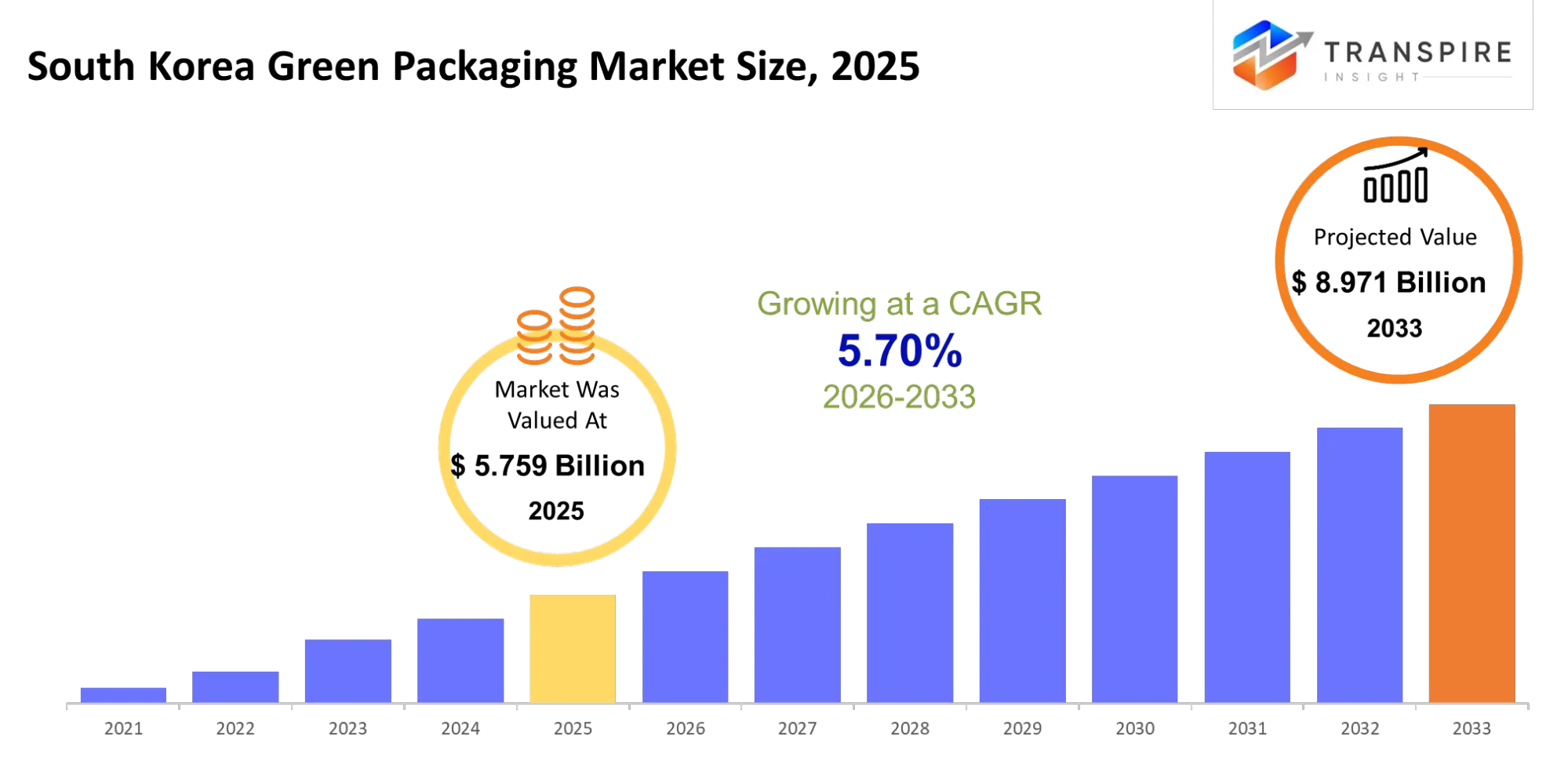
- South Korea Green Packaging Market Size 2025: USD 5.759 Billion
- South Korea Green Packaging Market Size 2033: USD 8.971 Billion
- South Korea Green Packaging Market CAGR: 5.70%
- South Korea Green Packaging Market Segments: By Material (Paper & Paperboard, Bioplastics, Recycled Plastic, Glass, Metal, Others); By Packaging Type (Bags, Bottles, Containers, Boxes, Others); By End User (Food & Beverage, Healthcare, Personal Care, E-commerce, Others)
To learn more about this report,  Download Free Sample Report
South Korea Green Packaging Market Summary
The South Korea Green Packaging Market was valued at USD 5.759 Billion in 2025. It is forecast to reach USD 8.971 billion by 2033. That is a CAGR of 5.70% over the period.
South Korea, green packaging market kinda talks about a pretty real issue, that manufacturers retailers, and logistics operators bump into all the time—how to cut packaging waste while still keeping product protection solid, shelf stability ok, and transport speed not getting messed up. Sustainable packaging materials such as recycled paperboard, biodegradable plastics, and reusable containers help firms lower disposal expenses but still stay in line with the more and more strict environmental rules, especially across food, healthcare, and e-commerce supply chains. Packaging producers are also starting to treat sustainable materials as regular day to day operational efficiency, not only some eco branding thing.
Over the last three to five years the whole market vibe shifted, sort of from “we can do sustainability if we want” programs into changes that are more regulation driven. South Korea’s stronger waste reduction rules and plastic recycling targets have nudged manufacturers to redesign packaging formats, and use more recycled content. Then during, and after the COVID-19 period, e-commerce grew really fast, so packaging consumption also jumped, and it made the weak points of conventional single use plastic systems stand out. That put extra pressure on retailers, plus logistics providers to move toward recyclable alternatives. In the end, this transition opened some fresh revenue avenues for material innovators, paper packaging suppliers, and recycling infrastructure companies, since corporate buyers now tend to choose packaging options that reduce regulatory exposure, and also support long term supply chain sustainability goals.
Key Market Insights
- So the South Korea Green Packaging Market is kinda drifting into recyclable fiber materials, bioplastics, and those closed-loop packaging setups, mostly because of regulatory pressure and like the bigger e-commerce wave, not sure why it feels so intense but yeah it’s happening. The industry players are expected to keep seeing solid forecast growth through 2032, as manufacturers push faster away from single-use plastic packaging formats.
- The Seoul metro area dominated the South Korea Green Packaging Market with nearly 45% share in 2025, mainly because retail activity, and online commerce are really clustered there , basically together.
- Busan is projected as the fastest-growing regional market through 2032, because logistics operators alongside export manufacturers upped their sustainable packaging investments.
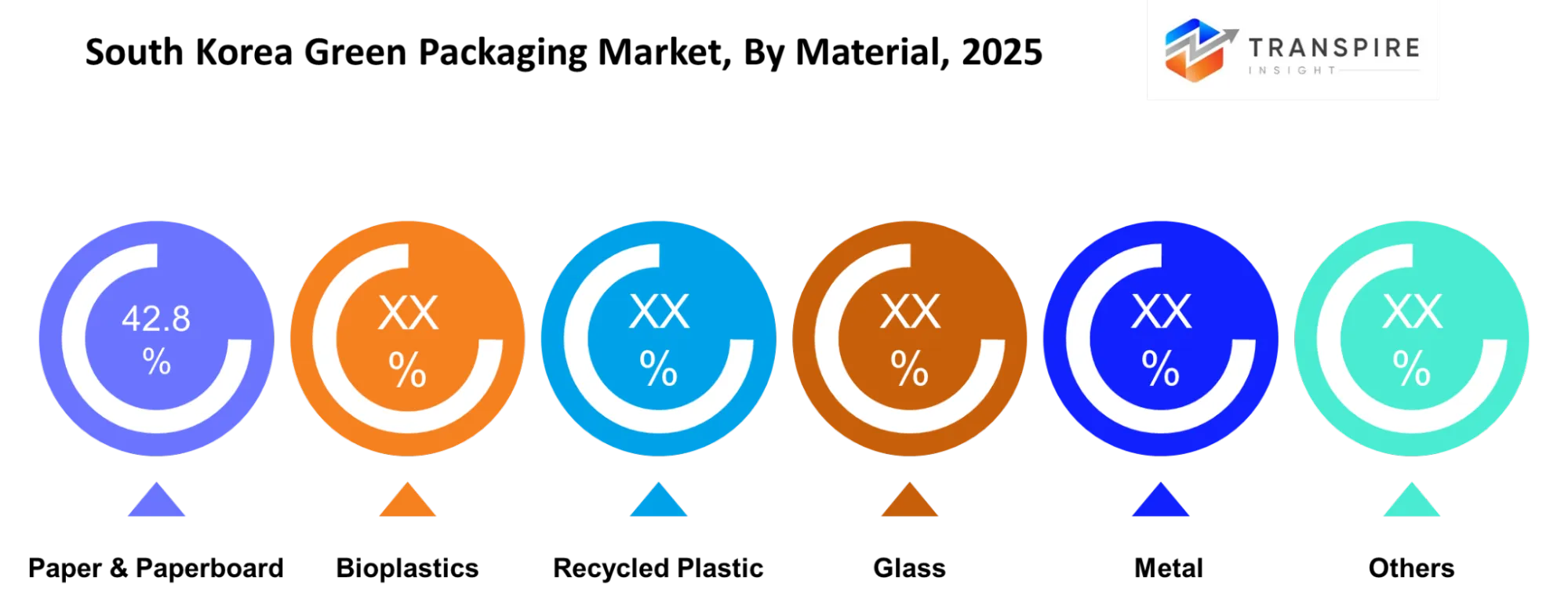
- Paper and paperboard packaging held roughly 39% market share in 2025 , driven by wide food delivery usage and retail wrap adoption, so it’s everywhere
- Recycled plastic showed up as the second-largest segment, as FMCG brands ramped up recycled content inclusion, to satisfy sustainability compliance targets.
- Bioplastics are the fastest-growing material category during the forecast period, after compostable packaging technology investments increased more strongly post 2023.
- Containers led packaging formats with nearly 34% revenue share, since food delivery and healthcare prioritized protective packaging systems that are more recyclable.
- Flexible bags and pouches gained stronger traction across online retail channels, largely due to lower transport costs and less packaging material consumption.
- Food and beverage applications generated more than 41% share in 2025, because packaged food producers accelerated the shift toward recyclable and biodegradable materials.
- E-commerce packaging logged the fastest grow, like noticeably.
What are the Key Drivers, Restraints, and Opportunities in the South Korea Green Packaging Market?
The strongest force nudging the South Korea green packaging industry is the tightening regulatory framework around plastic waste reduction and recycling accountability, basically. Government policies aimed at single-use plastics, mandatory recycling standards, and producer responsibility obligations pushed manufacturers plus retailers to redesign packaging formats across food delivery, cosmetics, healthcare, and consumer goods. Big retail chains and e-commerce companies accelerated procurement of recyclable paperboard, mono material plastics, and biodegradable packaging, because non-compliance often turns into higher operational costs and, you know , reputational risk. This regulatory shift really did expand revenue pathways for sustainable material suppliers, recycling processors, and packaging technology developers who can still hit stricter environmental requirements.
The biggest restraint is still the high production cost and the limited scalability of advanced sustainable packaging materials. Bioplastics, compostable polymers, and specialty recyclable laminates depend on expensive raw inputs and kind of fragmented recycling infrastructure. These barriers are structural though, since packaging conversion means long-term manufacturing upgrades, material certification processes, and nationwide waste collection alignment. Smaller packaging producers often postpone adoption due to capital expenditure pressure . That slows wider market penetration and reduces pricing competitiveness versus conventional plastic packaging, in a very practical way.
A major future opportunity is starting to show up through closed loop recycling systems tied in with digital traceability technologies. Packaging manufacturers and retailers are increasingly investing in smart labeling , AI supported waste sorting , and post-consumer resin recovery infrastructure.
What Has the Impact of Artificial Intelligence Been on the South Korea Green Packaging Market?
Artificial intelligence and more advanced digital technologies are kind of reshaping South Korea’s sustainable packaging industry, by boosting manufacturing efficiency and cutting down waste, while also helping with better material traceability across production networks. Packaging manufacturers are increasingly leaning into AI-enabled quality inspection systems to watch for defects in paperboard , recycled plastics and biodegradable packaging materials, even while everything runs at full speed. With automated vision systems, they can catch material irregularities, printing problems and sealing failures in real time, which then helps reduce material waste and pushes production throughput higher. Then there are also smart factory platforms, they sort of optimize machine utilization and energy consumption by adjusting production settings based on order volume plus the condition of incoming raw materials.
Machine learning models are backing predictive maintenance in packaging plants too, by looking at vibration signals, equipment temperature, and recurring production cycle behavior. This reduces the risk of unexpected downtime, so operations stay steadier for those high-volume packaging lines. On top of that, AI-supported supply chain analytics improve how recycled material gets sourced, and they sharpen inventory forecasting—especially for post-consumer recycled plastics and fiber-based packaging inputs. A few packaging producers have actually mentioned lower material losses , and better compliance with recycling content requirements after they added digital tracking into their manufacturing routines.
Key Market Trends
- Since 2022, some major South Korean retailers kind of reduced multilayer plastic packaging a bit, and yeah expanded recyclable paper based packaging across their private label product lines.
- Food delivery platforms meanwhile leaned more into molded fiber containers after municipal governments in metropolitan regions tightened disposable plastic rules during 2023 not sure why but that timing felt pretty clear.
- Packaging manufacturers started shifting investment toward mono material flexible packaging, mostly because the recycling process is simpler , so the post consumer material recovery efficiency gets better , sort of.
- E-commerce logistics operators have also been replacing oversized packaging with lighter flexible formats more often, to cut transportation costs and reduce warehouse storage space requirements , and that’s been happening steadily.
- Since 2021, procurement costs for recycled plastic went up due to tighter global resin supply conditions and stronger requirements for recycled content compliance, which definitely made planning harder.
- Companies like Amcor and Mondi have also sped up development of recyclable barrier packaging, specifically for food preservation uses.
- Beverage and dairy producers increased their fiber based carton usage after South Korea expanded extended producer responsibility enforcement across consumer packaging industries, so everyone adjusted.
- AI supported sorting systems improved recycled material separation accuracy, which helped packaging recyclers lower contamination rates and increase usable resin recovery volumes.
- Since 2023, cosmetics brands have been adopting biodegradable packaging more frequently too, aiming to strengthen export competitiveness in European and North American retail markets.
South Korea Green Packaging Market Segmentation
By Material
Paper and paperboard materials still kept that strong commercial preference, because retail brands and food service operators kinda leaned hard toward recyclable and light weight packaging solutions. In response, packaging converters kept expanding production capacity for fiber based cartons, wrapping materials, and molded containers, just to stay aligned with regulatory compliance goals. Also, the strong availability of recycled paper feedstock helped a lot, pushing broader industrial adoption across consumer goods plus e-commerce packaging uses. At the same time, sustainable packaging developers kept tuning moisture resistance and durability levels, so the whole thing felt more suitable for food and healthcare distribution.
Bioplastics got more noticeable industry attention as well, since manufacturers looked for substitutes to conventional petroleum based plastics, especially for premium packaging applications. Recycled plastic materials grew too, gradually, largely because tougher recycled content requirements showed up, and because waste collection systems improved in metropolitan regions. Glass and metal packaging held fairly steady demand inside beverage, cosmetics, and healthcare industries, where product protection and long shelf life stay absolutely critical. And the other material categories kept plugging away for niche uses, but without really reaching broad large scale commercial penetration.
To learn more about this report, Download Free Sample Report
By Packaging Type
Containers kept getting broader adoption, because food delivery companies, grocery retailers, and healthcare suppliers really needed secure and also recyclable packaging formats for transport and storage operations. You can see how fast things grew in online food ordering and ready to eat meal distribution, and it basically pulled commercial demand upward for fiber based plus recyclable plastic containers. Then packaging manufacturers worked on better structural strength , and thermal insulation capability too, so it could handle more temperature sensitive products without issues. Retail chains also started ramping up procurement of sustainable containers, to fit their waste reduction commitments and their wider shift in packaging strategy, overall.
Bags and flexible packaging formats became way more commercially relevant, because lighter structures lowered shipping costs and improved warehouse efficiency inside e-commerce workflows. Bottles kept generating steady revenue across beverage, personal care, and household product sectors, mainly because refillable and recyclable packaging demand stayed pretty consistent. Boxes still held a big role in logistics and retail distribution networks, since corrugated packaging helps protect products during transit. Other packaging formats remained kinda limited to specialized industrial use or promotional applications, depending on the category.
By End User
Food and beverage companies sort of ended up driving most of the packaging demand, mostly because regulatory pressure and retail sustainability standards kept showing up, and yeah they kept pushing faster replacement of single use plastic packaging. Packaged food manufacturers moved toward recyclable trays, paper cartons and biodegradable wrapping materials, to meet their waste reduction goals. And at the same time restaurant delivery services, along with supermarket chains, leaned harder into sustainable packaging solutions so they could stay within operational compliance rules , even when things got messy. Packaging innovation for food use cases was basically about stretching shelf life a bit longer while still cutting down material usage, which sounds easy but is kinda the whole point isn’t it.
Healthcare applications also kept expanding at a steady pace, or at least that’s how it looked. That happened because pharmaceutical and medical product suppliers demanded traceable, hygienic, and recyclable packaging formats, especially for regulated distribution environments . Personal care brands increased the use of refillable packaging systems and recycled materials, which helped them reinforce a more premium product image, in local markets and also for export. E-commerce operators ran packaging optimization programs more aggressively to lower excess packaging material and also reduce transportation related costs, it was very practical. Beyond that, other end user industries stuck to moderate adoption levels, depending on how their operations worked , and whether the materials could actually get along with their equipment.
What are the Key Use Cases Driving the South Korea Green Packaging Market?
Food and beverage packaging still sits as the main use case, because supermarkets, restaurant chains, and delivery platforms need recyclable but also lightweight material, for all that high volume daily distribution. You know, fiber based trays paper cartons, and recyclable containers keep getting pulled into demand, mostly since plastic waste rules are getting tighter, and the packaged food appetite stays huge across city markets.
At the same time e-commerce and personal care are growing in a steady way, online retailers try to cut the oversized stuff and cosmetics brands push more refillable plus biodegradable formats. Even healthcare suppliers are joining in, they often adopt recyclable sterile packaging types, for better regulatory compliance and to keep material traceability clearer across pharmaceutical distribution channels.
Some newer areas look interesting too, like smart packaging systems that use digital traceability labels, plus closed loop reusable packaging programs inside metropolitan delivery networks. Packaging teams are also testing compostable insulation material for temperature sensitive grocery shipments, especially along those high density logistics corridors in Seoul and Incheon.
|
Report Metrics |
Details |
|
Market size value in 2025 |
USD 5.759 Billion |
|
Market size value in 2026 |
USD 6.086 Billion |
|
Revenue forecast in 2033 |
USD 8.971 Billion |
|
Growth rate |
CAGR of 5.70% from 2026 to 2033 |
|
Base year |
2025 |
|
Historical data |
2021 - 2024 |
|
Forecast period |
2026 - 2033 |
|
Report coverage |
Revenue forecast, competitive landscape, growth factors, and trends |
|
Regional scope |
South Korea |
|
Key company profiled |
Amcor, Mondi, DS Smith, Smurfit WestRock, Tetra Pak, Sealed Air, Sonoco, Berry Global, Huhtamaki, Stora Enso, UPM, Ball Corporation, Crown Holdings, International Paper, WestRock |
|
Customization scope |
Free report customization (country, regional & segment scope). Avail customized purchase options to meet your exact research needs. |
|
Report Segmentation |
By Material (Paper & Paperboard, Bioplastics, Recycled Plastic, Glass, Metal, Others); By Packaging Type (Bags, Bottles, Containers, Boxes, Others); By End User (Food & Beverage, Healthcare, Personal Care, E-commerce, Others) |
Which Regions are Driving the South Korea Green Packaging Market Growth?
Seoul metropolitan region continues to dominate the market because strong environmental regulations, dense retail activity, and advanced recycling infrastructure support large-scale adoption of sustainable packaging materials. Major consumer goods manufacturers, e-commerce companies, and food delivery platforms maintain strong operational presence across Seoul and surrounding urban districts, creating continuous packaging demand. Municipal waste reduction policies and strict plastic disposal rules accelerated transition toward recyclable paperboard, fiber packaging, and reusable container systems. Research institutions, packaging technology firms, and recycling operators also contribute to a well-developed ecosystem that supports faster product innovation and commercial scalability.
Busan represents the second-largest regional contributor, although growth patterns differ from Seoul due to stronger export manufacturing and logistics-oriented packaging demand. Port-linked industries and industrial exporters prioritize durable recyclable packaging solutions that improve international shipping compliance and supply chain efficiency. Stable manufacturing activity and long-term investment from consumer goods and electronics producers create reliable demand for corrugated boxes, industrial paper packaging, and recycled plastic materials. Consistent infrastructure development and established recycling networks also support predictable market expansion across commercial packaging applications.
Incheon is emerging as the fastest-growing regional market because logistics modernization and smart distribution infrastructure projects accelerated sustainable packaging adoption after 2023. Expansion of fulfillment centers, cold chain facilities, and airport-linked cargo operations increased demand for lightweight recyclable packaging and temperature-controlled sustainable materials. Regional authorities also strengthened circular economy programs focused on waste recovery and advanced recycling investment. This growth trajectory will likely create strong opportunities for packaging innovators, recycled material suppliers, and logistics-focused packaging developers between 2026 and 2033.
Who are the Key Players in the South Korea Green Packaging Market and How Do They Compete?
Competition in South Korea green packaging stays a bit moderately fragmented , since multinational packaging groups and regional material suppliers both push into paper , recycled plastic , and biodegradable packaging categories kinda at the same time. Competitive stance is still being shaped more by technology capability and material innovation than by price alone , especially across food delivery , healthcare, and e-commerce packaging uses. Big, established manufacturers keep defending their market share via recycling partnerships, advanced barrier packaging know-how , and large production networks. Meanwhile smaller innovators are picking up commercial momentum by zeroing in on compostable materials, lighter packaging formats , and more tailored sustainable packaging solutions for premium consumer brands.
Amcor leans heavily into recyclable flexible packaging and mono-material technology, aimed at boosting recyclability without cutting product protection performance. Strategic investment in advanced material science plus partnerships with consumer goods companies helps widen expansion across food and personal care packaging applications. Mondi , on the other hand, differentiates through integrated paper production and fiber-based packaging systems that back lower carbon packaging conversion. Their ongoing build-out of sustainable corrugated packaging capacity also supports positioning in e-commerce logistics and retail distribution channels.Tetra Pak competes with renewable carton packaging systems and solid experience in food preservation technologies that reduce material waste and extend shelf stability. Regional collaboration with beverage producers and recycling infrastructure operators backs longer-term packaging recovery capabilities.
Company List
- Amcor
- Mondi
- DS Smith
- Smurfit WestRock
- Tetra Pak
- Sealed Air
- Sonoco
- Berry Global
- Huhtamaki
- Stora Enso
- UPM
- Ball Corporation
- Crown Holdings
- International Paper
- WestRock
Recent Development News
"In April 2026, Amcor entered a strategic collaboration with Metsä Group and G. Mondini to develop integrated fiber-based food packaging systems. The partnership strengthened recyclable tray packaging innovation for chilled food applications and expanded advanced sustainable packaging capabilities across global food supply chains.https://www.amcor.com
"In April 2026, Mondi announced a joint venture with PT Indocement Tunggal Prakarsa Tbk to expand paper bag production in Southeast Asia. The investment increased regional sustainable packaging manufacturing capacity and strengthened fiber-based industrial packaging supply for growing Asian markets.https://www.mondigroup.com
"In May 2025, Amcor entered a partnership with Metsä Group to develop molded fiber-based food packaging solutions. The collaboration combined high-barrier liner technology with wood-based molded fiber materials to improve recyclable packaging performance for food manufacturers.https://proxy.amcor.com
What Strategic Insights Define the Future of the South Korea Green Packaging Market?
South Korea green packaging industry is kinda moving toward fully integrated circular packaging systems, where material recovery, digital traceability, and low-carbon manufacturing will end up shaping long-term competitiveness. Over the next five to seven years, packaging procurement decisions will increasingly rely on recyclability performance, carbon footprint visibility, and fit with automated waste-sorting infrastructure, not just packaging cost by itself. Regulatory enforcement around recycled content use and producer responsibility programs is going to keep pushing this structural shift across retail, food distribution, and e-commerce supply chains.
One bit of hidden risk is this rising dependence on imported recycled feedstock and specialty bio-based raw materials. If there are supply disruptions, or price whiplash in recycled resin and fiber markets, it could raise production costs and squeeze profitability for packaging converters working under fixed retail supply agreements. Another issue might surface from uneven recycling standards between domestic and export markets, especially when it comes to multilayer “sustainable packaging” formats, where everything is more complicated.
A key emerging opportunity, honestly, looks connected to AI-enabled smart packaging and digital watermark technologies. These are being designed for automated waste sorting and better traceability. Market players should lean into investment in closed-loop recycling partnerships and material recovery infrastructure because the longer-term edge will likely depend on having more control over recyclable material supply chains rather than chasing packaging production scale alone.
South Korea Green Packaging Market Report Segmentation
By Material
- Paper & Paperboard
- Bioplastics
- Recycled Plastic
- Glass
- Metal
- Others
By Packaging Type
- Bags
- Bottles
- Containers
- Boxes
- Others
By End User
- Food & Beverage
- Healthcare
- Personal Care
- E-commerce
- Others
Frequently Asked Questions
Find quick answers to common questions.
The expected South Korea Green Packaging Market size for the market will be USD 8.971 Billion in 2033.
By Material (Paper & Paperboard, Bioplastics, Recycled Plastic, Glass, Metal, Others); By Packaging Type (Bags, Bottles, Containers, Boxes, Others); By End User (Food & Beverage, Healthcare, Personal Care, E-commerce, Others).
Major South Korea Green Packaging Market players are Amcor, Mondi, DS Smith, Smurfit WestRock, Tetra Pak, Sealed Air, Sonoco, Berry Global, Huhtamaki, Stora Enso, UPM, Ball Corporation, Crown Holdings, International Paper, WestRock.
The South Korea Green Packaging Market size is USD 5.759 Billion in 2025.
The South Korea Green Packaging Market CAGR is 5.70% from 2026 to 2033.
- Amcor
- Mondi
- DS Smith
- Smurfit WestRock
- Tetra Pak
- Sealed Air
- Sonoco
- Berry Global
- Huhtamaki
- Stora Enso
- UPM
- Ball Corporation
- Crown Holdings
- International Paper
- WestRock
About the Authors

Kartik bhong
I am Kartik Bhong, a Senior Research Analyst at Transpire Insight, specializing in the Packaging, Manufacturing, and Construction industry. My work focuses on analyzing market trends, emerging technologies, industry regulations, and competitive landscapes to deliver accurate, data-driven insights. I am passionate about transforming complex industry information into clear, practical content that helps businesses, professionals, and decision-makers stay informed and make confident strategic decisions. Through continuous research and a strong commitment to accuracy, I strive to create reliable, well-researched content that reflects the latest developments across these dynamic industries and supports the vision of Transpire Insight in delivering valuable market intelligence.

Chakradhar Khansole
Chakradhar serves as the Research Director at Transpire Insight, bringing over 8 years of experience in technology, innovation, and strategic market intelligence. He specializes in transforming complex market data into actionable business insights that enable organizations to make informed, growth-oriented decisions. Recognized for his strategic vision and analytical expertise, Chakradhar leads high-impact research initiatives, delivering comprehensive market assessments, competitive intelligence, and forward-looking industry analysis.
Recently Published Reports
-
Apr 2026
Pharmaceutical Cold Chain Packaging Market
Pharmaceutical Cold Chain Packaging Market By Material (Plastic,(Polyethylene (PE), Polypropylene (PP), Polyethylene Terephthalate (PET), Expanded Polystyrene (EPS), Polyurethane (PU),Others), Paper, Metal, Others), By Product (Small Boxes, Pallets, Large Sized Pallet Containers, Others), By End Use (Biopharmaceutical Companies, Clinical Research Organizations, Hospitals, Research Institutes, Logistics and Distribution Companies, Others)”, By Industry Analysis, Size, Share, Growth, Trends, and Forecasts 2026-2033
-
Apr 2026
Active & Intelligent Packaging Market
Active & Intelligent Packaging Market By Type (Active Packaging, Smart Packaging), By Material (Polymer-Based, Paper & Board-Based, Metal-Based, Glass-Based), By Technology (Time-Temperature Indicators, Freshness Indicators, RFID, Antimicrobial Packaging, Modified Atmosphere Packaging), By Application (Food & Beverages, Pharmaceutical, Cosmetics & Personal Care, Electronics & Consumer Goods, Others), By Industry Analysis, Size, Share, Growth, Trends, and Forecasts 2026-2033
-
Apr 2026
Biodegradable Cut Flower Packaging Market
Biodegradable Cut Flower Packaging Market By Material Type (Paper & Paperboard, Biodegradable Plastics, Natural Fibers, Molded Pulp, Others), By Product Type (Sleeves, Wraps, Boxes & Cartons, Bags & Pouches, Inserts & Holders), By Application (Roses, Carnations, Tulips, Chrysanthemums, Mixed Flowers, Others) and By Distribution Channel (Direct Sales, Distributors & Wholesalers, Online Channels), By Industry Analysis, Size, Share, Growth, Trends, and Forecasts 2026-2033
-
May 2026
Pharmaceutical Packaging Market
Pharmaceutical Packaging Market By Material Type (Plastic, Glass, Metal, Paper & Paperboard, Others), By Packaging Type (Bottles, Blister Packs, Vials, Ampoules, Pouches & Sachets, Others) and By End User (Hospitals & Clinics, Retail Pharmacies, Online Pharmacies, Pharmaceutical Manufacturers), By Industry Analysis, Size, Share, Growth, Trends, and Forecasts 2026-2033