

South Korea Gold Nanoparticles Market Summary:
According to Transpire Insight, a detailed research report on the market reflects that the healthcare and biomedical application segment dominates the South Korea Gold Nanoparticles Market, accounting for a significant share of the total market, supported by increasing applications in medical imaging, targeted drug delivery, in-vitro diagnostics, sensors, probes, and therapeutic technologies. NanoComposix, Cytodiagnostics, and BBI Solutions lead the market with significant contributions to gold nanoparticle production and innovation, making them key contributors to market development, advanced gold nanoparticle manufacturing, expanding research and development capabilities, nanotechnology applications, and growth dynamics.
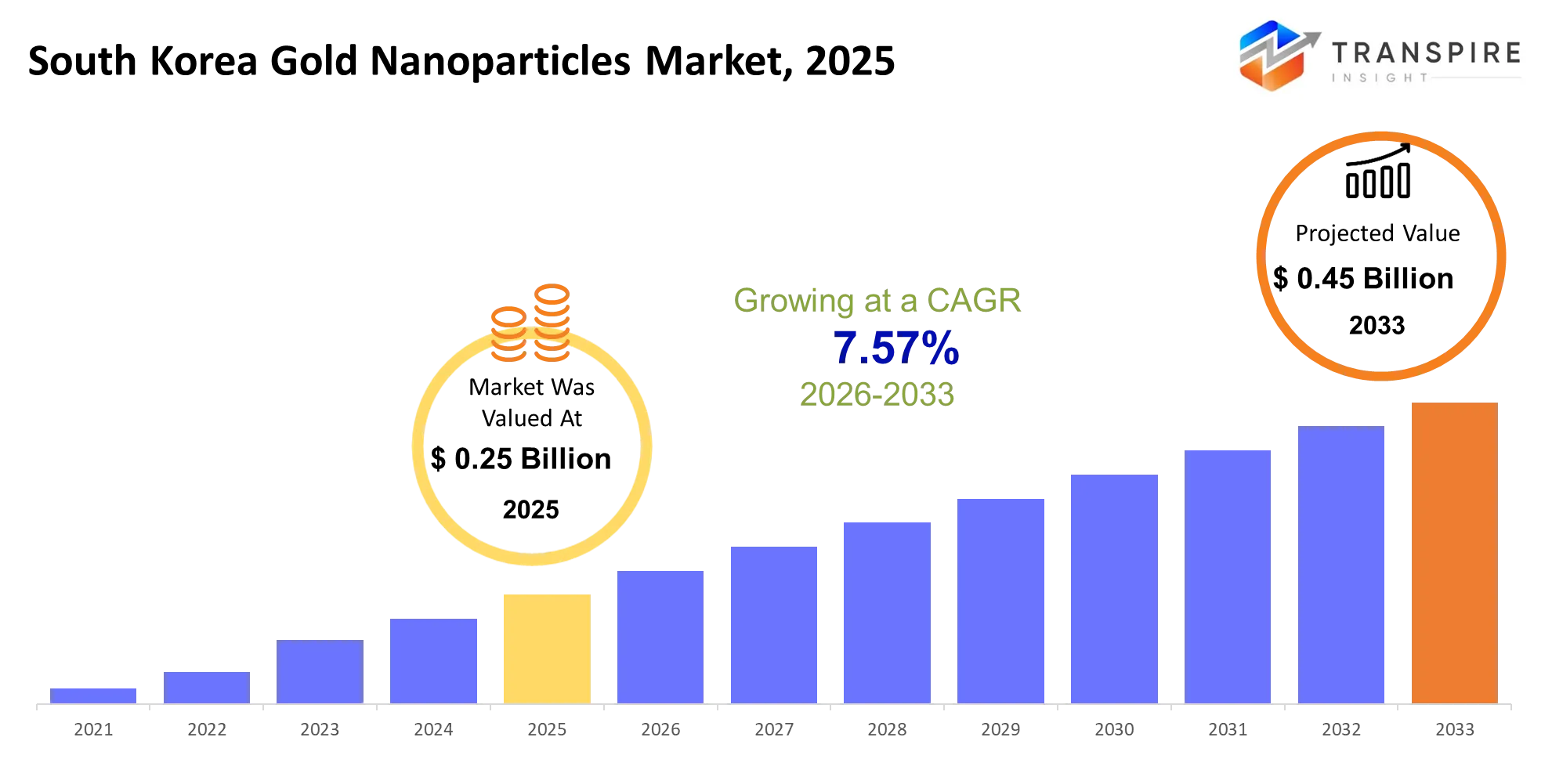
Market Snapshot
- Market Value (2025): USD 0.25 Billion.
- Expected Market Value (2026): USD 0.27 Billion.
- Estimated Market Value (2033): USD 0.45 Billion.
- Forecast CAGR (2026–2033): 7.57%.
Introduction
South Korea Gold Nanoparticles Market includes the production, innovation, distribution, and implementation of gold nanoparticles (AuNPs) within biomedical, diagnostics, electronics, sensors, photonics, energy, and advanced materials sectors. AuNPs have unique optical, electric, catalytic, and surface properties that make them applicable in biosensors, medical diagnostics, drug delivery research, photothermal processes, conductors, and advanced sensors. The existence of robust semiconductor industry, well-developed healthcare industry, nanotechnology research capacity, and burgeoning biotechnology industry within South Korea makes it an ideal market for AuNP. Research activities and development supported by the government on nanotechnology and advanced medical devices would drive the market growth. The increasing need for high performance materials, accurate diagnostics, miniaturized electronics, and functional nanomaterials would drive the market growth.
Key Market Highlights: -
- By Size, the50–100 nm segmentdominated the market and holds approximately 45% share in 2025 and is projected to grow at a substantial CAGR during the forecast period.
- By Shape, the Spherical dominated the market and holds approximately 57% share in 2025 and is projected to grow at a substantial CAGR during the forecast period.
- By Application, the Metering Units Manufacturers segment dominated the market and holds approximately 78% share in 2025 and is projected to grow at a substantial CAGR during the forecast period.
- The government-driven activities in South Korea related to nanotechnology, research and development of advanced materials, biotechnology, and semiconductors are speeding up the innovation, commercialization, and need for gold nanoparticles.
How is Technology Driving Growth in the South Korea Gold Nanoparticles Market?
The use of technology is enhancing the South Korea Gold Nanoparticles Market via precise nanoparticle production, surface modification, plasmonic detection, diagnostics, and materials science. Gold nanoparticles help in creating sensitive biosensors, diagnostic tools, optics, conductive materials, and new applications in biomedicine. The robust semiconductor industry, biotechnology industry, and advanced materials in South Korea offer a well-established platform for their commercialization. Government-funded nanomaterials initiatives are helping in the development of advanced materials, while AI-driven materials science research is facilitating research & development processes and technology discovery. These technological innovations are driving the demand for highly purified and specialized gold nanoparticles.
Market Drivers
Key factors driving growth in the South Korea Gold Nanoparticles Market include biomedical research, diagnostic tests, electronics innovations, nanotechnology developments supported by the government, and sustainable synthesis of AuNPs. The rise in need for biosensors, diagnostic tools, imaging techniques, and functionalized nanoparticles is increasing AuNP usage in various healthcare and life science applications. The presence of an advanced semiconductor and electronics industry in South Korea also facilitates potential application of gold nanoparticles in sensing and conducting materials and other specific applications in electronics. Government spending on nanotechnology and advanced materials is enhancing the research and commercialization of AuNPs in South Korea. Green synthesis processes are prompting innovation in the sustainable synthesis of AuNPs.
Restrain
South Korea Gold Nanoparticles Market will be limited by the challenges arising from the high cost of gold, complexity of synthesis and purification processes, health risks associated with nanoparticle safety, environmental issues, and regulatory challenges. Differing sizes, morphologies, surface chemistry, and exposure conditions of particles can affect their biological performance, making characterization and validation of particles a necessity. Moreover, demanding requirements in biomedical and diagnostic use cases can lengthen the product development process and add costs.
|
Driver |
Relative Impact on Growth (%) |
Geographic Relevance |
Impact Timeline |
Demand Strength |
Growth Mechanism |
Key Beneficiaries |
Major Constraint |
|
Driver 1: Rising Biomedical and Diagnostic Applications |
28% |
Seoul Capital Area, Daejeon, major biotechnology clusters |
Short-term |
High |
Expands biosensing, imaging, diagnostics, and targeted therapeutic applications. |
Nanoparticle manufacturers, biotech firms, diagnostic companies, research institutions |
High validation costs and stringent medical approval requirements |
|
Driver 2: Semiconductor and Advanced Electronics Development |
24% |
Gyeonggi, Seoul, Chungcheong |
Medium-term |
High |
Enables nanoscale sensing, conductive materials, photonics, and advanced electronic components. |
Electronics manufacturers, semiconductor firms, material suppliers, technology vendors |
Integration complexity and stringent semiconductor purity requirements |
|
Driver 3: Government Nanotechnology and Materials R&D Investment |
20% |
Nationwide, with major research hubs |
Short-term |
High |
Accelerates commercialization through funded nanomaterials research and technology development. |
R&D institutes, universities, nanoparticle producers, technology developers |
Long commercialization cycles and uncertain research-to-market conversion |
|
Driver 4: Growth of Biosensors and Point-of-Care Diagnostics |
16% |
Seoul, Daejeon, Gyeonggi |
Medium-term |
High |
Improves assay sensitivity through gold nanoparticle optical and surface properties. |
Diagnostic manufacturers, healthcare providers, laboratories, sensor developers |
Reimbursement limitations and clinical validation requirements |
|
Driver 5: Expansion of High-Performance Functional Nanomaterials |
12% |
Gyeonggi, Chungcheong, Busan |
Long-term |
Medium |
Broadens applications across catalysis, coatings, sensors, energy, and specialty materials. |
Specialty chemical firms, material manufacturers, industrial users, technology suppliers |
High production costs and nanoparticle handling concerns |
Analysis of Prices and Consumer Behaviour
The market for gold nanoparticles in South Korea is one where there is intense demand for gold nanoparticles that have high levels of purity and are engineered to perfection, and where the primary uses include biomedical diagnostics, biosensing, electronics, photonics, and advanced materials uses. The prices of high quality standardized gold nanoparticles are usually higher than conventional gold nanoparticles due to the fact that the manufacturing process requires controlled synthesis, accurate size distribution, surface modification, rigorous characterization, and consistency in quality per batch of the nanoparticles produced. Spherical gold nanoparticles constitute one of the most critical classes of gold nanoparticles due to the wide range of applications from research, diagnostics, sensing to biomedical uses. The industries of biomedical, diagnostic and advanced electronics make up some of the major markets, facilitated by the advanced biotechnology, semiconductor, and nanotechnology sectors in South Korea.
|
Company |
Est. Revenue Share Range |
Key Offerings |
Strategic Positioning |
Geographic Strength |
Technology Focus |
|
Merck KGaA (Sigma-Aldrich) |
12–16% |
Gold nanospheres; citrate-stabilized AuNPs; PBS-stabilized AuNPs; gold nanorods |
Broad catalog leadership across research applications |
Asia Pacific, North America, Europe |
Monodisperse AuNPs, surface chemistry, plasmonics |
|
nanoComposix |
9–13% |
Gold nanospheres; nanorods; nanoshells; diagnostic gold conjugates |
Diagnostics-focused technology and customization |
North America, Asia Pacific, Europe |
Precision synthesis, conjugation, optical engineering |
|
Nanocs |
7–11% |
Spherical AuNPs; PEG-coated AuNPs; dextran-coated AuNPs; functionalized particles |
Functionalized nanoparticle specialization |
North America, Asia Pacific, Europe |
Surface functionalization, bioconjugation, monodispersity |
|
TANAKA Precious Metals |
6–9% |
Gold colloids; citrate gold nanoparticles; diagnostic materials; biosensor materials |
Precious-metals expertise with high-purity positioning |
Asia Pacific, North America, Europe |
High-purity colloids, controlled synthesis, diagnostics |
|
Cytodiagnostics |
5–8% |
Standard AuNPs; activated AuNPs; gold conjugates; gold nanourchins |
Biomedical nanoparticle specialization |
North America, Asia Pacific, Europe |
Surface activation, bioconjugation, nanostructure engineering |
|
Nanopartz |
4–7% |
Gold nanospheres; nanorods; nanostars; nanocubes |
Specialty gold nanomaterial diversification |
North America, Asia Pacific, Europe |
Shape-controlled nanoparticles, plasmonics, functionalization |
|
BBI Solutions |
3–6% |
Colloidal gold; gold conjugates; antibody-gold labels; diagnostic reagents |
Diagnostic reagent and conjugate specialization |
Europe, North America, Asia Pacific |
Colloidal gold, antibody conjugation, lateral-flow diagnostics |
|
Creative Diagnostics |
2–5% |
Colloidal gold labels; gold nanoparticles; diagnostic particles; assay components |
Integrated diagnostic-material supplier |
North America, Asia Pacific, Europe |
Gold labeling, immunoassays, lateral-flow platforms |
|
Golden Crow Co., Ltd. |
2–4% |
Colloidal gold; spherical AuNPs; rod-shaped AuNPs; customized colloids |
Korean niche supplier with customization strategy |
Asia Pacific, South Korea |
Size control, shape control, customized colloidal synthesis |
|
Bangs Laboratories |
1–3% |
Gold nanoparticles; gold microspheres; functionalized particle systems; assay particles |
Specialty particle supplier through Korean distribution |
North America, Asia Pacific, Europe |
Particle engineering, functionalization, assay development |
Who are the Key Players in the South Korea Gold Nanoparticles Market and how do they compete?
International competitiveness in South Korea Gold Nanoparticles Market is dependent on companies focused on the innovations of technology, industry-specific solutions, and distribution network development on an international level. Competition not on the price but on the basis of high purity nanoparticles, advanced technology synthesis, functionalized solutions, and biomedical, diagnostic, electronic, and research applications, such a competition approach allows reaching constant product development and helps companies gain better precision, consistency, application performance, and efficiency.
The advanced development of gold nanoparticles, functionalized nanomaterials, synthesis technology, and application-specific solutions enables NanoComposix to strengthen its market position. The development of high-performance gold nanoparticles, which are used for biomedical, diagnostic, biosensing, and research purposes, makes Cytodiagnostics distinguishable from other players. BBI Solutions strengthens its market position through the provision of integrated solutions in gold nanoparticles, diagnostic reagents, bioconjugation, and life science applications to help customers improve the performance and efficiency of their assays.
Top Companies in the South Korea Gold Nanoparticles Market
- NanoComposix
- Cytodiagnostics
- BBI Solutions
- Tanaka Precious Metals
- Nanopartz
- Sigma-Aldrich/Merck
- Thermo Fisher Scientific
- FUJIFILM Wako
- Nanocs
- Nanophase Technologies
- LG Chem
- Samsung Electronics
- SK Innovation
- Amorepacific
- Korea Institute of Science and Technology
South Korea Gold Nanoparticles Market Segmentation
The South Korea Gold Nanoparticles Market share is divided into six categories: By Size, By Shape, By Application, By Synthesis Method, By Functionalization, By End User
The 50–100 nm segment dominated the market, accounting for nearly 45% in 2025 and is expected to rise at a significant CAGR during the forecast period.
The South Korea Gold Nanoparticles Market is segmented by size into below 10 nm, 10–20 nm, 20–50 nm, 50–100 nm, 100–200 nm, above 200 nm, nanoclusters, custom sizes. Among these, the50–100 nm segmentsegment dominated the market, accounting for nearly 45% in 2025 and expected to increase at a significant CAGR during the forecast period. The selection of the segment is justified by its high relevance for biosensing and diagnostic purposes, drug delivery studies, and biomedical applications, thus ensuring high market demand within the healthcare and life science industry sectors.
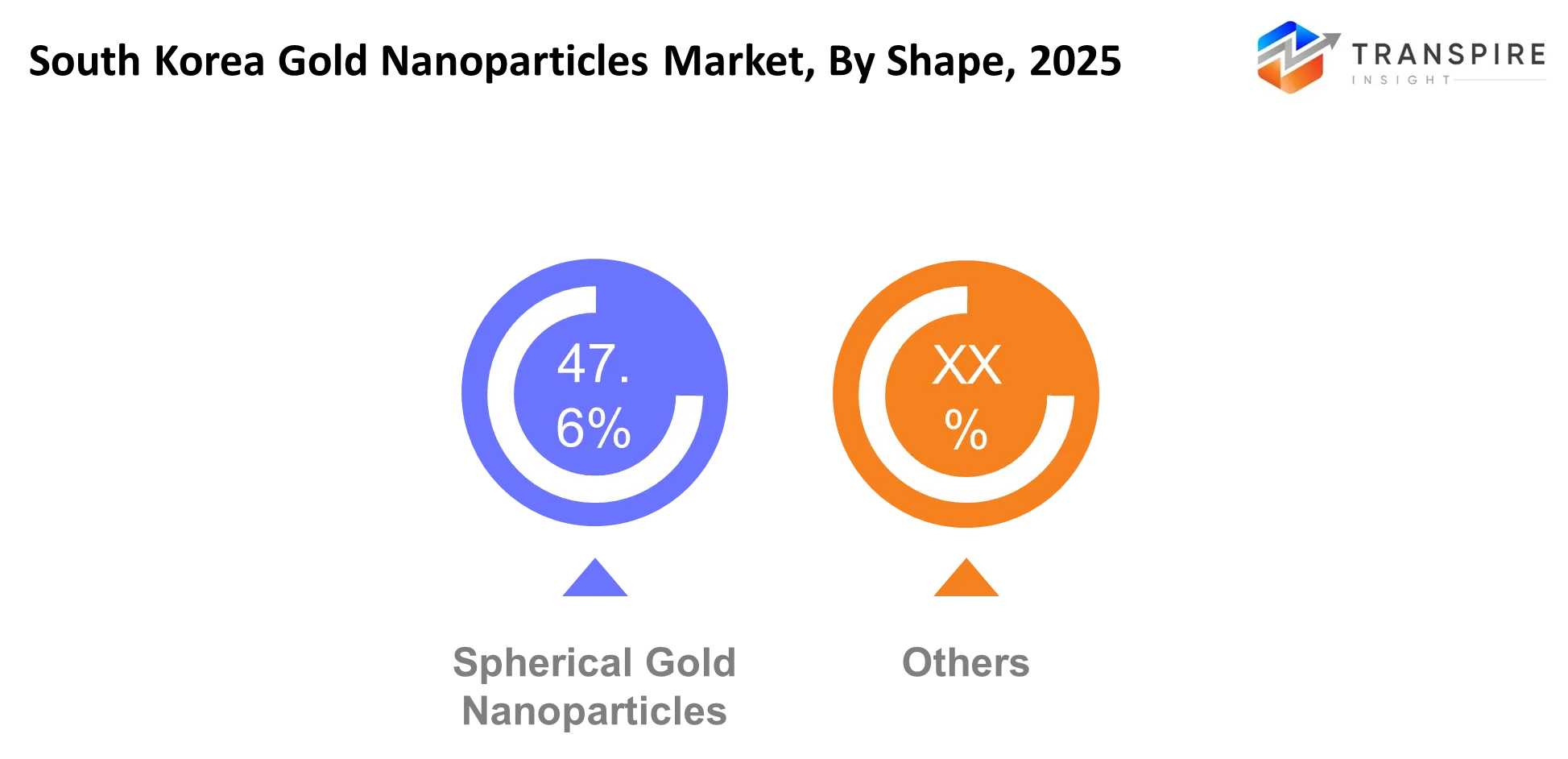
The Spherical dominated the market, accounting for nearly 57% in 2025, and is expected to rise at a significant CAGR during the forecast period.
The South Korea Gold Nanoparticles Market is segmented by shape into spherical, rods, stars, triangles, shells, cubes, bipyramids, other shapes. Among these, the Spherical dominated the market, accounting for nearly 57% in 2025 and expected to increase at a significant CAGR during the forecast period. Spherical gold nanoparticles possess great potential for different functionalization options, uniform optical properties, and a wide range of application in diagnostics, biosensing, biomedical research, and electronic devices.
The Metering Units dominated the market, accounting for nearly 78% in 2025 and is expected to rise at a significant CAGR during the forecast period.
The South Korea Gold Nanoparticles Market is segmentedby application into diagnostics, drug delivery, biosensing, electronics, catalysis, imaging, photonics, cosmetics. Among these, the Metering Units dominated the market, accounting for nearly 78% in 2025 and expected to increase at a significant CAGR during the forecast period. The choice of metering units is explained by their high relevance for utility installations, necessity of measurements, and increasing implementation of smart metering solutions.
Future Market Trends for the South Korea Gold Nanoparticles Market: -
- Nanomedicine and Diagnostics Growth: The increasing use of gold nanoparticles in biosensors, diagnostics, drug delivery systems, and biomedical research is anticipated to stimulate market demand.
- Advanced Electronics and Semiconductors: The growth of the semiconductor, photonic, sensing, and advanced materials industries is anticipated to lead to increased use of gold nanoparticles in electronics applications.
- Sustainable Nanotech and Greener Synthesis: Increasing sustainability focus in nanotechnology, environmentally friendly materials, and advanced synthesis techniques is anticipated to spur development of green gold nanoparticles.
Recent Development
- In March 30, 2026 – Launch of Nano Printing Technique: Researchers from KAIST launched a nano printing technique that will be used for fine metal circuits for wearable devices for healthcare and bioelectronics.
- In April 27, 2026 – Research and Development on Nanomaterials: South Korea started 2026 nanomaterials research and development focusing on artificial nanomaterials, nano-bio hybrid, and advanced nanotechnology.
- In February 5, 2026 – Green Nanoparticle Production: Novel studies revealed that gold nanoparticles can be produced biologically in a green manner.
Market Segmentation
This study forecasts revenue at Japan, regional and country levels from 2020 to 2033. Transpire Insight has segmented the South Korea Gold Nanoparticles Market based on the below-mentioned segments:
South Korea Gold Nanoparticles Market, By Size
- Below 10 nm
- 10–20 nm
- 20–50 nm
- 50–100 nm
- 100–200 nm
- Above 200 nm
- Nanoclusters
- Custom Sizes
South Korea Gold Nanoparticles Market, By Shape
- Spherical
- Rods
- Stars
- Triangles
- Shells
- Cubes
- Bipyramids
- Other Shapes
South Korea Gold Nanoparticles Market, By Application
- Diagnostics
- Drug Delivery
- Biosensing
- Electronics
- Catalysis
- Imaging
- Photonics
- Cosmetics
South Korea Gold Nanoparticles Market, By Synthesis Method
- Chemical Reduction
- Citrate Reduction
- Seed-Mediated Growth
- Green Synthesis
- Laser Ablation
- Electrochemical Synthesis
- Biological Synthesis
- Microemulsion
South Korea Gold Nanoparticles Market, By Functionalization
- Unmodified
- PEGylated
- Antibody-Conjugated
- DNA-Functionalized
- Protein-Functionalized
- Polymer-Coated
- Ligand-Functionalized
- Other Surface Modifications
South Korea Gold Nanoparticles Market, By End User
- Pharmaceutical Companies
- Biotechnology Companies
- Electronics Manufacturers
- Research Institutes
- Hospitals
- Chemical Companies
- Universities
- Diagnostic Companies
Frequently Asked Questions
Find quick answers to common questions.
Biomedical research, advanced diagnostics, semiconductor applications, nanotechnology development, sustainable synthesis, and government-supported research initiatives are driving market growth across South Korea.
Spherical gold nanoparticles dominate due to versatile functionalization, uniform optical properties, and broad applications across diagnostics, biosensing, biomedical research, and electronics.
Gold nanoparticles are widely applied in diagnostics, drug delivery, biosensing, electronics, catalysis, imaging, photonics, and cosmetics across South Korea.
Nanomedicine expansion, advanced semiconductor applications, sustainable synthesis, greener nanotechnology, and innovative biomedical technologies are expected to shape future market development.
Recent developments include nano-printing technologies, nanomaterials research programs, and green nanoparticle production studies supporting healthcare, bioelectronics, and sustainable nanotechnology applications.
- NanoComposix
- Cytodiagnostics
- BBI Solutions
- Tanaka Precious Metals
- Nanopartz
- Sigma-Aldrich/Merck
- Thermo Fisher Scientific
- FUJIFILM Wako
- Nanocs
- Nanophase Technologies
- LG Chem
- Samsung Electronics
- SK Innovation
- Amorepacific
- Korea Institute of Science and Technology
About the Authors

Avinash Kumar
I’m Avinash Kumar, a Senior Research Analyst at Transpire Insight, with expertise in the Electronics and Semiconductor and Energy & Power industry. My work focuses on analyzing emerging technologies, market trends, industry developments, and innovation across these sectors. I specialize in transforming complex technical and market insights into clear, research-backed content that helps professionals, businesses, and decision-makers stay informed. Through continuous industry research and data-driven analysis, I strive to deliver accurate, reliable, and practical perspectives on the latest advancements shaping the semiconductor and energy landscape.

Chakradhar Khansole
Chakradhar serves as the Research Director at Transpire Insight, bringing over 8 years of experience in technology, innovation, and strategic market intelligence. He specializes in transforming complex market data into actionable business insights that enable organizations to make informed, growth-oriented decisions. Recognized for his strategic vision and analytical expertise, Chakradhar leads high-impact research initiatives, delivering comprehensive market assessments, competitive intelligence, and forward-looking industry analysis.
Recently Published Reports
-
Apr 2026
Fiber Optic Faceplates Market
Fiber Optic Faceplates Market Size, Share & Analysis Report By Type (< 300 mm2, 300-350 mm2, and > 350 mm2, By Application (Night Vision, Holographic Imaging, Medical, and Others), and Geography (North America, Europe, Asia-Pacific, Middle East and Africa, South and Central America), 2021 - 2031
-
Apr 2026
High Temperature Superconductors Market
High Temperature Superconductors Market Size, Share & Analysis Report By Type (1G HTS, and 2G HTS), By Application (Power Cable, Fault Current Limiter, and Transformer), and Geography (North America, Europe, Asia-Pacific, Middle East and Africa, South and Central America), 2021 - 2031
-
Apr 2026
Industrial Plugs and Socket Market
Industrial Plugs and Socket Market Size, Share & Analysis Report By Type (Industrial Plugs, Industrial Sockets), By Current (Up to 32 A, 32 to 125 A, Above 125 A), By Protection (Dustproof and Splash Proof, Waterproof, Explosion Proof), By End User (Heavy Industries, Oil and Gas, Chemicals and Pharmaceuticals, Power Generation, Others), and Geography (North America, Europe, Asia-Pacific, Middle East and Africa, South and Central America), 2021 - 2031
-
Apr 2026
InGaAs Avalanche Photodiodes Market
InGaAs Avalanche Photodiodes Market Size, Share & Analysis Report By Type (1100 - 1700 nm, and 1000 - 1600 nm), By Application (Missile Warning System, Muzzle Flash Detection, Wafer Defect Inspection, Laser Rangefinders, and Others), and Geography (North America, Europe, Asia-Pacific, Middle East and Africa, South and Central America), 2021 - 2031