South Korea Drone Delivery Services Market Summary:
According to Transpire Insights, a detailed research report on the market reflects that the hardware component segment dominates the South Korea Delivery Drones Market, accounting for approximately 60.0% of market revenue in 2023. The South Korea Delivery Drones Market generated approximately USD 26.5 million in 2023 and is projected to reach USD 387.0 million by 2030, expanding at a 46.7% CAGR from 2024 to 2030, supported by increasing autonomous delivery adoption, commercial drone deployment, and logistics modernization.
Market Snapshot
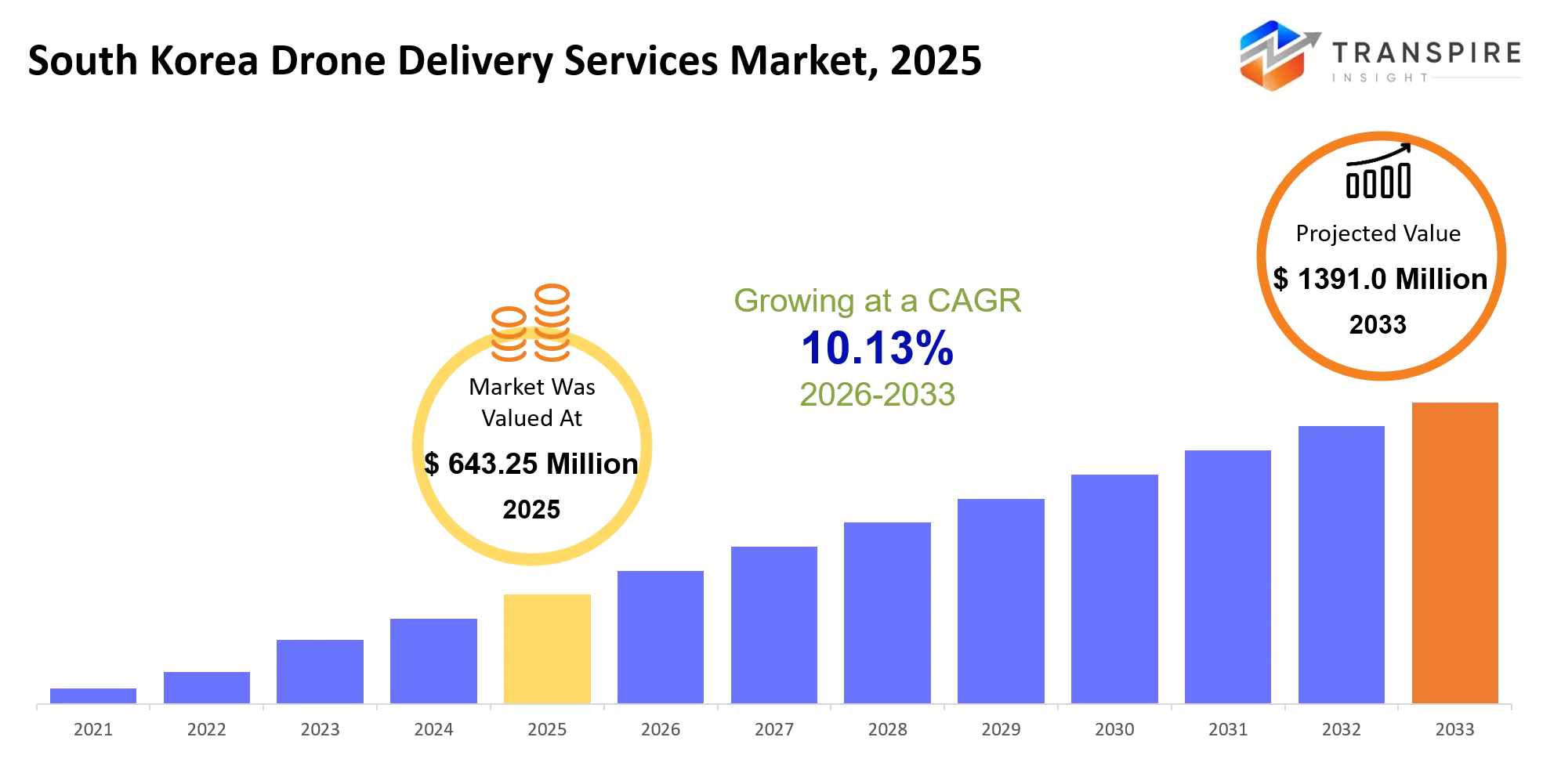
- Market Value (2025): USD 643.25 Million.
- Expected Market Value (2026): USD 708.0 Million.
- Estimated Market Value (2033): USD 1391.0 Million.
- Forecast CAGR (2026–2033): 10.13%
Introduction
The drones delivery services market is defined as revenues generated from UAVs to deliver cargo as a part of the logistics chain. It encompasses both scheduled and demand-driven deliveries of small cargo loads such as food, retail packages, and medical supplies. Drones Delivery Services is the utilization of unmanned aerial vehicles (UAVs) also referred to as drones for transportation of small cargo loads such as food, retail packages, and medical supplies from the warehouses or retailers to customers' delivery addresses. There are considerable gains that the market for South Korea Drone Delivery Services can generate in logistics, e-commerce, and last-mile deliveries. Firstly, the speed with which drones move through the air can eliminate any time wastage due to road traffic, thus enabling deliveries to be made in a timely manner. Secondly, cost savings can be achieved by virtue of automation and decreased reliance on traditional modes of transport and manpower. Thirdly, safety is increased through minimizing the ground traffic in crowded pedestrian and road traffic environments. Finally, there are considerable environmental gains to be made by utilizing electric drones over fossil fuel-based delivery methods.
Key Market Highlights: -
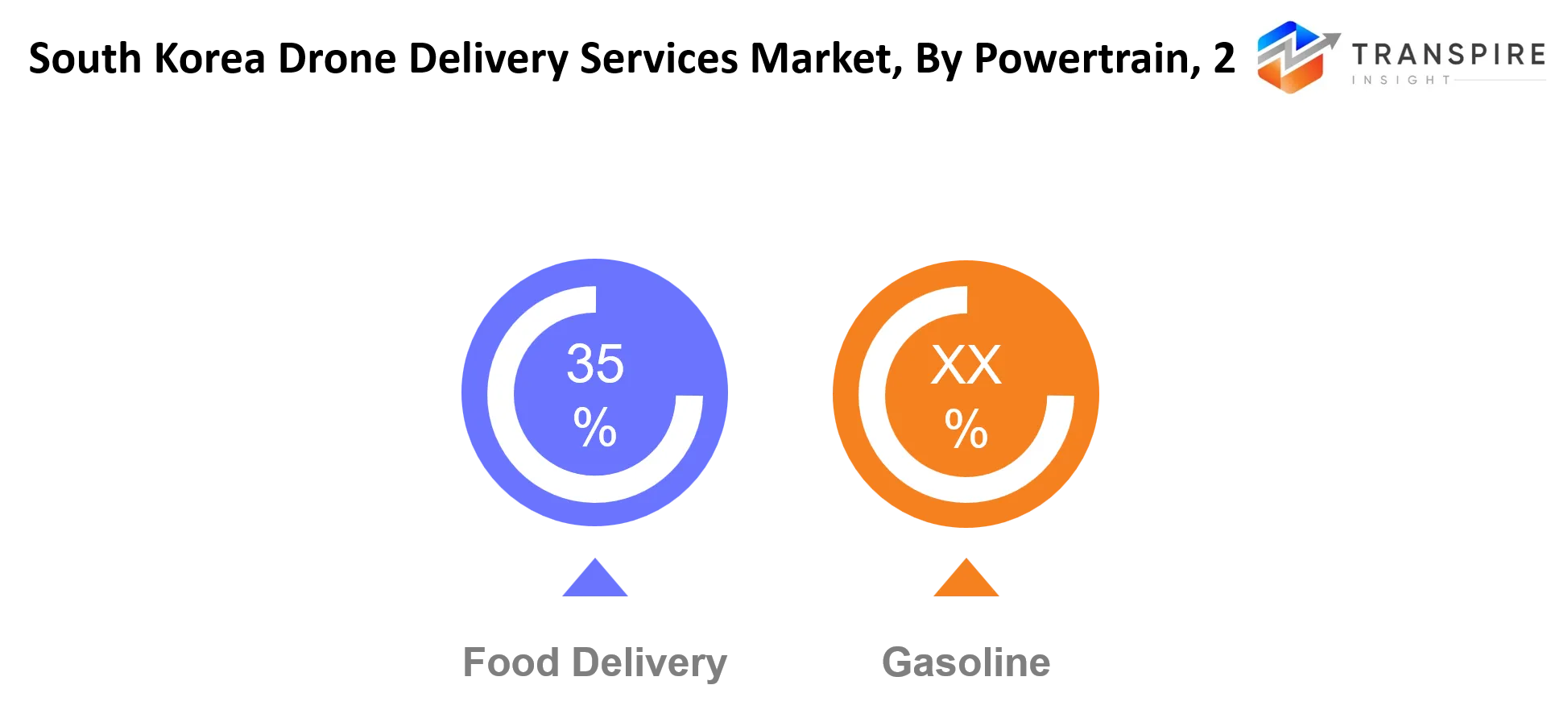
- By drone type, the Multirotor segment dominated the market and holds nearly 72 % share in 2025 and is projected to grow at a substantial CAGR during the forecast period.
- By application, the E-Commerce segment dominated the market and holds nearly 51 % share in 2025 and is projected to grow at a substantial CAGR during the forecast period.
- By end user, the Retail & E-Commerce segment dominated the market and holds nearly 32 % share in 2025 and is projected to grow at a substantial CAGR during the forecast period.
- Initiatives by the Government: The market for Drone Delivery Services Market in South Korea is boosted by projects like the Drone Demonstration City Project, K-Drone Delivery Service, and Drone Special Free Zones initiated by MOLIT. By 2024, services were extended to 32 islands, 17 parks, and one port in the country.
How is Technology Driving Growth in the South Korea Drone Delivery Services Market?
Innovations in battery technology, payload capability, 5G network, artificial intelligence, and autonomous navigation drive development in the South Korea Drone Delivery Services Market. Innovations in battery and propulsion technologies increase the range of operations and allow carrying payloads weighing more than those that can be carried by commercially used drones funded by the government. The use of advanced communication systems ensures that data can be transferred safely and enables efficient fleet management from any remote location. Artificial intelligence allows autonomous flight path planning, obstacle recognition, collision prevention, and precision routes. In addition, South Korea is developing drone-robotic integration, which has been shown to carry loads up to 40 kg and deliver them autonomously using robotic delivery vehicles.
Market Drivers
The South Korea Drone Delivery Services Market is being propelled by certain structural and technological forces. With the growth of e-commerce, the need for fast and flexible last mile deliveries has been growing significantly. Government support through drone cities, drone commercialization and regulatory measures is pushing forward actual implementation of drone delivery solutions. Geographic availability is one more driver, because drone deliveries may help to reach islands and areas with constrained transport. Urban logistics optimization is leading to the development of airborne deliveries that will decrease the dependency from the crowded land transport. Also, improvements in the area of autonomous navigation, fleet management, safety systems and drone infrastructure have been made. There exist a number of favorable structural factors that favor the development of South Korea Drone Delivery Services Market. Regulations and drone commercialization activities from the government are aiding in the formation of delivery routes, demonstration zones, and operational frameworks. The use of advanced technology such as wide coverage of the 5G network supports low latency communication for the operation of drones and management of the drone fleets. There is an increased population of e-commerce sites in South Korea and high demand from consumers for speedy delivery services which makes for favorable conditions for last-mile logistics through the air especially in the cities.
Restrain
The Market for South Korea Drone Delivery Services is subject to complicated regulatory frameworks, high costs for equipment setup, and operation problems. Difficulties of access to airspace and permits will affect the implementation process of the commercial aspect of the business. Public opinion about noise, privacy, and security might limit the application in residential areas. Furthermore, the bad weather and battery capacity can influence the range of flights.
|
Driver |
Relative Impact on Growth (%) |
Geographic Relevance |
Impact Timeline |
Demand Strength |
Growth Mechanism |
Key Beneficiaries |
Major Constraint |
|
Government-led drone commercialization and demonstration programs |
26% |
Nationwide; islands, parks, ports |
Short-term |
High |
Expands approved routes and accelerates commercial deployments |
Drone operators, manufacturers, logistics providers, municipalities |
Regulatory approval complexity |
|
Rapid e-commerce and last-mile delivery demand |
24% |
Seoul, Gyeonggi, Busan, major urban centers |
Short-term |
High |
Increases demand for faster automated last-mile fulfillment |
E-commerce platforms, retailers, logistics companies, consumers |
Limited urban operating corridors |
|
Autonomous navigation, AI and fleet-management technologies |
20% |
Nationwide; urban logistics hubs |
Medium-term |
High |
Improves autonomous routing, safety, and fleet scalability |
Drone OEMs, AI vendors, logistics operators |
Technology integration costs |
|
5G connectivity and smart logistics infrastructure |
16% |
Metropolitan areas and connected logistics zones |
Medium-term |
High |
Enables low-latency control and real-time fleet monitoring |
Telecom operators, drone service providers, logistics firms |
Network coverage and integration costs |
|
Demand for remote-area, medical and emergency deliveries |
14% |
Islands, rural areas, coastal communities |
Long-term |
Medium |
Provides reliable delivery where conventional logistics face access constraints |
Healthcare providers, municipalities, emergency services, communities |
Weather and payload limitations |
Analysis of Prices and Consumer Behaviour
It should be noted that the hardware segment holds the largest share in the South Korea Drone Delivery market in 2023, making up about 60.0% of total revenue in the market due to high demand for delivery drones, navigation system, propulsion systems, and other physical devices necessary for business operation. The South Korea Drone Delivery Market is estimated to generate around USD 26.5 million in 2023 and will reach USD 387.0 million by 2030, demonstrating the 46.7% CAGR from 2024 to 2030. It can be stated that the services are the most dynamically growing component segment in the South Korea Drone Delivery market owing to high demand for autonomous delivery operations, fleet management, monitoring, and logistic services.
Who are the Key Players in the South Korea Drone Delivery Services Market and how do they compete?
The Competition in South Korean Drone Delivery Services Market includes companies providing services related to autonomous flight technology, industry-specific logistic solutions, and creation of drone delivery networks across the entire country. In addition to competing according to the cost of services provided, organizations compete on the basis of autonomous delivery services, fleet management, BVLOS flights, unmanned traffic management, and integration of logistics and e-commerce systems. Such an approach to competition results in constant technological development, as well as allowing increasing efficiency, reliability, and visibility of deliveries provided by organizations.
Through development of autonomous drone delivery solutions, fleet management software, and unmanned traffic management solutions, PABLO AIR increases its competitive advantage. Companies differentiate themselves from the competitors by developing highly efficient delivery drones for usage in logistics, emergency medical transportation, island communities, quick commerce, and urban delivery applications. PABLO AIR creates its competitive advantage through development of integrated drone delivery solutions involving delivery aircraft, ground control systems, fleet management and autonomous logistics technologies for commercial drone delivery in South Korea.
Top Companies in the South Korea Drone Delivery Services Market
- Hyundai Motor Group
- CJ Logistics
- Korean Air
- Lotte Global Logistics
- Naver
- Kakao Mobility
- SK Telecom
- KT
- Hanwha Systems
- Doosan Mobility Innovation
- DJI
- Zipline
- Wing
- Amazon Prime Air
- Matternet
|
Company |
Est. Revenue Share Range |
Key Offerings |
Strategic Positioning |
Geographic Strength |
Technology Focus |
|
PABLO AIR |
12–18% |
Drone delivery platforms; PAMNet; L-FOMS; GCS; delivery drones |
Integrated drone delivery technology leadership |
South Korea; North America; Asia-Pacific |
AI swarm control, BVLOS, fleet management |
|
CJ Logistics |
8–14% |
CJ Sky-door; UAV fleet; parachute delivery; automated logistics |
Logistics-integrated service differentiation |
South Korea; Asia-Pacific; North America |
UAV logistics, AI automation, IoT monitoring |
|
Korean Air |
6–10% |
Unmanned aircraft; drone systems; aerospace solutions; PABLO partnership |
Aerospace-led ecosystem expansion |
South Korea; Asia-Pacific; North America |
Autonomous UAVs, aerospace systems, swarm AI |
|
Doosan Mobility Innovation |
4–8% |
Hydrogen drones; DS30W; DT30X; DMI View |
Long-endurance delivery specialization |
South Korea; North America; Europe |
Hydrogen fuel cells, BVLOS, cloud monitoring |
|
Lotte Global Logistics |
3–6% |
Drone parcel delivery; logistics networks; automated delivery |
Logistics-network diversification |
South Korea; Asia-Pacific |
Drone logistics, automation, delivery systems |
|
Hyundai Motor Group |
2–5% |
42air drone delivery; autonomous mobility platforms; UAM ecosystem |
Mobility ecosystem and autonomous logistics |
South Korea; North America; Asia-Pacific |
Autonomous mobility, aerial logistics, robotics |
|
SK Telecom |
1–3% |
5G drone connectivity; UAM communications; traffic-management support |
Connectivity and digital-infrastructure strategy |
South Korea; Asia-Pacific |
5G, AI, UAM communications, fleet connectivity |
|
KT |
1–3% |
5G connectivity; drone communications; digital infrastructure |
Telecom-enabled drone ecosystem development |
South Korea; Asia-Pacific |
5G, IoT, cloud, remote connectivity |
|
Kakao Mobility |
1–3% |
Mobility platform; UAM integration; logistics connectivity |
Platform/ecosystem integration |
South Korea; Asia-Pacific |
Mobility platforms, MaaS, AI routing |
|
Hanwha Systems |
0.5–2% |
UAM aircraft systems; CNSi; navigation/control; mobility infrastructure |
Aerospace and infrastructure-led diversification |
South Korea; North America; Europe |
Avionics, radar, CNSi, autonomous systems |
South Korea Drone Delivery Services Market Segmentation
The South Korea Drone Delivery Services Market share is divided into five categories: By drone type, payload, application, end user and operation.
The Multirotor dominated the market, accounting for nearly 72% in 2025 and is expected to rise at a significant CAGR during the forecast period.
The South Korea Drone Delivery Services Market is segmented by drone type into Multirotor, Fixed-Wing, Hybrid VTOL, Autonomous Drones, Cargo Drones, Heavy-Lift Drones, Small Delivery Drones. Among these, the Multirotor segment dominated the market, accounting for nearly 72% in 2025 and expected to increase at a significant CAGR during the forecast period. In 2025, the Multirotor category led the market owing to features such as greater maneuverability, VTOL, adaptability, and cost-efficient utilization. The potential of the Multirotor technology in the areas of surveillance, mapping, inspection, agriculture, and delivery will continue to be a key reason behind its popularity in the coming years. Demand for adaptable UAS will ensure CAGR growth in the coming years.
The E-Commerce dominated the market, accounting for nearly 51% in 2025, and is expected to rise at a significant CAGR during the forecast period.
The South Korea Drone Delivery Services Market is segmented by application into Food Delivery, E-Commerce, Medical Supplies, Grocery Delivery, Parcel Delivery, Emergency Supplies, Industrial Parts. Among these, the E-Commerce segment dominated the market, accounting for nearly 51% in 2025 and expected to increase at a significant CAGR during the forecast period. The E-Commerce segment ruled the market in 2025 because of fast adoption of digitization, more online retail platforms, convenience in purchase and greater consumer accessibility. The increasing use of smartphones, security in digital payment, personalization in shopping experience and efficient logistics are helping the online purchases grow faster.
The Retail & E-Commerce dominated the market, accounting for nearly 32% in 2025 and is expected to rise at a significant CAGR during the forecast period.
The South Korea Drone Delivery Services Market is segmented by end user into Retail & E-Commerce, Restaurants, Healthcare, Logistics, Government, Manufacturing, Agriculture. Among these, the Retail & E-Commerce segment dominated the market, accounting for nearly 32% in 2025 and expected to increase at a significant CAGR during the forecast period. The Retail & E-Commerce sector held a dominating position in the market during 2025 owing to factors such as the rise in digital retail distribution channels, the increasing consumer inclination towards convenient purchases, omnichannel approach, and high penetration rates of smartphones and the internet. Online transaction trends, personalized shopping experience, payment integrations, and effective fulfillment channels are contributing toward increased adoption.
Future Market Trends for the South Korea Drone Delivery Services Market: -
- Convenience Store and Retailing: Some of the major national convenience stores such as 7-Eleven are leading the way by conducting commercial experiments in which autonomous drones are used to deliver snacks and other essential products to distant destinations like campsites and pensions within minutes.
- Utilization of AI and Machine Learning: Operators are now increasingly incorporating artificial intelligence and machine learning technologies to optimize flight path in real time, avoid obstacles dynamically and handle emergencies automatically.
- 5G Network Integration: Using its exceptional telecommunications infrastructure, South Korea is now incorporating 5G network integration to enable real-time and low latency command and control of the autonomous delivery fleet.
- Governmental Framework and Incentives: The South Korean government is continuously liberalizing regulations, developing smart cities and providing incentives for research and development to make its nation a hub of drone logistics in Asia.
- Increased Payload and Range Capacity: Modern commercial drones are now enhancing battery and designing capabilities which enable heavy payloads (up to 7 kg) and longer range (up to 20 km).
Recent Development
- In September 2026: Miryang City implemented an outdoor drone delivery service spanning Sangmun-dong and Hanam-eup with eight pre-defined locations. The project was introduced within the framework of the Drone Demonstration City Project by the Ministry of Land, Infrastructure and Transport, which fills delivery deficiencies in the outdoor area in addition to building infrastructure in drone deliveries in South Korea.
- In May 2026: Drone deliveries during weekends have been made possible at Central Park in Seongnam city by combining robot transport of food items from restaurants to drones and making final delivery by drones. This is a clear example of a drone-robot integrated smart logistics that enhances autonomous delivery, last mile deliveries, and commercialization of South Korea Drone Delivery Services Market.
Market Segment
This study forecasts revenue at South Korea, regional and country levels from 2020 to 2033. Transpire Insights has segmented the South Korea Drone Delivery Services Market based on the below-mentioned segments:
South Korea Drone Delivery Services Market, By Drone Type
- Multirotor
- Fixed-Wing
- Hybrid VTOL
- Autonomous Drones
- Cargo Drones
- Heavy-Lift Drones
- Small Delivery Drones
South Korea Drone Delivery Services Market, By Payload
- Up to 2 kg
- 2–5 kg
- 5–10 kg
- 10–20 kg
- 20–50 kg
- 50+ kg
- Specialized Payload
South Korea Drone Delivery Services Market, By Application
- Food Delivery
- E-Commerce
- Medical Supplies
- Grocery Delivery
- Parcel Delivery
- Emergency Supplies
- Industrial Parts
South Korea Drone Delivery Services Market, By End User
- Retail & E-Commerce
- Restaurants
- Healthcare
- Logistics
- Government
- Manufacturing
- Agriculture
South Korea Drone Delivery Services Market, By Operation
- Autonomous
- Remote-Piloted
- Beyond Visual Line of Sight
- Visual Line of Sight
- Urban Delivery
- Rural Delivery
- Offshore Delivery
Frequently Asked Questions
Find quick answers to common questions.
The market is projected to reach USD 1,391 million by 2033, growing at a 10.13% CAGR.
Multirotor drones dominate with a 72% share, supported by maneuverability, VTOL capabilities, flexibility, and cost-efficient delivery operations.
E-Commerce leads with 51%, driven by digitalization, online shopping, smartphone penetration, convenient purchasing, and efficient last-mile logistics.
AI, machine learning, 5G, autonomous navigation, advanced batteries, and fleet-management systems enhance delivery efficiency, safety, and operational capabilities.
Key trends include autonomous delivery, 5G integration, drone-robot logistics, higher payload capacity, AI optimization, and government-supported commercialization initiatives.
- Hyundai Motor Group
- CJ Logistics
- Korean Air
- Lotte Global Logistics
- Naver
- Kakao Mobility
- SK Telecom
- KT
- Hanwha Systems
- Doosan Mobility Innovation
- DJI
- Zipline
- Wing
- Amazon Prime Air
- Matternet
About the Authors

Tejashri Dhatrak
I am Tejashri Dhatrak, a Senior Research Analyst at Transpire Insight, specializing in the Aerospace and Defence sector. My work focuses on analyzing industry trends, defence technologies, market developments, and emerging innovations that shape the global aerospace and security landscape. At Transpire Insight, I research complex topics, evaluate credible sources, and transform technical insights into accurate, well-structured, and easy-to-understand content for industry professionals and decision-makers. My goal is to provide reliable, research-backed information that helps readers stay informed about defence capabilities, aerospace advancements, strategic developments, and the evolving dynamics of the global defence ecosystem.

Chakradhar Khansole
Chakradhar serves as the Research Director at Transpire Insight, bringing over 8 years of experience in technology, innovation, and strategic market intelligence. He specializes in transforming complex market data into actionable business insights that enable organizations to make informed, growth-oriented decisions. Recognized for his strategic vision and analytical expertise, Chakradhar leads high-impact research initiatives, delivering comprehensive market assessments, competitive intelligence, and forward-looking industry analysis.
Recently Published Reports
-
Apr 2026
Aerospace Fluoropolymers Market
Aerospace Fluoropolymers Market Size, Share & Analysis Report By Type (PTFE, FEP, PFA, ETFE, and Others), By Application (Electrical Insulation, Seals & Gaskets, Coatings, and Others), By End User (Commercial Aviation, Military Aviation, General Aviation, and Others), and Geography (North America, Europe, Asia-Pacific, Middle East and Africa, South and Central America), 2021 - 2031
-
Apr 2026
Airborne SATCOM System Market
Airborne SATCOM System Market Size, Share & Analysis Report By Type (SATCOM Terminals, Transceivers, Airborne Radio, Modems and Routers, SATCOM Radomes, and Other), By Application (Government and Defense and Commercial), and Geography (North America, Europe, Asia-Pacific, Middle East and Africa, South and Central America), 2021 – 2031
-
Apr 2026
Ship Leasing Market
Ship Leasing Market Size, Share & Analysis Report By Vessel Type (Container Ships, Bulk Carriers, Tankers, and Specialized Vessels), By Lease Duration (Short-Term Lease (Less than 1 year), Medium-Term Lease (1-5 years), and Long-Term Lease (More than 5 years)), By Lease Type (Bareboat Charter, Time Charter, Financial Lease, and Others), By End-User Industry (Oil and Gas, Manufacturing and Industrial, Automotive, Agriculture and Food, Retail and Consumer Goods, and Others), and Geography (North America, Europe, Asia-Pacific, Middle East and Africa, South and Central America), 2021 – 2031
-
Apr 2026
Thread Rolling Dies Market
Thread Rolling Dies Market Size, Share & Analysis Report By Type (Flat Thread Rolling Dies, Circular (Cylindrical) Dies, Tangential Thread Rolling Dies, Planetary Thread Rolling Dies, and Other Types), By Material Type (High-Speed Steel (HSS), Carbide, Tool Steel, Alloy Steel, and Other Specialized Alloys), By Distribution Channel (Direct Sales, Distributors and Dealers, and Online Platforms), By Application (Automotive Industry, Aerospace and Defense, Construction and Infrastructure, Industrial Machinery, Electronics and Electrical Components, Medical Devices, and Fastener Production), and Geography (North America, Europe, Asia-Pacific, Middle East and Africa, South and Central America), 2021 – 2031
Our Clients