
South Korea Cocoa Butter Market Size & Forecast:
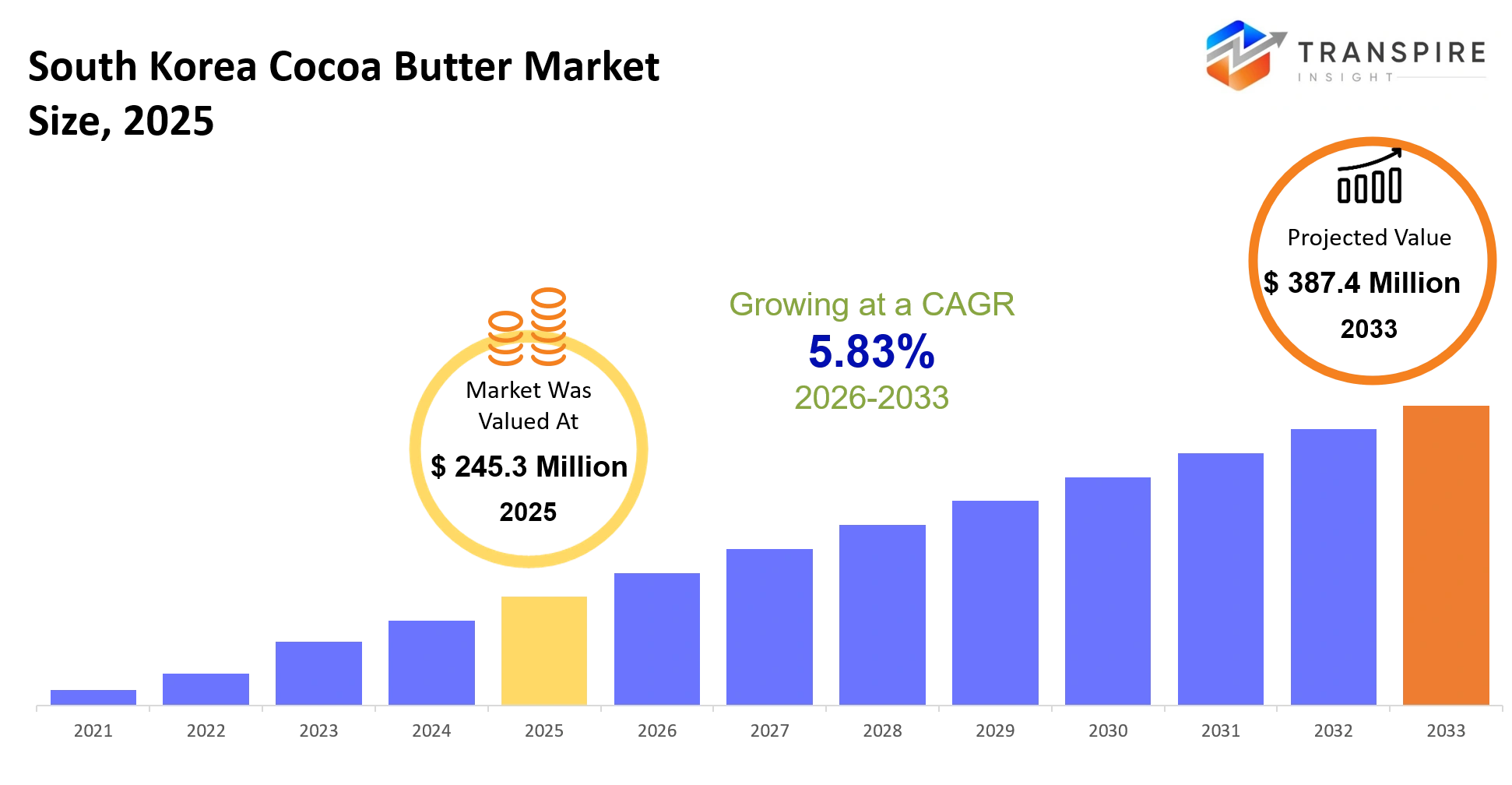
- South Korea Cocoa Butter Market Size 2025: USD 245.3 Million
- South Korea Cocoa Butter Market Size 2033: USD 387.4 Million
- South Korea Cocoa Butter Market CAGR: 5.83%
- South Korea Cocoa Butter Market Segments: By Type (Natural Cocoa Butter, Deodorized Cocoa Butter, Organic Cocoa Butter, Others); By Application (Chocolate, Confectionery, Bakery, Cosmetics, Others); By End User (Food Industry, Cosmetics Industry, Others); By Distribution (B2B, Retail, Online, Others)
To learn more about this report,  Download Free Sample Report
South Korea Cocoa Butter Market Summary
The South Korea Cocoa Butter Market was valued at USD 245.3 Million in 2025. It is forecast to reach USD 387.4 Million by 2033. That is a CAGR of 5.83% over the period.
In South Korea, the cocoa butter market sort of works like a key input layer for confectionery manufacturing and high performance skincare. It matters because the fat profile stays stable, which helps keep chocolate texture consistent. At the same time, it brings emollient benefits in creams, balms and some dermatological blends, you know, the kind that needs a smooth feel without too much fuss. Over roughly the last five years, the whole market has shifted in a noticeable way toward clean label products and sustainably sourced ingredients. That happened because cosmetics and food producers have been swapping away from synthetic options or palm derived alternatives, and choosing traceable cocoa based fats instead.
This change did not come from nowhere. It has been reinforced by supply side shocks, especially cocoa crop instability across West Africa. Because of that the global prices got jumpy, and the volatility got worse after 2023, which then messed up import planning, slightly. So in response, Korean manufacturers have leaned more heavily on long term sourcing agreements and higher value formulations, basically to lock in quality consistency rather than just hoping for it.
Taken together, the impact shows up as stronger integration of cocoa butter in premium K beauty products, along with more confectionery innovation. In the end, what looks like raw material scarcity gets turned into differentiated product positioning, better pricing power, and more resilient supply chain strategies, rather than plain disruption.
Key Market Insights
- Seoul Capital Region seems to dominate the South Korea Cocoa Butter Market, with almost 40% share in 2025, because of a rather strong mix of food processing activity and cosmetics pull that’s concentrated there .
- Meanwhile, urbanization keeps moving forward and that premium consumption trend is also still boosting demand in the biggest metropolitan areas across South Korea.
- Within the market, refined cocoa butter takes the lead , and it holds the largest portion—over 45%—mainly since it fits a broad set of food-grade uses.
- After that, deodorized cocoa butter sits as the second-largest segment, supported by its neutral flavor profile and its broad versatility for processed foods.
- On the faster side, organic and sustainably sourced cocoa butter is acting like the fastest-growing slice, and it’s projected to rise strongly through 2030, mostly tied to the clean-label demand that consumers keep asking for.
- Premium specialty cocoa butter variants are kinda gaining traction in high-end cosmetics and also in gourmet chocolate production overall, you know.
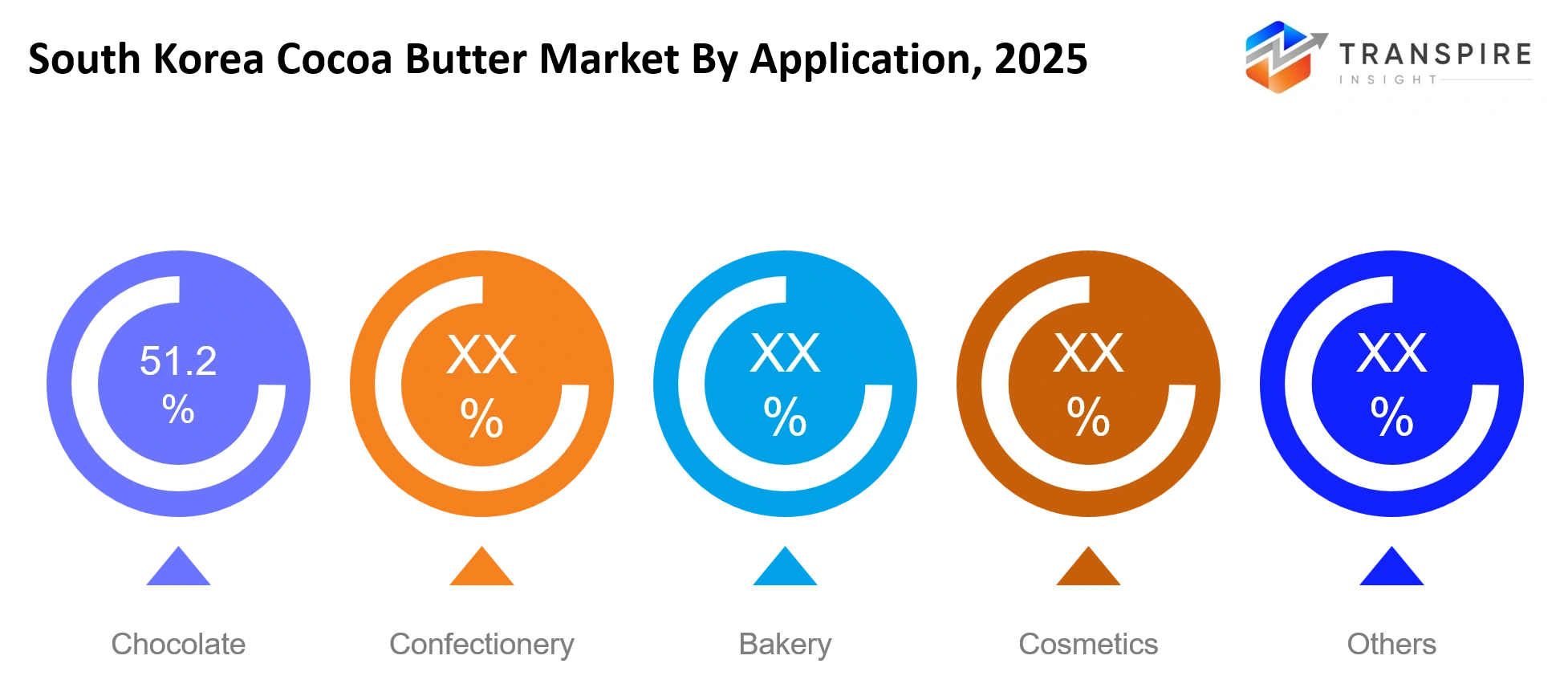
- Confectionery seems to dominate the market with about 50% share , mostly dragged along by solid chocolate consumption, plus bakery expansion across South Korea.
- Then cosmetics and personal care are, like, the fastest-growing application slice, powered by K-beauty premium skincare formulations that aim for a smoother feel, and dependable texture it’s sort of that reliable vibe.
- Bakery too, along with functional food uses, is growing steadily , because people keep reaching for natural fats and texture-enhancing components, even if the wording sounds a bit too polished.
- At the same time , nutraceutical use is popping up more often, supported by the gradual rise in health minded preferences, and the change feels slow but also very real.
What are the Key Drivers, Restraints, and Opportunities in the South Korea Cocoa Butter Market?
The South Korea Cocoa Butter Market is mostly driven by the fast premiumization of confectionery and cosmetics production. One big push behind it has been the move toward high-fat, clean label formulations in chocolate-making and K-beauty skincare items since 2022, after consumers started demanding more transparency and ingredient traceability, sort of stricter expectations. In practice this shift has nudged up cocoa butter use across local processors, because makers try to swap synthetic fats, or other blended fats, with more valuable natural cocoa butter. They do it to stand out and to keep export strength, mainly when selling into Japan and parts of Southeast Asia.
Still, there is this hard, structural limitation connected to raw cocoa butter import dependency and those price swings that show up, kinda suddenly. South Korea does not really grow cocoa beans on its own, so the supply chain kind of leans hard on imports, usually from West Africa, and also Southeast Asia. Then, when supply gets interrupted, climate conditions stay kind of uncharted, or logistics costs spike , pricing gets wobbly too, and not just a little.This kind of exposure is not something you can fix quickly, it then squeezes margins for mid tier manufacturers and also slows down longer term contract steadiness, especially for smaller and medium confectionery firms that, frankly, have trouble hedging ingredient costs effectively.
A big forward looking opportunity sits in pushing traceable, specialty cocoa butter sourcing, sorta linked up with blockchain-enabled supply chains. Ingredient suppliers are more and more piloting end-to-end traceability setups with Korean cosmetic and chocolate producers. The point is to certify origin, and also the quality, really. If this gets scaled through partnerships with firms like Barry Callebaut, and with regional distributors around Busan’s import hubs, it could open up premium pricing tiers, and also strengthen South Korea’s place in higher value functional chocolate and dermatological skincare exports.
What Has the Impact of Artificial Intelligence Been on the South Korea Cocoa Butter Market?
With the adoption of AI and modern digital technologies, the growth in the South Korea Cocoa Butter Market keeps getting a kind of boost, because manufacturing becomes more efficient, plus the quality control is better managed and the supply chain agility is more responsive. And yes, it sort of enhances things across food, as well as cosmetic production, where teams can coordinate faster and with that “smart” oversight.Automation systems run by artificial intelligence are now being adopted across all of the major refining processes including deodorizing, quality control, and temperature monitoring within processing facilities in an effort to further cut manual inputs, as well as improve batch homogeneity. Image processing systems utilizing AI are utilized to conduct quality control, which inspects for crystallization anomalies and inconsistencies in fat ratios that directly affect shelf life in chocolate and cosmetics products.
A trend of using predictive models is also on the rise, with the installation of ML algorithms that predict maintenance requirements through real-time equipment vibration, thermal data, and throughput rates. This has further decreased downtime for production by an approximate 10-15% and allowed for smoother and more stable production runs for major refineries and processing plants. An improvement in the utilization of raw material imports is also predicted due to the use of AI forecasting in a manner which aligns the timing of import shipments of African cocoa beans to a schedule for processing.
The implementation of AI systems is limited due to high installation costs and scattered legacy systems found among mid-sized manufacturers who often lack a history of updating equipment to modern standards. This causes some factories to use dated refining and storage equipment, which inhibits the adoption of these modern systems.
Key Market Trends
- South Korean processors moved away from combined vegetable oil alternatives, leading to a rise in cocoa butter imports from West Africa since 2023.
- Certified sustainable sourcing of cocoa butter, via expanded sourcing programs initiated by Barry Callebaut in 2024, was quickly adopted by the majority of Korean chocolate manufacturers.
- The demand for cosmetic use of cocoa butter in K-beauty products since 2022 rose by more than 20% as Korean cosmetic firms turned from synthesized emollients to cocoa butter in high-end beauty creams.
- A 2023 rise in AI driven refining control led to enhanced consistency in crystallization and reduced batch rejection rate for major Seoul-based processors.
- Cargill enhanced the digital tracking system for its supply chain in 2024 allowing for continuous, real time, tracking of cocoa butter shipments along various import routes across the Asia Pacific region.
- The need to serve the increasing demand from functional chocolates, along with dermatology grade applications, in 2025 led Wilmar International to develop enhanced specialized cocoa butter production capabilities.
- A rise in the export of products of a higher quality grade to Japanese markets since 2023 led Korean confectionery producers to focus on single-origin cocoa butter supply.
- Between 2023 and 2025 the usage of automated predictive maintenance reduced unplanned downtime in the processing sector by almost 12%.
- Manufacturers became more transparent regarding product composition and cocoa butter origin due to an increased stringent regulations of ingredient disclosures enacted since 2022.
South Korea Cocoa Butter Market Segmentation
Market By Type :
Natural cocoa butter remains very well established in chocolate & confectionery manufacturing sectors of South Korea owing to its constant fat constitution and predictable melting performance. Its preference in natural form by food manufacturers for regular recipes thus ensures a uniform and constant industrial demand for natural cocoa butter. Deodorised cocoa butter finds a prevalent application wherever the neutral taste and flavour profiles are crucial and necessary in the food sectors, i.e. Fillings of bakery and processed products. Particularly in bulk manufacturing units where constant uniformity across different production lots becomes paramount.
Organic cocoa butter continues gaining acceptance in premium quality cosmetic applications and also the niche speciality foods due to the inclination of manufacturers toward natural and clean ingredient alternatives. Requirement of certification and export based manufacturing of products and since 2022 the increased availability and awareness also driven the market. The demand for specialty processed cocoa butter or compounded cocoa butter is relatively small, though stable, due to customized development in applications, mainly cosmetic emulsions and premium confectioneries.
By Application :
Food application accounts for the majority of chocolate consumption owing to a flourishing domestic chocolate and confectionery sector supported by a growing export of processed cocoa. Cocoa butter acts as a texture stabiliser and emulsifier that imparts a smooth mouth feel to provide product quality consistency for various confectionery applications. Confectionery demand follows a strong seasonal pattern that coincides with the festive season and exports orders thereby aiding the raw material purchase planning for all major chocolate manufacturers. Bakery sector demand continues to be on an upturn as the demand for higher quality baked products and filled pastry products increases. Cocoa butter serves the purpose of moisture retention and product softness for multiple products manufactured in the industrial baking industry. The cosmetic sector is the fastest moving, largely because of the popularity of Korean Beauty products that utilize cocoa butter for their moisturizers and other body care items. Nutraceutical and special food processing applications of cocoa butter continue to strengthen as their functional properties help enhance the textures of various products.
To learn more about this report, Download Free Sample Report
By End User :
Food is the largest consuming sector due to mass cocoa, bakery, and confectioneries being produced throughout Korea. Manufacturers use cocoa butter to provide product uniformity and stability in fat. It improves the overall taste of food products. The supply system is still very regulated, where long term agreements provide stable supplies from international ingredient suppliers through import channels.
Cosmetics is a sector experiencing strong growth because of the increasing reliance of cosmetic makers in using cocoa butter as an ingredient for high end cream, lotion and barrier repairing products. Demand increases as formulators like to use natural emollients. Pharmaceutical and Specialty are other end use sectors, using cocoa butter as base ingredients for formulation control and texturizing effects.
By Distribution :
Market channels are predominantly through B2B as both food processors and cosmetic manufacturers purchase the commodity on a bulk basis and thus deal directly with food suppliers and distributors all over the world. ThroughBulk purchase systems, a stable flow of supply is guaranteed to manufacturing plants and the food processors that produce industrial sized quantities of cocoa butter.
Contract purchasing systems help the manufacturing plants have control over pricing and have good foresight over raw material acquisition over various plants in Korea. Retail distribution channels though, are scarce and largely catered towards smaller bakery business establishments and small independent chocolate producers that would only purchase on small scales. Online market distribution channels have increased steadily since 2003, catering towards boutique producers and exclusive cosmetics companies who wish to purchase on a smaller scale.
What are the Key Use Cases Driving the South Korea Cocoa Butter Market?
Chocolate production continues to be the predominant application for the South Korea Cocoa Butter Market, with major confectionery manufacturers requiring the product for textural stability, smooth melting profiles and uniform quality of the finished product. Stable buying habits of food manufacturers driven by solid domestic consumption and export-led chocolate manufacturing provide consistent sourcing to the food industry and constitute the leading demand for this application among industrial processors.
Growing applications are seen within Cosmetics and bakery product manufacturing where K-beauty skincare and premium bakery chains are utilizing cocoa butter as an additional component. The cosmetic sector uses cocoa butter for emollient and barrier repair applications, whereas bakery manufacturers add cocoa butter in fillings and coatings for softer texture and prolonged shelf-life; these are being explored mainly by mid-sized manufacturers opting for high-quality ingredient branding.
Emerging applications involve nutraceutical formulas and functional food products and researchers are testing cocoa butter as a natural fat base. Specialty health product manufacturers are testing the applications for energy-dense nutritional supplements and dermatological creams, supported by consumer trends toward natural ingredient based wellness products.
|
Report Metrics |
Details |
|
Market size value in 2025 |
USD 245.3 Million |
|
Market size value in 2026 |
USD 260.6 Million |
|
Revenue forecast in 2033 |
USD 387.4 Million |
|
Growth rate |
CAGR of 5.83% from 2026 to 2033 |
|
Base year |
2025 |
|
Historical data |
2021 - 2024 |
|
Forecast period |
2026 - 2033 |
|
Report coverage |
Revenue forecast, competitive landscape, growth factors, and trends |
|
Country scope |
South Korea |
|
Key company profiled |
Barry Callebaut, Cargill, Olam, Blommer, JB Foods, Guan Chong, Ecom, Fuji Oil, Touton, Puratos, Nestle, Mondelez, Ferrero, Mars, Cemoi |
|
Customization scope |
Free report customization (country, regional & segment scope). Avail customized purchase options to meet your exact research needs. |
|
Report Segmentation |
By Type (Natural Cocoa Butter, Deodorized Cocoa Butter, Organic Cocoa Butter, Others); By Application (Chocolate, Confectionery, Bakery, Cosmetics, Others); By End User (Food Industry, Cosmetics Industry, Others); By Distribution (B2B, Retail, Online, Others) |
Which Regions are Driving the South Korea Cocoa Butter Market Growth?
The Seoul Capital Region holds the largest share in the South Korea Cocoa Butter Market, as it houses many leading cosmetics company headquarters, R&D facilities for the confectionery industry, and premium food manufacturers. This area boasts a continuous requirement for the ingredient driven by the high consumer purchasing power of premium skin care and chocolate products. The area also benefits from its dense network of formulation laboratories, import distributors, and contract manufacturers which facilitates high speed development of the products. These characteristics enable the companies based in Seoul to shape the country's quality standards, which would then direct the procurement process throughout the country.
The Busan-Ulsan-Gyeongnam region is positioned as the second growing cluster due to its well-established port facilities and its strong position as an industrial manufacturing area. Through bulk handling operations at Busan Port, continuous importation of cocoa butter can be secured for the subsequent processes to support the overall domestic and export market. Unlike the demand-driven structure in Seoul, this cluster is led by supply and logistic capabilities focused on efficient storage, processing and subsequent distribution. Due to decades of strong presence in the heavy industries and exports, the demand of the cluster has been consistent over years, spanning through packaged foods and cosmetic ingredient supply chains.
Incheon & the Western Industrial Corridor represents the quickest growing cluster. Due to the recent developments on free economic zone expansion and the improvement of port-connected food clusters, the investment in logistics has boosted import lead times through cold chain processes. The growth in participation from mid-level chocolate makers and cosmetic companies is driving the demands in this cluster. In the years 2026-2033, these shifts in dynamics are expected to bring in more ingredient suppliers and help form a distributed production network countrywide.
Who are the Key Players in the South Korea Cocoa Butter Market and How Do They Compete?
In South Korea, the cocoa butter market is moderately concentrated with global ingredient providers controlling imported supply while local processors rely on such suppliers to ensure steady pricing and uniform quality. The market is essentially driven by availability and reliability, traceable supply, and by manufacturers with sufficient resources to produce specialized grades of cocoa butter used in both the cosmetics and food/confectionery industries. The entry for new suppliers is restricted by international and domestic quality and sustainability certifications; existing buyers tend to have fixed long-term supply arrangements with established providers and to be hesitant to enter new agreements. Competitive firms are also able to use their large scale to ensure supply consistency at stable costs, which is a key decision parameter for any large-volume buyer.
Examples of key global players’ competitive strategies: - Barry Callebaut leverages its controlled sustainability sourcing and meticulous traceability to allow Korean customers to achieve the compliance with export standards required in other Asian markets such as Japan and Southeast Asia. - Cargill focuses on creating its supply chain resiliency and implementing sophisticated risk-managed purchasing practices which ensures cocoa butter availability, even amid global market price volatilities, giving Cargill an edge with any larger-sized order. - Olam Food Ingredients utilizes origin-integrated sourcing models and digitally enhanced traceability systems which connect African origin and Korean buyers at all points in the supply chain. -
Wilmar International relies on the broad distribution network across Asia-Pacific to offer cost efficiencies and speedy logistics, catering mainly to medium-sized food processing businesses in the region. - Fuji Oil is competitive on the strength of its specialty fats R&D to deliver the appropriate custom formulations of cocoa butter for specific use-applications in confectionery or cosmetic products and works towards strengthening its position with the expansion of sustainability certification initiatives and with the signing of long-term purchase commitments with Korean customers.
Company List
- Barry Callebaut
- Cargill
- Olam
- Blommer
- JB Foods
- Guan Chong
- Ecom
- Fuji Oil
- Touton
- Puratos
- Nestle
- Mondelez
- Ferrero
- Mars
- Cemoi
Recent Development News
In April 2026, F&F committed approximately 67.2 billion KRW to an investment partnership acquiring 쑥쑥컴퍼니, known for its “Hetras” diffuser brand. The deal reflects expansion into fragrance and home-care categories, where cocoa butter derivatives and lipid-based emulsifiers are frequently used in product formulations for stability and scent delivery systems.
Source https://en.topdaily.kr/
In April 2026, 더벤처스 completed a seed investment in K-beauty startup 클레버스텝스. The funding supports international expansion into Latin American beauty markets and accelerates formulation development for skincare products, where cocoa butter is commonly used as a moisturizing and texture-enhancing ingredient. Source https://zdnet.co.kr/
What Strategic Insights Define the Future of the South Korea Cocoa Butter Market?
The South Korea Cocoa Butter Market structure is moving towards a higher value, traceable, application-specific demand within the next five-seven years, based on increased demands in food and cosmetics on ingredient transparency and increased dependence of export volume for higher-value positioned chocolate and K-beauty formulation. Accordingly, players will increasingly invest in differentiated grades over bulk commodities which would change sourcing patterns of all manufacturers.
One less recognized risk comes from reliance of supply chains in one or two West African transit corridors, where weather volatility and exporter policy change could bring about an abrupt shortage, but is not shown in the growth prediction of near-term demand, but could affect Korea's price volatility and contract stability more seriously.
An opportunity appears with the possibility of utilizing the blockchain technology to trace ingredients in cosmetics export, especially towards the European market and for high-value skincare products, and early players linking with verifiable systems by direct partnership with original processors are expected to have leverage over price negotiation power and export reputation. Market players need to focus on long-term origin relationships rather than short-term transactions to secure stability in price and profit.
South Korea Cocoa Butter Market Report Segmentation
By Type
- Natural Cocoa Butter
- Deodorized Cocoa Butter
- Organic Cocoa Butter
By Application
- Chocolate
- Confectionery
- Bakery
- Cosmetics
By End User
- Food Industry
- Cosmetics Industry
By Distribution
- B2B
- Retail
- Online
Frequently Asked Questions
Find quick answers to common questions.
The expected South Korea Cocoa Butter Market size is USD 387.4 Million in 2033.
Key segments for the South Korea Cocoa Butter Market are By Type (Natural Cocoa Butter, Deodorized Cocoa Butter, Organic Cocoa Butter, Others); By Application (Chocolate, Confectionery, Bakery, Cosmetics, Others); By End User (Food Industry, Cosmetics Industry, Others); By Distribution (B2B, Retail, Online, Others).
Major South Korea Cocoa Butter Market players are Barry Callebaut, Cargill, Olam, Blommer, JB Foods, Guan Chong, Ecom, Fuji Oil, Touton, Puratos, Nestle, Mondelez, Ferrero, Mars, Cemoi.
The South Korea Cocoa Butter Market size is USD 245.3 Million in 2025.
The South Korea Cocoa Butter Market CAGR is 5.83% from 2026 to 2033.
- Barry Callebaut
- Cargill
- Olam
- Blommer
- JB Foods
- Guan Chong
- Ecom
- Fuji Oil
- Touton
- Puratos
- Nestle
- Mondelez
- Ferrero
- Mars
- Cemoi
About the Authors

Chetan Dhatrak
I’m Chetan Dhatrak, a Senior Research Analyst at Transpire Insight, specializing in the Consumer Goods, Foods and Beverages industry. I focus on analyzing market trends, consumer behavior, competitive landscapes, and industry developments to deliver accurate, data-driven insights. My research at Transpire Insight is built on credible sources and in-depth analysis, helping businesses and readers better understand market dynamics, emerging opportunities, and evolving consumer preferences. I’m committed to creating reliable, well-researched content that supports informed decision-making and reflects the latest developments in the consumer goods and food & beverage sectors.

Chakradhar Khansole
Chakradhar serves as the Research Director at Transpire Insight, bringing over 8 years of experience in technology, innovation, and strategic market intelligence. He specializes in transforming complex market data into actionable business insights that enable organizations to make informed, growth-oriented decisions. Recognized for his strategic vision and analytical expertise, Chakradhar leads high-impact research initiatives, delivering comprehensive market assessments, competitive intelligence, and forward-looking industry analysis.
Recently Published Reports
-
Apr 2026
Baby Infant Formula Market
Baby Infant Formula Market Size, Share & Analysis Report By ype (Infant Milk, Follow On Milk, Specialty Baby Milk, Growing-Up Milk), By Ingredient (Carbohydrate, Fat, Protein, Minerals, Vitamins, and Others), By Product Form (Powder, Liquid, and Ready-to-feed), By Distribution Channels (Supermarket/Hypermarket, Specialty Store, Pharmacies, Online Retail, and Others), and Geography (North America, Europe, Asia-Pacific, Middle East and Africa, South and Central America), 2021 - 2031
-
Apr 2026
Edible Insects for Animal Feed Market
Edible Insects for Animal Feed Market Size, Share & Analysis Report By Type (Insect Powder, Insect Meal, Insect Bar, Insect Paste, Insect Oil, and Others), By Insect Type (Beetles, Cricket, Caterpillar, Hymenoptera, Orthoptera, Tree Bugs, and Others), By Application (Livestock, Pet Food, and Aquaculture), By Livestock Type (Poultry, Swine, and Others), and Geography (North America, Europe, Asia-Pacific, Middle East and Africa, South and Central America), 2021 - 2031
-
Apr 2026
Food Industry Disinfection and Bacterial Control Market
Food Industry Disinfection and Bacterial Control Market Size, Share & Analysis Report By Type (Chemical Disinfectants, Physical Disinfectants, and Biocides and Antimicrobials), By Application (Food Processing Equipment Surface Disinfection, Food Preparation Areas Surface Disinfection, Storage Areas Surface Disinfection, Anti-microbial Coatings Food Preservation, and Preservative Solutions Food Preservation), By End User (Meat and Poultry Processing, Dairy Processing, Seafood Processing, Bakery and Confectionery, Restaurants and Commercial Kitchens, and Food Service Providers), By Sales Channel (Online, Offline), and Geography (North America, Europe, Asia-Pacific, Middle East and Africa, South and Central America), 2021 - 2031
-
May 2026
Freeze Dried Food Market
Freeze Dried Food Market Size, Share & Analysis Report By Product Type (Fruits, Vegetables, Freeze-Dried Dairy Products, Freeze-Dried Meat and Seafood, Freeze-Dried Pet Food, and Prepared Meal), By Nature (Organic, and Conventional), By Form (Powdered, Granules, and Diced), By End Use (Breakfast Cereals, Dairy Products, Bakery & Confectionery, Nutritional Bars & Supplements, Powdered Beverages, Snacks, and Retail (Household)), and Geography (North America, Europe, Asia-Pacific, Middle East and Africa, South and Central America), 2021 - 2031