
South Korea Clean Labelled Food Additives Market Summary:
According to Transpire Insights, a detailed research report on the market reflects that the sweeteners application segment dominates the South Korea Clean Labelled Food Additives Market, accounting for approximately 57% of the total share in 2025. CJ CheilJedang Corporation leads the market with approximately USD 18.6 billion in annual food-business revenue and a strong domestic presence, making it a leading contributor to South Korea market development, innovation, clean-label ingredient solutions, advanced food-additive production, expanding manufacturing capabilities, and growth dynamics.
Market Snapshot
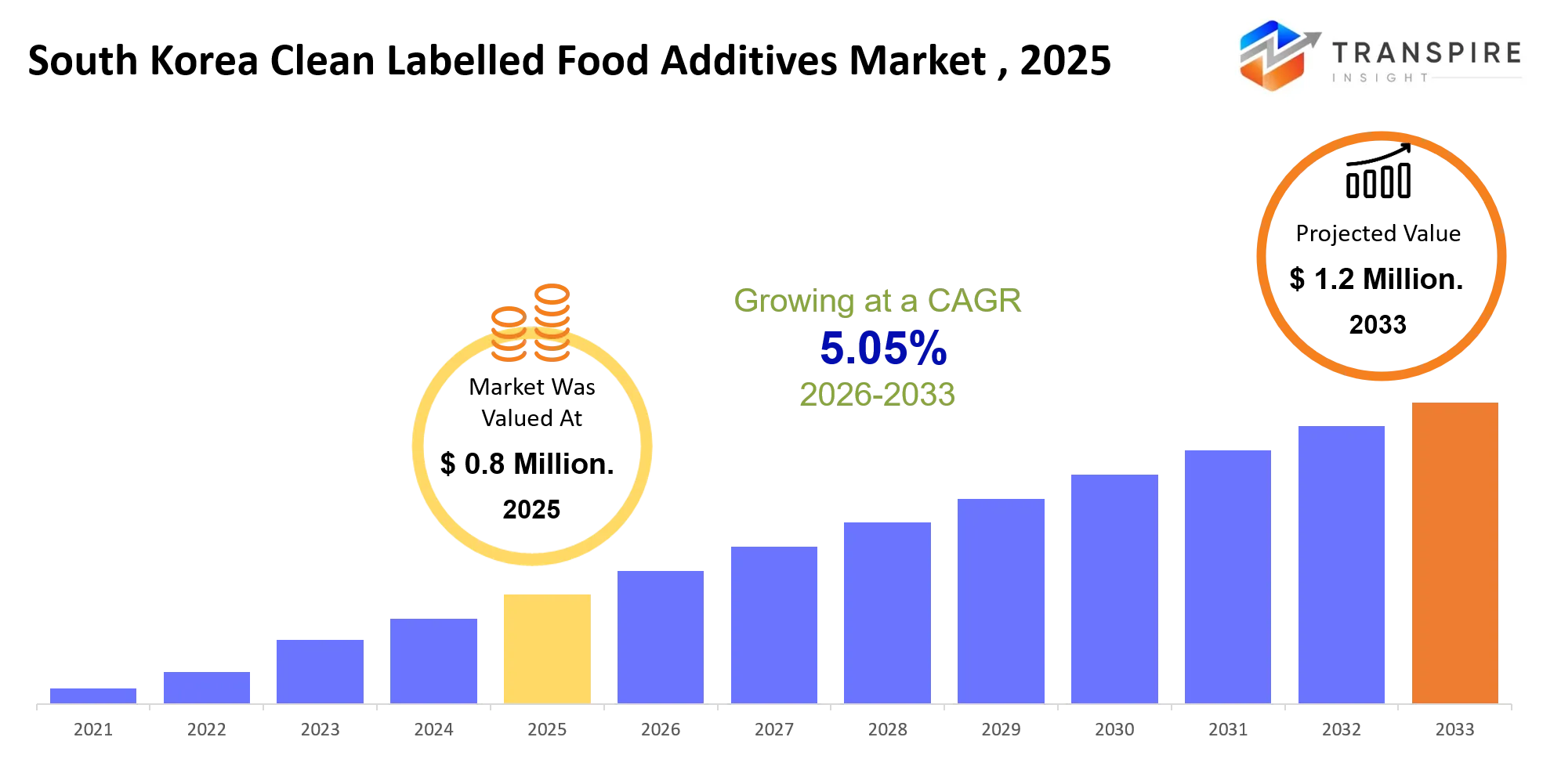
- Market Value (2025): USD 0.8 Billion.
- Expected Market Value (2026): USD 0.85 Billion.
- Estimated Market Value (2033): USD 1.2 Billion.
- Forecast CAGR (2026–2033): 5.05%
Introduction
The clean label food additives market includes natural, clean, and less processed food ingredients—like natural preservatives, colorants, flavors, starches, and sweeteners—used by the food industry in their food products to enhance their longevity, flavor, and aesthetic effects without the use of chemicals or synthetics. 'Clean label' is based on a simple and open list of ingredients free from chemical additives and substances that are normally regarded as unhealthy. Clean label is defined as products made from natural and simple ingredients without chemical additives, synthetic substances, preservatives, or artificial colors. Food additive (as per Korean definitions) is defined as a substance used in food manufacturing which may include the addition of sweetness to the food, coloring, bleaching, or controlling oxidation. The clean label food additives market in South Korea is contributing positively to the healthier and more transparent food formulations by substituting the artificial preservatives, chemicals, and obscure additives with the alternatives based on natural ingredients. Natural extracts, herbs, and spices are important when it comes to preserving the original Korean flavor and responding to the changing demands of consumers. Moreover, clean label formulations allow manufacturers to position themselves better in the market since they can separate premium products on the basis of their characteristics. The fact that clean label formulations comply with the strict food safety and labeling standards in South Korea adds to the credibility of a company.
Key Market Highlights: -
- By additive type, the Natural Flavors segment dominated the market and holds nearly 30% share in 2025 and is projected to grow at a substantial CAGR during the forecast period.
- By application, the Bakery segment dominated the market and holds nearly 34% share in 2025 and is projected to grow at a substantial CAGR during the forecast period.
- By end user, the Food Manufacturers segment dominated the market and holds nearly 40% share in 2025 and is projected to grow at a substantial CAGR during the forecast period.
- Natural-Origin Recognition Expansion (2024): The MFDS has expanded its natural-origin recognition criteria for specific food additives, including propionic acid and benzoic acid obtained from animal source materials. This new regulation allows the food industry to minimize unnecessary paperwork for qualifying trace levels and improves clarity on compliance. The rule is important in terms of the innovation of naturally sourced ingredients and transparent formulations providing clean-label food additive solutions.
How is Technology Driving Growth in the South Korea Clean Labelled Food Additives Market?
Through the use of advanced extraction and encapsulation technologies, producers are now able to achieve plant extracts and other functional compounds of the highest purity while increasing stability and controlling the release of the products. Automation processes such as inline mixing and real-time quality process analysis help maintain consistency, scalability, and efficiency in production of plant-based ingredients. Digitalization as a part of traceability and supply chain management increases transparency, quality according to standards and regulatory requirements, and consumer confidence in the industry. Biotechnology and fermentation technology speed up the process of getting plant-based organic acids, antioxidants, preservatives, and functional ingredients used in natural clean-label products and contributing to their extended shelf life. Consequently, all above-mentioned technologies help improve product quality, manufacturing process, and ingredients’ traceability.
Market Drivers
Rising consumer awareness regarding health and wellness is increasing the propensity of individuals to steer clear of synthetic additives and artificial preservatives and colors, which drives the market for clean Labelled food additives in South Korea. The increase in the desire of consumers for transparency is further supporting the growth of preference for simplified labels and familiar food, whereas the interest of consumers in flavorful ingredients is also boosting the usage of natural herbs, spices and plant-based substances. Strict food safety standards and regulations are making food producers to develop clean-label products that are safer and complying with the regulations. The fact that the acceptance of convenience and processed food is growing boosts the demand for natural preservatives and functional ingredients and expands the market for clean-label food additives in South Korea. Consumer trust aids the South Korea Clean Labelled Food Additives Market, allowing brands to improve product differentiation and justify high price points in domestic and foreign markets. The compliance with strict food safety, transparency and sustainability laws enables companies to secure the right to manufacture and sell clean label products. The know-how to utilize traditional Korean functional ingredients gives domestic players a competitive edge. Further, the growth of exports is creating substantial market opportunities rising from the worldwide demand for food ingredients that can be called clean, natural, and ethically produced. All these factors contribute positively to the ecosystem of clean label food additives in South Korea.
Restrain
The South Korean Clean Labelled Food Additives Market has to overcome several obstacles such as high production costs arising from natural ingredient sourcing and processing. Clean label food additives are less stable with shorter shelf life than synthetic ones. The availability of raw materials depends on seasons which leads to quality inconsistency while strict labeling policies, complicated formulations, and issues in supply chain complicate production processes affecting both time and costs.
|
Driver |
Relative Impact on Growth (%) |
Geographic Relevance |
Impact Timeline |
Demand Strength |
Growth Mechanism |
Key Beneficiaries |
Major Constraint |
|
Rising Consumer Demand for Natural Ingredients |
28% |
South Korea, especially urban markets |
Short-term |
High |
Replaces synthetic additives with recognizable natural alternatives |
Clean-label manufacturers, ingredient suppliers, food brands |
Higher natural ingredient procurement costs |
|
Health and Wellness Awareness |
23% |
Nationwide, strongest in metropolitan areas |
Short-term |
High |
Encourages healthier formulations and transparent ingredient declarations |
Functional food producers, natural ingredient suppliers, retailers |
Consumer price sensitivity limits premium adoption |
|
Growth of Processed and Convenience Foods |
20% |
Seoul, Gyeonggi, major urban centers |
Medium-term |
High |
Increases demand for clean-label preservation and functionality |
Processed food manufacturers, additive producers, technology vendors |
Natural additives may provide shorter shelf stability |
|
Advanced Extraction, Fermentation and Encapsulation Technologies |
16% |
South Korea manufacturing hubs |
Medium-term |
Medium |
Improves stability, consistency, functionality and scalability |
Ingredient innovators, food manufacturers, biotechnology firms |
High technology and processing investment requirements |
|
Regulatory Focus on Food Safety and Transparency |
13% |
Nationwide |
Long-term |
Medium |
Supports compliant natural ingredients and transparent formulations |
Certified suppliers, compliant manufacturers, exporters |
Regulatory compliance increases formulation complexity |
Analysis of Prices and Consumer Behaviour
The market for natural colors takes the first position in South Korea Clean Labelled Food Additives Market and will take up almost 22–26% of the total market in 2026 catering to the needs of growing consumer demand for visible, natural ingredients in beverages, candies, snacks and processed food. The clean-label additives price is generally higher than synthetic alternative prices because of the necessity for special extraction, fermentation, stabilization, and quality processes. About 20–24% of the market value comprises natural flavors and enhancers, triggered by the growing demand for clean-label taste and fermentation-based product manufacturing. The sales volume is affected by the versatility of application of these products in processed food, bakery, beverages, sauces, and functional food recipes. The market for natural preservatives and natural texturizers & emulsifiers represents about 30–38% of the total demand. The behavior of consumers indicates that 68.9% of surveyed South Korean consumers showed their readiness for purchasing processed foods with a minimum amount of additives. Moreover, 63.7% of the respondents expressed their doubts concerning food additives, which makes them prefer transparent labeling, recognizable ingredients, and natural clean-label options.
Who are the Key Players in the South Korea Clean Labelled Food Additives Market and how do they compete?
Competition in the South Korean Clean Labelled Food Additives Market is defined by businesses that focus on innovative natural ingredients, solutions for clean-label and reliable supply chains for food and beverage applications. Competing based on transparent labeling and functionality as opposed to price encourages companies to continue innovating and developing products by providing better formulation solutions.
CJ CheilJedang strengthens its position in the market through the production of natural food ingredients and solutions focused on the clean-label formulation technologies. Using high-quality natural food colors, flavors, preservatives, texturizers, and unique food ingredients in businesses gives it an edge over competitors. The company also enhances its standing by offering natural food ingredients, food additives and advanced services in the fermentation-based ingredient sector.
Top Companies in the South Korea Clean Labelled Food Additives Market
- Cargill
- Ingredion
- Kerry Group
- Tate & Lyle
- ADM
- Givaudan
- DSM-Firmenich
- IFF
- Chr. Hansen
- Kemin Industries
- Corbion
- Symrise
- BASF
- Jungbunzlauer
- Roquette
|
Company |
Est. Revenue Share Range |
Key Offerings |
Strategic Positioning |
Geographic Strength |
Technology Focus |
|
CJ CheilJedang |
10–14% (Estimated) |
TasteNrich®, FlavorNrich™, natural seasonings, functional sweeteners |
Integrated Korean ingredient and fermentation leader |
Asia Pacific, North America, Europe |
Microbial fermentation and natural flavor technology |
|
Daesang Corporation |
8–12% (Estimated) |
Natural seasonings, starches, sweeteners, amino acids |
Domestic fermentation and ingredient diversification |
Asia Pacific, North America, Europe |
Fermentation, biotechnology and functional ingredients |
|
Samyang Corporation |
6–9% (Estimated) |
Allulose, dietary fiber, oligosaccharides, starch sweeteners |
Specialty ingredient and sweetener differentiation |
Asia Pacific, North America, Europe |
Food biotechnology and functional sweetener technology |
|
Kerry Group |
5–8% (Estimated) |
Fermentates, buffered vinegar, plant extracts, natural flavors |
Clean-label preservation and formulation expertise |
Asia Pacific, Europe, North America |
Fermentation and multifunctional preservation systems |
|
Givaudan |
4–7% (Estimated) |
Natural flavors, botanical ingredients, texture solutions |
Premium natural taste and texture innovation |
Asia Pacific, Europe, North America |
Natural flavor, texture and sensory technologies |
|
Ingredion |
4–7% (Estimated) |
Functional native starches, citrus fiber, stevia, plant proteins |
Clean-label texturization and formulation solutions |
Asia Pacific, North America, Europe |
Native starch and formulation technologies |
|
IFF |
3–6% (Estimated) |
Natural flavors, cultures, enzymes, fermentates, plant extracts |
Broad clean-label ingredient technology platform |
North America, Europe, Asia Pacific |
Fermentation, enzymes and natural flavor technologies |
|
Symrise |
3–5% (Estimated) |
Natural flavors, botanical extracts, clean-label culinary ingredients |
Natural ingredient and sensory specialization |
Europe, Asia Pacific, North America |
Natural extraction and sensory optimization |
|
ADM |
2–4% (Estimated) |
Natural colors, PearlEdge™, plant proteins, functional ingredients |
Integrated natural ingredient and color solutions |
North America, Asia Pacific, Europe |
Natural color and formulation technologies |
|
Corbion |
2–4% (Estimated) |
Natural preservatives, fermentation ingredients, functional systems |
Specialty preservation and fermentation expertise |
Europe, North America, Asia Pacific |
Fermentation and natural preservation technology |
South Korea Clean Labelled Food Additives Market Segmentation
The South Korea Clean Labelled Food Additives Market share is divided into six categories: By additive type, source, application, function, form and end user.
The Natural Flavors dominated the market, accounting for nearly 30% in 2025 and is expected to rise at a significant CAGR during the forecast period.
The South Korea Clean Labelled Food Additives Market is segmented by additive type into Natural Preservatives, Natural Colors, Natural Sweeteners, Natural Flavors, Natural Emulsifiers, Natural Stabilizers, Natural Antioxidants, Natural Acidity Regulators. Among these, the Natural Flavors segment dominated the market, accounting for nearly 30% in 2025 and expected to increase at a significant CAGR during the forecast period. In 2025, the market is anticipated to be led by the natural flavor segment driven by the shift in consumer attitude toward clean labels, plant-based foods, and other minimally processed products. Growing demand for genuine flavors in food products and more accurate labeling of components will also stimulate producers to swap synthetic additives for natural counterparts, promoting the steady development of the market in the period under review.
The Bakery dominated the market, accounting for nearly 34% in 2025, and is expected to rise at a significant CAGR during the forecast period.
The South Korea Clean Labelled Food Additives Market is segmented by application into Bakery, Beverages, Dairy, Confectionery, Meat & Poultry, Sauces & Dressings, Snacks, Processed Foods. Among these, the Bakery segment dominated the market, accounting for nearly 34% in 2025 and expected to increase at a significant CAGR during the forecast period. The market was led by the Bakery category, which catered to the consumers’ needs for delicious and straightforward baked items in the year 2025. The use of natural flavors in baked goods such as bread, cakes, tarts, and cookies in addition to other premium bakery products encouraged the manufacturers to enhance the taste profiles.
The Food Manufacturers dominated the market, accounting for nearly 40% in 2025 and is expected to rise at a significant CAGR during the forecast period.
The South Korea Clean Labelled Food Additives Market is segmented by end user into Food Manufacturers, Beverage Companies, Dairy Producers, Bakery Companies, Meat Processors, Confectionery Manufacturers, Foodservice Companies, Ingredient Suppliers. Among these, the Food Manufacturers segment dominated the market, accounting for nearly 40% in 2025 and expected to increase at a significant CAGR during the forecast period. In 2025, Food Manufacturers segment accounted for the highest market share due to rising demand for natural flavors across processed food, bakery, beverages, dairy products, and functional food. The manufacturers are focusing on elements such as clean label formulations, authentic taste, and transparency of ingredients in order to satisfy consumer needs, and this would help in higher adoption of natural flavors.
Future Market Trends for the South Korea Clean Labelled Food Additives Market : -
- Ascendance of Natural Colors: Naturally derived colorings from plants like turmeric, spirulina, and beet are increasingly taking over synthetic dyes owing to increased safety concerns.
- Natural Preservatives: Customers prefer products made with easy and understandable ingredients.
- Health and Food Conscious Consumers: The widening gap between rising health issues relating to obesity, diabetes, and heart diseases drives South Korea’s consumers to choose least processed and no additives products.
- Biotechnology and Technology: Producers are increasingly working on solutions such as ingredients made using fermentation process, getting better conversion systems as well as other innovative natural preservation techniques.
- Digital Transparency: Many brands are adopting digital tracking methods as they provide transparent supply chain information that can be verified.
Recent Development
- In January 2026: In a recent Public Notice No. 2026-009, the MFDS of South Korea has proposed the broadening of the approval of recycled polypropylene (PP) feedstock for food-contact items. The initiative will promote sustainable packaging, resource efficiency, and environmentally friendly food production, in line with the clean label trend and within the framework of the food production industry that is more environmentally sustainable as a whole.
- In May 2026: The MFDS of South Korea has published Notice No. 2026-40, which updates various food regulation aspects, such as food standards, maximum residue limits, various analytical procedures, and approved food raw materials. The revised regulations will boost food safety, meet compliance with the food industry raw materials, and provide transparency in formulation of products.
Market Segment
This study forecasts revenue at South Korea, regional and country levels from 2020 to 2033. Transpire Insights has segmented the South Korea Clean Labelled Food Additives Market based on the below-mentioned segments:
South Korea Clean Labelled Food Additives Market, By Additive Type
- Natural Preservatives
- Natural Colors
- Natural Sweeteners
- Natural Flavors
- Natural Emulsifiers
- Natural Stabilizers
- Natural Antioxidants
- Natural Acidity Regulators
South Korea Clean Labelled Food Additives Market, By Source
- Plant-Based
- Fruit-Based
- Vegetable-Based
- Fermentation-Derived
- Mineral-Based
- Animal-Derived
- Marine-Based
- Microbial-Based
South Korea Clean Labelled Food Additives Market, By Application
- Bakery
- Beverages
- Dairy
- Confectionery
- Meat & Poultry
- Sauces & Dressings
- Snacks
- Processed Foods
South Korea Clean Labelled Food Additives Market, By Function
- Preservation
- Coloring
- Flavoring
- Sweetening
- Emulsification
- Stabilization
- Texture Modification
- Antioxidation
South Korea Clean Labelled Food Additives Market, By Form
- Powder
- Liquid
- Granules
- Extracts
- Concentrates
- Emulsions
- Solutions
- Blends
South Korea Clean Labelled Food Additives Market, By End User
- Food Manufacturers
- Beverage Companies
- Dairy Producers
- Bakery Companies
- Meat Processors
- Confectionery Manufacturers
- Foodservice Companies
- Ingredient Suppliers
Frequently Asked Questions
Find quick answers to common questions.
Growing demand for natural, transparent, safer ingredients is encouraging manufacturers to replace synthetic additives with recognizable alternatives.
Bakery, processed foods, beverages, and convenience foods increasingly adopt clean-label additives to meet evolving consumer preferences.
Advanced extraction, fermentation, encapsulation, automation, and traceability technologies improve ingredient stability, consistency, safety, and production efficiency.
High production costs, shorter shelf life, inconsistent raw-material quality, and formulation complexity remain significant challenges for manufacturers.
Natural preservatives, plant-based colors, functional ingredients, sustainable formulations, and export-oriented clean-label solutions offer attractive growth opportunities.
- Cargill
- Ingredion
- Kerry Group
- Tate & Lyle
- ADM
- Givaudan
- DSM-Firmenich
- IFF
- Chr. Hansen
- Kemin Industries
- Corbion
- Symrise
- BASF
- Jungbunzlauer
- Roquette
About the Authors

Chetan Dhatrak
I’m Chetan Dhatrak, a Senior Research Analyst at Transpire Insight, specializing in the Consumer Goods, Foods and Beverages industry. I focus on analyzing market trends, consumer behavior, competitive landscapes, and industry developments to deliver accurate, data-driven insights. My research at Transpire Insight is built on credible sources and in-depth analysis, helping businesses and readers better understand market dynamics, emerging opportunities, and evolving consumer preferences. I’m committed to creating reliable, well-researched content that supports informed decision-making and reflects the latest developments in the consumer goods and food & beverage sectors.

Chakradhar Khansole
Chakradhar serves as the Research Director at Transpire Insight, bringing over 8 years of experience in technology, innovation, and strategic market intelligence. He specializes in transforming complex market data into actionable business insights that enable organizations to make informed, growth-oriented decisions. Recognized for his strategic vision and analytical expertise, Chakradhar leads high-impact research initiatives, delivering comprehensive market assessments, competitive intelligence, and forward-looking industry analysis.
Recently Published Reports
-
Apr 2026
Baby Infant Formula Market
Baby Infant Formula Market Size, Share & Analysis Report By ype (Infant Milk, Follow On Milk, Specialty Baby Milk, Growing-Up Milk), By Ingredient (Carbohydrate, Fat, Protein, Minerals, Vitamins, and Others), By Product Form (Powder, Liquid, and Ready-to-feed), By Distribution Channels (Supermarket/Hypermarket, Specialty Store, Pharmacies, Online Retail, and Others), and Geography (North America, Europe, Asia-Pacific, Middle East and Africa, South and Central America), 2021 - 2031
-
Apr 2026
Edible Insects for Animal Feed Market
Edible Insects for Animal Feed Market Size, Share & Analysis Report By Type (Insect Powder, Insect Meal, Insect Bar, Insect Paste, Insect Oil, and Others), By Insect Type (Beetles, Cricket, Caterpillar, Hymenoptera, Orthoptera, Tree Bugs, and Others), By Application (Livestock, Pet Food, and Aquaculture), By Livestock Type (Poultry, Swine, and Others), and Geography (North America, Europe, Asia-Pacific, Middle East and Africa, South and Central America), 2021 - 2031
-
Apr 2026
Food Industry Disinfection and Bacterial Control Market
Food Industry Disinfection and Bacterial Control Market Size, Share & Analysis Report By Type (Chemical Disinfectants, Physical Disinfectants, and Biocides and Antimicrobials), By Application (Food Processing Equipment Surface Disinfection, Food Preparation Areas Surface Disinfection, Storage Areas Surface Disinfection, Anti-microbial Coatings Food Preservation, and Preservative Solutions Food Preservation), By End User (Meat and Poultry Processing, Dairy Processing, Seafood Processing, Bakery and Confectionery, Restaurants and Commercial Kitchens, and Food Service Providers), By Sales Channel (Online, Offline), and Geography (North America, Europe, Asia-Pacific, Middle East and Africa, South and Central America), 2021 - 2031
-
May 2026
Freeze Dried Food Market
Freeze Dried Food Market Size, Share & Analysis Report By Product Type (Fruits, Vegetables, Freeze-Dried Dairy Products, Freeze-Dried Meat and Seafood, Freeze-Dried Pet Food, and Prepared Meal), By Nature (Organic, and Conventional), By Form (Powdered, Granules, and Diced), By End Use (Breakfast Cereals, Dairy Products, Bakery & Confectionery, Nutritional Bars & Supplements, Powdered Beverages, Snacks, and Retail (Household)), and Geography (North America, Europe, Asia-Pacific, Middle East and Africa, South and Central America), 2021 - 2031