
South Korea Chain Conveyors Market Summary:
According to Transpire Insight, a detailed research report on the market reflects that the chain conveyors application segment dominates the South Korea Chain Conveyors Market, accounting for a significant share of the total market, driven by increasing adoption across automotive, electronics, food & beverage, logistics, warehousing, and advanced manufacturing industries. The South Korea conveyor systems market is valued at approximately USD 377 million in 2026 and is projected to reach USD 579 million by 2031, expanding at a 6.3% CAGR, making chain conveyor solutions an important contributor to industrial automation, efficient material handling, smart manufacturing integration, expanding production capabilities, and market growth dynamics.
Market Snapshot
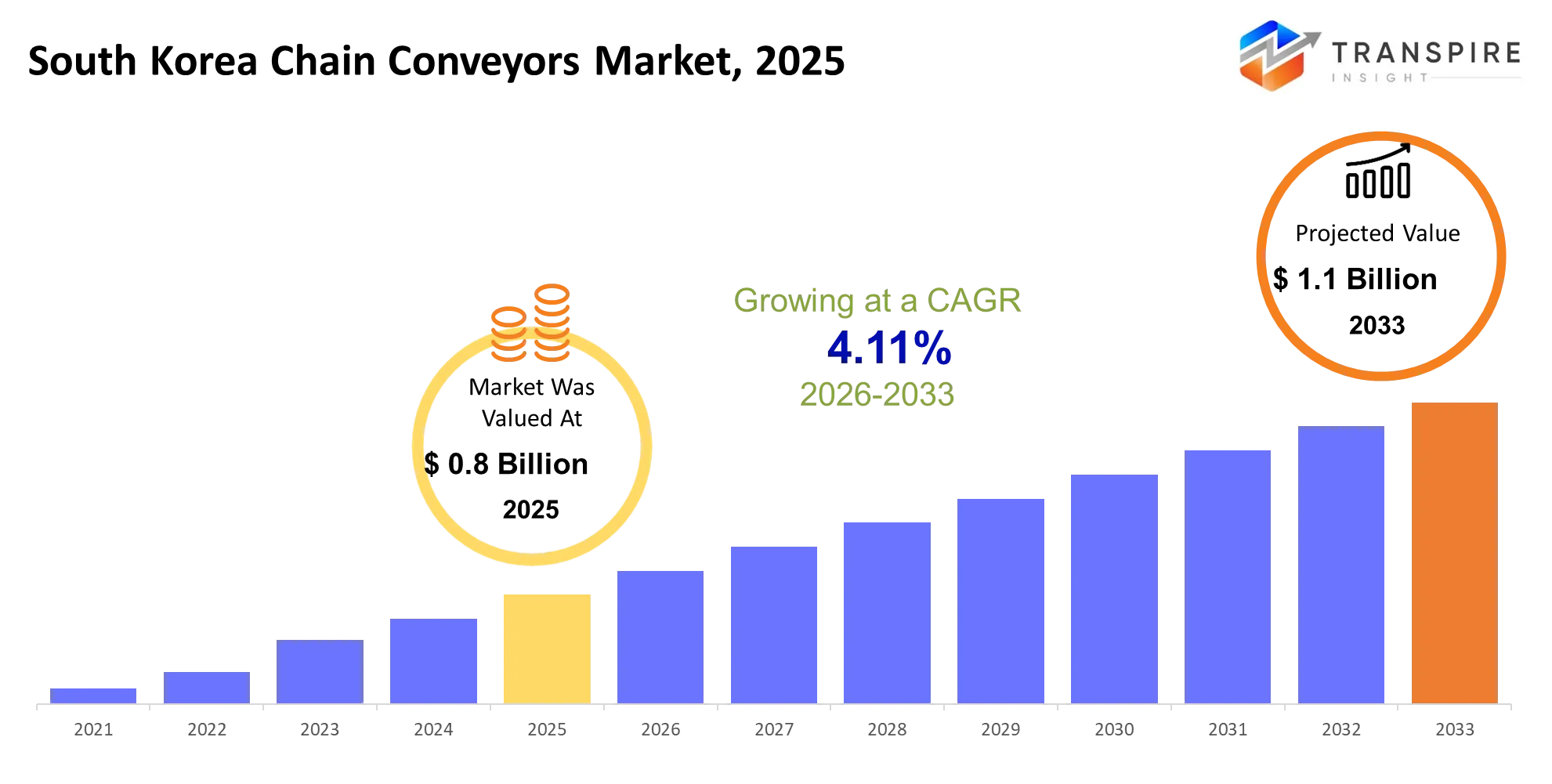
- Market Value (2025): USD 0.8 Billion.
- Expected Market Value (2026): USD 0.83 Billion.
- Estimated Market Value (2033): USD 1.1 Billion.
- Forecast CAGR (2026–2033): 4.11%
Introduction
The South Korea chain conveyor market is an important part of the country’s overall industrial automation and material handling landscape. These systems include drag chains, slat chains and multi-strand systems specifically designed to carry heavy, high temperature and rugged loads that cannot be reliably conveyed by traditional belt and roller conveyors. South Korean manufacturers are stepping up their adoption of smart factories and Industry 4.0-enabled production environments, and this is driving a steady increase in the demand for robust, precision-engineered chain conveyor systems in the automotive, electronics, food and beverage, and logistics industries. This trend toward automated intralogistics solutions is also fueled by rising labor costs and the requirement for smooth integration with warehouse management systems. These dynamics are making chain conveyor technology a pillar of South Korea’s developing industrial infrastructure.
Key Market Highlights: -
- By Type, the Roller Chain Conveyors dominated the market and holds approximately 40% share in 2025 and is projected to grow at a substantial CAGR during the forecast period.
- By Operation, the Semi-Automatic Equipment dominated the market and holds approximately 66.22% share in 2025 and is projected to grow at a substantial CAGR during the forecast period.
- By Application, the Material Handling Manufacturers segment dominated the market and holds approximately 84% share in 2025 and is projected to grow at a substantial CAGR during the forecast period.
- South Korea’s US$7.5 billion AI Autonomous Manufacturing push is driving the adoption of smart factories nationwide, resulting in strong demand for connected, automation-ready chain conveyor systems with real-time diagnostics and predictive maintenance capabilities.
How is Technology Driving Growth in the South Korea Chain Conveyors Market?
Technology is the key driving force behind the South Korean chain and intralogistics conveyor market, supported by the adoption of smart manufacturing, government-backed digital logistics initiatives and the constant need to counter rising labor costs. IoT enabled sensors can now be used by manufacturers to monitor mechanical wear and send out real-time performance data. AI-powered predictive maintenance can evaluate vibration and load patterns and prevent costly downtime. The e-commerce boom continues to push warehouses toward automated sorting systems powered by AI, supported by robust Industry 4.0 government funding. Meanwhile local engineering companies are enhancing the durability and corrosion resistance of components for demanding industrial applications.
Market Drivers
Several converging forces underpin growth in the South Korea’s chain conveyor market. Government-led Industry 4.0 initiatives are helping to speed the adoption of smart manufacturing in conveyor networks, with IoT sensors, real-time monitoring and predictive maintenance being key features. Growing manufacturing output, e-commerce fulfillment, port logistics, and automotive and electronics production are driving demand for high-capacity, durable material handling systems. The growing food and beverage processing industry is, meanwhile, driving demand for hygienic, corrosion resistant stainless steel and plastic chain conveyors. Also, tighter regulations for environmental and workplace safety, such as South Korea’s Occupational Safety and Health Act, incentivize manufacturers to invest in energy-efficient, low-emission conveyor machinery.
Restrain
Chain conveyor market in South Korea is expected to face significant restraints despite strong growth momentum High costs of implementation from custom engineering and smart factory integration limit adoption by smaller manufacturers. Project timelines and cost stability are at risk due to supply chain disruptions and volatile raw material prices (especially carbon and stainless steel). Regulatory and workplace safety compliance can be stringent and slow down deployment. In heavy-duty operations, constant friction and mechanical stress results in significant maintenance and part replacement costs over time.
|
Driver |
Relative Impact on Growth (%) |
Geographic Relevance |
Impact Timeline |
Demand Strength |
Growth Mechanism |
Key Beneficiaries |
Major Constraint |
|
Industrial Automation and Smart Factory Adoption |
28% |
Seoul Capital Area, Gyeonggi, Ulsan, Busan |
Long-term |
High |
Automates material movement and improves production throughput |
Conveyor manufacturers, automation integrators, smart-factory technology vendors |
High initial automation and integration costs |
|
Expansion of Automotive and EV Manufacturing |
23% |
Ulsan, Gyeonggi, Chungnam |
Medium-term |
High |
Supports automated handling across vehicle production lines |
Automotive OEMs, conveyor manufacturers, system integrators |
Volatile automotive investment cycles |
|
Semiconductor and Electronics Manufacturing Expansion |
19% |
Gyeonggi, Chungcheong, Incheon |
Long-term |
High |
Enables precise continuous handling in advanced production facilities |
Semiconductor manufacturers, conveyor suppliers, robotics vendors |
Strict cleanroom and precision requirements |
|
Growth of E-commerce and Automated Logistics |
16% |
Seoul, Gyeonggi, Incheon, Busan |
Short-term |
High |
Accelerates automated sorting, transfer, and warehouse operations |
Logistics firms, warehouse operators, conveyor integrators |
Limited warehouse space and capital expenditure |
|
Sustainability and Energy-Efficient Material Handling |
14% |
Nationwide industrial and logistics hubs |
Medium-term |
Medium |
Encourages efficient conveyors reducing energy and operational waste |
Equipment manufacturers, industrial users, sustainability solution providers |
Higher costs for advanced energy-efficient systems |
Analysis of Prices and Consumer Behaviour
Demand for industrial chain conveyor systems is highly influenced by industrial applications. The chain conveyor demand is influenced mainly by the demand in the automotive, electronics, logistics, food and beverages, and manufacturing industry sectors. Price for advanced automated chain conveyors tends to be high compared to price of conventional conveyor systems since such conveyors utilize engineered chains, automation controls, customized design and integration features of conveyor systems in intelligent manufacturing processes. Around 45% of the demand for chain conveyors is linked to applications of automation for material handling and production purposes due to requirements for material flow, dependability and limited manual operations. The industries of automotive and electronics manufacture account for about 70% of demand for advanced industrial conveyor systems in South Korea due to development of production facilities and factory automation. The buying behavior of industrial clients demonstrates that 55% of them value the highest quality of conveyor durability, precision, efficiency, and dependability. An additional 33% of clients prefer customized agreements on conveyor purchase or services contracts because they want to save costs of maintenance and procurements as well as keep conveyor systems available.
|
Company |
Est. Revenue Share Range |
Key Offerings |
Strategic Positioning |
Geographic Strength |
Technology Focus |
|
Daifuku Co., Ltd. |
10–14% (Estimated) |
Power & Free Conveyors; Chain Conveyors; Automotive Production Systems; EV Battery Handling |
Integrated automation leadership across industrial production |
Asia Pacific; Europe; North America |
Chain automation; centralized control; automotive material handling |
|
EQCell Co., Ltd. |
8–11% (Estimated) |
Single/Double Chain Conveyors; Slat Conveyors; Power & Free; Battery Logistics Systems |
Customized automation integration for Korean manufacturers |
South Korea; North America; China |
Smart logistics; simulation; battery-line automation |
|
Tsubakimoto Korea Co., Ltd. |
7–10% (Estimated) |
Conveyor Chains; Large Conveyor Chains; Sprockets; Attachment Chains |
Chain engineering and component specialization |
Asia Pacific; Europe; North America |
High-load chains; wear resistance; precision engineering |
|
Interroll Korea Corp. |
5–8% (Estimated) |
Conveyor Platforms; Sortation Systems; Conveyor Modules; Controls |
Modular material-handling technology and systems |
Europe; Asia Pacific; North America |
Modular conveyors; controls; energy-efficient material flow |
|
FlexLink / Namyang Automation |
4–6% (Estimated) |
Chain Conveyors; Production Flow Systems; High-Speed Conveyors; Battery-Line Conveyors |
Flexible modular conveyor solutions for manufacturing |
Europe; Asia Pacific; North America |
Modular automation; production-flow optimization; smart conveyors |
|
S.J.C., Inc. |
3–5% (Estimated) |
Chain Conveyors; Conveyor Chains; Automation Conveyors; Customized Conveyor Systems |
Korean specialist in customized conveyor engineering |
South Korea; Asia Pacific |
Custom conveyor design; chain systems; industrial automation |
|
Daedong Mobility Co., Ltd. |
3–5% (Estimated) |
Automotive Conveyor Chains; Free-Flow Chains; Large Conveyor Chains; Slat-Line Chains |
Specialized chain manufacturing for heavy applications |
South Korea; Europe; North America |
Heavy-duty chains; automated assembly; precision manufacturing |
|
Dong Bo Chain Co., Ltd. |
2–4% (Estimated) |
Free-Flow Chains; Double-Plus Chains; Top-Roller Chains; Side-Roller Chains |
Application-focused chain solutions for assembly lines |
South Korea; Asia Pacific; Global export markets |
Accumulation chains; roller chains; automotive handling |
|
Samwon Machinery Co., Ltd. |
1–3% (Estimated) |
Chain Conveyors; Roller Conveyors; Automatic Packaging Systems; Palletizing Systems |
Value-oriented packaging and conveyor integration |
South Korea; Asia Pacific |
Packaging automation; conveyor integration; material handling |
|
Motion Convey / MSCB |
1–3% (Estimated) |
Chain Conveyors; Food Conveyors; Roller Conveyors; High-Speed Conveyors |
Specialized conveyor manufacturing for diverse industries |
South Korea; Asia Pacific |
High-speed conveying; food handling; standardized conveyors |
Who are the Key Players in the South Korea Chain Conveyors Market and how do they compete?
Competitiveness on the international market of South Korea Chain Conveyors Market relies on companies focusing on technological innovations, industry-specific solutions, and building up distribution channels on a global scale. Competitive strategy not based on pricing and based on durable machinery, technology innovation, smart and connected solutions and integration with digital platform and systems results in continuous development of products and increased efficiency and productivity, as well as resource optimization and operations visibility.
Development of intelligent material handling systems, automated conveyor systems, smart logistics solutions, and connected equipment makes Daifuku competitive in the market. Development of high performance conveyors and automated material handling systems designed for the automotive manufacturing, logistics, warehousing and other industrial operations gives Dematic the advantage over its rivals. SSI Schaefer competes on the market by developing its position through integrated solutions in material handling, warehouse automation, conveyors and smart logistics providing industrial clients with increased efficiency and productivity.
Top Companies in the South Korea Chain Conveyors Market
- Daifuku
- Dematic
- SSI Schaefer
- Vanderlande
- BEUMER Group
- Honeywell Intelligrated
- FlexLink
- mk Technology Group
- Dorner
- Interroll
- Bosch Rexroth
- Siemens
- Mitsubishi Electric
- SMC
- Hyundai WIA
South Korea Chain Conveyors Market Segmentation
The South Korea Chain Conveyors Market share is divided into five categories: By Type, By Operation, By Application, By Industry, By Configuration.
The Roller Chain Conveyors dominated the market, accounting for nearly 40% in 2025 and is expected to rise at a significant CAGR during the forecast period.
The South Korea Chain Conveyors Market is segmented by type into drag chain conveyors, roller chain conveyors, slat chain conveyors, apron chain conveyors, scraper chain conveyors, overhead chain conveyors, flight chain conveyors. Among these, the Roller Chain Conveyors segment dominated the market, accounting for nearly 40% in 2025 and expected to increase at a significant CAGR during the forecast period. Roller chain conveyors prevail because of their high load carrying capability, toughness, cost effectiveness, and wide range of applications in various processes including automotive, electronics, and heavy industries.
The Semi-Automatic Equipment dominated the market, accounting for nearly 66.22% in 2025, and is expected to rise at a significant CAGR during the forecast period.
The South Korea Chain Conveyors Market is segmented by operation into automatic, semi-automatic, manual, continuous, intermittent, programmable, robotic. Among these, the Semi-Automatic Equipment dominated the market, accounting for nearly 66.22% in 2025 and expected to increase at a significant CAGR during the forecast period. Semi automatic machinery prevails through its ability to offer cost effective operation coupled with flexibility in automation so that efficiency can be achieved without expensive automation setup.
The Material Handling dominated the market, accounting for nearly 84% in 2025 and is expected to rise at a significant CAGR during the forecast period.
The South Korea Chain Conveyors Market is segmentedby application into material handling, assembly lines, packaging, sorting, pallet handling, bulk material transport, production transfer. Among these, the Material Handling dominated the market, accounting for nearly 84% in 2025 and expected to increase at a significant CAGR during the forecast period. Material handling prevails because of increased needs for material movement in warehousing, logistics and manufacturing process.
Future Market Trends for the South Korea Chain Conveyors Market:-
- Industry 4.0 and Smart Factory Integration: Factories are integrating IoT sensors and real-time analytics into the conveyor architecture to enable predictive maintenance, reduce down time and increase overall operational efficiency across facilities.
- Modular and Reconfigurable Designs: Growing demand for flexible, modular chain conveyor systems enables manufacturers to rapidly reconfigure production layouts for multi-product assembly lines and evolving operational requirements.
- Robotics and Cobot Synchronization: The integration with collaborative robots and automated guided vehicles is becoming increasingly seamless, optimizing sorting, packing and material routing in the highly automated manufacturing facilities of South Korea.
Recent Development
- In March 4-6, 2026 Automation World 2026: The Seoul exhibition kicked off March 4, 2026, with AI-enabled conveyor diagnostics, low-maintenance drag chains and advanced vertical sortation technologies.
- In April 13-17, 2026 SIMTOS 2026: Modular conveyor systems and 3D CAD-customizable solutions for smart manufacturing were on display at the Goyang exhibition that opened on April 13, 2026.
Market Segmentation
This study forecasts revenue at Japan, regional and country levels from 2020 to 2033. Transpire Insight has segmented the South Korea Chain Conveyors Market based on the below-mentioned segments:
South Korea Chain Conveyors Market, By Type
- Drag Chain Conveyors
- Roller Chain Conveyors
- Slat Chain Conveyors
- Apron Chain Conveyors
- Scraper Chain Conveyors
- Overhead Chain Conveyors
- Flight Chain Conveyors
South Korea Chain Conveyors Market, By Operation
- Automatic
- Semi-Automatic
- Manual
- Continuous
- Intermittent
- Programmable
- Robotic
South Korea Chain Conveyors Market, By Application
- Material Handling
- Assembly Lines
- Packaging
- Sorting
- Pallet Handling
- Bulk Material Transport
- Production Transfer
South Korea Chain Conveyors Market, By Industry
- Automotive
- Electronics
- Food & Beverage
- Logistics
- Mining
- Manufacturing
- Warehousing
South Korea Chain Conveyors Market, By Configuration:
- Horizontal
- Inclined
- Vertical
- Z-Type
- Loop
- Multi-Level
- Modular
Frequently Asked Questions
Find quick answers to common questions.
Smart factory adoption, industrial automation, automotive production, electronics manufacturing, e-commerce logistics, and demand for efficient material handling are driving market growth.
Roller chain conveyors dominate, supported by high load capacity, durability, cost effectiveness, and extensive automotive, electronics, and industrial applications.
Material handling dominates, driven by increasing requirements for efficient material movement across South Korean manufacturing, warehousing, logistics, and industrial facilities.
IoT sensors, real-time monitoring, AI predictive maintenance, and automated sorting improve conveyor reliability, operational visibility, efficiency, and downtime management capabilities.
Smart factories, modular conveyor designs, IoT integration, predictive maintenance, robotics synchronization, and automated material routing will shape future market development.
- Daifuku
- Dematic
- SSI Schaefer
- Vanderlande
- BEUMER Group
- Honeywell Intelligrated
- FlexLink
- mk Technology Group
- Dorner
- Interroll
- Bosch Rexroth
- Siemens
- Mitsubishi Electric
- SMC
- Hyundai WIA
About the Authors

Kartik bhong
I am Kartik Bhong, a Senior Research Analyst at Transpire Insight, specializing in the Packaging, Manufacturing, and Construction industry. My work focuses on analyzing market trends, emerging technologies, industry regulations, and competitive landscapes to deliver accurate, data-driven insights. I am passionate about transforming complex industry information into clear, practical content that helps businesses, professionals, and decision-makers stay informed and make confident strategic decisions. Through continuous research and a strong commitment to accuracy, I strive to create reliable, well-researched content that reflects the latest developments across these dynamic industries and supports the vision of Transpire Insight in delivering valuable market intelligence.

Chakradhar Khansole
Chakradhar serves as the Research Director at Transpire Insight, bringing over 8 years of experience in technology, innovation, and strategic market intelligence. He specializes in transforming complex market data into actionable business insights that enable organizations to make informed, growth-oriented decisions. Recognized for his strategic vision and analytical expertise, Chakradhar leads high-impact research initiatives, delivering comprehensive market assessments, competitive intelligence, and forward-looking industry analysis.
Recently Published Reports
-
Apr 2026
Handling and Lifting Equipment Market
Handling and Lifting Equipment Market Size, Share & Analysis Report By Product (Cranes and Hoists, Forklifts, Conveyor Systems, Aerial Work Platforms, Others), By Application (E-Commerce, Automotive and Railway, Food and Beverages, Aviation, Others), and Geography (North America, Europe, Asia-Pacific, Middle East and Africa, South and Central America), 2021 - 2031
-
Nov 2026
HVAC Equipment Market
HVAC Equipment Market Size, Share & Analysis Report By Heating Equipment Type (Boilers and Furnaces, Heat Pumps, and Unitary Heaters), By Ventilation Equipment (Air Handling Units, Humidifiers and Dehumidifiers, Air Filters, and Fan Coiling Units), By Air Conditioning Equipment (Unitary Air Conditioners, Room Air Conditioners, Packaged Terminal Air Conditioners, and Chillers), By End User (Commercial, Residential, Industrial, and others), and Geography (North America, Europe, Asia-Pacific, Middle East and Africa, South and Central America), 2021 – 2031
-
Apr 2026
Refrigeration Valves Market
Refrigeration Valves Market Size, Share & Analysis Report By Type (Solenoid Valves, Expansion Valves, Check Valves, Service Valves, Others), By Application (Commercial Refrigeration, Industrial Refrigeration, Transport Refrigeration, Residential Refrigeration, Air Conditioning Systems), By End User (Food and Beverage Industry, Pharmaceutical Industry, HVAC Industry, Chemical Industry, Others), and Geography (North America, Europe, Asia-Pacific, Middle East and Africa, South and Central America), 2021 – 2031
-
Apr 2026
E-Commerce Packaging Materials Market
E-Commerce Packaging Materials Market By Material Type (Corrugated Boxes, Paper & Paperboard, Foam & Cushioning Materials, Plastic Packaging, Flexible Packaging, Protective Packaging, Others), By Product(Primary Packaging, Secondary Packaging, Tertiary Packaging), By Packaging Function (Protective Packaging, Branding & Presentation Packaging, Transit & Logistic Packaging, Sustainable Packaging, Tamper Evidence Packaging), By End-User (Retail & Consumer Goods, Electronic Appliances, Food & Beverages, Healthcare & Pharmaceutical, Fashion & Apparel, Home & Furnishing, Others); By Industry Analysis, Size, Share, Growth, Trends, and Forecasts 2021-2033