
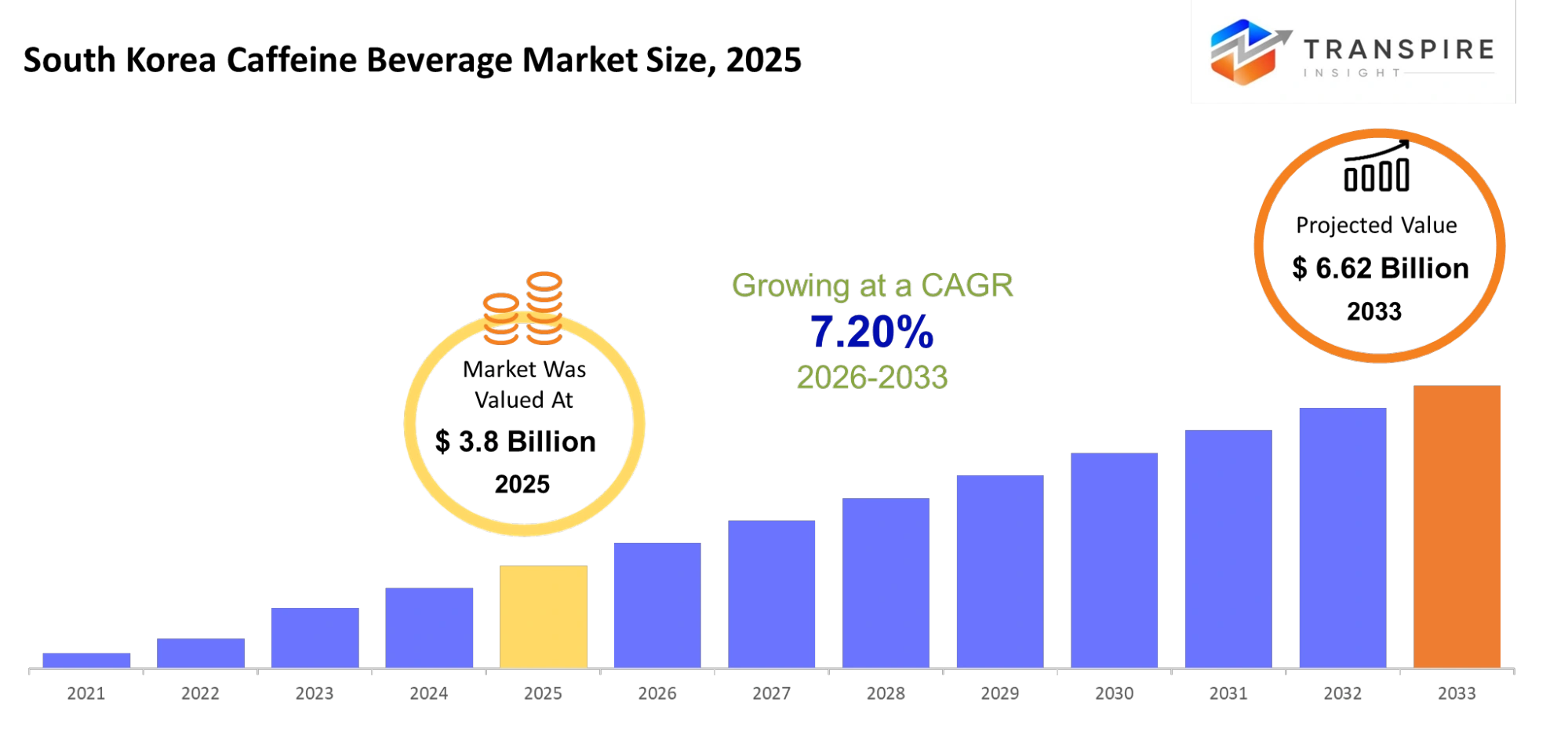
South Korea Caffeine Beverage Market Size & Forecast:
- South Korea Caffeine Beverage Market Size 2025: USD 3.8 Billion
- South Korea Caffeine Beverage Market Size 2033: USD 6.62 Billion
- South Korea Caffeine Beverage Market CAGR: 7.20%
- South Korea Caffeine Beverage Market Segments: By Product Type (Energy Drinks, Coffee-Based Beverages, Soft Drinks), By Distribution Channel (Supermarkets & Hypermarkets, Convenience Stores, Online Retail), By End-User (Adults, Youth)
To learn more about this report,  Download Free Sample Report
South Korea Caffeine Beverage Market Summary:
South Korea Caffeine Beverage Market size was estimated at USD 3.8 Billionin 2025 and is anticipated to reach USD 6.62 Billion by 2033, growing at a CAGR of 7.20% from 2026 to 2033.
The South Korean caffeine drinks market functions as a segment of the non-alcoholic beverage industry because urban centers in South Korea experience continuous non-alcoholic beverage consumption throughout both daytime work hours and nighttime study periods.The market will move toward ready-to-drink coffee products and compact energy shots and functional teas which people can use in their everyday life. Younger consumers will select beverages that reflect their personal identity which leads them to choose products that contain clean-label ingredients and low sugar content and use local flavoring materials like roasted grains and herbal blends.
The production and consumption of beverages will increasingly use technology because smart vending machines and app-based ordering systems and data-driven flavor development systems will dictate brand strategies. Companies will need to present better product information and create safer products because regulators will start to enforce their new caffeine labeling standards and health disclosure requirements. Public awareness about sustainability issues has increased which drives companies to implement recyclable packaging and refill systems for their products.
Key Market Trends & Insights:
- The South Korean Caffeine Beverage Market demonstrates a consistent trend toward functional beverages which provide consumers both energy and health benefits. The market shows ongoing demand for beverages which contain vitamin and amino acid and natural extract ingredients. Urban residents who have busy schedules tend to drink energy drinks while they work because they want to achieve energy balance through beverages which contain moderate caffeine and simple ingredient formulations.
- As health awareness increases South Korean Caffeine Beverage Market shows a significant decrease in high-sugar product offerings. Companies today offer sugar-free products and reduced-calorie alternatives which maintain identical taste profiles while avoiding excessive sweetening. Younger consumers and working professionals increasingly prefer product labels which display natural sweeteners and offer clear nutritional facts.
- The South Korean Caffeine Beverage Market experiences growth because ready-to-drink coffee beverages which offer instant convenience have become increasingly popular. The two main distribution channels operate through convenience stores and vending machines. The specialty blends and single-origin beans and their improved packaging present a solution for consumers who want café-quality beverages without needing to visit actual coffee shops.
- Brand Recognition is established through connections between South Korean Caffeine Beverage Market and entertainment and lifestyle practices.The combination of limited-edition packaging and celebrity partnerships and attractive product designs results in products that create a stronger visual presence on retail shelves. The social media presence of products creates brand recognition while products with unique visual designs attract younger consumers who want beverages that match their personality and taste preferences.
- The South Korean caffeine beverage market experiences growing demand for tea-based beverages and guarana-based drinks and plant-based drinks. Green tea and matcha-based drinks attract consumers seeking smoother energy effects. The alternatives support wellness-focused preferences while providing businesses with new market opportunities beyond their standard coffee and energy drink offerings.
South Korea Caffeine Beverage Market Segmentation
By Product Type :
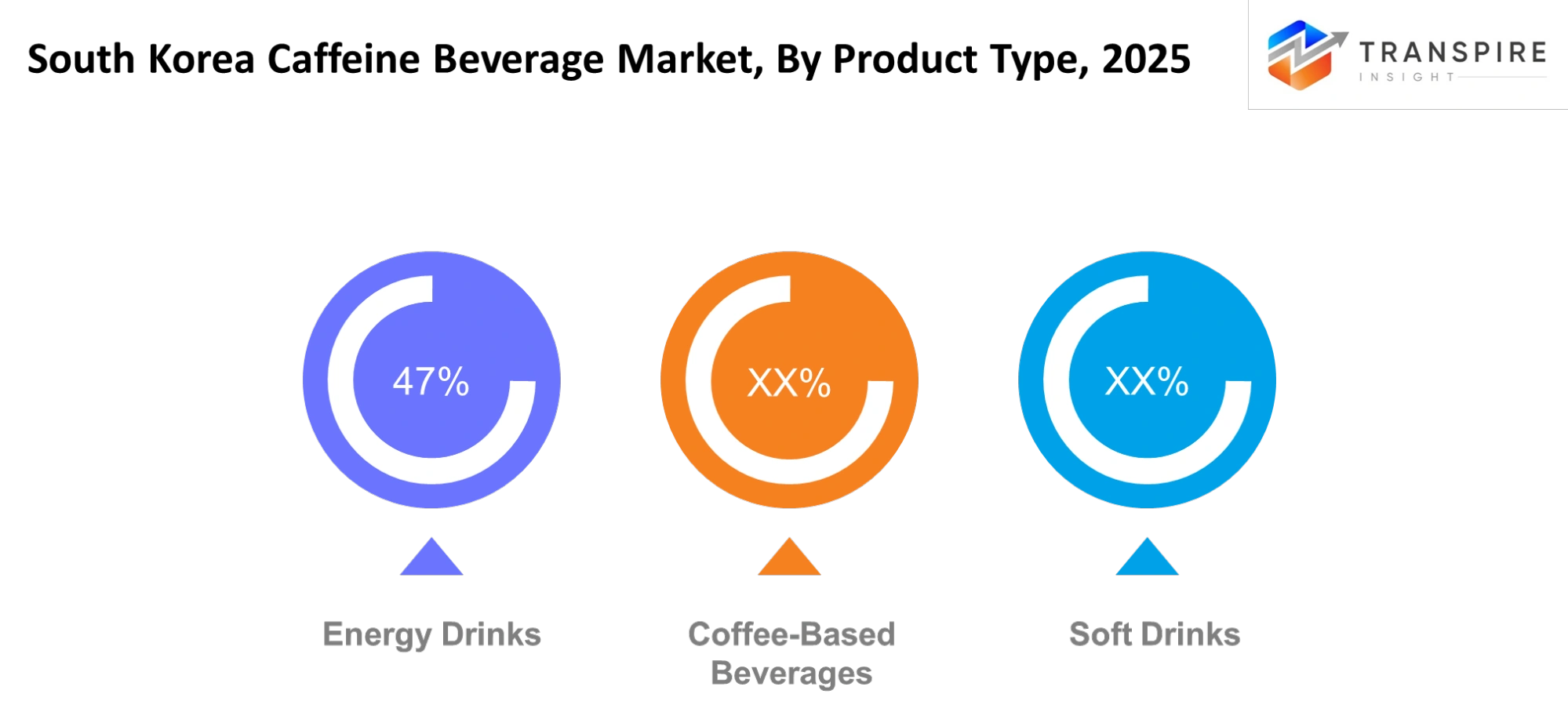
- Energy Drinks: The South Korean caffeine beverage industry experiences strong energy drink demand because people work quickly and study for extended periods. The high caffeine content of energy drinks provides instant energy which attracts both professionals and students. Compact packaging, especially for urban consumers, comes with an added advantage of having plenty of space left for more fresh flavor bites over the day.
- Coffee-Based Beverages: In South Korea, companies are encouraged to create coffee products blending both café culture and ready-to-drink products.The bottled cold brews and canned lattes attract consumers because they offer portable beverages with consistent taste. The product attracts consumers who need daily caffeine because it contains premium ingredients and multiple flavor selections.
- Soft Drinks: The South Korean market for caffeinated soft drinks functions as an enduring segment which attracts young consumers. The product appeals to many people because it offers mild caffeine levels together with familiar flavors. The product provides refreshment through carbonation while its affordable price enables customers to buy it frequently. The market stays interested because of seasonal product launches and special edition releases.
To learn more about this report, Download Free Sample Report
By Distribution Channel :
- Supermarkets & Hypermarkets: The South Korean caffeine beverage market in South Korea benefits from supermarkets and hypermarkets which provide extensive product selection. The store displays provide customers with enough space to evaluate different products from various brands while they also assess different pricing options. Bulk buying opportunities create an attractive shopping option for both families and regular shoppers. The traditional retail channel achieves its peak sales performance through the combination of promotional discounts and product displays which customers can see when they enter the store.
- Convenience Stores: The South Korean caffeine beverage market depends on convenience stores because urban areas have many of these stores which operate throughout the day. The ready-to-drink products suit consumers who need beverages for their daily activities. The store layout design places products next to checkout areas to encourage customers to make spontaneous purchases. The company maintains customer interest through its product offering because it introduces new products to customers at regular intervals.
- Online Retail: The South Korean caffeine beverage market shifts towards online retail because digital technology becomes more popular while delivery services become faster. The subscription service combined with bundle deals helps to drive customer purchasing behavior. The product selection at online stores surpasses what customers find in physical locations because online stores provide access to both rare products and imported items which customers can use to create their own specific product combinations.
By End-User :
- Adults: The South Korean caffeine beverage market maintains steady demand from adults who need to manage their work obligations and their extended workhours. People choose to consume these products because they provide functional benefits which help them stay awake and fight off exhaustion. People choose to drink coffee-based beverages and energy drinks which contain moderate to high caffeine because these drinks fit with their daily work schedules and business obligations.
- Youth: South Korean youths show rising interest in caffeine drinks because they require study assistance and want to follow contemporary social trends. The mixture of taste beverages and visually appealing packaging solutions creates an effective customer attraction system. People choose to drink products that contain moderate caffeine levels because they understand their personal caffeine consumption boundaries.The way people buy products gets determined by their friends and the marketing tactics used by brands.
Country Insights
- The South Korean caffeine beverage market keeps growing because city residents need caffeine to work long hours and because café culture has become essential to life in Seoul and Busan. The demand for ready-to-drink coffee energy drinks and functional beverages keeps increasing because convenience stores and vending machines provide these products throughout the day.
- Consumers in South Korea Caffeine Beverage Market demonstrate their preference for premium products which deliver unique tastes through their selection of cold brew and specialty blends and low-sugar products.Local brands and global names compete through packaging innovation and seasonal offerings, while health awareness encourages interest in products with added vitamins or reduced caffeine content.
- South Korea Caffeine Beverage Market uses its advanced retail infrastructure together with its digital capabilities to allow online platforms and delivery applications to provide products to customers. The marketing strategies use lifestyle branding to enhance brand image, while ongoing product innovation maintains consumer interest among younger and working-age population groups.
Recent Development News
Energy drinks outperform overall beverage market slowdown
In February 2026, Energy drinks emerged as a key growth driver in South Korea's otherwise slowing beverage sector. Energy drinks showed continuous growth despite overall consumption decline which occurred because of economic pressures and reduced household spending. The main domestic company announced its yearly revenue increase of 11 percent which demonstrates that people now consider caffeine-based drinks to be essential parts of their daily activities. The demand is no longer limited to students but now includes office workers and fitness users who prefer functional performance-based products.
Convenience stores driving caffeine beverage penetration
In February 2026, Caffeine beverage sales experienced significant growth through retail channels which include convenience stores as essential distribution points. The major chains reported double-digit growth of 18 to 26 percent for their energy drink sales while they rapidly expanded their product ranges. South Koreans now display caffeine consumption as a regular buying practice because they prefer to purchase private-label caffeine drinks, which provide both low-cost options and convenient access.
|
Report Metrics |
Details |
|
Market size value in 2025 |
USD 3.8 Billion |
|
Market size value in 2026 |
USD 4.07 Billion |
|
Revenue forecast in 2033 |
USD 6.62 Billion |
|
Growth rate |
CAGR of 7.20% from 2026 to 2033 |
|
Base year |
2025 |
|
Historical data |
2021 - 2024 |
|
Forecast period |
2026 - 2033 |
|
Report coverage |
Revenue forecast, competitive landscape, growth factors, and trends |
|
Country scope |
South Korea |
|
Key company profiled |
Red Bull GmbH, Monster Beverage Corporation, PepsiCo Inc., Coca-Cola Company, Nestlé S.A., Starbucks Corporation, Keurig Dr Pepper Inc., Suntory Holdings Ltd., Asahi Group Holdings Ltd., Danone S.A., Kraft Heinz Company, Tingyi Holding Corp., Uni-President Enterprises Corp., Yakult Honsha Co. Ltd., Otsuka Holdings Co. Ltd. |
|
Customization scope |
Free report customization (country, regional & segment scope). Avail customized purchase options to meet your exact research needs. |
|
Report Segmentation |
By Product Type (Energy Drinks, Coffee-Based Beverages, Soft Drinks), By Distribution Channel (Supermarkets & Hypermarkets, Convenience Stores, Online Retail), By End-User (Adults, Youth) |
Key South Korea Caffeine Beverage Company Insights
- The South Korean caffeine beverage market shows active business operations through which companies attempt to merge their traditional coffee practices with current energy drink market developments. Manufacturers continuously improve their product development through ongoing market competition, which drives them to enhance their flavor profiles and packaging designs and their product pricing methods. The local brands deliver culturally relevant products through their traditional flavors, whereas international brands establish uniform product standards that help them build their market presence. The combination of local and global businesses creates a product assortment which successfully retains customer interest.
- The South Korean caffeine beverage market shows how health consciousness and lifestyle changes affect consumer buying patterns.Companies respond to consumer demands by developing products with lower sugar content and functional components and providing clear product information through their product labels. The industry experiences growth through new product development and improved access to products that urban consumers need to meet their daily caffeine consumption requirements.
South Korea Caffeine Beverage Market Companies:
- Red Bull GmbH
- Monster Beverage Corporation
- PepsiCo Inc.
- Coca-Cola Company
- Nestlé S.A.
- Starbucks Corporation
- Keurig Dr Pepper Inc.
- Suntory Holdings Ltd.
- Asahi Group Holdings Ltd.
- Danone S.A.
- Kraft Heinz Company
- Tingyi Holding Corp.
- Uni-President Enterprises Corp.
- Yakult Honsha Co. Ltd.
- Otsuka Holdings Co. Ltd.
South Korea Caffeine Beverage Market Segmentation
By Product Type
- Energy Drinks
- Coffee-Based Beverages
- Soft Drinks
By Distribution Channel
- Supermarkets & Hypermarkets
- Convenience Stores
- Online Retail
By End-User
- Adults
- Youth
Frequently Asked Questions
Find quick answers to common questions.
The approximate South Korea Caffeine Beverage Market size for the market will be USD 6.62 Billion in 2033.
Key segments for the South Korea Caffeine Beverage Market are By Product Type (Energy Drinks, Coffee-Based Beverages, Soft Drinks), By Distribution Channel (Supermarkets & Hypermarkets, Convenience Stores, Online Retail), By End-User (Adults, Youth).
Major South Korea Caffeine Beverage Market players are Red Bull GmbH, Monster Beverage Corporation, PepsiCo Inc., Coca-Cola Company, Nestlé S.A., Starbucks Corporation, Keurig Dr Pepper Inc., Suntory Holdings Ltd., Asahi Group Holdings Ltd., Danone S.A., Kraft Heinz Company, Tingyi Holding Corp., Uni-President Enterprises Corp., Yakult Honsha Co. Ltd., Otsuka Holdings Co. Ltd.
The South Korea Caffeine Beverage Market size is USD 3.8 Billion in 2025.
The South Korea Caffeine Beverage Market CAGR is 7.20%.
- Red Bull GmbH
- Monster Beverage Corporation
- PepsiCo Inc.
- Coca-Cola Company
- Nestlé S.A.
- Starbucks Corporation
- Keurig Dr Pepper Inc.
- Suntory Holdings Ltd.
- Asahi Group Holdings Ltd.
- Danone S.A.
- Kraft Heinz Company
- Tingyi Holding Corp.
- Uni-President Enterprises Corp.
- Yakult Honsha Co. Ltd.
- Otsuka Holdings Co. Ltd.
Recently Published Reports
-
Apr 2026
Baby Infant Formula Market
Baby Infant Formula Market Size, Share & Analysis Report By ype (Infant Milk, Follow On Milk, Specialty Baby Milk, Growing-Up Milk), By Ingredient (Carbohydrate, Fat, Protein, Minerals, Vitamins, and Others), By Product Form (Powder, Liquid, and Ready-to-feed), By Distribution Channels (Supermarket/Hypermarket, Specialty Store, Pharmacies, Online Retail, and Others), and Geography (North America, Europe, Asia-Pacific, Middle East and Africa, South and Central America), 2021 - 2031
-
Apr 2026
Edible Insects for Animal Feed Market
Edible Insects for Animal Feed Market Size, Share & Analysis Report By Type (Insect Powder, Insect Meal, Insect Bar, Insect Paste, Insect Oil, and Others), By Insect Type (Beetles, Cricket, Caterpillar, Hymenoptera, Orthoptera, Tree Bugs, and Others), By Application (Livestock, Pet Food, and Aquaculture), By Livestock Type (Poultry, Swine, and Others), and Geography (North America, Europe, Asia-Pacific, Middle East and Africa, South and Central America), 2021 - 2031
-
Apr 2026
Food Industry Disinfection and Bacterial Control Market
Food Industry Disinfection and Bacterial Control Market Size, Share & Analysis Report By Type (Chemical Disinfectants, Physical Disinfectants, and Biocides and Antimicrobials), By Application (Food Processing Equipment Surface Disinfection, Food Preparation Areas Surface Disinfection, Storage Areas Surface Disinfection, Anti-microbial Coatings Food Preservation, and Preservative Solutions Food Preservation), By End User (Meat and Poultry Processing, Dairy Processing, Seafood Processing, Bakery and Confectionery, Restaurants and Commercial Kitchens, and Food Service Providers), By Sales Channel (Online, Offline), and Geography (North America, Europe, Asia-Pacific, Middle East and Africa, South and Central America), 2021 - 2031
-
Apr 2026
Freeze Dried Food Market
Freeze Dried Food Market Size, Share & Analysis Report By Product Type (Fruits, Vegetables, Freeze-Dried Dairy Products, Freeze-Dried Meat and Seafood, Freeze-Dried Pet Food, and Prepared Meal), By Nature (Organic, and Conventional), By Form (Powdered, Granules, and Diced), By End Use (Breakfast Cereals, Dairy Products, Bakery & Confectionery, Nutritional Bars & Supplements, Powdered Beverages, Snacks, and Retail (Household)), and Geography (North America, Europe, Asia-Pacific, Middle East and Africa, South and Central America), 2021 - 2031