

South Korea Building Information Modeling Market Size & Forecast:
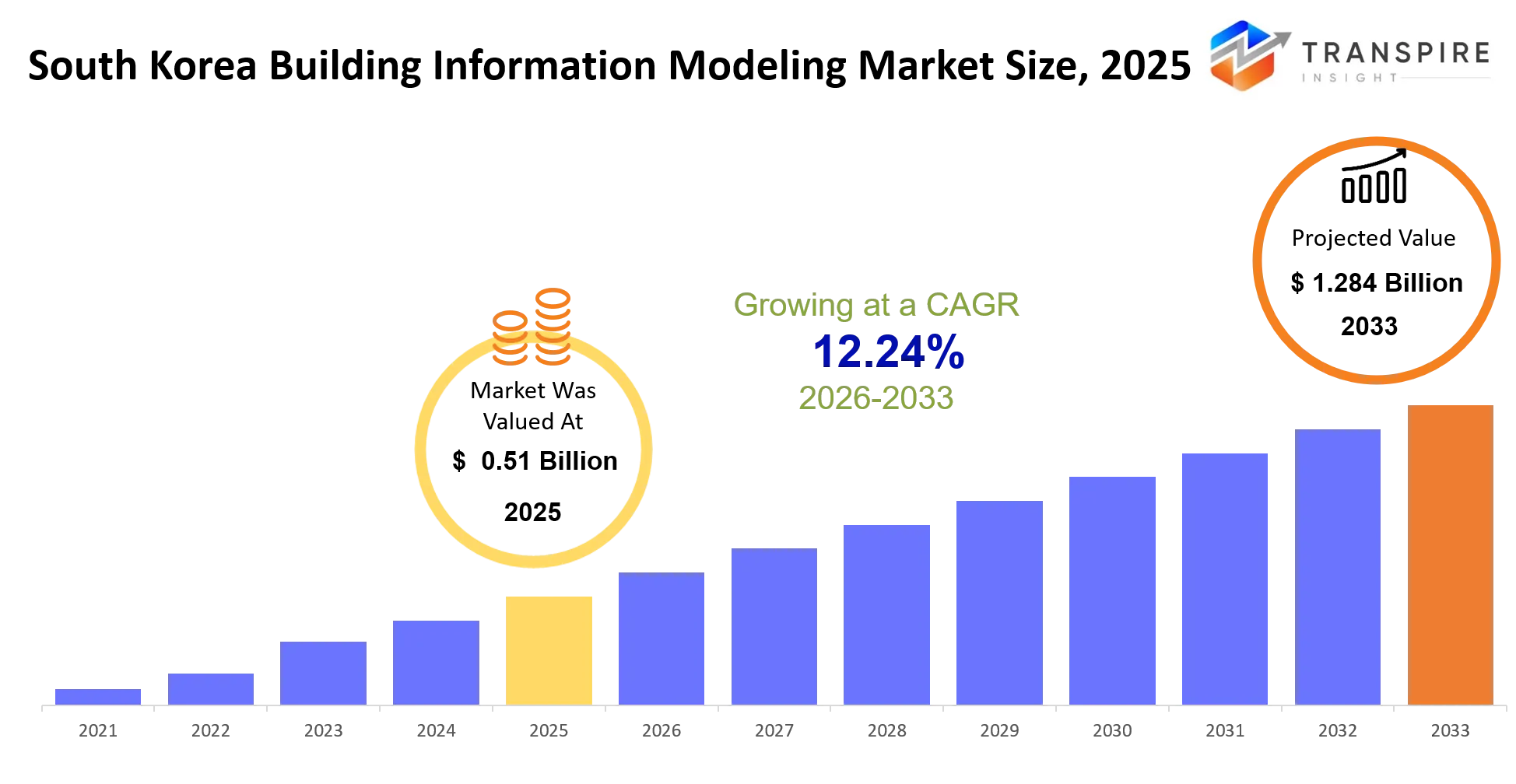
- South Korea Building Information Modeling Market Size 2025: USD 0.51 Billion
- South Korea Building Information Modeling Market Size 2033: USD 1.284 Billion
- South Korea Building Information Modeling Market CAGR: 12.24%
- South Korea Building Information Modeling Market Segments: By Component (Software, Services, Hardware, Others); By Deployment (Cloud, On-Premise, Hybrid, Others); By Application (Commercial Buildings, Residential Buildings, Infrastructure, Industrial Projects, Others)
To learn more about this report,  Download Free Sample Report
South Korea Building Information Modeling Market Summary
The South Korea Building Information Modeling Market was valued at USD 0.51 Billion in 2025. It is forecast to reach USD 1.284 Billion by 2033. That is a CAGR of 12.24% over the period.
In South Korea, Building Information Modeling (BIM) gets used by contractors architects, and infrastructure operators, to coordinate those complicated build jobs, from tall high-rise developments to transport and industrial facilities, in a way that blends design details scheduling, and cost info into this kind of single digital workspace,so you get less clashes, and also less rework later during execution. Over the last five years the market has really moved in a structural sense, away from those standalone 2D drafting routines, toward cloud based collaborative BIM platforms, which are also tied to digital twin capabilities, letting stakeholders sync up projects in near real time.
This shift was pushed faster by government smart construction requirements and public infrastructure digitization programs, plus the kind of pandemic-era interruptions that made inefficiencies in on-site coordination and approvals much more obvious, not to mention annoying. So now a lot of firms are adopting BIM, not only for design visualization, but for lifecycle management, and risk mitigation, which lifts output and shortens the overall schedule, and yeah that basically feeds into higher software adoption and more steady recurring service revenues.
Key Market Insights
- Seoul metropolitan area kind of dominates the South Korea Building Information Modeling market, with around 48% share, mainly because dense infrastructure modernization projects are rolling through in 2025.
- Busan and Incheon also stand out as the quickest-growing hubs, backed by smart port and logistics infrastructure expansion through 2030, basically.
- At the same time, regional smart city initiatives are pushing BIM rollout across the public-sector construction ecosystem around the country, faster than before.
- On the software side, solutions take the lead with roughly 55% share, largely thanks to solid enterprise adoption.
- Consulting and integration services end up holding the second-largest portion too, because organizations need BIM workflow tuning and data interoperability help, you know.
- And the cloud based BIM platforms segment is the fastest growing from 2024–2030, driven by demand for real time collaboration.
- Commercial construction is still the big one, like it’s basically taking up almost 42% of the South Korea Building Information Modeling Market, which is, honestly, hard to ignore.
- Infrastructure development, and this includes transport as well as smart city projects, is moving the quickest, fastest-growing application segment through 2030.
- Meanwhile, industrial facility management is growing in a steady way, because BIM keeps getting tied into lifecycle asset optimization systems, with less friction over time.
- On the end-use side, Architecture, Engineering, and Construction firms are leading adoption, holding more than 50% share in 2025.
What are the Key Drivers, Restraints, and Opportunities in the South Korea Building Information Modeling Market?
The main driver is basically government-led digital construction mandates, hooked to smart city initiatives and broader public infrastructure modernization programs. Regulatory expectations that came in for big public builds have kind of pushed contractors to use BIM as a compliance and bidding requirement, not really a “nice to have” thing. In practice this has increased software licensing revenue, and it has sped up enterprise-wide rollout too, because firms fold BIM into cost estimation, sequencing, and lifecycle management so they can stay competitive in state backed tenders.
The key restraint is persistent interoperability problems, plus a kind of skills fragmentation across older construction ecosystems. A lot of mid-tier contractors still run mixed toolsets, with mostly 2D CAD alongside partial BIM workflows, and that setup makes it difficult to integrate data cleanly across every project stage. This structural gap does not get fixed quickly because it needs workforce retraining and standardized data protocols across scattered subcontractor networks. So project inefficiencies just linger, adoption depth stays uneven, and the whole thing suppresses the productivity upside, while also delaying full monetization of the more advanced BIM capabilities.
The major opportunity is AI-enabled digital twin integration, especially within large infrastructure corridors like smart transport routes and port redevelopment programs, in places such as Busan and Incheon. Pilot efforts that mix BIM with real-time sensor signals are starting to show predictive maintenance outcomes, and asset optimization gains too. That is drawing additional attention from public funding streams as well as private investment.
What Has the Impact of Artificial Intelligence Been on the South Korea Building Information Modeling Market?
Artificial intelligence and advanced digital technologies are quietly changing the South Korea Building Information Modeling Market, by pushing BIM workflows into sort of real-time operational intelligence across construction, shipbuilding, and port infrastructure ecosystems, not just for design anymore.
On the automation side, AI-enabled systems are being used more and more to do design clash detection, update construction sequencing, and keep equipment compliance on track across big infrastructure efforts. In shipbuilding and port-linked engineering work, AI layers are also showing up in scrubber performance systems and exhaust gas cleaning technology, where sensor data is processed continuously so emissions compliance and system efficiency can be monitored, with minimal human fuss or manual intervention. That tends to lower supervisory workload and makes regulatory reporting feel more precise
Predictive capabilities are also moving fast, especially with machine learning models that forecast maintenance needs, energy usage patterns, and emissions output variability. These models help with predictive maintenance scheduling for built assets as well as marine emission control systems, so unexpected downtime can drop and lifecycle asset performance can stay steadier. Operators often mention directional gains like 10–15% better maintenance planning efficiency, plus clear reductions in operational disruption risk
Still, a major bottleneck remains the integration cost of AI with legacy BIM and industrial control systems. A lot of operators deal with fragmented data environments, and training datasets with high quality tend to be limited when you look at real-world maritime conditions, so model accuracy can weaken in more complex offshore settings. This also slows down broad deployment across the South Korea Building Information Modeling Market ecosystem.
Key Market Trends
- After 2022, the public procurement rules got updated in a way that sort of turned BIM from an optional add-on into a mandatory need, especially for big infrastructure tenders.
- Around 2021 to 2025, contractors in Seoul metro jobs were moving away from standalone CAD setups into more integrated BIM platforms, step by step, even if not everyone did it in the same rhythm.
- Then post 2023, cloud-based BIM take-up spiked pretty fast, because many firms wanted real-time coordination between scattered building teams and subcontractors.
- In the 2024 to 2026 window, digital twin rollouts also widened, where BIM models started talking to operational infrastructure monitoring systems, mostly within smart city efforts.
- AI-assisted clash detection tools helped lower the amount of design rework, so coordination became less of a bottleneck across a number of major Korean construction companies.
- Also, in Busan and Incheon, port and logistics infrastructure projects have increasingly used BIM for lifecycle asset tracking since 2023, not just for design, but for follow-through as well.
- That said, mid-tier contractors lagged in full BIM integration, mainly because of workforce skill gaps, which has slowed consistent uptake across these fractured supply chains.
- And globally, technology providers like Autodesk and Bentley Systems have pushed deeper into the market by offering localized cloud and AI-enabled BIM tools, making the whole thing feel more “nearby” for local teams.
South Korea Building Information Modeling Market Segmentation
By Component :
Software pretty much sits at the center of the South Korea Building Information Modeling Market, since most construction firms are, you know, moving away from just basic design tools and toward more integrated digital platforms. Adoption will keep climbing, because firms want to cut down on design mistakes, improve overall coordination, and keep project data in one place, kind of under one roof system. In a way this shows a noticeable departure from those scattered, fragmented drafting approaches toward centralized digital construction planning, with less chaos on the back end.
Services still act as a strong supporting role in all of this, and companies often lean on consulting integration, and training so BIM is actually used effectively. A lot of firms still don’t have deep in-house know-how, so external providers end up bridging the workflow gaps, and making sure teams use the system properly. Hardware also remains significant, especially when supporting high-performance modeling setups. Then there are the other supporting tools, the ones that help with data handling and visualization needs across big infrastructure projects, not just one building.
By Deployment :
Cloud deployment is getting more attention as the preferred model in the South Korea Building Information Modeling Market, mainly because construction teams need real-time collaboration across several project sites. Cloud setups make it easier to share data quickly, they also reduce version conflict headaches, and they help contractors and engineers coordinate more smoothly. Basically, this reflects the rising demand for project environments that are flexible,and can be accessed remotely, without all the friction.
That said, on-premise systems are still around and some large enterprises keep them, especially when internal data control and security are the top priority. But over time, usage has been sliding a bit, since maintenance costs can add up and scalability is kind of limited, which creates operational pressure. Hybrid models are also growing, because firms try to balance security requirements with the flexibility you get from the cloud, and that ends up making the transition toward fully connected digital construction systems feel less abrupt.
By Application :
Commercial buildings are a big chunk of the South Korea Building Information Modeling Market, kinda like where developers keep pushing for efficiency in design cost control, and quicker project delivery. BIM uptake here is expected to keep moving upward too, mostly because the urban redevelopment push is expanding and people want more optimized building planning outcomes, not just “good enough”.
For residential buildings the adoption looks steady, with contractors using BIM to cut down on construction errors, and to keep housing timelines on track. Infrastructure projects are moving the fastest, mainly driven by smart city programs, transport upgrades and public sector funding, so yes there’s a lot of momentum there. Industrial projects also lean into BIM for facility planning and operational efficiency, while the other application areas mostly back specialized construction requirements across smaller developments, where the scope is narrower, but the need for coordination is still very real.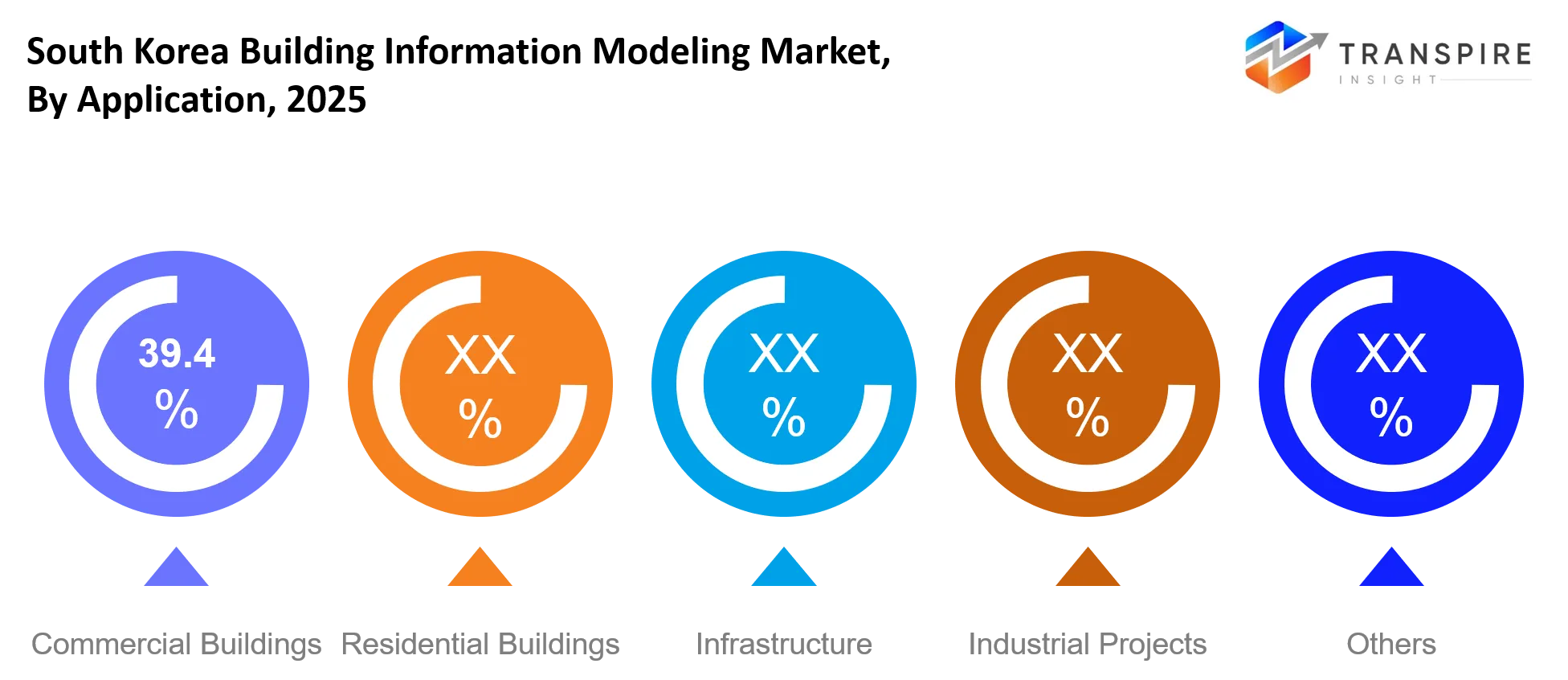
To learn more about this report, Download Free Sample Report
What are the Key Use Cases Driving the South Korea Building Information Modeling Market?
Commercial construction planning is still the main use case in the South Korea Building Information Modeling Market, mostly because developers really lean on integrated design coordination, to cut down on rework and keep construction costs from climbing too fast in crowded urban setups. Big real estate players and infrastructure teams use BIM so architectural, structural, and cost information are in sync, and that helps their decisions feel more solid, while also shrinking delivery schedules a bit.
Infrastructure development, plus facility management is getting more attention too, particularly with public agencies and engineering contractors working on transport corridors, smart city improvements, and utility networks. They want BIM to handle the complicated sequencing, and to boost coordination across many subcontractors and government stakeholders, especially on metro rail and highway expansion programs, where timelines can get tight fast.
Newer use cases are also showing up, like digital twin integration for operational asset monitoring and automated compliance tracking on big industrial and public infrastructure efforts. Even shipyard-linked construction and port modernization work are starting to look more closely at BIM-based lifecycle monitoring systems where real-time data can support maintenance planning and overall long term asset performance management.
|
Report Metrics |
Details |
|
Market size value in 2025 |
USD 0.51 Billion |
|
Market size value in 2026 |
USD 0.572 Bnillion |
|
Revenue forecast in 2033 |
USD 1.284 Billion |
|
Growth rate |
CAGR of 12.24% from 2026 to 2033 |
|
Base year |
2025 |
|
Historical data |
2021 - 2024 |
|
Forecast period |
2026 - 2033 |
|
Report coverage |
Revenue forecast, competitive landscape, growth factors, and trends |
|
Country scope |
South Korea |
|
Key company profiled |
Autodesk, Bentley Systems, Trimble, Nemetschek, Dassault Systemes, Hexagon, Oracle, Siemens, Procore, Graphisoft, AVEVA, RIB Software, Asite, Revizto, ACCA Software |
|
Customization scope |
Free report customization (country, regional & segment scope). Avail customized purchase options to meet your exact research needs. |
|
Report Segmentation |
By Component (Software, Services, Hardware, Others); By Deployment (Cloud, On-Premise, Hybrid, Others); By Application (Commercial Buildings, Residential Buildings, Infrastructure, Industrial Projects, Others) |
Which Regions are Driving the South Korea Building Information Modeling Market Growth?
Seoul and the area around it, the Gyeonggi region, kind of lead the South Korea Building Information Modeling market because of tough policy enforcement and all that focused infrastructure build-out. You can see government-backed smart city programs running alongside strict digital construction rules, especially on public projects, so a lot of major contractors pick BIM early. Also, the whole place has this dense cluster of architecture firms, engineering consultants, and bigger construction companies, they keep working together on high value urban redevelopment, so it feels like the know-how and the demand just stay in motion. That kind of concentration helps keep leadership steady and speeds up tech integration across different project types, not just one.
Then there’s Busan, it acts like a more stable second region, mainly because of the port economy and a long standing industrial infrastructure foundation. Instead of Seoul’s kind of policy push fast track approach, Busan’s BIM uptake is more anchored in steady spending from shipping, logistics, and coastal industrial operators. Shipbuilding related infrastructure efforts and port modernization programs keep generating fairly consistent needs for digital coordination tools on projects. Adoption there looks slower but still more predictable, driven more by operational efficiency needs than by quick regulatory changes, so overall the market grows reliably, but in a more gradual way.
Incheon is sort of the fastest-growing region right now, mainly because of recent expansions in smart port infrastructure and airport-linked logistics, plus a bunch of airport-adjacent logistics development that keeps stacking up. After 2023, there was also large-scale government investment which is kinda pushing quicker adoption of BIM in transport hubs and integrated industrial zones. As a result this change is producing new demand from contractors that really care about multi-modal infrastructure planning and lifecycle asset management, not just construction. For market entrants and investors, Incheon is basically sending a clear signal of long-term opportunity between 2026 and 2033, particularly in cloud-based BIM platforms, and in infrastructure systems enabled by digital twins.
Who are the Key Players in the South Korea Building Information Modeling Market and How Do They Compete?
The South Korea Building Information Modeling Market looks kinda moderately consolidated when you only look at the platform level, but it’s definitely more fragmented across implementation work, and integration services too. Big global software names go head to head with system integrators and engineering consultancies, and lately the real rivalry seems to be about cloud interoperability, AI-enabled coordination, and staying aligned with public procurement digital standards. A lot of vendors now push for lifecycle data integration instead of just offering basic modeling tools. If a company wants strong positioning, it usually has to embed its platform into government-backed smart construction programs and the bigger enterprise project ecosystems, because switching costs stay high, and long-term contracts tend to generate steady revenue.
Autodesk, Bentley Systems, and Trimble Inc. keep expanding by using pretty differentiated digital strategies. Autodesk leans into cloud-first BIM ecosystems and subscription-style workflows that keep users tied into ongoing platform upgrades. Bentley Systems goes harder on infrastructure-grade digital twin capabilities that are tuned for transport and utility networks, so it stays relevant in major public-sector programs. Trimble, meanwhile, builds leverage through field-to-office integration, meaning it links on-site equipment data directly into BIM platforms and then grows adoption through partnerships with Korean construction firms.
Nemetschek Group, and Hexagon AB seem to grow by leaning into niche specialization kind of thing and also industrial integration. Nemetschek goes after mid sized contractors with those modular software suites, so teams can deploy things in a more flexible way without doing the whole “full enterprise migration” step. Hexagon AB, on the other hand, strengthens its stance using digital reality capture and metrology tools that get used a lot in heavy infrastructure and in construction settings that are somehow linked to manufacturing. In the end, both companies expand their reach via regional alliances, cloud upgrades and, lots of collaboration with engineering firms that work on smart city initiatives and industrial automation plans.
Company List
- Autodesk
- Bentley Systems
- Trimble
- Nemetschek
- Dassault Systemes
- Hexagon
- Oracle
- Siemens
- Procore
- Graphisoft
- AVEVA
- RIB Software
- Asite
- Revizto
- ACCA Software
Recent Development News
In May 2025, Hyundai Engineering and Trimble Solutions Korea announced a collaboration to develop a BIM process management program. The initiative focuses on integrating 3D BIM with steel and PC construction workflows to improve productivity, reduce project delays, and enhance site-level digital coordination in large-scale infrastructure projects.
Source https://www.businesskorea.co.kr/
In May 2025, Umi Construction (Umi Construction Co.) entered into a partnership with Changsoft to jointly develop a BIM-based structural frame construction management platform. The solution aims to link real-time construction data with BIM models to detect design deviations early, reduce rework, and improve cost and quality control in Korean construction projects.
Source https://www.edaily.co.kr/
What Strategic Insights Define the Future of the South Korea Building Information Modeling Market?
South Korea's Building Information Modeling Market is slowly leaning into a more fully integrated digital construction ecosystem, where BIM kinda becomes the central layer, linking design, execution, and asset operations, all together. Over the next 5–7 years, adoption will likely be pushed forward by tighter public procurement digitization rules, plus the growth of smart infrastructure programs that basically demand real-time data continuity over the whole project lifecycle. So yeah, BIM moves out of being only a planning tool into an operational infrastructure standard, used broadly across both public and private work.
One thing that is kinda hidden though, is the growing dependency on a small set of global software platforms, which could quietly put contractors under pricing pressure, and also reduce customization flexibility. If licensing costs go up, or if platform policies shift, mid-tier construction firms might see margin compression, and slower timelines for their digital transition. And this concentration risk is often left out when people look at the headline growth projections, it doesn’t get enough attention.
There’s also an emerging opportunity that’s showing up, mainly around AI-integrated digital twin ecosystems tied to transport corridors and smart port developments, especially in Incheon and Busan. These setups are still in early stage deployment, but they are getting more policy support lately. Market participants should focus on interoperable cloud-native BIM solutions, and start building partnerships early with public infrastructure agencies, so they can secure more durable contract positions later on.
South Korea Building Information Modeling Market Report Segmentation
By Component
- Software
- Services
- Hardware
By Deployment
- Cloud
- On-Premise
- Hybrid
By Application
- Commercial Buildings
- Residential Buildings
- Infrastructure
- Industrial Projects
Frequently Asked Questions
Find quick answers to common questions.
The Expected South Korea Building Information Modeling Market size is USD 1.284 Billion in 2033.
Key Segments for the South Korea Building Information Modeling Market are By Component (Software, Services, Hardware, Others); By Deployment (Cloud, On-Premise, Hybrid, Others); By Application (Commercial Buildings, Residential Buildings, Infrastructure, Industrial Projects, Others).
Major South Korea Building Information Modeling Market Players are Autodesk, Bentley Systems, Trimble, Nemetschek, Dassault Systemes, Hexagon, Oracle, Siemens, Procore, Graphisoft, AVEVA, RIB Software, Asite, Revizto, ACCA Software.
The Current South Korea Building Information Modeling Market size is USD 0.51 Billion in 2025.
The South Korea Building Information Modeling Market CAGR is 12.24% from 2026 to 2033.
- Autodesk
- Bentley Systems
- Trimble
- Nemetschek
- Dassault Systemes
- Hexagon
- Oracle
- Siemens
- Procore
- Graphisoft
- AVEVA
- RIB Software
- Asite
- Revizto
- ACCA Software
About the Authors

Mayur Shinde
I am Mayur Shinde, a Senior Research Analyst at Transpire Insight, specializing in the Automotive & Transportation and Information & Communication Technology (ICT) Industry. My work focuses on analyzing emerging market trends, technological advancements, competitive landscapes, and industry developments to deliver accurate, data-driven insights. I am passionate about transforming complex market information into clear, actionable content that helps businesses, professionals, and decision-makers stay informed and make confident strategic decisions.

Chakradhar Khansole
Chakradhar serves as the Research Director at Transpire Insight, bringing over 8 years of experience in technology, innovation, and strategic market intelligence. He specializes in transforming complex market data into actionable business insights that enable organizations to make informed, growth-oriented decisions. Recognized for his strategic vision and analytical expertise, Chakradhar leads high-impact research initiatives, delivering comprehensive market assessments, competitive intelligence, and forward-looking industry analysis.
Recently Published Reports
-
Apr 2026
3D Optical Profiler Market
3D Optical Profiler Market Size, Share & Analysis Report By Type (Desktop 3D Optical Profiler, and Portable 3D Optical Profiler), By Technology (Confocal Technology, and White Light Interference), By End-Use Industry (Manufacturing, Research Institutions, Automotive, Aerospace and Defense, Medical Devices, and Other), and Geography (North America, Europe, Asia-Pacific, Middle East and Africa, South and Central America), 2021 - 2031
-
Apr 2026
Depth Sensor Market
Depth Sensor Market Size, Share & Analysis Report By Type (Infrared Depth Sensors, Time-of-Flight (ToF) Sensors, Stereo Vision Sensors, Structured Light Sensors, Ultrasonic Depth Sensors), By Application (Automotive, Robotics, Gaming, Consumer Electronics, Industrial Automation, Healthcare, Security & Surveillance, Others), By End Users (Automotive Manufacturers, Consumer Electronics Companies, Healthcare Providers, Industrial Companies, Security Agencies, Gaming Companies, Robotics Companies, Others), and Geography (North America, Europe, Asia-Pacific, Middle East and Africa, South and Central America), 2021 – 2031
-
Apr 2026
Digital Manufacturing Market
Digital Manufacturing Market Size, Share & Analysis Report By Component (Hardware, Software, and Services), By Technology (Robotics, 3D Printing, Internet of Things (IoT), and Others), By Application (Automotive and Transportation, Aerospace and Defense, Consumer Electronics, Industrial Machinery, and Others), By Process Type (Computer-Based Designing, Computer-Based Simulation, Computer 3D Visualization, Analytics, and Others), and Geography (North America, Europe, Asia-Pacific, Middle East and Africa, South and Central America), 2021 – 2031
-
Apr 2026
Digital Visa Services Market
Digital Visa Services Market Size, Share & Analysis Report By Type (Individual Travelers, Group Travelers), By Application (Tourism, Business Travel, Others), and Geography (North America, Europe, Asia-Pacific, Middle East and Africa, South and Central America), 2021 – 2031