
Asia Pacific 3D Animation Software Market Size & Forecast:
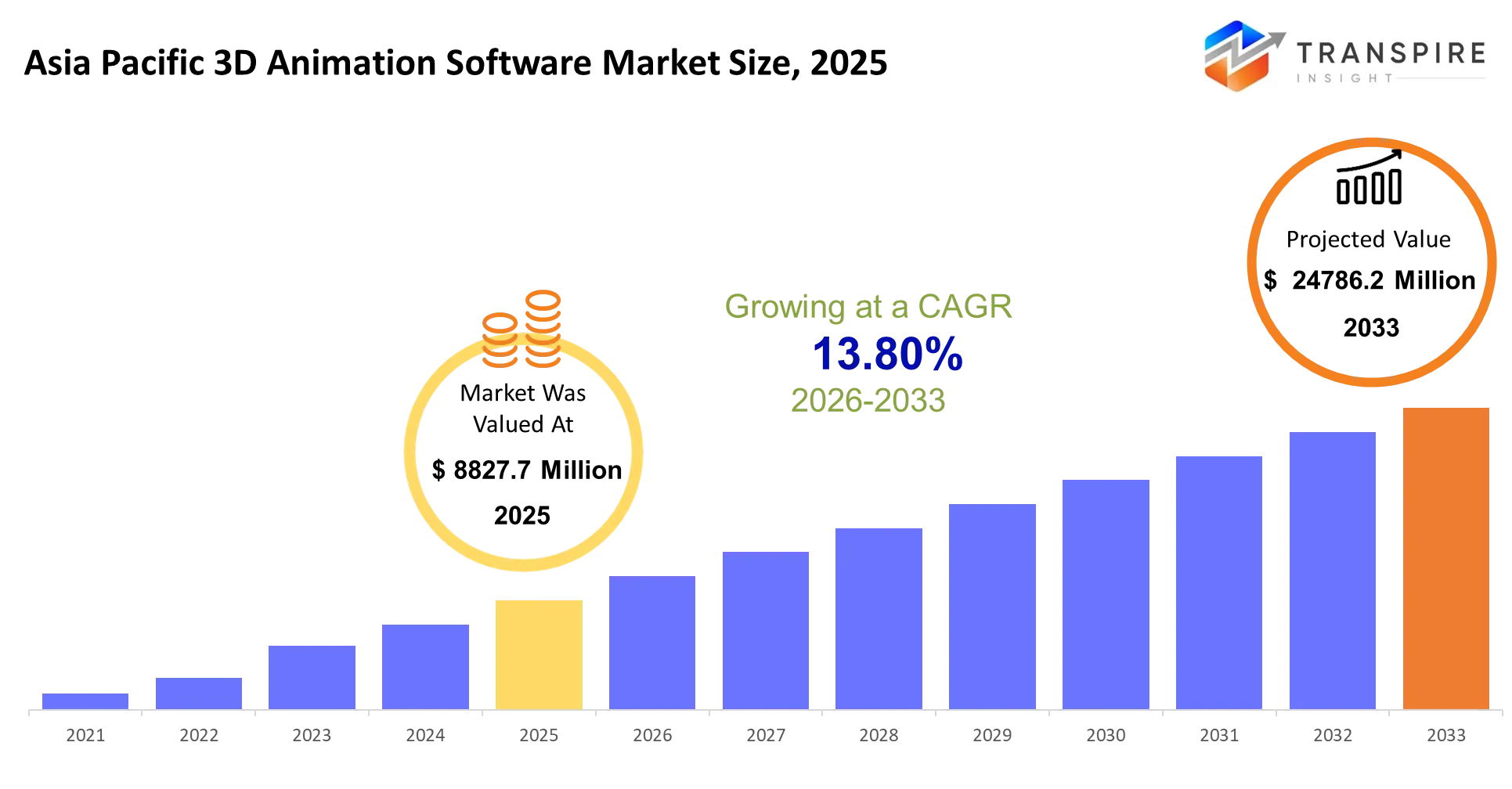
- Asia Pacific 3D Animation Software Market Size 2025: USD 8827.7 Million
- Asia Pacific 3D Animation Software Market Size 2033: USD 24786.2 Million
- Asia Pacific 3D Animation Software Market CAGR: 13.80%
- Asia Pacific 3D Animation Software Market Segments: By Type (Modeling Software, Rendering Software, Animation Software, Simulation Software, VFX Software, Others); By Application (Media & Entertainment, Gaming, Architecture, Education, Advertising, Others); By End-User (Studios, Enterprises, Freelancers, Educational Institutes, Designers, Others); By Deployment (Cloud, On-premises, Hybrid, SaaS, Digital Platforms, Others)
To learn more about this report,  Download Free Sample Report
Asia Pacific 3D Animation Software Market Summary
The Asia Pacific 3D Animation Software Market was valued at USD 8827.7 Million in 2025. It is forecast to reach USD 24786.2 Million by 2033. That is a CAGR of 13.80% over the period.
The Asia Pacific 3D animation software market enables studios, game developers, architects, and industrial designers to build highly detailed digital environments and simulations used in films, gaming, product design, and even maritime training systems such as ship bridge simulators and offshore project visualization. The market has experienced a transition from traditional desktop tools to modern cloud-based systems which allow users to render content in real time because developers create engines that support fast design testing and cooperative work in different locations.
The major structural change establishes a new framework that combines AI supported modeling with physics simulation rendering to decrease manual tasks and accelerate production time. Studios and design firms needed to create remote production workflows after the COVID-19 pandemic caused a major disruption which led them to implement digital collaboration tools. Businesses today make larger investments in software systems that can grow because these systems enable faster operations and lower expenses while maintaining support for creative teams who work across multiple locations in Asia's digital content and industrial design industries.
Key Market Insights
- China will dominate the Asia Pacific 3D animation software market because it holds 32% of the market share in 2025.
- The Japanese market follows this trend because it uses simulation software and film production software at advanced levels.
- India will become the fastest-growing region between 2025 and 2033 because its IT outsourcing sector and digital content creation sector are both expanding.
- The Asia Pacific 3D Animation Software Market will see 3D modeling software as its leading product with a market share of 38% in 2025.
- The second largest market segment consists of rendering software which the gaming and VFX industries drive to create high-quality visual content.
- The real-time animation tools market will grow at the fastest rate because game engines will integrate with this technology until 2033.
- The gaming and entertainment applications market generates 45% of its total revenue which makes it the primary revenue source for the year 2025.
- The fastest expanding application segment for architectural visualization develops through smart city projects and infrastructure development programs.
- The Media and entertainment companies lead end-user adoption with around 40% share in the Asia Pacific 3D Animation Software Market.
- The industrial and engineering sector experiences its most rapid growth through increased adoption of simulation and digital twin modeling technologies.
What are the Key Drivers, Restraints, and Opportunities in the Asia Pacific 3D Animation Software Market?
The fast progression of real-time rendering technologies together with AI-based content development methods has emerged as the main driving force behind the Asia Pacific 3D Animation Software Market. The shift began when studios faced rising production costs and shorter delivery cycles, pushing them to adopt engines such as Unreal Engine-based pipelines and cloud rendering platforms. The current business requirements lead to increased software subscription rates because organizations need tools which can grow with them and support teamwork while decreasing the time needed for modeling and increasing their production of revenue-generating content.
The restraint exists because developing Asian Pacific nations need advanced hardware systems which require extensive computational facilities yet they have restricted access to such technology. Many mid-sized studios and educational institutions still rely on outdated systems that cannot fully support GPU-intensive rendering or real-time animation workflows. The existing system constraints prevent software vendors from achieving widespread market presence while they need to keep their software products affordable in markets which require high-cost infrastructure upgrades.
The opportunity is emerging through the progress of digital twin technology in maritime operations and manufacturing processes and smart city systems which develop in China and Singapore and South Korea. The use of 3D animation software by governments and enterprises has increased for simulation-based planning systems which require predictive modeling and operational visualization. Port authorities in Singapore use simulation environments to improve vessel traffic management which establishes a new business requirement that connects entertainment with industrial decision-making systems.
What Has the Impact of Artificial Intelligence Been on the Asia Pacific 3D Animation Software Market?
The implementation of automated systems for monitoring and simulation and compliance verification operations leads to the transformation of scrubber performance systems and complete marine emission control systems through their usage of artificial intelligence and modern digital technologies. Researchers utilize AI-powered 3D visualization systems to create simulations of exhaust gas cleaning system operations, which help engineers find optimal settings for scrubbers while reducing the need for manual system adjustments. The system achieves compliance automation through its ability to merge sensor information with digital twin models, which provide continuous emission threshold monitoring for ships that operate throughout Asia Pacific trade routes.
Machine learning models enhance predictive maintenance capabilities by examining vibration, temperature, and flow-rate data from scrubber units to predict fouling, corrosion risks, and performance decline. The process decreases unplanned downtime while increasing maintenance schedule efficiency, which results in operational availability improvements of more than 10 percent for optimized fleets together with reductions in fuel consumption and cleaning operation costs.
The current structure of AI deployment encounters major problems because of two main obstacles which include sporadic internet access on ships and insufficient high-quality training data for maritime applications. The inability of many remote shipping vessels to transmit continuous sensor data creates a model accuracy problem which results in delayed optimization of real-time operations. The AI-enabled scrubber systems and emission optimization tools maintain their potential because software development progresses quickly through the Asia Pacific maritime technology ecosystem.
Key Market Trends
- The 3D Animation Software Market in Asia Pacific studios to the present day has implemented real-time engine technology which replaced their previous offline rendering process.
- The animation industry adopted cloud-based platforms which replaced existing standalone software systems to allow teams from Japan, India, and China to work together in real time.
- The development of AI-powered modeling tools after 2023 technology enabled designers to create assets automatically through texture generation and motion design process automation.
- Game developers increasingly adopted Unreal Engine-based pipelines, with Epic Games reporting stronger enterprise licensing growth across Asia Pacific studios.
- The demand for products shifted from entertainment-only usage to industrial simulation needs which included maritime training and smart infrastructure visualization projects.
- The shift to subscription-based pricing systems from perpetual licensing enabled small studios to access software while generating new revenue streams for companies such as Autodesk.
- The Blender Foundation open-source ecosystem enabled independent creators from India and Southeast Asia to adopt its platform because it disrupted cost-sensitive markets.
- Digital content localization required regulatory compliance which forced businesses to develop animation technologies that enable them to create content for different regions using multiple languages and local cultural elements.
- The period after 2021 witnessed a major increase in international outsourcing activities as Japan and South Korea began transferring their VFX production needs to more affordable facilities located in Vietnam and India.
- The implementation of digital twin technology changed how companies adopted digital twins across different industries, especially manufacturing and urban planning development.
Asia Pacific 3D Animation Software Market Segmentation
By Type :
The Asia Pacific 3D Animation Software Market will use modeling software to create digital objects and characters which will be used in movies and video games and training simulations. The rendering software transforms 3D scenes into final visual outputs which display realistic lighting and textures. The animation software enables artists to create motion sequences while the simulation software enables them to create physics-based movements. VFX software will enhance visual storytelling through digital effects while additional tools will provide support for editing tasks and workflow integration tasks.
The production pipeline needs different types of tools which together will enable complete content creation. Visual quality improvement will drive up demand for tools which studios and independent creators need for their work. The integration of tools will enhance efficiency by reducing production time and enabling better teamwork among teams who develop animation and digital media projects.
By Application :
The media and entertainment sector will keep showing strong demand because animated films and television series and digital content continue to grow in popularity. The gaming sector will experience strong growth because more players now prefer 3D gaming environments that feature lifelike character animations. Animation software will serve architectural purposes by enabling 3D building design visualization while educational institutions will use it to create interactive learning materials.
3D animation will function as an advertising tool for businesses to create visually impactful product promotions and digital marketing campaigns. The other applications will include healthcare visualization and industrial design. Businesses and institutions will adopt interactive content because they need realistic visuals to create more engaging ways for their audiences to receive information.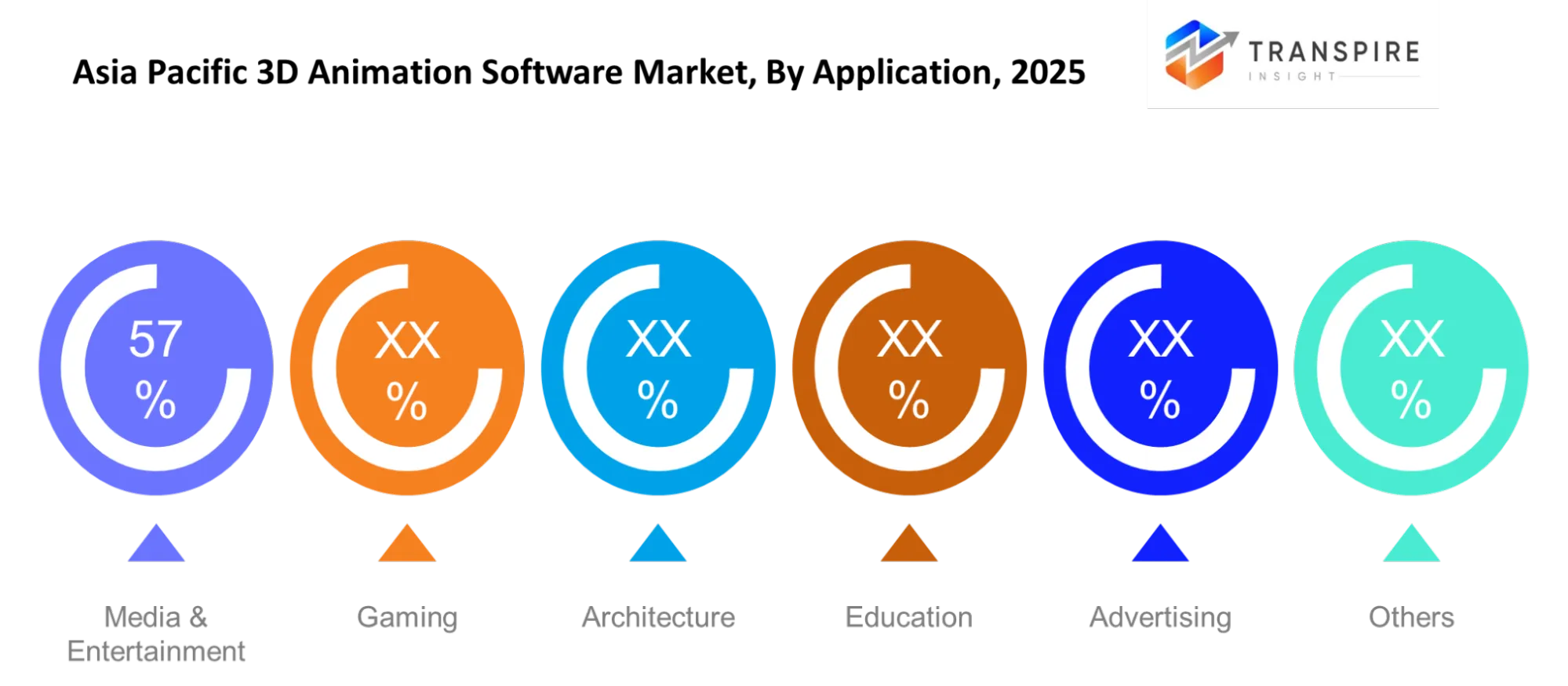
To learn more about this report, Download Free Sample Report
By End-User :
Studios will remain key end-users as they produce large-scale animation, film, and gaming content which requires advanced tools. Enterprises will use 3D animation software to create branding materials and marketing content which shows their products. Freelancers will increasingly adopt these tools because they enable them to work on digital content creation and animation projects which they can do across multiple platforms.
Educational institutes will use animation software for teaching design media and technical subjects through interactive learning. Designers will use these tools to create product designs and visualizations and develop their artistic work. The research organizations and small creative teams will use these applications as their primary software. The demand for visual content will increase because more industries use visual content to improve their communication and training activities.
By Deployment :
The animation tools will be accessible through cloud deployment which will allow teams to work together in real-time from different locations. The large studios will continue using on-premises solutions because they need full control over their data and processing capabilities. The hybrid models will use both systems to achieve operational flexibility which needs to be balanced with performance requirements.
SaaS-based tools will allow subscription-based access to software without heavy installation requirements which makes them suitable for freelancers and small teams. Digital platforms will support integrated workflows which allow users to store and share their animation assets. The deployment trends in the Asia Pacific 3D Animation Software Market will shift toward systems that provide flexible access for production purposes while enabling quick and efficient team collaboration.
What are the Key Use Cases Driving the Asia Pacific 3D Animation Software Market?
The major application for 3D Animation Software in Asia Pacific markets exists through gaming and entertainment content production, which requires studios to create realistic character models and virtual environments and special effects through advanced modeling and real-time rendering technologies. The production industry demands this area because studios need to create assets quickly while developing content that matches the visual standards of international streaming and gaming platforms.
The field of architectural visualization and industrial design has expanded beyond its original boundaries to become essential for engineering companies and media production studios. 3D animation tools enable users to create virtual models of infrastructure projects and product prototypes and large-scale urban developments which enhances design precision and boosts client communication before they start actual building work.
The development of new applications creates rising demand for maritime simulation training and smart manufacturing digital twin technology. The shipping industry and port authorities use 3D animation software to create models of vessel navigation scenarios while manufacturers use it to demonstrate production line efficiency and anticipate system breakdowns which enables them to develop safer and more economical operational strategies throughout the upcoming forecast period.
|
Report Metrics |
Details |
|
Market size value in 2025 |
USD 8827.7 Million |
|
Market size value in 2026 |
USD 10028.4 Million |
|
Revenue forecast in 2033 |
USD 24786.2 Million |
|
Growth rate |
CAGR of 13.80% from 2026 to 2033 |
|
Base year |
2025 |
|
Historical data |
2021 - 2024 |
|
Forecast period |
2026 - 2033 |
|
Report coverage |
Revenue forecast, competitive landscape, growth factors, and trends |
|
Regional scope |
India, China, Japan, and Australia |
|
Key company profiled |
Autodesk, Adobe, Blender, Maxon, SideFX, Epic Games, Unity, Pixar, NVIDIA, Dassault Systemes, Trimble, Corel, Foundry, NewTek, Smith Micro |
|
Customization scope |
Free report customization (country, regional & segment scope). Avail customized purchase options to meet your exact research needs. |
|
Report Segmentation |
By Type (Modeling Software, Rendering Software, Animation Software, Simulation Software, VFX Software, Others); By Application (Media & Entertainment, Gaming, Architecture, Education, Advertising, Others); By End-User (Studios, Enterprises, Freelancers, Educational Institutes, Designers, Others); By Deployment (Cloud, On-premises, Hybrid, SaaS, Digital Platforms, Others) |
Which Regions are Driving the Asia Pacific 3D Animation Software Market Growth?
The Asia Pacific 3D Animation Software Market which China controls stems from its state-supported digital media system and its huge investments in industrial simulation and gaming development. The government promotes digital content production and smart manufacturing which leads studios and engineering firms to adopt advanced 3D animation tools. The country benefits from a widespread network of animation studios and game developers together with maritime training centers which require advanced visualization software. The country uses 3D modeling for port automation and urban planning projects which enables both commercial and industrial sectors to continuously use their software solutions. Japan represents a more stable but technologically mature contributor to the Asia Pacific 3D Animation Software Market.
Japan bases its expansion on precise manufacturing processes and established animation studios and its long-term commitment to enterprise software systems while China uses its massive production capacity to grow its market. Shipbuilders and automotive firms consistently use 3D animation for simulation design validation and safety testing under strict quality standards. The presence of regulatory stability together with strong intellectual property protection creates an environment that fosters continuous investment in advanced visualization technologies. The system generates stable demand patterns which lead to predictable business growth without experiencing sudden market shifts. The system generates stable demand patterns which lead to predictable business growth without experiencing sudden market shifts.\
The region of India experiences its fastest growth because IT outsourcing and gaming development and low-cost digital production services are expanding at a rapid pace. The creation of creative technology parks and governmental digital skills training programs has resulted in studios obtaining software access at a much higher level. The increasing demand for outsourcing services from Japan and the United States has caused more companies to adopt cloud-based 3D animation platforms. The Indian market offers investors and new businesses a chance to grow because cost benefits and an increasing talent pool will drive business expansion until 2033.
Who are the Key Players in the Asia Pacific 3D Animation Software Market and How Do They Compete?
The Asia Pacific 3D Animation Software Market remains under moderate market consolidation because advanced toolchains stay under control of a few global market leaders while open-source platforms and smaller tools create new pricing and distribution challenges. Competition between companies depends on their technological abilities because real-time rendering and AI modeling and cloud systems create the most significant advantages. Studios and enterprises prefer to work with vendors who provide complete system packages that enable them to connect their animation and simulation and rendering operations across different workflows. The subscription pricing system together with the SaaS delivery system in the last few years has created a more competitive environment which enables gaming and media and industrial design vendors to compete because it makes their products easier to switch between and increases their market rivalry.
Autodesk maintains its advantage through enterprise-grade software like Maya and 3ds Max which delivers deep pipeline integration and cloud collaboration tools that support large studios and architecture firms. Adobe uses Substance 3D and After Effects to strengthen its market position because it offers advanced material design capabilities which work seamlessly with its Creative Cloud ecosystem. Unity Technologies uses its real-time engine to compete in the market because its technology now extends to automotive and maritime simulation projects which require interactive visualization.
Epic Games develops its business through Unreal Engine because it enables photorealistic rendering and virtual production features that film and gaming studios widely use. Dassault Systèmes develops industrial digital twins to provide aerospace and maritime engineering clients with authentic simulation environments. The Blender Foundation uses its open-source pricing structure to gain popularity among independent creators and small studios throughout the Asia Pacific region.
Company List
- Autodesk
- Adobe
- Blender
- Maxon
- SideFX
- Epic Games
- Unity
- Pixar
- NVIDIA
- Dassault Systemes
- Trimble
- Corel
- Foundry
- NewTek
- Smith Micro
Recent Development News
In October 2025, Kaixin Holdings announced the intended acquisition of Honglu Technology. The deal aims to strengthen Kaixin’s ‘AI + Animation’ ecosystem by integrating Honglu’s 3D animation production capabilities, including Unreal Engine-based workflows and AI-driven animation tools. Sourcehttps://kaixin.gcs-web.com/
In March 2026, Tencent Cloud expanded its partnership with 3D AI Studio to scale generative AI-based 3D content creation. The collaboration enhances AI-powered model generation and animation workflows for gaming, media, and immersive applications across Asia Pacific markets.Source https://www.prnewswire.com/
What Strategic Insights Define the Future of the Asia Pacific 3D Animation Software Market?
The Asia Pacific 3D Animation Software Market is moving toward a future where all production systems will use real-time AI technology to create animation and simulation and industrial visualization through a single cloud system. The industry requirement for quicker content production together with the current digital twin technology used across gaming and maritime and smart infrastructure development practices drives this transformation. The upcoming 5 to 7 years will see platforms that integrate rendering and physics simulation and generative AI technologies into a unified workflow environment generate greater value than separate software applications.
A less obvious risk lies in rising platform dependency on a few dominant engine ecosystems which could restrict interoperability and increase long-term switching costs for studios and enterprises. The current market structure prevents mid-tier developers from setting their own prices because of its concentration.
Southeast Asian governments are launching smart city and port modernization projects which create an opportunity for 3D simulation technology to become essential in planning and operational modeling. Market participants should prioritize building interoperable AI-augmented toolchains that integrate seamlessly with major engines while remaining adaptable to industrial and entertainment use cases.
Asia Pacific 3D Animation Software Market Report Segmentation
By Type
- Modeling Software
- Rendering Software
- Animation Software
- Simulation Software
- VFX Software
By Application
- Media & Entertainment
- Gaming
- Architecture
- Education
- Advertising
By End-User
- Studios
- Enterprises
- Freelancers
- Educational Institutes
Designers
By Deployment
- Cloud
- On-premises
- Hybrid
- SaaS
- Digital Platforms
Frequently Asked Questions
Find quick answers to common questions.
The Asia Pacific 3D Animation Software Market size is USD 24786.2 Million in 2033.
Key segments for the Asia Pacific 3D Animation Software Market are By Type (Modeling Software, Rendering Software, Animation Software, Simulation Software, VFX Software, Others); By Application (Media & Entertainment, Gaming, Architecture, Education, Advertising, Others); By End-User (Studios, Enterprises, Freelancers, Educational Institutes, Designers, Others); By Deployment (Cloud, On-premises, Hybrid, SaaS, Digital Platforms, Others).
Major Asia Pacific 3D Animation Software Market Players are Autodesk, Adobe, Blender, Maxon, SideFX, Epic Games, Unity, Pixar, NVIDIA, Dassault Systemes, Trimble, Corel, Foundry, NewTek, Smith Micro.
The current Asia Pacific 3D Animation Software Market size is USD 8827.7 Million in 2025.
The Asia Pacific 3D Animation Software Market CAGR is 13.80% from 2026 to 2033.
- Autodesk
- Adobe
- Blender
- Maxon
- SideFX
- Epic Games
- Unity
- Pixar
- NVIDIA
- Dassault Systemes
- Trimble
- Corel
- Foundry
- NewTek
- Smith Micro
Recently Published Reports
-
Apr 2026
3D Optical Profiler Market
3D Optical Profiler Market Size, Share & Analysis Report By Type (Desktop 3D Optical Profiler, and Portable 3D Optical Profiler), By Technology (Confocal Technology, and White Light Interference), By End-Use Industry (Manufacturing, Research Institutions, Automotive, Aerospace and Defense, Medical Devices, and Other), and Geography (North America, Europe, Asia-Pacific, Middle East and Africa, South and Central America), 2021 - 2031
-
Apr 2026
Depth Sensor Market
Depth Sensor Market Size, Share & Analysis Report By Type (Infrared Depth Sensors, Time-of-Flight (ToF) Sensors, Stereo Vision Sensors, Structured Light Sensors, Ultrasonic Depth Sensors), By Application (Automotive, Robotics, Gaming, Consumer Electronics, Industrial Automation, Healthcare, Security & Surveillance, Others), By End Users (Automotive Manufacturers, Consumer Electronics Companies, Healthcare Providers, Industrial Companies, Security Agencies, Gaming Companies, Robotics Companies, Others), and Geography (North America, Europe, Asia-Pacific, Middle East and Africa, South and Central America), 2021 – 2031
-
Apr 2026
Digital Manufacturing Market
Digital Manufacturing Market Size, Share & Analysis Report By Component (Hardware, Software, and Services), By Technology (Robotics, 3D Printing, Internet of Things (IoT), and Others), By Application (Automotive and Transportation, Aerospace and Defense, Consumer Electronics, Industrial Machinery, and Others), By Process Type (Computer-Based Designing, Computer-Based Simulation, Computer 3D Visualization, Analytics, and Others), and Geography (North America, Europe, Asia-Pacific, Middle East and Africa, South and Central America), 2021 – 2031
-
Apr 2026
Digital Visa Services Market
Digital Visa Services Market Size, Share & Analysis Report By Type (Individual Travelers, Group Travelers), By Application (Tourism, Business Travel, Others), and Geography (North America, Europe, Asia-Pacific, Middle East and Africa, South and Central America), 2021 – 2031