
South Korea Black Mass Recycling Market Size & Forecast:
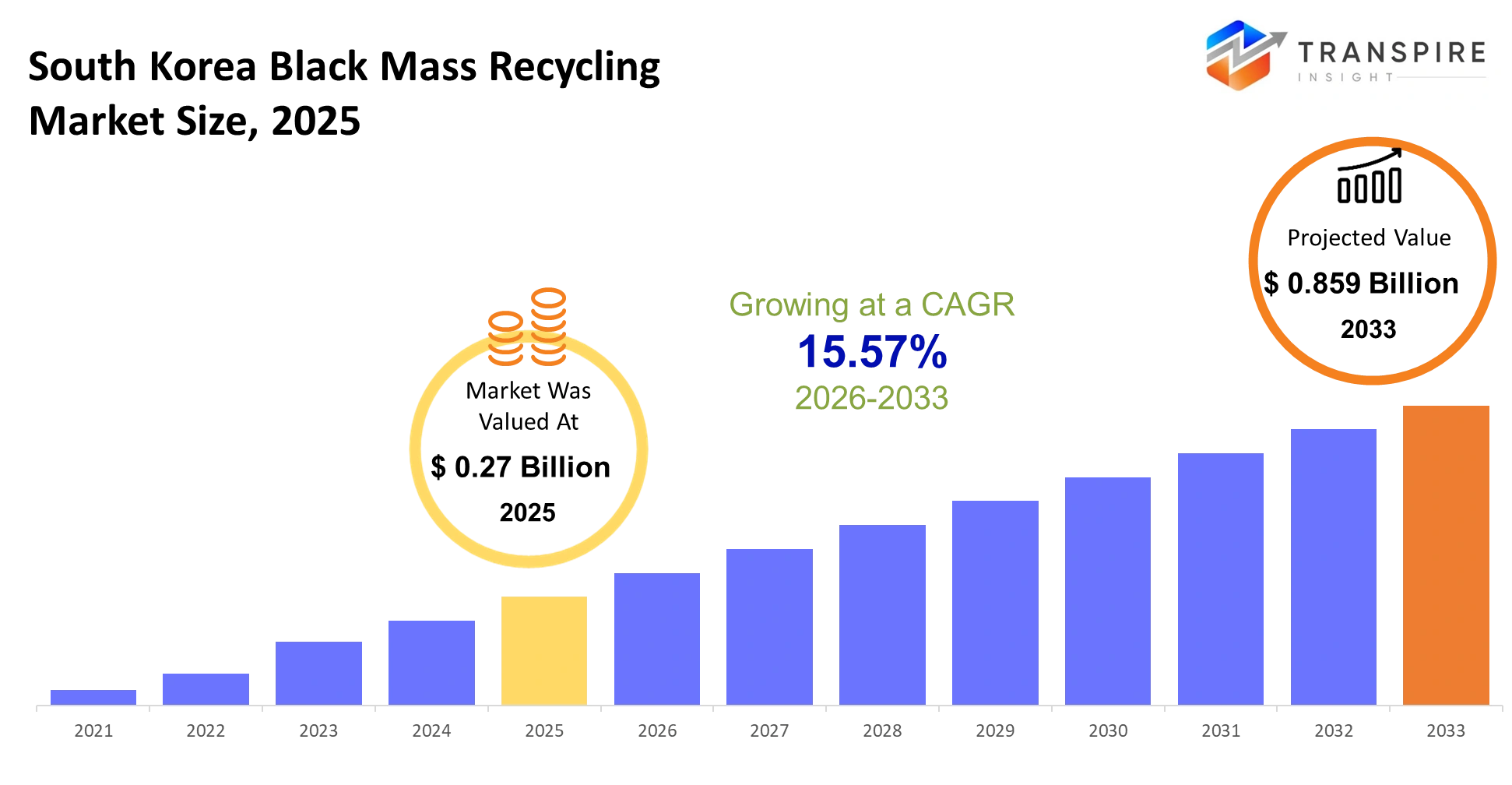
- South Korea Black Mass Recycling Market Size 2025: USD 0.27 Billion
- South Korea Black Mass Recycling Market Size 2033: USD 0.859 Billion
- South Korea Black Mass Recycling Market CAGR: 15.57%
- South Korea Black Mass Recycling Market Segments: By Source (EV Batteries, Consumer Electronics Batteries, Industrial Batteries, Energy Storage Batteries, Others); By Metal Recovery (Lithium Recovery, Nickel Recovery, Cobalt Recovery, Manganese Recovery, Others); By Technology (Hydrometallurgical Recycling, Pyrometallurgical Recycling, Direct Recycling, Others); By End User (Battery Manufacturers, Automotive OEMs, Recycling Companies, Others); By Application (Battery Material Production, Metal Refining, Circular Economy Solutions, Others)
To learn more about this report,  Download Free Sample Report
South Korea Black Mass Recycling Market Summary
The South Korea Black Mass Recycling Market was valued at USD 0.27 Billion in 2025. It is forecast to reach USD 0.859 Billion by 2033. That is a CAGR of 15.57% over the period.
South Korea Black Mass Recycling Market kind of sits at the center of recovering lithium , nickel , cobalt , manganese and graphite from used electric vehicle packs plus battery manufacturing scrap. In real practice it supports battery producers and automakers lowering reliance on imported raw materials while also dealing with disposal risks tied to hazardous lithium ion waste. Over the last five years, the market has slowly moved from small scale waste handling to more industrial grade resource recovery that is basically plugged straight into the EV battery supply chain.
A big structural shift showed up when South Korea pushed harder to get battery materials sourced locally, and not just from somewhere else. This kind of move came after global lithium and nickel price swings made the supply chain feel, kind of shaky, during the post pandemic recovery. Around the same time stricter recycling mandates, and carbon neutrality targets too, started directing more funds toward hydrometallurgical recycling facilities.
So, this whole transition is starting to improve material recovery economics, which then gives recyclers and battery manufacturers a reason to sign longer term contracts. And beyond that it also supports the ongoing income streams tied to secondary battery raw material production.
Key Market Insights
- South Korea black mass recycling market capacity jumped by more than 35% after 2022, it seems battery manufacturers started localizing lithium, nickel, and cobalt procurement, just to cut down import dependence a bit, also timing felt tighter than before.
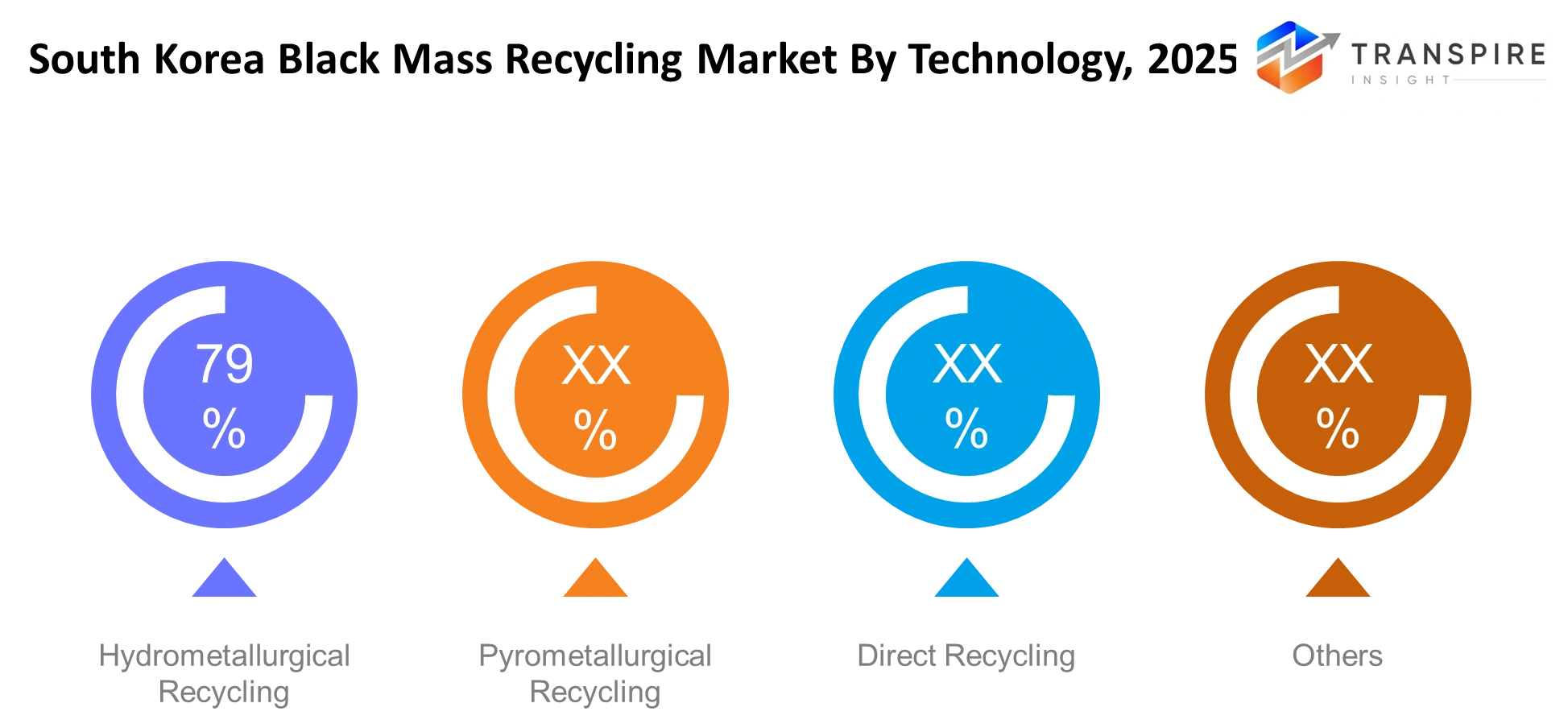
- In the market overall hydrometallurgical recycling technology is still the main approach, holding over 60% share because it manages higher metal recovery rates, fewer impurities, and the output ends up more battery-grade, in other words cleaner feedstock for later steps.
- Then the feedstock story changed, battery manufacturing scrap turned into the leading source after gigafactory expansion pushed recyclable material volumes up nearly 25–30% between 2021 and 2025, so the supply side got louder.
- For applications EV battery recycling became the fastest-growing segment after 2024, mainly from rising retirement volumes tied to first-generation electric vehicles and also energy storage systems, like a slow wave turning into a bigger tide.
- Chungcheong and Gyeonggi took a large slice of the recycling investment because the battery manufacturing clusters are dense, logistics infrastructure is advanced, and cathode producers are nearby, so transport costs and delays were less of an issue.
- Market participants increasingly signed multi-year supply agreements with cathode manufacturers from year to year, basically to stabilize secondary raw material pricing and also reduce supply volatility, which makes planning feel less risky.
- Between 2021 and 2025 recyclers moved toward closed-loop processing models, this allowed recovered nickel and cobalt to circle right back into domestic battery production supply chains more directly, no big detours.
- After 2023 AI-driven sorting and recovery optimization technologies improved processing efficiency by around 10–15%, and that reduction helped lower chemical waste generation and operational downtime too, so plants spent less time stuck waiting.
- Strategic expansion into precursor and cathode material production, let recyclers take higher downstream margins while strengthening South Korea’s localized battery materials ecosystem.
What are the Key Drivers, Restraints, and Opportunities in the South Korea Black Mass Recycling Market?
The strongest force pushing the South Korea Black Mass Recycling Market forward is the reshaping of battery raw material supply chains after the lithium and nickel price spikes from 2021 through 2023. South Korean battery makers ran into taller procurement costs, plus geopolitical worries linked to imported critical minerals, especially from China and Indonesia. Instead of standing still, automakers along with cell producers kept boosting funding into closed loop recycling setups that can recover battery-grade metals domestically, and well, that’s where the momentum really shows up. This change improves the revenue angle for recyclers, since the recovered nickel, cobalt, and lithium can be priced in a way that looks economically competitive versus imported sources. Also, longer term supply agreements between recyclers and battery producers help raise capacity utilization. That in turn trims down earnings volatility, which is not a small detail.
Now, the market’s biggest structural hurdle is the sheer capital intensity that comes with advanced hydrometallurgical processing infrastructure. To run at commercial scale, facilities need multi-step chemical recovery systems, wastewater treatment operations, and purification technologies that can output battery-grade products. The problem is these investments don’t get paid back fast, because margins depend on metal price swings and on whether there is stable feedstock coming in. Smaller recyclers often can’t lock in enough financing , so facility expansion gets postponed. When that happens, nationwide processing capacity stays capped.
Looking ahead, a big opportunity is to integrate recycling activities straight into next-generation battery manufacturing clusters. South Korea’s widening solid-state and high-nickel battery ecosystem helps create better conditions for localized reuse of recycled materials. Firms investing in high-purity lithium recovery know how are position themselves to provide precursor material, which feels like a natural extension of the whole value chain.
What Has the Impact of Artificial Intelligence Been on the South Korea Black Mass Recycling Market?
Artificial intelligence and advanced digital systems are increasingly, kinda quietly, changing battery recycling operations across South Korea by boosting metal recovery efficiency, making process stability better and supporting operational forecasting. Recycling facilities now roll out AI-powered sensor setups to spot battery chemistries, sort the feedstock quality into categories and automate the sorting stage before shredding, then black mass extraction. These newer tools reduce the chance of contamination, and they also help throughput feel more consistent in those high-volume recycling lines.
Machine learning models are being used in parallel to fine tune hydrometallurgical recovery steps, mostly by reading temperature, acidity and solvent behavior in near real time. Operators rely on predictive analytics to estimate equipment wear ahead of time, time the maintenance cycles, and cut down on unexpected shutdowns. In a number of advanced plants, digital process optimization has lifted recovery yields for nickel and cobalt while at the same time lowering energy usage and reducing chemical waste. On top of that, AI-assisted production control helps meet the tightening environmental reporting expectations, because traceability across recycled material streams improves, end to end.
Even so, uptake is not totally smooth. Bringing AI platforms into older recycling infrastructure takes a lot of money upfront plus highly specialized operational data. Also, many recyclers do not have large enough historical datasets to train predictive models that hold up when feedstock conditions swing around. That gap ends up weakening reliability when you scale up into full commercial operations.
Key Market Trends
- Between 2021 and 2025, more than 65% of newly announced recycling projects kinda drifted toward hydrometallurgical processing, because the lithium and nickel recovery efficiency is just better, at least in practice.
- Battery scrap from domestic gigafactories apparently made up nearly 55% of the total black mass feedstock by 2025, and that number beat out consumer electronics waste streams across South Korea, in a fairly clear way.
- South Korean recyclers started forming joint ventures with cathode manufacturers more and more, which in turn helped lock in over 40% of recycled nickel and cobalt supply via long-term procurement agreements, kind of like a steady pipeline.
- AI-enabled material sorting systems improved recovery accuracy by roughly 12–15% , while also cutting processing losses, and contamination rates in advanced recycling facilities after 2023, which sounds small but isn’t.
- Regulatory pressure got stronger after South Korea’s carbon neutrality roadmap pushed higher recycled material integration within domestic battery manufacturing operations toward the 2030 targets , so yeah it became harder to ignore.
- Recyclers also accelerated investments in lithium recovery technology once lithium carbonate prices wobbled by over 70% between 2022 and 2023, that basically reshaped margin optimization strategies, in a practical sense.
- Export restrictions, plus general geopolitical uncertainty, nudged battery manufacturers to localize supply chains, which increased domestic recycled material sourcing commitments by almost 30% after 2022.
- Finally, market participants expanded recycling capacity near the Chungcheong and Gyeonggi battery clusters, so transportation and logistics costs dropped by an estimated 10–12% , at least according to the projections people were using.
South Korea Black Mass Recycling Market Segmentation
By Source
EV Batteries keep the top spot, mostly because the expansion of electric vehicle production has been generating big amounts of end-of-life battery packs along with manufacturing scrap across the local supply chains for batteries. Also, strong feedstock consistency and higher levels of recoverable nickel, lithium, and cobalt make the recycling numbers work out better than with smaller consumer battery formats. Consumer Electronics Batteries sit in the second place, mainly from the collection programs that are already there, plus the steady stream of waste from phones, laptops, and those portable gadgets. Industrial Batteries and Energy Storage Batteries , along with other types, are still pushing forward thanks to wider electrification across logistics, renewable energy, and heavy industry operations.
EV Batteries continue to pick up market share as the first wave of electric vehicles starts reaching retirement windows after 2024, so more high-capacity, recyclable battery materials show up in the system. Energy Storage Batteries are the fastest growing source segment, because renewable energy rollouts and grid-scale storage investments are ramping up across both commercial entities and utilities. Industrial Batteries remain pretty steady, driven by routine replacement cycles in manufacturing and warehouse automation systems. During the forecast period, recyclers will lean more and more on high-volume EV plus energy storage feedstock agreements, to improve how smoothly they operate and to support longer-term profitability.
By Metal Recovery
Nickel Recovery holds the leading position because high-nickel cathode chemistries still get used widely in premium electric vehicle batteries that are made across South Korea. There’s strong commercial value and a direct re-use potential inside cathode manufacturing, which helps keep the recycling margins fairly stable for nickel extraction operations. Lithium Recovery comes in second because lithium carbonate price volatility keeps rising and the strategic need keeps growing within more localized battery supply chains. Cobalt Recovery, Manganese Recovery, and Others keep showing up too, since diversified battery-chemistry processing requirements keep needing attention.
Lithium Recovery is really starting to pick up now, since battery manufacturers are trying to get more independence from imported lithium refining networks. Newer hydrometallurgical methods are pushing lithium recovery efficiency higher, but they also help cut down chemical waste and day to day operational costs, which kind of matters more than people think. Even though there is a slower shift toward lower-cobalt battery chemistry, Cobalt Recovery stays important because recycled cobalt still has strong economic value, especially for battery-grade applications. Over the forecast period, investment activity should lean toward higher-purity lithium and nickel recovery technologies so they can back next generation battery manufacturing needs and all the stuff around it.
By Technology
Hydrometallurgical Recycling still has the dominant spot, largely because newer chemical recovery setups manage to pull out lithium nickel, and cobalt with better extraction efficiency than the thermal type options. Adoption stays strong, too, due to less impurity creation and a better fit for high-value battery-grade material recovery work. In comparison Pyrometallurgical Recycling lands in second place, mostly from long-standing industrial infrastructure and processing that feels more straightforward when dealing with mixed battery waste streams. Direct Recycling and Others keep moving forward, driven by research that aims at better material protection and more energy-sparing processing ways.
Hydrometallurgical Recycling keeps growing, especially as recyclers focus on closed-loop recovery systems that can deliver cathode-grade outputs, with cleaner purity profiles. Direct Recycling is becoming the fastest-growing segment since it helps maintain cathode structure, while it also cuts down the heavy refining stages needed during battery material recovery. Meanwhile Pyrometallurgical Recycling is getting slower, not instantly but gradually, because it tends to involve higher carbon emissions and it often shows weaker lithium recovery rates as environmental rules tighten. Over the forecast window, technology work will more and more point toward low-emission processing, automation integration, and AI-supported recovery optimization platforms, so operations can run more precisely and with fewer side effects.
To learn more about this report, Download Free Sample Report
By End User
Battery Manufacturers keep the dominant position, because the bigger cell makers more and more integrate recycled nickel, lithium, and cobalt straight into their battery production supply chains, kinda like it stays in-house. The strong demand is driven by long term raw material security strategies and also by carbon reduction commitments, tied to the wider EV manufacturing expansion across the globe. Automotive OEMs sit in second place, largely due to growing investments in circular battery ecosystems and localized supply chain partnerships with recyclers. Recycling Companies and Others are still pushing ahead too, mainly through specialized recovery services and industrial material processing know-how.
Battery Manufacturers are continuing to reinforce closed loop partnerships so they can lower their exposure to global critical mineral price swings and geopolitical supply concerns. Automotive OEMs are also stepping up investments in recycling agreements, as electric vehicle retirement volumes grow across global markets. Recycling Companies are the fastest growing end user segment, since independent recyclers are scaling processing capacity quickly and expanding downstream refining operations. Over the forecast period, end user competition will increasingly center on feedstock access, recovery efficiency, and vertically integrated battery material production approaches.
By Application
Battery Material Production is still in the lead because recovered lithium, nickel, and cobalt get reused more and more in cathode and precursor manufacturing. There’s also the fact that the economic value stays high, and the whole process ties in directly with battery supply chains which helps keep demand steady for the long run. Metal Refining comes in second, mainly as purified battery-grade metals keep getting pulled into lots of uses across industrial production and automotive too. Circular Economy Solutions And Others keep picking up momentum too, largely because sustainability driven industrial policies and carbon reduction targets are becoming more common.
Battery Material Production keeps growing as battery makers start leaning harder into localized sourcing, and trying to cut down on reliance on imported refined minerals. Circular Economy Solutions look like the fastest-growing application segment, because governments and manufacturers keep pushing for resource efficiency and these closed loop industrial systems. Metal Refining is still important as well, since the need for high purity metals does not really slow down, it supports both battery applications and non battery industrial sectors. Over the forecast period, application growth is likely to tilt more toward integrated recycling-to-cathode business models, these are able to earn stronger downstream margins, and they also help strengthen supply chain resilience.
What are the Key Use Cases Driving the South Korea Black Mass Recycling Market?
The main use case behind the South Korea Black Mass Recycling Market, well it is largely about getting nickel, cobalt, lithium, and manganese back from EV battery manufacturing scrap. Battery makers at gigafactories produce tons of off-spec cathode material plus electrode waste, and so recyclers end up with a dependable inflow of feedstock . This particular route is the most wanted, because the recovered substances can be fed back into battery production supply chains, more or less like an internal loop.
Beyond that, the market is also expanding into other kinds of recycling like taking apart and reprocessing end-of-life electric vehicle batteries from both private passenger cars, and commercial fleets. At the same time, operators of energy storage systems are starting to recycle aging lithium-ion batteries tied to renewable energy integration projects. These parts are moving faster now, as more batteries are retiring across industrial and transport categories.
More new use cases are showing up too, for example recycling next-generation solid-state batteries, and recovering graphite so it can be used again for anode production. Some companies are even experimenting with urban mining models, where battery collection, dismantling, and material refining happen in localized industrial ecosystems, kind of in the same place rather than scattered around.
|
Report Metrics |
Details |
|
Market size value in 2025 |
USD 0.27 Billion |
|
Market size value in 2026 |
USD 0.312 Billion |
|
Revenue forecast in 2033 |
USD 0.859 Billion |
|
Growth rate |
CAGR of 15.57% from 2026 to 2033 |
|
Base year |
2025 |
|
Historical data |
2021 - 2024 |
|
Forecast period |
2026 - 2033 |
|
Report coverage |
Revenue forecast, competitive landscape, growth factors, and trends |
|
Regional scope |
South Korea |
|
Key company profiled |
LG Energy Solution, SungEel HiTech, SK ecoplant, POSCO Future M, Umicore, Glencore, Li-Cycle, Redwood Materials, Ecopro, TES, Duesenfeld, GEM Co., Brunp Recycling, Fortum, American Battery Technology Company . |
|
Customization scope |
Free report customization (country, regional & segment scope). Avail customized purchase options to meet your exact research needs. |
|
Report Segmentation |
By Source (EV Batteries, Consumer Electronics Batteries, Industrial Batteries, Energy Storage Batteries, Others); By Metal Recovery (Lithium Recovery, Nickel Recovery, Cobalt Recovery, Manganese Recovery, Others); By Technology (Hydrometallurgical Recycling, Pyrometallurgical Recycling, Direct Recycling, Others); By End User (Battery Manufacturers, Automotive OEMs, Recycling Companies, Others); By Application (Battery Material Production, Metal Refining, Circular Economy Solutions, Others) |
Which Regions are Driving the South Korea Black Mass Recycling Market Growth?
The Chungcheong region is leading the South Korea Black Mass Recycling Market, mostly because it kind of blends battery manufacturing concentration, more mature industrial infrastructure, and direct access to big logistics corridors, in a way that makes things move faster. North Chungcheong and South Chungcheong both host key production facilities that are tied to EV battery manufacturers, and cathode material suppliers as well. This builds a tight ecosystem for closed-loop recycling operations, where feedstock flows more smoothly across steps than in some other places. On top of that, the region gets a lot from policy backing that is aligned with carbon neutrality goals and industrial decarbonization efforts. Those programs pushed investments into hydrometallurgical recovery plants after 2022, and it shows in the pace of expansion.
Gyeonggi Province, meanwhile, is basically the second most influential regional market, but the growth pattern is not the same as Chungcheong. It’s driven more by technology integration and downstream material processing rather than manufacturing density only. The area also enjoys more stable industrial financing, plus advanced research capabilities and ongoing collaboration networks among recyclers, battery players, and electronics companies. In practice, many companies in Gyeonggi are shifting toward high-purity lithium recovery, AI-supported material sorting, and precursor production know-how. This supports higher-margin business approaches, and makes their positioning a bit more resilient when demand swings.
Elsewhere, the southeastern industrial corridor, including Ulsan and parts of Gyeongsang Province, is becoming the fastest-growing regional market. The reason is recent investments in EV supply chain localization, plus export-focused battery infrastructure. Growth picked up after 2023, as automakers and battery suppliers expanded domestic recycling partnerships, trying to lower exposure to volatile imported critical mineral supply chains. And because port connectivity in Ulsan and Busan is strong, conditions for large-scale battery collection and material export have become noticeably more favorable, overall.
Who are the Key Players in the South Korea Black Mass Recycling Market and How Do They Compete?
Competition in the South Korea Black Mass Recycling Market is getting, more and more, tech oriented instead of only cost driven. Big battery manufacturers, recycling specialists, and material processing firms are basically racing to lock in long-term access to battery scrap and end-of-life EV batteries before feedstock gaps get worse later in the decade. The market is still somewhat consolidated, mostly because advanced hydrometallurgical recovery systems cost a lot upfront, they need chemical processing know-how, and they also have to slot neatly into battery manufacturing supply chains, not just run standalone.
LG Energy Solution sets itself apart by folding recycling directly into its global battery production network. The company grew joint ventures with recycling partners across Europe and North America to secure long-term recycled nickel, cobalt, and lithium supply, while also trimming procurement volatility that keeps showing up. SungEel HiTech leans into advanced hydrometallurgical extraction technology and tries to deliver higher recovery yields, so it can treat various battery chemistries with fewer impurities. POSCO Future M competes with vertical integration, tying recycled material recovery to precursor and cathode material manufacturing operations, almost like one continuous line.
SK ecoplant has expanded quickly via partnerships and environmental infrastructure investments aimed at strengthening circular economy operations across Asia. Umicore, on the other hand, leans on global refining know-how and advanced metal purification abilities, supporting premium battery grade material production. Meanwhile, international players like Li-Cycle and Redwood Materials keep shaping the competitive picture by pushing closed loop recovery approaches and scalable black mass processing models, and that creates extra pressure on Korean
Company List
- LG Energy Solution
• SungEel HiTech
• SK ecoplant
• POSCO Future M
• Umicore
• Glencore
• Li-Cycle
• Redwood Materials
• Ecopro
• TES
• Duesenfeld
• GEM Co.
• Brunp Recycling
• Fortum
• American Battery Technology Company
Recent Development News
"In April 2025,LG Energy Solution entered a joint venture with Derichebourg to establish a battery recycling plant in France. The facility will process battery scrap and end-of-life EV batteries to extract black mass, strengthening closed-loop battery material recovery across Europe.http://www.lgcorp.com
"In June 2025, LG Energy Solution and Toyota Tsusho established Green Metals Battery Innovations, a battery recycling joint venture in North Carolina. The project targets an annual processing capacity of 13,500 tons of battery scrap and expands black mass recovery infrastructure for EV battery supply chains.http://www.lgcorp.com
"In July 2025, LG Energy Solution and Toyota Tsusho advanced operations for their Green Metals Battery Innovations recycling venture in the United States. The initiative reinforced North American black mass extraction capacity and supported long-term recycled nickel, cobalt, and lithium sourcing strategies.http://www.batterytechonline.com
What Strategic Insights Define the Future of the South Korea Black Mass Recycling Market?
South Korea’s Black Mass Recycling market is kinda, well, moving steadily toward vertically integrated circular battery manufacturing, where recyclers cathode producers and battery makers kinda sit inside a tightly connected material recovery ecosystem. People say this shift isn’t mainly happening because of waste management rules, but more because everyone wants localized lithium nickel, and cobalt supply locked in, even while geopolitical uncertainty keeps lingering and raw material prices keep swinging around.
There is also a quiet risk that’s getting bigger: market concentration around a small group of battery manufacturers who end up controlling feedstock access and downstream processing ties, so independent recyclers may see their bargaining power shrink over time. At the same time direct lithium recovery and next generation graphite purification tech are still, maybe underdeveloped, but they look like potentially high margin plays, especially as solid-state and high-nickel batteries get adopted faster.
In terms of what market participants should do, they should treat long-term feedstock agreements as a priority and invest early in high-purity recovery approaches that can deliver battery-grade outputs, not just lean on basic black mass processing margins.
South Korea Black Mass Recycling Market Report Segmentation
By Source
- EV Batteries
- Consumer Electronics Batteries
- Industrial Batteries
- Energy Storage Batteries
- Others
By Metal Recovery
- Lithium Recovery
- Nickel Recovery
- Cobalt Recovery
- Manganese Recovery
- Others
By Technology
- Hydrometallurgical Recycling
- Pyrometallurgical Recycling
- Direct Recycling
- Others
By End User
- Battery Manufacturers
- Automotive OEMs
- Recycling Companies
- Others
By Application
- Battery Material Production
- Metal Refining
- Circular Economy Solutions
- Others
Frequently Asked Questions
Find quick answers to common questions.
The expected South Korea Black Mass Recycling Market size for the market will be USD 0.859 Billion in 2033.
Key segments for the South Korea Black Mass Recycling Market are By Source (EV Batteries, Consumer Electronics Batteries, Industrial Batteries, Energy Storage Batteries, Others); By Metal Recovery (Lithium Recovery, Nickel Recovery, Cobalt Recovery, Manganese Recovery, Others); By Technology (Hydrometallurgical Recycling, Pyrometallurgical Recycling, Direct Recycling, Others); By End User (Battery Manufacturers, Automotive OEMs, Recycling Companies, Others); By Application (Battery Material Production, Metal Refining, Circular Economy Solutions, Others).
Major South Korea Black Mass Recycling Market players are LG Energy Solution, SungEel HiTech, SK ecoplant, POSCO Future M, Umicore, Glencore, Li-Cycle, Redwood Materials, Ecopro, TES, Duesenfeld, GEM Co., Brunp Recycling, Fortum, American Battery Technology Company.
The South Korea Black Mass Recycling Market size is USD 0.27 Billion in 2025.
The South Korea Black Mass Recycling Market CAGR is 15.57% from 2026 to 2033.
- LG Energy Solution
• SungEel HiTech
• SK ecoplant
• POSCO Future M
• Umicore
• Glencore
• Li-Cycle
• Redwood Materials
• Ecopro
• TES
• Duesenfeld
• GEM Co.
• Brunp Recycling
• Fortum
• American Battery Technology Company
Recently Published Reports
-
May 2026
Healthcare Polymer Packaging Market
Healthcare Polymer Packaging Market Size, Share & Analysis Report By Packaging Type (Syringes, IV Bottles and Pouches, Clamshells, Blisters, Bottles & Jars, Containers, Tubes, IV Parental Packaging, Others), By Type (Regulated, Non-regulated), By Polymer Type (LDPE (Low-Density Polyethylene), HDPE (High-Density Polyethylene), Homo-polymer (Homo), Random Copolymer (Random), Block Copolymer (Block), PET, Polystyrene, Polyvinyl Chloride, Polyamide/EVOH, Others), and Geography (North America, Europe, Asia-Pacific, Middle East and Africa, South and Central America), 2021 - 2031
-
Apr 2026
Hydrophilic Tape (Waterstop) Market
Hydrophilic Tape (Waterstop) Market Size, Share & Analysis Report By Type (Bentonite-Based Hydrophilic Tape, Rubber-Based Hydrophilic Tape), By Application (Residential Buildings, Commercial Buildings, Infrastructure Projects), and Geography (North America, Europe, Asia-Pacific, Middle East and Africa, South and Central America), 2021 - 2031
-
Apr 2026
Metalens Market
Metalens Market Size, Share & Analysis Report By Type (Visible Light Metalens, and Infrared Metalens), By Application (Consumer Electronics, Automotive Electronics, Industrial, Medical, and Others), and Geography (North America, Europe, Asia-Pacific, Middle East and Africa, South and Central America), 2021 - 2031
-
Apr 2026
PBT Resin Market
PBT Resin Market Size, Share & Analysis Report By Type (Reinforced PBT Resin, Unreinforced PBT Resin), By Processing Method (Injection Molding, Extrusion, Blow Molding, Others), By End-User (Automotive, Electrical & Electronics, Consumer Appliances, Industrial Machinery, Medical Devices, Packaging, Others), and Geography (North America, Europe, Asia-Pacific, Middle East and Africa, South and Central America), 2021 - 2031