
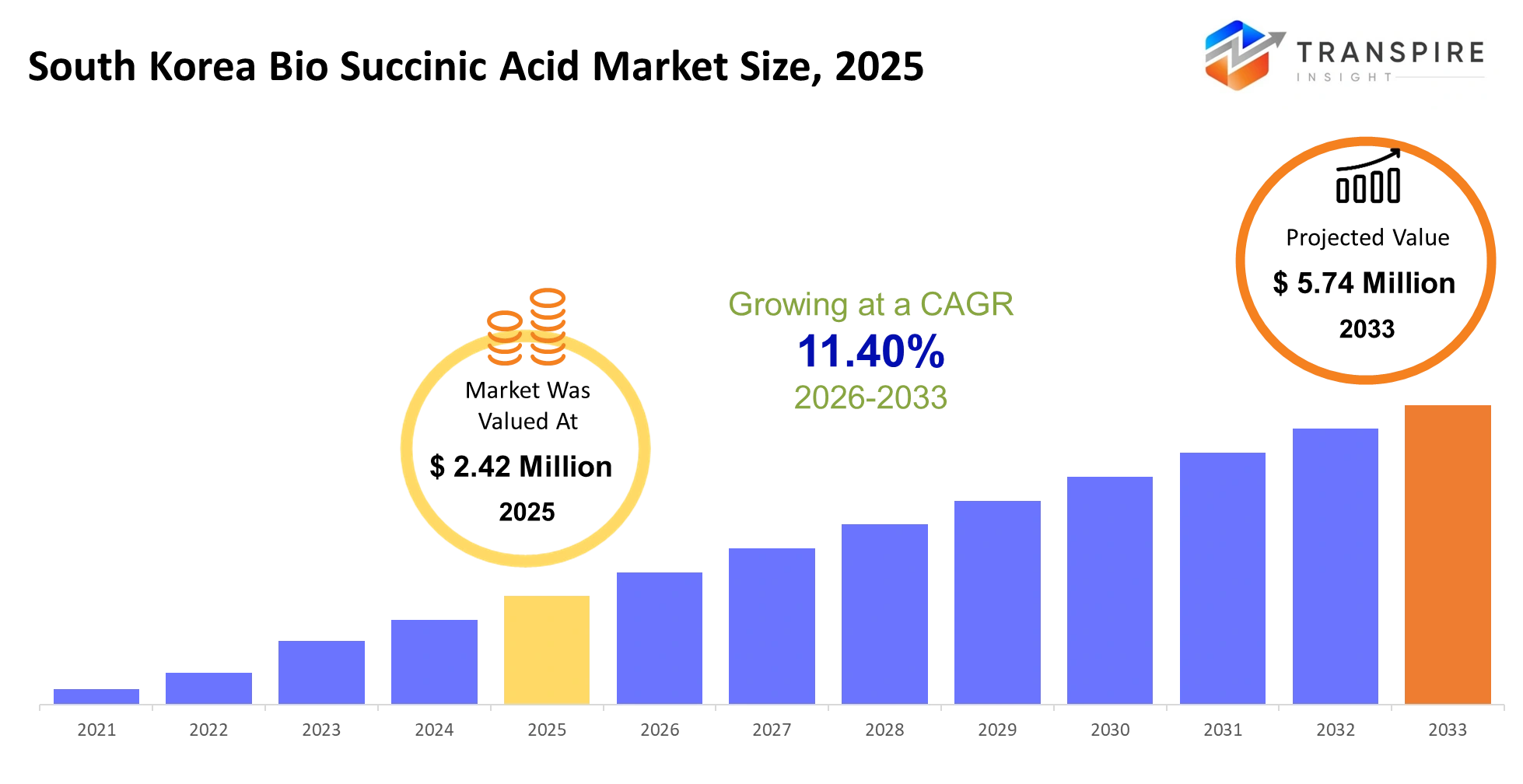
South Korea Bio Succinic Acid Market Size & Forecast:
- South Korea Bio Succinic Acid Market Size 2025: USD 2.42 Million
- South Korea Bio Succinic Acid Market Size 2033: USD 5.74 Million
- South Korea Bio Succinic Acid Market CAGR: 11.40%
- South Korea Bio Succinic Acid Market Segments: By Production Method (Fermentation-based Production, Petrochemical-based Production, Hybrid Production, Others); By Application (Bioplastics, Polyurethane, Food Additives, Pharmaceuticals, Others); By End User (Chemical Industry, Packaging Industry, Pharmaceutical Industry, Others); By Form (Liquid, Powder, Granules, Others).
To learn more about this report,  Download Free Sample Report
South Korea Bio Succinic Acid Market Summary
The South Korea Bio Succinic Acid Market was valued at USD 2.42 Million in 2025. It is forecast to reach USD 5.74 Million by 2033. That is a CAGR of 11.40% over the period.
Bio succinic acid in South Korea kinda works as a bio-based platform chemical that manufacturers use to swap out petroleum-derived intermediates, in making resins, plastics, coatings, solvents, and performance materials. Those get used across packaging, automotive components, and also industrial fluids. In real life, it helps companies lower dependence on fossil feedstocks while still passing stricter lifecycle and emissions requirements, especially across export-oriented value chains.
Over the last 3–5 years the market has gone from more pilot scale adoption toward integrated procurement, as fermentation efficiency kept improving. At the same time, domestic chemical processors started qualifying bio-based inputs, for larger batch production, which made it easier to scale. One big structural change is the slow substitution of fossil-based succinic acid with bio-fermentation routes. This is being driven by circular chemistry strategies in industrial clusters. A major trigger, was that post-pandemic supply chain volatility, showed how vulnerable import reliance on petrochemical intermediates can be, and then local buyers pushed to diversify feedstock sourcing.
So, nowadays adoption is more about cost stability and compliance priorities, rather than trying to position it as some niche sustainability thing.
Key Market Insights
- The South Korea Bio Succinic Acid Market sit at about ~USD 2.0 million in 2023, and looks set to climb to around USD 4.3 million by 2030, which signals a pretty solid industrial shift, like there is more traction than before.
- The South Korea Bio Succinic Acid Market is expanding at an estimated CAGR of ~11.7% from 2024–2030 , mainly because bio based chemical substitution is getting picked more often inside manufacturing routines.
- In Korea, bio-based succinic acid uptake makes up roughly ~55% share, mostly tied to the growing move toward renewable chemical feed stocks.
- Yeongnam industrial corridor keeps around ~38–42% market share, and it’s hard to ignore since the area is packed with petrochemical and polymer production capability.
- Meanwhile, Seoul metropolitan region is the fastest rising cluster with about ~12–14% higher adoption of green chemistry solutions during 2024–2029, even with competition elsewhere.
- On the application side, resins and coatings lead at ~40% share. This is linked to automotive lightweighting priorities and the continuing demand for stronger packaging performance.
- Polyester polyols, however, are the quickest accelerating application, expected to go above 13% CAGR through the 2024–2029 transition window.
- For end-users, chemical manufacturing leads with ~45% share, because many producers integrate bio-based intermediates early in their production systems.
- Packaging is also emerging fast, growing at roughly ~12–15% CAGR as sustainability rules tighten, especially across export supply chains where compliance matters.
- Overall, The South Korea Bio Succinic Acid Market growth is being sped up by better fermentation efficiency, cutting production costs by around ~20–25% since 2020.
What are the Key Drivers, Restraints, and Opportunities in the South Korea Bio Succinic Acid Market?
The South Korea Bio Succinic Acid Market is mostly pushed by a kinda structural move toward integrating bio-based feedstocks into chemical manufacturing. This change was sparked by how volatile crude oil linked input costs can be , plus tighter rules around lifecycle emissions reporting that export heavy sectors keep getting hit with, like automotive , packaging, and specialty chemicals. When producers started feeling stronger pressure to lock in input costs , and still show verified carbon progress, they began replacing petroleum based intermediates with fermentation derived succinic acid , used across resin, polymer, and coating production. In practice this has helped procurement reliability , makes long term supply agreements more common, and gives bio based producers more predictable revenue in industrial clusters.
Still, the market faces a stubborn constraint: bio fermentation routes often stay more expensive than traditional petrochemical pathways. The reason is basically structural, since it leans on glucose feedstock pricing, bioreactor scale performance that can be hard to keep efficient, and enzyme optimization cycles that call for continuous capital and long development schedules. So getting true large scale parity with fossil based succinic acid is tough, at least in the short run. Because of that, adoption tends to concentrate in compliance led uses or higher value applications , which narrows uptake and slows the overall revenue acceleration across the South Korea Bio Succinic Acid Market.
At the same time, there is a strong chance coming out of integrated biorefinery development in industrial zones like Ulsan and Yeongnam, where fermentation facilities are being colocated with downstream polymer and plastics plants. In effect, this sort of coupling reduces logistics costs and raises production efficiency, specially for PBS and other bioplastic uses. Some early pilot programs that merge bio-succinic acid manufacture with polymer conversion are already showing better yield economics. That kind of progress sets up the market for scalable commercialization, as infrastructure investment keeps deepening across the forecast period.
What Has the Impact of Artificial Intelligence Been on the South Korea Bio Succinic Acid Market?
Artificial intelligence is slowly but surely kind of reshaping the South Korea Bio Succinic Acid Market, not in a dramatic way at first, but more like by nudging fermentation methods into something more designed, controlled, and scalable. In everyday practical terms , AI-enabled bioprocess optimization systems are making it easier for producers to fine-tune microbial strains, watch nutrient consumption in real time , and even anticipate yield swings before they show up. That means fewer trial-and-error loops inside R&D , and in general a smoother, more predictable performance in fermentation-based succinic acid facilities. So, in the end, companies can push for steadier output and tighter cost handling, and that really backs broader commercial uptake across polymer, resin, and coatings supply chains.
On another front AI is also reinforcing predictive maintenance along with supply chain planning across bio-refinery operations in South Korea, a sort of quiet but important improvement. Machine learning models are being used to estimate equipment failures inside bioreactors, which cuts down downtime and helps batch continuity stay intact, that part is pretty essential for keeping profitability in bio-based chemical production. Meanwhile AI-driven demand forecasting tools help producers match their production rhythm to downstream needs from packaging and automotive sectors, which reduces the usual inventory messiness. All of this operational efficiency supports margin stability, and that matters a lot in a market that still reacts strongly to feedstock pricing and production cost pressures.
Looking ahead, AI integration with synthetic biology platforms is kinda a big growth driver for sure. When these firms tie together genomic data modeling and fermentation simulation, some South Korean biotech companies are speeding up strain development loops so they can boost succinic acid output. And yeah, that blend is projected to bring production costs down gradually, plus make scaling easier. In the end it should help lock in stronger competitiveness for the South Korea Bio Succinic Acid Market across wider global bio-chemicals value chains, even if the process details vary a bit from lab to lab.
Key Market Trends
- South Korea Bio Succinic Acid Market adoption rate for bio based chemicals moved up to about 55% share in 2025 , more or less swapping out petrochemical intermediates in a few specific uses, kind of selectively though.
- From 2021–2024, fermentation yield efficiency got better , somewhere in the 18–25% band, which helped lower production expenses and also kept commercial output steadier.
- After 2022, more than 40% of brand new chemical R&D programs in South Korea started tilting toward bio derived or low carbon material work instead of the usual route.
- AI enabled fermentation setups that landed after 2023 cut batch failure rates around 15–20% at pilot production sites , so fewer problems during scaling.
- Demand for PBS and bioplastics rose in a consistent way, and by 2025 they were taking roughly 30–35% of application share in downstream bio succinic acid use.
- CJ CheilJedang plus other local firms increased bio fermentation capacity by around 20–30% during 2022–2025, which gives domestic supply stability a stronger footing.
- Import reliance for petrochemical succinic acid inputs fell by nearly 25% after 2022, largely because supply chain localization efforts started making more difference.
- Automotive and packaging industries boosted adoption of bio based materials roughly 12–15% per year after 2023, pushed by carbon reporting rules that keep tightening.
- Strategic biotech partnerships expanded by over 35% in the period 2022–2025, helping commercialization timelines speed up across the South Korea Bio Succinic Acid Market.
- Looking ahead, the South Korea Bio Succinic Acid Market is expected to line up with circular bioeconomy systems, where waste based feedstock integration could go beyond 20% share by 2030 , yeah that trajectory makes sense.
South Korea Bio Succinic Acid Market Segmentation
By Production Method
The South Korea Bio Succinic Acid Market is getting more and more pushed forward by fermentation based production , because manufacturers shifted after 2021 toward bio catalytic processes , to hit carbon neutrality ambitions and handle tighter export related emissions requirements. This route has become kind of the go to option on the factory floor, since it lowers reliance on petroleum derived inputs, while also fitting neatly into polymers, resins and coating systems used in auto manufacturing and packaging value streams. Meanwhile , ongoing upgrades in microbial strain engineering and bioreactor tuning have improved yield efficiency , and the overall process stability too, so production is slowly moving away from pilot setups and into semi commercial operations across industrial hubs.
On the other hand, petrochemical based production has been shrinking since 2022 due to crude oil swings and growing spending on environmental compliance. Still , it keeps showing up in places that are more cost sensitive or where older plant setups exist , basically when a full replacement is not practical yet. After 2023, hybrid production models also started appearing as a stop gap, blending fermentation based intermediates with traditional chemical synthesis, aiming for cost control and operational adaptability at the same time. You can see this catching on in pilot plants and early stage facilities, particularly where local infrastructure is limited or where feedstock constraints make a complete bio transition harder, so overall the market structure in South Korea is evolving in a gradual way.
By Application
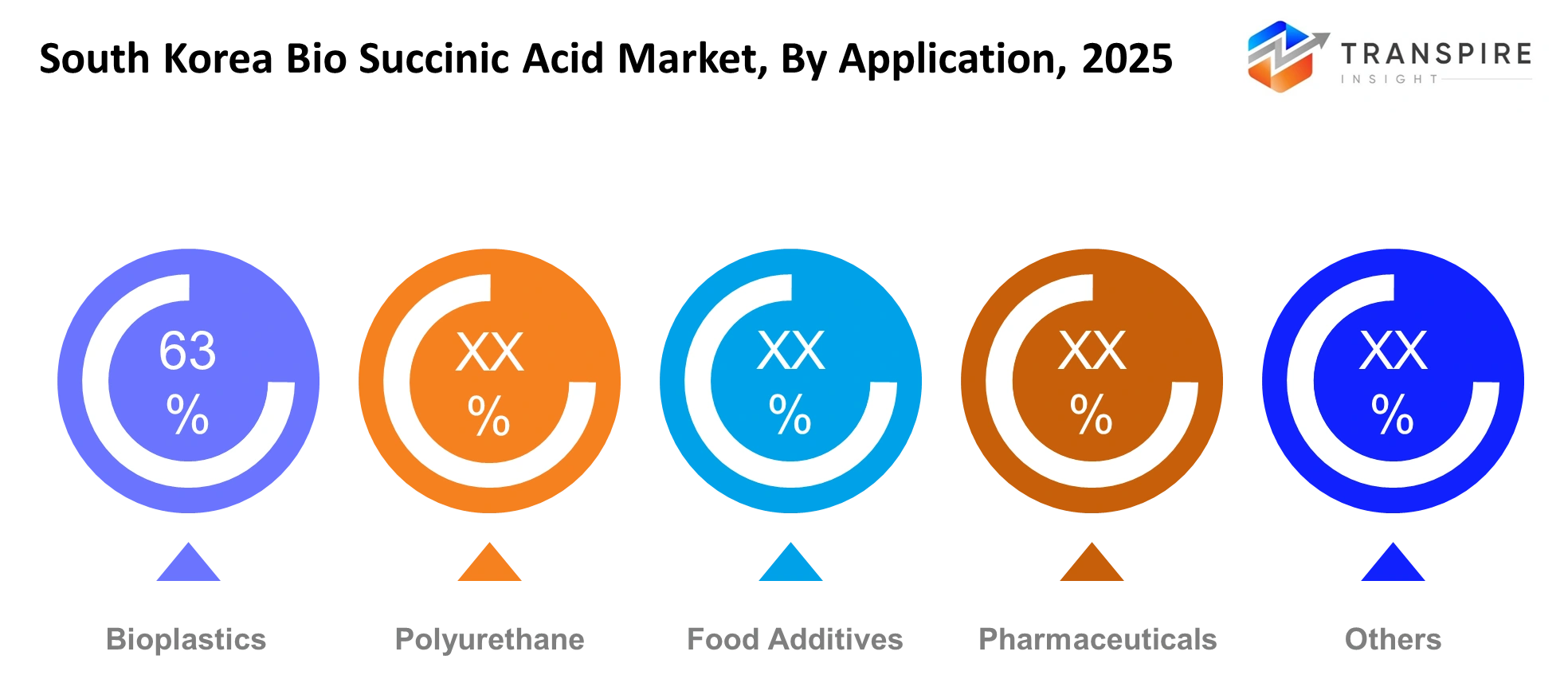
The South Korea Bio Succinic Acid Market is going through what looks like its strongest change toward bioplastics, which has sort of become the fastest-growing use-case since tighter plastic waste rules got reinforced after 2020. More and more manufacturers are turning to bio-succinic acid to make PBS and other biodegradable polymers, and it is being pushed by export compliance needs plus corporate pledges to cut down on single-use plastic footprints. Because of that, demand is drifting away from the usual petrochemical-based materials and moving toward bio-derived options, especially in packaging-heavy, consumer-facing segments where sustainability certifications now really sway procurement choices.
Polyurethane stays as a steady, high-value area too, with bio-succinic acid showing up in coatings, foams, and elastomers, mainly for automotive and construction inputs where lighter weight, and long-lasting performance matter. At the same time, food additive production and pharmaceuticals are expanding bit by bit, largely because stricter purity expectations, and evolving regulatory structures nudge formulators to use better fermentation-derived inputs in sensitive recipes. On the side, the “others” bucket—like specialty chemicals and industrial solvents—keeps growing but at a measured speed ,as companies gradually swap out petrochemical intermediates. Taken together, these movements point to a wider shift across the South Korea Bio Succinic Acid Market toward low-carbon, high-compliance industrial chemistry, you could say it is becoming more compliance-first than before.
To learn more about this report, Download Free Sample Report
By End User
In South Korea, the Bio Succinic Acid Market is mainly pushed by the chemical industry ,because it is still the biggest end user. Manufacturers keep folding bio-succinic acid into polymer , resin and coating recipes or so, and that momentum has not really slowed down since 2021. At that point producers started reacting harder to carbon reduction rules, plus those export linked sustainability expectations too. Bigger chemical companies are also moving away from some petrochemical intermediates, swapping in fermentation-derived inputs instead, partly to keep supply chains steady and partly to meet lifecycle emissions criteria , which makes this whole segment the most solid demand base.
Now packaging feels like the fastest mover. This growth is supported by tougher regulation on single-use plastics, and by the steady pull for biodegradable materials in export related markets. Adoption picked up after 2020, when global retailers and brand owners began pushing stricter sustainability standards through packaging supply channels. The pharmaceutical space is rising in a steadier way as well, with demand for high purity bio-based intermediates used in controlled drug formulation steps. And then there is the “others” bucket, covering automotive and electronics, where interest is building gradually for niche or specialty applications. Taken together , all these changes show a more structural transition across the South Korea Bio Succinic Acid Market, meaning it is shifting toward consumption patterns shaped by compliance first needs and sustainability-aligned industrial use.
By Form
The South Korea Bio Succinic Acid Market is pretty influenced by the liquid form and it’s widely used in continuous industrial processing, where direct integration into chemical reactions is kind of needed. This form has gotten steady adoption as manufacturers start streamlining large scale production systems, and they focus more on process efficiency in polymer, resin, and coating uses. You can also see it growing with automation in chemical plants because liquid handling helps maintain consistency and it cuts down on the time spent on intermediate steps.
The powder form is still the most widely traded option, mainly because it stays stable during storage, offers a longer shelf life, and fits well with export oriented supply chains. It’s often chosen in bulk procurement models especially when long distance logistics matter and when cost-efficient handling is critical. Granules started picking up faster after 2022, as chemical producers modernized facilities and rolled out automated feeding systems that need better flowability and less material loss. Then there’s the “others” grouping which covers customized and specialty formulations, used in niche industrial applications and that supports R&D led innovation in advanced materials. So overall these shifts by format point to a slow but clear transformation in the South Korea Bio Succinic Acid Market, driven by efficiency rather than just supply availability.
What are the Key Use Cases Driving the South Korea Bio Succinic Acid Market?
The South Korea Bio Succinic Acid Market is, mainly pushed by its role in bioplastic production, where it works as a core building block for PBS and PBST polymer types used for packaging films, disposable items and compostable materials. From around 2020 onward things sped up a bit because South Korea tightened rules on single-use plastics, and export buyers started asking for certified low-carbon packaging. So bio-succinic acid which used to feel like a niche sustainable chemical is now showing up in more mainstream polymer manufacturing, and it affects how procurement teams decide what to buy across packaging and consumer goods supply chains.
A second important application shows up in polyurethane production, since bio-succinic acid is used to make coatings, foams, and elastomers for automotive interiors, building materials, and industrial insulation systems. Demand has also grown because makers are trying to use lighter, more energy-efficient materials that still match carbon reduction goals. At the same time, the chemical industry treats bio-succinic acid as an intermediate for resins, solvents, and specialty chemicals, helping support large scale industrial synthesis. The pharmaceutical sector is starting to join in too, relying on high purity fermentation derived grades for drug intermediates, plus formulation chemistry. Taken together, these uses point to a more structural change in the South Korea Bio Succinic Acid Market, moving toward higher value, compliance led industrial chemistry and advanced material making.
|
Report Metrics |
Details |
|
Market size value in 2025 |
USD 2.42 Million |
|
Market size value in 2026 |
USD 2.696 Million |
|
Revenue forecast in 2033 |
USD 5.74 Million |
|
Growth rate |
CAGR of 11.40% from 2026 to 2033 |
|
Base year |
2025 |
|
Historical data |
2021 - 2024 |
|
Forecast period |
2026 - 2033 |
|
Report coverage |
Revenue forecast, competitive landscape, growth factors, and trends |
|
Regional scope |
South Korea |
|
Key company profiled |
BASF, Roquette Frères, Mitsubishi Chemical, BioAmber, Corbion, Myriant, Succinity GmbH, DSM, GC Innovation, Anhui Sunsing Chemicals, Kawasaki Kasei Chemicals, PTT Global Chemical, Reverdia, Nippon Shokubai, LCY Chemical. |
|
Customization scope |
Free report customization (country, regional & segment scope). Avail customized purchase options to meet your exact research needs. |
|
Report Segmentation |
By Production Method (Fermentation-based Production, Petrochemical-based Production, Hybrid Production, Others); By Application (Bioplastics, Polyurethane, Food Additives, Pharmaceuticals, Others); By End User (Chemical Industry, Packaging Industry, Pharmaceutical Industry, Others); By Form (Liquid, Powder, Granules, Others). |
Which Regions are Driving the South Korea Bio Succinic Acid Market Growth?
The South Korea Bio Succinic Acid Market is mostly pulled by the Yeongnam industrial belt, where Ulsan, Busan and Daegu kind of act like one concentrated hub for petrochemical, polymer and advanced materials manufacturing. This area has long been the chemical production leader, but now it’s quietly changing direction, moving toward bio based inputs. Large scale refiners and material producers are starting to weave fermentation derived intermediates into resin and plastic value chains , and the whole thing is speeding up. On top of that, the already strong industrial infrastructure and the close distance to export ports make Yeongnam stay as the main place for both production and consumption of bio succinic acid applications, more or less.
Then there is the Seoul Capital Region, which covers Seoul, Incheon, and Gyeonggi Province, and it is starting to look like the quickest growing innovation and demand cluster. The drivers here are biotech start ups, R&D centers, and specialty chemical companies working on green chemistry and fermentation optimization technologies. Incheon also supports industrial zones that help pilot scale bio refinery efforts tied to advanced materials development, so it’s not just theory. At the same time, southwestern coastal areas like Jeollanam-do are slowly getting more attention, largely because of fresh investments in bio refinery infrastructure and renewable feedstock integration . Taken together these regional shifts point to a wider decentralization of innovation, plus a sturdier industrial ecosystem inside the South Korea Bio Succinic Acid Market. .
Who are the Key Players in the South Korea Bio Succinic Acid Market and How Do They Compete?
The South Korea Bio Succinic Acid Market is basically shaped by a blend of global chemical leaders, and some local bio-based makers working at the same time with technology differentiation plus those kinda integrated value-chain steps. You see names like BASF, Corbion, Mitsubishi Chemical Corporation, Novamont, and also the domestic contributor CJ CheilJedang. They tend to push hard on scaling bio-fermentation know-how and then tightening the downstream application link so it’s not just “make it then hope”, it’s more like, make it and also fit it into real use cases.
In practice, competition is mostly about process efficiency, so companies invest a lot into advanced microbial fermentation , strain engineering, and yield tuning, all to cut production costs without losing quality. Firms such as BASF and Mitsubishi Chemical use their existing supply routes, plus wide polymer related portfolios, to keep industrial contracts stable over the long run. Meanwhile, bio-centered players like Corbion and Novamont put emphasis on renewable sourcing, and that circular bioeconomy narrative because it helps positioning and buyer confidence. CJ CheilJedang leans into localized production capacity, and deeper integration with Korea’s biotechnology network, which then supports faster commercialization ,and better supply reliability when demand shifts.
Strategically, companies are also forming partnerships with packaging, automotive, and chemical processing firms , to lock in offtake arrangements, and keep volumes steady. At the same time, they expand from pilot into commercial biorefineries, so scale doesn’t stall at the “almost ready” stage. Ongoing R&D on carbon-neutral manufacturing methods, and hybrid fermentation systems, is turning into a strong differentiator, letting players improve margins and secure a longer-term stance in the evolving South Korea Bio Succinic Acid Market.
Company List
- BASF
- Roquette Frères
- Mitsubishi Chemical
- BioAmber
- Corbion
- Myriant
- Succinity GmbH
- DSM
- GC Innovation
- Anhui Sunsing Chemicals
- Kawasaki Kasei Chemicals
- PTT Global Chemical
- Reverdia
- Nippon Shokubai
- LCY Chemical
Recent Development News
In August 2025, Sigachi Industries announced commencement of civil works for its new 12,000 MTPA microcrystalline cellulose manufacturing project at Dahej SEZ. The investment strengthened pharmaceutical excipient supply capacity across Asia-Pacific markets, including South Korean drug manufacturing networks.
Source: http://www.business-standard.com
What Strategic Insights Define the Future of the South Korea Bio Succinic Acid Market?
The future of the South Korea Bio Succinic Acid Market is getting shaped by a kind of structural shift that feels very clear, toward integrated bio-refinery ecosystems. Instead of just running standalone chemical production sites, manufacturers are now more and more co-locating fermentation units with downstream polymer and resin plants , mostly to trim logistics costs and also to improve carbon efficiency. That kind of mix is expected to reinforce long-term supply security and speed up the commercialization of bio based intermediates for packaging, automotive, and even specialty chemical value chains. Firms that manage to connect upstream fermentation with downstream use cases are more likely to earn better margins and keep revenue timelines steadier.
Another big insight is the growing dominance of technology-led cost competitiveness. Improvements in microbial strain engineering, better enzyme optimization, and AI enabled fermentation control systems are reducing yield variability, and they’re improving overall production efficiency. Slowly , this is narrowing the cost gap between bio based succinic acid and petrochemical succinic acid, which is still the main obstacle for broad mass adoption. Once the process economics keep improving, procurement choices are shifting away from purely compliance driven sourcing, toward performance-and-cost balanced procurement strategies across industrial buyers, and that sounds like the direction most major players are taking.
Finally, strategic partnerships and circular economy alignment will kinda define the next growth phase. You can see it when collaborations between biotech firms, chemical producers, and packaging manufacturers speed up commercialization timelines while also widening the application scope, a bit more than expected. At the same time, the pressure coming from global ESG frameworks is getting heavier, so South Korean manufacturers are adopting carbon-accounted supply chains. So overall this is pointing to the South Korea Bio Succinic Acid Market evolving into a technology-led, vertically integrated, and sustainability-aligned industrial ecosystem across the forecast period.
South Korea Bio Succinic Acid Market Report Segmentation
By Production Method
- Fermentation-based Production
- Petrochemical-based Production
- Hybrid Production, Others
By Application
- Bioplastics
- Polyurethane
- Food Additives
- Pharmaceuticals
- Others
By End User
- Chemical Industry
- Packaging Industry
- Pharmaceutical Industry
- Others
By Form
- Liquid
- Powder
- Granules
- Others
Frequently Asked Questions
Find quick answers to common questions.
The estimated South Korea Bio Succinic Acid Market size for the market will be USD 5.74 Million in 2033.
Key segments for the South Korea Bio Succinic Acid Market are By Production Method (Fermentation-based Production, Petrochemical-based Production, Hybrid Production, Others); By Application (Bioplastics, Polyurethane, Food Additives, Pharmaceuticals, Others); By End User (Chemical Industry, Packaging Industry, Pharmaceutical Industry, Others); By Form (Liquid, Powder, Granules, Others).
Major South Korea Bio Succinic Acid Market players are BASF, Roquette Frères, Mitsubishi Chemical, BioAmber, Corbion, Myriant, Succinity GmbH, DSM, GC Innovation, Anhui Sunsing Chemicals, Kawasaki Kasei Chemicals, PTT Global Chemical, Reverdia, Nippon Shokubai, LCY Chemical.
The South Korea Bio Succinic Acid Market size is USD 2.42 Million in 2025.
The South Korea Bio Succinic Acid Market CAGR is 11.40% from 2026 to 2033.
- BASF
- Roquette Frères
- Mitsubishi Chemical
- BioAmber
- Corbion
- Myriant
- Succinity GmbH
- DSM
- GC Innovation
- Anhui Sunsing Chemicals
- Kawasaki Kasei Chemicals
- PTT Global Chemical
- Reverdia
- Nippon Shokubai
- LCY Chemical
Recently Published Reports
-
May 2026
Healthcare Polymer Packaging Market
Healthcare Polymer Packaging Market Size, Share & Analysis Report By Packaging Type (Syringes, IV Bottles and Pouches, Clamshells, Blisters, Bottles & Jars, Containers, Tubes, IV Parental Packaging, Others), By Type (Regulated, Non-regulated), By Polymer Type (LDPE (Low-Density Polyethylene), HDPE (High-Density Polyethylene), Homo-polymer (Homo), Random Copolymer (Random), Block Copolymer (Block), PET, Polystyrene, Polyvinyl Chloride, Polyamide/EVOH, Others), and Geography (North America, Europe, Asia-Pacific, Middle East and Africa, South and Central America), 2021 - 2031
-
Apr 2026
Hydrophilic Tape (Waterstop) Market
Hydrophilic Tape (Waterstop) Market Size, Share & Analysis Report By Type (Bentonite-Based Hydrophilic Tape, Rubber-Based Hydrophilic Tape), By Application (Residential Buildings, Commercial Buildings, Infrastructure Projects), and Geography (North America, Europe, Asia-Pacific, Middle East and Africa, South and Central America), 2021 - 2031
-
Apr 2026
Metalens Market
Metalens Market Size, Share & Analysis Report By Type (Visible Light Metalens, and Infrared Metalens), By Application (Consumer Electronics, Automotive Electronics, Industrial, Medical, and Others), and Geography (North America, Europe, Asia-Pacific, Middle East and Africa, South and Central America), 2021 - 2031
-
Apr 2026
PBT Resin Market
PBT Resin Market Size, Share & Analysis Report By Type (Reinforced PBT Resin, Unreinforced PBT Resin), By Processing Method (Injection Molding, Extrusion, Blow Molding, Others), By End-User (Automotive, Electrical & Electronics, Consumer Appliances, Industrial Machinery, Medical Devices, Packaging, Others), and Geography (North America, Europe, Asia-Pacific, Middle East and Africa, South and Central America), 2021 - 2031