
South Korea Bevacizumab Market Size & Forecast:
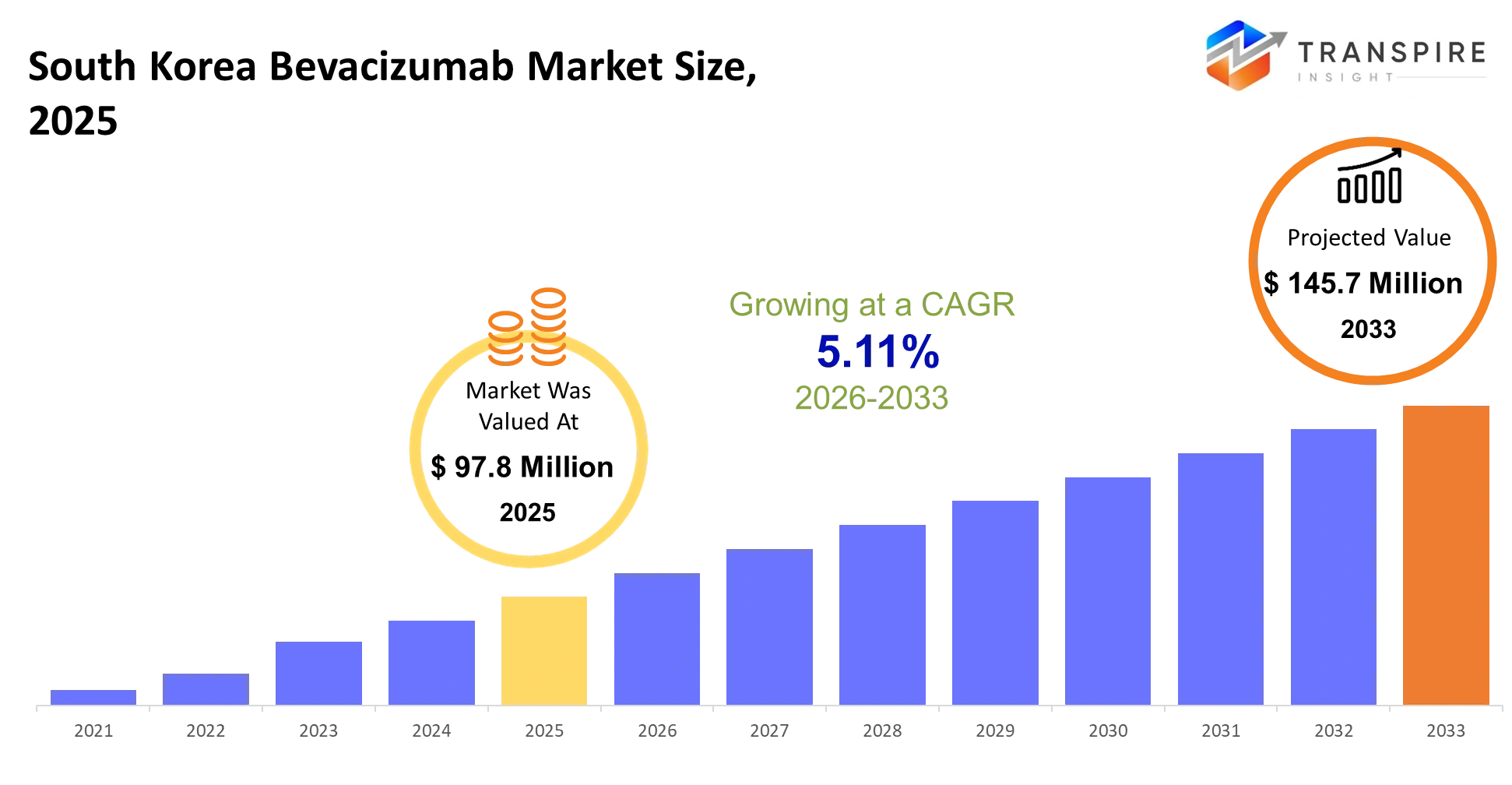
- South Korea Bevacizumab Market Size 2025: USD 97.8 Million
- South Korea Bevacizumab Market Size 2033: USD 145.7 Million
- South Korea Bevacizumab Market CAGR: 5.11%
- South Korea Bevacizumab Market Segments: By Type (Original, Biosimilars, Injectable, Combination Therapy), By Application (Cancer, Colorectal Cancer, Lung Cancer, Others), By End-User (Hospitals, Oncology Centers, Clinics, Patients)
To learn more about this report,  Download Free Sample Report
South Korea Bevacizumab Market Summary:
The South Korea Bevacizumab Market size is estimated at USD 97.8 Million in 2025 and is anticipated to reach USD 145.7 Million by 2033, growing at a CAGR of 5.11% from 2026 to 2033. South Korea's bevacizumab market in the pharmaceutical industry is shaped by hospital-based oncology care and biologics adoption trends. The evolution of treatment methods is driven by two factors: changing consumer demand for targeted cancer therapies and improved infusion safety. The development of biosimilars through technological advancements will create new pathways for drug approval which will transform clinical practice in hospitals.
The future usage of bevacizumab in tertiary care centers will be determined by two factors: changing hospital procurement methods and increasing adoption of precision oncology. The upcoming clinical settings will experience two changes which will affect treatment access and hospital decisions about biologic cancer therapies. The first change hospitals will make includes the adoption of digital health systems while the second change hospitals will face involves changes to their reimbursement models.
What Has the Impact of Artificial Intelligence Been on the South Korea Bevacizumab Market?
The South Korea Bevacizumab Market experiences rapid changes because artificial intelligence technology transforms how market participants understand customer demand and product availability. The South Korean Bevacizumab Market uses AI technology to process data which enables better market research results and faster insight development. Artificial intelligence enables companies in South Korea's Bevacizumab Market to use machine learning models for precise identification of market trends and patient demand changes.
The South Korea Bevacizumab Market benefits from this integration because it enables organizations to use predictive analytics for forecasting their decision-making processes. AI-powered smart automation systems improve production efficiency in the South Korea Bevacizumab Market by decreasing operational interruptions and enhancing biopharmaceutical workflow quality control processes.
The South Korea Bevacizumab Market uses machine learning systems to achieve supply chain optimization which results in cost savings and improved inventory management for both manufacturers and distributors. Predictive analytics serves as a vital component in demand forecasting because it guarantees the timely delivery of therapies while reducing unnecessary waste. The South Korea Bevacizumab Market uses AI technologies to boost its competitive edge while creating new opportunities for innovation development.
Key Market Trends & Insights:
- The Seoul Capital Region controls more than 60% of the South Korean Bevacizumab Market because it has advanced cancer treatment facilities which will lead to a 2025 market share of 60 to 62 percent.
- The Bevacizumab Market in South Korea will experience its fastest growth during the 2025 to 2030 period, as hospitals in Southern provinces make new investments.
- The South Korean bevacizumab market sees increased demand patterns because urban healthcare clustering improves treatment accessibility.
- Biosimilar bevacizumab holds the leading share of nearly 55% in the South Korea Bevacizumab Market because of its strong cost-efficient adoption.
- The South Korea Bevacizumab Market shows branded Avastin as its second-most-popular product, as medical professionals have established trust in its clinical performance and treatment history.
- The South Korea bevacizumab market will experience its highest growth from 2024 until 2030 through the introduction of biosimilars because of market conditions and governmental support.
- The South Korea Bevacizumab Market shows colorectal cancer treatment as its primary segment which occupies approximately 40% market share because of the high incidence of the disease.
- The South Korea Bevacizumab Market shows lung cancer treatment as its fastest expanding market segment because of increasing disease occurrence.
- The South Korea Bevacizumab Market demonstrates that hospitals control about 65% of the market because they deliver numerous infusion treatments to patients.
- The South Korea Bevacizumab Market experiences its fastest growth through cancer specialty centers which serve as its primary end-user sector.
- The South Korea Bevacizumab Market receives its main competition from Roche Amgen Samsung Bioepis Pfizer and Novartis.
South Korea Bevacizumab Market Segmentation
By Type :
The South Korea Bevacizumab Market maintains strong demand for its original products because medical professionals trust these products based to their established treatment results. The healthcare sector uses these formulations as standard treatments which they implement during critical care situations that require doctors to predict patient responses for effective long-term treatment strategies.
Biosimilars are becoming more popular because they provide affordable treatment alternatives that deliver identical medical benefits. The Bevacizumab Market in South Korea shows increasing adoption because hospitals and treatment centers need to achieve both effective treatments and cost-effective solutions. The medical community accepts new treatments based on clinical studies and regulatory approvals which promote their use in various oncology procedures.
By Application :
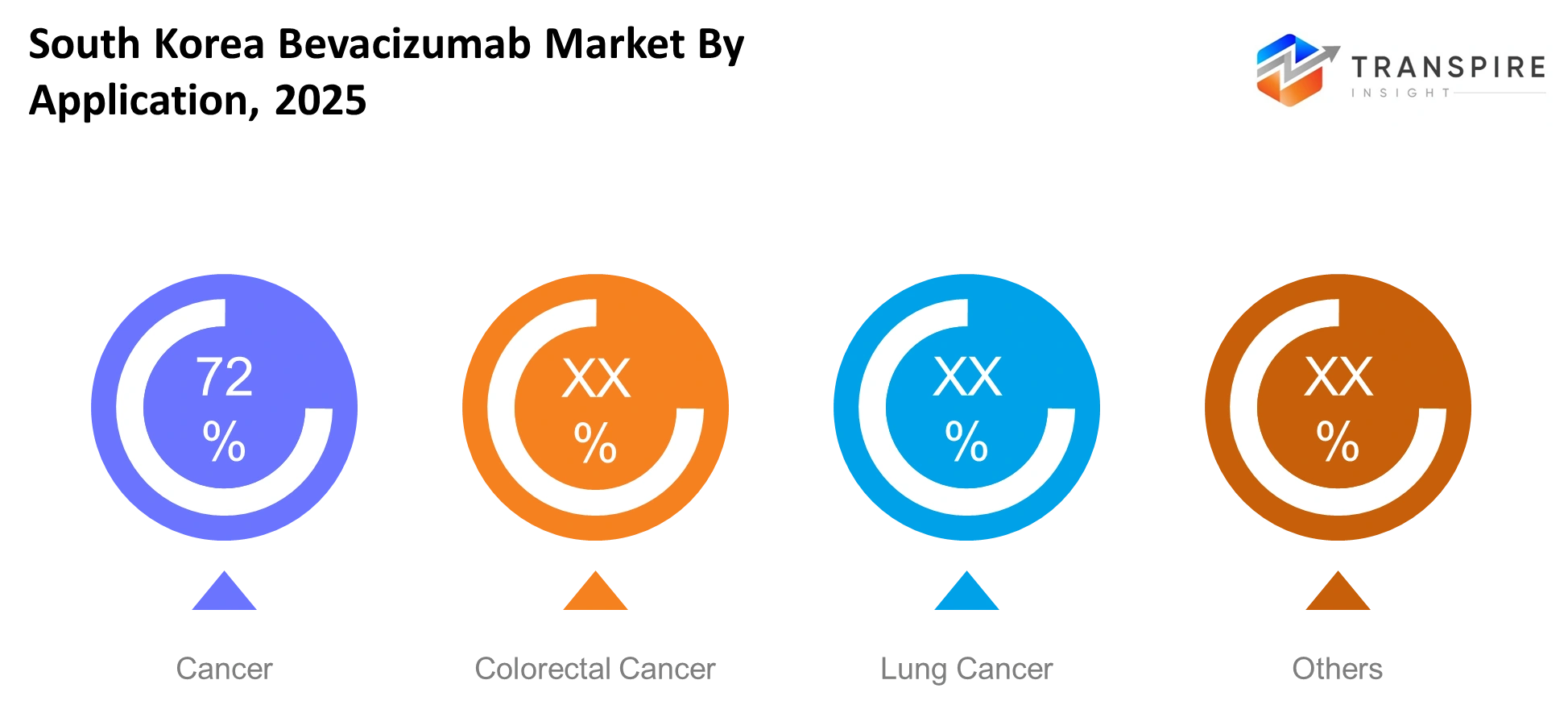
The South Korea Bevacizumab Market relies primarily on general cancer treatment as its main application area because the medication helps to prevent tumor growth while enabling physicians to apply specific treatment methods. The application of oncology treatment methods has grown because of their ability to deliver personalized health solutions for each individual patient.
Bevacizumab functions as a key treatment option for colorectal cancer patients who undergo chemotherapy treatments. The South Korean Bevacizumab Market application enables healthcare providers to achieve better disease control outcomes while extending the time patients remain free of cancer progression during their structured oncological treatment which doctors oversee.
Bevacizumab shows significant value in lung cancer treatment because it helps healthcare providers treat patients who have reached the disease's final stages. Hospitals use the medication to enhance their oncology treatment programs which aim to improve patient quality of life while controlling disease advancement.
To learn more about this report, Download Free Sample Report
By End-User :
The South Korea Bevacizumab Market shows hospitals as its primary user group because hospitals possess complete medical facilities and advanced treatment capabilities. The institutions operate at high capacity to provide comprehensive cancer treatment services which require specialized medical staff to handle exceptional cancer treatment demands.
Oncology centers function as specialized facilities which provide both cancer treatment and research-based medical services. The centers in South Korea's Bevacizumab Market enable medical professionals to create advanced treatment procedures while they observe patients' personal health and disease development throughout the entire treatment process.
Outpatient treatment centers depend on clinics and individual patients for both treatment delivery and patient follow-up services. clinics enable patients to maintain their treatment schedules but increasing patient demand exists through better cancer awareness and early diagnosis which helps to extend Bevacizumab usage throughout different cancer treatment stages.
What are the Main Challenges for the South Korea Bevacizumab Market Growth?
The South Korea Bevacizumab Market encounters multiple technical and operational obstacles which disrupt its capacity for sustained development. The South Korea Bevacizumab Market faces two primary challenges because monoclonal antibody formulations require specific product stability and special methods for handling biologics. The south korea bevacizumab market experiences greater operational challenges because companies must control cold-chain systems while assuring their products maintain consistent quality throughout different production batches.
The South Korea Bevacizumab Market experiences significant effects from manufacturing and commercialization activities which depend on strict regulatory compliance with GMP standards and bioequivalence testing.
The South Korea Bevacizumab Market faces two major obstacles which prevent its growth because of adoption issues and infrastructure shortcomings. The south korea bevacizumab market experiences limited expansion because semi-urban areas lack proper oncology treatment centers and the industry lacks trained biopharmaceutical workers. The uneven healthcare access combined with funding shortages for advanced biologics research restricts demand growth since people outside major metropolitan areas lack access to proper healthcare facilities.
The South Korean Bevacizumab Market faces permanent threats from competing oncology treatments together with rising consumer demand for affordable treatment options. The Bevacizumab market in South Korea experiences market restrictions from rapid biosimilar competition and developing reimbursement standards which require market participants to establish continuous product differentiation.
Country Insights
The South Korea Bevacizumab Market will continue to grow as demand for targeted cancer care rises across healthcare facilities. Bevacizumab serves as an essential treatment option for several cancers which require doctors to control the abnormal growth of blood vessels.The treatment will become essential for hospitals and specialty clinics in South Korea because it demonstrates clinical effectiveness and satisfies rising patient requirements.
The market will expand because of increasing cancer rates and better access to advanced biologic therapies.Healthcare providers will choose treatments that improve patient survival rates while maintaining their ability to stick to extended medical treatment plans. Major cities throughout the country will experience increased Bevacizumab-based treatment option adoption because of their existing supportive infrastructure.
The South Korea Bevacizumab Market will demonstrate greater market concentration within major urban healthcare centers which include Seoul Busan and Incheon. The regions will receive advantages because of their access to modern hospital systems and superior oncology facilities and increased patient knowledge. Healthcare funding and advanced cancer treatments which become available through early adoption will create continuous support for treatment operations in these areas.
The market will experience growth from secondary cities which include developing healthcare zones, but their growth rate will remain lower than that of major urban centers.The expansion of healthcare insurance coverage combined with hospital facility upgrades will create better access to medical treatment. The growing emphasis on early cancer detection will drive demand throughout various regions in South Korea.
Recent Development News
In March 2026, Samsung Bioepis and Sandoz established a new partnership which includes licensing, development, and commercial activities. The companies agreed to collaborate on up to five biosimilar assets which will strengthen Samsung Bioepis' global bevacizumab biosimilar commercialization footprint. Source https://www.bigmoleculewatch.com/
In March 2026, Samsung Bioepis expanded its biosimilar development strategy through renewed global commercialization agreements. The partnership structure strengthens its oncology biosimilars business which includes bevacizumab through international market expansion and distribution capabilities.
Source https://www.bigmoleculewatch.com/
|
Report Metrics |
Details |
|
Market size value in 2025 |
USD 97.8 Million |
|
Market size value in 2026 |
USD 102.8 Million |
|
Revenue forecast in 2033 |
USD 145.7 Million |
|
Growth rate |
CAGR of 5.11% from 2026 to 2033 |
|
Base year |
2025 |
|
Historical data |
2021 - 2024 |
|
Forecast period |
2026 - 2033 |
|
Report coverage |
Revenue forecast, competitive landscape, growth factors, and trends |
|
Regional scope |
United States; Canada; Mexico; United Kingdom; Germany; France; Italy; Spain; Denmark; Sweden; Norway; China; Japan; India; Australia; South Korea; Thailand; Brazil; Argentina; South Africa; Saudi Arabia; United Arab Emirates |
|
Key company profiled |
Roche, Amgen, Pfizer, Samsung Bioepis, Celltrion, Biocon, Dr Reddy’s, Mylan, Novartis, Teva, AstraZeneca, Merck, Bayer, Eli Lilly, AbbVie |
|
Customization scope |
Free report customization (country, regional & segment scope). Avail customized purchase options to meet your exact research needs. |
|
Report Segmentation |
By Type (Original, Biosimilars, Injectable, Combination Therapy), By Application (Cancer, Colorectal Cancer, Lung Cancer, Others), By End-User (Hospitals, Oncology Centers, Clinics, Patients) |
How Can New Companies Establish a Strong Foothold in the South Korea Bevacizumab Market?
New companies can establish a strong foothold in the South Korea Bevacizumab Market by focusing on biosimilar innovation, strategic partnerships, and precise oncology services. In the South Korea Bevacizumab Market, companies must establish their unique market presence through lower-cost biological products and their superior production methods to succeed against established international companies. New companies in the South Korea Bevacizumab market can use artificial intelligence-based clinical analytics together with intelligent manufacturing technologies to enhance their operational efficiency and shorten product development time, which will enable them to expand their market presence.
Businesses in the South Korea Bevacizumab Market succeed by implementing partnership-based expansion strategies that involve working together with hospitals and research institutions and contract manufacturing organizations. Samsung Bioepis operates biosimilar-focused research facilities that enable their products to enter new markets while Celltrion-derived spin-offs from emerging biotech startups build their research pipeline through innovation.
The examples demonstrate that organizations establish growth pathways through their innovation methods while their regulatory compliance activities help them succeed in the South Korean bevacizumab market by meeting existing oncology treatment needs. New companies entering the South Korea Bevacizumab Market must focus on targeting specific medical areas which include colorectal and lung cancer treatment segments that show continuous market demand.
Key South Korea Bevacizumab Market Company Insights
The South Korea Bevacizumab Market shows ongoing growth because patients require targeted cancer therapies for their oncological treatments. The treatment is becoming more popular because it helps hospitals and specialty clinics treat colorectal and lung and kidney cancers. The market will experience continued expansion because medical facilities will gain better access to advanced biologic treatments which they need for clinical purposes.
The South Korea Bevacizumab Market competitive environment consists of international and local pharmaceutical companies which develop biosimilars and implement their pricing methods. Companies focus on obtaining product approvals and making distribution partnerships and establishing hospital supply agreements. The rising presence of biosimilars creates price competition which makes treatments more accessible, while ongoing product development helps companies establish better market positions in oncology-related treatment areas.
Company List
- Roche
- Amgen
- Pfizer
- Samsung Bioepis
- Celltrion
- Biocon
- Dr Reddy’s
- Mylan
- Novartis
- Teva
- AstraZeneca
- Merck
- Bayer
- Eli Lilly
- AbbVie
What are the Key Use-Cases Driving the Growth of South Korea Bevacizumab Market?
The South Korea Bevacizumab Market experiences its main growth through increasing oncology clinical applications, which show rising demand for targeted biologic therapies instead of standard chemotherapy treatments. The South Korea Bevacizumab Market shows its highest demand for colorectal cancer treatment, which uses bevacizumab to enhance survival rates through combination with chemotherapy treatments.
The South Korea Bevacizumab Market uses lung cancer treatments, which include non-small cell lung cancer therapies that doctors quickly adopt through biologic combination treatments. The South Korea Bevacizumab Market shows hospitals developing standardized treatment protocols for bevacizumab use, which helps oncology departments achieve better patient outcomes and more efficient clinical processes.
The South Korean bevacizumab market grows from off-label ophthalmology uses that treat retinal diseases. The South Korean Bevacizumab Market grows through clinical usage and the development of personalized medicine and biomarker-based treatment methods.
South Korea Bevacizumab Market Report Segmentation
By Type
- Original
- Biosimilars
- Injectable
- Combination Therapy
By Application
- Cancer
- Colorectal Cancer
- Lung Cancer
By End-User
- Hospitals
- Oncology Centers
- Clinics
- Patients
Frequently Asked Questions
Find quick answers to common questions.
The approximate South Korea Bevacizumab Market size for the market will be USD 145.7 Million in 2033.
Key segments for the South Korea Bevacizumab Market are By Type (Original, Biosimilars, Injectable, Combination Therapy), By Application (Cancer, Colorectal Cancer, Lung Cancer, Others), By End-User (Hospitals, Oncology Centers, Clinics, Patients).
Major South Korea Bevacizumab Market players are Roche, Amgen, Pfizer, Samsung Bioepis, Celltrion, Biocon, Dr Reddy’s, Mylan, Novartis, Teva, AstraZeneca, Merck, Bayer, Eli Lilly, AbbVie.
The South Korea Bevacizumab Market size is USD 97.8 Million in 2025.
The South Korea Bevacizumab Market CAGR is 5.11%.
- Roche
- Amgen
- Pfizer
- Samsung Bioepis
- Celltrion
- Biocon
- Dr Reddy’s
- Mylan
- Novartis
- Teva
- AstraZeneca
- Merck
- Bayer
- Eli Lilly
- AbbVie
Recently Published Reports
-
May 2026
Biosimilars Market
Biosimilars Market By Product Type (Monoclonal Antibodies, Recombinant Hormones, Erythropoietin, G-CSF, Others), By Indication (Oncology, Autoimmune Diseases, Blood Disorders, Diabetes, Others), By Manufacturing Type (In-House Manufacturing, Contract Manufacturing), By Distribution Channel (Hospital Pharmacies, Retail Pharmacies, Online Pharmacies), By Industry Analysis, Size, Share, Growth, Trends, and Forecasts 2021-2033
-
Apr 2026
Gastrointestinal Endoscopy Market
Gastrointestinal Endoscopy Market By Type (Rigid Gastrointestinal Endoscope, Flexible Gastrointestinal Endoscopes, Disposable Gastrointestinal Endoscope), By Procedure Type (Colonoscopy, Gastroscopy, Duodenoscopy, Enteroscopy, Flexible Sigmoidoscopy, Others), By Application (Diagnosis, Treatment), By End-Users (Hospitals, Ambulatory Surgical Centers, Specialty Clinics, Laboratories, Others), By Industry Analysis, Size, Share, Growth, Trends, and Forecasts 2021-2033
-
Apr 2026
Rare Inherited Metabolic Disorder Drug Market
Rare Inherited Metabolic Disorder Drug Market By Drug Class (Enzyme Replacement Drugs, Gene Therapy Drugs, Substrate Reduction Drugs, Small Module Drugs, Protein Drugs), By Route of Administration(Parenteral, Oral, Intrathecal), By Clinical Development (Marketed Drugs, Late Stage Clinical Phase III, Early Stage Clinical Phase I-II, Preclinical Candidates), By Indication (Lysosomal Storage Disorders, Urea Cycle Disorders, Amino Acid Metabolic Disorders, organic Acidemias, Peroximal Disorders), By Industry Analysis, Size, Share, Growth, Trends, and Forecasts 2021-2033
-
Jan 2026
Pharmaceutical Cleanroom Technology Market
Pharmaceutical Cleanroom Technology Market By Product (Equipment, Consumables, Services); By Cleanroom Type (Standard Cleanrooms, Modular Cleanrooms); By End Use (Pharmaceutical Companies, Biotechnology Companies), By Industry Analysis, Size, Share, Growth, Trends, and Forecasts 2021-2033