
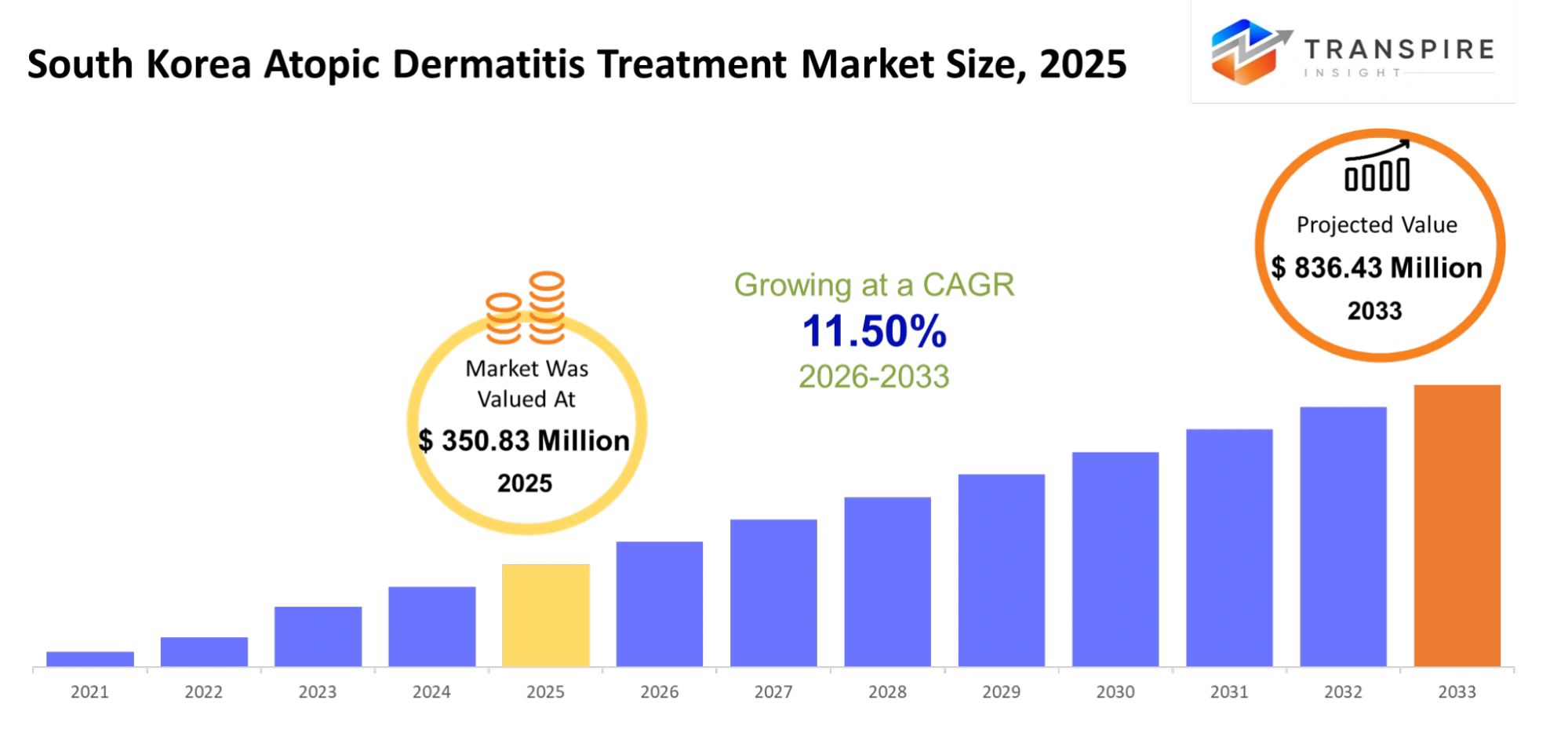
South Korea Atopic Dermatitis Treatment Market Size & Forecast:
- South Korea Atopic Dermatitis Treatment Market Size 2025: USD 350.83 Million
- South Korea Atopic Dermatitis Treatment Market Size 2033: USD 836.43 Million
- South Korea Atopic Dermatitis Treatment Market CAGR: 11.50%
- South Korea Atopic Dermatitis Treatment Market Segments: By Treatment (Topical Drugs, Biologics, Corticosteroids, Immunomodulators), By Application (Mild, Moderate, Severe), By End-User (Hospitals, Clinics, Patients, Dermatology Centers)
To learn more about this report,  Download Free Sample Report
South Korea Atopic Dermatitis Treatment Market Summary:
South Korea Atopic Dermatitis Treatment Market size was estimated at USD 350.83 Millionin 2025 and is anticipated to reach USD 836.43 Million by 2033, growing at a CAGR of 11.50% from 2026 to 2033.
The South Korean Atopic Dermatitis Treatment Market exists as part of the pharmaceutical and dermatology sector because people currently show greater understanding of skin health and persistent medical conditions. Patients will seek treatments which provide lasting benefits because they need to stop their skin problems from happening again. South Korean dermatologists will start prescribing targeted biologics and non-steroidal treatments instead of their current prescribing methods. People will drive the demand for treatments which provide both medical benefits and aesthetic relief from visible skin conditions.
Healthcare delivery and monitoring processes will receive major technological influence. Digital health platforms together with AI-supported diagnostic tools will create possibilities for earlier diagnosis and customized treatment solutions during the treatment process for younger patients. South Korean regulatory authorities will introduce stricter evaluation procedures which will result in the development of safer product formulas and the disclosure of clinical research findings. Research funding from both local and international pharmaceutical companies will focus on developing treatments which meet patient demands for minimal side effects. The need for effective treatment solutions will persist because urbanization and modern life result in higher stress levels among people.
Key Market Trends & Insights:
- South Korea Atopic Dermatitis Treatment Market shows stable expansion because patients increasingly choose treatments which specifically target their immune system pathways. The medical field considers biologics and advanced topical solutions as effective treatments because they deliver better results for patients. Healthcare professionals recommend modern treatments which use different methods instead of traditional steroid-based methods because they provide better long-term disease management results.
- The South Korea Atopic Dermatitis Treatment Market grows because people show increased understanding about skin health together with chronic skin conditions. Early diagnosis which educational campaigns and dermatologist consultations support helps to reduce disease progression. Parents and young adults actively seek medical advice which leads to quicker treatment initiation and improved symptom management across all age groups.
- The South Korea Atopic Dermatitis Treatment Market grows because new biologics and systemic drugs enter the market. The therapies treat moderate to severe cases which do not respond to standard medical treatments. Healthcare providers increasingly recommend such options because these treatments show better results and lower rates of treatment failure which helps to expand the market.
- The South Korea Atopic Dermatitis Treatment Market expands through the establishment of new dermatology clinics and skin care facilities. Professional care becomes more accessible for patients, which results in better treatment compliance and follow-up care. Urban areas possess numerous advanced medical facilities, whereas semi-urban areas are developing their dermatological services at a gradual pace.
- The South Korea Atopic Dermatitis Treatment Market experiences changes because of people changing their way of life and environmental pollution and their food consumption patterns.The medical community reports that rising allergen exposure combined with increased stress levels leads to more frequent cases of the disease. Healthcare experts identify preventive care and lifestyle changes as vital elements which doctors need to use together with medical treatment for effective symptom management.
South Korea Atopic Dermatitis Treatment Market Segmentation
By Treatment :
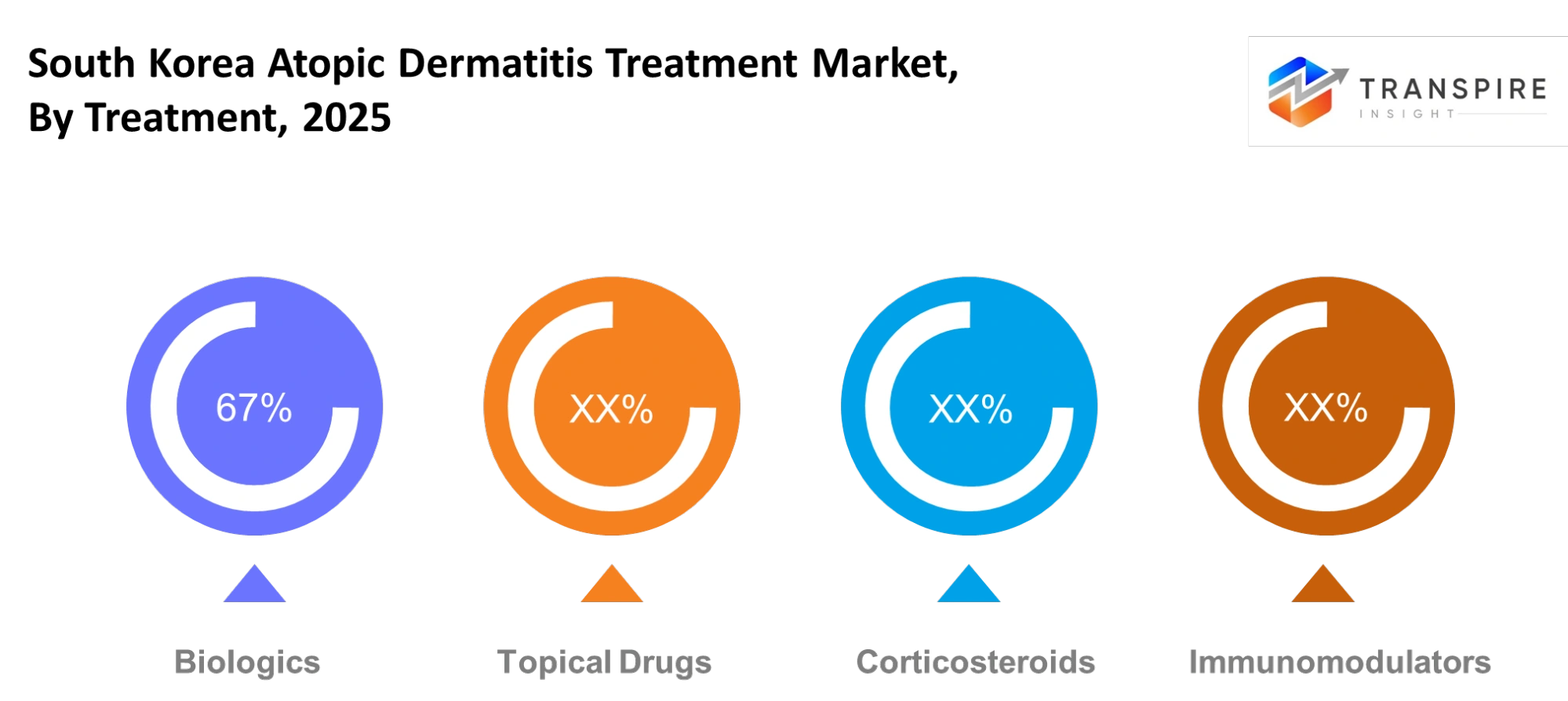
- Topical Drugs:The South Korea Atopic Dermatitis Treatment Market depends on topical drugs which remain available with immediate effects on treated skin. The creams and ointments provide relief from itching and redness while also treating dryness. The products enable skin barrier restoration through their ongoing application which benefits both initial treatment and continuous skin maintenance.
- Biologics: Biologics have started to receive more recognition within the South Korea Atopic Dermatitis Treatment Market because they provide focused treatment against specific immune system pathways. The treatments target deep tissue inflammation which affects patients experiencing severe medical conditions. The medical community is more aware of biologic therapies because they now have improved access to specialized medical services.
- Corticosteroids: The South Korea Atopic Dermatitis Treatment Market uses corticosteroids as the primary treatment option because they provide patients with immediate relief from skin flare-ups. The medications effectively control both inflammation and itching. The medical team needs to control dosage and treatment time because extended use of medication brings about possible side effects that require expert oversight.
- Immunomodulators: Immunomodulators offer a different treatment method in the South Korea Atopic Dermatitis Treatment Market which modifies immune function without producing strong steroid effects. Patients select these treatments to use them on sensitive body areas or for prolonged periods. Dermatology experts increasingly adopt the treatments because they consistently decrease skin irritation while preventing future skin issues.
To learn more about this report, Download Free Sample Report
By Application :
- Mild: Mild cases in the South Korea Atopic Dermatitis Treatment Market rely on basic skincare and low-strength medications. The initial stage of treatment helps to stop the disease from advancing while diminishing patient suffering. The body responds well to basic routines which include both moisturization and gentle treatment methods which help control symptoms and protect skin health for extended periods.
- Moderate: Patients with moderate conditions in the South Korea Atopic Dermatitis Treatment Market need multiple treatment methods to achieve better disease management. The patient shows increased symptoms which require stronger topical treatments or additional medical interventions. Medical professionals need to oversee treatment because they help patients find safe yet effective balance between different treatment methods.
- Severe: Patients with severe Atopic Dermatitis in the South Korea treatment market need special treatment because their symptoms cause continuous problems which affect their normal activities. Patients typically require advanced therapies which include biologic treatments and systemic treatment options. The combination of continuous monitoring together with structured care plans enables medical professionals to control complications while enhancing patient health outcomes.
By End-User :
- Hospitals:The South Korea Atopic Dermatitis Treatment Market depends on hospitals which provide their patients advanced diagnostic and treatment capabilities. The combination of specialist availability together with current treatment options enables medical professionals to deliver optimal solutions for intricate medical situations. Treatment facilities which follow established procedures, support medical professionals in managing critical medical situations through their ability to monitor patients closely.
- Clinics: The South Korea Atopic Dermatitis Treatment Market receives major support from clinics which deliver essential medical services to people who need ongoing treatment. The process of maintaining health requires patients to have regular check-ups, subsequent appointments, and individualized treatment approaches. Patients who need medical attention can use these facilities to receive ongoing treatment that does not require full hospital services.
- Patients: The South Korea Atopic Dermatitis Treatment Market relies on patients, who participate in self-treatment methods and follow their prescribed medical treatments. People who know their skin care methods together with their medicine consumption knowledge achieve better treatment results. The rising availability of information empowers people to make better choices while they respond to their initial symptoms.
- Dermatology Centers: Specialized dermatology centers enable the South Korea Atopic Dermatitis Treatment Market to develop through their focused medical expertise which treats skin diseases. Medical facilities which possess specialized instruments together with certified personnel can implement exact medical procedures. The centers treat patients who need specialized medical treatment because they need to manage their conditions through individualized medical programs and continuous support systems.
Country Insights
- The Atopic Dermatitis Treatment Market in South Korea experiences continuous development because people now understand chronic skin diseases better and they can access dermatology services more easily. The urban population develops more skin diseases because they encounter pollution and adopt new lifestyle patterns which leads to a higher need for advanced medical treatments and skin creams and extended disease management solutions.
- The Atopic Dermatitis Treatment Market in South Korea receives strong support from the country's well-developed healthcare system and complete insurance protection which enables patients to obtain their first medical consultation. The local pharmaceutical sector together with clinical research activities enables the development of targeted biologics and safer product formulations which results in a balanced system of traditional treatments and contemporary medical methods.
- The Atopic Dermatitis Treatment Market in South Korea shows how patients now prefer customized treatment methods which focus on disease prevention. The demand for mild products which protect the skin continues to grow because consumers now understand skincare better and medical treatments. Government focus on healthcare quality further supports consistent treatment adoption and long-term disease monitoring practices.
Recent Development News
In September 2025, the global trend of expanding non-steroidal topical treatments for young children through JAK inhibitor creams will reach South Korea. Korean dermatologists are developing safer long-term treatment methods which decrease their need for corticosteroids when treating pediatric patients.
In July 2024, Korean medical research conducted demonstrated that severe eczema functions as more than a skin disease because it leads to increased permanent health problems for patients, which results in medical professionals adopting early intensive treatment methods as their new standard approach.
|
Report Metrics |
Details |
|
Market size value in 2025 |
USD 350.83 Million |
|
Market size value in 2026 |
USD 390.49 Million |
|
Revenue forecast in 2033 |
USD 836.43 Million |
|
Growth rate |
CAGR of 11.50% from 2026 to 2033 |
|
Base year |
2025 |
|
Historical data |
2021 - 2024 |
|
Forecast period |
2026 - 2033 |
|
Report coverage |
Revenue forecast, competitive landscape, growth factors, and trends |
|
Country scope |
South Korea |
|
Key company profiled |
Sanofi, Regeneron, Pfizer, AbbVie, Novartis, Eli Lilly, Roche, Bayer, Takeda, Astellas, GSK, AstraZeneca, Teva, LEO Pharma, Almirall |
|
Customization scope |
Free report customization (country, regional & segment scope). Avail customized purchase options to meet your exact research needs. |
|
Report Segmentation |
By Treatment (Topical Drugs, Biologics, Corticosteroids, Immunomodulators), By Application (Mild, Moderate, Severe), By End-User (Hospitals, Clinics, Patients, Dermatology Centers) |
Key South Korea Atopic Dermatitis Treatment Company Insights
- The South Korea Atopic Dermatitis Treatment market shows strong activity among established pharmaceutical firms and emerging biotech companies which specialize in skin health. Companies are currently funding research to develop specific treatment methods through their work on biologics and non-steroidal treatments which will lead to better patient experiences and extended disease management while they work to resolve safety issues associated with conventional treatment methods.
- The South Korea Atopic Dermatitis Treatment market operates through continuous joint efforts which domestic manufacturers and global companies use to enhance treatment access. The research efforts will proceed through clinical trials which will receive expedited regulatory approval. Growing patient awareness will create demand which will drive companies to enhance product distribution throughout hospitals and dermatology clinics.
South Korea Atopic Dermatitis Treatment Market Companies:
- Sanofi
- Regeneron
- Pfizer
- AbbVie
- Novartis
- Eli Lilly
- Roche
- Bayer
- Takeda
- Astellas
- GSK
- AstraZeneca
- Teva
- LEO Pharma
- Almirall
South Korea Atopic Dermatitis Treatment Market Segmentation
By Treatment
- Topical Drugs
- Biologics
- Corticosteroids
- Immunomodulators
By Application
- Mild
- Moderate
- Severe
By End-User
- Hospitals
- Clinics
- Patients
- Dermatology Centers
Frequently Asked Questions
Find quick answers to common questions.
The approximate South Korea Atopic Dermatitis Treatment Market size for the market will be USD 836.43 Million in 2033.
Key segments for the South Korea Atopic Dermatitis Treatment Market are By Treatment (Topical Drugs, Biologics, Corticosteroids, Immunomodulators), By Application (Mild, Moderate, Severe), By End-User (Hospitals, Clinics, Patients, Dermatology Centers).
Major South Korea Atopic Dermatitis Treatment Market players are Sanofi, Regeneron, Pfizer, AbbVie, Novartis, Eli Lilly, Roche, Bayer, Takeda, Astellas, GSK, AstraZeneca, Teva, LEO Pharma, Almirall.
The South Korea Atopic Dermatitis Treatment Market size is USD 350.83 Million in 2025.
The South Korea Atopic Dermatitis Treatment Market CAGR is 11.50%.
- Sanofi
- Regeneron
- Pfizer
- AbbVie
- Novartis
- Eli Lilly
- Roche
- Bayer
- Takeda
- Astellas
- GSK
- AstraZeneca
- Teva
- LEO Pharma
- Almirall
Recently Published Reports
-
May 2026
Biosimilars Market
Biosimilars Market By Product Type (Monoclonal Antibodies, Recombinant Hormones, Erythropoietin, G-CSF, Others), By Indication (Oncology, Autoimmune Diseases, Blood Disorders, Diabetes, Others), By Manufacturing Type (In-House Manufacturing, Contract Manufacturing), By Distribution Channel (Hospital Pharmacies, Retail Pharmacies, Online Pharmacies), By Industry Analysis, Size, Share, Growth, Trends, and Forecasts 2021-2033
-
Apr 2026
Gastrointestinal Endoscopy Market
Gastrointestinal Endoscopy Market By Type (Rigid Gastrointestinal Endoscope, Flexible Gastrointestinal Endoscopes, Disposable Gastrointestinal Endoscope), By Procedure Type (Colonoscopy, Gastroscopy, Duodenoscopy, Enteroscopy, Flexible Sigmoidoscopy, Others), By Application (Diagnosis, Treatment), By End-Users (Hospitals, Ambulatory Surgical Centers, Specialty Clinics, Laboratories, Others), By Industry Analysis, Size, Share, Growth, Trends, and Forecasts 2021-2033
-
Apr 2026
Rare Inherited Metabolic Disorder Drug Market
Rare Inherited Metabolic Disorder Drug Market By Drug Class (Enzyme Replacement Drugs, Gene Therapy Drugs, Substrate Reduction Drugs, Small Module Drugs, Protein Drugs), By Route of Administration(Parenteral, Oral, Intrathecal), By Clinical Development (Marketed Drugs, Late Stage Clinical Phase III, Early Stage Clinical Phase I-II, Preclinical Candidates), By Indication (Lysosomal Storage Disorders, Urea Cycle Disorders, Amino Acid Metabolic Disorders, organic Acidemias, Peroximal Disorders), By Industry Analysis, Size, Share, Growth, Trends, and Forecasts 2021-2033
-
Jan 2026
Pharmaceutical Cleanroom Technology Market
Pharmaceutical Cleanroom Technology Market By Product (Equipment, Consumables, Services); By Cleanroom Type (Standard Cleanrooms, Modular Cleanrooms); By End Use (Pharmaceutical Companies, Biotechnology Companies), By Industry Analysis, Size, Share, Growth, Trends, and Forecasts 2021-2033