
South Korea Algorithmic Trading Market Size & Forecast
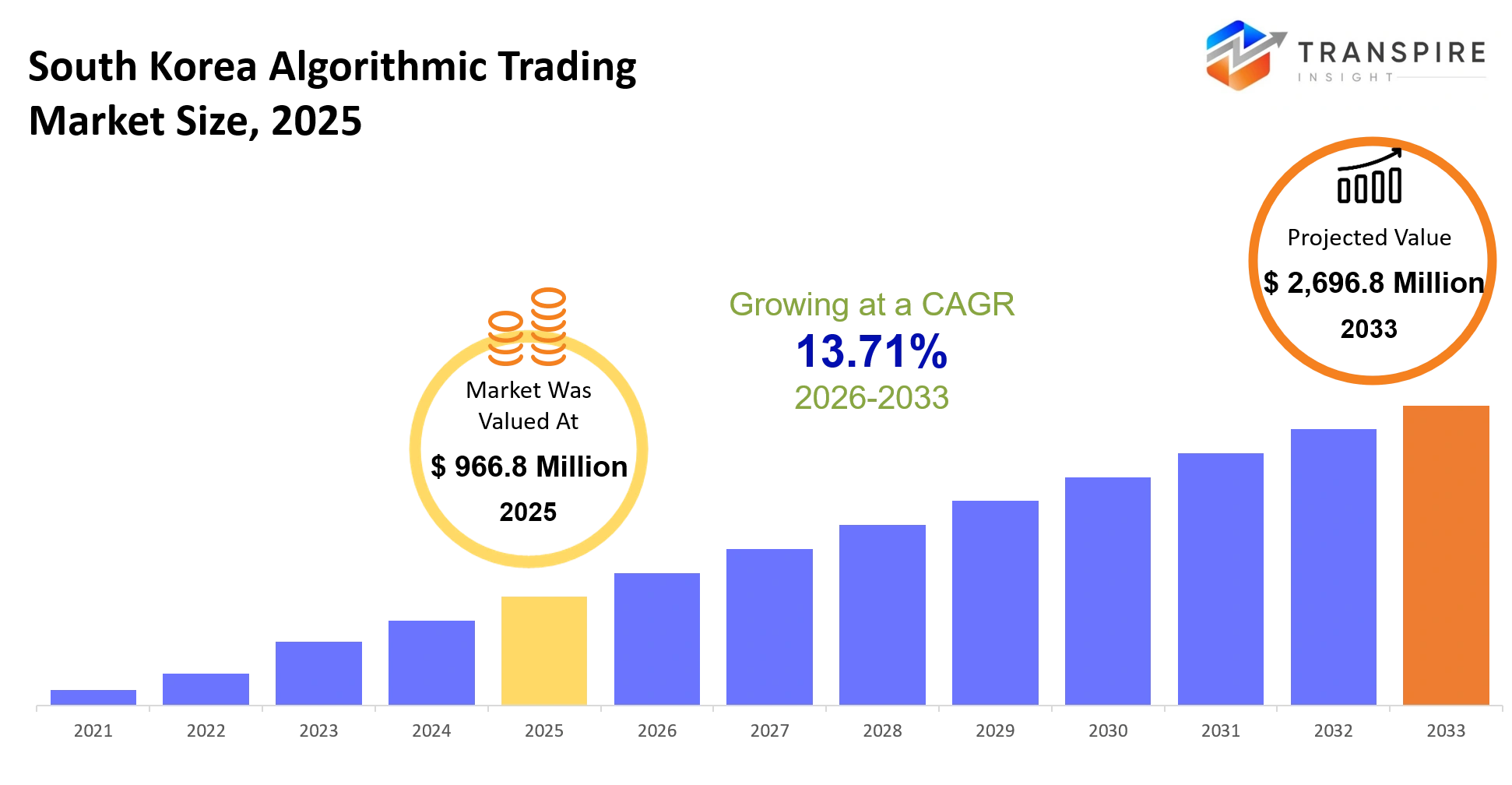
- South Korea Algorithmic Trading Market Size 2025: USD 966.8 Million
- South Korea Algorithmic Trading Market Size 2026: USD 1,097.3 Million
- South Korea Algorithmic Trading Market Size 2033: USD 2,696.8 Million
- South Korea Algorithmic Trading Market CAGR: 13.71%
- South Korea Algorithmic Trading Market Segments: By Trading Type (High-frequency Trading, Statistical Arbitrage, Automated Market Making, Trend-following Algorithms, Others); By Asset Class (Equities, Forex, Commodities, Cryptocurrencies, Others); By Deployment (Cloud-based Trading Platforms, On-premise Trading Platforms, Hybrid Platforms, Others); By Application (Portfolio Management, Risk Management, Trade Execution, Market Surveillance, Others); By End User (Investment Banks, Hedge Funds, Retail Traders, Asset Management Firms, Others)
South Korea Algorithmic Trading Market Summary
As per Transpire Insight Analysis, in South Korea, this function sits at the center of the Korea Exchange (KRX) equity market, the country's active retail derivatives segment, and a rapidly institutionalizing cryptocurrency trading environment. At USD 966.8 Million in 2025, the market is projected to reach USD 2,696.8 Million by 2033. Algorithmic trading replaces manual order entry with rule-based software that scans price feeds, evaluates conditions, and submits trades in milliseconds.
The defining structural change over the last few years has really been the KRX's gradual transition towards longer and eventually nearly continuous trading sessions - all while the exchange implemented its 2023 short-selling ban requiring systematic desks to rebuild their execution logic around a much narrower set of acceptable strategies. Both moves really compelled local brokerages and hedge funds to redevelop their algorithmic infrastructure from scratch instead of just importing foreign models into the Korean market.
The actual market event that really accelerated current growth was the 2023 lifting of restrictions on foreign high-frequency trading companies' direct market access alongside significant KRX system updates that greatly reduced order latency times. Citadel Securities and Virtu Financial expanded their presence in Seoul relatively quickly afterwards, really drawing local participants into an even faster competitive rhythm. Retail participation further amplifies this impact: Korea Investment & Securities and Mirae Asset Securities have both developed retail-focused algorithmic order tools, taking automated trading far beyond the institutional desks that used to have almost exclusive access
Key South Korea Algorithmic Trading Market Insights
- Seoul's metropolitan financial district holds a massive amount of investment in algorithmic trading infrastructure - mostly because it's home to most KRX co-location facilities, brokerage data centers, and quantitative trading desks.
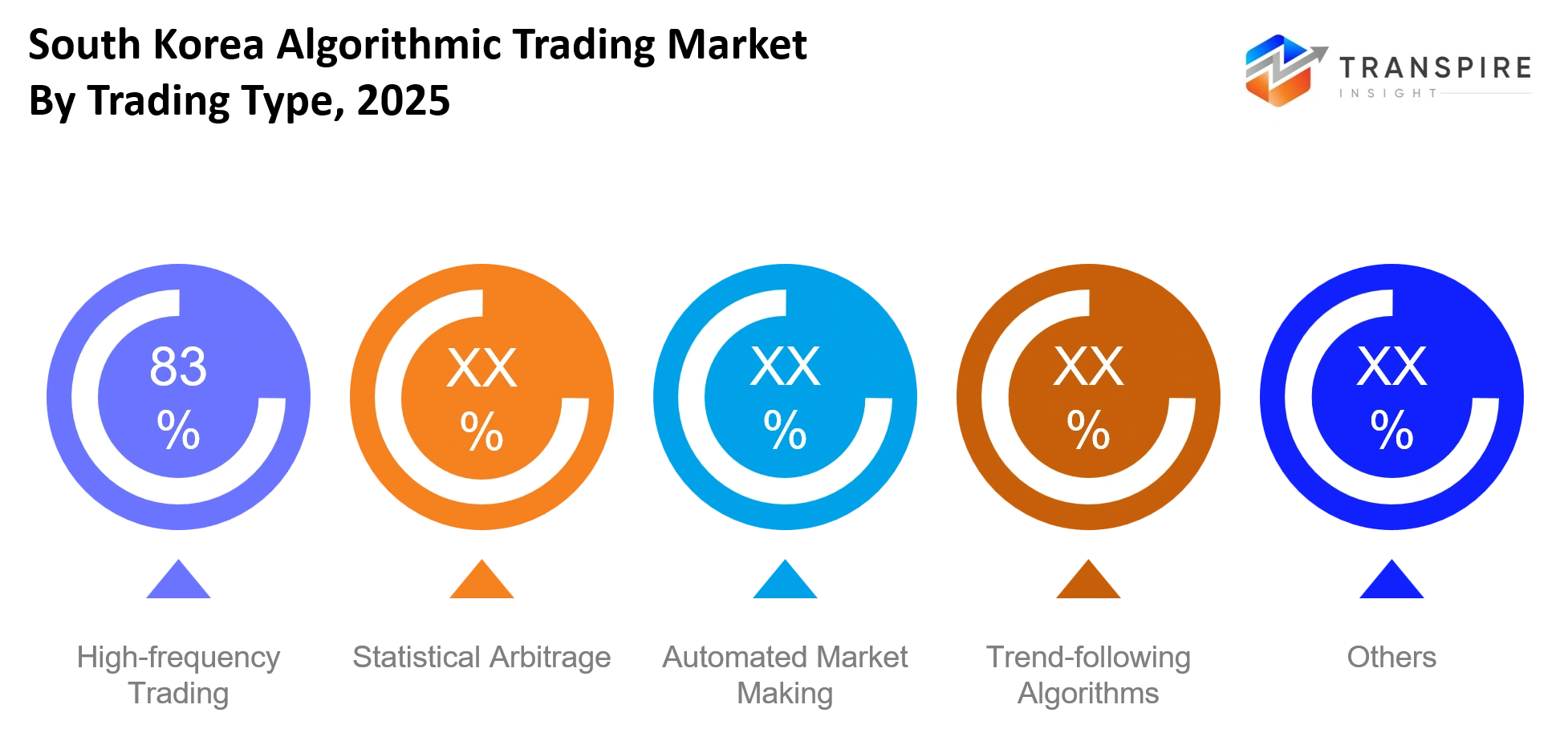
- High-frequency Trading is the biggest player in this space, making up about 83% of South Korea's algorithmic trading market revenue in 2025 thanks to KRX's ongoing low-latency infrastructure upgrades and the arrival of international HFT firms post-2023 market access reforms.
- Statistical Arbitrage is gaining ground as quantitative hedge funds take advantage of pricing discrepancies between KOSPI 200 futures and their underlying equity baskets - something they can do more easily now that KRX has lengthened its trading sessions.
- Equities are still the top asset class by trading volume, although Cryptocurrencies are growing at the quickest rate as Upbit and Bithumb increase their institutional-grade API access for systematic trading desks.
- Cloud-based Trading Platforms are expanding rapidly, especially among smaller hedge funds and proprietary trading firms looking to save on capital costs by using cloud infrastructure instead of setting up their own on-premise low-latency data centers.
- Trade Execution is the number one application segment, showing us that the market really values speed and fill quality - even over portfolio-level optimization tools used by other firms.
- Investment Banks and Hedge Funds make up the largest part of end-user revenue, but Retail Traders are growing the fastest as brokerages make it easier for individuals to use automated order types.
- Citadel Securities and Virtu Financial have both set up bigger market-making operations in Seoul since 2023, which is further increasing competition in KRX equity and derivatives execution.
- Korea Investment & Securities and Mirae Asset Securities are the top local players, competing against global entrants by integrating algorithmic order types right into retail trading apps themselves.
- Regulatory tightening under the Financial Services Commission - including recalibrating circuit breakers and introducing new requirements for algorithmic orders after the 2023 short-selling ban - is changing how trading firms design and register their systems quite a bit.
What are the Key Drivers, Restraints, and Opportunities in the South Korea Algorithmic Trading Market?
Driver: KRX infrastructure modernization has been the strongest driving force behind our current growth. The exchange's years-long efforts to decrease round-trip order latency and lengthen trading session hours finally eliminated a fundamental limit that had long made Korean market structure slower than those of Tokyo, Hong Kong, or Singapore. When that ceiling was lifted in 2023, global market makers - armed with existing HFT technology stacks - were able to deploy into KRX with relatively little reengineering work, and their arrival really pulled domestic brokerages into a much faster competitive cycle. Korea Investment & Securities and Mirae Asset Securities reacted by speeding up their systematic trading and retail algo-order rollouts instead of yielding execution share to the new foreign entrants arriving on the scene, which directly drives the market's 13. 71% forecast CAGR.
Restraint: The biggest structural hurdle remains South Korea's history of occasional short-selling restrictions - most recently an all-out ban that lasted from November 2023 through March 2025. Statistical arbitrage and market-making strategies rely heavily on being able to sell short within a hedged position, and a regulatory ban doesn't just slightly hinder these strategies - it actually takes away the mathematical foundation for implementing them at scale. Firms can't simply put things on hold and then get going again; they must rebuild their risk models and capital allocation plans around the restriction, and then do it all over again when it's lifted, incurring a significant cost each time the FSC revisits the policy in response to retail investor sentiment or market fluctuations, thus suppressing the market's available strategy options compared to jurisdictions with more stable short-selling frameworks.
Opportunity: Institutional-grade cryptocurrency algorithmic trading represents our clearest forward opportunity. Upbit and Bithumb together control a huge chunk of Korean crypto trading volume, and both platforms have greatly expanded their API infrastructure targeting systematic trading companies rather than just individual retail traders. As the FSC works on creating clearer licensing guidelines for institutional crypto participation under Korea's Virtual Asset User Protection Act, quantitative funds will finally have a solid regulatory basis to deploy statistical arbitrage and market-making strategies across a 24-hour asset class that exhibits behavior quite different from KRX equities. QuantConnect and AlgoTrader, both already established players in the Korean market through platform partnerships, are well-positioned to take hold of the tooling layer of this transition as local funds build out their own crypto-native strategy teams between 2026 and 2029.
What Has the Impact of Artificial Intelligence Been on the South Korea Algorithmic Trading Market?
Artificial intelligence has advanced from being a mere research interest to a working part of Korean systematic trading desks over the last three years - really focusing on signal creation, execution optimization, and monitoring. On signal creation, more and more quantitative funds are employing machine learning models taught using order book microstructure and alternative information, such as Korean-language news emotion and Naver search trend data, so as to produce short-term predictive signs that traditional statistical models often overlook. Mirae Asset Securities has actually invested in natural language processing pathways especially set up to process Korean financial news, because general English-trained models don't perform very well with Korean text and lose out on the subtlety of local corporate disclosure language.
Execution optimization is our second key application: reinforcement learning models are currently used for making decisions about order slicing for big institutional trades, learning how to minimize market impact by adjusting execution speed based on actual-time liquidity conditions on the KRX order book instead of following pre-set time-weighted timetables. This has really reduced slippage expenses for big block trades carried out by domestic asset managers. On the regulatory side, the Financial Services Commission's stricter algorithmic order flagging demands have forced brokerages to put in place AI-based monitoring systems that can tell apart valid high-frequency strategies from potential market manipulation patterns in real time, a quite difficult classification task given how much alike the two can look like in basic order flow data. The most obvious current constraint is the lack of data: Korean market microstructure datasets are relatively small and less standardised than US or European counterparts, which severely limits the statistical power of locally trained models - and therefore pushes several funds towards transfer learning from international datasets, a method that brings along its own accuracy risks whenever Korean market behaviour deviates from the training data's source market.
Key Market Trends
- KRX's 2023 latency and session-length reforms really set off a wave of international HFT entry - with Citadel Securities and Virtu Financial significantly increasing their Seoul market-making desks within 12 months of the changes taking effect.
- The short-selling ban that ran from November 2023 to March 2025 forced statistical arbitrage desks to redirect capital towards futures-based and long-only systematic strategies - a reallocation that was somewhat reversed when the ban was lifted.
- Retail algorithmic order adoption really took off very sharply after Korea Investment & Securities and Mirae Asset Securities started integrating conditional and algo-order types directly into consumer trading apps starting in 2023.
- Cryptocurrency algorithmic trading volume on Upbit grew significantly as the exchange expanded its institutional API access, attracting quantitative funds that had previously avoided Korean crypto markets because of thin institutional infrastructure.
- Cloud-based deployment got a lot more popular over on-premise infrastructure as smaller proprietary trading firms tried to compete based on strategy quality rather than investing heavily in capital-intensive data center costs.
- The FSC's algorithmic order flagging mandate, put in place after the short-selling ban controversy, prompted brokerages to spend a lot on real-time surveillance and compliance reporting infrastructure starting in 2024 onwards.
- Bloomberg and Refinitiv both really expanded their Korean-language data feed offerings in 2024 and 2025 to meet the demand from local funds developing NLP-driven trading signals.
- CME Group and Nasdaq data licensing agreements with Korean asset managers increased significantly as domestic funds looked for cross-market arbitrage opportunities between KOSPI derivatives and US index futures.
South Korea Algorithmic Trading Market Segmentation
By Trading Type
High-frequency Trading dominates this segment at 83% of revenue in 2025, a concentration driven directly by KRX's post-2023 latency infrastructure and the arrival of global market makers who brought existing HFT technology stacks into the Korean market. Statistical Arbitrage ranks second, gaining renewed traction now that the short-selling ban has lifted and hedged pairs strategies are viable again across KOSPI futures and underlying equity baskets. Automated Market Making and Trend-following Algorithms occupy smaller shares, the former concentrated among firms providing liquidity in less-traded KOSDAQ names, the latter more common among retail-facing algo tools. Over the forecast period, statistical arbitrage growth will outpace high-frequency trading as regulatory stability returns and hedge funds rebuild strategies that require consistent short-selling access, gradually narrowing HFT's dominant share without displacing its leadership position.
By Asset Class
Equities remain the largest asset class by trading volume, anchored by KOSPI and KOSDAQ order flow that most systematic strategies were originally built around. Cryptocurrencies represent the fastest-growing asset class as Upbit and Bithumb expand institutional API infrastructure, giving quantitative funds a regulatory and technical basis to deploy strategies in a 24-hour market with different volatility characteristics than equities. Forex and commodities trading remain smaller segments, constrained by Korea's historically tighter capital account controls relative to fully open currency markets. Product developers building for this market should prioritize crypto-native execution infrastructure, since institutional adoption in that asset class is still early enough that platform choice made in the next two years will likely determine which vendors capture the segment's growth.
By Deployment
On-premise platforms currently hold the largest installed base among established investment banks and hedge funds that built co-located infrastructure during earlier KRX latency-reduction cycles. Cloud-based platforms are the fastest-growing deployment type, adopted primarily by smaller proprietary trading firms and newer quantitative funds that cannot justify the capital expenditure of dedicated data center infrastructure. Hybrid platforms, combining on-premise execution engines with cloud-based backtesting and research environments, are emerging as a middle path for mid-sized funds. Over the forecast period, cloud adoption will continue narrowing the cost barrier to entry, which should broaden the competitive field beyond the incumbent institutions that have historically dominated Korean systematic trading through infrastructure advantage alone.
By Application
Trade Execution is the leading application, reflecting the market's institutional tilt toward firms whose primary objective is speed and fill quality rather than portfolio-level analytics. Risk Management ranks as a close secondary application, gaining relative importance as the FSC's post-2023 regulatory scrutiny pushed brokerages to invest in real-time position and exposure monitoring tools. Portfolio Management and Market Surveillance applications are smaller but structurally important, the latter growing quickly due to mandatory algorithmic order flagging requirements. Investors evaluating this segment should note that surveillance-focused vendors are likely to see disproportionate near-term demand growth as compliance requirements tighten further under continued regulatory attention to algorithmic trading activity.
By End User
Investment Banks and Hedge Funds together generate the largest share of end-user revenue, reflecting their historical role as the first adopters of systematic trading infrastructure in Korea. Retail Traders represent the fastest-growing end-user category, a shift driven directly by Korea Investment & Securities and Mirae Asset Securities embedding algorithmic order types into consumer-facing trading applications since 2023. Asset Management Firms occupy a steady middle position, using algorithmic tools primarily for execution efficiency on large block trades rather than proprietary alpha generation. The retail expansion trend is likely to continue as brokerages compete on feature differentiation, extending automated trading tools to a customer base that historically relied entirely on manual order entry.
What are the Key Use Cases Driving the South Korea Algorithmic Trading Market?
The main usage scenario still holds sway - institutional trade execution on KRX equities and derivatives, wherein investment banks and hedge funds employ algorithmic order splitting to reduce market impact for those massive block trades. This scenario produces the most consistent demand since it is tied very closely to the trading volumes of South Korea's two major exchanges itself - rather than to some new emerging strategy or asset class.
Retail algorithmic trading has become our fastest-growing additional usage scenario - all linked quite directly to our Retail Traders end-user group. Korea Investment & Securities and Mirae Asset Securities have actually started offering conditional orders and basic algo-order tools allowing individual investors to set up automatic entry and exit criteria without needing all that expensive institutional-grade infrastructure, really taking systematic trading far beyond its traditional expert investor base.
Cryptocurrency market-making and arbitrage present the clearest new usage scenario emerging right now. As Upbit and Bithumb start opening up more institutional API access, quantitative funds are beginning to apply statistical arbitrage strategies between Korean cryptocurrency exchanges and international platforms, capitalizing on price differences existing due to South Korea's historically higher premiums for crypto assets compared to world-wide markets.
|
Report Metrics |
Details |
|
Market size value in 2025 |
USD 966.8 Million |
|
Market size value in 2026 |
USD 1,097.3 Million |
|
Revenue forecast in 2033 |
USD 2,696.8 Million |
|
Growth rate |
CAGR of 13.71% from 2026 to 2033 |
|
Base year |
2025 |
|
Historical data |
2021 - 2024 |
|
Forecast period |
2026 - 2033 |
|
Report coverage |
Revenue forecast, competitive landscape, growth factors, and trends |
|
Regional scope |
Seoul Capital Area; Busan; Incheon; Daegu; Gwangju; Daejeon; Rest of South Korea |
|
Key companies profiled |
Citadel Securities, Virtu Financial, Goldman Sachs, JPMorgan Chase, Morgan Stanley, Interactive Brokers, Bloomberg, MetaQuotes, AlgoTrader, QuantConnect, Refinitiv, Nasdaq, CME Group, Mirae Asset Securities, Korea Investment & Securities |
|
Customization scope |
Free report customization (country, regional & segment scope). Avail customized purchase options to meet your exact research needs. |
|
Report Segmentation |
By Trading Type (High-frequency Trading, Statistical Arbitrage, Automated Market Making, Trend-following Algorithms, Others); By Asset Class (Equities, Forex, Commodities, Cryptocurrencies, Others); By Deployment (Cloud-based Trading Platforms, On-premise Trading Platforms, Hybrid Platforms, Others); By Application (Portfolio Management, Risk Management, Trade Execution, Market Surveillance, Others); By End User (Investment Banks, Hedge Funds, Retail Traders, Asset Management Firms, Others) |
Which Regions are Driving the South Korea Algorithmic Trading Market Growth?
Seoul and the surrounding Capital Area dominate the market by a wide margin, hosting nearly all KRX co-location facilities, brokerage trading desks, and hedge fund offices in the country. This concentration exists because KRX's primary data center and matching engine infrastructure sit in the Seoul metropolitan region, and low-latency strategies require physical proximity to that infrastructure to compete on execution speed. The city's dense financial services labor market, including quantitative talent from KAIST and Seoul National University, further reinforces this concentration by giving firms local access to the specialized engineering talent that systematic trading requires.
Busan holds a smaller but distinct position as home to the Korea Exchange's derivatives division and a growing fintech cluster supported by regional government investment incentives. Busan's contribution to market revenue is more stable than fast-growing, since firms based there tend to serve derivatives-focused institutional clients rather than compete in the fastest-moving equity HFT segment concentrated in Seoul.
Growth momentum outside the Seoul Capital Area is limited but not absent: Daejeon's research and technology sector has begun producing quantitative trading talent and occasional fintech spinouts, supported by proximity to KAIST, though this remains a talent pipeline effect rather than a meaningful independent trading hub. For market entrants and technology vendors, the practical reality is that near-term revenue opportunity remains overwhelmingly concentrated in Seoul-based institutions, with regional markets serving primarily as talent and specialization pools rather than independent demand centers through the 2026 to 2033 forecast period.
Who are the Key Players in the South Korea Algorithmic Trading Market and How Do They Compete?
The South Korean algorithmic trading market is moderately fragmented, split between newly arrived global market-making firms, established international investment banks with long-standing Seoul operations, and domestic brokerages defending home-market share through retail platform integration. The primary basis of competition is speed and infrastructure access for institutional players, and product accessibility for firms targeting the retail segment.
Citadel Securities and Virtu Financial compete on pure execution speed, having entered the Korean market after 2023's latency reforms with technology stacks already proven in US and European markets. Both firms compete for market-making revenue on KRX order flow, differentiating primarily through the sophistication of their existing quantitative infrastructure rather than any Korea-specific product feature. Goldman Sachs, JPMorgan Chase, and Morgan Stanley compete on a different basis, leveraging existing institutional client relationships and prime brokerage services to bundle algorithmic execution with broader Korean market access services for foreign institutional investors entering KOSPI and KOSDAQ.
Korea Investment & Securities and Mirae Asset Securities compete on domestic distribution and retail platform integration, a strategy that global entrants cannot easily replicate given the regulatory and relationship barriers to building a retail brokerage franchise in Korea from scratch. Both firms have expanded algorithmic order capabilities within their consumer trading apps specifically to defend retail market share against the broader trend of automated trading tool adoption. Interactive Brokers competes as the primary channel for Korean retail traders seeking direct access to foreign markets and more sophisticated algorithmic order types than domestic brokerages have historically offered, carving out a specific niche among technically sophisticated individual traders.
South Korea Algorithmic Trading Market Companies
- Citadel Securities
- Virtu Financial
- Goldman Sachs
- JPMorgan Chase
- Morgan Stanley
- Interactive Brokers
- Bloomberg
- MetaQuotes
- AlgoTrader
- QuantConnect
- Refinitiv
- Nasdaq
- CME Group
- Mirae Asset Securities
- Korea Investment & Securities
Recent Developments
In February 2026, Mirae Asset Securities announced the launch of an upgraded algorithmic order platform for retail clients, adding conditional order types and natural-language strategy configuration aimed at non-institutional traders. https://www.miraeasset.com/news (Mirae Asset Securities Press Release).
In January 2026, Citadel Securities expanded its Seoul market-making desk following continued KRX infrastructure upgrades, adding headcount focused on KOSDAQ liquidity provision. https://www.citadelsecurities.com/news (Citadel Securities Newsroom).
In March 2026, Korea Investment & Securities entered a data partnership with Refinitiv to integrate real-time Korean-language news sentiment feeds into its institutional algorithmic trading platform. https://www.koreainvestment.com/news (Korea Investment & Securities Press Room).
What Strategic Insights Define the Future of the South Korea Algorithmic Trading Market?
Over the next five to seven years, the South Korea algorithmic trading market will be shaped less by speed competition and more by regulatory stability, as firms increasingly weigh the FSC's willingness to reintroduce short-selling restrictions or tighten algorithmic surveillance rules against the capital they commit to Korean infrastructure. The underlying force driving this shift is investor confidence: sustained regulatory predictability, not additional latency reduction, will determine whether global market makers continue expanding Seoul operations or treat Korea as a secondary market relative to Tokyo and Singapore.
The hidden risk not captured in headline growth figures is regulatory reversal risk. Korea's short-selling ban demonstrated that the FSC will restrict core algorithmic strategies in response to retail investor political pressure, and a similar reversal during a future market downturn could abruptly compress statistical arbitrage and market-making revenue regardless of underlying technology investment. The opportunity not yet reflected in most market analyses is Korea's position as a testing ground for crypto-equity cross-asset arbitrage, given the unusual persistence of the so-called Kimchi premium on Korean crypto exchanges relative to global venues. The strategic recommendation for market entrants is to build regulatory relationships and compliance infrastructure in parallel with trading technology, since firms that treat FSC engagement as a secondary concern have historically been the most exposed when policy shifts occur without warning.
South Korea Algorithmic Trading Market Report Segmentation
By Trading Type
- High-frequency Trading
- Statistical Arbitrage
- Automated Market Making
- Trend-following Algorithms
- Others
By Asset Class
- Equities
- Forex
- Commodities
- Cryptocurrencies
- Others
By Deployment
- Cloud-based Trading Platforms
- On-premise Trading Platforms
- Hybrid Platforms
- Others
By Application
- Portfolio Management
- Risk Management
- Trade Execution
- Market Surveillance
- Others
By End User
- Investment Banks
- Hedge Funds
- Retail Traders
- Asset Management Firms
- Others
Frequently Asked Questions
Find quick answers to common questions.
The South Korea Algorithmic Trading Market size is expected to reach USD 2,696.8 Million by 2033.
The key segments of the South Korea Algorithmic Trading Market are By Trading Type (High-frequency Trading, Statistical Arbitrage, Automated Market Making, Trend-following Algorithms, Others), By Asset Class (Equities, Forex, Commodities, Cryptocurrencies, Others), By Deployment (Cloud-based Trading Platforms, On-premise Trading Platforms, Hybrid Platforms, Others), By Application (Portfolio Management, Risk Management, Trade Execution, Market Surveillance, Others), and By End User (Investment Banks, Hedge Funds, Retail Traders, Asset Management Firms, Others).
Major players in the South Korea Algorithmic Trading Market include Citadel Securities, Virtu Financial, Goldman Sachs, JPMorgan Chase, Morgan Stanley, Interactive Brokers, Bloomberg, MetaQuotes, AlgoTrader, QuantConnect, Refinitiv, Nasdaq, CME Group, Mirae Asset Securities, and Korea Investment & Securities.
The South Korea Algorithmic Trading Market size is USD 966.8 Million in 2025.
The South Korea Algorithmic Trading Market CAGR is 13.71% from 2026 to 2033.
- Citadel Securities
- Virtu Financial
- Goldman Sachs
- JPMorgan Chase
- Morgan Stanley
- Interactive Brokers
- Bloomberg
- MetaQuotes
- AlgoTrader
- QuantConnect
- Refinitiv
- Nasdaq
- CME Group
- Mirae Asset Securities
- Korea Investment & Securities
About the Authors

Mayur Shinde
I am Mayur Shinde, a Senior Research Analyst at Transpire Insight, specializing in the Automotive & Transportation and Information & Communication Technology (ICT) Industry. My work focuses on analyzing emerging market trends, technological advancements, competitive landscapes, and industry developments to deliver accurate, data-driven insights. I am passionate about transforming complex market information into clear, actionable content that helps businesses, professionals, and decision-makers stay informed and make confident strategic decisions.

Chakradhar Khansole
Chakradhar serves as the Research Director at Transpire Insight, bringing over 8 years of experience in technology, innovation, and strategic market intelligence. He specializes in transforming complex market data into actionable business insights that enable organizations to make informed, growth-oriented decisions. Recognized for his strategic vision and analytical expertise, Chakradhar leads high-impact research initiatives, delivering comprehensive market assessments, competitive intelligence, and forward-looking industry analysis.
Recently Published Reports
-
Apr 2026
3D Optical Profiler Market
3D Optical Profiler Market Size, Share & Analysis Report By Type (Desktop 3D Optical Profiler, and Portable 3D Optical Profiler), By Technology (Confocal Technology, and White Light Interference), By End-Use Industry (Manufacturing, Research Institutions, Automotive, Aerospace and Defense, Medical Devices, and Other), and Geography (North America, Europe, Asia-Pacific, Middle East and Africa, South and Central America), 2021 - 2031
-
Apr 2026
Depth Sensor Market
Depth Sensor Market Size, Share & Analysis Report By Type (Infrared Depth Sensors, Time-of-Flight (ToF) Sensors, Stereo Vision Sensors, Structured Light Sensors, Ultrasonic Depth Sensors), By Application (Automotive, Robotics, Gaming, Consumer Electronics, Industrial Automation, Healthcare, Security & Surveillance, Others), By End Users (Automotive Manufacturers, Consumer Electronics Companies, Healthcare Providers, Industrial Companies, Security Agencies, Gaming Companies, Robotics Companies, Others), and Geography (North America, Europe, Asia-Pacific, Middle East and Africa, South and Central America), 2021 – 2031
-
Apr 2026
Digital Manufacturing Market
Digital Manufacturing Market Size, Share & Analysis Report By Component (Hardware, Software, and Services), By Technology (Robotics, 3D Printing, Internet of Things (IoT), and Others), By Application (Automotive and Transportation, Aerospace and Defense, Consumer Electronics, Industrial Machinery, and Others), By Process Type (Computer-Based Designing, Computer-Based Simulation, Computer 3D Visualization, Analytics, and Others), and Geography (North America, Europe, Asia-Pacific, Middle East and Africa, South and Central America), 2021 – 2031
-
Apr 2026
Digital Visa Services Market
Digital Visa Services Market Size, Share & Analysis Report By Type (Individual Travelers, Group Travelers), By Application (Tourism, Business Travel, Others), and Geography (North America, Europe, Asia-Pacific, Middle East and Africa, South and Central America), 2021 – 2031