
South Korea AI Camera Market Summary:
According to Transpire Insight, a detailed research report on the market reflects that the smart surveillance application segment dominates the South Korea AI Camera Market, accounting for approximately 45% of the total share in 2025. Hanwha Vision Co., Ltd. leads the market with approximately (around USD 5.5 billion) in annual revenue and an estimated 18–22% South Korea market share, making it a leading contributor to South Korea market development, innovation, advanced AI camera technologies, expanding manufacturing capabilities, and growth dynamics.
Market Snapshot
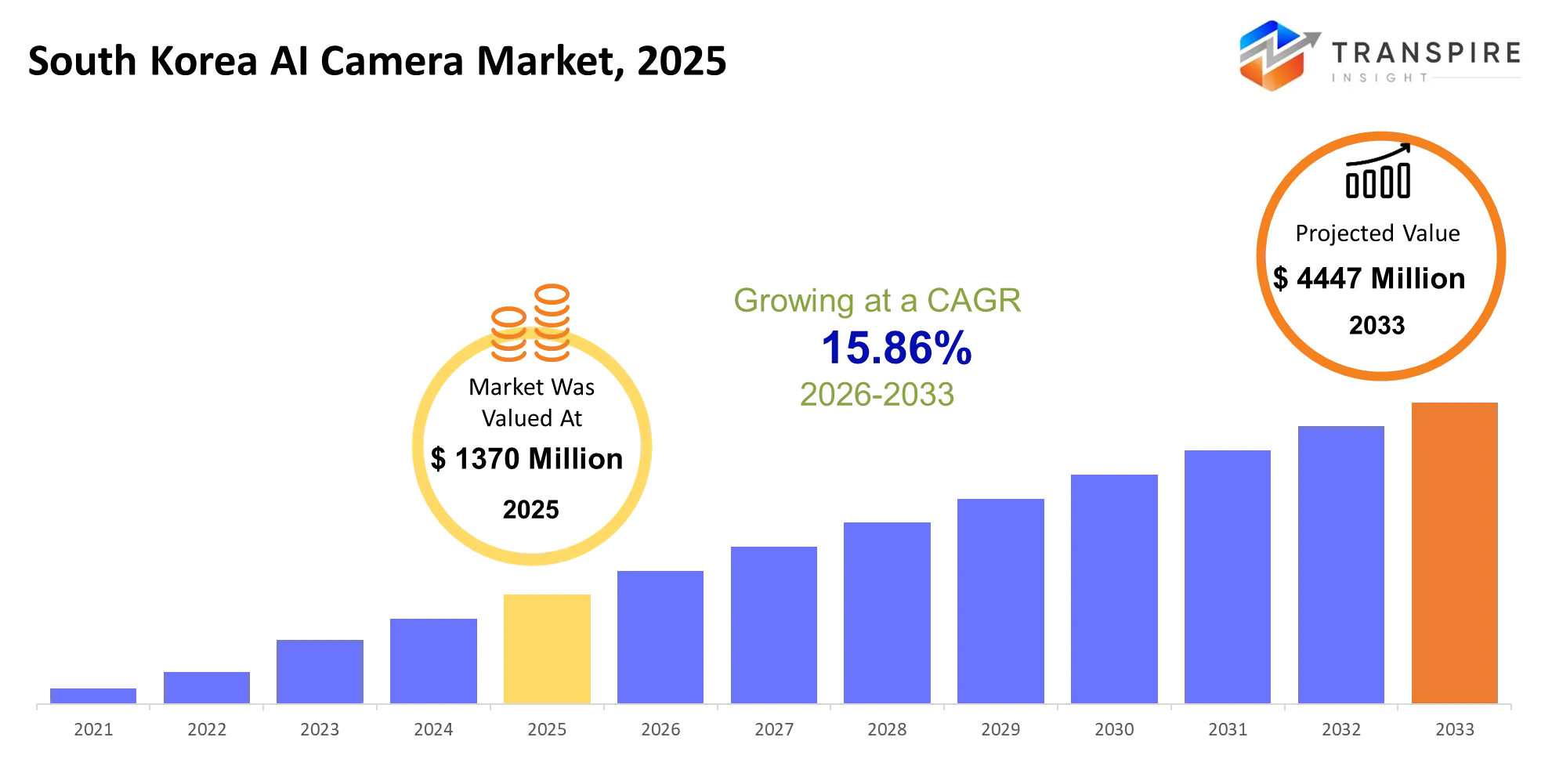
- Market Value (2025): USD 1370 Million.
- Expected Market Value (2026): USD 1587.28 Million.
- Estimated Market Value (2033): USD 4447 Million.
- Forecast CAGR (2026–2033): 15.86%
Introduction
Hardware, software, and related services for the cameras that can be called intelligent cameras due to their embedded artificial intelligence and computer vision are considered to form the market of AI cameras. The technologies used in the mentioned devices include machine learning and deep learning algorithms, which allow carrying out some tasks such as facial recognition, object tracking, behavioral analysis, or real-time anomalies detection independently from the external processing systems. Edge AI is the direct implementation of the artificial intelligence algorithms on the local device (AI camera or even a smartphone). In the South Korea AI Camera Market, advancements have been made in the areas of real-time anomaly detection, automation of industries, edge computing, and smart infrastructure integration. Automated detection of security risks, anomalies, and crowd behavior is facilitated by AI-enabled cameras. Machine vision is used in manufacturing to detect defects, conduct quality control, improve processes, and perform predictive maintenance in semiconductor, electronics, and automotive plants. The low latency of edge computing allows real-time decision making without the need for sending data over the network. In addition, 5G networking, intelligent traffic management, automatic parking, and IoT platforms are used in smart infrastructure.
Key Market Highlights: -
- By camera type, the IP Cameras segment dominated the market and holds nearly 64% share in 2025 and is projected to grow at a substantial CAGR during the forecast period.
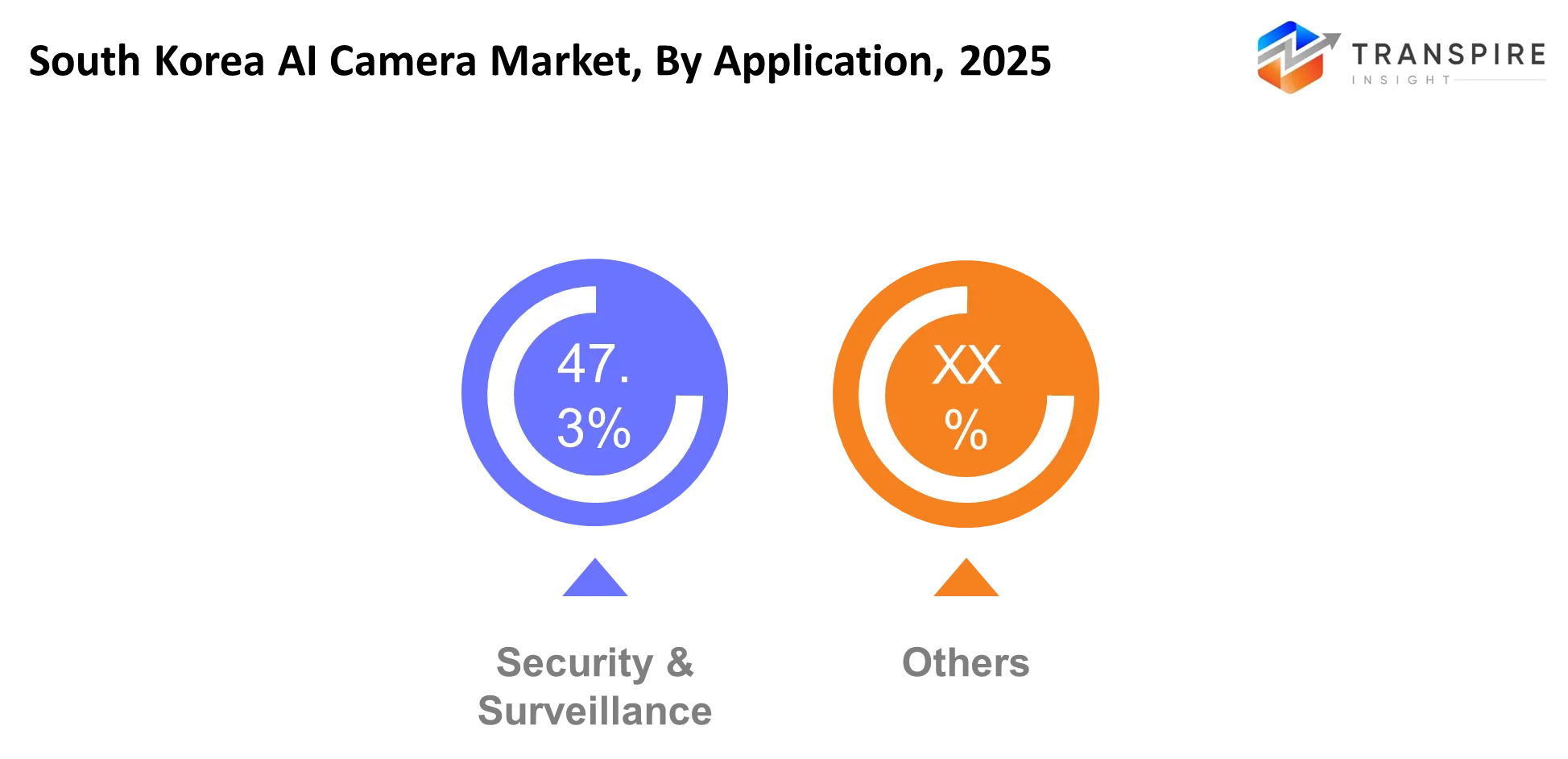
- By application, the Security & Surveillance segment dominated the market and holds nearly 40% share in 2025 and is projected to grow at a substantial CAGR during the forecast period.
- By end user, the BFSI segment dominated the market and holds nearly 18% share in 2025 and is projected to grow at a substantial CAGR during the forecast period.
- South Korea initiated a major public AI CCTV project amounting to KRW 11.68 billion, deploying around 18,100 cameras with locally manufactured NPUs from Rebellions, DeepX, and Mobilint integrated in the project. This program facilitates real-time video processing, disaster recognition, traffic supervision, and public protection, thus supporting the development of the AI Camera Market in South Korea.
How is Technology Driving Growth in the South Korea AI Camera Market?
The South Korean AI Camera Market is undergoing a transformation with the help of semiconductor technology, 5G connectivity, edge computing, smart-city infrastructure, and Industry 4.0. Thanks to its local technological capabilities, advanced neural processing units, image sensors, and real-time analysis Edge computing technologies improve image quality and speed of image processing. 5G technology allows for fast synchronizing with the cloud and low-latency communication at the same time. The implementation of the smart-city initiatives increases the use of AI cameras for traffic management systems as well as for anomaly detection and public safety. Finally, automation in industry increases the need for vision systems used for quality inspection, maintenance, and defect detection in semiconductor, electronic, and automotive manufacturing.
Market Drivers
The AI Camera Market in South Korea is propelled by the concept of smart cities, leadership in semiconductors, 5G network, and adoption of Industry 4.0. City-level investment in AI-based CCTV camera systems will allow traffic analysis and anomaly detection applications. South Korea’s leadership in semiconductors will help develop edge-AI processors and neural computing technology for real-time analysis of videos. The vast coverage of the 5G network in South Korea will ensure low latency in data transfer and remote monitoring. On the other hand, machine vision application in electronics, automotive, and semiconductor production industries presents immense opportunities for market growth in South Korea. Strengths of the South Korea AI Camera Market include a robust semiconductor industry, superior 5G network, favorable government initiatives, and high automation maturity. Top-tier tech firms along with domestic providers develop their expertise in the areas of neural processing units, image sensors, and edge computing hardware that will enable development of advanced AI cameras. Superior 5G network provides capabilities of video streaming, real-time analytics, and multi-camera collaboration. Government initiatives in artificial intelligence research and technology-friendly policies foster innovation among enterprises and startups. Moreover, South Korea's highly developed automobile, semiconductor, electronics, and robotics sectors present a great demand for AI-driven machine vision, automated inspection, anomaly detection, and quality control solutions.
Restrain
The South Korea AI Camera Market is vulnerable to cyber security risks, strict data privacy regulations, expensive installation process, and supply chain restrictions. Surveillance cameras connected online need effective safeguards against any form of security breach. Data protection compliance adds to the complexity of implementation of the technology, while use of advanced sensors and integration with legacy systems increase capital expenditure.
|
Driver |
Relative Impact on Growth (%) |
Geographic Relevance |
Impact Timeline |
Demand Strength |
Growth Mechanism |
Key Beneficiaries |
Major Constraint |
|
Driver 1: Smart-City and Public-Safety AI Deployment |
27% |
Seoul, Busan, Incheon, major metropolitan areas |
Short-term |
High |
Expands AI CCTV deployment for public safety |
Camera manufacturers, AI vendors, municipalities |
Privacy compliance and public acceptance requirements |
|
Driver 2: Semiconductor and Edge-AI Technology Leadership |
23% |
Seoul Capital Area, Gyeonggi, Chungcheong |
Medium-term |
High |
Enables faster local video processing capabilities |
NPU makers, camera manufacturers, semiconductor firms |
High R&D costs and advanced component requirements |
|
Driver 3: Industry 4.0 and Machine-Vision Adoption |
20% |
Gyeonggi, Chungcheong, Ulsan, industrial clusters |
Medium-term |
High |
Automates inspection, defect detection, and monitoring |
Manufacturers, vision vendors, AI software providers |
Integration costs with legacy manufacturing systems |
|
Driver 4: 5G, Edge Computing and Intelligent Connectivity |
16% |
Nationwide, especially urban and industrial areas |
Short-term |
High |
Enables low-latency analytics and connected cameras |
Telecom operators, edge-AI vendors, camera manufacturers |
Cybersecurity risks and infrastructure investment |
|
Driver 5: AI Commercialization and Regulatory Enablement |
14% |
Nationwide |
Long-term |
Medium |
Accelerates AI product commercialization and video-data utilization |
AI startups, technology vendors, public institutions |
Evolving privacy rules and compliance costs |
|
Total |
100% |
— |
— |
— |
— |
— |
— |
Analysis of Prices and Consumer Behaviour
The South Korea AI cameras market had a valuation of USD 1.37 billion in 2025, which is mainly due to the demand for AI surveillance and security, as well as smart infrastructure, automotive system, and industrial applications. The market size is estimated to be valued at USD 4.447 billion by 2033, recording a CAGR of 15.86% between 2026 and 2033. The market comprises smart surveillance cameras, smartphone AI cameras, automotive AI cameras, and industrial AI cameras with applications in security and surveillance, consumer electronics, automotive systems, and smart retail. Factors such as increased usage of real-time image analysis, object detection, facial recognition, motion tracking, and AI image enhancement drive the sales volume. Security and surveillance, consumer electronics, automotive systems, and industrial applications are the key application segments in the South Korea market. Increasing importance of factors such as accuracy of AI processing, image quality, real-time analytics, connectivity, reliability, and integration with security and enterprise systems become vital in purchase decisions. Long-term purchasing contracts are important in government, commercial and industrial segment procurement processes.
Who are the Key Players in the South Korea AI Camera Market and how do they compete?
Competitive Advantage of enterprises engaged in competition in the international market of AI cameras can be achieved by companies being focused on innovations in artificial intelligence and imaging technologies, industry-specific innovations, and creation of global distribution channels. Not competing on price but using AI analytics, high resolution imaging, edge AI, intelligent video analysis, and integration with smart factory, security, transport, and enterprise systems can serve as an example of how competitiveness may bring about continuous improvement in product development and more effective monitoring, image accuracy, operational intelligence and decision-making.
Development of AI cameras, intelligent video analysis and edge imaging technologies helps Hanwha Vision to enhance its competitive advantage. By improving high-end AI cameras which are suitable for various security, manufacturing, retail, transport and smart city uses, companies differentiate themselves from their rivals. Competitive advantage of Samsung Electronics is achieved through innovations in image sensors, AI cameras and imaging solutions, effective cooperation with security, industrial automation, smart city and enterprise technology providers. Competitive advantage of LG Electronics is achieved through innovation in AI imaging and smart camera technologies for intelligent monitoring and connected spaces. Competitive advantage of KT Corporation is achieved through innovations in AI, video analysis and intelligent infrastructure solutions.
Top Companies in the South Korea AI Camera Market
- Samsung Electronics
- Hanwha Vision
- LG Electronics
- SK Telecom
- KT Corporation
- Naver Corporation
- Hikvision
- Dahua Technology
- Axis Communications
- Bosch Security Systems
- Sony Corporation
- Panasonic
- Cisco Systems
- Intel Corporation
- NVIDIA Corporation
|
Company |
Est. Revenue Share Range |
Key Offerings |
Strategic Positioning |
Geographic Strength |
Technology Focus |
|
Hanwha Vision |
16–21% (Estimated) |
Wisenet AI cameras, Wisenet 9, AI PTZ, LPR/ANPR, thermal cameras |
Domestic leadership with integrated AI security solutions |
Asia Pacific, Europe, North America |
Edge AI, dual NPU, intelligent video analytics |
|
IDIS |
8–12% (Estimated) |
Edge AI Plus, AI PTZ, DirectIP, IDLA, AI NVRs |
Korean specialist emphasizing integrated surveillance platforms |
Asia Pacific, Europe, Middle East & Africa |
Deep learning, edge analytics, AI search |
|
Hikvision |
7–11% (Estimated) |
AI network cameras, DeepinView, AcuSense, PTZ, thermal cameras |
Broad portfolio with scale-driven technology deployment |
Asia Pacific, Europe, Middle East & Africa |
Deep learning, object detection, intelligent analytics |
|
Dahua Technology |
6–10% (Estimated) |
WizMind cameras, AI PTZ, thermal cameras, ANPR, NVRs |
Vertical-focused AI portfolio with competitive pricing |
Asia Pacific, Europe, Middle East & Africa |
AI chips, deep learning, metadata analytics |
|
Axis Communications |
5–8% (Estimated) |
AI network cameras, PTZ, panoramic, thermal, ARTPEC-9 |
Premium enterprise positioning through analytics innovation |
Europe, North America, Asia Pacific |
Edge AI, ARTPEC SoC, cybersecurity, analytics |
|
i-PRO |
4–7% (Estimated) |
X-Series, S-Series, AI PTZ, fisheye, multisensor cameras |
Open-platform strategy with advanced edge intelligence |
Asia Pacific, North America, Europe |
Edge AI, GenAI, open SDK, deep learning |
|
Bosch Security Systems |
3–6% (Estimated) |
FLEXIDOME, AUTODOME, INTEOX, IVA Pro, Intelligent Insights |
Enterprise differentiation through predictive video intelligence |
Europe, North America, Asia Pacific |
Deep learning, edge analytics, predictive intelligence |
|
Avigilon (Motorola Solutions) |
2–5% (Estimated) |
H5A/H6A cameras, Alta Video, Unity Video, AI PTZ |
Premium AI surveillance with cloud integration |
North America, Europe, Asia Pacific |
AI analytics, appearance search, cloud VMS |
|
VIVOTEK |
2–4% (Estimated) |
V-Series AI cameras, PTZ, panoramic cameras, VORTEX |
Flexible edge-to-cloud surveillance for enterprises |
Asia Pacific, Europe, North America |
Edge AI, Smart VCA, hybrid cloud, GenAI |
|
Johnson Controls |
1–3% (Estimated) |
Tyco video surveillance, Illustra cameras, video management |
Integrated security solutions for enterprise facilities |
North America, Europe, Asia Pacific |
Video analytics, AI surveillance, integrated security |
South Korea AI Camera Market Segmentation
The South Korea AI Camera Market share is divided into five categories: By camera type, AI technology, application, end user and deployment.
The IP Cameras dominated the market, accounting for nearly 64% in 2025 and is expected to rise at a significant CAGR during the forecast period.
The South Korea AI Camera Market is segmented by camera type into IP Cameras, CCTV Cameras, Smart Cameras, Thermal Cameras, PTZ Cameras, Dome Cameras, Bullet Cameras, Edge AI Cameras, Others. Among these, the IP Cameras segment dominated the market, accounting for nearly 64% in 2025 and expected to increase at a significant CAGR during the forecast period. In 2025, IP Cameras captured almost 64% of the marketplace because they can be used in a scalable network, are remotely accessible, obtain high-resolution photos, and can be integrated with AI technology-based video analytics. Their ability to work with cloud storage, Internet of Things setup, and innovative surveillance systems supports the rise in usage and swift market expansion thanks to real-time surveillance and automatic threat identification.
The Security & Surveillance dominated the market, accounting for nearly 40% in 2025, and is expected to rise at a significant CAGR during the forecast period.
The South Korea AI Camera Market is segmented by application into Security & Surveillance, Smart Cities, Retail Analytics, Industrial Monitoring, Healthcare, Transportation, Automotive, Public Safety, Others. Among these, the Security & Surveillance segment dominated the market, accounting for nearly 40% in 2025 and expected to increase at a significant CAGR during the forecast period. The Security and Surveillance sector dominated the market, capturing nearly 40% share in 2025 due to the increasing need for real-time monitoring, crime prevention, and ensuring the safety of the people. The rise in use of AI camera systems, Facial Recognition technology, video analytics systems, and smart surveillance systems across commercial, industrial, and public sectors is further driving the market growth.
The BFSI dominated the market, accounting for nearly 18% in 2025 and is expected to rise at a significant CAGR during the forecast period.
The South Korea AI Camera Market is segmented by end user into Government, Retail, Manufacturing, Transportation, Healthcare, BFSI, Residential, Education, Others. Among these, the BFSI segment dominated the market, accounting for nearly 18% in 2025 and expected to increase at a significant CAGR during the forecast period. By accounting for around 18% of the market share in 2025, BFSI led the industry due to its growing need for enhanced security, fraud detection, customer authentication, and instant monitoring. Financial companies are adapting AI-based cameras, video analytics, facial recognition, and smart surveillance solutions to improve safety in branches, protect assets, gain visibility into operations, and comply with regulations.
Future Market Trends for the South Korea AI Camera Market: -
- Intelligent Infrastructure and Monitoring: The implementation of police safety laws and smart city establishments has created a significant requirement for video monitoring.
- Installing Edge AI Technology: With the help of speedy 5G technology, users can now instantly transmit and process video data without having to rely on human intervention.
- Industrial and 3D Vision Growth: Advances in smart manufacturing have encouraged industries such as automobile safety equipment to use compact 3D imaging technology.
- Service-oriented Business Models: Companies are moving towards profit generation models based on the use of software technology, predictive maintenance, and cloud computing solutions.
- Miniaturization and Solidification: The latest design of cameras aims to create small yet highly robust devices capable of working in adverse environment conditions.
Recent Development
- In August 2026: Using the overhead system, Woojong Entry introduced South Korea's first intelligent speed gate that relies on artificial intelligence for real-time passage analysis and security and direction of travel monitoring. The new product strengthens the adoption of artificial intelligence cameras in smart buildings, physical security, infrastructure and access control, thus contributing to their successful development.
- In May 2026: In South Korea, EssilorLuxottica and Meta have introduced Oakley Meta Vanguard and the HSTN AI glasses with 12 megapixel ultra-wide and 3K ultra HD cameras for hands-free imaging and Meta AI functionality at the introductory price of KRW 690,000. This launch broadens the application of AI wearables technology and helps facilitate the development of the AI camera market in South Korea.
Market Segment
This study forecasts revenue at South Korea, regional and country levels from 2020 to 2033. Transpire Insight has segmented the South Korea AI Camera Market based on the below-mentioned segments:
South Korea AI Camera Market, By Camera Type
- IP Cameras
- CCTV Cameras
- Smart Cameras
- Thermal Cameras
- PTZ Cameras
- Dome Cameras
- Bullet Cameras
- Edge AI Cameras
- Others
South Korea AI Camera Market, By AI Technology
- Computer Vision
- Facial Recognition
- Object Detection
- Behavior Analysis
- License Plate Recognition
- Motion Detection
- Anomaly Detection
- Predictive Analytics
- Others
South Korea AI Camera Market, By Application
- Security & Surveillance
- Smart Cities
- Retail Analytics
- Industrial Monitoring
- Healthcare
- Transportation
- Automotive
- Public Safety
- Others
South Korea AI Camera Market, By End User
- Government
- Retail
- Manufacturing
- Transportation
- Healthcare
- BFSI
- Residential
- Education
- Others
South Korea AI Camera Market, By Deployment
- Cloud-Based
- Edge-Based
- On-Premise
- Hybrid
- AI-as-a-Service
- Others
Frequently Asked Questions
Find quick answers to common questions.
The market is projected to reach USD 4,447 million by 2033, growing at a 15.86% CAGR from 2026–2033.
IP Cameras dominate, accounting for nearly 64% market share in 2025, supported by scalable connectivity and AI-enabled video analytics.
Security & Surveillance leads, holding nearly 40% share in 2025, driven by real-time monitoring, public safety, and intelligent surveillance.
BFSI dominates, accounting for nearly 18% share in 2025, supported by security, fraud detection, authentication, and monitoring requirements.
Edge AI, 5G, computer vision, facial recognition, anomaly detection, and predictive analytics are accelerating intelligent surveillance and real-time video processing.
- Samsung Electronics
- Hanwha Vision
- LG Electronics
- SK Telecom
- KT Corporation
- Naver Corporation
- Hikvision
- Dahua Technology
- Axis Communications
- Bosch Security Systems
- Sony Corporation
- Panasonic
- Cisco Systems
- Intel Corporation
- NVIDIA Corporation
About the Authors

Mayur Shinde
I am Mayur Shinde, a Senior Research Analyst at Transpire Insight, specializing in the Automotive & Transportation and Information & Communication Technology (ICT) Industry. My work focuses on analyzing emerging market trends, technological advancements, competitive landscapes, and industry developments to deliver accurate, data-driven insights. I am passionate about transforming complex market information into clear, actionable content that helps businesses, professionals, and decision-makers stay informed and make confident strategic decisions.

Chakradhar Khansole
Chakradhar serves as the Research Director at Transpire Insight, bringing over 8 years of experience in technology, innovation, and strategic market intelligence. He specializes in transforming complex market data into actionable business insights that enable organizations to make informed, growth-oriented decisions. Recognized for his strategic vision and analytical expertise, Chakradhar leads high-impact research initiatives, delivering comprehensive market assessments, competitive intelligence, and forward-looking industry analysis.
Recently Published Reports
-
Apr 2026
3D Optical Profiler Market
3D Optical Profiler Market Size, Share & Analysis Report By Type (Desktop 3D Optical Profiler, and Portable 3D Optical Profiler), By Technology (Confocal Technology, and White Light Interference), By End-Use Industry (Manufacturing, Research Institutions, Automotive, Aerospace and Defense, Medical Devices, and Other), and Geography (North America, Europe, Asia-Pacific, Middle East and Africa, South and Central America), 2021 - 2031
-
Apr 2026
Depth Sensor Market
Depth Sensor Market Size, Share & Analysis Report By Type (Infrared Depth Sensors, Time-of-Flight (ToF) Sensors, Stereo Vision Sensors, Structured Light Sensors, Ultrasonic Depth Sensors), By Application (Automotive, Robotics, Gaming, Consumer Electronics, Industrial Automation, Healthcare, Security & Surveillance, Others), By End Users (Automotive Manufacturers, Consumer Electronics Companies, Healthcare Providers, Industrial Companies, Security Agencies, Gaming Companies, Robotics Companies, Others), and Geography (North America, Europe, Asia-Pacific, Middle East and Africa, South and Central America), 2021 – 2031
-
Apr 2026
Digital Manufacturing Market
Digital Manufacturing Market Size, Share & Analysis Report By Component (Hardware, Software, and Services), By Technology (Robotics, 3D Printing, Internet of Things (IoT), and Others), By Application (Automotive and Transportation, Aerospace and Defense, Consumer Electronics, Industrial Machinery, and Others), By Process Type (Computer-Based Designing, Computer-Based Simulation, Computer 3D Visualization, Analytics, and Others), and Geography (North America, Europe, Asia-Pacific, Middle East and Africa, South and Central America), 2021 – 2031
-
Apr 2026
Digital Visa Services Market
Digital Visa Services Market Size, Share & Analysis Report By Type (Individual Travelers, Group Travelers), By Application (Tourism, Business Travel, Others), and Geography (North America, Europe, Asia-Pacific, Middle East and Africa, South and Central America), 2021 – 2031