
South Korea 3D NAND Flash Memory Market Summary
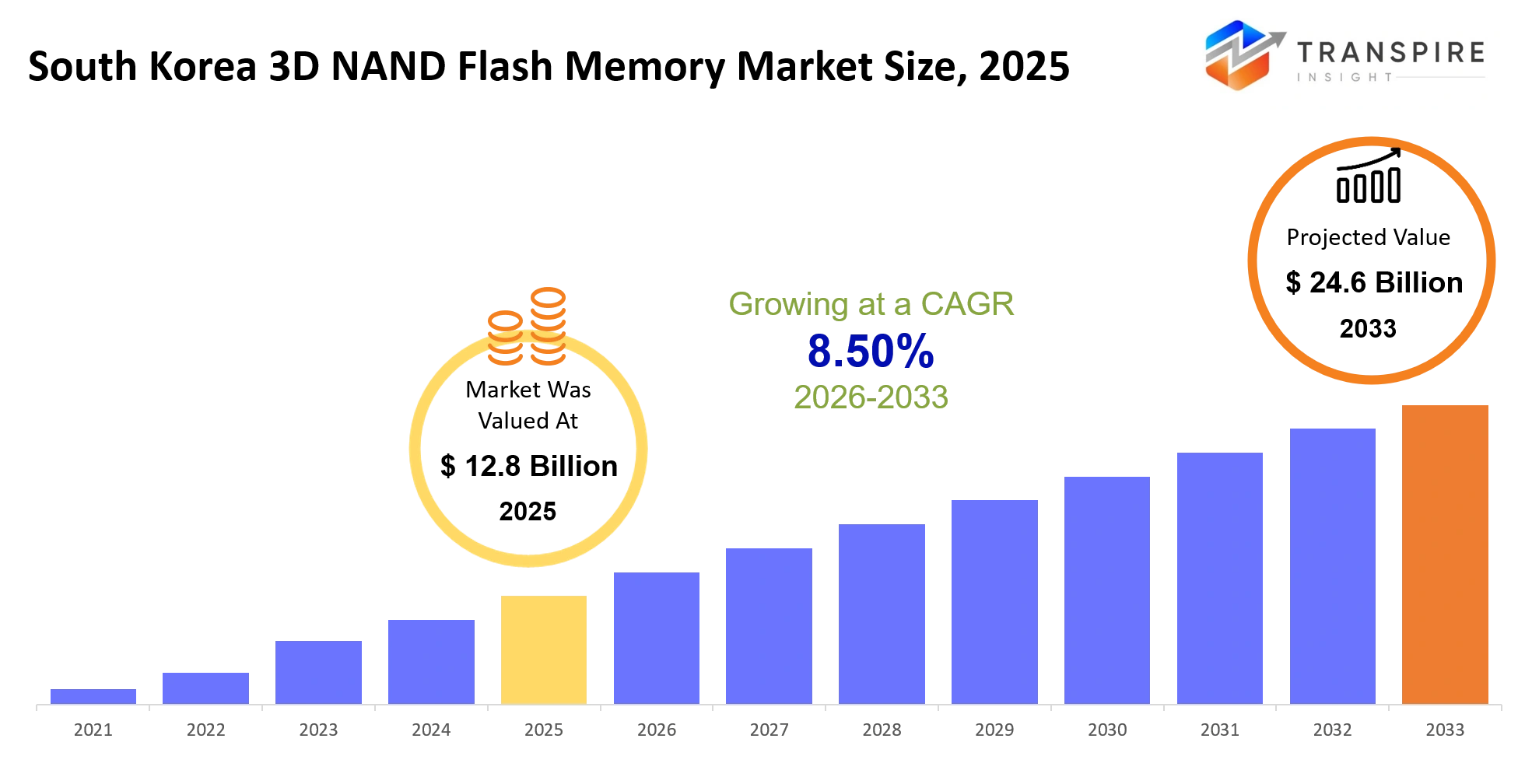
As per Transpire Insight Analysis the South Korea 3D NAND Flash Memory Market size is estimated at USD 12.8 Billion in 2025 and is anticipated to reach USD 24.6 Billion by 2033, growing at a CAGR of 8.50% from 2026 to 2033.
South Korea’s firms produce 3D NAND flash chips for storage that stays put and scales up in capacity. The saved data remains even when power stops. You can see these chips in phones, office servers, data centers, cars, and factory machines. They let devices keep large files without needing constant power.In recent years, chip makers moved to updated 3D NAND designs. Instead of a simple stack, they build many more layers on top of each other. This approach helps pack more bits into the same footprint. At the same time, vendors aim for quicker read and write performance. They also work to reduce the cost for each gigabyte. Buyers tend to favor chips that feel fast but still fit a budget, so the push continues.
The COVID-19 period shook supply chains worldwide. Even after the worst waves, gaps still showed up in some places. Some buyers learned a hard lesson about relying on just a few sources. So they changed how they buy. They started to plan orders earlier. They also looked for added suppliers or steadier routes to avoid sudden shortages.Demand rose further when AI tools spread and new data-center builds began. Many teams needed storage that can handle heavy, nonstop workloads. They also had to plan for data growth over time. Higher-layer NAND can store more in a given area. That makes it simpler to fit enough storage into server racks while still meeting required capacity targets.
For South Korean companies, the ongoing shift can help with product positioning. It can also support smoother output during production runs. If this path keeps going, it could translate into steadier sales for enterprise setups and for industrial gear.
South Korea 3D NAND Flash Memory Market Size & Forecast:
- South Korea 3D NAND Flash Memory Market Size 2025: USD 12.8 Billion
- Expected Market Value 2033: USD 24.6 Billion
- Forecast CAGR: 8.50%
- Leading region in 2025: England
- Fastest Growing region: Scotland
- Key Profile: Samsung Electronics, SK hynix, Kioxia Corporation, Micron Technology, Western Digital, Solidigm, YMTC, Intel Corporation, Phison Electronics, Kingston Technology, ADATA Technology, Seagate Technology, Transcend Information, Silicon Motion Technology, Netac Technology.
Key Market Insights
- South Korea is at the top for 3D NAND output. In 2025, its share is about 45% of the Asia Pacific total. Samsung and SK hynix drive most of that output.
- The pace of growth is also strong at home. New NAND families should roll out faster from 2026 to 2030.
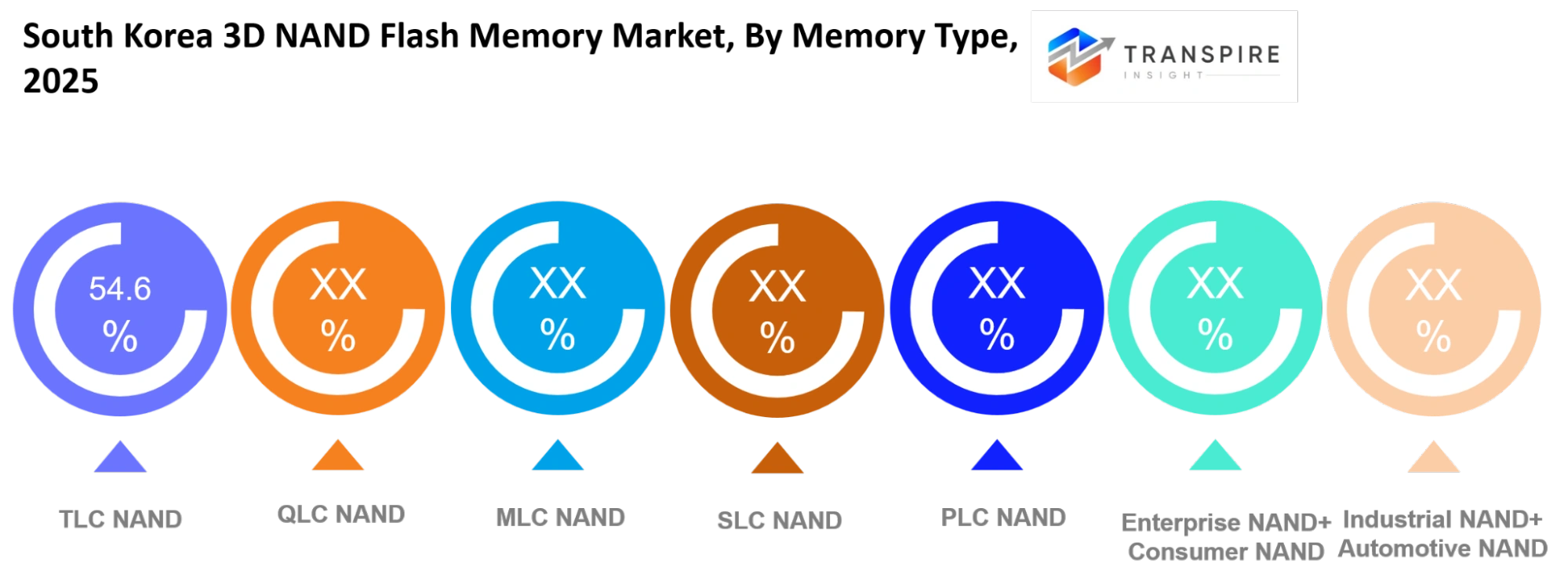
- Right now, TLC NAND sells the most. It holds roughly 60% of current demand. Many buyers choose it since it balances write speed, storage density, and cost. That fit works well for consumer products and office systems.
- QLC NAND comes after that. Vendors keep pushing it because demand is shifting toward very large capacity drives. Data centers, PCs, and AI workloads are the biggest pull.
- Looking ahead to 2030, QLC and newer stacked NAND should rise the most. The main point is basic. More capacity is required, and the cost for each stored bit is lower.
- In 2025, the biggest portion of NAND use goes to enterprise and data center storage. That segment is nearly 40% of the market. AI jobs and the expansion of cloud services in Korea are key reasons.
- AI servers are getting more attention. Top end data center storage is moving too. Training newer models needs large storage pools, and those pools are often spread across multiple sites.
- When it comes to early buyers, enterprise teams are first. They make up about 42% in 2025. They want high capacity SSDs for cloud stacks, analytics, and AI related work.
- AI infrastructure firms are growing quicker than others. As GPU clusters expand, they need extra space for data sets, saved training states, and repeated inference runs.
What are the Key Drivers, Restraints, and Opportunities in the South Korea 3D NAND Flash Memory Market?
AI hardware is expanding quickly. GPU farms now produce massive data. These setups need storage that can keep up. They also rely on SSDs that move data fast. That matters when models are trained and when results are served.New NAND designs are part of the answer. As more layers are added, a wafer can store more bits. This can bring the price down for each unit of capacity. When storage is cheaper, it is easier for firms to launch and scale large AI systems. Samsung and SK hynix are pushing newer node NAND aimed at this demand. As orders rise, more budgets shift toward enterprise SSDs. Buyers want larger drives to fit growing workloads.
Still, there is a clear weak spot. Supply is not spread evenly. Transpire Insight reviewed buying signals across regions and the timing of public launches. A small set of makers can shape what is available. Advanced NAND is hard to build. It takes costly equipment, rare process materials, and long validation. If any step fails, ramp schedules can slip. Then customer projects can also slide by a few quarters.Cost is another problem. Prices can move when stock levels shift. If inventories swing the other way, suppliers may throttle shipments. Some may delay new capex plans. That squeeze can hit profit at many tiers, not just the chip maker.
The next growth chance is very high-layer NAND for data centers. Going past 300 layers can increase density. It can also reduce cost per stored bit. Korean vendors could benefit by pairing this NAND with enterprise SSD controllers. They can also fit it into AI server platforms. More gains in process work and packaging should improve margins. It should also support larger and faster storage needs as data centers keep scaling.
What Has the Impact of Artificial Intelligence Been on the South Korea 3D NAND Flash Memory Market?
NAND chip making is changing fast. Factories are moving from “wait and see” to watching the process from the start. Instead of only checking after trouble, teams can follow the run minute by minute and adjust as they go. The key is solid data and clear charts that people can trust. With this approach, wafer steps get tighter attention. Operators can also review things like tool heat, shaking or vibration levels, the force used during steps, and early warnings that defects may be forming. Small shifts can show up sooner when the signals are watched closely.
Once the data is live, drift is easier to spot. If a tool starts to move outside normal limits, alerts can pop up. Sometimes the team can correct the settings right away. That reduces the chance that flawed output passes into the next batches. It also means less emergency work on the floor.
There is more to it than runs and alerts. Teams can use learning methods to notice patterns that show up in normal machine noise. Over time, the model can flag a likely failure before it happens. Then maintenance can be planned during slower hours. If fixes happen early, production is less likely to be hit by a sudden stop.
Supply planning can benefit as well. Models can take in server plans, SSD shipment timing, what is in stock, and customer demand signals. From that, teams can decide how many units to build and when to start. Fewer mismatches can lead to less downtime caused by missing parts and less cash tied up in extra inventory.Some sites also use digital twins. These are virtual models that let teams try to process changes in a safe way. The trials do not risk real output. Still, rollout is not simple. Older equipment may log data in odd formats. Sites can also differ in how clean and complete their data is, which can weaken the results.All of this takes more than software. Companies need people who understand the fab steps and also know how to test and check models. Without that blend, progress slows. Even when the payoff is obvious, the path to real results can be bumpy.
Key Market Trends
- Samsung and SK hynix moved more of their NAND work toward chips with more than 200 layers in 2024 and 2025. The main goal was to pack more data into each wafer and cut the cost per bit.
- More makers are now building NAND with over 300 layers. This shift points to tighter vertical stacking and better cost results from the same wafer size.
- Since 2024, many AI servers have been going live. That change pushed enterprise SSD plans toward larger drives. Teams need room for training data, plus model files and frequent checkpoints.
- QLC is getting more attention too. Operators often pick it when they want the lowest cost per stored bit. This matters most for big cloud services and AI workloads that need lots of space.
- Korean firms are also putting more money into newer NAND lines. They are thinking about supply shocks and trying to keep stronger local production.
- Enterprise SSDs are more important now than before. After the inventory pullback around 2023, vendors started paying more attention to business needs. They shifted away from lower-margin consumer focus.
- In 2025, layer counts became a bigger brag point. Samsung, SK hynix, and other players pushed denser designs to keep a lead in the tech race.
- Inside semiconductor fabs, more data tools are being used. Teams apply analytics to tune tool upkeep, watch process stability, find defects earlier, and raise yields.
- Data center power use is under tighter scrutiny. As sites expand, SSD makers are asked to improve performance without a matching jump in energy use.
South Korea 3D NAND Flash Memory Market Segmentation
By Memory Type :
TLC NAND should stay where it is. Lots of phones, laptops, drives, and company systems need a balanced choice. They look at capacity, how long the memory lasts, and the price.QLC NAND might gain more shares later. Cloud services and data centers are chasing lower cost per stored bit. As data growth keeps rising, QLC fits that goal more often.For business setups, enterprise NAND still feels like the safer bet. Many teams want stable write speed and smooth, predictable behavior. They do not chase maximum space only.
MLC and SLC NAND will keep showing up in cases that need very high endurance. They also help when results must stay steady. SLC is especially useful when the drive must survive many cycles without losing performance.Automotive NAND may matter more as well. Cars now run more software and store more logs and maps. Industrial NAND can also remain important where equipment faces heat, dust, and shocks.PLC based NAND is not widely used yet. Still, it may grow if makers keep improving it. The goal is more capacity in the same area, while keeping the bill low.
By Storage Capacity :
Storage needs keep moving upward. Many products now target 512 GB to 1 TB. Some systems push into the 1 TB to 2 TB range as apps grow, media files get bigger, and AI training data expands. Beyond 2 TB, more companies start buying for server rooms, data centers, and workstations that do heavy computation. Cheaper drives still matter too, especially for simple gadgets and low cost consumer gear.
Embedded storage stays useful in phones and cars. It also shows up in machines used on factory floors and in IoT units. These devices need small parts that fit inside tight spaces. Enterprise storage gets the next wave of larger buys since cloud services and AI setups want more room for files. Removable storage will keep a clear niche for cameras and handheld tools. It also helps in labs or special equipment where users need to move files quickly and swap media easily.
By Application :
SSDs should stay on top. PCs are replacing older drives with flash. Big servers and office server rooms are doing the same. When teams move to faster storage, the switch tends to keep going.In data centers, the pull is even stronger. AI work needs quick reads from large data sets. Teams also want fast access to saved model results. Regular services still need their usual files too. On top of that, handset makers keep ordering NAND. More phones now come with more space, plus improved tools for photos and video.
Cars are another growing storage lane. Modern cars run a lot of software. They add new screens, new media features, and driver support functions. That means more data, not less. Plants and smart devices also need solid local drives. Those systems keep sensor events and service notes. They also run control software.Game consoles will likely add capacity as well. New games install bigger packages. Players also want faster loading and smoother play.
By End User :
Large electronics makers are still placing big orders for NAND. A lot of consumer gear depends on it, including phones and computers.Data centers may be the main driver next. Cloud firms are doing more AI work. They are also buying more SSD space as their services expand.Car makers are set to add more NAND demand. Modern vehicles already include more sensors and control units. That extra electronics needs storage.
In industrial sites, buyers care about durability. Factories run nonstop, so they want memory that holds up. They put it into control systems, sensors, and linked devices.Telecom operators also need more capacity. Their network tools keep growing in size. Edge computing pushes them to keep SSD stock ready.Healthcare organizations use NAND for several workflows. It supports scans and monitoring gear. It is also used in internal systems that store patient files.Public sector groups will buy in their own way too. They need storage for protected computing tasks and digital programs.
By Distribution Channel :
OEM Supply is still the best path for large NAND orders. When chip makers set their output, they can line it up with what phone brands, PC makers, and other system builders plan to buy. This kind of timing matters most when the order sizes are huge.Direct Sales can be very useful for enterprise teams. Some buyers need unusual parts or extended supply schedules. Others also ask for direct technical help during planning and rollout. They often care a lot about having a clear purchase schedule.Electronics Distributors tend to fit better for smaller companies. Many of these firms order in modest lots. They usually want more options on dates, quantities, and delivery plans.
System Integrators and VARs may grow in importance as projects get larger. Storage deployments often require setup work, on site checks, and follow up support. That is where these partners tend to help, not just sell.Online Sales usually works best for small orders and fast replacements. Retail Stores handle more consumer focused storage needs, where people want to grab items quickly.Exporters will also stay involved. NAND made in South Korea moves to many regions and feeds global electronics channels and wider tech supply chains.
What are the Key Use Cases Driving the South Korea 3D NAND Flash Memory Market?
Solid state drives are still the top product in this space. You can spot them in business data rooms, public cloud services, and everyday devices. Many shoppers choose NAND SSD models when they need a lot of space, quick access, and consistent performance. Because of that, they end up in servers, thin laptops, and a range of compute heavy systems.
More teams are now paying attention to this storage approach. Car makers and plant operators are rolling out smart functions and software based control. They also prefer to keep data close to the machine instead of sending it far away. This has helped IoT roll out in factories, warehouses, and connected products that need a compact yet reliable storage chip.
What comes next may be driven by edge setups tied to AI. Cars and vehicle hardware are also changing in this direction. Telecom providers might use bigger drives at the edge so service stays smooth for end users. In health care, clinics and hospitals can use NAND SSDs in tools that collect large amounts of patient data, such as imaging systems and continuous monitoring devices.
|
Report Metrics |
Details |
|
Market size value in 2025 |
USD 12.8 Billion |
|
Market size value in 2026 |
USD 13.9 Billion |
|
Revenue forecast in 2033 |
USD 24.6 Billion |
|
Growth rate |
CAGR of 8.50% from 2026 to 2033 |
|
Base year |
2025 |
|
Historical data |
2021 - 2024 |
|
Forecast period |
2026 - 2033 |
|
Report coverage |
Revenue forecast, competitive landscape, growth factors, and trends |
|
Country scope |
South Korea |
|
Key company profiled |
Samsung Electronics, SK hynix, Kioxia Corporation, Micron Technology, Western Digital, Solidigm, YMTC, Intel Corporation, Phison Electronics, Kingston Technology, ADATA Technology, Seagate Technology, Transcend Information, Silicon Motion Technology, Netac Technology. |
|
Customization scope |
Free report customization (country, regional & segment scope). Avail customized purchase options to meet your exact research needs. |
|
Report Segmentation |
By Memory Type (TLC NAND, QLC NAND, MLC NAND, SLC NAND, PLC NAND, Enterprise NAND, Consumer NAND, Industrial NAND, Automotive NAND, Others); By Storage Capacity (Below 128 GB, 128–512 GB, 512 GB–1 TB, 1–2 TB, Above 2 TB, Embedded Storage, Removable Storage, Enterprise Storage, Others); By Application (Smartphones, SSDs, Data Centers, Laptops, Consumer Electronics, Automotive Electronics, Industrial Equipment, IoT Devices, Gaming Consoles, Others); By End User (Consumer Electronics Companies, Enterprise Data Centers, Automotive Manufacturers, Industrial Manufacturers, Cloud Service Providers, Government Organizations, Telecom Operators, Healthcare Providers, Others); By Distribution Channel (OEM Supply, Direct Sales, Electronics Distributors, Online Sales, Retail Stores, System Integrators, Value-Added Resellers, Exporters, Others). |
Which Regions are Driving the South Korea 3D NAND Flash Memory Market Growth?
Seoul Capital Area has a strong position in South Korea’s 3D NAND scene. Some watchers think its share of activity will stay close to 45%. A large number of chip firms are already based there. On top of that, public funding supports new plant projects. The area also benefits from a steady supply of trained researchers. Samsung Electronics and SK hynix matter a lot in this mix. They operate major fabrication sites, bring in skilled staff, and coordinate with many component vendors. They keep working on new process steps. Being near big tech buyers and well known service networks should help Seoul hold its lead through 2033.
Chungcheong feels more geared toward output than R and D. More growth in that region links to semiconductor sites around Cheongju and other nearby industrial areas. Rules there have been fairly stable. Supplier partnerships are already established. Local budgets keep backing roads, power lines, and factory support. Because of that, equipment makers and materials firms can reach plants with fewer hurdles. Even when consumer electronics slow down or swing from quarter to quarter, the region can still attract steady spend.
Gyeonggi is where many people expect faster gains. Spending on advanced chips is spreading across the province. New builds tied to AI also add extra momentum. Capacity has increased, and new labs and equipment sites are clustering more tightly. This tends to draw in more partners over time. Between 2026 and 2033, the quicker build pace may favor companies that can handle thicker NAND stacks and harder process steps used in advanced production.
Who are the Key Players in the South Korea 3D NAND Flash Memory Market and How Do They Compete?
South Korea’s 3D NAND supply is still tight. A handful of large players drive most output. In the real world, success depends on more than just where a firm sells. It comes down to production reach, yield and manufacturing efficiency, how many layers can be stacked, and the end cost to store one bit.Samsung Electronics is a key force in its home market. The company leans on V-NAND and on stacks that run with more layers. Samsung also owns major fabrication capacity and can steer many linked process steps. With that setup, it can push higher density and keep unit costs in check. Samsung continues to fund newer NAND process nodes. It also directs much of the output to enterprise SSDs and to storage systems that fit AI workflows.
SK hynix is chasing higher-layer NAND too, but it takes a different path. The firm is working toward greater layer counts in its 3D NAND line. It pairs that direction with upgrades in enterprise SSD products. The target is more storage per unit while keeping speed and reliability steady. Cost control is also a priority for SK hynix, with an eye on what works on the factory floor.Micron competes with its own product set. It emphasizes advanced 3D NAND and also sells high-capacity SSDs. Much of its message is aimed at enterprise customers. Those buyers usually care about consistent throughput and lower power draw.
Kioxia builds around its BiCS technology. It focuses on higher density NAND and pushes products that fit cloud and data center needs. The plan is to stand out through both process progress and product choices made for that market.Solidigm is focused on enterprise SSDs with large capacities. It does not try to cover every segment. Instead, it concentrates on storage systems that suit AI and data center tasks. In many of these purchases, buyers care most about usable space and stable write behavior, ahead of other features.
Company List
- Samsung Electronics
- SK hynix
- Kioxia Corporation
- Micron Technology
- Western Digital
- Solidigm
- YMTC
- Intel Corporation
- Phison Electronics
- Kingston Technology
- ADATA Technology
- Seagate Technology
- Transcend Information
- Silicon Motion Technology
- Netac Technology
Recent Development News
In April 2026, SK hynix began full-scale supply of its 321-layer QLC NAND cSSD to Dell Technologies. The supply agreement brings higher-capacity, power-efficient NAND storage into Dell systems and strengthens SK hynix’s position in AI-oriented client and enterprise storage.
Source: https://news.skhynix.com/
In March 2026, SK hynix partnered with Applied Materials to collaborate on advanced memory-chip development through Applied Materials’ EPIC research center. The partnership will support new materials, process integration, and advanced packaging research, strengthening South Korean semiconductor technology development for AI and high-performance computing.
Source: https://www.reuters.com/
What Strategic Insights Define the Future of the South Korea 3D NAND Flash Memory Market?
Over the next five to seven years, South Korea’s NAND producers may push more products into stacked, many layer designs. At the same time, enterprise storage needs should grow as AI work expands inside more data centers. Buyers may stop chasing the lowest $ per gigabyte. They may care more about how much fits on a drive, how quickly it transfers data, and how little electricity it draws.
New factory plans reflect this change. For instance, SK hynix is setting up a NAND site in Cheongju. The plan is called M17 and it focuses on making more output at home.Still, there are risks. If the market depends too much on just a few companies, a disruption can travel quickly. The same problem can happen when parts of the process rely on rare equipment or imported raw materials. When demand swings or output levels shift, prices can move fast.
Another trend is ultra high layer NAND built for AI facilities. For those users, packing more data into less space and using less power can matter as much as speed. Samsung’s move to begin V10 Bonding V-NAND in 2026, with more than 400 layers, signals where the industry is headed.
To respond, firms should try to sign deals that last more than one year, when they can. They should also spread purchases across more than one supplier. More investment in advanced layer production may help protect margins, while keeping a strong push toward the premium end of the storage market.
South Korea 3D NAND Flash Memory Market Report Segmentation
By Memory Type
- TLC NAND
- QLC NAND
- MLC NAND
- SLC NAND
- PLC NAND
- Enterprise NAND
- Consumer NAND
- Industrial NAND
- Automotive NAND
By Storage Capacity
- Below 128 GB
- 128–512 GB
- 512 GB–1 TB
- 1–2 TB
- Above 2 TB
- Embedded Storage
- Removable Storage
- Enterprise Storage
By Application
- Smartphones
- SSDs
- Data Centers
- Laptops
- Consumer Electronics
- Automotive Electronics
- Industrial Equipment
- IoT Devices
- Gaming Consoles
By End User
- Consumer Electronics Companies
- Enterprise Data Centers
- Automotive Manufacturers
- Industrial Manufacturers
- Cloud Service Providers
- Government Organizations
- Telecom Operators
- Healthcare Providers
By Distribution Channel
- OEM Supply
- Direct Sales
- Electronics Distributors
- Online Sales
- Retail Stores
- System Integrators
- Value-Added Resellers
- Exporters
Frequently Asked Questions
Find quick answers to common questions.
The expected South Korea 3D NAND Flash Memory Market size for the market will be USD 24.6 Billion in 2033.
Key segments for the South Korea 3D NAND Flash Memory Market are By Memory Type (TLC NAND, QLC NAND, MLC NAND, SLC NAND, PLC NAND, Enterprise NAND, Consumer NAND, Industrial NAND, Automotive NAND, Others); By Storage Capacity (Below 128 GB, 128–512 GB, 512 GB–1 TB, 1–2 TB, Above 2 TB, Embedded Storage, Removable Storage, Enterprise Storage, Others); By Application (Smartphones, SSDs, Data Centers, Laptops, Consumer Electronics, Automotive Electronics, Industrial Equipment, IoT Devices, Gaming Consoles, Others); By End User (Consumer Electronics Companies, Enterprise Data Centers, Automotive Manufacturers, Industrial Manufacturers, Cloud Service Providers, Government Organizations, Telecom Operators, Healthcare Providers, Others); By Distribution Channel (OEM Supply, Direct Sales, Electronics Distributors, Online Sales, Retail Stores, System Integrators, Value-Added Resellers, Exporters, Others).
Major South Korea 3D NAND Flash Memory Market players are Samsung Electronics, SK hynix, Kioxia Corporation, Micron Technology, Western Digital, Solidigm, YMTC, Intel Corporation, Phison Electronics, Kingston Technology, ADATA Technology, Seagate Technology, Transcend Information, Silicon Motion Technology, Netac Technology.
The South Korea 3D NAND Flash Memory Market size is USD 12.8 Billion in 2025.
The South Korea 3D NAND Flash Memory Market CAGR is 8.50% from 2026 to 2033.
- Samsung Electronics
- SK hynix
- Kioxia Corporation
- Micron Technology
- Western Digital
- Solidigm
- YMTC
- Intel Corporation
- Phison Electronics
- Kingston Technology
- ADATA Technology
- Seagate Technology
- Transcend Information
- Silicon Motion Technology
- Netac Technology
About the Authors

Avinash Kumar
I’m Avinash Kumar, a Senior Research Analyst at Transpire Insight, with expertise in the Electronics and Semiconductor and Energy & Power industry. My work focuses on analyzing emerging technologies, market trends, industry developments, and innovation across these sectors. I specialize in transforming complex technical and market insights into clear, research-backed content that helps professionals, businesses, and decision-makers stay informed. Through continuous industry research and data-driven analysis, I strive to deliver accurate, reliable, and practical perspectives on the latest advancements shaping the semiconductor and energy landscape.

Chakradhar Khansole
Chakradhar serves as the Research Director at Transpire Insight, bringing over 8 years of experience in technology, innovation, and strategic market intelligence. He specializes in transforming complex market data into actionable business insights that enable organizations to make informed, growth-oriented decisions. Recognized for his strategic vision and analytical expertise, Chakradhar leads high-impact research initiatives, delivering comprehensive market assessments, competitive intelligence, and forward-looking industry analysis.
Recently Published Reports
-
Apr 2026
Fiber Optic Faceplates Market
Fiber Optic Faceplates Market Size, Share & Analysis Report By Type (< 300 mm2, 300-350 mm2, and > 350 mm2, By Application (Night Vision, Holographic Imaging, Medical, and Others), and Geography (North America, Europe, Asia-Pacific, Middle East and Africa, South and Central America), 2021 - 2031
-
Apr 2026
High Temperature Superconductors Market
High Temperature Superconductors Market Size, Share & Analysis Report By Type (1G HTS, and 2G HTS), By Application (Power Cable, Fault Current Limiter, and Transformer), and Geography (North America, Europe, Asia-Pacific, Middle East and Africa, South and Central America), 2021 - 2031
-
Apr 2026
Industrial Plugs and Socket Market
Industrial Plugs and Socket Market Size, Share & Analysis Report By Type (Industrial Plugs, Industrial Sockets), By Current (Up to 32 A, 32 to 125 A, Above 125 A), By Protection (Dustproof and Splash Proof, Waterproof, Explosion Proof), By End User (Heavy Industries, Oil and Gas, Chemicals and Pharmaceuticals, Power Generation, Others), and Geography (North America, Europe, Asia-Pacific, Middle East and Africa, South and Central America), 2021 - 2031
-
Apr 2026
InGaAs Avalanche Photodiodes Market
InGaAs Avalanche Photodiodes Market Size, Share & Analysis Report By Type (1100 - 1700 nm, and 1000 - 1600 nm), By Application (Missile Warning System, Muzzle Flash Detection, Wafer Defect Inspection, Laser Rangefinders, and Others), and Geography (North America, Europe, Asia-Pacific, Middle East and Africa, South and Central America), 2021 - 2031