

Solid State Drive (SSD) Market Summary:
According to Transpire Insights, a detailed research report on the market reflects that the enterprise SSD application segment dominates the Global Solid State Drive (SSD) Market, accounting for a significant share of the total market worldwide. Samsung Electronics Co., Ltd. leads the market with approximately USD 14.35 billion in enterprise SSD revenue in 2Q 2026, supported by its strong NAND Flash portfolio, advanced SSD technologies, high-capacity storage solutions, and expanding data-center and AI infrastructure applications, making it a leading contributor to global Solid State Drive (SSD) Market development, innovation, advanced solid-state storage production, expanding manufacturing capabilities, and overall market growth dynamics.
Market Snapshot
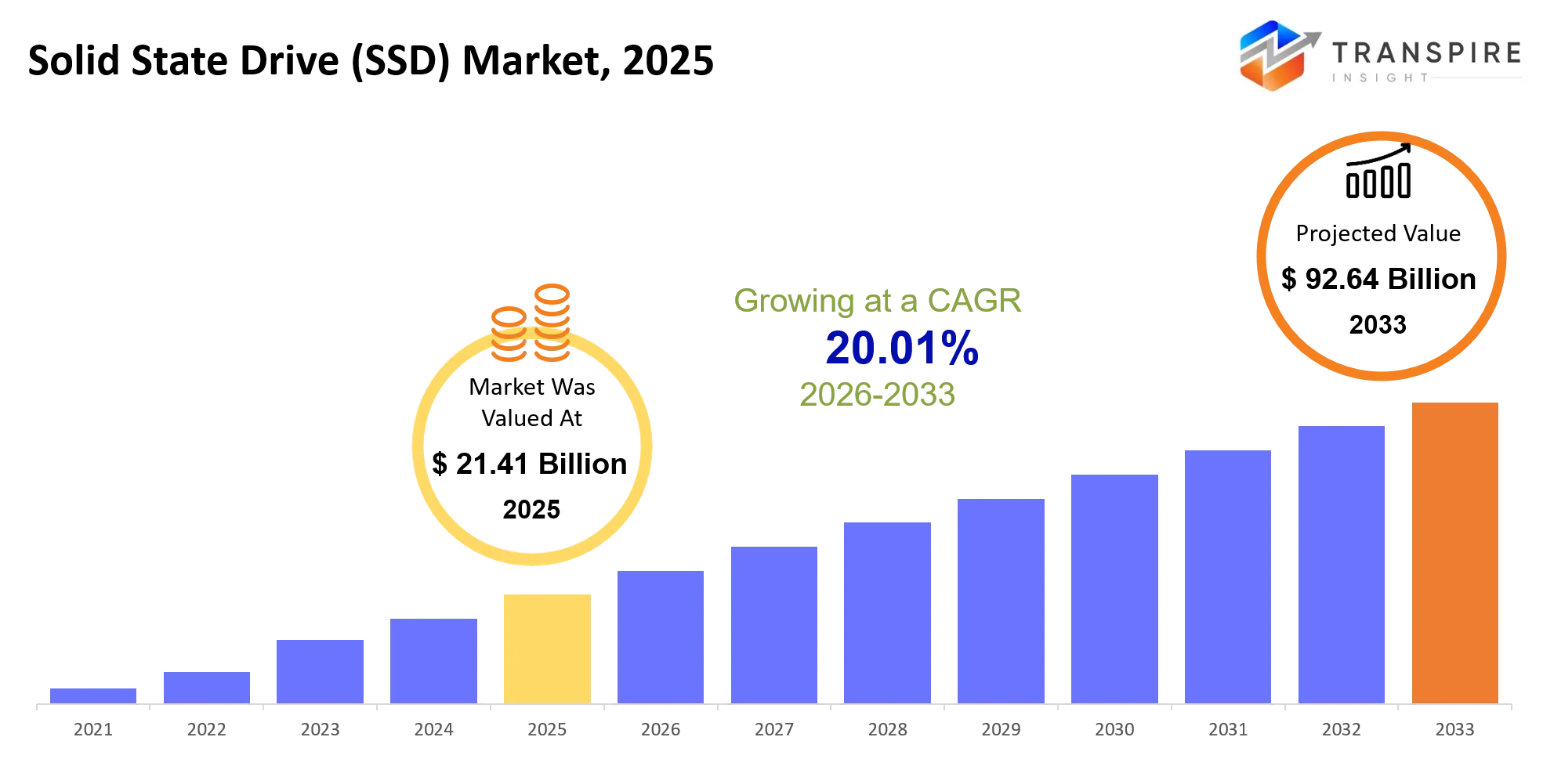
- Market Value (2025): USD 21.41 Billion.
- Expected Market Value (2026): USD 25.84 Billion.
- Estimated Market Value (2033): USD 92.64 Billion.
- Forecast CAGR (2026–2033): 20.01%.
- Leading Region in 2025: Asia Pacific
- Second-largest Region: North America
- Fastest Growing Region: Europe
Introduction
The Solid State Drive (SSD) Market includes the production, distribution, and sale of non-volatile electronic storage media using NAND flash memory and integrated circuit technology to store and access data without mechanical parts. SSDs offer higher performance, lower latency, reliability, and power consumption relative to traditional hard disk drives for computing and other data-intensive processes. Applications include enterprise and data center infrastructure, where NVMe SSDs are used in cloud computing, artificial intelligence, real-time analytics, and high performance computing. Computing devices such as laptops, desktop computers, workstations, and gaming machines are an important application segment. Another growing application area is content creation, automation, edge computing, and automotive systems.
For instance:-
- North America: AI data centers’ expansions, hyperscale infrastructure developments, and memory manufacturing are driving enterprise SSD deployments, especially in high-performance NVMe and data-intensive workloads.
- Europe: The semiconductor ecosystem and data-center infrastructure of Germany are fueling enterprise SSD deployments, and EU initiatives for semiconductor development are contributing to the technological advancements within the region.
Key Market Highlights: -
- Asia Pacific is expected to grow at a rapid CAGR in the Solid State Drive (SSD) Market by holding around46.73% of the share during the forecast period.
- North America is anticipated to hold roughly41% share of the Solid State Drive (SSD) Market over the predicted timeframe.
- Europe is anticipated to hold nearly 15%share of the Solid State Drive (SSD) Market over the predicted timeframe.
- By Form Factor, the M.2 form factor dominated the market and holds nearly 52% share in 2025 and is projected to grow at a substantial CAGR during the forecast period.
- By Interface, the NVMe (over PCIe) dominated the market and holds close to 63% share in 2025 and is projected to grow at a substantial CAGR during the forecast period.
- By Technology, the Multinational Corporations dominated the market and holds about 34% share in 2025 and is projected to grow at a substantial CAGR during the forecast period.
- India’s incentives for electronics manufacturing, AI data center infrastructure, and semiconductor ecosystem investments are fueling opportunities for SSD manufacturing and enterprise storage solutions.
How is Technology Driving Growth in the Solid State Drive (SSD) Market?
Technology is driving growth in the Solid State Drive (SSD) market by virtue of increased storage capacity, fast data transmission, low latency, and improved reliability. 3D NAND technology offers higher storage capacity and cost effectiveness, whereas PCIe 5.0 and NVMe offer increased bandwidth and input/output speed in the enterprise, gaming, and professional segments. The growing demand for high-speed enterprise SSDs that can manage data-intensive computations is being fueled by AI and hyperscale data centers. Advanced controllers, heat management techniques, and rugged SSD designs have also boosted applications in harsh environments.
|
Report Metrics |
Details |
|
Market size value in 2025 |
USD 21.41 Billion |
|
Market size value in 2026 |
USD 25.84 Billion |
|
Revenue forecast in 2033 |
USD 92.64 Billion |
|
Growth rate |
CAGR of 20.01%from 2026 to 2033 |
|
Base year |
2025 |
|
Historical data |
2021 - 2024 |
|
Forecast period |
2026 - 2033 |
|
Report coverage |
Revenue forecast, competitive landscape, growth factors, and trends |
|
Regional scope |
United States; Canada; Mexico; United Kingdom; Germany; France; Italy; Spain; Denmark; Sweden; Norway; China; Japan; India; Australia; South Korea; Thailand; Brazil; Argentina; South Africa; Saudi Arabia; United Arab Emirates |
|
Key company profiled |
Samsung Electronics, SK hynix, Kioxia, Micron Technology, Western Digital, Seagate, Kingston Technology, Solidigm, SanDisk, Crucial, Intel, ADATA, Corsair, TeamGroup, Transcend |
|
Customization scope |
Free report customization (country, regional & segment scope). Avail customized purchase options to meet your exact research needs. |
|
Report Segmentation |
By Form Factor (2.5-inch, M.2, U.2, U.3, PCIe Add-in Card, EDSFF, mSATA, Others); By Interface (SATA, PCIe, NVMe, SAS, USB, Thunderbolt, PCIe Gen4, PCIe Gen5); By Technology (3D NAND, TLC, QLC, MLC, SLC, V-NAND, BiCS NAND, Others); By Application (Client Computing, Enterprise Storage, Data Centers, Gaming, Industrial, Automotive, Consumer Electronics, Others); By Storage Capacity (Below 256 GB, 256 GB–512 GB, 512 GB–1 TB, 1–2 TB, 2–4 TB, 4–8 TB, Above 8 TB, Others); By End User (Consumer, Enterprise, Data Centers, Cloud Providers, Government, Industrial, Automotive, Others); By Sales Channel (OEM, Retail, Online, Distributors, Direct Sales, System Integrators, Enterprise Procurement, Others) |
Market Drivers
The SSD Market is being driven by the rapid developments of AI and adoption of hyperscale data centers, growing need for large storage capacity solutions within enterprises, as well as trends in transition to PCIe 5.0 and NVMe architectures. QLC SSDs are becoming more common with cloud providers adopting them to reduce the costs and achieve higher densities of storage capacity required for AI, vector databases, and inference workloads. The investments in semiconductor industry and the adoption of measures such as the European Chips Act have been improving regional manufacturing capabilities, but do not directly influence SSDs production yet.
For instance:-
- Asia Pacific: Asia Pacific is vital for the manufacturing and production of NANDs and SSDs due to the semiconductor ecosystem, manufacturing capabilities, electronics manufacturing, and data centers.
- Latin America: Cloud adoption, digital transformation, enterprise IT transformation, and investment in data centers are leading to growing opportunities for SSD deployments.
Restrain
Restraints in the market for Solid State Drives (SSDs)
In the market for Solid State Drives, restraints can come in form of higher costs per gigabyte compared to HDDs in applications where capacities are an important feature. Price fluctuations for NAND flash and supply chain disruptions can impact production and pricing. Legacy systems can also pose a restraint on adoption of high performance NVMe and PCIe SSDs. The finite life span of NAND flash also presents restraints.
|
Driver |
Relative Impact on Growth (%) |
Geographic Relevance |
Impact Timeline |
Demand Strength |
Growth Mechanism |
Key Beneficiaries |
Major Constraint |
|
AI, Generative AI and Data-Center Expansion |
32% |
North America, Asia Pacific, Europe |
Short-term |
High |
AI workloads require high-speed, high-capacity enterprise storage. |
SSD manufacturers, cloud providers, AI infrastructure vendors |
NAND shortages and elevated enterprise SSD pricing |
|
Transition to PCIe 5.0 and High-Layer 3D NAND |
24% |
North America, Asia Pacific, Europe |
Short-term |
High |
Faster interfaces and higher NAND density improve SSD performance. |
NAND manufacturers, SSD vendors, server OEMs |
Advanced-node manufacturing complexity and capital intensity |
|
Enterprise Server and Cloud Infrastructure Upgrades |
19% |
North America, Asia Pacific |
Medium-term |
High |
Server modernization increases demand for scalable enterprise SSDs. |
Data centers, CSPs, enterprise SSD vendors |
High procurement costs and infrastructure investment requirements |
|
Growing Adoption of SSDs Across Consumer and Industrial Devices |
15% |
Asia Pacific, North America, Europe |
Medium-term |
High |
SSD adoption replaces HDDs across PCs, workstations, and industrial systems. |
PC OEMs, SSD manufacturers, device users |
Consumer price sensitivity and NAND price volatility |
|
Energy Efficiency and Sustainable Data-Storage Requirements |
10% |
Europe, North America, Asia Pacific |
Long-term |
Medium |
Efficiency requirements encourage lower-power, higher-performance storage architectures. |
Data centers, storage vendors, enterprise customers |
Higher costs for energy-efficient storage technologies |
Analysis of Prices and Consumer Behaviour
Enterprise SSDs, characterized by their high performance (68% of the total market; mostly because of the demand in data centers, cloud computing, artificial intelligence and enterprise IT infrastructure), lead the market of Solid State Drives (SSDs). The cost of a high performance, enterprise-class SSD with advanced NAND flash, high endurance and enhanced storage performance is predicted to be 35% higher than any other product because the product will be built with advanced controller technology, certified components and high performance and reliability. Approximately 45% of all sales of Solid State Drives (SSDs) occur in NVMe form factors. Sales are boosted by the flexibility of usage in enterprise computing, data centers, consumer electronics and high performance applications and superior speed, reliability and energy-efficiency of SSDs. Data centers and enterprise computing industries constitute about 70% of demand in these sectors. Consumer buying pattern reveals that 55% of consumers value the highest storage performance, product reliability and standardization of SSDs. Yet another 33% of the consumers prefer buying their goods using bulk deals or long-term contracts so that they could cut down on their procurement costs for storing solutions and also ensure regular supply to their customers worldwide.
|
Company |
Est. Revenue Share Range |
Key Offerings |
Strategic Positioning |
Geographic Strength |
Technology Focus |
|
Samsung Electronics |
18–24% |
PM9D3a; PM1743; PM1753; QLC enterprise SSDs |
Vertically integrated global SSD market leadership |
North America, Asia Pacific, Europe |
3D NAND, PCIe 5.0, QLC, enterprise NVMe |
|
SK hynix |
11–17% |
Platinum P51; Platinum P41; enterprise NVMe SSDs; NAND solutions |
Integrated memory leadership targeting AI storage workloads |
North America, Asia Pacific, Europe |
3D NAND, TLC, PCIe 5.0, AI storage |
|
Micron Technology |
9–14% |
9650 NVMe; 9550 NVMe; 6600 ION; 4600 NVMe |
High-performance enterprise and AI-storage differentiation |
North America, Asia Pacific, Europe |
PCIe Gen6, Gen5, G9 NAND, QLC |
|
Kioxia |
8–13% |
CM9 Series; CD9 Series; XG8 Series; FL6 Series |
NAND-led innovation across enterprise and client SSDs |
Asia Pacific, North America, Europe |
BiCS NAND, PCIe 5.0, XL-FLASH, NVMe |
|
SanDisk |
7–12% |
SN861; SN8100; Ultrastar SSDs; WD_BLACK SSDs |
Broad consumer-to-data-center storage portfolio |
North America, Asia Pacific, Europe |
3D NAND, PCIe 5.0, enterprise NVMe, QLC |
|
Kingston Technology |
5–9% |
KC3000; Fury Renegade; NV3; DC3000ME |
Channel leadership with broad SSD portfolio |
North America, Europe, Asia Pacific |
NVMe, PCIe 4.0/5.0, gaming, client storage |
|
ADATA Technology |
2–5% |
LEGEND Series; XPG GAMMIX; XPG MARS; industrial SSDs |
Value-performance and gaming-focused differentiation |
Asia Pacific, Europe, North America |
PCIe 4.0/5.0, NVMe, gaming SSDs |
|
Lexar |
2–4% |
NM1090; NM990; Professional NM800; PLAY Series |
Performance-focused consumer and gaming expansion |
Asia Pacific, North America, Europe |
PCIe 5.0, NVMe, gaming, high-speed NAND |
|
Solidigm |
3–6% |
D7-P5520; D7-PS1010; D5-P5430; high-capacity QLC SSDs |
High-capacity enterprise QLC specialization |
North America, Asia Pacific |
QLC NAND, high-density storage, enterprise NVMe |
|
Seagate Technology |
1–3% |
Nytro 5050; Nytro 5550; Nytro 4350; enterprise SSDs |
Enterprise storage diversification beyond HDDs |
North America, Europe, Asia Pacific |
NVMe, PCIe Gen4/Gen5, enterprise endurance |
Who are the Key Players in the Solid State Drive (SSD) Market and how do they compete?
The competitiveness of Solid State Drive (SSD) market in the international market is achieved through companies that focus on innovation technology, industry-specific solutions, and establishment of global distribution network. The competitive advantage in terms of non-price competition achieved through provision of high-performance storage solutions, NAND technology, intelligent storage architecture, as well as integration with digital platform and enterprise IT solutions results in continuous innovation and increases efficiency in terms of data processing.
Samsung Electronics builds up its competitive position in the market by producing advanced NAND flash storage, high-performance NVMe SSDs, enterprise storage solutions and connected storage technologies. SK Hynix competes with its competitors by focusing on manufacturing high-performance solid state drives for data centers, enterprise computing, consumer electronics, gaming, and other digital purposes. Kioxia builds up its competitive position in the market through provision of integrated solutions in terms of NAND flash memory, enterprise SSDs, client SSDs, and high-performance storage technologies.
Top Companies in the Solid State Drive (SSD) Market
- Samsung Electronics
- SK Hynix
- Kioxia
- Micron Technology
- Western Digital
- Seagate
- Kingston Technology
- Solidigm
- SanDisk
- Crucial
- Intel
- ADATA
- Corsair
- TeamGroup
- Transcend
|
Investment Factor |
Why It Matters to Investors |
Opportunity |
Investment Implication |
|
AI and Data-Center Storage Expansion |
AI workloads require substantially faster, higher-capacity storage infrastructure. |
Enterprise NVMe, AI servers, hyperscale data centers |
Why it is attractive: Strong structural demand from AI infrastructure |
|
PCIe 5.0 and Next-Generation SSD Adoption |
Performance upgrades create replacement cycles across servers, workstations, and premium PCs. |
PCIe 5.0/Gen6, high-throughput enterprise and performance SSDs |
Why it is attractive: Premium performance supports differentiated product opportunities |
|
**High-Capacity QLC and Advanced |
Airport Quick Service Restaurant (QSR) Market Segmentation
The Solid State Drive (SSD) Market share is divided into seven categories: By Form Factor, By Interface, By Technology, By Application, By Storage Capacity, By End User, By Sales Channel.
The M.2 form factor dominated the market, accounting for nearly 52% in 2025 and is expected to rise at a significant CAGR during the forecast period.
The Solid State Drive (SSD) Market is by form factor into 2.5-inch, m.2, u.2, u.3, pcie add-in card, edsff, msata, others. Among these, the M.2 form factor dominated the market, accounting for nearly 52% in 2025 and expected to increase at a significant CAGR during the forecast period. M.2 form factor dominated the market share with a share of almost 52% in 2025 and is expected to hold significant CAGR growth during the forecast period owing to its small size, high speed NVMe technology, and its widespread use in laptops, computers, and enterprises.
The NVMe (over PCIe) dominated the market, accounting for close to 63% in 2025, and is expected to rise at a significant CAGR during the forecast period
The Solid State Drive (SSD) Market is segmented by interface into sata, pcie, nvme, sas, usb, thunderbolt, pcie gen4, pcie gen5. Among these, the NVMe (over PCIe) dominated the market, accounting for close to 63% in 2025 and expected to increase at a significant CAGR during the forecast period. NVMe (over PCIe) dominated the market with almost 63% of the market in 2025 owing to their high bandwidth, low latency, fast data transfer, and increased enterprise adoption.
The Citrus segment dominated the market, accounting for about 34% in 2025 and is expected to rise at a significant CAGR during the forecast period.
The Solid State Drive (SSD) Market by technology into 3d nand, tlc, qlc, mlc, slc, v-nand, bics nand, others. Among these, theMultinational Corporations dominated the market, accounting for about 34% in 2025 and expected to increase at a significant CAGR during the forecast period. Citrus dominated the market with almost 34% share in 2025 owing to its various uses, high demand from consumers, nutritious value, and versatile use of products.
Regional Segment Analysis of the Solid State Drive (SSD) Market
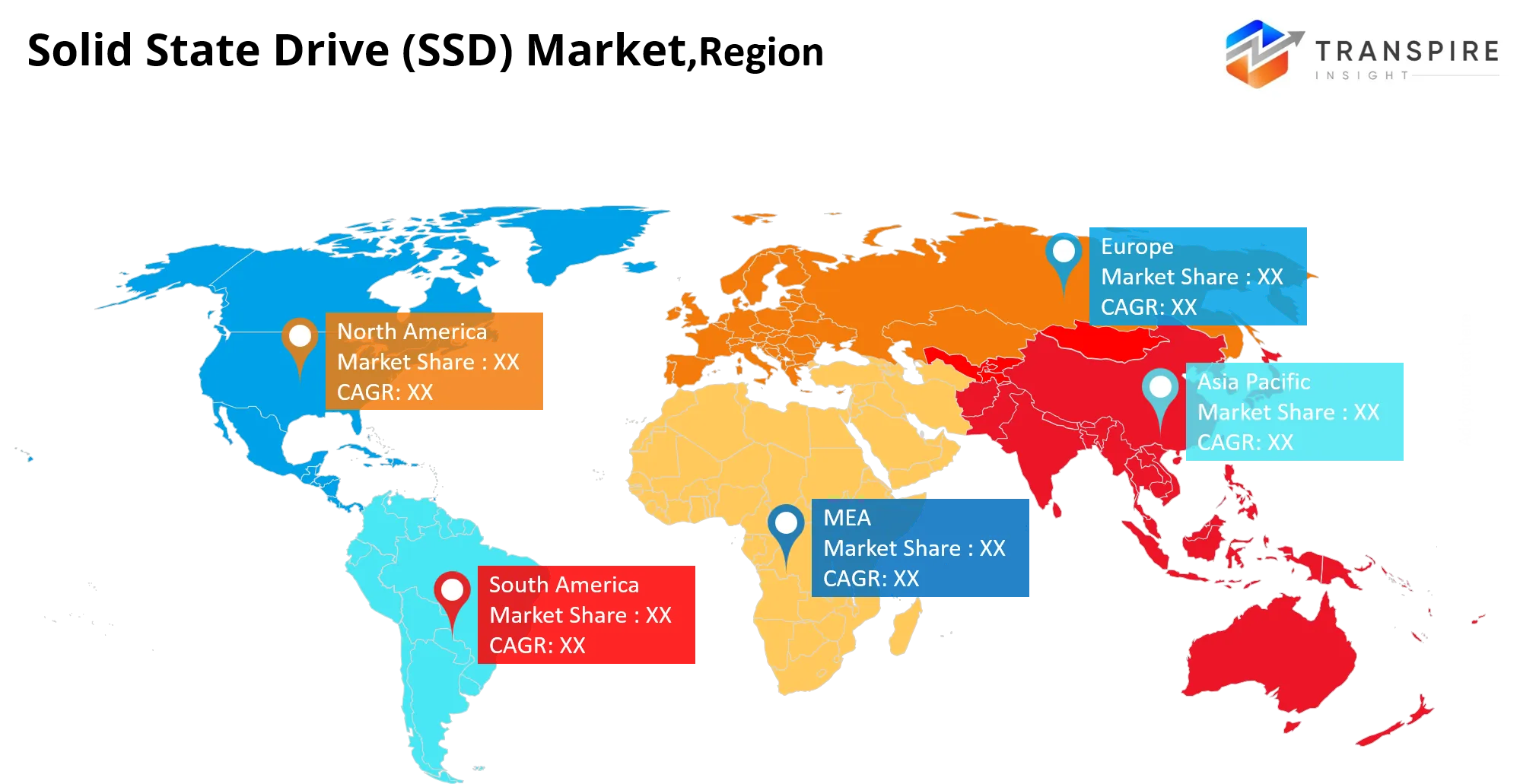
- Europe (Germany, France, U.K., Italy, Spain, Rest of Europe)
- North America (U.S., Canada, Mexico)
- Asia-Pacific (China, Japan, India, Rest of APAC)
- South America (Brazil and the Rest of South America)
- The Middle East and Africa (UAE, South Africa, Rest of MEA)
Asia Pacific is expected to grow at a rapid CAGR in the Solid State Drive (SSD) Market, holding around 46.73% of the share during the forecast period.
The Asia Pacific is expected to witness rapid CAGR in the Solid State Drive (SSD) Market with about 46.73% of the market share during the forecast period owing to the increased semiconductor production, high NAND flash manufacturing, rising data center investments, increasing use of cloud computing, digital transformation, and the increasing demand for high-performance storage devices in consumer electronics, enterprises, artificial intelligence, gaming, and industries.
North America is the high-growth region in the Solid State Drive (SSD) Market during the period, holding roughly 41% share.
North America is the fastest-growing region in the Solid State Drive (SSD) Market during the period, holding a market share of around 41%, fueled by rising construction of hyperscale data centers, growing artificial intelligence deployment, rising cloud computing spending, IT transformation of enterprises, and increasing demand for high-speed NVMe storage drives. The advanced technology environment, data infrastructure spending, gaming sector growth, and deployment of enterprise solid-state drives in the region also boost regional market growth and development.
Europe is the fastest-growing region in the Solid State Drive (SSD) Market during the period, holding nearly 15% share.
Europe is the fastest-growing region in the Solid State Drive (SSD) Market during the period, accounting for a market share of almost 15%, powered by the rising construction of data centers, growing adoption of the cloud, digital transformation of enterprises, and increasing demand for energy-efficient storage drives. Investments in artificial intelligence, high-performance computing, and semiconductor technology will help in the growth and deployment of solid-state drives in the region.
Strategies for Market Growth in Non-Leading Regions:
The development of non-leaders' regions through scalable Solid State Drive (SSD) production and assembling technology will benefit small-to-medium-sized storage technology suppliers. The development of local production of SSD, sourcing of its components and the creation of regional SSD testing and integration centers can lower dependence on imports and reduce the cost of production and logistics chain. Formation of strategic partnerships with regional semiconductor manufacturers, data center, cloud services providers, IT enterprises and technology distributors will increase the market penetration of the SSD products. The level of knowledge about SSD production, NAND flash integration, controller technologies, quality control and standardization of the performance should be increased; thus, training and technical skill improvement will be necessary. Also, flexible financing schemes, supply agreements and contract manufacturing will increase affordability and popularity of the SSD solutions for enterprise, consumer and industrial markets. Collaboration programs with governmental agencies, semiconductor, electronics manufacturing and digital infrastructure projects together with digital sales approach will increase the access to the SSD products and promote sustainable growth of worldwide market in developing countries.
Future Market Trends for the Solid State Drive (SSD) Market: -
PCIe 5.0 and NVMe: The faster adoption of high-speed interface is enhancing the performance of SSDs, lowering latency and aiding data-intensive applications such as AI, cloud, and enterprise applications.
High-Capacity Adoption: There is an increased need for SSDs of more than 2 TB that is being caused by AI data sets, gaming, content creation, cloud storage, and enterprise data.
3D NAND & QLC: There is an advanced use of 3D NAND technology and QLC technology to increase storage capacity and increase cost-effectiveness of high-capacity SSDs.
EDSFF Form Factor: EDSFF form factor usage is increasing in data centers owing to better thermal management, serviceability, and capacity density.
Recent Development
InJuly 8, 2026: Samsung introduced the PM1763 enterprise SSD, equipped with PCIe 6.0, 9th generation V-NAND, and 4 nm controller for AI infrastructure.
In July 3, 2026: Kioxia & SanDisk introduced the production of 10th generation 3D Flash Memory at Kitakami, which can support more capacity, performance, and energy efficiency enterprise SSD solutions.
In March 17, 2026: Kioxia announced the development of GP Series Super High IOPS SSD for enabling GPU direct flash access and low latency memory expansion.
Market Segment
This study forecasts revenue at global, regional and country levels from 2020 to 2033. Transpire Insights has segmented the Solid State Drive (SSD) Market based on the below-mentioned segments:
Solid State Drive (SSD) Market, By Form Factor
- 2.5-inch
- M.2
- U.2
- U.3
- PCIe Add-in Card
- EDSFF
- mSATA
- Others
Solid State Drive (SSD) Market, By Interface
- SATA
- PCIe
- NVMe
- SAS
- USB
- Thunderbolt
- PCIe Gen4
- PCIe Gen5
Solid State Drive (SSD) Market, By Technology
- 3D NAND
- TLC
- QLC
- MLC
- SLC
- V-NAND
- BiCS NAND
- Others
Solid State Drive (SSD) Market, By Application
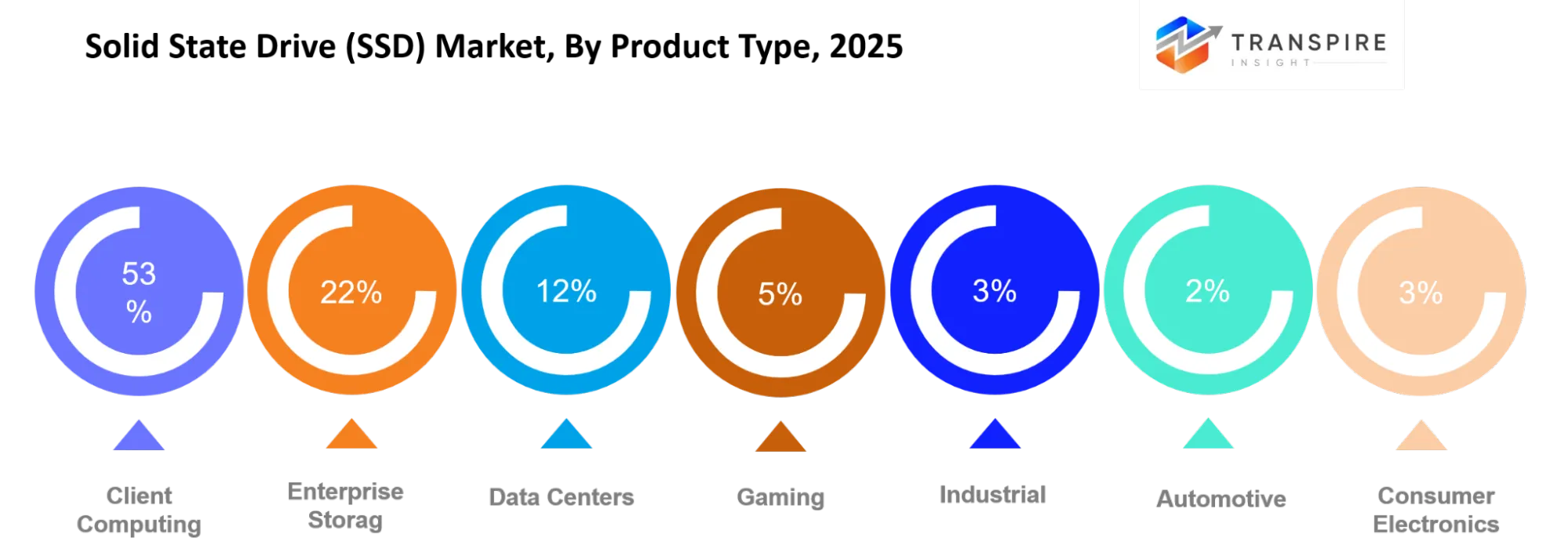
- Client Computing
- Enterprise Storage
- Data Centers
- Gaming
- Industrial
- Automotive
- Consumer Electronics
- Others
Solid State Drive (SSD) Market, By Storage Capacity
- Below 256 GB
- 256 GB–512 GB
- 512 GB–1 TB
- 1–2 TB
- 2–4 TB
- 4–8 TB
- Above 8 TB
- Others
Solid State Drive (SSD) Market, By End User
- Consumer
- Enterprise
- Data Centers
- Cloud Providers
- Government
- Industrial
- Automotive
- Others
Solid State Drive (SSD) Market, By Sales Channel
- OEM
- Retail
- Online
- Distributors
- Direct Sales
- System Integrators
- Enterprise Procurement
- Others
Solid State Drive (SSD) Market, By Regional Analysis
North America
- US
- Canada
- Mexico
Europe
- Germany
- UK
- France
- Italy
- Spain
- Russia
- Rest of Europe
Asia Pacific
- China
- Japan
- India
- South Korea
- Australia
- Rest of Asia Pacific
South America
- Brazil
- Argentina
- Rest of South America
Middle East & Africa
- UAE
- Saudi Arabia
- Qatar
- South Africa
- Rest of the Middle East & Africa
Frequently Asked Questions
Find quick answers to common questions.
AI workloads are increasing demand for high-capacity, low-latency enterprise SSDs supporting faster data processing, cloud infrastructure, and advanced computing applications.
NVMe delivers high bandwidth, low latency, faster data transfer, and improved performance, making it suitable for enterprise, gaming, and data-center workloads.
M.2 SSDs provide compact designs, high-speed NVMe performance, efficient installation, and broad compatibility across laptops, desktops, workstations, and enterprise systems
3D NAND increases storage density, improves cost efficiency, supports higher capacities, and enables advanced SSD solutions for enterprise and consumer applications
Asia Pacific is expected to lead SSD market growth, supported by semiconductor manufacturing, NAND production, data centers, cloud adoption, and electronics demand.
- Samsung Electronics
- SK Hynix
- Kioxia
- Micron Technology
- Western Digital
- Seagate
- Kingston Technology
- Solidigm
- SanDisk
- Crucial
- Intel
- ADATA
- Corsair
- TeamGroup
- Transcend
About the Authors

Avinash Kumar
I’m Avinash Kumar, a Senior Research Analyst at Transpire Insight, with expertise in the Electronics and Semiconductor and Energy & Power industry. My work focuses on analyzing emerging technologies, market trends, industry developments, and innovation across these sectors. I specialize in transforming complex technical and market insights into clear, research-backed content that helps professionals, businesses, and decision-makers stay informed. Through continuous industry research and data-driven analysis, I strive to deliver accurate, reliable, and practical perspectives on the latest advancements shaping the semiconductor and energy landscape.

Chakradhar Khansole
Chakradhar serves as the Research Director at Transpire Insight, bringing over 8 years of experience in technology, innovation, and strategic market intelligence. He specializes in transforming complex market data into actionable business insights that enable organizations to make informed, growth-oriented decisions. Recognized for his strategic vision and analytical expertise, Chakradhar leads high-impact research initiatives, delivering comprehensive market assessments, competitive intelligence, and forward-looking industry analysis.
Recently Published Reports
-
Apr 2026
Fiber Optic Faceplates Market
Fiber Optic Faceplates Market Size, Share & Analysis Report By Type (< 300 mm2, 300-350 mm2, and > 350 mm2, By Application (Night Vision, Holographic Imaging, Medical, and Others), and Geography (North America, Europe, Asia-Pacific, Middle East and Africa, South and Central America), 2021 - 2031
-
Apr 2026
High Temperature Superconductors Market
High Temperature Superconductors Market Size, Share & Analysis Report By Type (1G HTS, and 2G HTS), By Application (Power Cable, Fault Current Limiter, and Transformer), and Geography (North America, Europe, Asia-Pacific, Middle East and Africa, South and Central America), 2021 - 2031
-
Apr 2026
Industrial Plugs and Socket Market
Industrial Plugs and Socket Market Size, Share & Analysis Report By Type (Industrial Plugs, Industrial Sockets), By Current (Up to 32 A, 32 to 125 A, Above 125 A), By Protection (Dustproof and Splash Proof, Waterproof, Explosion Proof), By End User (Heavy Industries, Oil and Gas, Chemicals and Pharmaceuticals, Power Generation, Others), and Geography (North America, Europe, Asia-Pacific, Middle East and Africa, South and Central America), 2021 - 2031
-
Apr 2026
InGaAs Avalanche Photodiodes Market
InGaAs Avalanche Photodiodes Market Size, Share & Analysis Report By Type (1100 - 1700 nm, and 1000 - 1600 nm), By Application (Missile Warning System, Muzzle Flash Detection, Wafer Defect Inspection, Laser Rangefinders, and Others), and Geography (North America, Europe, Asia-Pacific, Middle East and Africa, South and Central America), 2021 - 2031