
Secondary Ticket Market Summary:
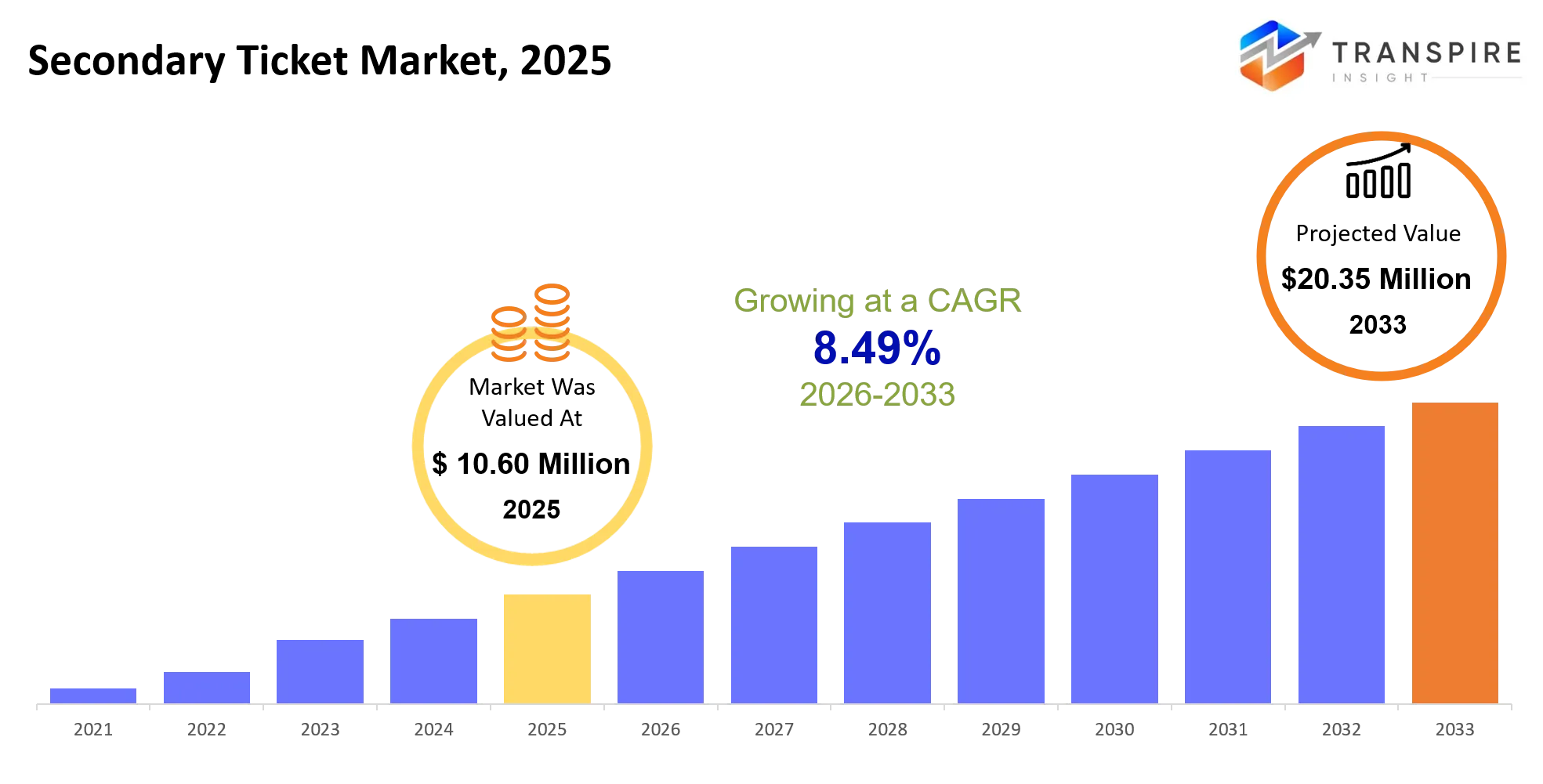
As per Transpire Insight Analysis, the Secondary Ticket Market size is estimated at USD 10.60 billion in 2025 and is anticipated to reach USD 20.35 billion by 2033, growing at a CAGR of 8.49% from 2026 to 2033.
The secondary ticket market around the world lets fans buy and sell tickets for sports games, concerts, theatre shows, festivals and other live events using sites, phone apps and ticket exchange services. Over the past three to five years, the industry has started to focus more on digital ticket purchases on phones first and clearer ways to check if a ticket is real. More people are using tickets, which makes it easier to transfer them and handle resale across different places. A big change is when resale services are added to ticket systems. This helps event organisers and approved marketplaces have control over how tickets are given out. New rules about protecting customers have also changed how resale sites handle prices, costs and whether the tickets are real. The UK government said in November that it wants to limit resale, which shows how important it is to keep tickets protected for fans. These changes are making platforms spend more on payments, better pricing options and better experiences for fans.
Secondary Ticket Market Size & Forecast:
- Market Size 2025: USD 10.60 Billion
- Expected Market Value (2033): USD 20.35 Billion
- Forecast CAGR (2026–2033): 8.49%
- Leading Region in 2025:North America
- Fastest Growing Region: Asia Pacific
- Key Company Profiles: StubHub, Vivid Seats, SeatGeek, Ticketmaster, Viagogo, AXS, TickPick, Gametime, TicketNetwork, TicketSwap, Tixel, Event Tickets Center, Razorgator, TicketIQ, Live Nation
Key Market Insights:
market is moving towards the development of digital resale infrastructure, the popularity of live events and the flexibility of consumer behaviour when buying tickets.
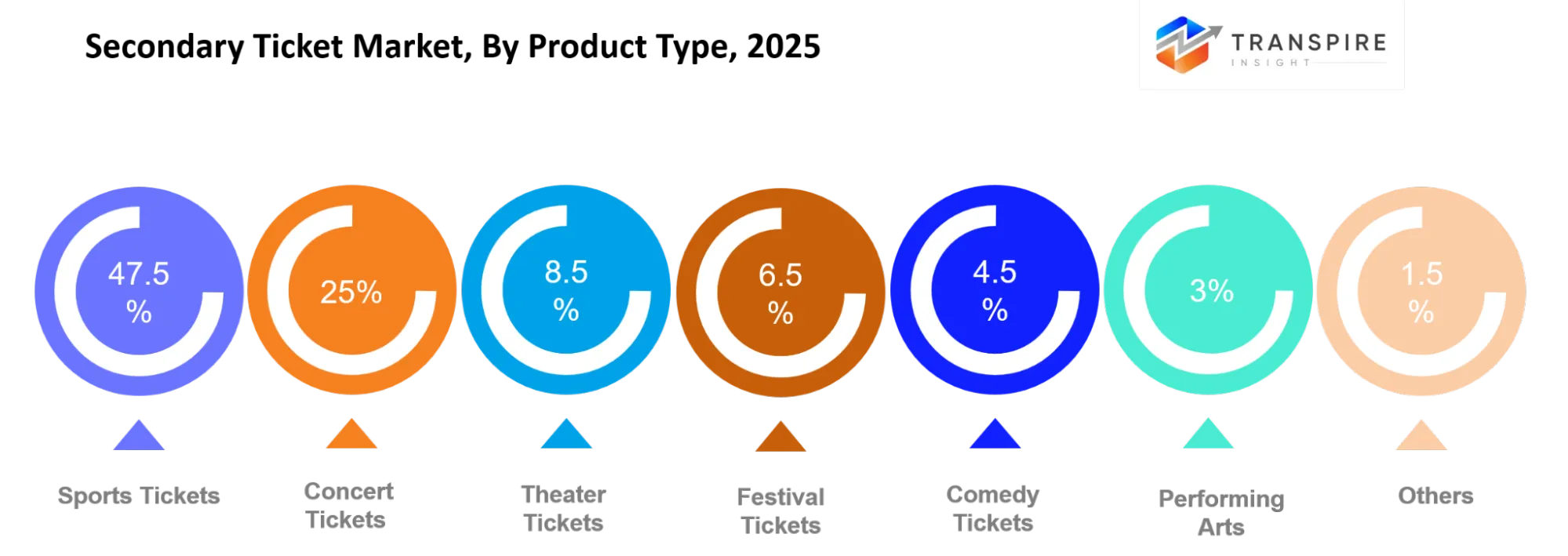
- Sports tickets have a market share of 47.5%, which has motivated both StubHub and SeatGeek to enhance their sports ticketing and resale experience through their digital platform.
- Concert tickets form 25.0% of the market, motivating the ticketing companies to increase inventory and mobile transfers for most sought-after tour concerts.
- Theatre tickets constitute 8.5% of the market, making it easier to provide good seat selection and last-minute resale through online marketplaces.
- Festival tickets constitute 6.5%, motivating ticketing companies to make digital transfers easy and provide easy access to highly sought-after events.
- Comedy tickets form 4.5% of the market, providing opportunities for the resale platforms to offer services to fans of the comedians and live performances.
- Family events constitute 3.5%, motivating the companies to increase group bookings, seat selections, and easy purchase processes.
- Performing arts constitute 3.0% of the market share, providing opportunities for specialised ticketing companies to cater to their target audience.
What are the Key Drivers, Restraints, and Opportunities in the Secondary Ticket Market?
Drivers
The growth of the market for sporting events, concert tours, and live events limited in size continues to draw more attention; the secondary market for tickets is poised to benefit. Sure, the primary outlets will still sell out, driving consumers to secondary marketplaces, but with features like mobile ticket transfers, electronic payment processing, and new inventory search tools, secondary ticket providers will see the transactions.
Restraint
high resale prices and add-on charges, fake listings, and varying consumer protection policies dog the market. Regulations on resale of tickets vary from one country to another, and hot-ticket events may experience bots buying up tickets en masse or speculative listings. There's evidence of this increasing attention, as shown by the UK government's November 2025 statement on resale of tickets above face value.
Opportunities
Mobile resale for investment in secure transfers, automated fraud detection, and personalised ticket insights. Resale marketplaces might also be able to forge partnerships with teams, venues, and pre‐release resellers, enhancing inventory sharing and buyer trust., where the use of mobile and digital ticketing is likely to grow over time. Players that offer transparent pricing, verified inventory, and intuitive experiences may be better equipped to foster loyalty and get a share of future revenue.
|
Driver |
Relative Impact on Growth (%) |
Geographic Relevance |
Impact Timeline |
Demand Strength |
Growth Mechanism (5–10 words) |
Key Beneficiaries (5–10 words) |
Major Constraint (5–10 words) |
|
Growing demand for live sports, concerts, and entertainment events |
28% |
North America, Europe, Asia Pacific |
Short-term (≤2 years) |
High |
Expands resale demand for sold-out and high-profile events |
Ticket marketplaces, event organizers, sellers, and buyers |
High ticket prices and reduced consumer spending |
|
Expansion of digital ticketing platforms and mobile resale applications |
23% |
North America, Europe, Asia Pacific |
Short-term (≤2 years) |
High |
Simplifies ticket discovery, resale, payments, and transfers |
Online marketplaces, mobile platforms, payment technology providers |
Cybersecurity risks and fraudulent ticket listings |
|
Dynamic pricing, AI-driven analytics, and personalized recommendations |
19% |
North America, Europe |
Medium-term (2–4 years) |
High |
Optimizes pricing, predicts demand, and personalizes offers |
Resale platforms, ticket brokers, data analytics vendors |
Pricing inaccuracies, algorithmic bias, and implementation costs |
|
Growing acceptance of ticket resale and cross-platform marketplaces |
17% |
North America, Europe, Latin America |
Medium-term (2–4 years) |
High |
Connects buyers and sellers across fragmented ticket markets |
Independent resellers, ticket exchanges, consumers, marketplace operators |
Consumer distrust and inconsistent resale regulations |
|
Stronger consumer protection, secure ticket transfers, and resale transparency |
13% |
Europe, North America, Asia Pacific |
Long-term (≥4 years) |
Medium |
Builds trust through verified tickets and transparent transactions |
Compliant platforms, event organizers, regulators, ticket buyers |
Regulatory fragmentation and restrictions on resale pricing |
|
Total |
100% |
— |
— |
— |
— |
— |
— |
What Has the Impact of Artificial Intelligence Been on the Secondary Ticket Market?
The use of artificial intelligence brings new opportunities to optimise pricing, identify fraud, and provide customised tickets to users. Machine learning techniques allow the analysis of sales history, event popularity, seat location, number of listed tickets, and purchasing behaviours to understand how price dynamics are changing. This way, sellers can make more accurate offers, and platforms can present the most suitable offers to buyers. Operational automation can be achieved through the identification of odd activity in accounts, duplicated listing detection, and prioritisation of tickets that need verification. The recommendation engine based on browsing history and preferences allows the suggestion of different sports matches, concerts, and performances for particular users. For large marketplaces, it can facilitate the reduction of manual reviews and improve inventory management. Demand forecasting is another field where AI can be used. It will give information about the changes in the supply of tickets close to the start of the event. At the same time, the problem of prediction accuracy can become a challenge since the demand can change dramatically due to lineup changes, weather issues, cancellations, and other unpredictable factors.
Instance
In November 2025, Seatpin launched its PinAI, which is a ticket assistant powered by AI and lets users search for event tickets through conversations and receive recommendations based on their needs. The system also facilitates ticket resale, while plans include extending AI-assisted services to listing, repricing, and transfer of tickets. This example shows how artificial intelligence can be used to make the process of searching for tickets easier.
Key Market Trends
The used ticket business is evolving from individual resale listings into networked and data-enabled marketplaces with increased integrations with ticket providers.
- Users increasingly use the mobile apps for buying tickets that encourages companies to optimize purchase process and make it more convenient.
- Event and ticket organisers are building more connections with their official resales channels to have better inventory control.
- Companies receive more pressure from regulators and consumers to be clearer in fee communication and overall prices.
- Verification of users, accounts, and automatic risk analysis become more significant as the resale becomes increasingly online-oriented.
- Dynamic pricing powered by data: Using past sales and current listing activity to adjust prices for buyers becomes more common among marketplaces.
- Consumer protection regulations become effective and impact how the platforms deal with resale pricing, speculation, and fee management.
Secondary Ticket Market Segmentation
By ticket type
sports tickets have a market share of 47.5% because of the regular league games and tournaments. Concert tickets comprise 25.0% of the market due to their popularity and restricted availability. The market for theatre tickets is 8.5%, while festival tickets occupy 6.5% due to the opportunities associated with live performance and seasonality. Comedy tickets constitute 4.5% of the market, followed by family events with 3.5%, performing arts with 3.0%, and others with 1.5%. This distribution reveals the significance of sports and music in the resale industry.
By platform type
online marketplaces enable users to access listings of various sellers, while ticket exchanges assist in buying and selling tickets from the ticket holder. Broker platforms concentrate on inventory management and ticket resale operations. Mobile apps enable searching and purchasing of tickets along with ticket transfers, while social platforms connect buyers and sellers through online communities. Auction platforms enable price-based bidding, while resale websites provide platforms to list and buy tickets.
By event type
Each type of event has regular schedules, competitive events, and a following of fans. Music events appeal to buyers of tickets to popular artists, completed festivals, and sold-out concerts. Theatre and festival event types target markets at different time scales of booking, with larger entertainment events adding other types such as comedy events and live events. Corporate events have a use case for use by business guests, conferences, and professional events.
By ticket category
General admission tickets are appealing to those consumers that seek access without a particular seat. Reserved seating is appealing to consumers who seek to choose a particular seat. VIP and premium tickets are appealing to that consumer that seeks a unique experience (perhaps even a unique seat). Hospitality packages may include tickets along with hotels, transport, and access to various fixtures. Season tickets are appealing to a fixture-goer that may resell access to some fixtures; club seats are a special kind of seating.
By buyer type
The most people might consider face value sales, other kinds of buyers and fans also value access to fixtures that matter to them. Businesses buy tickets for entertaining clients or for company events, fans check resale sites when travelling in order to gain access to a local game or concert, collectors will sometimes seek tickets to an important event, and resellers stock up on tickets to meet the changing demand for tickets.By sales channel
Sellers maintain a number of different channels which allow customers to acquire tickets. This may be through a website which allows for searching and comparing, or an app which allows for quicker access and mobile ticketing. Traditional brokers may be used by consumers who prefer more direct assistance, and social media may be used by sellers to attract audiences for sales. Affiliate agents/marketplaces may use referral arrangements, with direct resale through existing ticketing platforms, or access to existing third-party brokerages.
What are the Key Use Cases Driving the Secondary Ticket Market?
Sports ticket reselling is another important use case. Fans can buy tickets from the secondary market for sold-out games, prestigious tournaments, or games that get more interesting closer to the event date. The mobile listing and transfer process makes this task easier to accomplish. The other important use cases are concert, theatre play, and festival ticket buying. These use cases help those who are looking for alternative ways of ticket purchasing when regular sales are low. The new use cases are corporate event access, tourism-related ticket discovery, and authorised fan-to-fan ticket transfers. Improved ticket verification and mobile-based resale will help accomplish these use cases.
|
Report Metrics |
Details |
|
Market size value in 2025 |
USD 10.60 Billion |
|
Market size value in 2026 |
USD 11.50 Billion |
|
Revenue forecast in 2033 |
USD 20.35 Billion |
|
Growth rate |
CAGR of 8.49% from 2026 to 2033 |
|
Base year |
2025 |
|
Historical data |
2021 - 2024 |
|
Forecast period |
2026 - 2033 |
|
Report coverage |
Revenue forecast, competitive landscape, growth factors, and trends |
|
Regional scope |
United States; Canada; Mexico; United Kingdom; Germany; France; Italy; Spain; Denmark; Sweden; Norway; China; Japan; India; Australia; South Korea; Thailand; Brazil; Argentina; South Africa; Saudi Arabia; United Arab Emirates |
|
Key company profiled |
StubHub, Vivid Seats, SeatGeek, Ticketmaster, Viagogo, AXS, TickPick, Gametime, TicketNetwork, TicketSwap, Tixel, Event Tickets Center, Razorgator, TicketIQ, Live Nation |
|
Customization scope |
Free report customization (country, regional & segment scope). Avail customized purchase options to meet your exact research needs. |
|
Report Segmentation |
Ticket Type (Sports Tickets, Concert Tickets, Theater Tickets, Festival Tickets, Comedy Tickets, Family Events, Performing Arts, Others)Platform Type (Online Marketplaces, Ticket Exchanges, Broker Platforms, Mobile Apps, Social Platforms, Auction Platforms, Resale Websites, Others)Event Type (Sports, Music, Theater, Festivals, Entertainment, Corporate Events, Family Events, Others)Ticket Category (General Admission, VIP, Premium, Reserved Seating, Hospitality, Season Tickets, Club Seats, Others)Buyer Type (Individual Buyers, Corporate Buyers, Tourists, Fans, Collectors, Resellers, Event Organizers, Others)Sales Channel (Websites, Mobile Apps, Physical Brokers, Social Media, Affiliate Platforms, Direct Resale, Marketplaces, Others) |
Which Regions are Driving the Secondary Ticket Market Growth?
North America
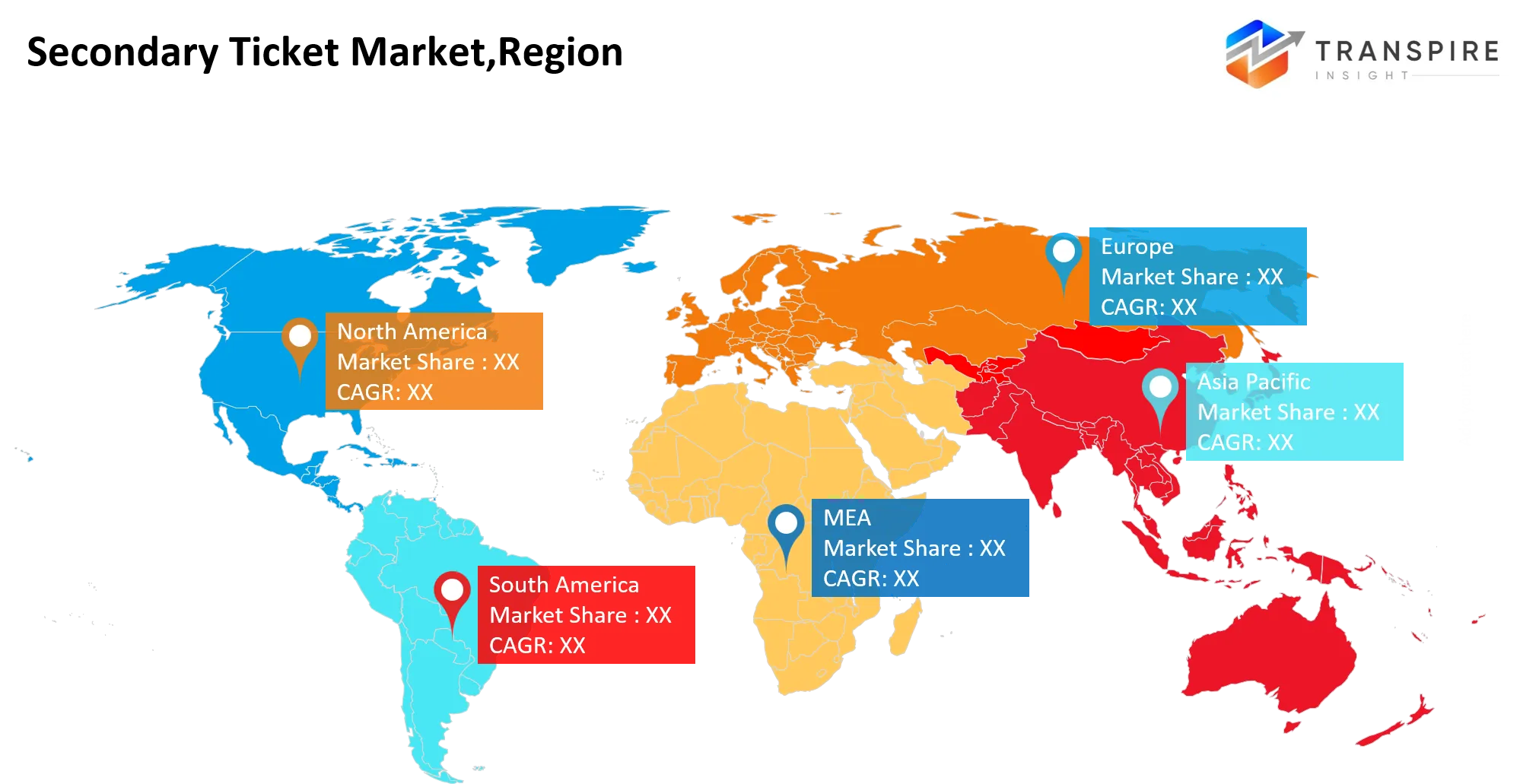
North America has a leading regional market share of 48.5% due to its professional sports leagues, major tours and concerts, and extensive use of digital ticketing services. The robust e-payment system and cooperation between ticket markets, teams, and venues contribute to resale activities. The advanced live entertainment sector in the region offers many opportunities for resellers and buyers.
In November 2025, The NLL has partnered with StubHub to enhance its ticket services and fan marketplace. This is an example of how sports partnerships can help expand the number of secondary ticket sales in North America.
Europe
Europe accounts for 30.0%. It has its market due to international football matches, music festivals, theatres, and the attendance of people from other countries to participate in events. In comparison to North America, this market has diverse national regulations and approaches to ticket resale.
In November 2025, It was revealed that the UK Government plans to ban the resale of tickets above original costs for live events. This is an indication of the increasing emphasis being put on consumer protection within the European secondary ticketing market.
Asia Pacific
The Asia Pacific constitutes 13.0% of the market and is the fastest-growing region, exhibiting a projected CAGR of 12.4%. Increasing use of smartphones, digital payments, live entertainment venues, and involvement in sporting and musical events provide chances for growth in the marketplace. Those platforms that are able to build regional partnerships and provide regional payment options, along with ticket verification, may benefit from this trend.
In December 2025, the NOL Universe of South Korea revealed that they will be rebranding Interpark into NOL World. This is an example of the growth of online ticketing services in Asia Pacific. Even though this is not necessarily secondary ticketing, it still relates to the overall ticketing industry.
Who are the Key Players in the Secondary Ticket Market and how do they compete?
The competition in the secondary ticket market of the world involves factors such as inventory availability, customer trust, transaction convenience, price transparency, and geographic coverage. Businesses apply various combinations of marketplace size, technology, event partnership, and buyer protection to attract users. The provided regional and ticket type data suggest significant opportunities in the North American sports resale market and mobile-based transactions.StubHub's competitive advantage is based on the large resale marketplace and international coverage, running StubHub in North America and Viagogo globally. Its strategy is based on the marketplace liquidity, access to event inventory, and technology that enables buying and selling tickets between markets. The competitive advantages of SeatGeek are digital ticket discovery, mobile features, and partnership with sports teams. The company's agreements with the Arizona Diamondbacks and Los Angeles Dodgers for 2025 show the strategy that includes cooperation with sports teams and official marketplace access. Vivid Seats is known for its event selection, customer service, and buyer guarantee. The company's partnerships and research among fans allow it to communicate with people involved in sports, music, and theatre.
Secondary Ticket Marketcompanies
- StubHub
- Vivid Seats
- SeatGeek
- Ticketmaster
- Viagogo
- AXS
- TickPick
- Gametime
- TicketNetwork
- TicketSwap
- Tixel
- Event Tickets Center
- Razorgator
- TicketIQ
- Live Nation
|
Company |
Est. Revenue Share Range |
Key Offerings |
Strategic Positioning |
Geographic Strength |
Technology Focus |
|
StubHub / viagogo |
Estimated 15–25% |
Sports resale, concert tickets, international event resale, seller marketplace |
scale through dual-brand marketplace integration |
North America, Europe, Asia Pacific |
Dynamic pricing, inventory matching, transaction analytics |
|
Ticketmaster |
Estimated 10–20% |
Verified Resale, fan-to-fan resale, ticket exchanges, secure transfers |
Primary-to-resale ecosystem integration |
North America, Europe, Asia Pacific |
Digital ticket verification, secure transfers, account-linked resale |
|
Vivid Seats |
Estimated 5–12% |
Sports tickets, concert resale, theater tickets, broker marketplace |
Large-scale resale marketplace with broad event coverage |
North America |
Marketplace analytics, mobile ticket delivery, demand forecasting |
|
SeatGeek |
Estimated 4–9% |
Fan-to-fan resale, sports tickets, concert tickets, Deal Score |
Data-driven ticket discovery and value differentiation |
North America, Europe |
AI-backed Deal Score, seat visualization, price comparison |
|
AXS |
Estimated 3–8% |
AXS Official Resale, ticket exchanges, mobile tickets, venue-linked resale |
Official resale integrated with event and venue relationships |
North America, Europe |
Digital ticketing, identity-linked transfers, resale verification |
|
TickPick |
Estimated 2–5% |
Sports resale, concert tickets, theater tickets, buyer-fee-free marketplace |
Transparent pricing and cost-conscious customer acquisition |
North America |
All-in price comparison, marketplace matching, mobile commerce |
|
Gametime |
Estimated 1–4% |
Last-minute tickets, sports resale, concert tickets, event deals |
Mobile-first, last-minute purchase specialization |
North America |
Mobile commerce, location-aware discovery, real-time inventory |
|
TicketNetwork |
Estimated 1–4% |
Ticket exchange, broker inventory, event ticket resale, distribution services |
Broker network and third-party marketplace distribution |
North America |
Inventory aggregation, broker integrations, automated listings |
|
TicketSwap |
Estimated 1–3% |
Fan-to-fan resale, festival tickets, concert resale, event-linked resale |
Fair-price resale and event-partner trust |
Europe, Asia Pacific |
Barcode replacement, ticket validation, fraud prevention |
Bottom of Form
Recent Development News
In March 2026, StubHub formed a partnership with vivenu to establish a channel from primary ticketing to StubHub’s community of 125 million fans. It is designed to help event organisers enhance their ticket distribution channels and link primary ticketing services with the secondary market.
In May 2025, SeatGeek formed a multi-year partnership with the United States Golf Association, making it the official ticketing partner for several major tournaments, including the U.S. Open and U.S. Women's Open. It increases SeatGeek's position in the golf industry and expands its connection with major sporting events
What Strategic Insights Define the Future of the Secondary Ticket Market?
The secondary ticket market, including the official ticketing process, mobile applications, and price optimisation technologies, seems rather realistic. There is no doubt that these companies will have strong incentives to enhance their inventory access and smartphone-based shopping experience. Another potential problem is regulatory differences. Inconsistent regulation of the resale prices, fee structures, and ticket transfers may affect the overall compliance cost and prevent uniform application of the same business model in different countries. The companies that depend heavily on their resale margins will be under increased pressure. The new business area that appears is the venue-controlled resale, where event organisers may encourage fan-to-fan transfers while retaining control over their inventory and customers. The Asia Pacific region is also promising from a growth perspective.
Ticket Type
- Sports Tickets
- Concert Tickets
- Theater Tickets
- Festival Tickets
- Comedy Tickets
- Family Events
- Performing Arts
- Others
Platform Type
- Online Marketplaces
- Ticket Exchanges
- Broker Platforms
- Mobile Apps
- Social Platforms
- Auction Platforms
- Resale Websites
- Others
Event Type
- Sports
- Music
- Theater
- Festivals
- Entertainment
- Corporate Events
- Family Events
- Others
Ticket Category
- General Admission
- VIP
- Premium
- Reserved Seating
- Hospitality
- Season Tickets
- Club Seats
- Others
Buyer Type
- Individual Buyers
- Corporate Buyers
- Tourists
- Fans
- Collectors
- Resellers
- Event Organizers
- Others
Sales Channel
- Websites
- Mobile Apps
- Physical Brokers
- Social Media
- Affiliate Platforms
- Direct Resale
- Marketplaces
- Others
Frequently Asked Questions
Find quick answers to common questions.
The secondary ticket market size was valued at USD 10.60 billion in 2025 and is poised to reach USD 20.35 billion by 2033, expanding at an 8.49% CAGR.
Key segments for the secondary ticket market are Ticket Type (Sports Tickets, Concert Tickets, Theater Tickets, Festival Tickets, Comedy Tickets, Family Events, Performing Arts, Others)Platform Type (Online Marketplaces, Ticket Exchanges, Broker Platforms, Mobile Apps, Social Platforms, Auction Platforms, Resale Websites, Others)Event Type (Sports, Music, Theater, Festivals, Entertainment, Corporate Events, Family Events, Others)Ticket Category (General Admission, VIP, Premium, Reserved Seating, Hospitality, Season Tickets, Club Seats, Others)Buyer Type (Individual Buyers, Corporate Buyers, Tourists, Fans, Collectors, Resellers, Event Organizers, Others)Sales Channel (Websites, Mobile Apps, Physical Brokers, Social Media, Affiliate Platforms, Direct Resale, Marketplaces, Others)
Growth is primarily driven by increasing demand for sold-out event tickets, the rising popularity of live sports and concerts, growing adoption of online resale platforms, wider smartphone usage, and the convenience of digital ticket transactions.
The market is led by major manufacturers including StubHub, Vivid Seats, SeatGeek, Ticketmaster, Viagogo, AXS, TickPick, Gametime, TicketNetwork, TicketSwap, Tixel, Event Tickets Center, Razorgator, TicketIQ, Live Nation
North America accounts for 48.5% of the world’s secondary ticket market due to high demand for live sporting events, concerts, and entertainment shows. The continent enjoys the advantage of existing ticket reselling platforms, high consumer spending power, wide use of technology, and an advanced event industry.
About the Authors

Mayur Shinde
I am Mayur Shinde, a Senior Research Analyst at Transpire Insight, specializing in the Automotive & Transportation and Information & Communication Technology (ICT) Industry. My work focuses on analyzing emerging market trends, technological advancements, competitive landscapes, and industry developments to deliver accurate, data-driven insights. I am passionate about transforming complex market information into clear, actionable content that helps businesses, professionals, and decision-makers stay informed and make confident strategic decisions.

Chakradhar Khansole
Chakradhar serves as the Research Director at Transpire Insight, bringing over 8 years of experience in technology, innovation, and strategic market intelligence. He specializes in transforming complex market data into actionable business insights that enable organizations to make informed, growth-oriented decisions. Recognized for his strategic vision and analytical expertise, Chakradhar leads high-impact research initiatives, delivering comprehensive market assessments, competitive intelligence, and forward-looking industry analysis.
Recently Published Reports
-
Apr 2026
3D Optical Profiler Market
3D Optical Profiler Market Size, Share & Analysis Report By Type (Desktop 3D Optical Profiler, and Portable 3D Optical Profiler), By Technology (Confocal Technology, and White Light Interference), By End-Use Industry (Manufacturing, Research Institutions, Automotive, Aerospace and Defense, Medical Devices, and Other), and Geography (North America, Europe, Asia-Pacific, Middle East and Africa, South and Central America), 2021 - 2031
-
Apr 2026
Depth Sensor Market
Depth Sensor Market Size, Share & Analysis Report By Type (Infrared Depth Sensors, Time-of-Flight (ToF) Sensors, Stereo Vision Sensors, Structured Light Sensors, Ultrasonic Depth Sensors), By Application (Automotive, Robotics, Gaming, Consumer Electronics, Industrial Automation, Healthcare, Security & Surveillance, Others), By End Users (Automotive Manufacturers, Consumer Electronics Companies, Healthcare Providers, Industrial Companies, Security Agencies, Gaming Companies, Robotics Companies, Others), and Geography (North America, Europe, Asia-Pacific, Middle East and Africa, South and Central America), 2021 – 2031
-
Apr 2026
Digital Manufacturing Market
Digital Manufacturing Market Size, Share & Analysis Report By Component (Hardware, Software, and Services), By Technology (Robotics, 3D Printing, Internet of Things (IoT), and Others), By Application (Automotive and Transportation, Aerospace and Defense, Consumer Electronics, Industrial Machinery, and Others), By Process Type (Computer-Based Designing, Computer-Based Simulation, Computer 3D Visualization, Analytics, and Others), and Geography (North America, Europe, Asia-Pacific, Middle East and Africa, South and Central America), 2021 – 2031
-
Apr 2026
Digital Visa Services Market
Digital Visa Services Market Size, Share & Analysis Report By Type (Individual Travelers, Group Travelers), By Application (Tourism, Business Travel, Others), and Geography (North America, Europe, Asia-Pacific, Middle East and Africa, South and Central America), 2021 – 2031