

Media & Entertainment Market Summary:
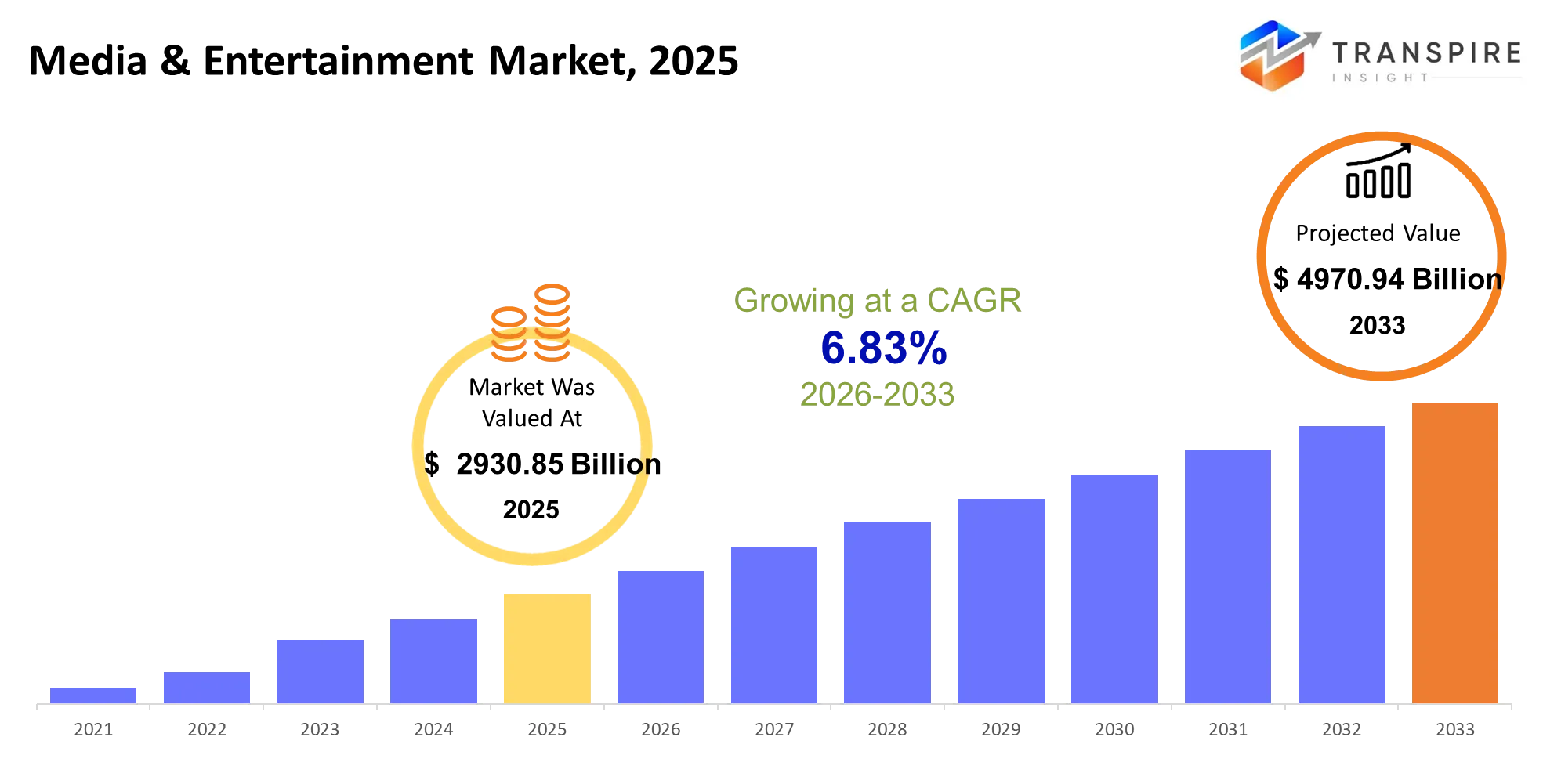
As per the Transpire Insight Analysis, The Media & Entertainment Market size is estimated at USD 2930.85 billion in 2025 and is anticipated to reach USD 4970.94 billion by 2033, growing at a CAGR of 6.83% from 2026 to 2033.
The media and entertainment market has moved from a scheduled, channel-based consumption model to an always-on digital ecosystem - streaming, social video, gaming, music, creator content, and live experiences. Over the past three to five years, streaming has shifted from subscription-led to a mixed economy of subscriptions, advertising, licensing and commerce. Smartphones and connected TVs have made discovery increasingly algorithmic. There has been a structural shift in content, advertising and fan engagement, with platforms combining the experience of viewing, recommendations, creators and transactions across screens. Fragmented audience attention has been the major catalyst, with consumers spreading limited entertainment time across streaming, social and gaming – which has driven income expansion, since content can be monetized multiple times via targeted advertising, subscriptions, licensing, merchandise and live experiences, in addition to a lone release window. And artificial intelligence fuels growth by lowering production and localization costs and expanding discovery at scale.
Media & Entertainment Market Size & Forecast:
- Market Size 2025: USD 2930.85 Billion
- Expected Market Value (2033): USD 4970.94 Billion
- Forecast CAGR (2026–2033): 6.83%
- Leading Region in 2025: North America
- Fastest Growing Region: Asia-Pacific
- Key Company Profiles: The Walt Disney Company, Netflix, Comcast, Warner Bros. Discovery, Sony Group, Paramount , Amazon, Alphabet, Meta Platforms, Apple, Tencent, Spotify, Universal Music Group, Nintendo, Electronic Arts.
Key Media & Entertainment Market Insights:
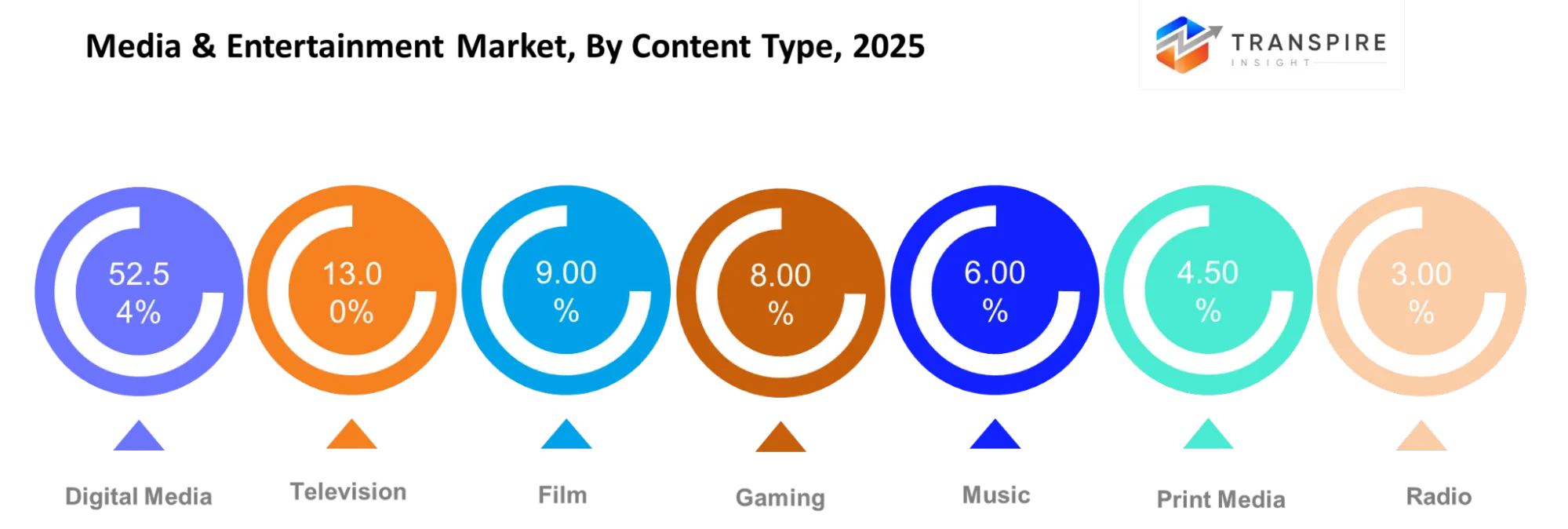
The 52.54% share of digital media shows that attention is the most valuable asset in the industry, and more platforms are vying for it based on data, discoverability, and repeat engagement, not on the number of posts. The market is moving to hybrid monetisation, where ads, subscriptions, licensing and commerce all contribute to funding content portfolios.
- Alphabet's AI-powered ad tools are bolstering digital media's 52.54% share, as discovery moves from a scheduled viewing model to a mobile-first approach.
- The 13.00% share of television is shifting to Comcast's Peacock and connected-TV libraries, creating more addressable ads than linear TV.
- At 9.00%, film is the beneficiary of Warner Bros. Discovery's franchise-windowing model, where movies go theatrically and then get streamed later.
- This 8.00% share is supported by Tencent's investments in live services, which transform playtime into a continuous stream of in-game transactions.
- As fans move away from ownership to access, Music is growing through personalisation at Spotify, and licensing discipline at Universal Music.
- The 4.50% share of print media is holding up from paid digital bundles and AI-driven newsroom processes rather than print reach.
- With the growing focus on social and in-person experiences, live entertainment is seeing a positive uptick at 3.96% with dynamic ticketing.
- Radio is rapidly becoming digital audio-with podcasts and connected cars and local advertising becoming more targeted. At 3.00%, radio is morphing into digital audio with podcasts, connected cars, and targeted local advertising.
- The 4.77% increase in streaming shows that Netflix and Disney have expanded their ad-tier offerings and that price-sensitive consumers are willing to pay less for ads.
What are the Key Drivers, Restraints, and Opportunities in the Media & Entertainment Market?
Driver:
Audience fragmentation is pushing media companies to redesign monetisation around advertising, creator ecosystems, and cross-platform distribution. The trigger is the migration of entertainment time from traditional television toward streaming, social video and gaming. Deloitte reports that US consumers spend about six hours a day on media and entertainment, while 54% of surveyed SVOD subscribers use at least one ad-supported service. This shift expands addressable inventory and gives platforms more ways to convert attention into advertising and subscription revenue.
Restraint:
Content economics remain difficult because premium production, rights, and customer-acquisition costs can rise faster than monetisation. This persists structurally as consumers have limited entertainment time and can cancel or rotate subscriptions, forcing platforms to continually refresh libraries while competing for advertising budgets.
Opportunity:
Always-on fandom can extend revenue beyond release windows through social content, exclusive experiences, shopping and merchandise. Deloitte’s 2026 research identifies year-round fan engagement as a route to retention, while AI can personalise discovery and automate localisation. Regional expansion, especially through mobile-first formats such as India’s short-form micro-dramas, can further unlock lower-cost content models. These models can also create new licensing opportunities by adapting successful intellectual property across languages, formats and distribution channels with faster production cycles ly.
What Has the Impact of Artificial Intelligence Been on the Media & Entertainment Market?
AI is providing a rethink of the media and entertainment sectors, moving from a focus on large-scale programming and manual workflows to data-driven content creation, delivery, and monetization. Streaming providers use recommendation engines to predict a viewer's next viewing choice, boosting viewer retention while drawing eyeballs to catalogue titles that would otherwise fly under the radar. Advertisers use AI models to align creative, audience segmentation, and placement in real time, boosting campaign relevance across social video and connected TV.
In production, generative AI can assist script ideation, tagging metadata, variants of trailers, subtitling, dubbing, visual effects pre-production, and archive searching. Newsrooms and studios can automate transcription, clipping, and moderation workflows to accelerate publishing and ease operator workloads. Predictive analytics can determine release strategies by estimating audience engagement, churn risk, and demand for various territories. But rights clearance, unreliable output, and integration costs present barriers to adoption. AI-generated content is potentially a threat to brand safety, misinformation and copyright infringement where the training data and rights ownership are contested. EU transparency obligations on AI-generated and manipulated content, including deepfakes, will be enforceable from August 2026.
In March 2026, CANAL+ partnered with Google Cloud to deploy advanced generative AI technologies across European and African streaming markets. This integration optimises the CANAL+ App ecosystem to unlock a new era of automated workflows, tailored audience engagement, and creative entertainment experiences.https://techafricanews.com/2026/03/11/new-canal-and-google-cloud-partnership-unlocks-ai-driven-entertainment-experiences/
Key Media & Entertainment Market Trends:
The industry is shifting from content ownership to audience data, advertising technology and creator-network benefits. Blended models, as opposed to a single subscription or advertising revenue, are increasingly becoming the revenue basis.
- Subscription growth is moving toward ad-supported and bundled streaming to lower churn.
- Social video has shifted from promotional media to a first choice for entertainment and advertising.
- The traditional linear TV purchase is being displaced by connected TV, which offers targeting and measurement at the household level.
- Short-form creator content is taking viewing time from destination television and movie-going
- Studios are increasingly licensing libraries with a mind to differentiate their platforms more effectively with proprietary content.
- Consumers are craving shared experiences, and live sports, concerts and immersive events are on the rise.
- Gaming is transitioning from a unit-based to a live-service, esports, virtual goods and community-reward business.
- AI is taking over localisation, discovery, moderation and campaign optimisation throughout content workflows.
- Privacy regulations are curbing reliance on third-party tracking and enhancing the worth of first-party audience data.
- Labelling and copyright control are increasingly becoming operational needs.
Media & Entertainment Market Segmentation
Content Type:
Digital Media leads at 52.54%, reflecting the rapid shift toward mobile, social, and on-demand consumption. Television accounts for 13.00%, retaining relevance through connected viewing and premium programming, while Film holds 9.00% and Gaming 8.00%, supported by cross-platform franchises and interactive experiences. Music contributes 6.00%, strengthened by streaming and personalised discovery, while Print Media represents 4.50% as publishers diversify digital revenue. Radio holds 3.00%, increasingly integrating podcasts and digital audio. Live Entertainment accounts for 3.96%, benefiting from event-led fan engagement. Meanwhile, Streaming Platforms are expanding at a 4.77% CAGR, as audiences increasingly prioritise flexible, personalised digital access across devices.
Revenue Model:
Advertising and Subscriptions remain core monetisation mechanisms as platforms balance recurring revenue with targeted audience reach. Licensing enables companies to extend successful intellectual property across territories, formats and third-party platforms, while Ticket Sales and Sponsorships strengthen live entertainment economics. Pay-Per-View supports premium sports, concerts and special events where consumers pay for specific access. Merchandise and commerce-linked models increasingly convert audience engagement into additional revenue, allowing media companies to monetise franchises beyond viewing and improve the lifetime value of established content.
Device Platform:
Smartphones & Tablets remain central to short-form video, social content, music and creator-led entertainment because they support frequent, mobile-first consumption. Smart TVs continue to support premium streaming and long-form viewing as households consolidate entertainment around connected screens. PCs & Laptops remain relevant for digital media, gaming and professional content consumption. Gaming Consoles strengthen interactive entertainment, while Set-Top Boxes retain relevance in traditional pay-TV ecosystems. Wearables and Connected Cars are creating additional contextual touchpoints for audio, video and personalised entertainment.
Distribution:
Streaming continues to reshape media access by allowing consumers to select content according to timing, device and location rather than fixed schedules. Broadcast remains important for mass-reach programming, particularly news, sports and national events, while Cable and Satellite retain established household infrastructure and premium channel relationships. Theatrical distribution remains strategically important for high-value film releases that depend on cinema experiences before subsequent digital windows. Digital Download supports transactional ownership, whereas Physical Media increasingly serves collectors, premium editions and specialised audiences seeking tangible content.
End User:
Consumers remain the principal audience and revenue base, but monetisation increasingly depends on relationships with Advertisers, Enterprises and other institutional users. Advertisers use audience data to improve targeting, measurement and campaign efficiency, while Enterprises adopt media for internal communications, training and customer engagement. Government and Educational Institutions use digital video and interactive content for public communication and learning. Media Agencies coordinate increasingly complex cross-platform campaigns, while Content Creators operate as independent production and distribution businesses, expanding the supply of specialised, community-driven entertainment.
What are the Key Use Cases Driving the Media & Entertainment Market?
The primary use case remains digital content consumption, led by Digital Media, smartphones, social platforms, and streaming services, which cater to consumers of videos, music, and creators. Streaming Platforms continue to bring incremental audiences at a 4.77% compound annual growth rate, beyond scheduled programming.
Growth of applications is directed to targeted advertising, subscription-based entertainment, gaming, and distribution of film and live events. Usage of audience data to optimise advertising campaigns, while platforms are integrating streaming, social discovery, and commerce to increase their retention and monetisation capabilities.
Emerging use cases include ongoing fandom, localisation through artificial intelligence, or interactive storytelling along with content-linked commerce. Connected televisions and connected cars, gaming environments, wearables, artificial intelligence and the Internet of things promise to transform content into an experiential and contextual offering.
|
Report Metrics |
Details |
|
Market size value in 2025 |
USD 2930.85 Billion |
|
Market size value in 2026 |
USD 3131.07 Billion |
|
Revenue forecast in 2033 |
USD 4970.94 Billion |
|
Growth rate |
CAGR of 6.83% from 2026 to 2033 |
|
Base year |
2025 |
|
Historical data |
2021 - 2024 |
|
Forecast period |
2026 - 2033 |
|
Report coverage |
Revenue forecast, competitive landscape, growth factors, and trends |
|
Regional scope |
United States; Canada; Mexico; United Kingdom; Germany; France; Italy; Spain; Denmark; Sweden; Norway; China; Japan; India; Australia; South Korea; Thailand; Brazil; Argentina; South Africa; Saudi Arabia; United Arab Emirates |
|
Key companies profiled |
The Walt Disney Company, Netflix, Comcast, Warner Bros. Discovery, Sony Group, Paramount , Amazon, Alphabet, Meta Platforms, Apple, Tencent, Spotify, Universal Music Group, Nintendo, Electronic Arts. |
|
Customization scope |
Free report customisation (country, regional & segment scope). Available customised purchase options to meet your exact research needs. |
|
Report Segmentation |
Content Type (Digital Media, Television, Film, Music, Gaming, Print Media, Radio, Live Entertainment); Revenue Model (Advertising, Subscriptions, Licensing, Ticket Sales, Sponsorships, Pay-Per-View, Merchandise, Others); Device Platform (Smartphones & Tablets, Smart TVs, PCs & Laptops, Gaming Consoles, Set-Top Boxes, Wearables, Connected Cars, Others); Distribution (Streaming, Broadcast, Cable, Satellite, Theatrical, Digital Download, Physical Media, Others); End User (Consumers, Advertisers, Enterprises, Government, Educational Institutions, Media Agencies, Content Creators, Others). |
Which Regions are Driving the Media & Entertainment Market Growth?
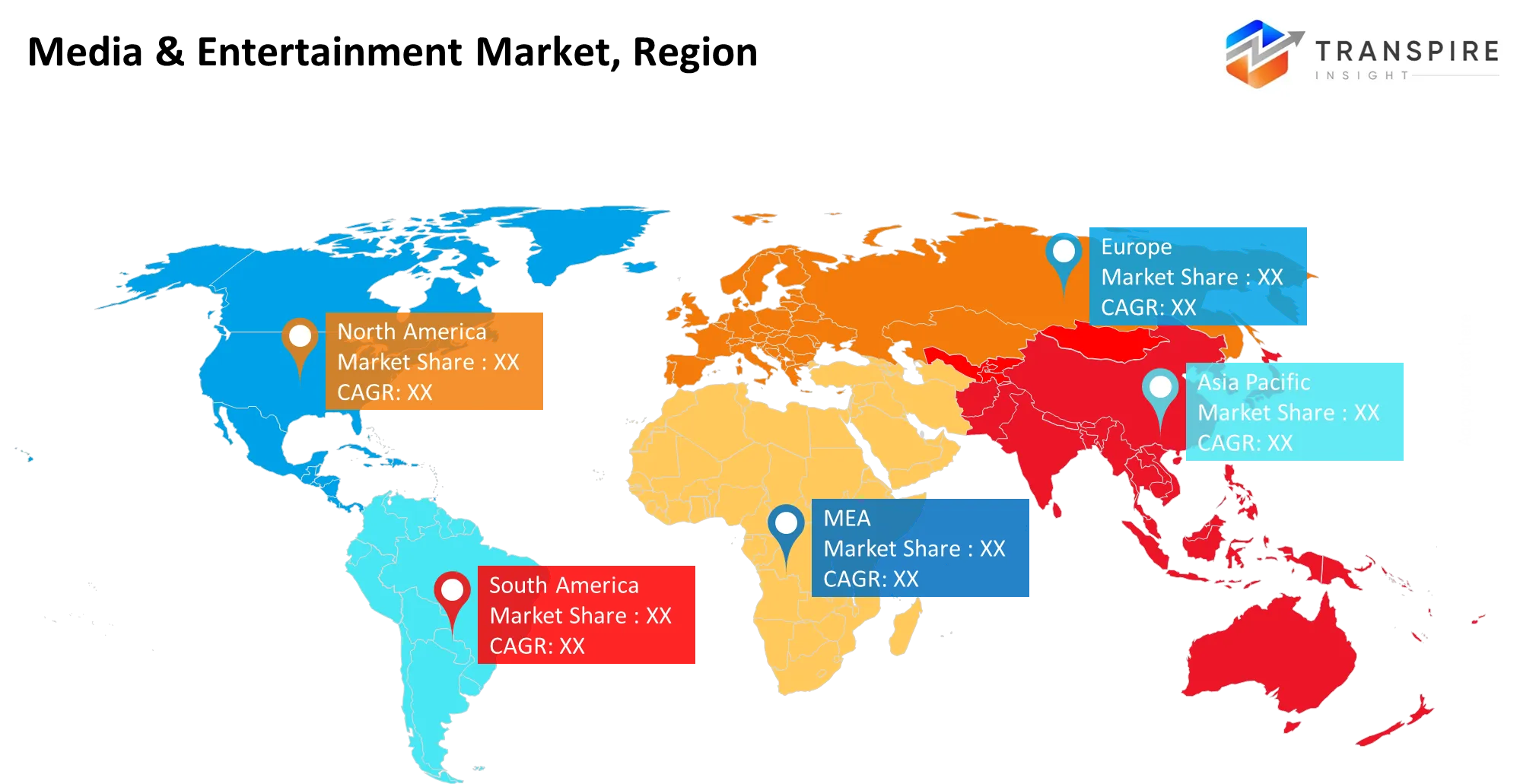
North America holds the largest market share of 39.87% owing to a significant content library, high ad spend, and mature subscription expenditure. The United States is the biggest video-streaming market and generates 113.3 billion, contributing the lion's share in the industry with the help of renowned studios, technology platforms, high-end cloud infrastructure, and a mature connected-TV ad ecosystem. This market enjoys clear policies on Intellectual Property Rights and high consumer willingness to pay for world-class sports and franchises, which enables monetisation of the market even in the mature industry at a lower growth rate.
In September 2026, Amazon launched a five-service streaming bundle on Prime Video in the U.S. This corporate partnership brings together AMC+, BritBox, MGM+, PBS Masterpiece, and STARZ into a single discounted interface, reinforcing how tech platforms leverage mature subscription ecosystems to optimise content distribution and retain price-sensitive consumers.http://press.aboutamazon.com/prime-video/2026/9/five-service-streaming-bundle-launches-on-prime-video-in-the-u-s
Europe is the biggest regional market at 22.00%, with a multi-language consumer base, a Public Service Broadcaster market, and strong regulation. Increasing broadband penetration and investment obligations in local content and Pan-European digital distribution are supporting regional growth. Privacy regulation pushes towards first-party data models, with an increased need for trusted relationships with local publishers and broadcasters. Europe's strength comes from a diversity of public and commercial media services, although the sheer scale of language diversification and disparate national rights markets complicate the ecosystem.
In July 2026, MFE-MediaForEurope announced plans to launch a single, unified pan-European streaming platform by combining the user interface developed in Italy with the technology supporting Germany's Joyn streaming service.https://www.broadbandtvnews.com/2026/07/10/mfe-to-launch-unified-european-streaming-platform-from-2027/
Asia Pacific is 27.00%, the most rapidly expanding region, with a CAGR of 5.03%, driven by mobile-first video, gaming, creator commerce and the acceleration of digital advertising on the back of less mature subscription spend. Improved connectivity, affordable phones and local language content are broadening access beyond major urban centres, with the opportunity capital on scalable ad-supported streaming, gaming conglomerates and international intellectual property. Revenue from the entertainment and media market in China is forecast to grow 6.1% annually, mostly from the internet advertising segment.
In September 2026, iQIYI unveiled a slate of over 350 new titles and expanded its "All in AI" strategy at its iJOY Conference. This product launch accelerates long-form content production and enhances commercial digital advertising frameworks by fostering a dynamic creator ecosystem tailored to China’s expanding digital entertainment market.https://sg.finance.yahoo.com/news/iqiyi-ijoy-conference-2026-expanding-075400560.html
Who are the Key Players in the Media & Entertainment Market, and how do they compete?
In a world of reserved rights, proprietary audiences, and cross-platform monetisation, competition increasingly centres on premium intellectual property, proprietary audience data, and monetisation of audiences at scale through advertising, subscriptions, and commerce. Disney, Warner Bros. Discovery, Paramount , and Comcast compete via their franchises, sports rights, and bundled streaming ecosystems with advertising tiers that provide scale to price-sensitive households. Netflix wins on scale, recommendation, and disciplined spend on content; Amazon and Apple leverage entertainment to create on-demand ecosystems that support broad Prime and device access. Alphabet and Meta shift budgets to creator-led video, artificial intelligence-based targeting and measurement, abandoning expensive studio libraries. Sony, Nintendo, and Electronic Arts depend on exclusive franchises, hardware ecosystems, live services, and digital purchases to compete in gaming; Tencent has combined gaming, social distribution, and mobile payments in Asia; Spotify and Universal Music Group focus on personalisation, licensing negotiations, artist tools, and podcast or audio inventory expansion. The strongest will succeed by controlling costs, producing locally, acquiring selective rights, and leveraging data-enabled advertising.
Key Players are:
- The Walt Disney Company
- Netflix
- Comcast
- Warner Bros
- Discovery
- Sony Group
- Paramount
- Amazon
- Alphabet
- Meta Platforms
- Apple
- Tencent
- Spotify
- Universal Music Group
- Nintendo
- Electronic Arts
Recent Development News
- In September 2026, Vzy launched its Linear TV Streaming (LTS) platform in India. This unified application integrates over 200 live television channels with 29 major OTT streaming services and an expansive repository of free content. The service directly addresses the fragmented digital viewing experience by allowing consumers to toggle seamlessly between traditional broadcast networks and on-demand streaming through a singular login interface.https://www.moneycontrol.com/technology/vzy-launches-linear-tv-streaming-with-200-live-channels-and-ott-platforms-article-14037996.html
- In February 2026, Paramount Skydance Corporation entered into a definitive merger agreement to acquire Warner Bros. Discovery for approximately USD 108 billion. This massive linear and digital asset consolidation forms a next-generation media powerhouse, resetting streaming and studio scale expectations worldwide.https://www.minichart.com.sg/2026/03/02/paramount-skydance-to-acquire-warner-bros-discovery-in-110-billion-merger-creating--media-powerhouse/
What Strategic Insights Define the Future of the Media & Entertainment Market?
The industry is shifting to an attention-led future as platforms incorporate premium content, creators, and measurable advertising, rather than subscription-only. The threat is not just cancellation; it's audience fragmentation causing higher marketing costs as viewership is divided across social video, games, streaming, and live, as well as increased regulation around AI transparency, copyright, and access to personal data that will restrict automation and targeting of content. AI-enabled rights-free localisation, through high-speed dubbing and subtitling, metadata enrichment, and replica ads, can allow a hit show to become multilingual and multiplatform at marginal cost. Beyond unifying the available first-party data, investing in open advertising stacks, and introducing live, gaming, and creator media as brand extensions should be a priority. Companies should combine the strengths of human imagination and intellectual property rights teams with responsible AI governance, which will be even more important as ad spend outpaces consumer spend.
Key Segmentations are:
Content Type
- Digital Media
- Television
- Film
- Music
- Gaming
- Print Media
- Radio
- Live Entertainment
Revenue Model
- Advertising
- Subscriptions
- Licensing
- Ticket Sales
- Sponsorships
- Pay-Per-View
- Merchandise
- Others
Device Platform
- Smartphones & Tablets
- Smart TVs
- PCs & Laptops
- Gaming Consoles
- Set-Top Boxes
- Wearables
- Connected Cars
- Others
Distribution
- Streaming
- Broadcast
- Cable
- Satellite
- Theatrical
- Digital Download
- Physical Media
- Others
End User
- Consumers
- Advertisers
- Enterprises
- Government
- Educational Institutions
- Media Agencies
- Content Creators
- Others
By Regional Analysis
North America
- US
- Canada
- Mexico
Europe
- Germany
- UK
- France
- Italy
- Spain
- Russia
- Rest of Europe
Asia Pacific
- China
- Japan
- India
- South Korea
- Australia
- Rest of Asia Pacific
South America
- Brazil
- Argentina
- Rest of South America
Middle East & Africa
- UAE
- Saudi Arabia
- Qatar
- South Africa
- Rest of the Middle East & Africa
Frequently Asked Questions
Find quick answers to common questions.
The media & entertainment market size was valued at USD 2930.85 billion in 2025 and is poised to reach USD 4970.94 billion by 2033, expanding at a 6.83% CAGR.
Key segments for the media & entertainment market are Content Type (Digital Media, Television, Film, Music, Gaming, Print Media, Radio, Live Entertainment); Revenue Model (Advertising, Subscriptions, Licensing, Ticket Sales, Sponsorships, Pay-Per-View, Merchandise, Others); Device Platform (Smartphones & Tablets, Smart TVs, PCs & Laptops, Gaming Consoles, Set-Top Boxes, Wearables, Connected Cars, Others); Distribution (Streaming, Broadcast, Cable, Satellite, Theatrical, Digital Download, Physical Media, Others); End User (Consumers, Advertisers, Enterprises, Government, Educational Institutions, Media Agencies, Content Creators, Others).
Growth is primarily driven by the shift toward streaming and digital media, expansion of ad-supported platforms, mobile-first consumption, gaming and creator ecosystems, AI-enabled content personalisation and localisation, and cross-platform monetisation of entertainment intellectual property.
The media & entertainment market is led by major manufacturers, including The Walt Disney Company, Netflix, Comcast, Warner Bros. Discovery, Sony Group, Paramount , Amazon, Alphabet, Meta Platforms, Apple, Tencent, Spotify, Universal Music Group, Nintendo, Electronic Arts.
North America holds 39.87% of the market, supported by mature streaming infrastructure, strong advertising ecosystems, major content and intellectual-property owners, high digital penetration, and advanced connected-TV and gaming networks.
Key opportunities include AI-enabled content localisation, ad-supported streaming, creator monetisation, live-event experiences, gaming-media convergence, digital commerce, and expansion of mobile-first entertainment across Asia-Pacific.
- The Walt Disney Company
- Netflix
- Comcast
- Warner Bros
- Discovery
- Sony Group
- Paramount
- Amazon
- Alphabet
- Meta Platforms
- Apple
- Tencent
- Spotify
- Universal Music Group
- Nintendo
- Electronic Arts
About the Authors

Mayur Shinde
I am Mayur Shinde, a Senior Research Analyst at Transpire Insight, specializing in the Automotive & Transportation and Information & Communication Technology (ICT) Industry. My work focuses on analyzing emerging market trends, technological advancements, competitive landscapes, and industry developments to deliver accurate, data-driven insights. I am passionate about transforming complex market information into clear, actionable content that helps businesses, professionals, and decision-makers stay informed and make confident strategic decisions.

Chakradhar Khansole
Chakradhar serves as the Research Director at Transpire Insight, bringing over 8 years of experience in technology, innovation, and strategic market intelligence. He specializes in transforming complex market data into actionable business insights that enable organizations to make informed, growth-oriented decisions. Recognized for his strategic vision and analytical expertise, Chakradhar leads high-impact research initiatives, delivering comprehensive market assessments, competitive intelligence, and forward-looking industry analysis.
Recently Published Reports
-
Apr 2026
3D Optical Profiler Market
3D Optical Profiler Market Size, Share & Analysis Report By Type (Desktop 3D Optical Profiler, and Portable 3D Optical Profiler), By Technology (Confocal Technology, and White Light Interference), By End-Use Industry (Manufacturing, Research Institutions, Automotive, Aerospace and Defense, Medical Devices, and Other), and Geography (North America, Europe, Asia-Pacific, Middle East and Africa, South and Central America), 2021 - 2031
-
Apr 2026
Depth Sensor Market
Depth Sensor Market Size, Share & Analysis Report By Type (Infrared Depth Sensors, Time-of-Flight (ToF) Sensors, Stereo Vision Sensors, Structured Light Sensors, Ultrasonic Depth Sensors), By Application (Automotive, Robotics, Gaming, Consumer Electronics, Industrial Automation, Healthcare, Security & Surveillance, Others), By End Users (Automotive Manufacturers, Consumer Electronics Companies, Healthcare Providers, Industrial Companies, Security Agencies, Gaming Companies, Robotics Companies, Others), and Geography (North America, Europe, Asia-Pacific, Middle East and Africa, South and Central America), 2021 – 2031
-
Apr 2026
Digital Manufacturing Market
Digital Manufacturing Market Size, Share & Analysis Report By Component (Hardware, Software, and Services), By Technology (Robotics, 3D Printing, Internet of Things (IoT), and Others), By Application (Automotive and Transportation, Aerospace and Defense, Consumer Electronics, Industrial Machinery, and Others), By Process Type (Computer-Based Designing, Computer-Based Simulation, Computer 3D Visualization, Analytics, and Others), and Geography (North America, Europe, Asia-Pacific, Middle East and Africa, South and Central America), 2021 – 2031
-
Apr 2026
Digital Visa Services Market
Digital Visa Services Market Size, Share & Analysis Report By Type (Individual Travelers, Group Travelers), By Application (Tourism, Business Travel, Others), and Geography (North America, Europe, Asia-Pacific, Middle East and Africa, South and Central America), 2021 – 2031