
Satellite Communications Market Summary:
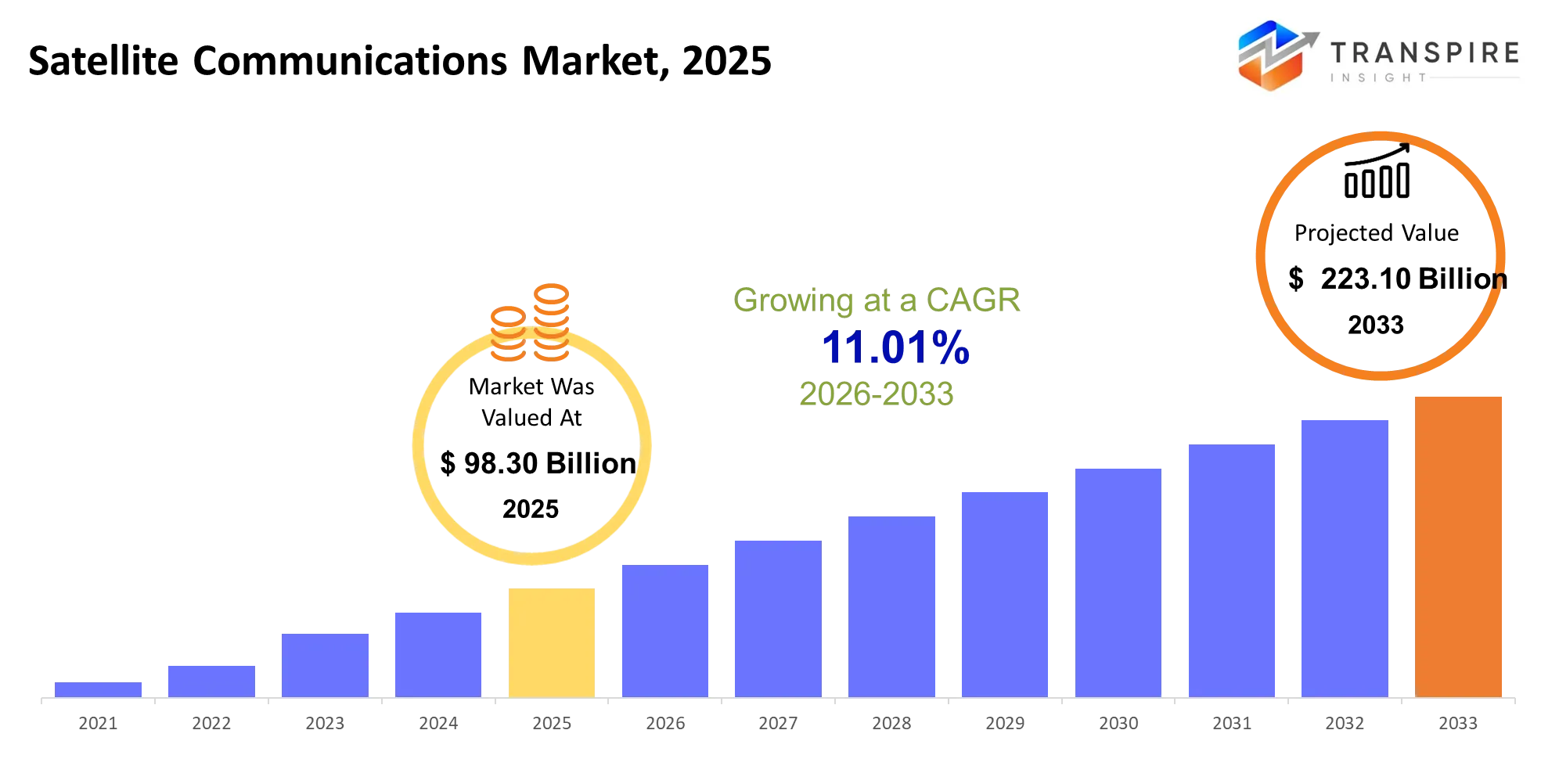
As per Transpire Insight Analysis, the Satellite Communications Market size is estimated at USD 98.30 billion in 2025 and is anticipated to reach USD 223.10 billion by 2033, growing at a CAGR of 11.01% from 2026 to 2033.
The satellite communications market provides broadband, voice, data, broadcasting, mobility and secure connectivity in places where terrestrial networks are not available, not reliable or too expensive to extend. In the past three to five years, the industry has moved away from relying mostly on traditional geostationary satellites. It has shifted toward -orbit networks, especially low Earth orbit constellations. These low Earth orbit constellations are built for latency and broader coverage. A major change in the industry has been the increased use of software-defined payloads. These payloads allow satellites to adapt easily. High-throughput satellites have also become more common. They carry data at higher speeds. Flexible ground infrastructure is another development. It adjusts capacity based on how much traffic's using the network at any given time. Demand has grown in sectors. The maritime sector uses satellite communications for ships at sea.
The aviation sector relies on it for in-flight connectivity. Remote enterprises need it to stay connected in remote areas. Government networks use it for communications. Direct-to-device services are now becoming a reality. These services let mobile phones connect directly to satellites. This has expanded the potential of satellite communications. Recent satellite deployments and industry partnerships show a trend. Satellite links are no longer treated as connections. Instead, they are being integrated with networks. This integration boosts service flexibility. It also opens up revenue opportunities. These opportunities are especially strong in regions and in markets focused on mobility.
Satellite Communications Market Size & Forecast:
- Market Size 2025: USD 98.30 Billion
- Expected Market Value (2033): USD 223.10 Billion
- Forecast CAGR (2026-2033): 11.01%
- Leading Region in 2025: North America
- Fastest Growing Region: Asia Pacific
- Key Company Profiles: SES, Intelsat, Eutelsat Group, Viasat, SpaceX, Telesat, Inmarsat, EchoStar, Iridium Communications, star, Thuraya, Hughes Network Systems, Gilat Satellite Networks, ST Engineering iDirect, Kratos Defense & Security Solutions
Key Market Insights:
The market is moving towards satellite companies offering increasingly flexible and high-capacity connectivity. It seems that the emerging trend in the usage of LEO and hybrid satellite-terrestrial systems is impacting the way connectivity is provided.
- Broadband is still leading the segment, accounting for 31.20% of the market owing to growing high-capacity connectivity for remote and mobility applications.
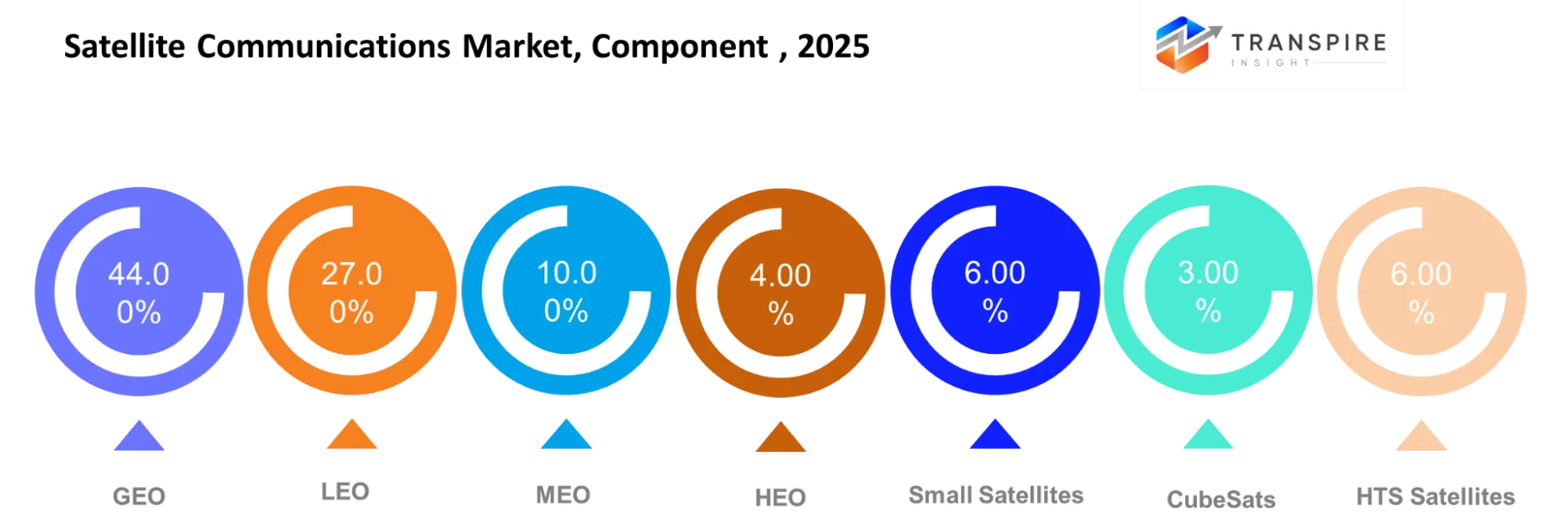
- The LEO satellite type holds 27.00% of the satellite type segment, driven by constellation connectivity services offering low latency and wide connectivity.
- The MEO satellites account for 10.00% of the segment and continue to cater to applications that require a balance between coverage and communication latency.
- The small satellites occupy 6.00% of the segment and continue to be deployed by companies exploring new spacecraft architecture designs.
- Cube satellites continue to hold 3.00% of the segment and drive experimentation with satellite platforms and communications applications.
- The HTS satellites constitute 6.00% of the segment and provide higher-capacity satellites used to direct bandwidth into areas with high traffic.
What are the Key Drivers, Restraints, and Opportunities in the Satellite Communications Market?
Drivers
Growth is facilitated by the increasing deployment of high-bandwidth broadband and multiorbital connectivity. The shift towards LEO has been very significant since reduced height of orbit can help decrease latency and make satellite broadband feasible for enterprise, maritime, aviation, and remote users. The provided segmentation categorises broadband as the requirement for reliable communication when the terrestrial network is poor, congested, broken, or unavailable. It is prompting providers to integrate their satellite networks with fibre, cellular, cloud, and wireless networks.
Restraints
The high costs of satellite manufacturing and launches, spectrum coordination, complicated ground infrastructure, and special terminals required. Structural impediments may delay the process and increase the cost of reaching underserved areas.
Opportunities
The Opportunities in the use of multi-orbital systems, software-based satellites, direct-to-device access, and shared infrastructure models where capital expenses are divided among several users. In the industry of shared D2D infrastructure and LEO maritime services, these demonstrate how collaborations can extend service to more people while making networks economically efficient. As these approaches evolve, operators will be able to reach new clients without relying solely on costly infrastructure.
What Has the Impact of artificial intelligence on the Satellite Communications Market?
The use of artificial intelligence will also be beneficial for satellite communication by providing ways to optimise the operation, capacity, and equipment management. It will help the operators to identify where and how much bandwidth should be redirected based on traffic analysis through machine learning and automated detection. Artificial intelligence will also contribute to the maintenance of satellites and ground equipment due to the identification of anomalies in the operation before they occur and lead to interruptions. In the case of multi-orbit satellites, artificial intelligence may be beneficial when it comes to finding the proper route among GEO, MEO and LEO satellites, taking into account the latency, congestion, coverage, and other considerations. This technology can also help with such tasks as antenna control, spectrum control and management, and detection of interference, as well as identification of customer demands. All this is quite relevant because of the increasing dynamism of satellites. The key difficulty will be associated with data availability, computational capacity, integration with network infrastructure and human competences needed for this process. In case of bad quality of data or incorrect forecasts, artificial intelligence will not be efficient enough as far as routing and maintenance are concerned. Thus, its adoption will be gradual.
Instance
In April 2026, Viasat introduced its Tactical Mission Fabric, which is an edge-to-cloud networking architecture that is meant to serve the purpose of military communication. TMF integrates multi-path satellite links with automatic network orchestration and artificial intelligence-driven data analytics to assist military users in making efficient use of the information for decision-making.https://www.viasat.com/news/latest-news/government/2026/viasat-tactical-mission-fabric-edge-to-cloud-connectivity/
Key Market Trends:
Market trends are moving from traditional satellite-based connectivity toward integration of connectivity involving several orbital layers with terrestrial connectivity. However, the most important move involves the trend toward flexible connectivity, direct device service, and adaptive capacity architecture based on location and traffic.
- The traditional GEO-only approach has been increasingly supplemented with LEO and MEO systems, providing more flexible multi-orbit connectivity.
- Satellite networks have been increasingly integrated with fibre, cellular, cloud, and edge terrestrial networks instead of being operated in isolation.
- Direct-to-device services have developed from development projects into commercial deployments.
- Operators of maritime satellites are shifting from the concept of satellite networks for connectivity to always-connected networks that facilitate not only crew communications but also navigation, operations, and digital services within the ship.
- Aviation connectivity is increasingly driven by the capacity to deliver reliable broadband to passengers, aircraft, and airline crew members.
- Throughputs and software-defined payloads help redirect capacity towards more demanding traffic areas.
Satellite Communications Market Segmentation
By Component
The component consists of Satellite Transponders, Antennas, Modems, Gateways, Terminals, Amplifiers, Network Equipment, and Software. Transponders and antennas continue to be an integral part of satellite communication infrastructure, but gateways and terminals are acquiring greater significance with the development of broadband and multi-orbit communications. Modems, network equipment, and software are also acquiring strategic significance as modern satellites need flexible traffic handling capabilities and network integration with terrestrial networks. Future growth will be driven by software-based equipment and adaptable ground infrastructure for multi-satellite operations.
By Satellite Type
Satellite types consist of GEO, MEO, LEO, HEO, Small Satellites, CubeSats, and HTS Satellites. GEO has the highest supplied share at 44.00% due to wide coverage and a well-established position in broadcasting and communications. LEO accounts for 27.00% and is the fastest-growing segment at 19.40% CAGR, owing to low-latency broadband and direct-to-device services. MEO accounts for 10.00%, whereas HEO accounts for 4.00%; Small Satellites and HTS Satellites have 6.00% each, and CubeSats make up 3.00%. Future demand will likely favour multi-orbital systems rather than any one orbital architecture.
By Services
Voice, Data, Broadband, Video Broadcasting, Mobile Satellite Services, Managed Services, and Connectivity Services are the types of services offered. Broadband Services dominate with 31.20%, owing to growing demand for fast connectivity in remote areas, enterprise, mobility markets, and underserved areas. Managed connectivity and mobile satellite services are also becoming important due to the preference for end-to-end network solutions rather than satellite capacity alone. Future demand will likely favour service providers that offer broadband, mobility, managed connectivity, and hybrid terrestrial connections.
By Application
These range from Telecommunications, Broadcasting, Maritime, Aviation, Defence, Government, Enterprise, and Remote Connectivity. Telecommunications and broadcasting have remained traditional sources of customers, while maritime, aviation, defence, and remote connectivity have been contributing towards building a larger business case for satellite communications. The growing need for dependable communications in areas out of range of ground-based systems is leading companies to include satellite networks in their resilient communications architecture. The future growth will be seen in hybrid applications combining satellite communications with cellular, fibre, and cloud networking.
By Frequency Band
The segments comprise L-Band, S-Band, C-Band, X-Band, Ku-Band, Ka-Band, and Q/V-Band. There are different frequency bands that meet the requirements of specific use cases related to coverage, capacity, propagation characteristics, mobility, and bandwidth. Ku-Band and Ka-Band are relevant for higher capacity broadband applications and high throughput services, while traditional frequency bands have continued to play a role in mobility, broadcasting, government, and specialised communications applications.
By End User
The end-users in this case comprise Commercial entities, Government agencies, Military agencies, Telecom operators, Media companies, Airlines, and Marine operators. The commercial and telecom sectors are embracing satellites for broadband, backhaul, enterprise connectivity, and remote operations, whereas government and military sectors are stressing security and reliability in their communication needs. Airlines and marine operators have become significant end-users due to the increasing demand for constant connectivity among passengers and crews, as well as operational staff. The future will be determined by the ability to provide bundled services where one satellite platform can cater to multiple end-user segments.
What are the Key Use Cases Driving the Satellite Communications Market?
The connectivity use case corresponds to broadband services. Satellite broadband is being leveraged to establish connections to distant areas, companies, institutions, and places where it is hard to lay down terrestrial networks. Other addressable markets include maritime, aviation, broadcasting, backhaul of telecommunications networks, military, and government applications, as they have the requirement of establishing connections over wide geographic regions. New use cases include direct device-to-device connection, connected automobiles, IoT devices that leverage satellites, disaster recovery connectivity, and hybrid networks comprising satellite, cell, or fibre networks. It is important to note that Low Earth Orbit is pertinent in such applications due to the low latency. In fact, multi-orbit networks will enhance resiliency because traffic will flow across satellites in various layers of the network.
|
Report Metrics |
Details |
|
Market size value in 2025 |
USD 98.30 Billion |
|
Market size value in 2026 |
USD 107.40 Billion |
|
Revenue forecast in 2033 |
USD 223.10 Billion |
|
Growth rate |
CAGR of 11.01%from 2026 to 2033 |
|
Base year |
2025 |
|
Historical data |
2021 - 2024 |
|
Forecast period |
2026 - 2033 |
|
Report coverage |
Revenue forecast, competitive landscape, growth factors, and trends |
|
Regional scope |
United States; Canada; Mexico; United Kingdom; Germany; France; Italy; Spain; Denmark; Sweden; Norway; China; Japan; India; Australia; South Korea; Thailand; Brazil; Argentina; South Africa; Saudi Arabia; United Arab Emirates |
|
Key company profiled |
SES, Intelsat, Eutelsat Group, Viasat, SpaceX, Telesat, Inmarsat, EchoStar, Iridium Communications, star, Thuraya, Hughes Network Systems, Gilat Satellite Networks, ST Engineering iDirect, Kratos Defense & Security Solutions |
|
Customization scope |
Free report customization (country, regional & segment scope). Avail customized purchase options to meet your exact research needs. |
|
Report Segmentation |
Component (Satellite Transponders, Antennas, Modems, Gateways, Terminals, Amplifiers, Network Equipment, Software); Satellite Type (GEO, MEO, LEO, HEO, Small Satellites, CubeSats, HTS Satellites); Service (Voice, Data, Broadband, Video Broadcasting, Mobile Satellite Services, Managed Services, Connectivity Services); Application (Telecommunications, Broadcasting, Maritime, Aviation, Defense, Government, Enterprise, Remote Connectivity); Frequency Band (L-Band, S-Band, C-Band, X-Band, Ku-Band, Ka-Band, Q/V-Band); End User (Commercial, Government, Military, Telecom Operators, Media Companies, Airlines, Maritime Operators) |
Which Regions are Driving the Satellite Communications Market Growth?
North America
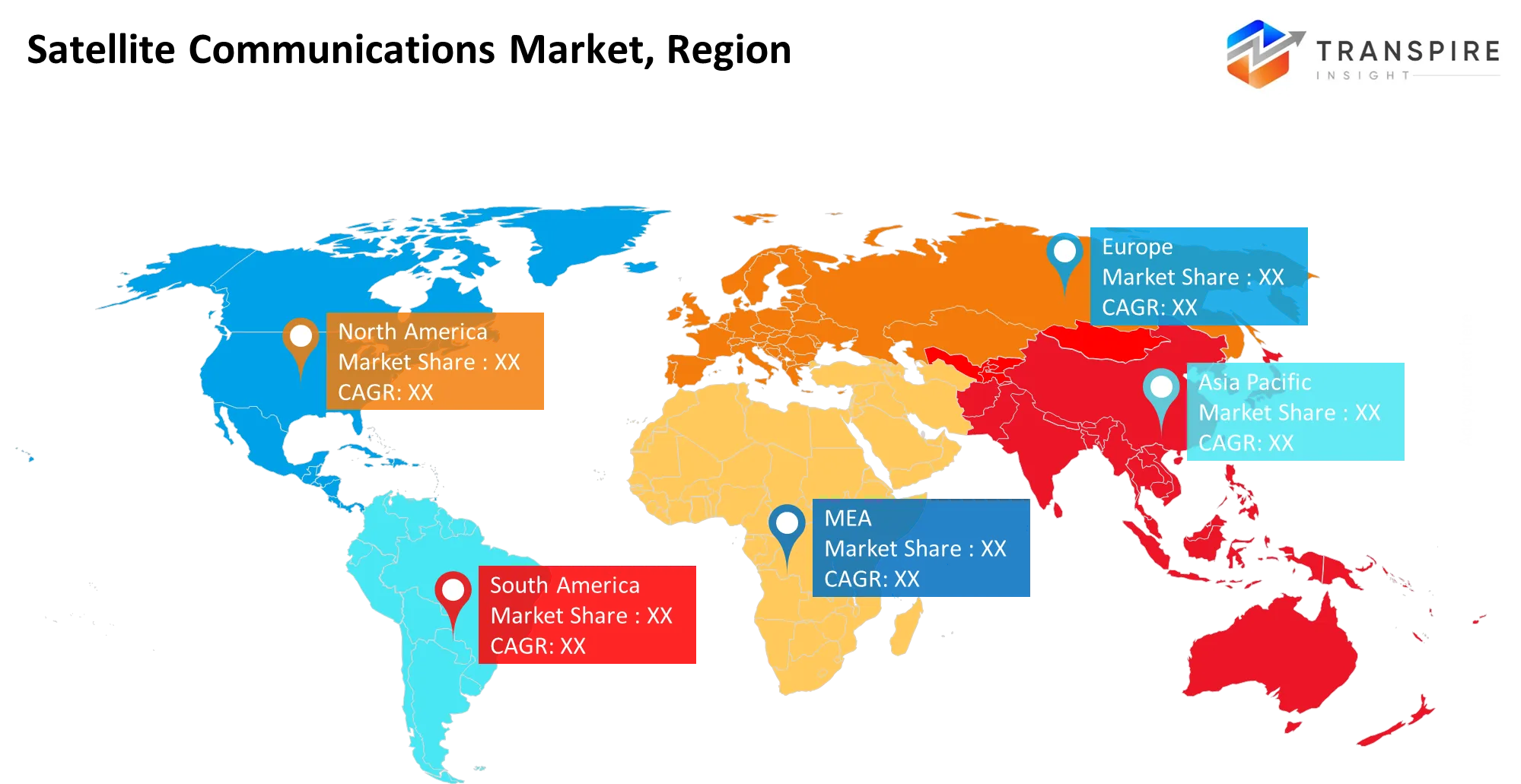
The North American market holds the lead in terms of the satellite communications market with a market share of 36.40%, owing to a well-established space industry and satellite operators, a high level of demand from the government segment, and effective communication infrastructure. This market features extensive spending on broadband, defence communications, high throughput satellites, and next-generation satellite constellations. In addition, owing to a strong customer base consisting of both government and commercial players, the region enjoys steady application of new technologies.
In September 2026, Viasat revealed that its ViaSat-3 F2 satellite had come into operation in the Americas region. The satellite increases Viasat’s capacity and flexibility in its network and will help satisfy the growing needs of the company’s government and commercial clients. This shows continuous investments in state-of-the-art satellite communication infrastructure in North America https://www.viasat.com/news/latest-news/corporate/2026/viasat-3-f2-enters-service/
Europe
Europe accounts for 27.00% of the market share. It is still a dominant force in the industry because of the presence of established satellite operators and aerospace firms, public sector programs, and borderless communications initiatives. Unlike North America, Europe takes pride in such aspects as security, autonomy, and reliability of digital infrastructure. Public sector involvement and the cooperation of satellite and telecom companies facilitate investment opportunities.
In October 2026, Eutelsat declared that Airbus Defence and Space had manufactured the first 32 new OneWeb LEO satellites at its Toulouse facility. These satellites are part of Eutelsat’s project to renew and improve its OneWeb satellite constellation in order to expand its satellite connectivity through LEO satellites. https://www.eutelsat.com/media-press/media-centre/news/eutelsats-oneweb-renewal-moves-toward-launch-first-new-satellites
Asia Pacific
The Asia Pacific holds 25.00% of the market share and is the fastest-growing, with a CAGR of 11.70%. Increasing digitisation, large populations in underserved regions, maritime operations, and rising connectivity demands are creating opportunities for satellite communications solutions. In addition, the development of satellite networks in various countries is expected to drive demand in the region for better internet connectivity and networking capabilities.
In July 2026, Reliance Jio was granted technical approval by India’s space regulator IN-SPACe for its 1,600-satellite LEO constellation. The constellation will be used to provide satellite broadband and mobile satellite services in India. https://www.business-standard.com/companies/news/reliance-jio-gets-in-space-approval-for-1-600-satellite-leo-network-126071700270_1.html
Who are the Key Players in the Satellite Communications Market, and how do they compete?
The competition in the satellite communications players will increasingly revolve around the architecture of their network, their geographical reach, capacity, latency, service reliability, and ability to link up their network to that on Earth. The firms have moved beyond selling capacity by deploying multiorbital networks, high throughput satellites, direct-to-device offerings, and customised connectivity solutions. Viasat relies on its high-capacity satellite infrastructure as well as its multiorbit offering. It uses its ViaSat-3 project, which focuses on adding capacity in major geographies, as well as its capability in beamforming that focuses bandwidth where there is more demand. The firm’s growth strategy entails both satellite launches and government, aviation, maritime and enterprise. Eutelsat uses its LEO (OneWeb) network and partnerships with telecom and connectivity providers. Its strategies centre around using partners across geographies and sectors, including maritime and government customers. Recent partnership agreements with AST Networks and Station Satcom are proof of Eutelsat’s focus on LEO scalability through established service channels.
Satellite Communications Market companies
- SES
- Intelsat
- Eutelsat Group
- Viasat
- SpaceX
- Telesat
- Inmarsat
- EchoStar
- Iridium Communications
- star
- Thuraya
- Hughes Network Systems
- Gilat Satellite Networks
- ST Engineering iDirect
- Kratos Defense & Security Solutions
Recent Development News
In August 2026, Eutelsat has confirmed its participation in the future European IRIS² sovereign connectivity program, where the firm will be taking a significant lead within the LEO constellation. It is worth noting that the new satellite infrastructure will comprise advanced features, such as beamforming antennas, 5G NTN, as well as optical ISL capability. https://www.eutelsat.com/media-press/media-centre/news/eutelsat-play-central-role-delivering-next-phase-europes-sovereign
In November 2025, Viasat successfully launched its ViaSat-3 F2 satellite via the United Launch Alliance Atlas V rocket. This satellite will provide high-capacity connectivity over the Americas and will be used for commercial mobility, fixed broadband, and defence applications. https://investors.viasat.com/news-releases/news-release-details/viasat-confirms-successful-launch-viasat-3-f2
What Strategic Insights Define the Future of the Satellite Communications Market?
The satellite communications market is evolving towards an integrated orbit network composed of GEO, MEO and LEO satellite assets working alongside terrestrial assets. One of the challenges that isn't obvious is the potential for increased pressure in spectrum coordination, orbital management, cyber security and ground network capacity. The largest market opportunity lies in to-device connectivity, particularly in areas where mobile coverage is difficult to successfully achieve using conventional towers and fibre. Those who are able to offer a mix of broadband, mobility, government and enterprise services on orbital layers will be better equipped to expand the revenue. Partnerships will remain relevant as satellite operators can engage customers more rapidly via telecom carriers, maritime integrators, cloud operators and government agencies. Strategic investments should concentrate on payload; systems that can collaborate on the ground; AI network management and technology at terminals to grow as necessary. Plans for launches and supplies should be added to reduce delays as well, and it is recommended that this is a retail business. The longterm benefits for the market will be seen when the connectivity is provided as a service rather than only selling a satellite capacity.
Component
- Satellite Transponders
- Antennas
- Modems
- Gateways
- Terminals
- Amplifiers
- Network Equipment
- Software
Satellite Type
- GEO
- MEO
- LEO
- HEO
- Small Satellites
- CubeSats
- HTS Satellites
Service
- Voice
- Data
- Broadband
- Video Broadcasting
- Mobile Satellite Services
- Managed Services
- Connectivity Services
Application
- Telecommunications
- Broadcasting
- Maritime
- Aviation
- Defense
- Government
- Enterprise
- Remote Connectivity
Frequency Band
- L-Band
- S-Band
- C-Band
- X-Band
- Ku-Band
- Ka-Band
- Q/V-Band
End User
- Commercial
- Government
- Military
- Telecom Operators
- Media Companies
- Airlines
- Maritime Operators
By Regional Analysis
North America
- US
- Canada
- Mexico
Europe
- Germany
- UK
- France
- Italy
- Spain
- Russia
- Rest of Europe
Asia Pacific
- China
- Japan
- India
- South Korea
- Australia
- Rest of Asia Pacific
South America
- Brazil
- Argentina
- Rest of South America
Middle East & Africa
- UAE
- Saudi Arabia
- Qatar
- South Africa
- Rest of the Middle East & Africa
Frequently Asked Questions
Find quick answers to common questions.
The satellite communications market size was valued at USD 98.30 Billion in 2025 and is poised to reach USD 223.10 Billion by 2033, expanding at a 11.01% CAGR.
Key segments for the satellite communications market are Component (Satellite Transponders, Antennas, Modems, Gateways, Terminals, Amplifiers, Network Equipment, Software); Satellite Type (GEO, MEO, LEO, HEO, Small Satellites, CubeSats, HTS Satellites); Service (Voice, Data, Broadband, Video Broadcasting, Mobile Satellite Services, Managed Services, Connectivity Services); Application (Telecommunications, Broadcasting, Maritime, Aviation, Defense, Government, Enterprise, Remote Connectivity); Frequency Band (L-Band, S-Band, C-Band, X-Band, Ku-Band, Ka-Band, Q/V-Band); End User (Commercial, Government, Military, Telecom Operators, Media Companies, Airlines, Maritime Operators)
Growth is primarily driven by increasing deployment of LEO satellites, growing satellite broadband adoption, expansion of 5G and IoT applications, and increasing demand for reliable communication in remote areas.
The market is led by major manufacturers including SES, Intelsat, Eutelsat Group, Viasat, SpaceX, Telesat, Inmarsat, EchoStar, Iridium Communications, star, Thuraya, Hughes Network Systems, Gilat Satellite Networks, ST Engineering iDirect, Kratos Defence & Security Solutions
The North American accounts for 36.40% of the total market share in satellite communication worldwide, owing to the superior infrastructure of satellites, robust military and aerospace expenditure, and the widespread use of satellite broadband internet
The commercial opportunities within the worldwide satellite communications market are seen in areas such as satellite broadband service growth, LEO satellites, rural connectivity, maritime and air communications, direct-to-device connectivity, and defense/government satellite services.
- SES
- Intelsat
- Eutelsat Group
- Viasat
- SpaceX
- Telesat
- Inmarsat
- EchoStar
- Iridium Communications
- star
- Thuraya
- Hughes Network Systems
- Gilat Satellite Networks
- ST Engineering iDirect
- Kratos Defense & Security Solutions
About the Authors

Tejashri Dhatrak
I am Tejashri Dhatrak, a Senior Research Analyst at Transpire Insight, specializing in the Aerospace and Defence sector. My work focuses on analyzing industry trends, defence technologies, market developments, and emerging innovations that shape the global aerospace and security landscape. At Transpire Insight, I research complex topics, evaluate credible sources, and transform technical insights into accurate, well-structured, and easy-to-understand content for industry professionals and decision-makers. My goal is to provide reliable, research-backed information that helps readers stay informed about defence capabilities, aerospace advancements, strategic developments, and the evolving dynamics of the global defence ecosystem.

Chakradhar Khansole
Chakradhar serves as the Research Director at Transpire Insight, bringing over 8 years of experience in technology, innovation, and strategic market intelligence. He specializes in transforming complex market data into actionable business insights that enable organizations to make informed, growth-oriented decisions. Recognized for his strategic vision and analytical expertise, Chakradhar leads high-impact research initiatives, delivering comprehensive market assessments, competitive intelligence, and forward-looking industry analysis.
Recently Published Reports
-
Apr 2026
Aerospace Fluoropolymers Market
Aerospace Fluoropolymers Market Size, Share & Analysis Report By Type (PTFE, FEP, PFA, ETFE, and Others), By Application (Electrical Insulation, Seals & Gaskets, Coatings, and Others), By End User (Commercial Aviation, Military Aviation, General Aviation, and Others), and Geography (North America, Europe, Asia-Pacific, Middle East and Africa, South and Central America), 2021 - 2031
-
Apr 2026
Airborne SATCOM System Market
Airborne SATCOM System Market Size, Share & Analysis Report By Type (SATCOM Terminals, Transceivers, Airborne Radio, Modems and Routers, SATCOM Radomes, and Other), By Application (Government and Defense and Commercial), and Geography (North America, Europe, Asia-Pacific, Middle East and Africa, South and Central America), 2021 – 2031
-
Apr 2026
Ship Leasing Market
Ship Leasing Market Size, Share & Analysis Report By Vessel Type (Container Ships, Bulk Carriers, Tankers, and Specialized Vessels), By Lease Duration (Short-Term Lease (Less than 1 year), Medium-Term Lease (1-5 years), and Long-Term Lease (More than 5 years)), By Lease Type (Bareboat Charter, Time Charter, Financial Lease, and Others), By End-User Industry (Oil and Gas, Manufacturing and Industrial, Automotive, Agriculture and Food, Retail and Consumer Goods, and Others), and Geography (North America, Europe, Asia-Pacific, Middle East and Africa, South and Central America), 2021 – 2031
-
Apr 2026
Thread Rolling Dies Market
Thread Rolling Dies Market Size, Share & Analysis Report By Type (Flat Thread Rolling Dies, Circular (Cylindrical) Dies, Tangential Thread Rolling Dies, Planetary Thread Rolling Dies, and Other Types), By Material Type (High-Speed Steel (HSS), Carbide, Tool Steel, Alloy Steel, and Other Specialized Alloys), By Distribution Channel (Direct Sales, Distributors and Dealers, and Online Platforms), By Application (Automotive Industry, Aerospace and Defense, Construction and Infrastructure, Industrial Machinery, Electronics and Electrical Components, Medical Devices, and Fastener Production), and Geography (North America, Europe, Asia-Pacific, Middle East and Africa, South and Central America), 2021 – 2031
Our Clients