
RTD Temperature Sensors Market Summary:
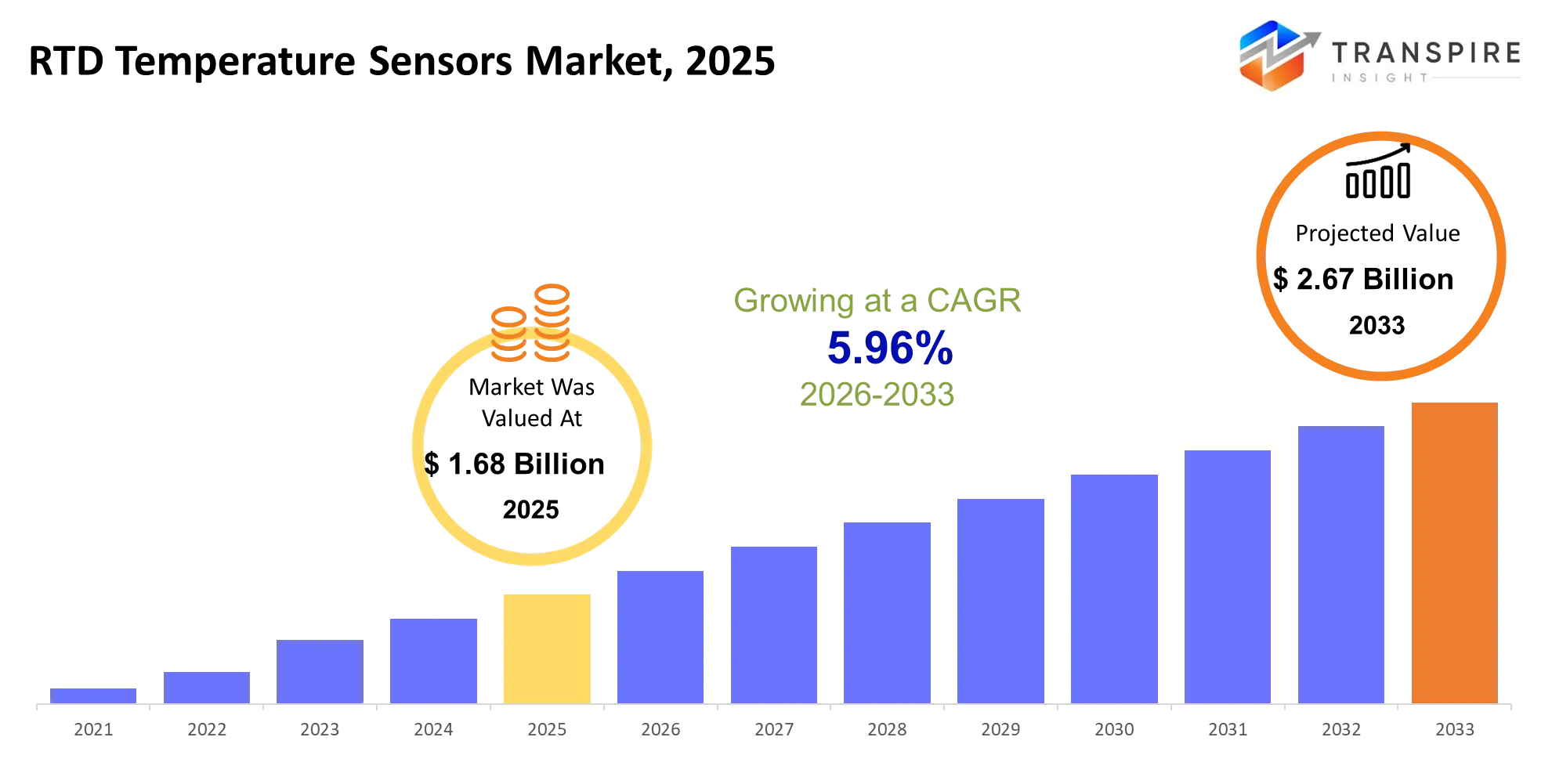
As per Transpire Insight, the RTD Temperature Sensors Market size is estimated at USD 1.68 billion in 2025 and is anticipated to reach USD 2.67 billion by 2033, growing at a CAGR of 5.96% from 2026 to 2033.
The RTD Temperature Sensors Market is changing accurate temperature monitoring across many industries. These include production, energy systems, healthcare equipment, automotive manufacturing, and building automation. Over the past three to five years, the market has seen a clear shift. Companies are now favouring sensor designs. Digital monitoring is becoming standard. Integration with automated control systems is also growing. Manufacturers need temperature readings. This is to keep product quality high. It is also to reduce equipment breakdowns. To meet important safety standards in processes. The rise of factories has made RTD sensors even more important. These sensors now support real-time monitoring in industrial environments. A major change is the use of film sensing elements. These offer smaller size and greater flexibility. They are ideal for applications with space. At the time, manufacturers are building sensor assemblies. These assemblies are designed to work with modern control platforms. This makes adoption easier and faster. As a result, more industrial operators are choosing RTD sensors. They are focused on measurements. They want to improve operating efficiency.. They aim for consistent process performance.
RTD Temperature Sensors Market Size & Forecast:
- Market Size 2025: USD 1.68 Billion
- Expected Market Value (2033): USD 2.67 Billion
- Forecast CAGR (2026–2033): 5.96%
- Leading Region in 2025: Europe
- Fastest Growing Region: Asia Pacific
- Key Company Profiles: TE Connectivity, Honeywell, Siemens, ABB, WIKA, Omega Engineering, Endress+Hauser, Emerson, Yokogawa, Watlow, Omron, Schneider Electric, Pepperl+Fuchs, Sensata Technologies, Baumer
Key Market Insights:
The market is moving towards reliable temperature measurement, with platinum RTDs in the prime position owing to their reliable performance in industrial settings.
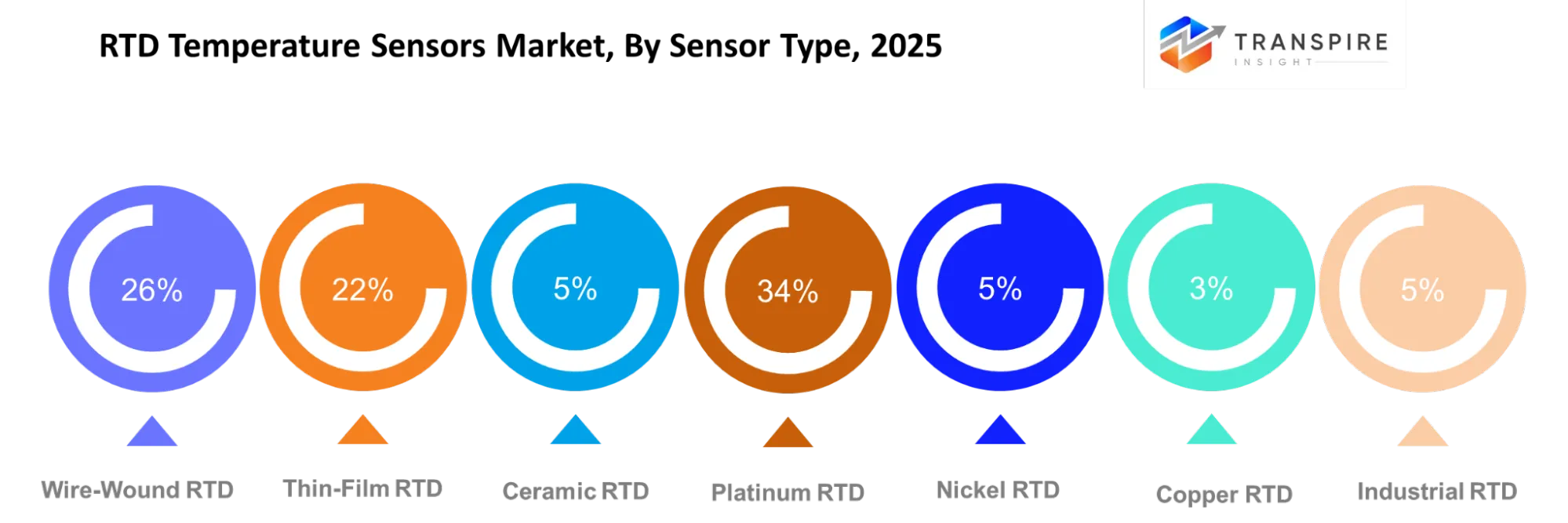
- The platinum RTDs holds 34.0% in the segment-wise distribution, backed by the reliability and stable performance in the industrial processes and measurement of temperature.
- The wire-wound RTDs account for 26.0% in the segment-wise distribution, with increasing efforts to improve their performance and stability in demanding operating conditions.
- Thin film RTDs make up 22.0% in the segment-wise distribution and will continue to enjoy a growth of 7.8% in CAGR, backed by the need for small sensor performance in automation systems.
- Ceramic RTDs have a 5.5% share in the segment distribution, with growing interest in their thermal resistance and stable performance in industrial applications.
- Nickel RTDs account for 5.0% in the market distribution owing to their application in temperature sensing within cost-effective ranges of measurement.
What are the Key Drivers, Restraints, and Opportunities in the RTD Temperature Sensors Market?
Drivers:
Industrial automation is making precise and repeatable temperature readings increasingly necessary. As factories upgrade their equipment, temperature data is used to manage the process parameters, ensure product uniformity, and detect abnormal system performance. Upgrading to interconnected factory systems provides further opportunities for RTD sensors due to the importance of accurate measurements for controlling the process and monitoring its progress. Thus, the development of digital control systems contributes to the transition of temperature measurement from an independent process to a management one.
Restraints:
The installation of high-accuracy RTD probes can be more expensive compared to other types of sensors when the application requires specific materials, protection of probes, transmitters, and proper cable wiring. Complicated installation procedures can also be seen in older plants that have to upgrade their control systems to be able to use digital data.
Opportunities:
Thin film designs along with measurement systems provide scope for developing products. The thin film RTD is estimated to r. This provides scope for manufacturers to design small-sized sensors which can be installed on equipment having limited space for installation. Opportunities also exist because of industrialisation in the Asia Pacific region, which can generate demand for process monitoring. Those suppliers that provide sensors with easy integration and diagnostics will have a competitive advantage over others.
|
Driver |
Relative Impact on Growth (%) |
Geographic Relevance |
Impact Timeline |
Demand Strength |
Growth Mechanism |
Key Beneficiaries |
Major Constraint |
|
Industrial automation and process control expansion |
30% |
Asia-Pacific, North America, Europe |
Medium-term |
High |
Improves process accuracy, safety, and operational efficiency |
Sensor manufacturers, automation integrators, industrial operators |
High installation costs and lengthy qualification cycles |
|
Rising demand for precision temperature monitoring |
24% |
North America, Europe, Asia-Pacific |
Short-term |
High |
Enables accurate temperature measurement across critical applications |
Sensor suppliers, pharmaceutical firms, food processors |
Competition from alternative temperature sensing technologies |
|
Industry 4.0, IIoT, and smart sensor integration |
19% |
North America, Europe, Asia-Pacific |
Medium-term |
High |
Enables real-time monitoring and predictive equipment maintenance |
Smart sensor vendors, software providers, automation manufacturers |
Legacy integration challenges and cybersecurity costs |
|
Pharmaceutical, biotechnology, and semiconductor manufacturing expansion |
15% |
North America, East Asia, Europe |
Long-term |
High |
Supports validated temperature control in sensitive manufacturing processes |
Precision sensor suppliers, semiconductor firms, pharmaceutical manufacturers |
Strict qualification and validation requirements |
|
Electrification, energy efficiency, and equipment modernization |
12% |
Asia-Pacific, Europe, North America |
Long-term |
Medium |
Supports thermal monitoring across batteries and power equipment |
RTD suppliers, automotive manufacturers, energy equipment providers |
Price sensitivity and competing sensor technologies |
|
Total |
100% |
— |
— |
— |
— |
— |
— |
What Has the Impact of Artificial Intelligence Been on the RTD Temperature Sensors Market?
The AI influence on RTD Temperature Sensors Market lies predominantly in the systems that collect, analyse, and take any further steps using temperature data rather than in the sensing elements themselves. In smart factories, the temperatures measured by RTDs may be correlated with information about vibrations, pressure, electrical current values, and the production processes. Machine learning may be used to find out peculiarities and changes in the patterns of temperature behaviour. Another potential domain for artificial intelligence influence on the RTD market is automation. As soon as temperature readings become available to industrial controllers and analytics systems, the software may assist the operators in managing the settings of production processes such as heating, cooling, and production. Predictive maintenance systems may use historical temperature data to predict any malfunction in equipment. The efficiency of AI depends on the quality of measurement, the availability of sufficient historical data and integration with the systems that are currently used in industrial processes. Such factors as sensor drift and poor calibration, insufficient amounts of data, and differences in equipment models may affect accuracy. Small enterprises may have problems with the cost of AI implementation due to additional expenses on software, connectivity, cybersecurity, and training personnel.
Instance:
In August 2026, the edgeRX Pro sensor module was introduced by TDK Corporation. This device uses edge AI and temperature sensing technology to identify equipment issues and perform predictive maintenance in industrial environments. This shows the advancements made by AI-based sensing technology in industry.
Key Market Trends
RTD sensor development trends are tending towards smaller dimensions, more convenient installations, and smarter temperature measurements.
- Suppliers of temperature measuring equipment stopped at conventional probe development and started to create sensors that can be installed on smaller electronics and automated equipment.
- There appeared new trends in thin-film RTDs manufacturing, which can allow building more compact sensors suitable for both industrial and electronic applications.
- Temperature measurements in industries have become closer to programmable controllers and remote input-output modules. So, there have been fewer barriers between sensors and the automation of manufacturing processes.
- More effort is made to increase long-term stability and measurement consistency for temperature sensors to decrease the time when calibrations become necessary and avoid production fluctuations.
- There has been developed a great variety of different types of housing, probe lengths and mounting methods for different conditions and different installation possibilities.
- RTD module wiring configurations have become more diverse to give engineers the possibility to choose wiring according to many criteria (installation distances, measurement accuracy
RTD Temperature Sensors Market Segmentation
By sensor types:
The platinum RTD is determined as the leading sensor type based on the provided data; however, there is a discrepancy between 74.0% and 34.0% of the mentioned values. The wire-wound RTD sensors make up 26.0% of the provided market segment distribution, while the thin-film RTDs have 22.0%. The thin-film RTDs are expected to experience the highest growth rate (CAGR) at 7.8%, offering opportunities for miniaturisation of the design. Ceramic RTDs make up 5.5%, nickel RTDs 5.0%, copper RTDs 3.5%, industrial RTDs 2.5%, and other RTD types 1.5%. These values need to be reconciled before publishing since the categories may overlap.
By materials:
Platinum must be used where stability and accuracy of the resistance values are desired. Nickel and copper can be used under certain temperature ranges and cost constraints. Ceramics, stainless steel, glass, and polymers will be used where specific characteristics of construction, insulation, and environmental protection are required. Selection will depend upon the sensor used and process conditions.
By Temperature range:
RTD Application -200°C to -50°C -50°C to 0°C 0°C to 200°C 200°C to 500°C 500°C to 850°C >850°C Cryogenic & other Sensor Limitation -materials and construction can constrain the range -not all RTD sensors can be made for all ranges -platinum type RTDs are mostly employed for mild industrial temperatures -specifically designed RTDs can be employed
By application:
Temperature is a parameter that should be measured in other industrial processes since it has an effect on the quality of the product, equipment, and safety of the process. It is extensively used in automotive systems, medical equipment, HVAC systems, food and beverage processing, aerospace systems and energy and power plants. All industries have their own demands when it comes to accuracy, speed, weather protection or compliance.
By configuration:
Two-wire, three-wire and four-wire versions meet different requirements for measurement and installation purposes. Surface mount sensors are suitable for small machinery while probe, head mount and cable assembly are more appropriate for machinery, tanks, pipes and control panels. The wires may lead to errors due to the resistance of the wire being not negligible. Phoenix Contact provides different RTD input modules with various conductor configurations showing that sensors may not be suitable for automation systems.
By end user:
Production plants utilise RTDs to track machinery performance and safeguard process stability; chemical, oil, and gas operations will certainly call for the ideal RTD assemblies to endure the harsh atmosphere. Automotive suppliers consider the temperature to be an important part of both the manufacturing process as well as tools monitoring. Medical and food handling companies also depend upon reputable body temperature monitoring to support their procedures. Power-generating companies will additionally depend on temperature level monitoring for tool efficiency as well as operational dependability.
What are the Key Use Cases Driving the RTD Temperature Sensors Market?
Monitoring of industrial processes is one of the application areas where RTD temperature sensors are applied, especially those made of platinum, which allow accurate and repeatable temperature measurement. They are used to monitor temperatures in machines, pipelines, storage tanks, and manufacturing equipment. Apart from industrial facilities, RTD temperature sensors are applied in HVAC systems, automotive products, medical instruments, the food industry, and power generation. Reliable temperature sensing is necessary to control the heating or cooling process and to ensure controlled conditions of operation. Thin-film RTDs may be installed in places where there is a lack of space. New application fields of RTD temperature sensors include equipment monitoring and predictive maintenance. If RTD data are combined with digital control systems and analytical tools, abnormal temperature changes are detected.
|
Report Metrics |
Details |
|
Market size value in 2025 |
USD 1.68 Billion |
|
Market size value in 2026 |
USD 1.78 Billion |
|
Revenue forecast in 2033 |
USD 2.67 Billion |
|
Growth rate |
CAGR of 5.96% from 2026 to 2033 |
|
Base year |
2025 |
|
Historical data |
2021 - 2024 |
|
Forecast period |
2026 - 2033 |
|
Report coverage |
Revenue forecast, competitive landscape, growth factors, and trends |
|
Regional scope |
United States; Canada; Mexico; United Kingdom; Germany; France; Italy; Spain; Denmark; Sweden; Norway; China; Japan; India; Australia; South Korea; Thailand; Brazil; Argentina; South Africa; Saudi Arabia; United Arab Emirates |
|
Key company profiled |
TE Connectivity, Honeywell, Siemens, ABB, WIKA, Omega Engineering, Endress+Hauser, Emerson, Yokogawa, Watlow, Omron, Schneider Electric, Pepperl+Fuchs, Sensata Technologies, Baumer |
|
Customization scope |
Free report customization (country, regional & segment scope). Avail customized purchase options to meet your exact research needs. |
|
Report Segmentation |
Sensor Type (Wire-Wound RTD, Thin-Film RTD, Ceramic RTD, Platinum RTD, Nickel RTD, Copper RTD, Industrial RTD, Others)Material (Platinum, Nickel, Copper, Ceramic, Stainless Steel, Glass, Polymer, Others)Temperature Range (Below -200°C, -200°C to 0°C, 0°C to 200°C, 200°C to 500°C, 500°C to 850°C, Above 850°C, Cryogenic, Others)Application (Industrial Process, Automotive, Healthcare, HVAC, Food & Beverage, Aerospace, Energy & Power, Others)Configuration (2-Wire, 3-Wire, 4-Wire, Surface Mount, Probe, Head-Mount, Cable Assembly, Others)End User (Manufacturing, Chemical, Oil & Gas, Automotive, Healthcare, Food Processing, Power Generation, Others) |
Which Regions are Driving the RTD Temperature Sensors Market Growth?
North America:
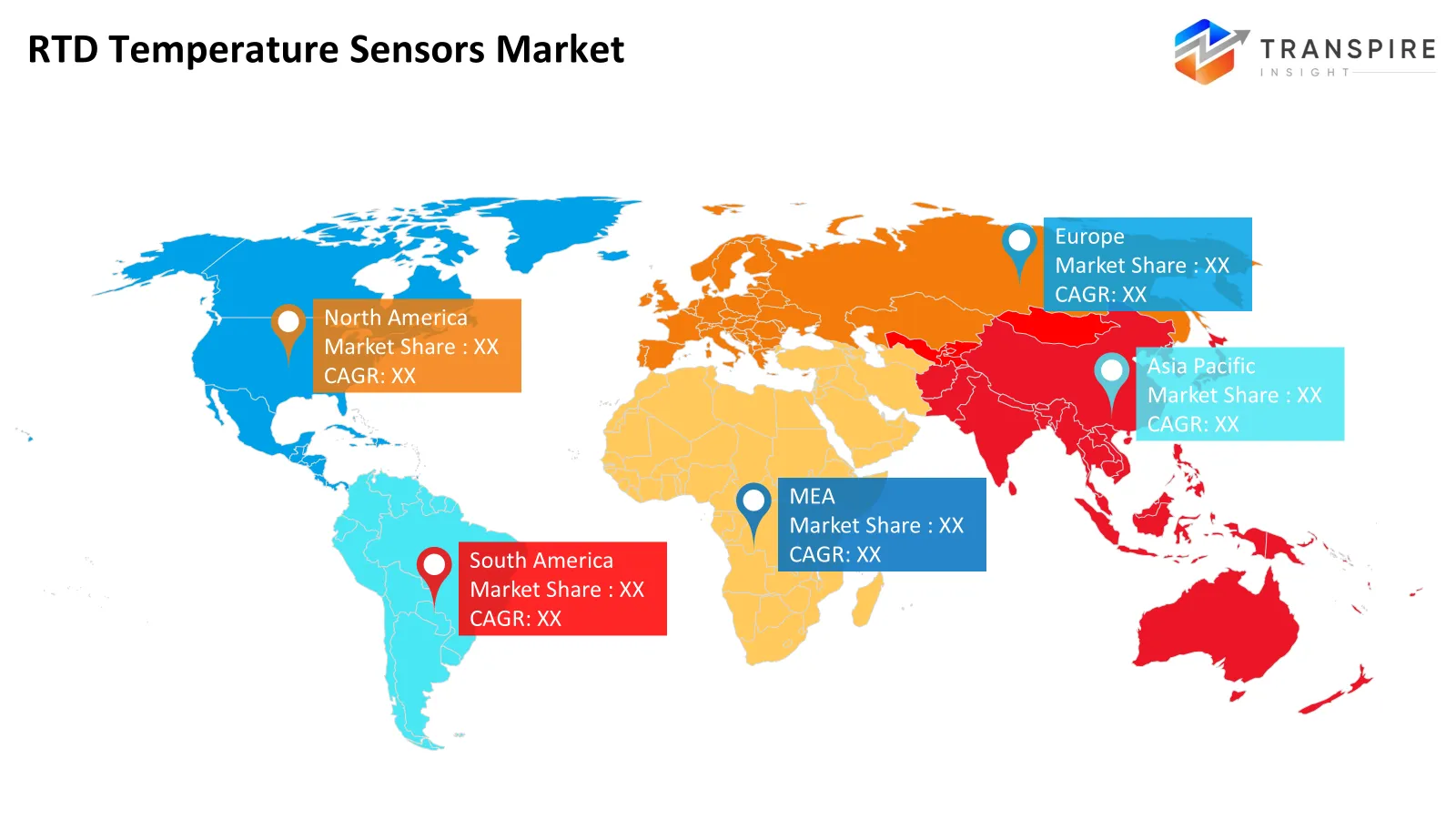
North America constitutes 27.0%. Due to its existing industrial automation base. Applications range from manufacturing, energy, health care equipment, and building systems. The demand is driven by modernisation of equipment, the need for reliable processes, and the need for measurement equipment in digital platforms. Suppliers of diagnostic, reliable measurement, and easily integrated equipment stand to benefit from replacement and industrial upgrades.
In October 2025, Bourns, Inc. launched the Riedon RTDW Series RTD Sensors that were built for precise temperature measurement and stability. This is in line with the need for precise sensing in industrial applications.
Europe:
The region accounts for 32.5%, with many applications for the high-accuracy process temperature measurement offered. With manufacturing growth, car production, chemical processes, and power plant infrastructure, multiple applications for RTD sensors exist. Industrial automation and the need for reliable process control, such as production and the use of accurate temperature measurement equipment, will continue to support demand. Modernisation of the manufacturing plants will also drive sales.
In April 2025, Phoenix Contact launched new RTD measuring modules for industrial automation that provide accurate temperature measurement and facilitate manufacturing transformation.
Asia Pacific:
Asia Pacific accounts for 30.0% of the distributed regional share and will be the fastest-growing region at a CAGR of 8.7%. Growth in manufacturing and investments in industrial infrastructure present opportunities for temperature sensing in factories. More automation means more demand for sensors that work with current control systems. Both local suppliers and foreign manufacturers can gain from providing affordable, specialised products with technical support on site.
In April 2025, Watlow has expanded its engineering and manufacturing capabilities by opening a new facility in Bengaluru, India.
https://www.watlow.com/Locations/BangaloreIN
Who are the Key Players in the RTD Temperature Sensors Market and how do they compete?
The competition in the RTD Temperature Sensors Market is based on the precision of measurements, sensor stability, product quality, customizability, and compatibility with industrial control systems. The market players are competing not only on price levels but also on their ability to meet specific application requirements and provide reliable after-sales services. Various kinds of companies operating in electronics manufacturing are covering different stages of the value chain. TE Connectivity stands out for its large choice of RTD elements and probe assemblies, both platinum thin film and wire wound. Honeywell is concentrating on the development of platinum RTDs in compact and surface-mount packages for thermal management and HVAC applications. In this way, the company is combining traditional temperature sensor technology with new types of sensors for electronics and buildings. Endress+Hauser provides industrial temperature measurement technologies, including special RTDs designed for improved response time, vibration resistance, and process reliability. Phoenix Contact is providing unique RTD input modules, connecting temperature sensors with industrial automation platforms.
RTD Temperature Sensors Market Companies
- TE Connectivity
- Honeywell
- Siemens
- ABB
- WIKA
- Omega Engineering
- Endress+Hauser
- Emerson
- Yokogawa
- Watlow
- Omron
- Schneider Electric
- Pepperl+Fuchs
- Sensata Technologies
- Baumer
|
Company |
Est. Revenue Share Range |
Key Offerings |
Strategic Positioning |
Geographic Strength |
Technology Focus |
|
Honeywell International |
Estimated: 3–7% |
RTD sensors, platinum sensing elements, miniature RTDs, industrial temperature sensors |
Precision sensing for industrial and electronic OEMs |
North America, Europe, Asia Pacific |
Miniaturized RTDs and precision platinum elements |
|
TE Connectivity |
Estimated: 3–7% |
Thin-film RTDs, platinum elements, RTD probes, custom sensor assemblies |
Broad OEM portfolio with application-specific customization |
North America, Europe, Asia Pacific |
Thin-film platinum elements and custom probe engineering |
|
Siemens |
Estimated: 2–5% |
SITRANS temperature instrumentation, resistance thermometers, industrial temperature assemblies |
Integrated instrumentation for automated industrial plants |
Europe, Asia Pacific, North America |
Digital temperature measurement and process automation |
|
Emerson |
Estimated: 2–5% |
Rosemount temperature sensors, RTD assemblies, thermowells, temperature transmitters |
Premium process measurement with lifecycle service support |
North America, Europe, Asia Pacific |
High-reliability RTDs and digital diagnostics |
|
Endress+Hauser |
Estimated: 2–5% |
iTHERM thermometers, modular RTDs, compact thermometers, measurement inserts |
Application-specific measurement for regulated industries |
Europe, Asia Pacific, North America |
Hygienic RTD designs and integrated diagnostics |
|
WIKA |
Estimated: 2–5% |
TR10, TR40, resistance thermometers, industrial RTD assemblies |
Industrial temperature portfolio and customized engineering |
Europe, North America, Asia Pacific |
Modular probe construction and process compatibility |
|
ABB |
Estimated: 1–4% |
SensyTemp sensors, resistance thermometers, temperature transmitters |
Industrial measurement integrated with automation systems |
Europe, Asia Pacific, North America |
Process-integrated sensing and digital connectivity |
|
OMEGA Engineering |
Estimated: 1–4% |
RTD probes, platinum RTD sensors, surface RTDs, temperature accessories |
Extensive catalog with flexible application solutions |
North America, Europe, Asia Pacific |
Flexible probe configurations and measurement compatibility |
|
JUMO |
Estimated: 1–3% |
Resistance thermometers, Pt100/Pt1000 sensors, industrial probes, temperature transmitters |
Specialized temperature measurement and control solutions |
Europe, Asia Pacific, North America |
Precision resistance measurement and configurable controls |
|
Watlow |
Estimated: 1–3% |
RTD sensors, temperature assemblies, thermal-system components, custom sensing solutions |
Application-led sensing for demanding thermal processes |
North America, Europe, Asia Pacific |
Integrated thermal engineering and customized sensor design |
Recent Development News
- In April 2025, Phoenix Contact launched three new RTD measuring modules in their Axioline F and Axioline P remote I/O systems. The modules accommodate common RTD sensors and have been made with specific configurations for industrial automation and hazardous-area applications. This marks an increase in the linkage between temperature measurement and industrial infrastructure. https://www.phoenixcontact.com/en-in/events-and-news/news/new-resistance-temperature-measuring-modules-for-axioline-f-and-axioline-p
- In January 2026, Phoenix Contact included Axioline RTD modules that had eight input channels and were capable of 2-wire, 3-wire, and 4-wire connections. The modules had hot-swap configurations in the Axioline P series. This is evidence of existing products and not an announcement of a different launch. https://www.phoenixcontact.com/en-ca/products/temperature-module-axl-p-rtd8-1f-1397156
What Strategic Insights Define the Future of the RTD Temperature Sensors Market?
Future development of the RTD Temperature Sensors Market depends on success in combining accurate measurement and miniaturisation, connectivity, and applicability. Development prospects of thin film RTDs lie in the need for small sensing units and their flexible integration where required by the equipment designers. Manufacturers working in Asia Pacific have opportunities associated with production expansion and further introduction of industrial automation. Another underestimated threat is related to misalignment of specifications of the sensors with conditions of their work. Inaccurate material choice, improper calibration or wiring, and low integration capability can worsen the results of measurement processes, even if sensors operate properly. Manufacturers should focus on ensuring high reliability of products, their compatibility with industrial control systems, and appropriate technical documentation. Partnerships with industrial automation firms could improve integration and allow reaching out to industrial consumers. Prior to making investments in this market, it is necessary to conduct a market assessment in terms of segment-level demands, regional outlooks, and the commercial potential of new applications.
Key Segmentations are:
Sensor Type
- Wire-Wound RTD
- Thin-Film RTD
- Ceramic RTD
- Platinum RTD
- Nickel RTD
- Copper RTD
- Industrial RTD
- Others
Material
- Platinum
- Nickel
- Copper
- Ceramic
- Stainless Steel
- Glass
- Polymer
- Others
Temperature Range
- Below -200°C
- -200°C to 0°C
- 0°C to 200°C
- 200°C to 500°C
- 500°C to 850°C
- Above 850°C
- Cryogenic
- Others
Application
- Industrial Process
- Automotive
- Healthcare
- HVAC
- Food & Beverage
- Aerospace
- Energy & Power
- Others
Configuration
- 2-Wire
- 3-Wire
- 4-Wire
- Surface Mount
- Probe
- Head-Mount
- Cable Assembly
- Others
End User
- Manufacturing
- Chemical
- Oil & Gas
- Automotive
- Healthcare
- Food Processing
- Power Generation
- Others
By Regional Analysis
North America
- US
- Canada
- Mexico
Europe
- Germany
- UK
- France
- Italy
- Spain
- Russia
- Rest of Europe
Asia Pacific
- China
- Japan
- India
- South Korea
- Australia
- Rest of Asia Pacific
South America
- Brazil
- Argentina
- Rest of South America
Middle East & Africa
- UAE
- Saudi Arabia
- Qatar
- South Africa
- Rest of the Middle East & Africa
Frequently Asked Questions
Find quick answers to common questions.
The RTD temperature sensors market size was valued at USD 1.68 Billion in 2025 and is poised to reach USD 2.67 Billion by 2033, expanding at a 5.96% CAGR.
Key segments for the RTD temperature sensors market are Sensor Type (Wire-Wound RTD, Thin-Film RTD, Ceramic RTD, Platinum RTD, Nickel RTD, Copper RTD, Industrial RTD, Others)Material (Platinum, Nickel, Copper, Ceramic, Stainless Steel, Glass, Polymer, Others)Temperature Range (Below -200°C, -200°C to 0°C, 0°C to 200°C, 200°C to 500°C, 500°C to 850°C, Above 850°C, Cryogenic, Others)Application (Industrial Process, Automotive, Healthcare, HVAC, Food & Beverage, Aerospace, Energy & Power, Others)Configuration (2-Wire, 3-Wire, 4-Wire, Surface Mount, Probe, Head-Mount, Cable Assembly, Others)End User (Manufacturing, Chemical, Oil & Gas, Automotive, Healthcare, Food Processing, Power Generation, Others).
Growth is primarily driven by increasing industrial automation, rising demand for accurate temperature measurement, expanding automotive and healthcare industries, growing adoption of Industry 4.0 technologies, and stringent quality and safety standards across manufacturing and process industries.
The market is led by major manufacturers including TE Connectivity, Honeywell, Siemens, ABB, WIKA, Omega Engineering, Endress+Hauser, Emerson, Yokogawa, Watlow, Omron, Schneider Electric, Pepperl+Fuchs, Sensata Technologies, Baumer.
The Europe region accounts for 32.5% share of the RTD temperature sensors market due to high automotive and industrial manufacturing base, stringent quality and safety requirements, rising automation, and the need for accurate temperature monitoring in healthcare, energy, and process industries.
The commercial opportunities in the RTD temperature sensors market are the increased demand for industrial automation, increased use of electric vehicles, growth in the healthcare and pharmaceutical industry, investment in renewable energy, and development of smart high-precision temperature sensing systems for Industry 4.0 applications.
- TE Connectivity
- Honeywell
- Siemens
- ABB
- WIKA
- Omega Engineering
- Endress+Hauser
- Emerson
- Yokogawa
- Watlow
- Omron
- Schneider Electric
- Pepperl+Fuchs
- Sensata Technologies
- Baumer
About the Authors

Avinash Kumar
I’m Avinash Kumar, a Senior Research Analyst at Transpire Insight, with expertise in the Electronics and Semiconductor and Energy & Power industry. My work focuses on analyzing emerging technologies, market trends, industry developments, and innovation across these sectors. I specialize in transforming complex technical and market insights into clear, research-backed content that helps professionals, businesses, and decision-makers stay informed. Through continuous industry research and data-driven analysis, I strive to deliver accurate, reliable, and practical perspectives on the latest advancements shaping the semiconductor and energy landscape.

Chakradhar Khansole
Chakradhar serves as the Research Director at Transpire Insight, bringing over 8 years of experience in technology, innovation, and strategic market intelligence. He specializes in transforming complex market data into actionable business insights that enable organizations to make informed, growth-oriented decisions. Recognized for his strategic vision and analytical expertise, Chakradhar leads high-impact research initiatives, delivering comprehensive market assessments, competitive intelligence, and forward-looking industry analysis.
Recently Published Reports
-
Apr 2026
Fiber Optic Faceplates Market
Fiber Optic Faceplates Market Size, Share & Analysis Report By Type (< 300 mm2, 300-350 mm2, and > 350 mm2, By Application (Night Vision, Holographic Imaging, Medical, and Others), and Geography (North America, Europe, Asia-Pacific, Middle East and Africa, South and Central America), 2021 - 2031
-
Apr 2026
High Temperature Superconductors Market
High Temperature Superconductors Market Size, Share & Analysis Report By Type (1G HTS, and 2G HTS), By Application (Power Cable, Fault Current Limiter, and Transformer), and Geography (North America, Europe, Asia-Pacific, Middle East and Africa, South and Central America), 2021 - 2031
-
Apr 2026
Industrial Plugs and Socket Market
Industrial Plugs and Socket Market Size, Share & Analysis Report By Type (Industrial Plugs, Industrial Sockets), By Current (Up to 32 A, 32 to 125 A, Above 125 A), By Protection (Dustproof and Splash Proof, Waterproof, Explosion Proof), By End User (Heavy Industries, Oil and Gas, Chemicals and Pharmaceuticals, Power Generation, Others), and Geography (North America, Europe, Asia-Pacific, Middle East and Africa, South and Central America), 2021 - 2031
-
Apr 2026
InGaAs Avalanche Photodiodes Market
InGaAs Avalanche Photodiodes Market Size, Share & Analysis Report By Type (1100 - 1700 nm, and 1000 - 1600 nm), By Application (Missile Warning System, Muzzle Flash Detection, Wafer Defect Inspection, Laser Rangefinders, and Others), and Geography (North America, Europe, Asia-Pacific, Middle East and Africa, South and Central America), 2021 - 2031