

Residential Water Heater Market Summary:
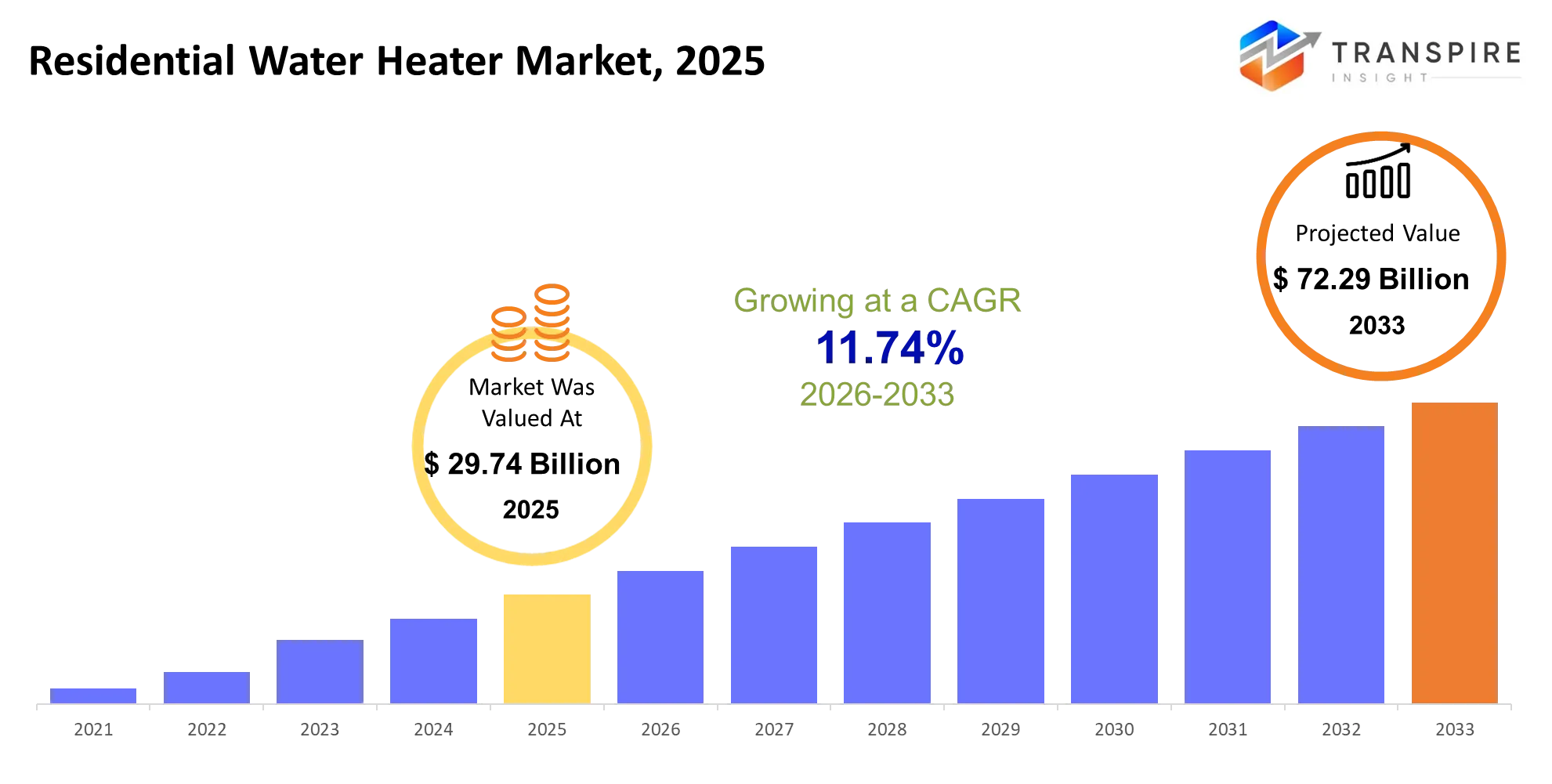
As per Transpire Insight, The Residential Water Heater Market size is estimated at USD 29.74 billion in 2025 and is anticipated to reach USD 72.29 billion by 2033, growing at a CAGR of 11.74% from 2026 to 2033.
Residential water heaters have long been a critical part of the building services infrastructure, providing hot water for bathing, cooking, laundry, cleaning, and, increasingly, efficient operation of the home. Over the past 3–5 years, the profile of purchase drivers has shifted away from replacement towards efficiency upgrades, connected appliances, and electrification. Product development priorities are being shaped by advancements in heat pump technologies, smart controls, and better installation flexibility, while electric water heaters still benefit from their affordability and familiarity. Energy-efficiency standards and incentives are also helping to influence customer purchase decisions in North America and Europe, as energy bill increases encourage consumers to look not just at purchase cost but lifetime operating costs. These dynamic forces are encouraging manufacturers to broaden their efficient product portfolios, facilitating installer familiarity with new products and changing retail sales strategies, and supporting energy savings-based product premiums and additional revenue opportunities from replacements, smart features, and installation upgrades.
Residential Water Heater Market Size & Forecast:
- Market Size 2025: USD 29.74 Billion
- Expected Market Value (2033): USD 72.29 Billion
- Forecast CAGR (2026–2033): 11.74%
- Leading Region in 2025: North America
- Fastest Growing Region: Asia Pacific
- Key Company Profiles: Rheem Manufacturing, A. O. Smith, Bradford White, Rinnai, Ariston Group, Bosch Thermotechnology, Noritz, Haier, Panasonic, Whirlpool, V-Guard Industries, Havells, Bajaj Electricals, Crompton Greaves, Jaquar.
Key Residential Water Heater Market Insights:
Residential water heating is changing from a replacement-driven product category to an energy-efficient and smart home investment. The key to competitive advantage is increasingly in being able to lower operating costs, simplify installation, and customize products to meet regional electrification needs.
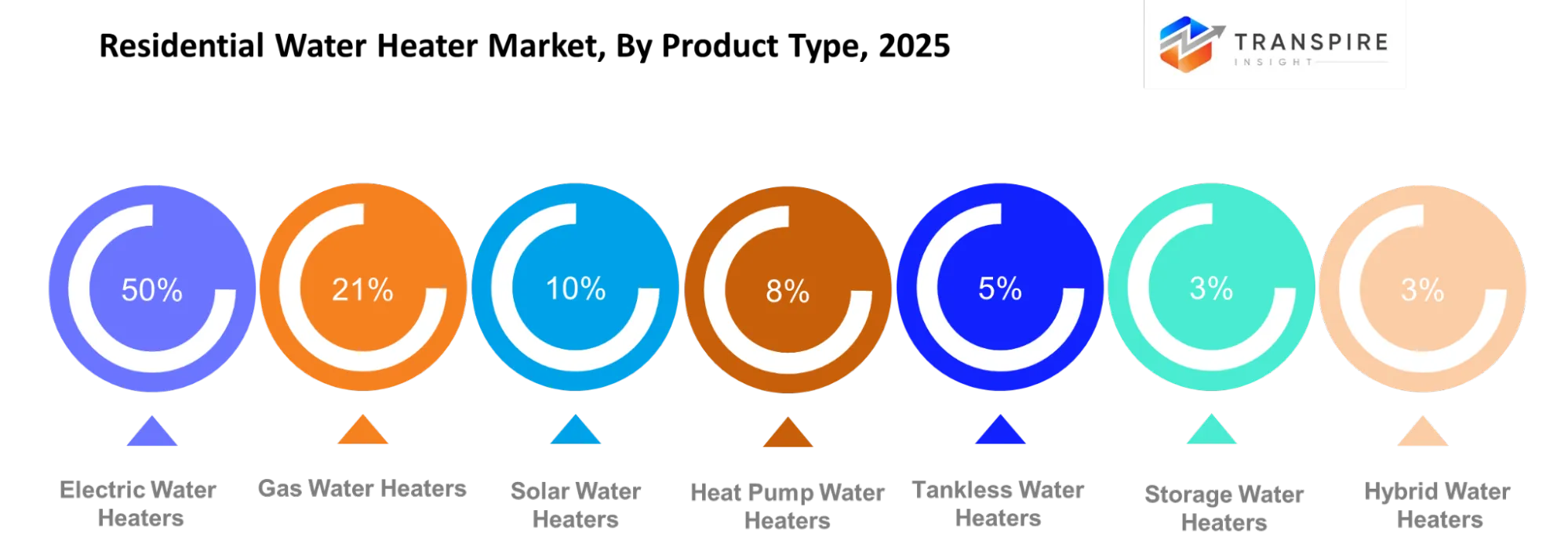
- Electric water heaters hold the top position at 49.6%, with simple installation and houses being electrified.
- Rheem's Pro Terra range of hybrid heat pumps delivers significantly reduced energy consumption when compared to electric tanks.
- O'Smith is making strides in connected diagnostics via its iCOMM platform, which brings services into the realm of remote monitoring.
- Heat pump water heaters (HPWHs) only account for 8.0% of the market, though they are growing at an 8.5% CAGR, thanks to the new efficiency landscape in replacement.
- Rinnai is extending its tankless power into high-efficiency gas, propane, and electric smart home products.
- Ariston is melding European thermal comfort know-how with Racold's distribution in India, catering to high-end and mass-market users.
- Beyond just tank capacity, consumers are looking for apps that enable them to schedule more convenient use, receive alerts when the tanks are leaking, and perform operations based on the tariff.
- As utilities sign water heaters to participate in peak-load programs, demand-response capability is emerging as a buying criterion.
- Noritz has shifted its focus away from the positioning of gas to heat pump installation in Australia and low-emission products in Japan.
What are the Key Drivers, Restraints, and Opportunities in the Residential Water Heater Market?
Driver:
Household energy-cost management and efficiency-focused purchasing are driving residential water heater upgrades. Water heating represents a significant household energy expense, making efficient equipment financially attractive over its operating life. ENERGY STAR-certified heat pump water heaters can substantially reduce electricity consumption compared with conventional electric resistance models. Incentives, efficiency programs, and energy-conscious home renovations further encourage adoption. The resulting shift supports higher-value equipment sales, replacement activity, and installer revenue.
Restraint:
Upfront cost, installation complexity, and space constraints still limit heat pump penetration. Heat pump units need adequate ambient air, clearance, condensate management, and sometimes ducting or relocation, which raises installed cost and complicates retrofits in apartments and older homes. The issue persists because existing housing stock was designed around compact tank or gas systems.
Opportunity:
Electrification-ready housing, smart energy management, and heat pump adoption create substantial opportunities. Manufacturers can develop compact, quieter, and installation-friendly heat pump models, while utilities and builders can integrate water heating into demand-response and efficiency programs. ENERGY STAR identifies installer engagement, consumer education and coordinated incentives as important elements of accelerating adoption. Emerging residential construction across Asia-Pacific also offers opportunities for affordable electric, solar, and hybrid solutions tailored to local infrastructure.
Driver Impact Analysis – Residential Water Heater Market
|
Driver |
Relative Impact on Growth (%) |
Geographic Relevance |
Impact Timeline |
Demand Strength |
Growth Mechanism |
Key Beneficiaries |
Major Constraint |
|
Energy-efficiency regulations and appliance replacement requirements |
25% |
North America, Europe |
Short-term (≤2 years) |
High |
Stricter efficiency standards accelerate replacement of conventional heaters. |
Compliant heater manufacturers, distributors, installation contractors |
Higher equipment costs and regulatory compliance burdens. |
|
Residential construction, urbanization, and household infrastructure expansion |
23% |
Asia-Pacific, Middle East & Africa |
Medium-term (2–4 years) |
High |
New housing developments increase residential hot-water installation requirements. |
Water heater manufacturers, builders, plumbing contractors |
Construction slowdowns and inadequate residential infrastructure. |
|
Adoption of energy-efficient heat pump and solar water heating technologies |
22% |
Europe, North America, Asia-Pacific |
Medium-term (2–4 years) |
High |
Efficient technologies reduce operating costs and encourage premium equipment adoption. |
Heat pump manufacturers, solar technology providers, energy-efficient appliance suppliers |
High upfront costs and installation complexity. |
|
Rising disposable incomes and demand for residential comfort appliances |
17% |
Asia-Pacific, Latin America, Middle East & Africa |
Medium-term (2–4 years) |
High |
Improved purchasing power increases household hot-water appliance penetration. |
Appliance manufacturers, retailers, residential consumers |
Price sensitivity and uneven household purchasing power. |
|
Smart-home integration, connected controls, and energy-management technologies |
13% |
North America, Europe, Asia-Pacific |
Long-term (≥4 years) |
Medium |
Connected heaters enable energy monitoring, automation, and optimized consumption. |
Smart appliance manufacturers, IoT vendors, energy-management providers |
Cybersecurity concerns and limited smart-home compatibility. |
|
Total |
100% |
— |
— |
— |
— |
— |
— |
What Has the Impact of Artificial Intelligence Been on the Residential Water Heater Market?
Artificial intelligence is beginning to turn the smart water heater from a static appliance into an intelligent participant in the home's overall energy management system. More and more smart water heaters are incorporating connected sensors, control algorithms, and energy monitoring tools to determine whether and when to heat a home's water, factoring in the home's usage patterns, electrical tariffs, and resident preferences. Optimizations enabled by artificial intelligence could prioritise heating when electricity prices are low, avoid unnecessary reheating, or synchronise water heating with rooftop solar or a home energy management system. In addition to these optimisations, predictive maintenance functions, such as determining abnormal operation, predicting component failure, and forecasting maintenance, could help improve equipment availability, efficiency, and customer experience, while also providing monetised connected services and differentiated product features for manufacturers. On the other hand, adoption is often limited by the price premium of extra hardware and software, connectivity issues, cybersecurity challenges, and the variety of home automation standards and different products. Limited baseline operating data in the home might also reduce prediction accuracy, especially in homes with irregular occupancy and hot-water consumption patterns.
In June 2026, Lennox marked the first-year anniversary of its residential water heating joint venture, Ariston Lennox Water Heating North America. The partnership successfully launched a new lineup of Lennox-branded residential gas, electric, and smart heat pump water heaters across the United States and Canada.
Key Residential Water Heater Market Trends:
The transition from simple delivery of hot water to energy-managed household infrastructure, for residential water heating applications, is underway. Innovation and purchasing decisions are increasingly driven by efficiency, connectivity, and ease of installation.
- Legacy electric systems are still in a strong position, while more energy-conscious customers are now comparing their systems by their life-cycle operating costs.
- The market is shifting from early adopters to the mass market as efficiency programs make the market more familiar with heat pump use and installer education.
- Smart controls are becoming more than just convenience; they are now becoming key solutions for tariff-driven heating and household energy optimisation.
- Compact and split systems are being developed by manufacturers to meet the constraints of space in apartment and retrofit settings.
- Solar water heating is now being increasingly seen in tandem with electric backup to address the intermittent availability of solar energy.
- Where savings in space and around-the-clock hot water delivery are more important than installation costs, tankless technology is being noticed.
- Electrification-ready layouts, electrical circuits, and equipment access as part of home construction are major factors in homebuilders' thinking.
- Consumer perceptions of specifications, efficiency ratings, and installation information are enhanced via online retail and digital product comparisons.
Residential Water Heater Market Segmentation
Product Type:
Electric water heaters lead with a 49.6% share because they are simple to install, widely compatible with existing housing, and supported by electrification policies. Gas water heaters hold 21.0%, retaining strength where natural-gas infrastructure and rapid recovery requirements favour combustion systems. Solar water heaters account for 10.5%, with growth concentrated in high-irradiance markets where fuel savings offset installation costs. Heat pump water heaters represent 8.0% but carry the strongest growth logic, expanding at an 8.5% CAGR as efficiency mandates and utility incentives make them the preferred replacement technology. Tankless units hold 5.5%, appealing to space-constrained households seeking continuous hot water, while storage systems retain 3.4% through familiarity and low replacement cost. Hybrid systems, at 2.0%, are positioned as a transitional premium option combining heat pump efficiency with backup heating.
Capacity:
Residential water heater capacity ranges from below 30 gallons to above 100 gallons, including compact and custom systems. Below 30 gallons and compact models serve apartments, small households, and space-constrained installations. The 30–50-gallon category addresses routine household hot-water requirements, while 51–75-gallon and 76–100-gallon systems accommodate larger families and simultaneous usage. Above 100 gallons and custom configurations support high-consumption homes and specialised residential needs. Future demand will increasingly depend on occupancy, energy efficiency and installation flexibility.
Fuel Type:
Residential water heaters operate using electricity, natural gas, LPG, solar energy, heat pump technology, hybrid systems and other fuels. Electricity benefits from established household infrastructure and straightforward installation, supporting broad adoption. Natural gas and LPG remain relevant where fuel connections are readily available and rapid heating is preferred. Solar energy attracts environmentally conscious households, while heat pumps offer efficiency-focused alternatives. Hybrid configurations provide flexibility across energy sources. Future adoption will depend on electricity tariffs, fuel availability, efficiency incentives, and regional infrastructure.
Technology:
Conventional storage, tankless, heat pump, solar thermal, condensing, hybrid, and smart water heating technologies address different household priorities. Conventional storage systems remain attractive through familiar operation and established replacement channels. Tankless technology offers space efficiency and continuous hot-water delivery, while heat pumps reduce electricity consumption. Solar thermal systems support renewable energy utilization, and condensing designs improve fuel efficiency. Hybrid systems combine complementary technologies. Smart water heating introduces programmable controls, consumption monitoring, and automated scheduling, strengthening differentiation through operating efficiency and connected-home integration.
Application:
Residential water heaters support bathing, kitchen activities, laundry, space heating, multi-purpose requirements, apartment use, and other household applications. Bathing remains the primary application because households require consistent hot-water availability for daily hygiene. Kitchen and laundry applications create additional consumption requirements, encouraging appropriate capacity selection. Space heating and multi-purpose configurations broaden equipment functionality in suitable residential environments. Apartment use favours compact equipment, installation flexibility and efficient space utilisation. Future product development will increasingly reflect household occupancy, simultaneous hot-water usage, building layouts and integrated home-energy requirements.
Distribution Channel:
Residential water heaters reach consumers through offline retail, speciality stores, home improvement stores, online retail, distributors, direct sales, and other channels. Offline retailers provide product inspection and immediate purchasing opportunities, while speciality stores support technical guidance and installation coordination. Home improvement stores benefit from renovation-related purchases. Online retail enables specification comparisons, price transparency, and convenient product discovery. Distributors remain important for contractor access and regional availability, while direct sales strengthen manufacturer relationships. Future channel performance will increasingly depend on digital research, installation partnerships, product availability, and reliable after-sales service.
What are the Key Use Cases Driving the Residential Water Heater Market?
The core use case remains reliable domestic hot water for bathing, which aligns with the dominant electric storage segment and its 49.6% share. Households replacing ageing tanks increasingly choose higher-efficiency electric or heat pump systems to reduce monthly energy bills while preserving familiar comfort levels.
Expanding applications include kitchen and laundry hot water, multifamily apartment supply, and combined bathing-and-space-heating configurations in electrified homes. Compact and point-of-use systems are gaining relevance in urban apartments, while larger storage capacities support households with simultaneous showers, appliances, and high occupancy.
Emerging use cases centre on grid-flexible water heating. Connected heat pump heaters can preheat water during low-tariff periods, respond to utility demand-response signals, and provide leak monitoring and remote diagnostics. This turns a basic household appliance into an energy-management asset, particularly in North American and European markets with time-of-use pricing and decarbonisation targets.
|
Report Metrics |
Details |
|
Market size value in 2025 |
USD 29.74 Billion |
|
Market size value in 2026 |
USD 33.23 Billion |
|
Revenue forecast in 2033 |
USD 72.29 Billion |
|
Growth rate |
CAGR of 11.74% from 2026 to 2033 |
|
Base year |
2025 |
|
Historical data |
2021 - 2024 |
|
Forecast period |
2026 - 2033 |
|
Report coverage |
Revenue forecast, competitive landscape, growth factors, and trends |
|
Regional scope |
United States; Canada; Mexico; United Kingdom; Germany; France; Italy; Spain; Denmark; Sweden; Norway; China; Japan; India; Australia; South Korea; Thailand; Brazil; Argentina; South Africa; Saudi Arabia; United Arab Emirates |
|
Key companies profiled |
Rheem Manufacturing, A. O. Smith, Bradford White, Rinnai, Ariston Group, Bosch Thermotechnology, Noritz, Haier, Panasonic, Whirlpool, V-Guard Industries, Havells, Bajaj Electricals, Crompton Greaves, Jaquar. |
|
Customization scope |
Free report customization (country, regional & segment scope). Available customized purchase options to meet your exact research needs. |
|
Report Segmentation |
Product Type (Electric Water Heaters, Gas Water Heaters, Solar Water Heaters, Heat Pump Water Heaters, Tankless Water Heaters, Storage Water Heaters, Hybrid Water Heaters); Capacity (Below 30 Gallons, 30–50 Gallons, 51–75 Gallons, 76–100 Gallons, Above 100 Gallons, Compact, Custom); Fuel Type (Electricity, Natural Gas, LPG, Solar Energy, Heat Pump, Hybrid, Other); Technology (Conventional Storage, Tankless, Heat Pump, Solar Thermal, Condensing, Hybrid, Smart Water Heating); Application (Bathing, Kitchen, Laundry, Space Heating, Multi-Purpose, Apartment Use, Other); Distribution Channel (Offline Retail, Specialty Stores, Home Improvement Stores, Online Retail, Distributors, Direct Sales, Others). |
Which Regions are Driving the Residential Water Heater Market Growth?
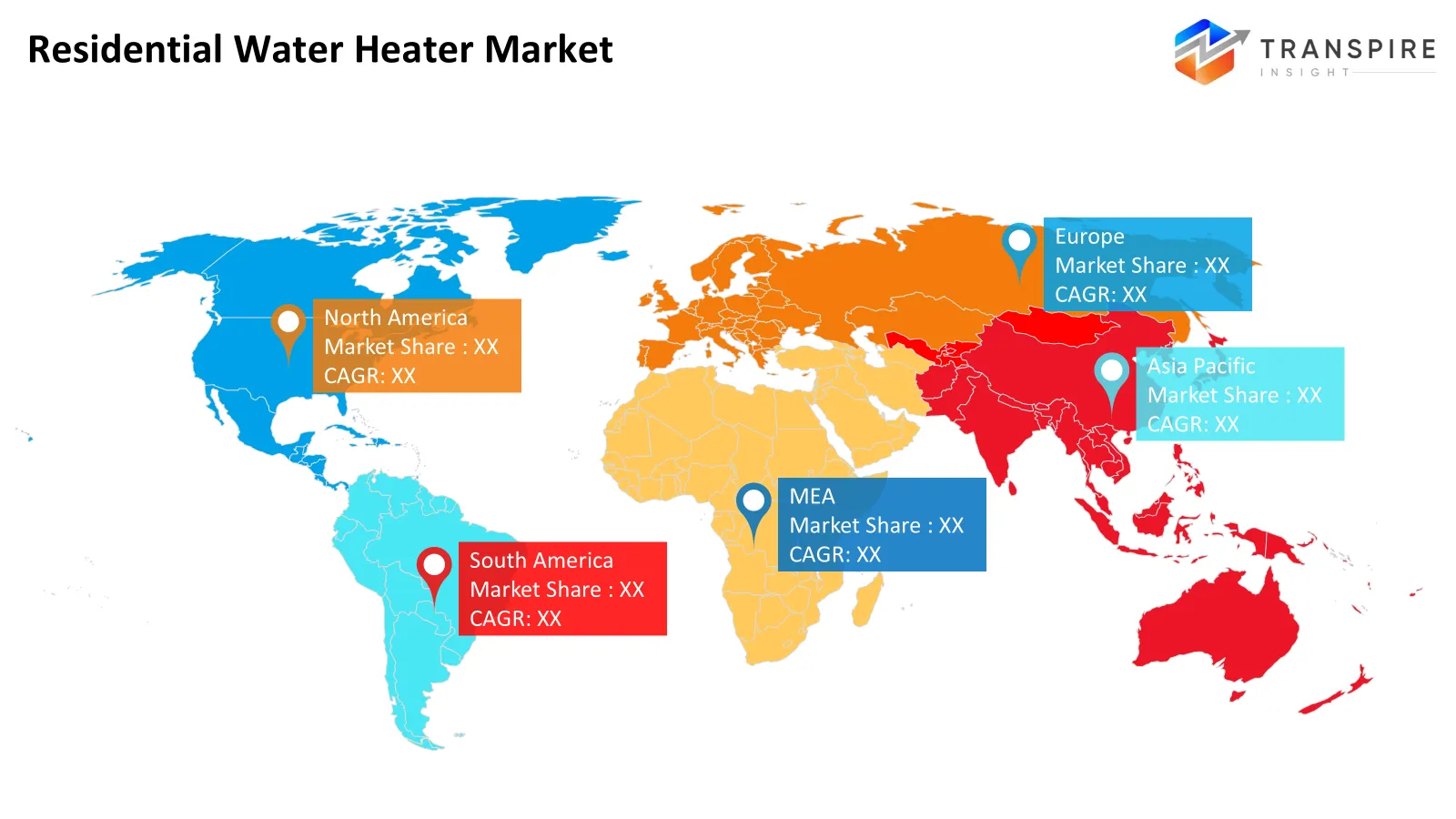
North America ranks number one at 38.4% of the market due to a mature replacement market, high household hot-water consumption, and strong contractor presence. Policy is the defining element in this space, as upcoming US efficiency standards will require nearly all higher-voltage electric storage heaters (both electric water and space) to include heat-pump technology, making higher efficiency products more attractive with utility incentives and demand response programs. North America is therefore a value-upgrade market, not just volume.
In April 2026, Daikin Comfort Technologies North America, Inc. launched the Daikin ALTHERMA 3 H HT high-temperature, air-to-water heat pump system across North America.
https://daikincomfort.com/about-daikin/news-media/news-detail/2026/04/22/daikin-press-release
Europe has 18.8% of the market and is competing on energy security, carbon policy, and high electricity prices, not replacement scale as in North America. Europe's strength lies in proven building codes, heat pump supply chains and familiarity among consumers with condensing and renewable-driven heating equipment. Ariston and Bosch are strong, given their holistically integrated water heating and thermal comfort portfolios. Europe's more moderate growth also makes it more regulation-driven, and the challenge of retrofitting and limited retrofit capacity are inevitable practical restrictions.
In July 2026, Ariston Group completed the acquisition of a 100% stake in Riello Group. This strategic transaction expanded Ariston's thermal-comfort and combustion technology portfolio by absorbing Riello's comprehensive manufacturing facilities and industrial boiler capabilities, directly enabling the group to leverage high-efficiency clean combustion and renewable energy solutions across key European and international markets.
https://www.aristongroup.com/en/news/ariston-group-completes-the-acquisition-of-riello
Asia Pacific is the fastest-growing region at a CAGR of 7.9%, with 31.2% of demand, and is, today, fuelled by urbanization, rural electrification, middle-class purchasing power and greater efficiency mandates in China, India and Japan. Growth opportunities in the region lie in cheap electric storage, solar-assisted solutions and small-sized heat pumps for apartments. Growth markets will include the development of local brands, regional distribution channels in tier-two and tier-three cities, and the ability to tap into the next wave of first-time buyers.
In October 2026, Midea Energy showcased its tailored residential All-in-One Energy Storage System and off-grid solutions at the Renewable Energy India (REI) Expo. This product rollout directly addresses India's expanding solar market by providing localized, compact low-voltage hybrid storage systems optimized for regional distribution networks and local installers.
Who are the Key Players in the Residential Water Heater Market, and how do they compete?
Competition is more complex than pricing and tank capacity, with efficiency, ease of installation, connectivity, and service costs coming to the fore. In mature countries, OEMs are turning to premium heat pump and hybrid offerings to offset falling replacement volumes, while in Asia Pacific, firms are competing on deep distribution, low costs, and local manufacturing.
Rheem is one of the few brands that differentiate by innovation and ecosystem play, with the Eco Net controls platform and new Pro Terra heat pumps aimed at energy efficiency, smart-home interoperability, and demand-response. Meanwhile, A. O. Smith stands out with a multi-technology approach in electric, gas, tankless, and heat pumps, highlighted by iCOMM diagnostics and a manufacturing footprint, while Rinnai and Noritz maintain niche leadership in tankless and gas while testing electrified product markets; Rinnai's 2026 product plan features high-efficiency gas, propane, and electric solutions for smart homes. Representatives from Ariston, Bosch, Haier, Panasonic, V-Guard, Havells, Bajaj Electricals, Crompton Greaves, and Jaquar vie for share through low-cost electric storage, regional service, and entering tier-two and tier-three cities.
Key Players are:
- Rheem Manufacturing
- A. O. Smith
- Bradford White
- Rinnai
- Ariston Group
- Bosch Thermotechnology
- Noritz
- Haier
- Panasonic
- Whirlpool
- V-Guard Industries
- Havells
- Bajaj Electricals
- Crompton Greaves
- Jaquar
Residential Water Heater Market — Enhanced Competitive Benchmarking
|
Company |
Est. Revenue Share Range |
Key Offerings |
Strategic Positioning |
Geographic Strength |
Technology Focus |
|
A. O. Smith Corporation |
8–11% |
ProLine, gas and electric storage heaters, tankless, hybrid heat pumps |
Broad portfolio leadership with strong distribution and brand recognition |
North America, Asia Pacific |
Heat pump efficiency, iCOMM connectivity, scale prevention |
|
Rheem Manufacturing Company |
8–11% |
Performance, Professional, tankless, ProTerra heat pump heaters |
High-volume competitor emphasizing reliability and energy efficiency |
North America, Australia, Asia Pacific |
Hybrid heat pumps, high-efficiency gas, connected controls |
|
Ariston Group |
5–8% |
Ariston electric storage, gas systems, heat pumps, solar-compatible heaters |
European premium positioning with diversified thermal solutions |
Europe, Asia Pacific, Middle East |
Renewable integration, heat pump systems, smart controls |
|
Rinnai Corporation |
4–7% |
RE-Series, tankless gas heaters, electric and hybrid systems |
Tankless specialization supported by premium efficiency positioning |
Asia Pacific, North America |
Condensing combustion, continuous-flow heating, compact designs |
|
Bosch Home Comfort Group |
4–7% |
Tronic electric heaters, tankless systems, heat pumps, indirect tanks |
Engineering-led differentiation through efficient integrated heating |
Europe, North America, Asia Pacific |
Heat pump integration, intelligent controls, thermal efficiency |
|
Haier Smart Home Co., Ltd. |
3–6% |
Electric storage heaters, gas heaters, instant water heaters |
Mass-market scale with appliance ecosystem integration |
Asia Pacific, Europe, Middle East |
Smart connectivity, efficient heating, digital appliance controls |
|
Panasonic Holdings Corporation |
2–4% |
EcoCute heat pump water heaters, electric storage systems |
Energy-efficient Japanese technology and residential electrification |
Asia Pacific, Japan |
CO₂ refrigerant heat pumps, inverter technology, EcoCute |
|
Bradford White Corporation |
2–4% |
Residential gas and electric tanks, tankless, heat pump heaters |
Professional-channel strength and durable product specialisation |
North America |
Advanced combustion, heat pump systems, tank durability |
|
Vaillant Group |
2–4% |
aroTHERM-compatible hot water systems, cylinders, domestic hot water solutions |
European heating-system integration and decarbonization expertise |
Europe |
Heat pump integration, smart energy management, thermal storage |
|
Midea Group |
2–5% |
Electric storage heaters, heat pump water heaters, air-source systems |
Cost-efficient manufacturing with expanding distribution |
Asia Pacific, Europe, Latin America |
Air-source heat pumps, inverter compressors, smart controls |
Recent Development
- In March 2026, Lennox announced the launch of its residential water heater portfolio through its joint venture with Ariston Group, with dealer orders beginning March 16. The launch includes gas, electric, and heat pump water heaters, expanding Lennox’s home comfort offering and strengthening its distribution opportunities across North America. https://investor.lennox.com/news-releases/news-release-details/lennox-expands-residential-water-heating-through-ariston-joint
- In April 2026, A. O. Smith announced the launch of its Voltex® X Outdoor Split Heat Pump Water Heater in partnership with Panasonic. The product expands its energy-efficient residential water heating portfolio, supporting outdoor installation flexibility and growing consumer interest in sustainable hot water solutions. https://www.hotwater.com/about-us/news.html
- In June 2025, General Electric Company launched the GE Profile GEOSPRING Smart Hybrid Heat Pump Water Heater. The residential system utilises a built-in electronic integrated mixing valve to maximize usable hot water capacity while providing grid-interactive capabilities for proactive household load management. https://pressroom.geappliances.com/news/ge-profileTM-geospringTM-smart-hybrid-heat-pump-water-heater-delivering-superior-energy-efficiency-to-homes-is-launching-now
What Strategic Insights Define the Future of the Residential Water Heater Market?
The residential water heater market is moving toward efficiency-led electrification, connected operation, and differentiated installation solutions rather than competing solely on heating capacity. Manufacturers should anticipate a gradual shift from conventional replacement purchases toward heat pump, smart electric, and hybrid systems, although adoption will vary considerably by region. The hidden risk is that electrification could outpace household electrical infrastructure, installer readiness and consumer affordability, creating installation delays and weakening conversion rates despite favourable efficiency economics. Another concern is dependence on incentives: changes in subsidy availability or energy pricing could alter purchasing decisions and investment returns. The emerging opportunity lies in combining water heating with rooftop solar, home energy management and demand-response programs. Compact heat pump designs and intelligent controls could unlock additional adoption in apartments and retrofit housing. Strategically, manufacturers should prioritize region-specific product portfolios, installer partnerships, service capabilities, and transparent lifecycle-cost communication. Companies that balance affordability, efficiency, and installation practicality will be better positioned to convert technology advancement into sustained commercial growth.
Key Segmentations are:
Product Type
- Electric Water Heaters
- Gas Water Heaters
- Solar Water Heaters
- Heat Pump Water Heaters
- Tankless Water Heaters
- Storage Water Heaters
- Hybrid Water Heaters
Capacity
- Below 30 Gallons
- 30–50 Gallons
- 51–75 Gallons
- 76–100 Gallons
- Above 100 Gallons
- Compact
- Custom
Fuel Type
- Electricity
- Natural Gas
- LPG
- Solar Energy
- Heat Pump
- Hybrid
- Other
Technology
- Conventional Storage
- Tankless
- Heat Pump
- Solar Thermal
- Condensing
- Hybrid
- Smart Water Heating
Application
- Bathing
- Kitchen
- Laundry
- Space Heating
- Multi-Purpose
- Apartment Use
- Other
Distribution Channel
- Offline Retail
- Specialty Stores
- Home Improvement Stores
- Online Retail
- Distributors
- Direct Sales
- Others
By Regional Analysis
North America
- US
- Canada
- Mexico
Europe
- Germany
- UK
- France
- Italy
- Spain
- Russia
- Rest of Europe
Asia Pacific
- China
- Japan
- India
- South Korea
- Australia
- Rest of Asia Pacific
South America
- Brazil
- Argentina
- Rest of South America
Middle East & Africa
- UAE
- Saudi Arabia
- Qatar
- South Africa
- Rest of the Middle East & Africa
Frequently Asked Questions
Find quick answers to common questions.
The residential water heater market size was valued at USD 29.74 billion in 2025 and is poised to reach USD 72.29 billion by 2033, expanding at an 11.74% CAGR.
Key segments for the residential water heater market are Product Type (Electric Water Heaters, Gas Water Heaters, Solar Water Heaters, Heat Pump Water Heaters, Tankless Water Heaters, Storage Water Heaters, Hybrid Water Heaters); Capacity (Below 30 Gallons, 30–50 Gallons, 51–75 Gallons, 76–100 Gallons, Above 100 Gallons, Compact, Custom); Fuel Type (Electricity, Natural Gas, LPG, Solar Energy, Heat Pump, Hybrid, Other); Technology (Conventional Storage, Tankless, Heat Pump, Solar Thermal, Condensing, Hybrid, Smart Water Heating); Application (Bathing, Kitchen, Laundry, Space Heating, Multi-Purpose, Apartment Use, Other); Distribution Channel (Offline Retail, Specialty Stores, Home Improvement Stores, Online Retail, Distributors, Direct Sales, Others).
Growth is primarily driven by residential construction, replacement of ageing water heaters, energy-efficiency regulations, rising household energy costs, electrification, heat pump adoption, smart water heating technologies, and demand for space-efficient residential appliances.
The market is led by major manufacturers including Rheem Manufacturing, A. O. Smith, Bradford White, Rinnai, Ariston Group, Bosch Thermotechnology, Noritz, Haier, Panasonic, Whirlpool, V-Guard Industries, Havells, Bajaj Electricals, Crompton Greaves, Jaquar.
North America, accounting for 38.4% of the market, influences dynamics through established replacement demand, energy-efficiency regulations, advanced distribution networks, heat pump adoption, and strong consumer purchasing power.
Commercial opportunities include heat pump water heater adoption, smart-home integration, solar-assisted heating, energy-efficient retrofits, compact residential systems, and expanding demand across Asia-Pacific.
- Rheem Manufacturing
- A. O. Smith
- Bradford White
- Rinnai
- Ariston Group
- Bosch Thermotechnology
- Noritz
- Haier
- Panasonic
- Whirlpool
- V-Guard Industries
- Havells
- Bajaj Electricals
- Crompton Greaves
- Jaquar
About the Authors

Avinash Kumar
I’m Avinash Kumar, a Senior Research Analyst at Transpire Insight, with expertise in the Electronics and Semiconductor and Energy & Power industry. My work focuses on analyzing emerging technologies, market trends, industry developments, and innovation across these sectors. I specialize in transforming complex technical and market insights into clear, research-backed content that helps professionals, businesses, and decision-makers stay informed. Through continuous industry research and data-driven analysis, I strive to deliver accurate, reliable, and practical perspectives on the latest advancements shaping the semiconductor and energy landscape.

Chakradhar Khansole
Chakradhar serves as the Research Director at Transpire Insight, bringing over 8 years of experience in technology, innovation, and strategic market intelligence. He specializes in transforming complex market data into actionable business insights that enable organizations to make informed, growth-oriented decisions. Recognized for his strategic vision and analytical expertise, Chakradhar leads high-impact research initiatives, delivering comprehensive market assessments, competitive intelligence, and forward-looking industry analysis.
Recently Published Reports
-
Apr 2026
Active Power Filter Market
Active Power Filter Market Size, Share & Analysis Report By Type (Shunt Active Power Filters, Series Active Power Filter, Hybrid Active Power Filter), By Application (Harmonics Mitigation, Reactive Power Compensation, Voltage Regulation, Power Factor Correction), By Phase (Single Phase, Three Phase), By End-User Industry (Manufacturing, Healthcare, Commercial, Automotive, Oil and Gas, Others), and Geography (North America, Europe, Asia-Pacific, Middle East and Africa, South and Central America), 2021 - 2031
-
Apr 2026
Electrical Transformer Market
Electrical Transformer Market Size, Share & Analysis Report By Core (Closed, Shell, and Berry), By Insulation (Gas, Oil, Solid, Air, and Other), By Phase (Single, and Three), By Rating (100 MVA to 500 MVA, 501 MVA to 800 MVA, and 801 MVA to 1200 MVA), and Geography (North America, Europe, Asia-Pacific, Middle East and Africa, South and Central America), 2021 – 2031
-
Apr 2026
Hydraulic Piston Pumps Market
Hydraulic Piston Pumps Market Size, Share & Analysis Report By Type (Axial Piston Pumps, Radial Piston Pumps), By Operating Pressure (Low Pressure, Medium Pressure, High Pressure), By Application (Construction, Mining, Agriculture, Automotive, Oil & Gas, Industrial Machinery, Others), By End-User (OEMs, Aftermarket), and Geography (North America, Europe, Asia-Pacific, Middle East and Africa, South and Central America), 2021 – 2031
-
Apr 2026
Laboratory Gas Generators Market
Laboratory Gas Generators Market Size, Share & Analysis Report By Product (Nitrogen Gas Generator, Hydrogen Gas Generator, Zero Air Gas Generator, Purge Gas Generator, TOC Gas Generators, Others), By Application (Gas Chromatography, Liquid Chromatography-mass Spectrometry (LC-MS), Gas Analyzers, Others), By End-user (Life Science, Chemical & Petrochemical, Food & Beverage, Others), and Geography (North America, Europe, Asia-Pacific, Middle East and Africa, South and Central America), 2021 – 2031