
Ready-to-Eat Food Market Summary:
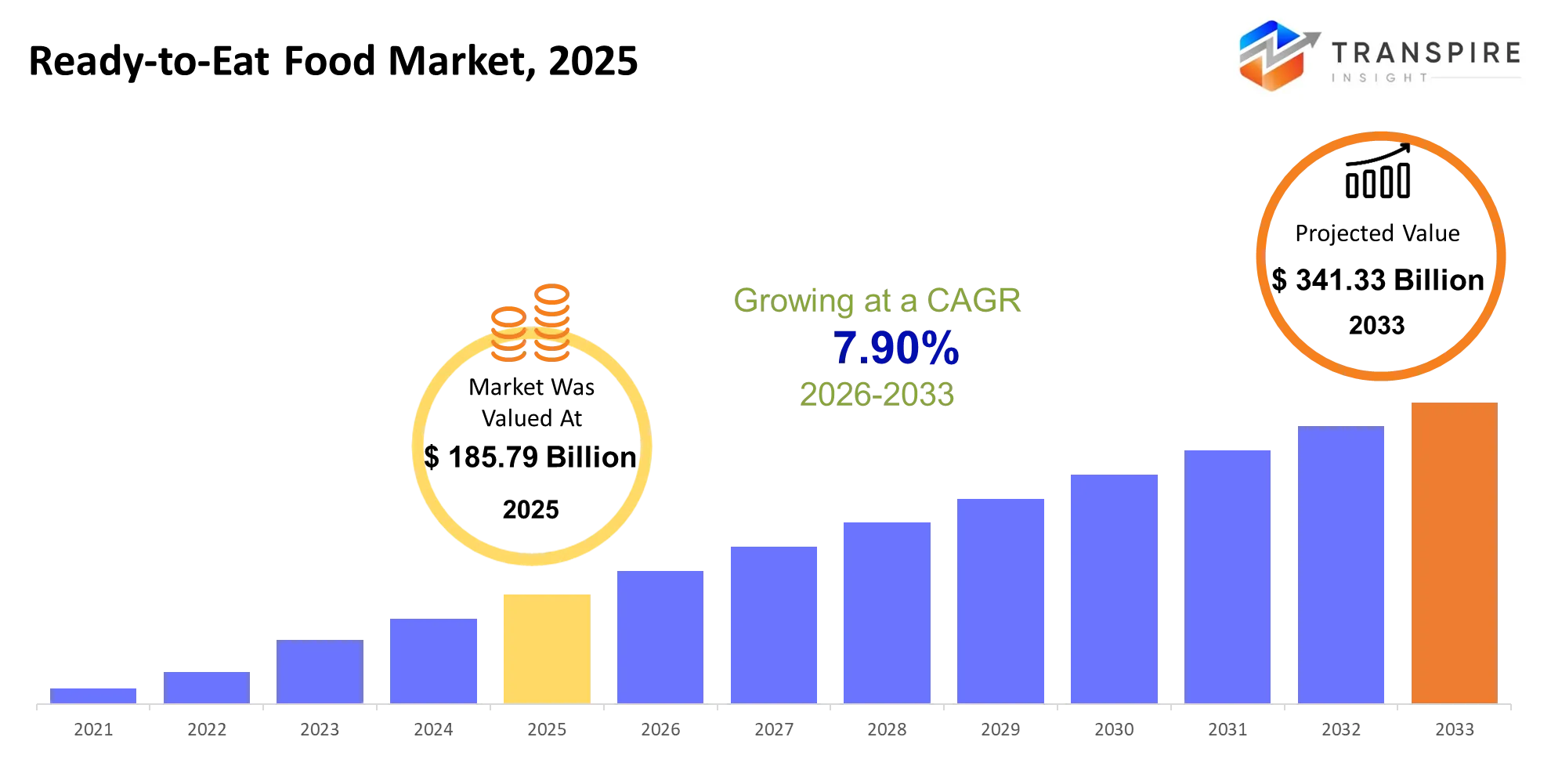
As per Transpire Insight, The Ready-to-Eat Food Market size is estimated at USD 185.79 billion in 2025 and is anticipated to reach USD 341.33 billion by 2033, growing at a CAGR of 7.90% from 2026 to 2033.
The ready-to-eat food market provides consumers with cooked and controlled portions of food and snacks that require no time or preparation and is targeted towards retailers and end-consumers who have time limitations and seek products that offer shelf life or refrigerated stability. The ready-to-eat food market has grown from a basic convenience market to nutrition-led, clean-label, and regional authenticity within the last 3-5 years. A key structural change is AI-enabled demand forecasting, automated inspection, and preservation methods such as modified-atmosphere packaging to preserve freshness, reduce wastage, and allow for a larger scale of distribution. The normalisation of eating at home during the pandemic, as well as hybrid working models and multi-person households, is a trigger for secondary purchase, which has resulted in more manufacturers catering to premium, high-protein, plant-based and single-serve ready-to-eat products, with increasing accessibility through online grocery channels and giving it the potential to turn convenience into a more continuous revenue stream.
Ready-to-Eat Food Market Size & Forecast:
- Market Size 2025: USD 185.79 Billion
- Expected Market Value (2033): USD 341.33 Billion
- Forecast CAGR (2026–2033): 7.90%
- Leading Region in 2025: North America
- Fastest Growing Region: Asia Pacific
- Key Company Profiles: Kraft Heinz, Nestlé, Conagra Brands, General Mills, PepsiCo, Tyson Foods, Campbell's, Unilever, Mars, McCain Foods, Nomad Foods, JBS, Hormel Foods, Amy's Kitchen, ITC.
Key Ready-to-Eat Food Market Insights:
The market is moving from convenience buying to balancing cost, quality, freshness, and dependability in preparation. Targeted product development, packaging performance, and meeting the evolving meal occasions are becoming more important for competitive differentiation.
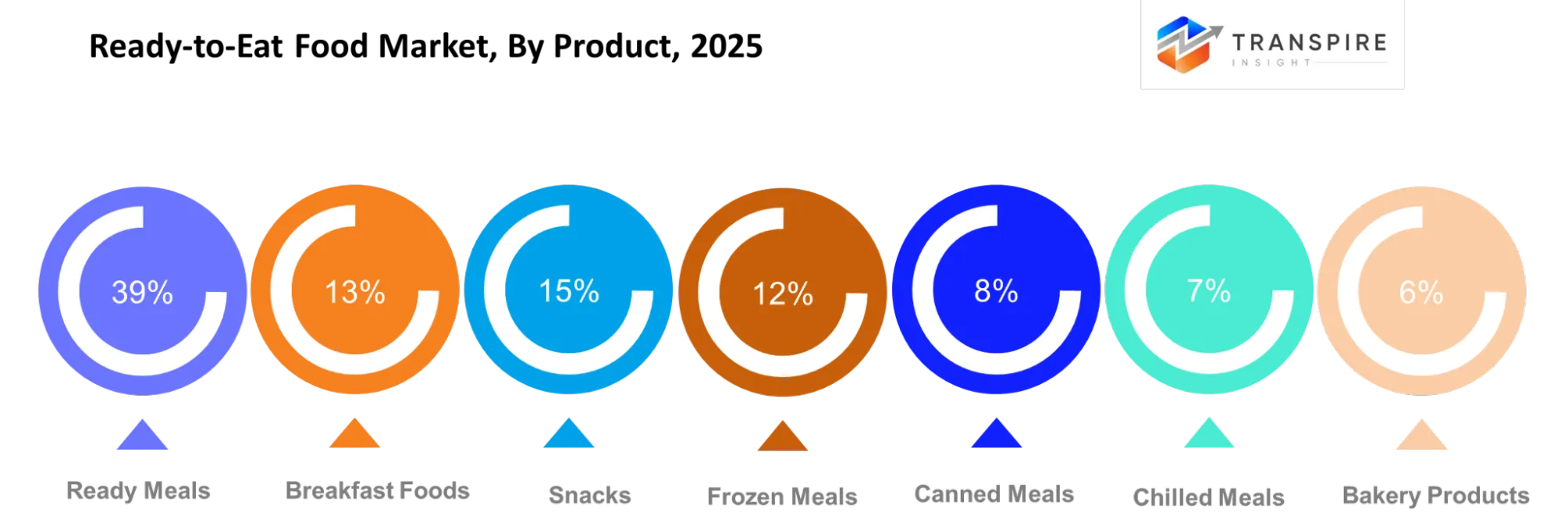
- Ready meals 38.7% anchor complete meal demand; Kraft Heinz and Nestlé refresh convenient meal choices with established food portfolios.
- Breakfast foods 13% benefit from time-pressed morning routines, encouraging General Mills to develop portable, easy-to-prepare formats.
- Snacks are 15% more frequent between-meal snacking, and PepsiCo is taking advantage of flavour innovation and its existing retail network.
- Frozen meals: 12% enable longer shelf life and flexibility in planning, while Conagra Brands takes advantage of the convenience of frozen food.
- Canned meals 8% maintain value through affordability and pantry storage, especially when consumers consider meal availability and reliability a priority.
- Chilled meals 7% are aligned with freshness-centric shopping; manufacturers that can enhance the efficiency of the cold chain in chilled foods and fresh ready meals will generate a 7.6% CAGR opportunity.
- Bakery products are 4% used for a quick breakfast or light meal, which can facilitate product bundling in grocery channels.
- Other products account for 2.3% and offer opportunities for niche recipes and new food formats as consumer tastes and preferences become more varied.
- Digital traceability and smarter packaging are enhancing quality control, and recyclability and easy storage directions are influencing buying choices.
What are the Key Drivers, Restraints, and Opportunities in the Ready-to-Eat Food Market?
Driver:
Urban professionals, students, and smaller households are shifting from cooking every meal to purchasing ready meals that offer predictable portioning, nutrition, and preparation speed. The trigger is the persistence of hybrid work, longer commutes, and rising female workforce participation, which compresses meal-preparation time. This supports higher purchase frequency, premium pricing, and adoption of single-serve and high-protein formats; manufacturers are increasingly targeting 25–30 grams of protein per serving in frozen and chilled meals.
Restraint:
Growth remains constrained by consumer scepticism over sodium, preservatives, ultra-processing, and packaging waste. The issue persists because long shelf life, low cost, and food safety often require formulation and packaging choices that conflict with clean-label expectations. Regulatory scrutiny, including sodium-reduction guidance and front-of-package labelling proposals in the United States, further raises reformulation and compliance costs.
Opportunity:
Manufacturers can capture higher-value demand through chilled meals, regional recipes, healthier formulations, and packaging that extends freshness without compromising food quality. Ingredion highlighted restaurant-inspired ready meals, high-protein formulations, and recyclable fibre-based packaging as emerging innovation areas. Investment in improved preservation, smaller production batches, and quick-commerce distribution can help brands test local preferences, reduce waste, and reach urban consumers seeking convenient meals with stronger nutritional and environmental credentials.
What Has the Impact of Artificial Intelligence Been on the Ready-to-Eat Food Market?
AI is also helping ready-to-eat manufacturers optimise production planning, manage inventory, streamline quality control and monitor distribution. Machine-vision systems can identify packaging defects, portion-size variation, damaged seals and obvious product defects, allowing production teams to address issues before batches are shipped to retailers. Automated tracking of vision and data from sensors can also signal when cooking and cooling cycles, stocking, and transportation are out of spec – prompting human assessment. Predictive analytics is helping them plan production based on product type, location, seasonality, promotion, and buying patterns. Better forecasting allows production schedules to match expected sales and limit overstocking and spoilage for short-shelf-life chilled foods. In distribution, algorithms can optimise routing and replenishment patterns as well as align with cold chain requirements. AI-assisted recipe development can help identify preferences and ingredient pairings to allow faster experimentation with high-protein, regional, and plant-based products. But high equipment costs, fragmented legacy platforms, and unpredictable data limit usage, and recipe creation cannot replace microbiological testing or food safety safeguards. The biggest commercial benefit for ready-to-eat food is when automated analysis collaborates with trained people, traceability systems, and quality-management processes.
In January 2026, Cropin launched the 'Cropin Ecosystem', uniting tech giants like Google and Wipro with food processors and CPG companies. This platform mitigates upstream agricultural procurement risks and unifies fragmented data to build more predictable food production systems.
Key Ready-to-Eat Food Market Trends:
The market is moving away from convenience and towards meals that are fast, fresh, nutritious, and restaurant-like. Preservation technology and product differentiation, as well as convenience, are becoming major factors in competitive advantage, and delivery is becoming more important than ever.
- As consumers look for satiety and fitness nutrition, high-protein ready meals are taking the place of generic frozen foods.
- Brands are being driven to reformulate products with clean labels that limit sodium, artificial ingredients, and unknown additives.
- As technology improves, chilled meals are becoming more popular due to their ability to preserve food for longer periods without the need for refrigeration.
- The viable distribution windows for fresh-format meals are being extended with modified atmosphere packaging and high pressure processing.
- Plant-based, vegan and flexitarian options are transitioning from speciality SKUs to mainstream product lines.
- Single-serve bowls, cups and pouches are growing in convenience stores, offices and travel retail.
- Regional cuisines and premium meals are making their way to smaller groups of customers via online grocery and quick-commerce.
- AI forecasting and vision inspection are enhancing waste management, food safety, and production uniformity.
- Private labels are improving quality and packaging, and are competing more heavily with brands.
- The pressure from regulators on product redesign for labelling and sodium content is gaining momentum, not holding back innovation.
Ready-to-Eat Food Market Segmentation
By Product:
Ready meals dominate with a 38.7% share, reflecting consumer preference for complete dishes that require minimal preparation and simplify daily meal planning. Snacks account for 15%, followed by breakfast foods at 13% and frozen meals at 12%, supported by flexible consumption and convenient storage. Canned meals contribute 8%, while chilled meals represent 7%, offering alternatives for consumers seeking variety and freshness. Bakery products hold 4%, and other products account for 2.3%, creating scope for specialised offerings. Chilled and fresh ready meals are projected to grow at a 7.6% CAGR, driven by improved preservation and freshness-focused innovation.
By Meal Type:
Lunch and dinner formats serve consumers, replacing conventional home-cooked meals, particularly for working professionals and households managing demanding schedules. Breakfast products target rushed mornings through portable portions and quick preparation. Snacks support between-meal consumption, while desserts, appetisers, and side dishes accommodate entertaining, celebrations, and flexible meal combinations. Manufacturers can expand usage occasions by offering coordinated meal bundles and portion-controlled products. Future growth will depend on balancing convenience, taste, affordability, and nutritional value while adapting recipes to regional food preferences and evolving consumer routines across different age groups and lifestyles.
By Packaging:
Cans and trays support product protection, portion control, and convenient storage, while pouches and cartons offer lightweight alternatives for transportation and handling. Plastic containers remain useful for microwaveable meals, whereas glass containers appeal to consumers seeking reusable or premium presentation formats. Flexible packs can reduce packaging weight, although barrier performance remains essential for protecting food quality. Manufacturers are increasingly evaluating recyclable materials, improved sealing technologies, and packaging designs that communicate storage and heating instructions. Future innovation will focus on balancing product safety, shelf life, cost efficiency, and environmental requirements.
By Distribution:
Supermarkets and hypermarkets provide extensive product visibility, broad assortment, and opportunities for promotional pricing. Convenience stores capture immediate purchases from commuters, students, and workers, while online retail supports scheduled grocery orders and rapid delivery. Speciality stores serve consumers seeking organic, premium, or dietary-specific products. Foodservice channels supply institutions and workplaces, whereas vending machines address locations requiring quick access to packaged meals. Distribution strategies increasingly depend on inventory visibility, temperature-controlled logistics, and accurate demand forecasting. Retailers that improve product availability and reduce expired inventory can strengthen profitability while delivering a more reliable purchasing experience.
By Consumer Type:
Working professionals and students prioritise speed, portability, and minimal preparation, making single-serving meals particularly relevant to their routines. Families seek convenient options that accommodate different tastes, portion requirements, and household budgets. Adults may prioritise balanced nutrition, while children require appealing flavours and age-appropriate portions. Seniors can benefit from easy-to-open packaging, manageable servings, and products designed around dietary requirements. Athletes represent an opportunity for protein-focused meal options. Manufacturers can improve customer retention through targeted recipes, transparent nutritional information, and flexible pack sizes that address distinct consumption habits without unnecessarily increasing product complexity.
By Food Type:
Vegetarian and non-vegetarian meals form established product categories, supported by familiar recipes and broad consumer acceptance. Vegan products appeal to plant-based consumers, while gluten-free options address specific dietary requirements. Organic meals attract shoppers interested in ingredient sourcing, whereas low-calorie products target consumers managing energy intake. High-protein formulations offer opportunities among fitness-oriented buyers and consumers seeking more filling meals. Manufacturers must balance nutritional positioning with taste, affordability, and processing requirements. Clear ingredient declarations, credible product claims, and transparent allergen information can strengthen confidence, particularly as consumers become more selective about the composition of packaged meals.
By Price:
Economy and mid-range products appeal to budget-conscious consumers seeking convenient alternatives to takeaway meals or more expensive prepared foods. Premium and super-premium products compete through distinctive recipes, higher-value ingredients, specialised dietary positioning, and restaurant-inspired experiences. Single-serve packs suit individuals, students, and professionals who need portion flexibility without substantial leftovers. Value packs and family packs can reduce the effective cost per serving and support planned household consumption. Manufacturers must manage ingredient costs, packaging expenses, and promotional activity carefully. A balanced portfolio spanning accessible everyday meals and differentiated premium options can broaden customer reach while protecting margins.
What are the Key Use Cases Driving the Ready-to-Eat Food Market?
Ready meals, representing 38.7% of the product mix, primarily serve working professionals, students, and households seeking complete meals without extensive preparation. Microwaveable trays, frozen dishes, and chilled options help reduce cooking time during workdays, while portion-controlled formats support individual consumption.
Expanding applications include workplace cafeterias, travel catering, convenience stores, healthcare facilities, and quick-commerce grocery delivery. Breakfast foods and snacks address shorter eating occasions, while family packs help households manage meal preparation and food budgets. Reliable packaging and temperature-controlled logistics are essential for maintaining product quality across these channels.
Emerging applications include high-protein meals for fitness-focused consumers, plant-based options, and specialised dietary products. AI-enabled forecasting and digital traceability can improve availability, inventory planning, and quality oversight as manufacturers serve increasingly diverse customer needs.
|
Report Metrics |
Details |
|
Market size value in 2025 |
USD 185.79 Billion |
|
Market size value in 2026 |
USD 200.46 Billion |
|
Revenue forecast in 2033 |
USD 341.33 Billion |
|
Growth rate |
CAGR of 7.90% from 2026 to 2033 |
|
Base year |
2025 |
|
Historical data |
2021 - 2024 |
|
Forecast period |
2026 - 2033 |
|
Report coverage |
Revenue forecast, competitive landscape, growth factors, and trends |
|
Regional scope |
United States; Canada; Mexico; United Kingdom; Germany; France; Italy; Spain; Denmark; Sweden; Norway; China; Japan; India; Australia; South Korea; Thailand; Brazil; Argentina; South Africa; Saudi Arabia; United Arab Emirates |
|
Key companies profiled |
Kraft Heinz, Nestlé, Conagra Brands, General Mills, PepsiCo, Tyson Foods, Campbell's, Unilever, Mars, McCain Foods, Nomad Foods, JBS, Hormel Foods, Amy's Kitchen, ITC |
|
Customization scope |
Free report customization (country, regional & segment scope). Available customized purchase options to meet your exact research needs. |
|
Report Segmentation |
By Product (Ready Meals, Breakfast Foods, Snacks, Frozen Meals, Canned Meals, Chilled Meals, Bakery Products, Others); By Meal Type (Breakfast, Lunch, Dinner, Snacks, Desserts, Appetizers, Side Dishes, Others); By Packaging (Cans, Trays, Pouches, Cartons, Plastic Containers, Glass Containers, Flexible Packs, Others); By Distribution (Supermarkets, Hypermarkets, Convenience Stores, Online Retail, Specialty Stores, Foodservice, Vending, Others); By Consumer Type (Adults, Children, Families, Seniors, Students, Professionals, Athletes, Others); By Food Type (Vegetarian, Non-vegetarian, Vegan, Gluten-free, Organic, Low-calorie, High-protein, Others); By Price (Economy, Mid-range, Premium, Super-premium, Value Pack, Single-serve, Family Pack, Others). |
Which Regions are Driving the Ready-to-Eat Food Market Growth?
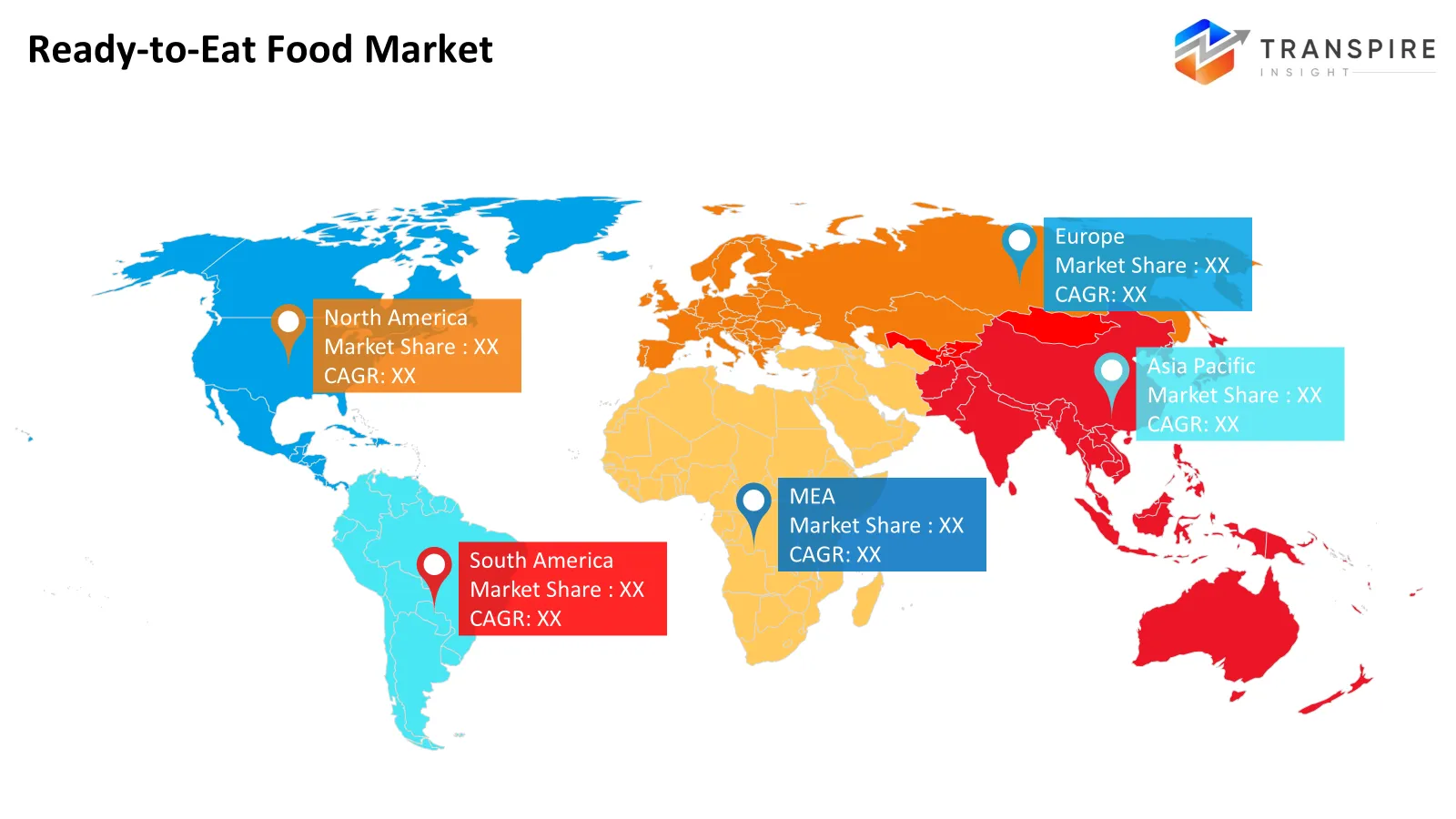
North America, the market leader with a 34.8% share, benefits from large, well-known packaged-food companies and supermarket chains, with mature frozen/refrigerated distribution channels. Consumers' receptivity to other quick-meal formats, such as packaged frozen entrees and portion-controlled items, drives reliable retail demand. Retailers' investment in automated food-processing platforms and longstanding private-label programs offer consumers a wide range of convenience pack prices. At the same time, food-safety traceability mandates encourage better documentation and supply chain alignment. However, the US Food and Drug Administration (USFDA) has extended the proposed compliance date for its Food Traceability Rule.
In March 2026, McCormick & Company entered into a definitive agreement to merge with Unilever’s food business. This $45 billion transaction establishes a prominent flavour and packaged-food leader, combining extensive grocery portfolios to significantly expand its overall scale.
https://www.fooddive.com/news/food-ma-acquisitions-2026-ingredients/827075/
Europe accounts for 28% of the market, with demand supported by mature prepared-food categories, a fully developed grocery retail network, and consumers seeking convenient solutions to eating at restaurants. Unlike North America, where the distribution system is based on scale, European competitors focus on the quality of the product, regional recipes and packaging regulations. Food-contact material standards and traceability requirements influence the selection of suppliers and packaging design, allowing manufacturers to maintain consumer confidence while customising products to a number of national preferences.
In October 2026, Tetra Pak launched its paper-based Ice Cream Wrap packaging solution. This design enables manufacturers to differentiate their products and satisfy growing consumer expectations for environmentally conscious materials without compromising strict food-safety performance.
Asia Pacific accounts for 26% of the market and was the fastest-growing region, with a CAGR of 8.2%. A wave of urbanization, increase in double-income households, growth of organized retail, and evolution of online grocery delivery is driving consumer access to packaged meals in India, China, Japan, and Southeast Asia. Backed by recent investments in cold-chain infrastructure and digital retail, chilled and frozen formats are being rolled out to consumers outside the traditional format for metro-centric outlets. The opportunity going forward is in portfolio diversification, with lower-cost regional recipes, smaller portions, and locally relevant meals that bring familiar flavours with an assured shelf life.
In October 2026, CJ Foods entered a strategic partnership with GTGO to roll out its first restaurant-format quick-service concept, Bibigo Bapsang, in India. This expansion targets urban professionals by introducing tailored, culturally adjusted packaged and fresh Korean meals, with the first three outlets launching in Bengaluru.
Who are the Key Players in the Ready-to-Eat Food Market, and how do they compete?
Competition is heating up in three key channels: portfolio innovation, packaging, and speed of distribution. Large companies are holding on to their positions through their frozen capacity and existing retailer connections, while smaller brands are going for nutrition specialisation and clean-label appeal.
A focus on innovation, starting with plant-based ready meals and circular packaging and freshness indicators, is differentiating Nestlé in its game plan. Its scale and premium meal formats are key to its growth. Conagra has a broad portfolio and fast innovation, with more than 50 new frozen launches and high-volume Power Bowls targeting the single-serve and wellness consumer. Nomad Foods relies on sustainability and collaboration as its point of difference, highlighting veggie-forward frozen foods and energy-efficient cold chain development. McCain Foods is redefining its portfolio from potato snack foods to plant-based burgers to target the flexitarian demographic. ITC takes a cost-effective and hyper-local approach with a focus on Indian veg and non-veg frozen foods, and has expanded its reach with fast commerce and exports. Kraft Heinz stands apart for its packaging innovation, while Tyson, JBS, and Hormel have potential as end-to-end supply chains for high-protein food formats.
Key Players are:
- Kraft Heinz
- Nestlé
- Conagra Brands
- General Mills
- PepsiCo
- Tyson Foods
- Campbell's
- Unilever
- Mars
- McCain Foods
- Nomad Foods
- JBS
- Hormel Foods
- Amy's Kitchen
- ITC
Recent Development News
- In October 2026, Giant Eagle and Market District partnered with celebrity chef Curtis Stone to launch the exclusive Dine In with Curtis Stone range of premium refrigerated ready-to-eat meals. The eight-meal range, featuring international flavours and meals ready in approximately five minutes, strengthens the retailers’ premium convenience-food offerings and targets consumers seeking restaurant-style dining at home. https://www.globenewswire.com/news-release/2026/10/09/3378216/0/en/giant-eagle-and-market-district-partner-with-renowned-chef-curtis-stone-to-launch-exclusive-new-chef-crafted-meal-program.html
- In May 2026, Nestlé launched Maggi Kitchen, a new range of single-serve ready meals featuring international dishes such as Chicken Tikka Masala, Spaghetti Bolognese and Chickpea Korma. Designed for microwave preparation in approximately two minutes, the range extends Maggi into convenient complete meals and addresses demand for quick meal solutions without compromising on flavour. https://www.nestle.co.uk/en-gb/media/pressreleases/allpressreleases/maggi-ready-meal-global-kitchen
What Strategic Insights Define the Future of the Ready-to-Eat Food Market?
The next wave will depend on manufacturers' ability to deliver convenient food at a price that's not only affordable but also credible on the shelf and safe to consume. Expanding the product basket is just the beginning. New formats such as chilled, regionally relevant recipes, and digitally enabled replenishment can help increase repeat purchases and help build retailer relationships. A challenge will be to calibrate demand modelling with short shelf lives to turn product expansion into wasted food, markdowns, and profit erosion. Food safety and sourcing regulations suggest the value of getting supplier information and recalls ready early on-U.S. Food and Drug Administration deadlines are more than two years away. Emerging opportunities include the combination of AI-enabled demand planning, smaller production runs, real-time monitoring of temperatures, and packaging that retains the product's shelf life. Manufacturers should focus on gaining consumer benefit signals, test new products in regionally constrained pilots, and measure success in repeat purchase, loss reduction, and margin rather than launch volume.
Key Segmentations are:
By Product
- Ready Meals
- Breakfast Foods
- Snacks
- Frozen Meals
- Canned Meals
- Chilled Meals
- Bakery Products
- Others
By Meal Type
- Breakfast
- Lunch
- Dinner
- Snacks
- Desserts
- Appetizers
- Side Dishes
- Others
By Packaging
- Cans
- Trays
- Pouches
- Cartons
- Plastic Containers
- Glass Containers
- Flexible Packs
- Others
By Distribution
- Supermarkets
- Hypermarkets
- Convenience Stores
- Online Retail
- Specialty Stores
- Foodservice
- Vending
- Others
By Consumer Type
- Adults
- Children
- Families
- Seniors
- Students
- Professionals
- Athletes
- Others
By Food Type
- Vegetarian
- Non-vegetarian
- Vegan
- Gluten-free
- Organic
- Low-calorie
- High-protein
- Others
By Price
- Economy
- Mid-range
- Premium
- Super-premium
- Value Pack
- Single-serve
- Family Pack
- Others
By Regional Analysis
North America
- US
- Canada
- Mexico
Europe
- Germany
- UK
- France
- Italy
- Spain
- Russia
- Rest of Europe
Asia Pacific
- China
- Japan
- India
- South Korea
- Australia
- Rest of Asia Pacific
South America
- Brazil
- Argentina
- Rest of South America
Middle East & Africa
- UAE
- Saudi Arabia
- Qatar
- South Africa
- Rest of the Middle East & Africa
Frequently Asked Questions
Find quick answers to common questions.
The ready-to-eat food market size was valued at USD 185.79 billion in 2025 and is poised to reach USD 341.33 billion by 2033, expanding at a 7.90% CAGR.
Key segments for the ready-to-eat food market are By Product (Ready Meals, Breakfast Foods, Snacks, Frozen Meals, Canned Meals, Chilled Meals, Bakery Products, Others); By Meal Type (Breakfast, Lunch, Dinner, Snacks, Desserts, Appetizers, Side Dishes, Others); By Packaging (Cans, Trays, Pouches, Cartons, Plastic Containers, Glass Containers, Flexible Packs, Others); By Distribution (Supermarkets, Hypermarkets, Convenience Stores, Online Retail, Specialty Stores, Foodservice, Vending, Others); By Consumer Type (Adults, Children, Families, Seniors, Students, Professionals, Athletes, Others); By Food Type (Vegetarian, Non-vegetarian, Vegan, Gluten-free, Organic, Low-calorie, High-protein, Others); By Price (Economy, Mid-range, Premium, Super-premium, Value Pack, Single-serve, Family Pack, Others).
Growth is primarily driven by busy lifestyles, urbanisation, demand for convenient meal solutions, expanding online grocery delivery, improved food-preservation technologies, and the growing availability of healthier, protein-rich, and regionally adapted ready meals.
The ready-to-eat food market is led by major manufacturers, including Kraft Heinz, Nestlé, Conagra Brands, General Mills, PepsiCo, Tyson Foods, Campbell's, Unilever, Mars, McCain Foods, Nomad Foods, JBS, Hormel Foods, Amy's Kitchen, ITC.
North America holds a 34.8% market share, supported by established packaged-food manufacturers, extensive supermarket networks, advanced cold-chain infrastructure, and strong consumer adoption of frozen and microwaveable meals.
Key opportunities include expanding chilled and fresh meals, developing healthier and high-protein formulations, adopting sustainable packaging, and using AI-driven demand forecasting to reduce food waste and improve distribution efficiency.
- Kraft Heinz
- Nestlé
- Conagra Brands
- General Mills
- PepsiCo
- Tyson Foods
- Campbell's
- Unilever
- Mars
- McCain Foods
- Nomad Foods
- JBS
- Hormel Foods
- Amy's Kitchen
- ITC
About the Authors

Chetan Dhatrak
I’m Chetan Dhatrak, a Senior Research Analyst at Transpire Insight, specializing in the Consumer Goods, Foods and Beverages industry. I focus on analyzing market trends, consumer behavior, competitive landscapes, and industry developments to deliver accurate, data-driven insights. My research at Transpire Insight is built on credible sources and in-depth analysis, helping businesses and readers better understand market dynamics, emerging opportunities, and evolving consumer preferences. I’m committed to creating reliable, well-researched content that supports informed decision-making and reflects the latest developments in the consumer goods and food & beverage sectors.

Chakradhar Khansole
Chakradhar serves as the Research Director at Transpire Insight, bringing over 8 years of experience in technology, innovation, and strategic market intelligence. He specializes in transforming complex market data into actionable business insights that enable organizations to make informed, growth-oriented decisions. Recognized for his strategic vision and analytical expertise, Chakradhar leads high-impact research initiatives, delivering comprehensive market assessments, competitive intelligence, and forward-looking industry analysis.
Recently Published Reports
-
Apr 2026
Baby Infant Formula Market
Baby Infant Formula Market Size, Share & Analysis Report By ype (Infant Milk, Follow On Milk, Specialty Baby Milk, Growing-Up Milk), By Ingredient (Carbohydrate, Fat, Protein, Minerals, Vitamins, and Others), By Product Form (Powder, Liquid, and Ready-to-feed), By Distribution Channels (Supermarket/Hypermarket, Specialty Store, Pharmacies, Online Retail, and Others), and Geography (North America, Europe, Asia-Pacific, Middle East and Africa, South and Central America), 2021 - 2031
-
Apr 2026
Edible Insects for Animal Feed Market
Edible Insects for Animal Feed Market Size, Share & Analysis Report By Type (Insect Powder, Insect Meal, Insect Bar, Insect Paste, Insect Oil, and Others), By Insect Type (Beetles, Cricket, Caterpillar, Hymenoptera, Orthoptera, Tree Bugs, and Others), By Application (Livestock, Pet Food, and Aquaculture), By Livestock Type (Poultry, Swine, and Others), and Geography (North America, Europe, Asia-Pacific, Middle East and Africa, South and Central America), 2021 - 2031
-
Apr 2026
Food Industry Disinfection and Bacterial Control Market
Food Industry Disinfection and Bacterial Control Market Size, Share & Analysis Report By Type (Chemical Disinfectants, Physical Disinfectants, and Biocides and Antimicrobials), By Application (Food Processing Equipment Surface Disinfection, Food Preparation Areas Surface Disinfection, Storage Areas Surface Disinfection, Anti-microbial Coatings Food Preservation, and Preservative Solutions Food Preservation), By End User (Meat and Poultry Processing, Dairy Processing, Seafood Processing, Bakery and Confectionery, Restaurants and Commercial Kitchens, and Food Service Providers), By Sales Channel (Online, Offline), and Geography (North America, Europe, Asia-Pacific, Middle East and Africa, South and Central America), 2021 - 2031
-
May 2026
Freeze Dried Food Market
Freeze Dried Food Market Size, Share & Analysis Report By Product Type (Fruits, Vegetables, Freeze-Dried Dairy Products, Freeze-Dried Meat and Seafood, Freeze-Dried Pet Food, and Prepared Meal), By Nature (Organic, and Conventional), By Form (Powdered, Granules, and Diced), By End Use (Breakfast Cereals, Dairy Products, Bakery & Confectionery, Nutritional Bars & Supplements, Powdered Beverages, Snacks, and Retail (Household)), and Geography (North America, Europe, Asia-Pacific, Middle East and Africa, South and Central America), 2021 - 2031