
Public Safety Analytics Market Summary:
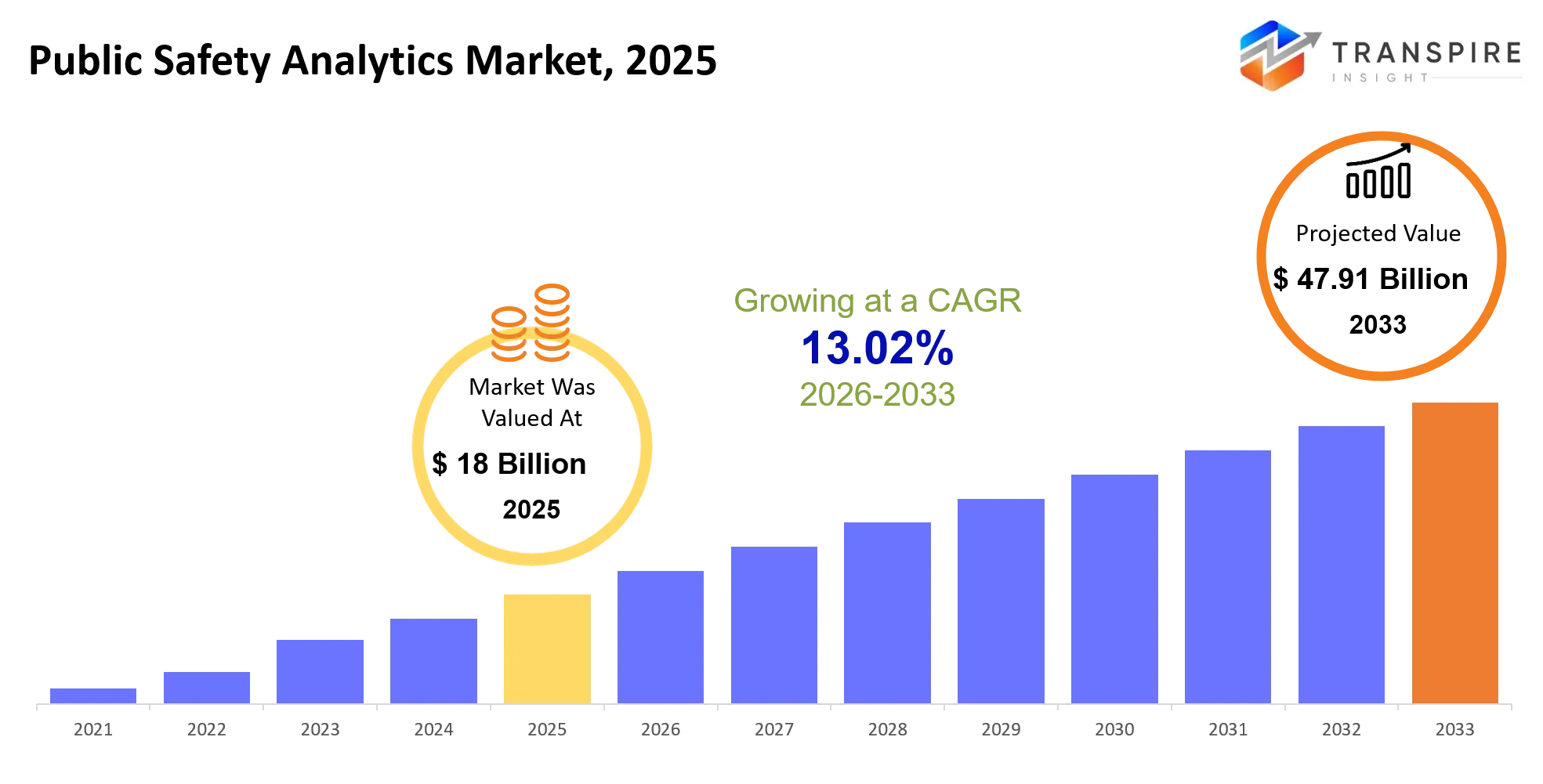
As per Transpire Insight Analysis, the Public Safety Analytics Market size is estimated at USD 18.0 billion in 2025 and is anticipated to reach USD 47.91 billion by 2033, growing at a CAGR of 13.02% from 2026 to 2033.
The public safety analytics market is becoming more important. Governments and emergency services want faster ways to handle crime, respond to emergencies and keep people safe. In the next three to five years, tools like artificial intelligence, cloud computing, video analytics and predictive policing have grown a lot. These tools help agencies study data from surveillance cameras, emergency calls and past incidents quickly. A big change is happening: police and emergency teams are moving away from ways of reacting after something happens. Now they are using integrated systems that help them spot dangers early and send help before things get worse. More people living in cities, growing safety worries, and the need for emergency responses are all pushing demand for these tools. Real events. Like violence, traffic accidents and natural disasters. Have shown how crucial it is to share information fast. As public agencies build digital systems, analytics solutions are no longer just nice to have. They are becoming necessary to work together, run operations more efficiently and truly improve public safety.
Public Safety Analytics Market Size & Forecast:
- Market Size 2025: USD 18.0 Billion
- Expected Market Value (2033): USD 47.91 Billion
- Forecast CAGR (2026–2033): 13.02%
- Leading Region in 2025: North America
- Fastest Growing Region:Asia Pacific
- Key Company Profiles: Motorola Solutions, IBM, Palantir Technologies, Hexagon, SAS, Microsoft, NEC Corporation, Tyler Technologies, Axon Enterprise, Cisco, Hitachi, Veritone, Genetec, Esri, Oracle
Key Market Insights:
The market is transitioning from independent monitoring systems to intelligent systems that help the agencies comprehend information and respond better.
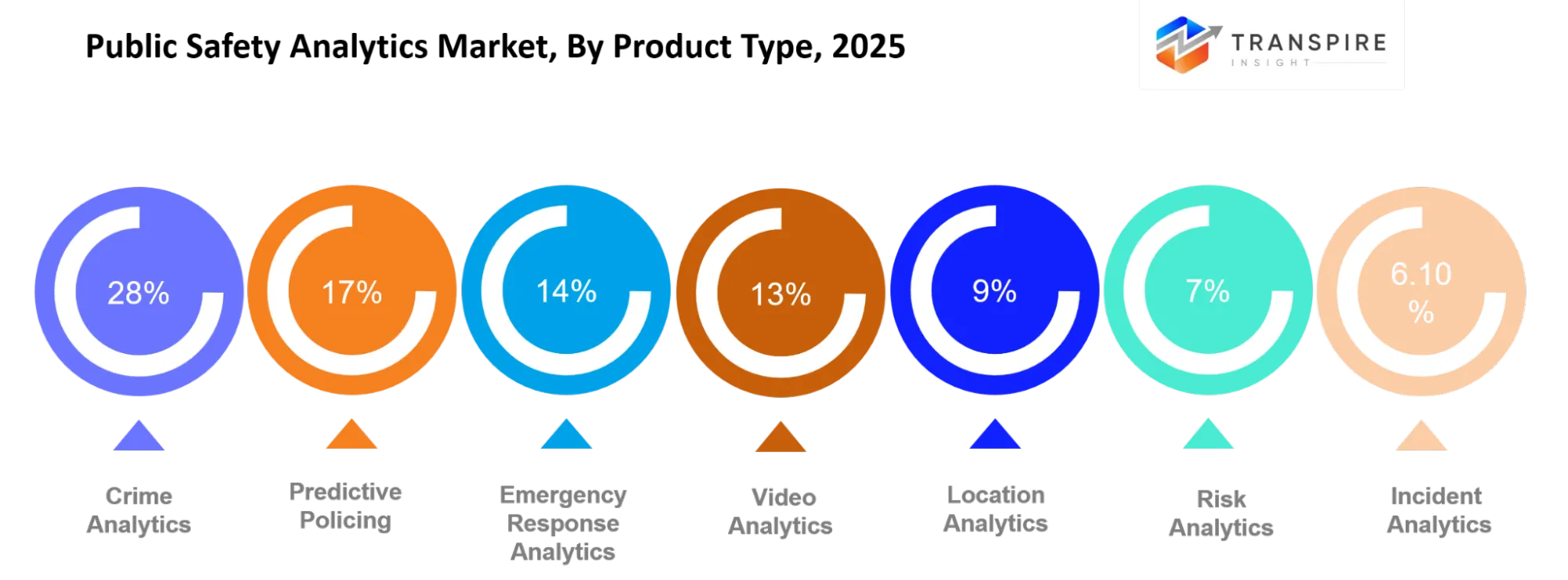
- The Crime Analytics solution constitutes 28.90% of the market since agencies make use of crime pattern analysis and records to help them investigate and effectively deploy their staff.
- The Predictive Policing solution makes up 17.00% of the market since the use of location, incident, and historical data is used to determine trends that will help in planning patrols and preventing crime.
- The Video Analytics solution makes up 13.00% of the market since the use of computer vision and intelligent cameras is made to help the agency analyze videos, detect anomalies, and find evidence.
- The Location Analytics solution makes up 9.00% of the market since the use of GPS data, geographic information systems, and real-time maps is made to increase the accuracy of incident locations and field coordination.
- The Risk Analytics solution constitutes 7.00% of the market since the use of historical incidents, environmental factors, and operational data is made to prioritize resources.
- The Incident Analytics solution makes up 6.00% of the market since the department can link reports, emergency calls, and operational records to detect any issues.
What are the Key Drivers, Restraints, and Opportunities in the Public Safety Analytics Market?
Drivers
Public safety agencies are employing analytics to address a problem commonly faced by such agencies. public safety agencies usually have separate databases for storing emergency calls, video from cameras, police reports, and location information. Such separation of data could lead to delayed investigations and slower decisions in case of an incident. With the increase in connected cameras, emergency digital communications, and sensor networks, there is an increasing need for such agencies to make sense out of the large amount of data they possess and share such information.
Restraints
Cost remains an issue, particularly for smaller municipalities and organizations that have limited technology budgets. The incorporation of new technology into current dispatch systems and old databases can cause delays and additional expenses in the process. There are concerns regarding data protection and surveillance, biased algorithms, and cybersecurity issues. As a result, there is a need for greater oversight and management, which leads to delayed decisions despite understanding the benefits of such technology.
Opportunities
The subsequent off-the-shelf opportunity is for interoperable, AI-enabled platforms that unify emergency call management, video analysis, GIS, and other incident records. Cloud deployment can be an enabler for smaller agencies that want to leverage advanced analytics but don't want to develop deep local infrastructure. , Combined dispatch and analytics platforms could enable regional agencies to coordinate fire, police, and medical responses across boundaries. But the Asia Pacific region should also continue to be a hotbed for opportunities, with investment set to grow as the region develops more-including benefits from connected emergency management and investments in public infrastructure upgrades. Vendors who can promise response improvements, secure data, and flexible deployment will be the most successful.
|
Driver |
Relative Impact on Growth (%) |
Geographic Relevance |
Impact Timeline |
Demand Strength |
Growth Mechanism (5–10 words) |
Key Beneficiaries (5–10 words) |
Major Constraint (5–10 words) |
|
AI-powered crime analytics and predictive policing |
27% |
North America, Asia-Pacific |
Short-term (≤2 years) |
High |
Identifies crime patterns and supports proactive resource deployment |
Police departments, AI vendors, analytics software providers |
Algorithmic bias, privacy concerns, and unreliable historical data |
|
Expansion of smart city surveillance and video analytics |
23% |
Asia-Pacific, North America |
Short-term (≤2 years) |
High |
Converts surveillance footage into real-time security intelligence |
Surveillance manufacturers, software vendors, city authorities |
High installation costs and public concerns over surveillance |
|
Modernization of emergency response and communication systems |
20% |
North America, Europe |
Medium-term (2–4 years) |
High |
Integrates dispatch data for faster incident response |
Emergency services, communication vendors, analytics providers |
Legacy infrastructure and complex system integration |
|
Rising government investment in public safety digitization |
17% |
Asia-Pacific, North America, Middle East |
Medium-term (2–4 years) |
High |
Funds analytics platforms, digital policing, and command centers |
Government agencies, system integrators, cloud providers |
Budget limitations and lengthy public procurement cycles |
|
Cloud computing, IoT, and real-time data integration |
13% |
Asia-Pacific, Europe, North America |
Long-term (≥4 years) |
Medium |
Connects distributed sensors and enables scalable data processing |
Cloud providers, IoT vendors, software developers, agencies |
Cybersecurity risks, data silos, and connectivity limitations |
|
Total |
100% |
— |
— |
— |
— |
— |
— |
|
AI-powered crime analytics and predictive policing |
27% |
North America, Asia-Pacific |
Short-term (≤2 years) |
High |
Identifies crime patterns and supports proactive resource deployment |
Police departments, AI vendors, analytics software providers |
Algorithmic bias, privacy concerns, and unreliable historical data |
What Has the Impact of Artificial Intelligence Been on the Public Safety Analytics Market?
AI is revolutionising public safety analytics by allowing agencies to process huge amounts of information that otherwise would have been processed manually. Machine learning models can analyse patterns within the incident history and help make appropriate patrol assignments and distribute necessary resources for emergencies. Computer vision can point out particular activities in camera footage, whereas natural language processing can record emergency phone calls and analyse any reports in detail. These technologies allow dispatchers and investigators to easily access valuable information. Tools of predicting can be helpful in case of analyzing and forecasting demand, planning traffic disruption, and determining places in need of special treatment. Nonetheless, predictive algorithms should inform people of their actions but not perform police work on their own. There are some obstacles to be tackled before implementing AI into public safety analytics. First of all, biased information within historical records can lead to inappropriate output results. In addition, missing information may worsen prediction results. It is necessary to take into consideration such problems as integration costs, cybersecurity, personal security, and explainability of machine suggestions.
Instance
In January 2026,Motorola Solutions introduced the Assist Suites range of artificial intelligence public safety services products. These tools use information from the emergency call, camera video recording and radio transcription to assist with dispatching, reporting an incident and decision making. This demonstrates that AI helps in the rise in demand for public safety analytics tools.
Key Market Trends:
The trend is toward smart operations that are connected and employ analytics in decision making during the incident rather than after the incident.
- A data-driven approach to dispatch services is more common through the inclusion of location, call details, and available resources in their operations.
- Agencies who cannot fund local computing infrastructure tend to turn more to cloud services, whereas sensitive workloads may need traditional or hybrid approaches.
- Interoperability has become one of the key priorities for public safety vendors that will allow agencies to communicate in different systems and with devices of choice.
- Privacy and accountability have become crucial factors for choosing any technologies, and more needs to be paid to data storage, management, algorithms, and audit.
- GIS is getting popular in urban agencies that bring together maps, traffic conditions, environmental parameters, and incidents.
Public Safety Analytics Market Segmentation
By Solution Type
The worldwide public safety analytics market is classified on the basis of solution type, technology, application, end-user, deployment, and data source. Crime Analytics holds the largest share of 28.90% in the solution type classification, while Predictive Policing has a market share of 17.00%, Emergency Response Analytics has a market share of 14.00%, and Video Analytics has a market share of 13.00%. The remaining segments in this classification include Location Analytics, Risk Analytics, Incident Analytics, and Traffic Analytics with shares of 9.00%, 7.00%, 6.00%, and 5.10%, respectively.
By technology
This market includes technologies such as AI, Machine Learning, Big Data Analytics, IoT, Cloud Computing, GIS, Computer Vision and Natural Language Processing. AI and Machine Learning assist in identifying and predicting risk; Big Data Analytics integrates data collected from other sources; IoT and Computer Vision help with connected safety surveillance, while Cloud Computing allows for the ability to increase data handling capabilities. GIS and natural language processing aid in location analysis and information extraction.
By application
Surveillance applications in the market include Law Enforcement, Emergency Services, Fire and Rescue, Disaster Management, Traffic Management, Border Security and Public Health. Law enforcement deploys analytics for investigation and crime monitoring. Emergency services and fire services for call dispatch. Disaster management for risk assessment, traffic management for congestion and road incident detection, border security and public health for surveillance and health intelligence, response planning and incident management.
By end user
The market further consists of Police Departments, Fire Departments, Emergency Medical Services, Government Agencies, Municipalities, Transportation Agencies and Homeland Security. Emergency services benefit from search, analysis, interpretation and investigations. police departments use these capabilities for the most effective deployment of forces and resources and to increase efficiency. Municipalities & Government Agencies use these tools for planning for safer cities and transportation & homeland security organizations utilize it for traffic management and surveillance.
By deployment
market includes Cloud, On-Premise, Hybrid, Edge, SaaS, Private Cloud and Public Cloud. Cloud offers investment in scalability, whereas on-premise offers greater direct control of sensitive data. Hybrid solves some of the data separation challenges and, combined with edge computing, enables faster, local processing. SaaS removes the hardware management, and both allow for more flexible choices for the agency, depending on their infrastructure, security requirements and budget.
By data source
The market includes CCTV, IoT Sensors, GPS, Social media, Public records, Mobile Data, Emergency Calls and Environmental sensors- CCTV will be needed for surveillance and incident investigation, the IoT and environmental sensors will also be providing real time information, GPS and mobile data will provide location data, Emergency calls will give additional real-time details, Public records and social media will provide them additional background subject to data quality, privacy and legal obligations.
What are the Key Use Cases Driving the Public Safety Analytics Market?
Crime investigations are one use case for public safety analytics, which is powered by Crime Analytics. Police organisations can analyse past incidents, link records, locate repeated areas of crime, and decide on the most relevant leads. This will allow investigators to work with the evidence at hand in a more effective manner. Emergency management is yet another application area. With dispatch analytics, GPS data, traffic analysis, and location intelligence, it becomes easier for police, firefighters, and emergency medical services to assess the situation and deploy appropriate resources to manage the incident. Video Analytics can be used to analyse videos and identify relevant incidents. Some emerging use cases are report preparation with the help of AI, demand prediction, connected disaster monitoring, and cross-agency intelligence sharing. Preparedness planning can be achieved with Risk Analytics. Environmental sensors and geographic systems will help authorities to evaluate developing threats.
|
Report Metrics |
Details |
|
Market size value in 2025 |
USD 18.0 Billion |
|
Market size value in 2026 |
USD 20.34 Billion |
|
Revenue forecast in 2033 |
USD 47.91 Billion |
|
Growth rate |
CAGR of 13.02% from 2026 to 2033 |
|
Base year |
2025 |
|
Historical data |
2021 - 2024 |
|
Forecast period |
2026 - 2033 |
|
Report coverage |
Revenue forecast, competitive landscape, growth factors, and trends |
|
Regional scope |
United States; Canada; Mexico; United Kingdom; Germany; France; Italy; Spain; Denmark; Sweden; Norway; China; Japan; India; Australia; South Korea; Thailand; Brazil; Argentina; South Africa; Saudi Arabia; United Arab Emirates |
|
Key company profiled |
Motorola Solutions, IBM, Palantir Technologies, Hexagon, SAS, Microsoft, NEC Corporation, Tyler Technologies, Axon Enterprise, Cisco, Hitachi, Veritone, Genetec, Esri, Oracle |
|
Customization scope |
Free report customization (country, regional & segment scope). Avail customized purchase options to meet your exact research needs. |
|
Report Segmentation |
Solution Type (Crime Analytics, Predictive Policing, Emergency Response Analytics, Video Analytics, Location Analytics, Risk Analytics, Incident Analytics, Traffic Analytics); Technology (AI, Machine Learning, Big Data Analytics, IoT, Cloud Computing, GIS, Computer Vision, Natural Language Processing); Application (Law Enforcement, Emergency Services, Fire & Rescue, Disaster Management, Traffic Management, Border Security, Public Health); End User (Police Departments, Fire Departments, Emergency Medical Services, Government Agencies, Municipalities, Transportation Agencies, Homeland Security); Deployment (Cloud, On-Premise, Hybrid, Edge, SaaS, Private Cloud, Public Cloud); Data Source (CCTV, IoT Sensors, GPS, Social Media, Emergency Calls, Public Records, Mobile Data, Environmental Sensors) |
Which Regions are Driving the Public Safety Analytics Market Growth?
North America
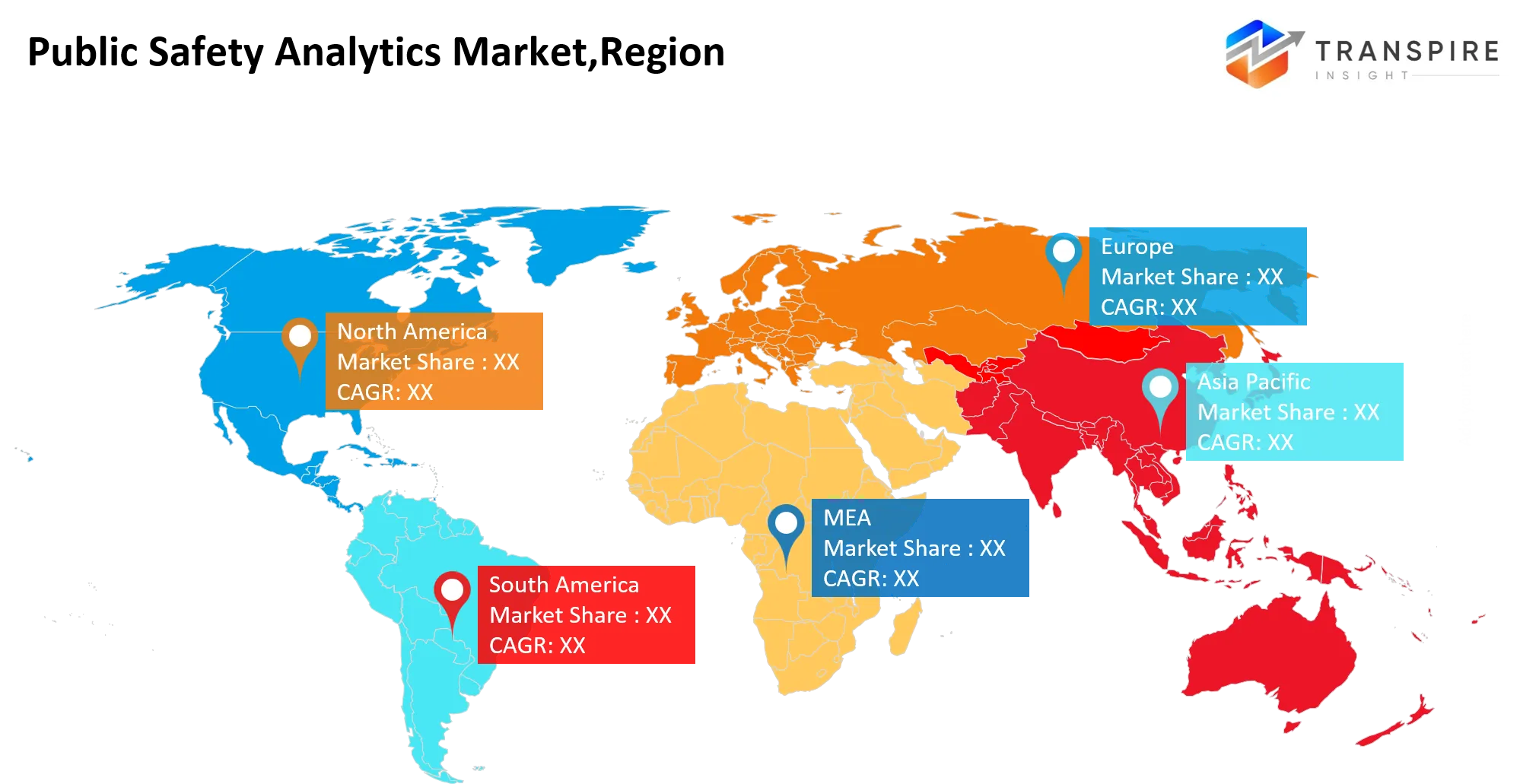
North America holds the highest share of 43.70% in the public safety analytics market, driven by advanced infrastructure for emergency communication, robust surveillance networks, and digital policing systems. Modernisation efforts in the public sector and the demand for dispatching and records management systems and video intelligence software drive the regional ecosystem. The presence of technology vendors such as Motorola Solutions and Axon helps in developing and implementing product solutions within public safety organisations. This creates a strong foundation for the adoption of analytics solutions that enhance coordination and visibility.
In April 2026, Motorola Solutions upgraded its CommandCentral Aware platform to streamline the process and monitor all investigative processes at crime centres. This news shows that more and more attention is paid to the use of analytics to enhance intelligence coordination and management in public safety organisations.
Europe
Europe constitutes 27.00% of the market, with investments in urban security, emergency management, and smart infrastructure of public sector. In contrast to North America, regional adoption is also influenced by data security laws that call for balancing public safety needs with privacy. Municipal services and collaboration initiatives across borders in the region provide scope for integrated information systems and emergency response. Technology vendors that offer transparent data governance, secure infrastructure, and integration with legacy systems could have an edge over others in Europe.
In June 2026, the Police AI project was started with million support over three years from the UK Home Office. It helps to promote the implementation of AI solutions in the police force, including systems to analyse digital evidence and summarize files. Such developments will enhance the need for investigations using analytics.
Asia Pacific
The Asia Pacific region holds a 22.00% share in the market and is the most rapidly growing segment at a CAGR of 13.40%. The rapid rate of urbanisation, increased smart city projects, and developments in emergency communication have been driving the authorities to adopt connected public safety solutions. The varied infrastructure and different digital development status make the region suitable for cloud-based analytics and surveillance systems for emergency management.
In May 2026, the Police Force in Singapore started using AI solutions to perform investigations and detect traffic violations in cooperation with the Home Team Science and Technology Agency.
 Who are the Key Players in the Public Safety Analytics Market and how do they compete?
public safety analytics competition will rely on providing reliable analytics, intelligence, secure communication, and useful tools for emergency services. The main competitors on the market include Motorola Solutions, Axon, Hexagon, Genetec, NEC Corporation, IBM, and Palantir Technologies. The distinction of the solutions includes such areas of focus as dispatching and incident management, video intelligence, digital evidence, geospatial analysis, or data integration. Purchasers consider compatibility with their current systems as the main characteristic, not the unique feature of the solution. Axon tries to outperform competitors with its integrated solutions in connected policing, digital evidence management, body-worn cameras, and AI workflows. This approach relies on connecting field operations, emergency communication, and investigative processes. The main characteristics that Hexagon provides include computer-aided dispatch, geospatial analysis, records management, and incident management. Genetec provides physical security solutions, video management, and vehicle intelligence. That is why companies compete in terms of integration, function, and contract.
Public Safety Analytics Market companies
- Motorola Solutions
- IBM
- Palantir Technologies
- Hexagon
- SAS
- Microsoft
- NEC Corporation
- Tyler Technologies
- Axon Enterprise
- Cisco
- Hitachi
- Veritone
- Genetec
- Esri
- Oracle
|
Company |
Est. Revenue Share Range |
Key Offerings |
Strategic Positioning |
Geographic Strength |
Technology Focus |
|
Motorola Solutions |
Estimated 5–9% |
CommandCentral Analytics, CommandCentral Aware, CAD/RMS integration, crime analytics |
Integrated public safety ecosystem and command-center leadership |
North America, Europe, Latin America |
AI analytics, cloud dashboards, real-time data integration |
|
Hexagon AB |
Estimated 3–6% |
HxGN OnCall, emergency dispatch, incident management, geospatial analytics |
Mission-critical operations and geospatial intelligence specialization |
Europe, North America, Asia Pacific |
GIS, location intelligence, real-time operational analytics |
|
IBM |
Estimated 2–5% |
i2 Analyst’s Notebook, data integration, investigative analytics, AI-enabled analysis |
Enterprise intelligence and complex data analysis |
North America, Europe, Asia Pacific |
AI, entity resolution, link analysis, data integration |
|
NICE Ltd. |
Estimated 2–5% |
NICE Inform, emergency communications analytics, incident reconstruction, evidence management |
Emergency communications and incident-analysis specialization |
North America, Europe, Asia Pacific |
Multimedia analytics, AI, cloud communications |
|
SAS Institute |
Estimated 2–4% |
SAS Viya, predictive analytics, statistical modelling, risk analytics |
Predictive modelling and analytical decision support |
North America, Europe, Asia Pacific |
Machine learning, forecasting, statistical analytics |
|
Tyler Technologies |
Estimated 2–4% |
Public safety CAD, records management, analytics and reporting, justice data integration |
Public-sector software and workflow integration |
North America |
Cloud platforms, operational reporting, data interoperability |
|
Esri |
Estimated 1–3% |
ArcGIS, spatial crime analysis, incident mapping, emergency management GIS |
Geospatial intelligence and location-based decision support |
North America, Europe, Asia Pacific |
GIS, spatial modelling, geospatial AI |
|
Axon Enterprise |
Estimated 1–3% |
Axon Evidence, digital evidence analytics, body-camera workflows, records integration |
Connected evidence management and investigative workflows |
North America, Europe |
AI-assisted evidence processing, cloud storage, video analytics |
|
Palantir Technologies |
Estimated 1–3% |
Foundry, Gotham, data integration, investigative intelligence workflows |
Data-fusion platforms for complex investigations |
North America, Europe |
AI-enabled data fusion, entity resolution, knowledge graphs |
|
NEC Corporation |
Estimated 1–3% |
Biometric identification, facial recognition, video analytics, security systems integration |
Identity intelligence and integrated security systems |
Asia Pacific, North America, Europe |
Biometrics, computer vision, AI-based identification |
Recent Development News
In April 2026, Axon developed new AI technologies for public safety. New developments by Axon include the introduction of AI capabilities such as Axon Vision that can detect important events in real-time video streams and help organisations handle increasing amounts of data. This development enables the use of real-time intelligence to enhance situational awareness.
In May 2025, Genetec added vehicle intelligence to SaferWatch. Genetec made an announcement regarding the integration of its AutoVu Cloudrunner vehicle investigation solution with the SaferWatch real-time alert and reporting platform. The integration brings together vehicle search with real-time communication tools, which enables enhanced coordination in incidents with vehicles of interest.
What Strategic Insights Define the Future of the Public Safety Analytics Market?
The future of the public safety analytics market will rely not so much on gathering more data, but rather on aiding agencies to turn existing information into effective decisions on time. Platforms that integrate emergency communication, video intelligence, GIS, incident records, etc., will most probably gain popularity. Companies have to focus on interoperability and operational efficiency rather than just integrating artificial intelligence without understanding where exactly they will apply it. One underestimated danger may be in biased historical records or incorrect forecasts resulting in biased decisions, loss of public faith, and legal issues. In this respect, agencies will require transparent algorithms, testing for accuracy, and control by humans. Another possible development area will be scalability of cloud and hybrid analytics platforms targeting small municipalities and developing countries since they lack the infrastructure necessary for advanced technology. Companies which provide flexible deployment options, robust cybersecurity measures, responsible artificial intelligence, and good training are most likely to establish long-lasting cooperation with government entities.
Solution Type
- Crime Analytics
- Predictive Policing
- Emergency Response Analytics
- Video Analytics
- Location Analytics
- Risk Analytics
- Incident Analytics
- Traffic Analytics
Technology
- AI
- Machine Learning
- Big Data Analytics
- IoT
- Cloud Computing
- GIS
- Computer Vision
- Natural Language Processing
Application
- Law Enforcement
- Emergency Services
- Fire & Rescue
- Disaster Management
- Traffic Management
- Border Security
- Public Health
End User
- Police Departments
- Fire Departments
- Emergency Medical Services
- Government Agencies
- Municipalities
- Transportation Agencies
- Homeland Security
Deployment
- Cloud
- On-Premise
- Hybrid
- Edge
- SaaS
- Private Cloud
- Public Cloud
Data Source
- CCTV
- IoT Sensors
- GPS
- Social Media
- Emergency Calls
- Public Records
- Mobile Data
- Environmental Sensors
Frequently Asked Questions
Find quick answers to common questions.
The public safety analytics market size was valued at USD 18.0 billion in 2025 and is poised to reach USD 47.91 billion by 2033, expanding at a 13.02%CAGR.
Key segments for the public safety analytics market are Solution Type (Crime Analytics, Predictive Policing, Emergency Response Analytics, Video Analytics, Location Analytics, Risk Analytics, Incident Analytics, Traffic Analytics); Technology (AI, Machine Learning, Big Data Analytics, IoT, Cloud Computing, GIS, Computer Vision, Natural Language Processing); Application (Law Enforcement, Emergency Services, Fire & Rescue, Disaster Management, Traffic Management, Border Security, Public Health); End User (Police Departments, Fire Departments, Emergency Medical Services, Government Agencies, Municipalities, Transportation Agencies, Homeland Security); Deployment (Cloud, On-Premise, Hybrid, Edge, SaaS, Private Cloud, Public Cloud); Data Source (CCTV, IoT Sensors, GPS, Social Media, Emergency Calls, Public Records, Mobile Data, Environmental Sensors)
Growth is primarily driven by increasing crime prevention needs, rising government investments in smart city infrastructure, growing adoption of AI and machine learning, demand for real-time surveillance, and the need for faster emergency response and data-driven policing.
The market is led by major manufacturers including Motorola Solutions, IBM, Palantir Technologies, Hexagon, SAS, Microsoft, NEC Corporation, Tyler Technologies, Axon Enterprise, Cisco, Hitachi, Veritone, Genetec, Esri, Oracle
The North American market has a market share of 43.70% of the worldwide market for public safety analytics due to the presence of digital infrastructure, adoption of AI and predictive analytics, significant government spending on public safety, and growing demand for real-time crime surveillance and emergency response systems.
the commercial opportunities that can be found in the public safety analytics market include the increased use of predictive policing through artificial intelligence, cloud-based analytics platforms, real-time video surveillance systems, safety systems in smart cities, and emergency response solutions. The increased investment in crime prevention and traffic monitoring also present an opportunity.
- Motorola Solutions
- IBM
- Palantir Technologies
- Hexagon
- SAS
- Microsoft
- NEC Corporation
- Tyler Technologies
- Axon Enterprise
- Cisco
- Hitachi
- Veritone
- Genetec
- Esri
- Oracle
About the Authors

Mayur Shinde
I am Mayur Shinde, a Senior Research Analyst at Transpire Insight, specializing in the Automotive & Transportation and Information & Communication Technology (ICT) Industry. My work focuses on analyzing emerging market trends, technological advancements, competitive landscapes, and industry developments to deliver accurate, data-driven insights. I am passionate about transforming complex market information into clear, actionable content that helps businesses, professionals, and decision-makers stay informed and make confident strategic decisions.

Chakradhar Khansole
Chakradhar serves as the Research Director at Transpire Insight, bringing over 8 years of experience in technology, innovation, and strategic market intelligence. He specializes in transforming complex market data into actionable business insights that enable organizations to make informed, growth-oriented decisions. Recognized for his strategic vision and analytical expertise, Chakradhar leads high-impact research initiatives, delivering comprehensive market assessments, competitive intelligence, and forward-looking industry analysis.
Recently Published Reports
-
Apr 2026
3D Optical Profiler Market
3D Optical Profiler Market Size, Share & Analysis Report By Type (Desktop 3D Optical Profiler, and Portable 3D Optical Profiler), By Technology (Confocal Technology, and White Light Interference), By End-Use Industry (Manufacturing, Research Institutions, Automotive, Aerospace and Defense, Medical Devices, and Other), and Geography (North America, Europe, Asia-Pacific, Middle East and Africa, South and Central America), 2021 - 2031
-
Apr 2026
Depth Sensor Market
Depth Sensor Market Size, Share & Analysis Report By Type (Infrared Depth Sensors, Time-of-Flight (ToF) Sensors, Stereo Vision Sensors, Structured Light Sensors, Ultrasonic Depth Sensors), By Application (Automotive, Robotics, Gaming, Consumer Electronics, Industrial Automation, Healthcare, Security & Surveillance, Others), By End Users (Automotive Manufacturers, Consumer Electronics Companies, Healthcare Providers, Industrial Companies, Security Agencies, Gaming Companies, Robotics Companies, Others), and Geography (North America, Europe, Asia-Pacific, Middle East and Africa, South and Central America), 2021 – 2031
-
Apr 2026
Digital Manufacturing Market
Digital Manufacturing Market Size, Share & Analysis Report By Component (Hardware, Software, and Services), By Technology (Robotics, 3D Printing, Internet of Things (IoT), and Others), By Application (Automotive and Transportation, Aerospace and Defense, Consumer Electronics, Industrial Machinery, and Others), By Process Type (Computer-Based Designing, Computer-Based Simulation, Computer 3D Visualization, Analytics, and Others), and Geography (North America, Europe, Asia-Pacific, Middle East and Africa, South and Central America), 2021 – 2031
-
Apr 2026
Digital Visa Services Market
Digital Visa Services Market Size, Share & Analysis Report By Type (Individual Travelers, Group Travelers), By Application (Tourism, Business Travel, Others), and Geography (North America, Europe, Asia-Pacific, Middle East and Africa, South and Central America), 2021 – 2031